- Base Value(2025): 2.5 Bn
- Estimated Value(2026): 2.9 Bn
- Forecast Value (2036): 10.1 Bn
- CAGR (2026 - 2036): 15%
Acoustic Vehicle Alerting System Market Forecast 2026 to 2036
In 2025, the acoustic vehicle alerting system (AVAS) market was valued at USD 2.5 billion. Based on Future Market Insights' analysis, demand for AVAS is estimated to grow to USD 2.9 billion in 2026 and USD 10.1 billion by 2036. FMI projects a CAGR of 15% during the forecast period.
The absolute dollar growth from 2026 to 2036 is USD 7.2 billion. This significant growth is driven by increasing regulations mandating sound emissions for electric and hybrid vehicles to improve pedestrian safety. The market is further supported by the rising adoption of electric vehicles (EVs) and growing consumer awareness of road safety. However, challenges such as regulatory variations across regions and technological integration costs may impact growth in some regions.
As Reji Mathai, Director of the Automotive Research Association of India (ARAI), noted regarding the implementation of acoustic vehicle alerting systems to enhance EV pedestrian safety,
‘The Acoustic Vehicle Alerting System (AVAS) will be mandatory for all electric four-wheelers travelling at 0-20 km per hour to improve pedestrian safety.’
China leads with a CAGR of 14.8%, driven by rapid EV adoption and increasing government mandates for vehicle sound systems. The USA follows with a 14.4% CAGR, supported by strong EV market growth and regulatory requirements for pedestrian safety. Germany, the UK, and India all show growth rates of 12.6%, reflecting rising demand for EVs and the need for safety measures in both established and emerging markets.
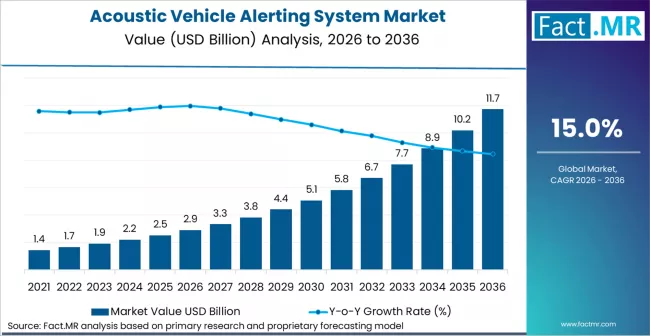
Acoustic Vehicle Alerting System Market Market Value Analysis | Source: Fact.MR
Acoustic Vehicle Alerting System Market
| Metric | Value |
|---|---|
| Estimated Value in (2026E) | USD 2.9 billion |
| Forecast Value in (2036F) | USD 10.1 billion |
| Forecast CAGR (2026 to 2036) | 15% |
Source: Fact.MR analysis. Updated Mar 3, 2026
Acoustic Vehicle Alerting System Market Definition
The acoustic vehicle alerting system market involves the development, production, and sale of sound‑generating systems designed to emit audible alerts for pedestrians and other road users when electric, hybrid, and low‑noise vehicles are in motion.
Market Inclusions
This report covers global and regional market sizes for acoustic vehicle alerting systems over a defined forecast period, including technology types (speaker‑based, directional sound), vehicle segments (EVs, hybrids, low‑noise vehicles), and sales channels (OEM fitment, aftermarket).
Market Exclusions
The scope excludes generic vehicle audio systems, unrelated safety electronics, and alerting solutions not specific to low‑noise mobility (e.g., standard horns on conventional vehicles).
Research Methodology
Primary Research
Interviews were conducted with system designers, automotive OEM specialists, and industry consultants.
Desk Research
Data was sourced from automotive publications, regulatory filings, and trade association statistics.
Market‑Sizing and Forecasting
A hybrid model combining top‑down vehicle electrification forecasts with bottom‑up production and shipment data was used.
Data Validation and Update Cycle
Findings were validated through expert review and aligned with recent adoption and regulatory trends.
Summary of the Acoustic Vehicle Alerting System Market
Market Definition
The Acoustic Vehicle Alerting System (AVAS) Market involves the development and sale of sound-generating systems that produce audible alerts for pedestrians and other road users, particularly in electric, hybrid, and low-noise vehicles. These systems are designed to enhance road safety, especially for pedestrians and cyclists, by making vehicles audible at low speeds.
Demand Drivers
- Increasing EV Adoption: The rise of electric and hybrid vehicles, which are quieter than traditional internal combustion engine vehicles, has led to regulatory requirements for sound emissions to ensure pedestrian safety.
- Regulatory Mandates: Governments globally are enforcing stricter regulations that require acoustic systems in low-noise vehicles, driving the market for AVAS.
- Focus on Road Safety: Growing consumer awareness about road safety, particularly for visually impaired pedestrians, is pushing automakers to integrate AVAS into vehicles.
- Technological Advancements: The development of active and hybrid acoustic systems, capable of producing high-quality sound with customization, is accelerating market growth.
Key Segments Analyzed
- Application: Passenger vehicles are projected to hold 45% of the market share by 2026, driven by the rising number of electric and hybrid passenger vehicles.
- Technology: Active acoustic systems are expected to dominate the technology segment, accounting for 55% of the market share by 2026.
- Geography: China leads with a CAGR of 14.8%, followed by the USA with 14.4%, driven by regulatory mandates and the adoption of EVs.
Analyst Opinion at FMR
Shambhu Nath Jha, Principal Consultant at Fact MR, states, "The Acoustic Vehicle Alerting System is vital for improving pedestrian safety, particularly with the rise in electric vehicles. It is now mandatory in many regions, pushing forward the growth of AVAS in the automotive industry."
Strategic Implications/Executive Takeaways
- Compliance with Safety Regulations: Manufacturers should focus on meeting global safety regulations, including UN Regulation No. 138, which mandates AVAS for electric vehicles.
- Technological Innovation: Invest in developing active acoustic systems with customizable sound profiles to comply with both regulatory standards and consumer preferences.
- Focus on Emerging Markets: As EV adoption grows in regions like China and India, manufacturers should prioritize AVAS integration into electric vehicles to capture emerging market opportunities.
Methodology
- Primary research through interviews with system designers, OEM specialists, and industry consultants.
- Desk research sourced from automotive publications, regulatory filings, and trade association statistics.
- Market sizing and forecasting using a hybrid model combining top-down industry forecasts with bottom-up production and shipment data.
Segmental Analysis
Acoustic Vehicle Alerting System Market Analysis by Application
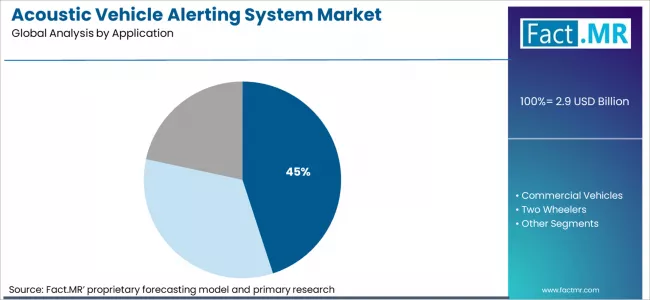
Acoustic Vehicle Alerting System Market Analysis By Application | Source: Fact.MR
- Market Overview: Passenger vehicles are expected to capture 45% of the market share by 2026. As electric vehicles (EVs) and hybrid vehicles continue to grow in popularity, the demand for Acoustic Vehicle Alerting Systems (AVAS) in passenger vehicles is increasing to comply with regulations and ensure pedestrian safety.
- Demand Drivers:
- Growth of Electric and Hybrid Vehicles: Electric and hybrid vehicles are quieter than conventional internal combustion engine vehicles, creating a safety concern for pedestrians. This has led to regulatory requirements for these vehicles to have an acoustic alerting system to make them audible at low speeds, driving demand for AVAS in passenger vehicles.
- Regulatory Compliance: Many countries have introduced regulations mandating the installation of AVAS in electric and hybrid vehicles to prevent accidents. These regulations are expanding the use of acoustic systems in passenger vehicles.
- Safety and Consumer Awareness: As awareness of road safety and pedestrian protection increases, automakers are focusing on incorporating AVAS to enhance vehicle visibility and safety, especially for those with visual impairments or in noisy environments.
Acoustic Vehicle Alerting System Market Analysis by Technology
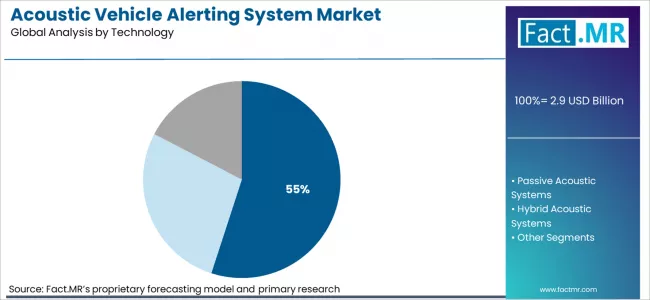
Acoustic Vehicle Alerting System Market Analysis By Technology | Source: Fact.MR
- Market Overview: Active acoustic systems are projected to hold 55% of the market share by 2026. Active systems generate sound through speakers or other devices to create an audible alert to pedestrians. These systems are increasingly used due to their ability to be customized for different vehicle models and their effective sound generation at low speeds.
- Demand Drivers:
- Customization and Flexibility: Active acoustic systems can be tailored to different vehicle types and models, allowing for specific sound design based on the manufacturer’s needs or legal requirements. This flexibility is one of the primary reasons for their growing use in the AVAS market.
- Compliance with Pedestrian Safety Standards: Active systems are capable of producing sounds at specific frequencies and volumes, making them effective at complying with safety regulations that aim to make electric and hybrid vehicles more audible. This compliance is driving the widespread adoption of active acoustic systems.
- Advanced Features and Integration: Active systems are often integrated with other vehicle technologies, such as collision detection and driver assistance systems, to enhance vehicle safety and the user experience. This integration and technological advancement contribute to the growing demand for active acoustic systems in vehicles.
Key Dynamics
Acoustic Vehicle Alerting System Market Drivers, Restraints, and Opportunities
FMR analysts observe that the acoustic vehicle alerting system (AVAS) market is a growth‑aligned, regulatory‑driven segment emerging from the increasing adoption of electric and hybrid vehicles, which produce minimal engine noise at low speeds. Historically, internal combustion engines generated sufficient sound for pedestrian awareness; as electrified powertrains became mainstream, structural demand arose for systems that generate external sound to enhance safety, particularly for visually impaired pedestrians and urban environments. The 2026 valuation reflects this shift, with AVAS adoption tied to mandatory safety requirements rather than optional features.
While demand for basic pedestrian warning buzzers remains, advanced AVAS solutions with customizable sound signatures and frequency modulation are gaining share. These higher‑value systems command premium pricing, contributing to net market value growth even as unit volumes grow with EV and hybrid vehicle production. The market exists at its current size because regulatory mandates and safety expectations make external alerts a standard requirement for electrified vehicles.
- Regulatory Safety Mandates: Regulations such as UN Regulation No. 138 and similar national rules require electric and hybrid vehicles to include audible alert systems for pedestrian safety, driving baseline adoption.
- EV Adoption Growth: Rising electric and hybrid vehicle production worldwide increases demand for AVAS as mandatory equipment, replacing implicit engine noise in ICE vehicles.
- Regional Policy Dynamics: In Europe and North America, strict regulatory frameworks and urban safety programs accelerate AVAS uptake, while other regions align as EV penetration expands.
Regional Analysis
The market analysis covers key global regions, including East Asia, North America, Western Europe, and South Asia. It is segmented geographically, with specific market dynamics for each region. The full report provides a detailed market attractiveness analysis.
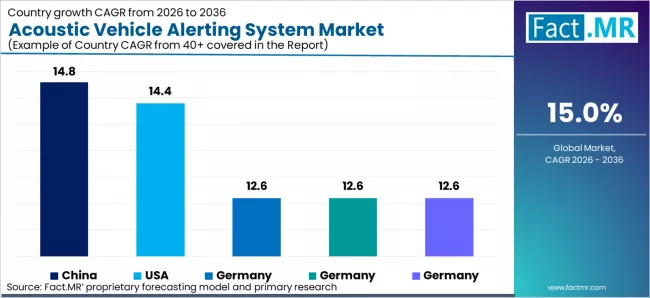
Acoustic Vehicle Alerting System Market Cagr Analysis By Country | Source: Fact.MR
| Country | CAGR (2026-2036) |
|---|---|
| China | 14.8% |
| USA | 14.4% |
| Germany | 12.6% |
| United Kingdom | 12.6% |
| India | 12.6% |
Source: Fact.MR analysis. Updated Mar 3, 2026
Source: Fact MR (FMR) analysis, based on proprietary forecasting model and primary research.
East Asia:
In East Asia, China is the leading market for acoustic vehicle alerting systems, supported by the increasing adoption of electric vehicles (EVs), rising safety concerns, and government regulations on vehicle noise standards.
- China: Demand for acoustic vehicle alerting systems in China is projected to rise at 14.8% CAGR through 2036. China’s rapid EV adoption, government mandates for vehicle sound systems, and expanding automotive manufacturing sector continue to drive strong growth in the market.
North America:
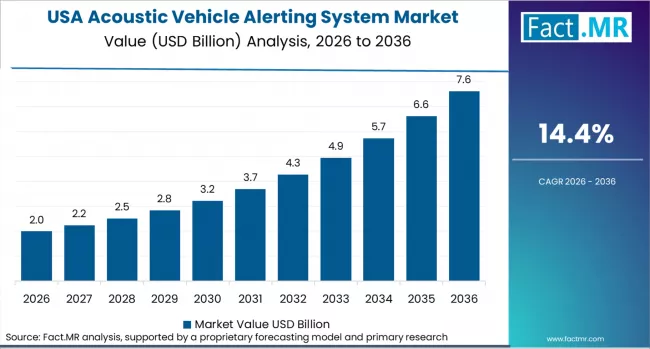
Acoustic Vehicle Alerting System Market Country Value Analysis | Source: Fact.MR
In North America, the USA is a key market for acoustic vehicle alerting systems, driven by the rising adoption of EVs, stringent regulations for pedestrian safety, and growing concerns about noise pollution from electric vehicles.
- USA: Demand for acoustic vehicle alerting systems in the U.S. is projected to rise at 14.4% CAGR through 2036. The USA’s growing EV market, government regulations for pedestrian safety, and increasing demand for noise-reducing systems continue to support the market’s growth.
Western Europe:
In Western Europe, both Germany and the United Kingdom are key markets, driven by regulations regarding vehicle noise emissions, the growing number of electric vehicles, and advancements in acoustic technology for vehicle alert systems.
- Germany: Demand for acoustic vehicle alerting systems in Germany is projected to rise at 12.6% CAGR through 2036. Germany’s leading role in the automotive industry, focus on vehicle safety, and expanding adoption of EVs contribute to steady growth in the market.
- United Kingdom: Demand for acoustic vehicle alerting systems in the UK is projected to rise at 12.6% CAGR through 2036. The UK’s increasing adoption of EVs, government regulations for vehicle noise control, and growing focus on pedestrian safety continue to drive market expansion
South Asia:
In South Asia, India is a growing market for acoustic vehicle alerting systems, supported by increasing vehicle production, the rise in electric vehicle adoption, and growing awareness of pedestrian safety.
- India: Demand for acoustic vehicle alerting systems in India is projected to rise at 12.6% CAGR through 2036. India’s expanding automotive sector, rising EV adoption, and increasing focus on pedestrian safety regulations contribute to growing market demand for acoustic alerting systems.
Fact MR's analysis of the Acoustic Vehicle Alerting System Market in East Asia, North America, Western Europe, and South Asia consists of country-wise assessments that include China, the USA, Germany, the United Kingdom, and India. Readers can find detailed trends, regulatory updates, and company-specific investments shaping the market’s growth in these countries.
Competitive Landscape
How Are Key Players Competing in the Acoustic Vehicle Alerting System Market?
In the growing Acoustic Vehicle Alerting System (AVAS) market, major automakers like Toyota, Honda, and Volkswagen are at the forefront, incorporating AVAS to comply with global regulations for electric vehicle (EV) pedestrian safety. BMW, Ford, and Nissan are also enhancing their EV models with advanced acoustic systems to improve road safety, while Mercedes-Benz integrates unique sound profiles for their EVs. Aisin Seiki, Continental, and Valeo are supplying the technology and components, including sound emitters, that enable effective AVAS solutions. Meanwhile, companies like Harman, Bose, and Panasonic are focusing on sound quality and innovation, developing advanced auditory systems to ensure a pleasant and clear sound for pedestrians. Aptiv, ZF, and Denso are contributing through their electronic expertise, incorporating AI and sensor technologies to enhance system performance. The competition is intensifying as OEMs seek to meet regulations while offering distinct driving experiences and prioritizing pedestrian safety with tailored acoustic solutions.
Recent Industry Developments
- India’s Mandatory AVAS Phased Rollout
- The Indian Ministry of Road Transport and Highways (MoRTH) finalized a mandate in early 2026 requiring all new electric and hybrid passenger cars (Category M) and goods carriers (Category N) to be equipped with AVAS by October 1, 2026. Existing models have until October 2027 to comply with the AIS-173 safety standards, which regulate artificial sounds at speeds below 20 km/h.
- Harman International Acquisition of ZF ADAS
- Harman International announced a definitive agreement to acquire the Advanced Driver Assistance Systems (ADAS) business of ZF Group for €1.5 billion, with the deal expected to close in the second half of 2026. This acquisition integrates ZF's smart cameras and radars with Harman’s audio expertise to create "perception-informed" AVAS that modulates sounds based on real-time pedestrian proximity.
- Denso and AUTOSAR Software Standardization
- As of January 2026, Denso has been elevated to a "Core Partner" of AUTOSAR, the global standard for automotive software architecture. This role allows Denso to drive the standardization of software-defined audio, ensuring that AVAS sound profiles can be consistently managed and updated over-the-air (OTA) across different vehicle platforms.
Key Players of the Acoustic Vehicle Alerting System Market
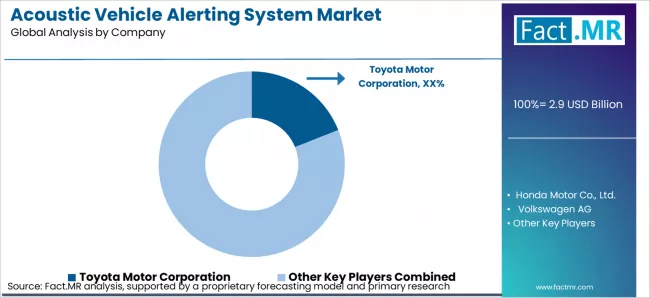
Acoustic Vehicle Alerting System Market Analysis By Company | Source: Fact.MR
- Toyota Motor Corporation
- Honda Motor Co., Ltd.
- Volkswagen AG
- Bayerische Motoren Werke AG (BMW AG)
- Subaru Corporation
- Ford Motor Company
- Nissan Motor Co., Ltd.
- Mercedes-Benz Group AG (formerly Daimler AG)
- Aisin Seiki Co., Ltd.
- Harman International (a subsidiary of Samsung Electronics Co., Ltd.)
- Continental AG
- Voxx International Corporation (brand relationships with Gentex Corporation)
- Robert Bosch GmbH
- Valeo S.A.
- Denso Corporation
- Aptiv PLC
- ZF Friedrichshafen AG
- Bose Corporation
- Panasonic Corporation
- Mitsubishi Electric Corporation
Report Scope
| Metric | Value |
|---|---|
| Quantitative Units | USD 2.9 billion (2026) to USD 10.1 billion (2036), at a CAGR of 15% |
| Market Definition | The acoustic vehicle alerting system market includes systems designed to produce sound alerts for electric and hybrid vehicles to enhance safety, especially for pedestrians and cyclists. |
| By Application | Passenger Vehicles, Commercial Vehicles, Two Wheelers, Heavy-Duty Vehicles |
| By Technology | Active Acoustic Systems, Passive Acoustic Systems, Hybrid Acoustic Systems |
| By Vehicle Type | Electric Vehicles (BEV), Hybrid Vehicles (HEV, PHEV), Internal Combustion Engine Vehicles |
| By End-User | Automobile Manufacturers (OEMs), Aftermarket Suppliers, Government Agencies |
| Regions Covered | North America, Latin America, Europe, East Asia, South Asia, Oceania, Middle East and Africa |
| Countries Covered | United States, Canada, Mexico, Brazil, Argentina, Germany, France, United Kingdom, Italy, Spain, China, India, Japan, South Korea, Indonesia, Australia, and 40+ countries |
| Key Companies Profiled | Toyota Motor Corporation, Honda Motor Co., Ltd., Volkswagen AG, Bayerische Motoren Werke AG (BMW AG), Subaru Corporation, Ford Motor Company, Nissan Motor Co., Ltd., Mercedes-Benz Group AG (formerly Daimler AG), Aisin Seiki Co., Ltd., Harman International (a subsidiary of Samsung Electronics Co., Ltd.), Continental AG, Voxx International Corporation (brand relationships with Gentex Corporation), Robert Bosch GmbH, Valeo S.A., Denso Corporation, Aptiv PLC, ZF Friedrichshafen AG, Bose Corporation, Panasonic Corporation, Mitsubishi Electric Corporation |
| Forecast Period | 2026 to 2036 |
| Approach | Hybrid top-down and bottom-up market modeling validated through primary interviews with manufacturers and supported by trade data benchmarking and market research. |
Source: Fact.MR analysis. Updated Mar 3, 2026
Bibliographies
Aisin Corporation. (2025). Acoustic vehicle alerting system components and safety technologies for electric and hybrid vehicles. Aisin Corporation.
Bayerische Motoren Werke AG (BMW AG). (2025). Integration of acoustic vehicle alerting systems in electric and hybrid vehicle platforms. Bayerische Motoren Werke AG.
Honda Motor Co., Ltd. (2025). Sound-generating systems for electric and hybrid vehicles to support pedestrian safety compliance. Honda Motor Co., Ltd.
Toyota Motor Corporation. (2025). Implementation of acoustic vehicle alerting systems in electrified vehicle portfolios. Toyota Motor Corporation.
Volkswagen AG. (2025). Pedestrian safety enhancements through acoustic vehicle alerting systems in electric vehicle models. Volkswagen AG.
Hindustan Times. (2026, January). India mandates phased rollout of pedestrian warning sound systems in electric vehicles beginning 2026 [News report]. Hindustan Times.
DENSO Corporation. (2026, January). DENSO promotes automotive software standardization as an AUTOSAR core partner [Press release]. DENSO Corporation.
HARMAN International. (2025/2026, December). HARMAN to acquire ZF’s ADAS business for €1.5 billion [Press release]. HARMAN International.
This report addresses
- Market Intelligence enabling comprehensive assessment of leading countries and service segments across the Acoustic Vehicle Alerting System Market globally.
- Market Volume (Sales Units) estimates and 10-year revenue forecasts from 2026 to 2036, validated through system manufacturer shipment data, channel partner surveys, and country-level demand modeling.
- Growth Opportunity Mapping across application categories (Passenger Vehicles, Commercial Vehicles, Two Wheelers, Heavy-Duty Vehicles), technologies (Active, Passive, Hybrid Acoustic Systems), and regions.
- Segment and Regional Revenue Forecasts by application, technology, vehicle type, distribution channel, and geography across 40+ countries.
- Competition Strategy Analysis covering dealer network structure, recent developments, product portfolio, USPs, and market share analysis.
- Product and Regulatory Compliance Tracking aligned with automotive safety standards, acoustic vehicle alerting systems, and regional regulations.
- Regulatory Impact Analysis addressing global market compliance, technological advancements in acoustic systems, and evolving regulatory frameworks.
- Report Delivery in PDF, Excel, PowerPoint, and interactive dashboard formats for executive, procurement, and operational planning use.
Segmentation
Acoustic Vehicle Alerting System Market Key Segments
-
Application :
- Passenger Vehicles
- Commercial Vehicles
- Light Commercial Vehicles
- Buses
- Delivery Vans
- Two Wheelers
- Electric Scooters
- Electric Motorcycles
- Heavy-Duty Vehicles
-
Technology :
- Active Acoustic Systems
- Speaker-Based Systems
- Amplifier-Integrated Systems
- Passive Acoustic Systems
- Hybrid Acoustic Systems
- Vehicle Type
- Electric Vehicles (BEV)
- Hybrid Vehicles (HEV, PHEV)
- Internal Combustion Engine Vehicles
- End User
- Automobile Manufacturers (OEMs)
- Aftermarket Suppliers
- Government Agencies
- Public Transport Fleets
- Municipal Fleets
- Active Acoustic Systems
-
Region :
- North America
- USA
- Canada
- Mexico
- Europe
- Germany
- UK
- France
- Italy
- Spain
- Nordic Countries
- BENELUX
- Rest of Europe
- Asia Pacific
- China
- Japan
- South Korea
- India
- Australia
- Rest of Asia Pacific
- Latin America
- Brazil
- Argentina
- Rest of Latin America
- Middle East and Africa
- Kingdom of Saudi Arabia
- United Arab Emirates
- South Africa
- Rest of Middle East and Africa
- Other Regions
- Oceania
- Central Asia
- Other Markets
- North America
Frequently Asked Questions
How large is the demand for Acoustic Vehicle Alerting Systems in the global market in 2026?
What will be the market size of Acoustic Vehicle Alerting Systems in the global market by 2036?
What is the expected demand growth for Acoustic Vehicle Alerting Systems in the global market between 2026 and 2036?
Which technology is expected to dominate the market?
Which region is expected to show the highest growth rate for Acoustic Vehicle Alerting Systems?
How significant is the growth outlook for the United States in this market?
What is the growth outlook for Germany in the Acoustic Vehicle Alerting System market?
What is the growth forecast for the United Kingdom in the Acoustic Vehicle Alerting System market?
What is the growth forecast for India in the Acoustic Vehicle Alerting System market?
Which company is identified as a leading player in the Acoustic Vehicle Alerting System market?
What are Acoustic Vehicle Alerting Systems used for?
What does the Acoustic Vehicle Alerting System market include in this report?
How is the market forecast developed in this report?
What is meant by the Acoustic Vehicle Alerting System market in this report?
Who worked on this report


Preview the report firsthand - request a free sample
Free SampleGet the brochure for pricing and purchase details
Download PDF