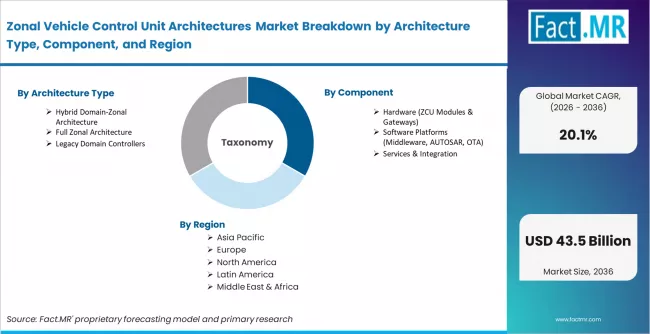
The Zonal Vehicle Control Unit Architectures Market is analyzed by architecture type, including hybrid domain-zonal, full zonal and legacy domain controllers, along with component, and region, forecast 2026 to 2036.
By Fact.MR Automotive DeskLead analyst:
Shubham PatidarPublished :
15 min read
Fact-checked under the Fact.MR editorial process
Zonal Vehicle Control Unit Architectures Market Forecast and Outlook By Fact.MR
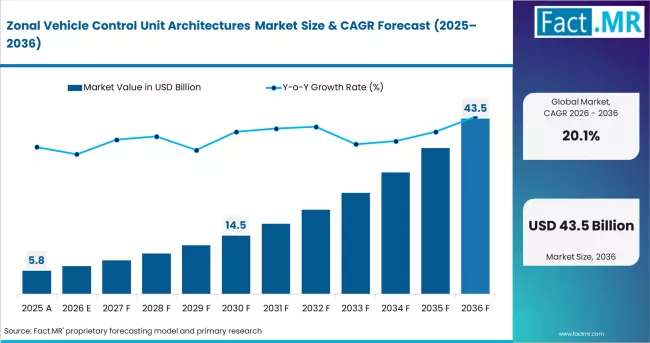
In 2025, the zonal vehicle control unit architectures market was valued at USD 4.4 billion.
Based on Fact.MR analysis, demand for zonal VCU architectures is estimated to grow to USD 5.8 billion in 2026 and USD 36.2 billion by 2036.
FACT.MR projects a CAGR of 20.1% during the forecast period.
Zonal Vehicle Control Unit Architectures Market Market Value Analysis | Source: Fact.MR
Metric
Value
Estimated Value in 2026
USD 5.8 billion
Forecast Value in 2036
USD 36.2 billion
Forecast CAGR (2026 to 2036)
20.1%
Source: Fact.MR analysis. Updated May 12, 2026
Summary of Zonal Vehicle Control Unit Architectures Market
Market Definition
The market includes zonal vehicle control unit architectures hardware modules, embedded software platforms, and integration servicest hat consolidate vehicle E/E functions by physical zone across passenger, commercial, and EV platforms.
Demand Drivers
EV platform launches by global OEMs are mandating zonal E/E architectures to reduce wiring harness weight, improve OTA update capability, and meet software-defined vehicle performance requirements.
Regulatory pressure on vehicle cybersecurity (UN R155/R156) is accelerating adoption of centralised ZCU platforms with integrated secure gateway and access control management.
Semiconductor partners NXP, Qualcomm, and Infineon are releasing purpose-built ZCU SoCs with integrated Ethernet switching, reducing hardware BOM complexity for Tier-1 integrators.
Key Segments Analyzed
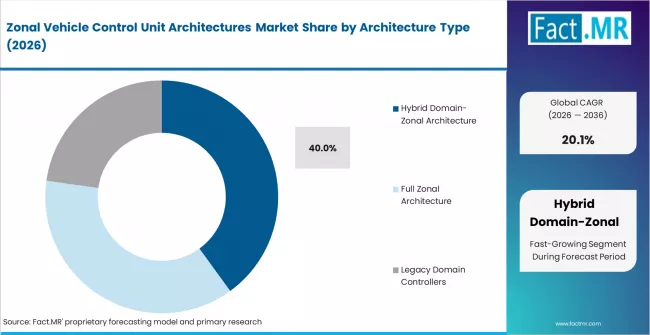
By Architecture Type: Hybrid domain-zonal architecture leads with approximately 40% share in 2026, preferred by OEMs managing transition from legacy ECU networks while maintaining existing toolchain investments.
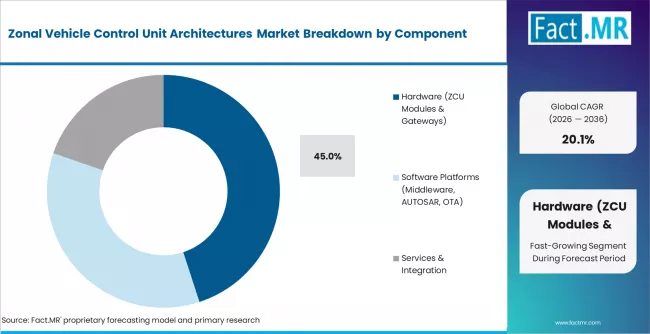
By Component: Hardware (ZCU modules and gateways) leads with approximately 45% share in 2026, driven by physical module content growth across new EV programme launches at major OEMs.
By Application: Body and comfort electronics leads with approximately 30% share in 2026, as OEMs prioritise zonal consolidation in lower-complexity zones before scaling to ADAS and powertrain.
Analyst Opinion at FACT.MR
Shambhu Nath Jha, Principal Consultant at Fact.MR, opines, ‘CXOs will find that the ZCU market increasingly rewards early platform commitment. OEMs that secure silicon and middleware partnerships ahead of 2027 will establish stronger architectural control. These early decisions will translate into advantages in platform licensing, software ownership, and over-the-air update monetisation across the next decade.
Strategic Implications
Secure long-term ZCU hardware supply agreements with NXP Semiconductors and Infineon before EV programme volume ramps in 2026–2027.
Invest in AUTOSAR Adaptive-compliant software platform capabilities to compete for OEM middleware and OTA update management contracts.
Target South Korea and India as priority growth markets where OEM E/E architecture standardisation is creating rapid, repeatable ZCU procurement opportunities.
Methodology
Market sizing uses vehicle production volume data by platform type, ZCU content-per-vehicle estimates, and software platform attach rates across OEM programmes.
Analysis incorporates SAE International standards, AUTOSAR consortium data, OEM E/E roadmaps, and Tier-1 supplier capacity disclosures (2024–2025).
Forecasts account for EV programme launch timelines, semiconductor supply lead times, and OEM qualification cycle durations across regions.
The market is projected to generate USD 30.4 billion in absolute opportunity between 2026 and 2036. Growth is transformational, driven by the automotive industry’s structural migration from point-to-point wiring architectures to centralized, software-defined zonal frameworks. E/E architecture redesign cycles tied to EV platforms and software-defined vehicle programmes sustain this expansion, while semiconductor supply chain complexity and long OEM qualification
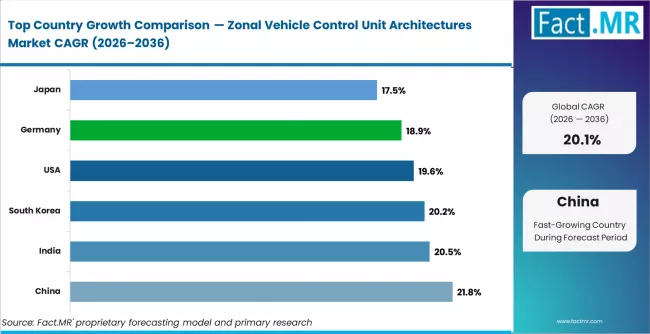
India leads at 20.5% CAGR through 2036, driven by cost-optimized zonal adoption and domestic electronics manufacturing push under PLI schemes. South Korea follows at 20.2%, underpinned by Hyundai’s standardized E/E architecture across electric vehicle platforms and an integrated supplier ecosystem. China grows at 21.8% (fastest), anchored by the world’s largest EV production base and policy-driven SDV adoption mandates. United States records 19.6%, reflecting active OEM transition to software-defined architectures and a deep chip design ecosystem. Germany grows at 18.9%, led by premium OEM early zonal adoption at Volkswagen Group, BMW, and Mercedes-Benz. Japan records 17.5%, with gradual migration from distributed ECU frameworks and a strong Tier-1 supplier base managing transition timelines.
Segmental Analysis
Zonal Vehicle Control Unit Architectures Market Analysis by Architecture Type
Zonal Vehicle Control Unit Architectures Market Analysis By Architecture Type | Source: Fact.MR
Hybrid domain-zonal architecture holds 40% share in 2026. It leads due to backward compatibility requirements. OEMs are managing phased migration across vehicle programmes. Hybrid setups reduce re-engineering cost and enable gradual transition.
Continental AG Investment: Continental invested in HPC zonal platforms in 2024. These support hybrid domain-zonal deployment. The platform integrates zone and domain control in one module. This aligns with OEM transition needs. [5]
Aptiv Architecture Development: Aptiv introduced its updated Smart Vehicle Architecture in 2025. It supports modular zone controllers for hybrid and full zonal systems. Production launches are expected in 2026–2027. This supports near-term hardware growth. [6]
Full Zonal Adoption Trend: Volkswagen Group deployed E3 1.2 architecture on the PPE platform. This was launched with Audi Q6 e-tron in 2024. Wiring is reduced by 30%. OTA updates are centralized across vehicle systems. [7]
Zonal Vehicle Control Unit Architectures Market Analysis by Component
Zonal Vehicle Control Unit Architectures Market Analysis By Component | Source: Fact.MR
Hardware holds 45% share in 2026. Every zonal vehicle requires physical module deployment. This includes silicon, PCBs, and connectors. Hardware content per vehicle is higher than legacy ECU systems.
NXP Semiconductors SoC: NXP launched S32Z and S32E processors in 2024. These support zonal control with Ethernet and safety integration. Over 50 OEM design wins were reported. This indicates strong hardware adoption. [8]
AUTOSAR Software Platform: AUTOSAR Adaptive Platform Release 23-11 was published in 2024. It supports service-oriented zonal architectures. Robert Bosch and Continental AG confirmed compliance. This strengthens middleware standardization. [9]
Services & Integration Growth: Magna International expanded ZCU integration services in 2025. Dedicated teams were added in North America and Europe. Electronics integration revenue grew 12% in 2024. This reflects rising OEM demand for deployment support. [10]
Drivers, Restraints, and Opportunities
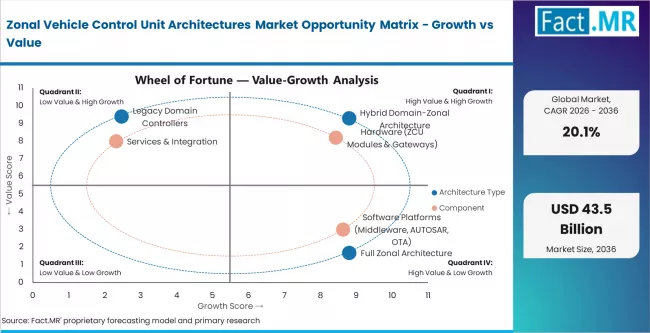
Zonal Vehicle Control Unit Architectures Market Opportunity Matrix Growth Vs Value | Source: Fact.MR
FACT.MR analysts observe that the zonal VCU architectures market is in an early-growth phase. Growth is driven by the shift toward software-defined vehicles. Current demand reflects adoption by EV-native OEMs and premium programmes. Mass-market transition remains the key growth driver through 2036.
Legacy ECU architectures are losing share to zonal platforms. Migration timelines vary by region and vehicle segment. EV platforms lead adoption, while ICE programmes lag by three to five years. Per-vehicle hardware content is higher in zonal systems. This is expanding revenue even with moderate volume growth. Software and integration services are emerging as higher-margin layers.
• SDV Regulatory Tailwinds: UNECE regulations R155 and R156 became mandatory from July 2024. These require cybersecurity and software update management systems. Centralised zonal architectures are structurally aligned with these requirements. EU enforcement began across new vehicle registrations in 2024. This is accelerating OEM architecture redesigns. [2]
• EV Platform Architecture Mandates: BYD, NIO, and Li Auto adopted zonal architectures across 2024–2025 platforms. China produced over 9.5 million EVs in 2024. Zonal content is embedded in most new platforms. This creates the largest ZCU deployment base globally. [3]
• North America OEM Software Transition: General Motors and Ford are deploying zonal architectures across Ultium and VIP platforms. Software-defined features are generating incremental revenue. This validates the commercial case for ZCU investment. [4]
Regional Analysis
The zonal vehicle control unit architectures market is assessed across Asia Pacific, North America, Europe, Latin America, and Middle East and Africa, covering demand profiles shaped by EV programme launch intensity, OEM E/E architecture roadmaps, semiconductor ecosystem strength, and regulatory frameworks. The full report provides market attractiveness analysis by region and country.
Top Country Growth Comparison Zonal Vehicle Control Unit Architectures Market Cagr (2026 2036) | Source: Fact.MR
Country
CAGR (2026 to 2036)
China
21.8%
India
20.5%
South Korea
20.2%
United States
19.6%
Germany
18.9%
Japan
17.5%
Source: Fact.MR analysis. Updated May 12, 2026
Source: Fact.MR (FACT.MR) analysis, based on proprietary forecasting model and primary research
Zonal Vehicle Control Unit Architectures Market Cagr Analysis By Country | Source: Fact.MR
Asia Pacific Zonal Vehicle Control Unit Architectures Market Analysis
Asia Pacific is the primary volume and growth epicentre. China drives scale, while South Korea drives platform standardisation. BYD, NIO, and Hyundai Motor Group are defining OEM architecture strategies. Denso Corporation, Hyundai Mobis, and LS Automotive shape Tier-1 execution and supply depth.
China: Production scale and policy alignment support 21.8% CAGR through 2036. EV output exceeded 9.5 million units in 2024, embedding ZCU architectures at platform level. BYD and NIO deploy zonal frameworks across new-generation architectures. Ministry of Industry and Information Technology mandates SDV capabilities, creating policy-backed demand visibility. Continental AG and Robert Bosch expanded local design programmes to secure OEM design wins. Scale, policy, and localisation combine to create the world’s most stable ZCU demand environment.
India: Policy-backed cost optimisation supports 20.5% CAGR through 2036. Production Linked Incentive schemes include electronic modules, supporting ZCU localisation. Tata Motors is integrating zonal architectures across EV platforms. Maruti Suzuki is evaluating zonal transitions for future programmes. Cost-efficient module design and local assembly create a differentiated adoption pathway versus global premium markets.
South Korea: Platform standardisation and ecosystem integration support 20.2% CAGR through 2036. Hyundai Motor Group is deploying a unified zonal architecture across Hyundai, Kia, and Genesis platforms. Hyundai Mobis acts as the primary system integrator, aligning hardware and software layers. LS Automotive and Aptiv support modular ZCU supply under long-term contracts. The tightly integrated OEM–supplier structure reduces validation cycles and accelerates production readiness versus fragmented global markets.
Fact.MR’s Asia Pacific analysis covers China, Japan, South Korea, India, ASEAN, and Australia. It includes EV platform adoption trends, architecture roadmaps, and Tier-1 supply positioning.
North America Zonal Vehicle Control Unit Architectures Market Analysis
Zonal Vehicle Control Unit Architectures Market Country Value Analysis | Source: Fact.MR
North America is driven by software monetisation and platform transition. General Motors, Ford, and Stellantis are actively restructuring E/E architectures. Aptiv and Magna International anchor Tier-1 execution. Qualcomm and NXP Semiconductors provide strong silicon ecosystem depth.
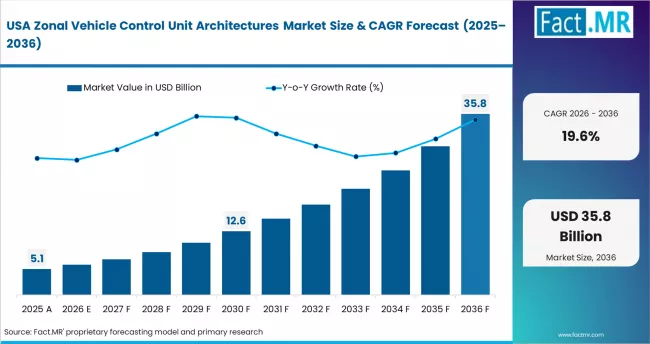
United States: Software-led architecture transition supports 19.6% CAGR through 2036. General Motors scaled zonal architectures on Ultium platforms. Ford deployed VIP architecture across next-generation vehicles. OTA-driven revenue validation is strengthening ZCU investment rationale. Qualcomm secured multiple design wins across OEM pipelines. Platform ownership and software monetisation define procurement decisions in this market.
Fact.MR’s North America analysis covers United States, Canada, and Mexico. It includes OEM platform strategies, SDV revenue models, and semiconductor supply chain insights.
Europe Zonal Vehicle Control Unit Architectures Market Analysis
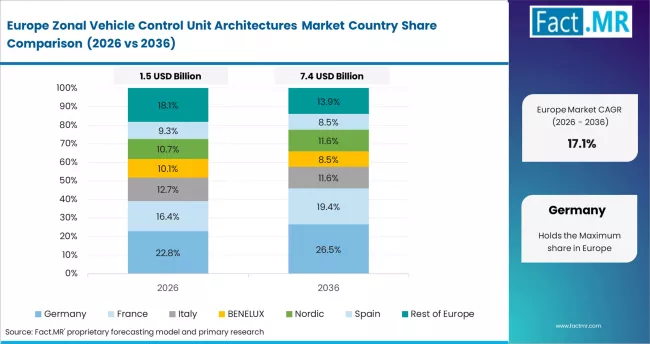
Zonal Vehicle Control Unit Architectures Market Europe Country Market Share Analysis, 2026 & 2036 | Source: Fact.MR
Europe is shaped by premium OEM engineering depth and regulatory enforcement. Volkswagen Group, BMW, and Mercedes-Benz lead zonal deployment timelines. Continental AG and Robert Bosch dominate Tier-1 supply. UNECE R155/R156 regulations create a structural compliance baseline favouring centralised architectures.
Germany: Engineering-led platform consolidation supports 18.9% CAGR through 2036. Volkswagen Group deployed E3 1.2 zonal architecture on PPE platforms. BMW is advancing Neue Klasse with fully zonal E/E architecture. Continental AG secured multi-programme supply contracts. Regulatory enforcement is accelerating OEM transition timelines. High premium vehicle content supports higher per-vehicle ZCU value.
Fact.MR’s Europe analysis covers Germany, France, United Kingdom, Italy, Spain, and Rest of Europe. It includes regulatory impacts, OEM timelines, and supplier positioning.
Competitive Aligners for Market Players
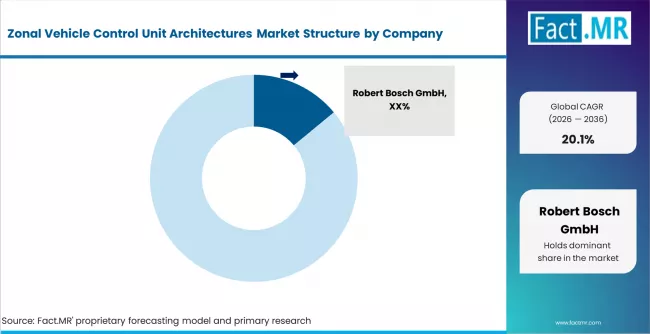
Zonal Vehicle Control Unit Architectures Market Analysis By Company | Source: Fact.MR
Competitive aligners in the zonal vehicle control unit architectures market are increasingly centered on early platform positioning, deep ecosystem integration, and long-cycle OEM programme alignment. Vendors are no longer competing on standalone hardware capability but on their ability to deliver complete zonal architecture stacks that combine silicon, middleware, and system integration within a unified framework.
A primary competitive lever is early design-win capture with OEMs transitioning to software-defined vehicle platforms. Suppliers aligned with OEM architecture roadmaps before platform freeze timelines typically 24 to 36 months ahead of production secure multi-year revenue visibility. Companies such as Aptiv and Continental AG are leveraging modular zonal platforms to fit both hybrid and full zonal deployments, improving win rates across diverse OEM transition strategies.
Silicon and middleware partnerships are another defining differentiator. Integration with players such as NXP Semiconductors and Qualcomm enables Tier-1 suppliers to offer pre-validated hardware-software stacks. This reduces OEM integration risk and shortens development cycles. AUTOSAR Adaptive compliance and service-oriented architecture capabilities are now baseline procurement requirements rather than optional features. System integration capability is emerging as a high-margin differentiator. OEMs increasingly prefer vendors that can deliver end-to-end zonal deployment, including wiring reduction design, gateway integration, and OTA enablement. Magna International is expanding in this area, capturing integration-led contracts beyond pure component supply.
Key Players
Robert Bosch GmbH
Continental AG
Aptiv PLC
Magna International Inc.
Denso Corporation
NXP Semiconductors N.V.
Qualcomm Incorporated
Infineon Technologies AG
Bibliography
[1] UNECE. (2021, amended enforcement 2024). UN Regulation No. 155 – Cyber Security and Cyber Security Management System; UN Regulation No. 156 – Software Update and Software Update Management System. unece.org/transport/vehicle-regulations
[2] China Association of Automobile Manufacturers (CAAM). (2025). China NEV Production and Sales Statistics 2024. caam.org.cn
[3] General Motors. (Q3 2024). Earnings Call Transcript: Software-Defined Vehicle Revenue Update – Ultium Platform OTA Features and Subscription Performance. Q3 2024. gm.com/investor-relations
Strategic intelligence on zonal VCU architecture demand across EV platform launches, OEM E/E redesign programmes, ADAS consolidation, and software-defined vehicle OTA update infrastructure globally.
Market forecast from USD 5.8 billion in 2026 to USD 36.2 billion by 2036 at a CAGR of 20.1%.
Growth opportunity mapping across China EV platform ZCU adoption, U.S. OEM software-defined architecture transition, South Korea Hyundai E/E standardisation, and India cost-optimised ZCU deployment.
Segment analysis by architecture type (hybrid domain-zonal, full zonal, legacy), component (hardware, software platforms, services), and application (body, ADAS, infotainment, powertrain).
Regional outlook covering Asia Pacific EV-platform ZCU volume, North America OEM software transition, and Europe UN R155/R156 regulatory compliance driving zonal gateway adoption.
Competitive analysis of Bosch, Continental, Aptiv, Magna, and NXP. Focus on silicon partnership depth, AUTOSAR Adaptive compliance, and OEM design-win pipeline visibility.
Regulatory impact analysis covering UN R155/R156 cybersecurity requirements, China SDV policy mandates, India PLI automotive electronics incentives, and EU type-approval timelines for zonal E/E architectures.
Report delivered in PDF, Excel datasets, and presentation formats. Supported by primary OEM and Tier-1 interviews, semiconductor design-win data, AUTOSAR platform disclosures, and vehicle production volume benchmarks.
Zonal Vehicle Control Unit Architectures Market Definition
The market covers zonal vehicle control unit (ZCU) architectures centralized electronic systems that consolidate vehicle functions by geographic zone rather than by domain. ZCUs integrate compute, power distribution, and communication management into single modules, replacing distributed ECU networks.
Zonal Vehicle Control Unit Architectures Market Inclusions
Covers global and regional forecasts from 2026 to 2036. Includes hybrid domain-zonal, full zonal, and legacy transition hardware and software across body, ADAS, infotainment, and powertrain applications in passenger cars, commercial vehicles, and EV platforms.
Zonal Vehicle Control Unit Architectures Market Exclusions
Excludes standalone domain controllers not integrated into zonal architectures and finished vehicle assembly systems. Omits wire harness manufacturing and raw semiconductor fabrication. Focus remains on ZCU hardware modules, embedded software platforms, and integration services as direct market inputs.
Zonal Vehicle Control Unit Architectures Market Research Methodology
Primary Research:Interviews with E/E architecture engineers at OEMs, ZCU hardware procurement teams, AUTOSAR middleware developers, and Tier-1 supplier product managers across Asia Pacific, Europe, and North America.
Desk Research:Uses SAE International technical standards, AUTOSAR consortium publications, OEM annual reports (2024–2025), and semiconductor earnings filings from NXP, Qualcomm, and Infineon.
Market-Sizing and Forecasting:Hybrid model combining vehicle production volumes by platform type, ZCU content-per-vehicle estimates by architecture tier, and software platform attach rates across OEM programmes.
Data Validation and Update Cycle:Validated using OEM E/E architecture roadmaps, Tier-1 supplier capacity disclosures, and cross-checks against vehicle programme launch timelines. Updated annually.
Market Breakdown
Segmentation
Scope of Report
Zonal Vehicle Control Unit Architectures Market Breakdown By Architecture Type, Component, And Region | Source: Fact.MR
Attribute
Details
Quantitative Units
USD 5.8 billion (2026) to USD 36.2 billion (2036), at a CAGR of 20.1%
Market Definition
Zonal vehicle control unit (ZCU) architectures including hardware modules, embedded software platforms (AUTOSAR, OTA, middleware), and integration services, deployed in passenger and commercial vehicles to consolidate ECU functions by physical zone.
Architecture Segmentation
Hybrid Domain-Zonal, Full Zonal, Legacy Domain Controllers
North America, Europe, Asia Pacific, Latin America, Middle East and Africa
Countries Covered
USA, Canada, Mexico, Germany, UK, France, Italy, Spain, Nordic, BENELUX, China, Japan, South Korea, India, ASEAN, Australia and New Zealand, Brazil, Argentina, Saudi Arabia, GCC, Turkey, South Africa, Rest of MEA
Key Companies Profiled
Robert Bosch GmbH, Continental AG, Aptiv PLC, Magna International Inc., Denso Corporation, NXP Semiconductors N.V., Qualcomm Incorporated, Infineon Technologies AG
Forecast Period
2026 to 2036
Approach
Hybrid top-down and bottom-up model using vehicle production volume by platform type, ZCU content-per-vehicle estimates by architecture tier, software platform attach rates, and primary OEM E/E architecture programme interviews.
Source: Fact.MR analysis. Updated May 12, 2026
Zonal Vehicle Control Unit Architectures Market by Segments
By Architecture Type:
Hybrid Domain-Zonal Architecture
Full Zonal Architecture
Legacy Domain Controllers
By Component:
Hardware (ZCU Modules & Gateways)
Software Platforms (Middleware, AUTOSAR, OTA)
Services & Integration
By Application:
Body & Comfort Electronics
ADAS & Safety
Infotainment & Cockpit
Powertrain Coordination
By Region:
North America
United States
Canada
Mexico
Latin America
Brazil
Argentina
Rest of Latin America
Western Europe
Germany
France
United Kingdom
Italy
Spain
Nordic Countries
BENELUX
Rest of Western Europe
Eastern Europe
Russia
Poland
Rest of Eastern Europe
East Asia
China
Japan
South Korea
South Asia and Pacific
India
ASEAN
Australia and New Zealand
Rest of South Asia and Pacific
Middle East and Africa
Kingdom of Saudi Arabia
Other GCC Countries
Turkey
South Africa
Rest of Middle East and Africa
Questions Answered
Frequently Asked Questions
How large is the global zonal vehicle control unit architectures market in 2025?
The global zonal vehicle control unit architectures market was valued at USD 4.4 billion in 2025.
What will the market size be in 2026?
Based on Fact.MR analysis, demand for zonal VCU architectures is estimated to grow to USD 5.8 billion in 2026.
What is the projected market size by 2036?
The market is projected to reach USD 36.2 billion by 2036, generating USD 30.4 billion in absolute dollar opportunity over the forecast period.
What is the expected CAGR from 2026 to 2036?
FACT.MR projects a CAGR of 20.1% for the global zonal vehicle control unit architectures market during the 2026 to 2036 forecast period.
Which architecture type segment is poised to lead the market?
Hybrid domain-zonal architecture leads with approximately 40% share in 2026, preferred by OEMs managing phased migration from legacy ECU networks while preserving existing toolchain investments.
Which component segment holds the largest share?
Hardware (ZCU modules and gateways) leads with approximately 45% share in 2026, driven by physical module content requirements across new EV platform launches at global OEMs.
Which country shows the fastest growth?
China leads at 21.8% CAGR through 2036, anchored by the world’s largest EV production base and policy-driven software-defined vehicle adoption mandates under MIIT programmes.
What is driving demand for zonal vehicle control unit architectures?
Demand is driven by EV platform ZCU content mandates at global OEMs, UN R155/R156 cybersecurity regulation enforcement from 2024, and semiconductor partner SoC launches by NXP and Qualcomm purpose-built for zonal applications.
.webp "Top Country Growth Comparison Zonal Vehicle Control Unit Architectures Market Cagr (2026 2036)")