- Market Value (2025): USD 720.4 Mn
- Estimated Value (2026): USD 760.1 Mn
- Forecast Value (2036): USD 1300.9 Mn
- CAGR (2026-2036): 5.5%
What is the Advanced Power Sweeper Market forecast to be worth by 2036?
USD 760.1 million in 2026 to USD 1,300.9 million by 2036 at a 5.5% CAGR.
- Fact.MR estimates the advanced power sweeper market at USD 720.4 million for 2025, with ride-on machines carrying most of the floor area cleaned in large facilities.
- Spending on powered sweeping equipment will lift revenue from USD 760.1 million in 2026 to USD 1,300.9 million by 2036 as commercial and industrial sites replace manual cleaning hours.
- A 5.5% CAGR reflects steady replacement demand in mature markets plus new fleets for municipal dust control and automated cleaning.
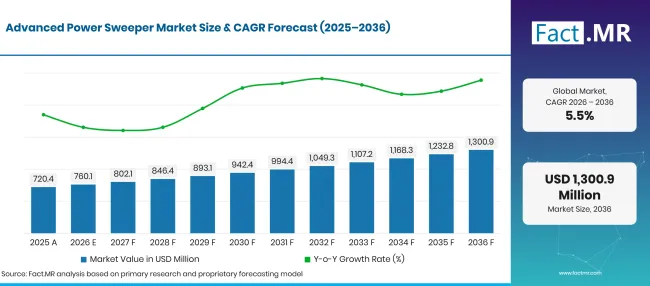
Advanced Power Sweeper Market Forecast Global | Source: Fact.MR
| Year | Basis | Market Value (USD million) |
|---|---|---|
| 2025 | Actual | 720.4 |
| 2026 | Estimate | 760.1 |
| 2036 | Forecast | 1,300.9 |
| CAGR 2026 to 2036 | Forecast period | 5.5% |
Source: Fact.MR analysis. Updated Nov 4, 2026
What are the defining numbers behind Advanced Power Sweeper Market growth?
The 2026 to 2036 period will add USD 540.7 million in new value, concentrated in commercial premises, battery machines and road dust programmes.
- Demand Drivers in the Market
- Large warehouses, factories and distribution centres need daily debris removal across wide aisles and loading areas. Ride-on sweepers let one operator clear these spaces in a fraction of the manual time. Hopper size and filter quality decide whether a machine can run a full shift without stopping.
- Public bodies are moving road dust control from brooms to machines. In February 2026, the Commission for Air Quality Management set norms for mechanised road sweeping machines in the National Capital Region of India, requiring at least 8 hours of operation per shift and only CNG or electric variants for new fleets [1]. Rules of this kind turn sweeping into a specified, measurable service.
- Battery supply rules shape the electric sweeper offer in Europe. The Council of the European Union adopted a law in July 2025 that moves battery due diligence obligations to 18 August 2027 [2]. Manufacturers gain time to document their battery sourcing while they widen electric ranges.
- Automation is reaching industrial sweeping. Tennant Company opened orders in April 2026 for the X16 SWEEP, an autonomous sweeper for warehouses, logistics centres and light manufacturing plants that can recharge itself between cycles [3]. Robotic units suit sites with repeat routes and predictable layouts.
- Key Segments Analyzed
- By Product Type: Ride-On Power Sweepers will hold 42.5% share in 2026, since a seated operator can cover long aisles and yards in one pass.
- By Application: Commercial will account for 45.3% of 2026 value as shopping centres, airports and offices clean large public floors every day.
- By Power Source: Electric will capture 36.7% in 2026, helped by indoor sites that cannot accept exhaust or engine noise.
- By Distribution Channel: Specialty Stores will take 45.1% of 2026 revenue, given that buyers want demonstrations, operator training and service contracts with the machine.
- Analyst Opinion at Fact.MR
- Shambhu Nath Jha, Principal Consultant at Fact.MR, states, “Advanced power sweeper buyers now judge a machine by cost per square metre cleaned over its whole life. Ride-on and electric units will keep gaining in warehouses and commercial estates, while autonomous sweepers will move from pilots into routine night shifts. Suppliers with dense service networks and proven battery packs will win the replacement cycle through 2036.”
- Strategic Implications
- Manufacturers should pair each ride-on platform with a battery option and a dust filtration grade suited to indoor air rules.
- Distributors should bundle demonstrations, operator training and planned maintenance, since service quality decides repeat orders.
- Facility buyers should compare total ownership cost per shift, counting battery replacement and brush wear alongside the purchase price.
- Investors should track municipal dust control norms and autonomous sweeper launches, which open new fleet orders.
Japan leads the country set at 7.1%, with labour scarcity pushing sites toward automated and compact sweepers. Brazil follows at 6.2% as retail and logistics estates mechanise cleaning from a low base. The United Kingdom, at 5.8%, gains from road dust attention and commercial replacement. The United States records 5.3%, a large installed base where growth comes mostly from upgrades to battery and robotic units. Germany closes the set at 3.9%, a mature market that buys on replacement cycles and air quality compliance.
How does the Advanced Power Sweeper Market break down by segment?
Ride-On Power Sweepers will lead Product Type at 42.5%; Commercial will head Application at 45.3%; Electric will lead Power Source at 36.7%; Specialty Stores will hold Distribution Channel at 45.1% in 2026.
Which Product Type leads?
Ride-On Power Sweepers hold 42.5% of 2026 sales.
| Product Type | Share (2026) |
|---|---|
| Ride-On Power Sweepers (Leading segment) | 42.5% |
| Other segments combined | 57.5%* |
| Total | 100.0% |
Source: Fact.MR analysis. Updated Nov 4, 2026
Warehouses, plants and logistics yards have floor areas that would take a walking operator many hours to cover. A seated driver with a wide main brush and side brushes clears these spaces quickly and with less fatigue. Large hoppers reduce emptying stops, so a single machine can finish a full shift route. Buyers often replace older diesel units with battery ride-ons when indoor air rules tighten. Walk-behind power sweepers serve shops, car parks and smaller workshops where turning space is limited. Robotic power sweepers form the newest group, aimed at sites that repeat the same routes each night. Many buyers also compare sweepers with scrubber dryer units when floors need wet cleaning after debris removal.
What supports Commercial within Application?
Commercial takes 45.3% of 2026 revenue.
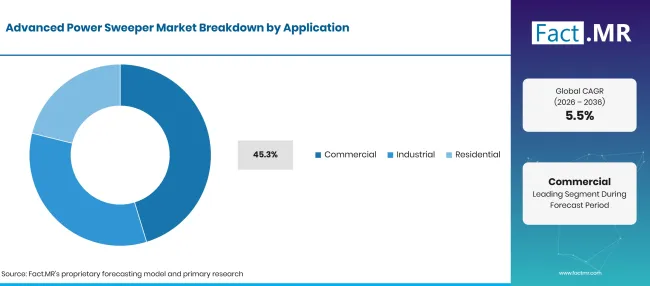
Advanced Power Sweeper Market Breakdown Application | Source: Fact.MR
| Application | Share (2026) |
|---|---|
| Commercial (Leading segment) | 45.3% |
| Other segments combined | 54.7%* |
| Total | 100.0% |
Source: Fact.MR analysis. Updated Nov 4, 2026
Shopping centres, airports, office parks and retail estates host heavy foot traffic and must look clean during opening hours. Facility managers schedule sweeping at night or early morning, which favours fast machines with low noise. Outdoor plazas and car parks add grit, leaves and packaging waste that manual teams struggle to clear. Industrial users need heavier machines for metal swarf, pallets and dust in production halls. Residential use stays small and centres on large housing estates and private grounds. Some industrial sites combine sweepers with industrial vacuum cleaners for fine dust in hard to reach areas.
How does Power Source shape demand?
Electric represents 36.7% of 2026 value.
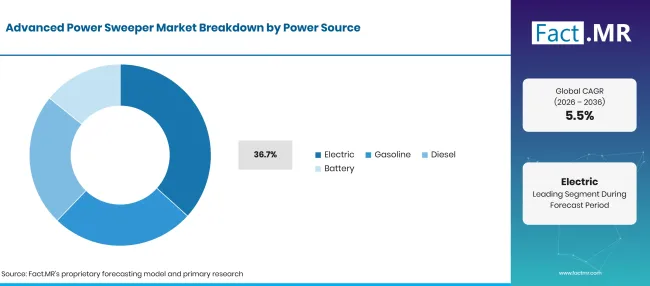
Advanced Power Sweeper Market Breakdown Power Source | Source: Fact.MR
| Power Source | Share (2026) |
|---|---|
| Electric (Leading segment) | 36.7% |
| Other segments combined | 63.3%* |
| Total | 100.0% |
Source: Fact.MR analysis. Updated Nov 4, 2026
Indoor operators favour machines that release no exhaust at the point of use and run quietly near staff and shoppers. Battery packs with longer run times now let electric sweepers complete a full shift in many warehouses. European battery rules give suppliers until August 2027 to meet due diligence duties, which keeps electric launches on schedule [2]. Gasoline and diesel machines remain common outdoors, on rough yards and where charging points are scarce. Battery units are listed as a separate category and overlap with electric designs in fleet planning. Buyers weigh charging time against fuel logistics when they choose a mix.
What supports Specialty Stores within Distribution Channel?
Specialty Stores capture 51.2% of 2026 purchases.
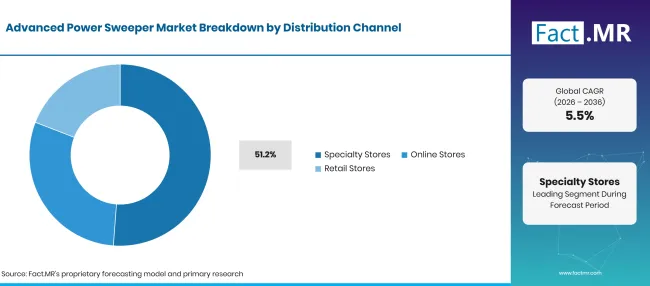
Advanced Power Sweeper Market Breakdown Distribution Channel | Source: Fact.MR
| Distribution Channel | Share (2026) |
|---|---|
| Specialty Stores (Leading segment) | 45.1% |
| Other segments combined | 54.9%* |
| Total | 100.0% |
Source: Fact.MR analysis. Updated Nov 4, 2026
Power sweepers are capital goods that buyers want to test on their own floors before signing an order. Specialist dealers bring machines on site, train operators and hold spare brushes, filters and batteries. Many also sell surface cleaning products and service contracts in the same visit. Online stores attract smaller buyers of compact walk-behind units with simple specifications. Retail stores reach occasional users and small businesses with entry level machines. Larger fleets still pass through dealers who can guarantee response times.
What is accelerating Advanced Power Sweeper Market adoption, and what is holding it back?
Mechanised cleaning in logistics, retail and public spaces will keep orders flowing, and battery and robotic models will widen the buyer base. High purchase prices still deter small sites. Battery run time, spare parts costs and cheap manual labour in some regions will also slow uptake.
Drivers Impact Analysis
| DRIVER | (~) % IMPACT ON CAGR | GEOGRAPHIC RELEVANCE | IMPACT TIMELINE |
|---|---|---|---|
| DRIVER | (~) % IMPACT ON CAGR | GEOGRAPHIC RELEVANCE | IMPACT TIMELINE |
| Mechanisation of commercial and industrial cleaning | +1.2% | Global | Short term (<=2 years) |
| Growth of warehouses, logistics and commercial floor space | +1.0% | North America, Western Europe, East Asia | Medium term (2-4 years) |
| Shift to electric cleaning equipment indoors | +0.8% | Western Europe, North America, East Asia | Medium term (2-4 years) |
| Mechanised road dust and public space cleaning | +0.6% | South Asia & Pacific, Latin America, Western Europe | Long term (>=4 years) |
Source: Fact.MR analysis. Updated Nov 4, 2026
Opportunity Impact Analysis
| OPPORTUNITY | (~) % IMPACT ON CAGR | GEOGRAPHIC RELEVANCE | IMPACT TIMELINE |
|---|---|---|---|
| OPPORTUNITY | (~) % IMPACT ON CAGR | GEOGRAPHIC RELEVANCE | IMPACT TIMELINE |
| High capacity battery ride-on sweepers | +0.8% | Western Europe, North America, East Asia | Medium term (2-4 years) |
| Robotic and autonomous sweepers | +0.6% | East Asia, North America, Western Europe | Long term (>=4 years) |
| Sweepers built for warehouse and logistics sites | +0.5% | North America, East Asia, South Asia & Pacific | Short term (<=2 years) |
| Municipal road sweeping programmes | +0.4% | South Asia & Pacific, Latin America, Western Europe | Long term (>=4 years) |
Source: Fact.MR analysis. Updated Nov 4, 2026
Restraints Impact Analysis
| RESTRAINT | (~) % IMPACT ON CAGR | GEOGRAPHIC RELEVANCE | IMPACT TIMELINE |
|---|---|---|---|
| RESTRAINT | (~) % IMPACT ON CAGR | GEOGRAPHIC RELEVANCE | IMPACT TIMELINE |
| High upfront equipment cost | -0.6% | Global | Short term (<=2 years) |
| Battery run time and charging limits | -0.4% | Global | Short term (<=2 years) |
| Maintenance costs and specialised spare parts | -0.3% | Global | Medium term (2-4 years) |
| Competition from manual cleaning and basic equipment | -0.2% | Emerging markets | Medium term (2-4 years) |
Source: Fact.MR analysis. Updated Nov 4, 2026
Which countries are scaling the Advanced Power Sweeper Market through 2036?
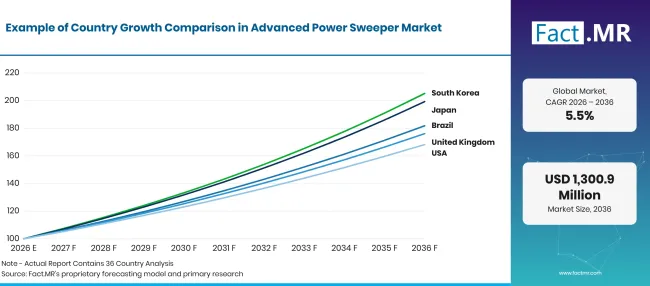
Advanced Power Sweeper Market Growth Index | Source: Fact.MR
| Country | CAGR (2026 to 2036) |
|---|---|
| Japan | 7.1% |
| Brazil | 6.2% |
| United Kingdom | 5.8% |
| United States | 5.3% |
| Germany | 3.9% |
Source: Fact.MR analysis. Updated Nov 4, 2026
What supports Japan’s adoption?
7.1% CAGR, driven by labour scarcity and demand for automated cleaning.
Japan’s Ministry of Health, Labour and Welfare reported an average job openings to applicants ratio of 1.22 for 2025 [4]. With more vacancies than job seekers, building service firms struggle to staff night cleaning crews. Compact ride-on and robotic sweepers let a smaller team cover car parks, stations and factory floors. Buyers in Japan also value low noise and tight turning circles for dense urban sites.
How is Brazil developing demand?
6.2% CAGR, helped by the mechanisation of urban and commercial cleaning.
Brazil’s Ministry of Cities reported in March 2025 that municipalities collected an estimated 78.2 million tonnes of urban solid waste a year, with public cleaning waste of 0.35 kg per inhabitant per day in reference year 2023 [5]. Much of that street and plaza debris is still swept by hand. Retail estates and logistics parks around São Paulo now buy ride-on units to cut labour hours. Dealer reach outside the large cities will shape the pace of uptake.
How is the United Kingdom scaling demand?
5.8% CAGR, backed by road dust attention and commercial replacement.
Great Britain had 247,200 miles of roads in 2025, according to the Department for Transport [6]. A report for the same department estimated that brake and tyre wear produced 59% of road transport PM2.5 in 2023, with road abrasion adding 23% [7]. Councils and estate managers use compact sweepers to remove this grit from town centres, car parks and depots. Indoor sites lean toward battery models.
What is supporting United States adoption?
5.3% CAGR, reflecting labour costs and a large installed fleet due for upgrade.
The Bureau of Labor Statistics counted 2,432,600 janitors and building cleaners in 2025, with about 321,800 openings each year to fill [8]. Hiring pressure on that scale pushes facility managers toward ride-on and autonomous sweepers. The Census Bureau put 2025 private manufacturing construction at USD 219.2 billion, which keeps new plant floors coming into service [9]. Distribution centres remain the core buyers of large battery machines.
How does Germany perform?
3.9% CAGR, as replacement cycles and air quality rules guide purchases.
Germany met all current air quality limits in 2025, yet the Federal Environment Agency found that about 18% of stations would miss the future annual PM2.5 limit of 10 micrograms per cubic metre [10]. Cities and industrial sites therefore value sweepers with fine dust filters and water spray. German buyers replace machines on fixed cycles and expect strong dealer service. Growth comes from swapping diesel units for battery models.
Who leads the Advanced Power Sweeper Market?
Three groups shape competition. Broad floor care suppliers such as Tennant Company, Kärcher, Nilfisk and Hako sell ride-on and walk-behind sweepers alongside scrubbers, which lets them serve a whole site through one dealer and one service contract.
Tennant Company opened orders for its X16 SWEEP autonomous sweeper in April 2026, built for multi-shift industrial work [3]. Nilfisk launched the CS7500 combination sweeper-scrubber in March 2025, designed with customer input to clean and scrub in one pass [11]. Italian specialists Fimap, Comac and IPC compete on compact ranges and price, with strong dealer networks in Europe. Dulevo and Factory Cat focus on heavier industrial and outdoor sweeping; Dulevo is showing its D.Zero² and D6 Veloce sweepers at Ecomondo in November 2026 [12]. Through 2036, success will turn on battery life, autonomous navigation and the speed of local service.
Which companies are the key providers?
Key companies in the Advanced Power Sweeper Market include Tennant Company, Kärcher, Nilfisk, Hako, Dulevo, Fimap, Comac, IPC and Factory Cat.
- Tennant Company
- Kärcher
- Nilfisk
- Hako
- Dulevo
- Fimap
- Comac
- IPC
- Factory Cat
Bibliography
- [1] Commission for Air Quality Management. (2026, February 11). CAQM Issues Technical and Operational Norms for Deployment and Utilization of MRSMs Towards Abatement of Road Dust in NCR.
- [2] Council of the European Union. (2025, July 18). Simplification: Council adopts law to "stop-the-clock" on due diligence rules for batteries.
- [3] Tennant Company. (2026, April 7). Tennant Company Unveils X16 SWEEP for Autonomous, Around-the-Clock Industrial Sweeping.
- [4] Ministry of Health, Labour and Welfare. (2026, January 30).
- [5] Ministry of Cities. (2025, March). Relatório dos Serviços de Limpeza Urbana e Manejo de Resíduos Sólidos: SINISA 2024.
- [6] Department for Transport. (2026, February 12). Road lengths in Great Britain: 2025.
- [7] Department for Transport. (2025, September 5). Road Wear and Dust Resuspension: Final Report.
- [8] U.S. Bureau of Labor Statistics. (2026, August 27). Janitors and Building Cleaners: Occupational Outlook Handbook.
- [9] U.S. Census Bureau. (2026, February 27). Monthly Construction Spending, December 2025.
- [10] Umweltbundesamt. (2026, February 11). Auch 2025 wurden alle Grenzwerte zur Luftqualität eingehalten.
- [11] Nilfisk. (2025, March 10). Nilfisk launches product designed with customers.
- [12] Dulevo. (2026, October 19). Dulevo at Ecomondo 2026: a story of innovation with an eye to the future.
This Report Answers
- How large will advanced power sweeper revenue be in each year from 2026 to 2036?
- Why do ride-on machines hold the biggest share of product demand, and where do walk-behind and robotic units fit?
- Which buyers in commercial and industrial sites drive purchase volumes?
- How do electric, battery, gasoline and diesel machines compare across indoor and outdoor work?
- What separates growth in Japan, Brazil, the United Kingdom, the United States and Germany?
- Which suppliers compete in the field, and what will decide their position through 2036?
What does the Advanced Power Sweeper Market cover?
This study values powered machines that sweep dust, debris and loose waste from floors, yards and paved outdoor areas. It covers ride-on, walk-behind and robotic sweepers sold to commercial, industrial and residential users.
Revenue is counted at the point of the first equipment sale in USD million. Values include the machine with its standard brushes, hopper, filter and battery or engine. The study tracks sales by power source and by sales channel.
What is included in the scope?
Ride-on power sweepers used in warehouses, factories, car parks and retail estates.
Walk-behind power sweepers for shops, workshops and smaller outdoor areas.
Robotic power sweepers that follow mapped routes, which overlap with the wider field of autonomous mobile robots.
Electric, battery, gasoline and diesel machines sold through specialty, online and retail channels.
What is excluded from the scope?
Manual brooms, push sweepers without a motor and other hand tools.
Truck mounted street sweeper vehicles used by municipal fleets on public roads.
Floor scrubbers and vacuum cleaners that do not sweep, unless sold as part of a combined sweeper unit.
Contract cleaning services, spare parts sold after the first sale and industrial cleaning chemicals.
How Was the Analysis Built?
The analysis draws on 120+ sources, 35+ company portfolios, 25+ countries, and more than 20 industry interviews.
- Primary Research: Primary research includes discussions with manufacturers, service providers, technology developers, distributors, end users, and subject-matter experts. These conversations examine purchasing priorities, product adoption, operational challenges, approval requirements, competitive positioning, and the factors that influence wider market acceptance.
- Desk Research: Desk research covers government statistics, regulatory publications, company filings, trade data, technical studies, industry associations, standards, public policy, and other authoritative sources. Every source used in the analysis is documented in the bibliography.
- Market Sizing and Forecasting: Market estimates combine historical performance, demand indicators, pricing and volume trends, segment shares, company participation, country-level growth, adoption patterns, investment activity, and barriers to market expansion.
- Data Validation and Update Cycle: Findings are validated by comparing primary interviews with public data, company activity, regulatory changes, trade patterns, and industry developments. Regular updates review new product launches, capacity changes, partnerships, approvals, and shifts in commercial adoption.
Segmentation
What is the report’s scope and coverage?
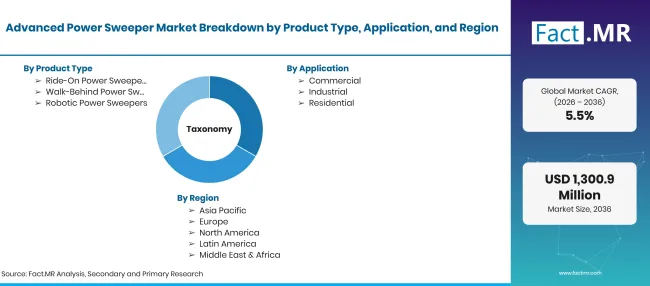
Advanced Power Sweeper Market Taxonomy | Source: Fact.MR
| Attribute | Details |
|---|---|
| Quantitative Units | USD million |
| Market Definition | Powered sweeping machines that collect dust, debris and loose waste from indoor and outdoor hard surfaces in commercial, industrial and residential settings. |
| Product Type | Ride-On Power Sweepers; Walk-Behind Power Sweepers; Robotic Power Sweepers |
| Application | Commercial; Industrial; Residential |
| Power Source | Electric; Gasoline; Diesel; Battery |
| Distribution Channel | Specialty Stores; Online Stores; Retail Stores |
| Regions Covered | North America; Latin America; Western Europe; Eastern Europe; East Asia; South Asia & Pacific; Middle East & Africa |
| Countries Covered | Japan; Brazil; United Kingdom; United States; Germany |
| Companies Profiled | Tennant Company; Kärcher; Nilfisk; Hako; Dulevo; Fimap; Comac; IPC; Factory Cat |
| Forecast Period | 2026 to 2036 |
| Approach | Unit shipments by machine type multiplied by average selling prices, checked against manufacturer ranges, dealer interviews and facility cleaning practice. |
Source: Fact.MR analysis. Updated Nov 4, 2026
How is the market segmented?
-
By Product Type
- Ride-On Power Sweepers
- Walk-Behind Power Sweepers
- Robotic Power Sweepers
-
By Application
- Commercial
- Industrial
- Residential
-
By Power Source
- Electric
- Gasoline
- Diesel
- Battery
-
By Distribution Channel
- Specialty Stores
- Online Stores
- Retail Stores
-
By Region
- North America
- Latin America
- Western Europe
- Eastern Europe
- East Asia
- South Asia & Pacific
- Middle East & Africa
Frequently Asked Questions
How large is the advanced power sweeper market in 2026?
What growth rate will the advanced power sweeper market record?
Which product type leads?
Which application leads?
Which power source leads?
Which distribution channel leads?
Which country will grow quickest?
Who are the main companies?
What holds the market back?
Who worked on this report


Preview the report firsthand - request a free sample
Free SampleGet the brochure for pricing and purchase details
Download PDF