- Market Value (2025): USD 2.22 Bn
- Estimated Value (2026): USD 2.33 Bn
- Forecast Value (2036): USD 3.71 Bn
- CAGR (2026-2036): 4.76%
What is the Aerospace Tire Market forecast to be worth by 2036?
USD 2.33 billion in 2026 to USD 3.71 billion by 2036, at a 4.76% CAGR.
- As per Fact.MR analysis, the aerospace tire market reached USD 2.22 billion in 2025.
- Demand will increase from USD 2.33 billion in 2026 to USD 3.71 billion in 2036.
- The market is forecast to grow at 4.76% CAGR from 2026 to 2036 as new aircraft deliveries and routine fleet maintenance sustain purchases of approved tires and replacements.
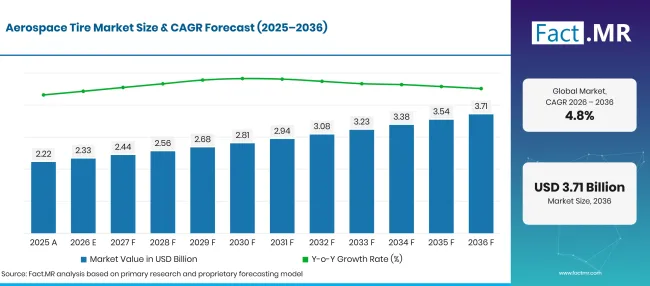
Factmr Aerospace Tire Market Forecast Global | Source: Fact.MR
| Year | Basis | Market Value (USD billion) |
|---|---|---|
| 2025 | Actual | 2.22 |
| 2026 | Estimate | 2.33 |
| 2036 | Forecast | 3.71 |
| CAGR 2026 to 2036 | Forecast period | 4.76% |
Source: Fact.MR analysis. Updated Oct 15, 2026
What are the defining numbers behind Aerospace Tire Market growth?
USD 1.38 billion absolute opportunity between 2026 and 2036, with radial tires and commercial aviation forming the largest specified product and application segments.
- Demand Drivers in the Market
- Every aircraft delivered needs an initial tire fitment. Airbus delivered 793 commercial aircraft in 2025, providing a useful measure of production activity. For suppliers in aerospace parts manufacturing, aircraft deliveries and approved tire specifications are more useful than an order backlog alone. Revenue depends on how many tires each programme actually takes. [2]
- Airlines and other operators inspect tires throughout their service life and remove them when required. FAA guidance sets out tire-care practices, while approved retreading can give a suitable casing another service cycle. A retread tire is an option only after the casing passes the necessary checks; replacement schedules still vary by aircraft and operation. [5] [4]
- Manufacturers are working on lower weight and longer service life. Michelin's Air X Sky Light development with Dassault is an example tied to a specific aircraft. Changes in tire cord or other materials also have to pass performance and approval tests in the complete product. The ability to document that performance is central to commercial adoption. [11]
- Operators also need a practical way to return used casings and obtain serviceable replacements. Goodyear lists a retread facility in São Paulo as part of its aviation network. Local service capacity can shorten the route between inspection and return to service. Tire size, availability and transport time can be as important as the quoted unit price. [8]
- Key Segments Analyzed
- By Product Type: Radial Tires make up 73.4% of sales in 2026. Their use depends on the aircraft programmes that approve the design.
- By Application: Commercial Aviation represents 56.4% of 2026 sales, including tires fitted to new aircraft and replacements during service.
- By End-User: OEM buyers account for 58.2% of the 2026 market. Sales to operators and maintenance providers are counted separately.
- Analyst Opinion at Fact.MR
- Shambu Nath Jha, Lead Consultant, Fact.MR says, “Aircraft operators buy approved performance and dependable availability. Price matters, but a cheaper tire may cost more over its service life if it requires frequent replacement or is difficult to obtain. Suppliers should compare products by fitment, service conditions and documented performance. Longer tread life can improve an operator's economics even when it reduces the number of tires sold. [6] [4] [11]”
- Strategic Implications
- Tire makers should plan around confirmed aircraft build schedules and the fitments approved for each model. Large aircraft order books show potential demand, but deliveries can move between years. Suppliers need enough production flexibility to handle those changes without leaving an airframe programme short of tires. [2]
- Retread providers need to explain how returned casings are inspected and when they are rejected. Dunlop describes checks and preparation work before a tire goes back into service. Operators also need clarity on the replacement supply available when a casing cannot be reused. [4]
- Tire costs are best compared over a stated operating period on the same aircraft type. Michelin's work on connected products makes aircraft sensors relevant to condition monitoring, but sensing technology sits alongside the established inspection process. Operators still have to follow the maintenance procedures that apply to each tire. [5] [10]
- Procurement teams need to align tire deliveries with the aircraft's broader aerospace and defense MRO schedule. Quotes should identify the exact tire supplied and separate it from charges for wheels, brakes or other servicing. That makes supplier offers easier to compare and limits surprises at the next maintenance visit. [5] [9]
Germany is forecast to grow at 5.98%, Brazil at 5.46% and the United States at 4.94%. The United Kingdom follows at 4.42%, with Japan at 3.90%. Country conditions vary: aircraft production, fleet servicing, qualified retreading and replacement logistics each influence demand in different ways.
How does the Aerospace Tire Market break down by segment?
Radial Tires 73.4%; Commercial Aviation 56.4%; OEM 58.2% in 2026.
Which Product Type dominates?
The Radial Tires segment holds 73.4% share in 2026.
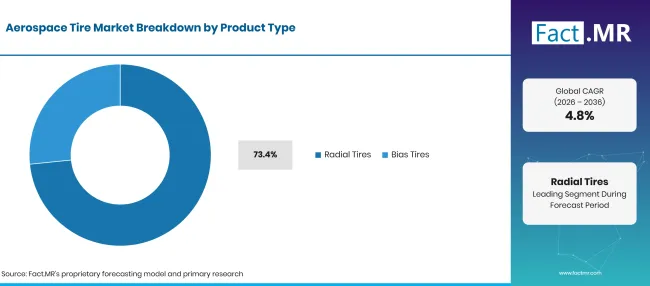
Factmr Aerospace Tire Market Breakdown Product Type | Source: Fact.MR
| Product Type | Share (2026) |
|---|---|
| Radial Tires (Leading segment) | 73.4% |
| Other segments combined | 26.6%* |
| Total | 100.0% |
Source: Fact.MR analysis. Updated Oct 15, 2026
Radial tires hold 73.4% of the product market, although bias tires remain necessary for some approved aircraft configurations. Goodyear's product range and fitment records show both constructions in use. Buyers cannot switch between them without confirming the aircraft's permitted tire specification. [6] [7]
What leads the Application segment?
The Commercial Aviation segment holds 56.4% share in 2026.
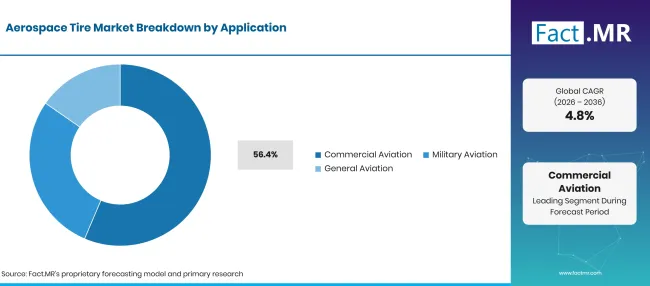
Factmr Aerospace Tire Market Breakdown Application | Source: Fact.MR
| Application | Share (2026) |
|---|---|
| Commercial Aviation (Leading segment) | 56.4% |
| Other segments combined | 43.6%* |
| Total | 100.0% |
Source: Fact.MR analysis. Updated Oct 15, 2026
Commercial passenger and freight aircraft form the largest application group. Military fleets and general aviation use tires under different loads, duty cycles and procurement arrangements. Bridgestone and Goodyear publish aviation-specific product information across these categories. For suppliers, the decisive detail is the aircraft model and approved tire, whether the purchase is for a new aircraft or an aircraft already flying. [7] [3]
How does End-User purchasing shape sales?
The OEM segment holds 58.2% share in 2026.
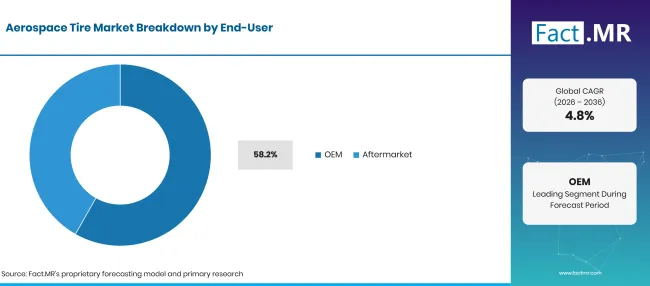
Factmr Aerospace Tire Market Breakdown End User | Source: Fact.MR
| End-User | Share (2026) |
|---|---|
| OEM (Leading segment) | 58.2% |
| Other segments combined | 41.8%* |
| Total | 100.0% |
Source: Fact.MR analysis. Updated Oct 15, 2026
The OEM segment accounts for 58.2% of market revenue in 2026. These tires are delivered with newly produced aircraft; aftermarket sales follow the needs of fleets already in use. Aftermarket work can involve new tires or qualified retreaded casings. Maintenance guidance explains how replacements are managed, but it cannot by itself establish a standard replacement rate across aircraft. [6] [5]
What is accelerating Aerospace Tire Market adoption, and what is holding it back?
Orders come from both aircraft production and the replacement needs of operating fleets. Tire approval, availability and service support govern which suppliers can win them. Retreading reduces the need to discard suitable casings, while improved tire life may lower replacement volumes per aircraft. These effects need to be considered alongside flight activity. [2] [4] [11]
Drivers Impact Analysis
| DRIVER | (~) % IMPACT ON CAGR | GEOGRAPHIC RELEVANCE | IMPACT TIMELINE |
|---|---|---|---|
| Aircraft production requirements | +1.0% | Global | Medium term (2 to 4 years) |
| In-service tire replacement | +0.9% | Global | Short term (up to 2 years) |
| Approved radial fitments | +0.5% | Relevant aircraft programmes | Medium term (2 to 4 years) |
| Local retread service access | +0.4% | Established service networks | Short term (up to 2 years) |
| New aircraft tire development | +0.4% | Selected OEM programmes | Long term (4 years or more) |
Source: Fact.MR analysis. Updated Oct 15, 2026
Opportunity Impact Analysis
| OPPORTUNITY | (~) % IMPACT ON CAGR | GEOGRAPHIC RELEVANCE | IMPACT TIMELINE |
|---|---|---|---|
| Aircraft-specific performance offers | +0.5% | Global | Medium term (2 to 4 years) |
| Faster replacement logistics | +0.4% | Major operating bases | Short term (up to 2 years) |
| Eligible casing recovery | +0.3% | Approved retread networks | Medium term (2 to 4 years) |
| Lower-weight qualified designs | +0.4% | New aircraft programmes | Long term (4 years or more) |
Source: Fact.MR analysis. Updated Oct 15, 2026
Restraints Impact Analysis
| RESTRAINT | (~) % IMPACT ON CAGR | GEOGRAPHIC RELEVANCE | IMPACT TIMELINE |
|---|---|---|---|
| Fitment and qualification requirements | -0.5% | Global | Long term (4 years or more) |
| Aircraft delivery rescheduling | -0.5% | OEM supply chains | Short term (up to 2 years) |
| Casing rejection and stock needs | -0.3% | Aftermarket networks | Short term (up to 2 years) |
| Longer tread life reducing replacement units | -0.4% | Relevant tire designs | Medium term (2 to 4 years) |
Source: Fact.MR analysis. Updated Oct 15, 2026
Which countries are scaling the Aerospace Tire Market through 2036?
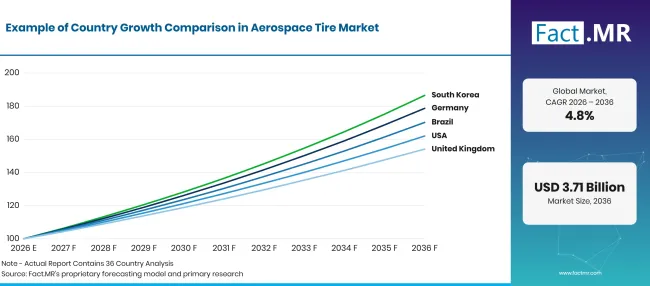
Factmr Aerospace Tire Market Growth Index | Source: Fact.MR
| Country | CAGR (2026 to 2036) |
|---|---|
| Germany | 5.98% |
| Brazil | 5.46% |
| United States | 4.94% |
| United Kingdom | 4.42% |
| Japan | 3.90% |
Source: Fact.MR analysis. Updated Oct 15, 2026
What supports Germany's aerospace tire opportunity?
5.98% CAGR. Established aircraft maintenance creates demanding institutional buyers.
Lufthansa Technik operates a substantial aircraft maintenance and materials business, including landing-gear capabilities. That gives tire suppliers access to technically experienced institutional purchasers, provided they can offer the correct fitment and reliable supply. Total maintenance revenue is not a useful proxy for tire spending, so a German sales case must be built around the tires those customers actually use. [9]
Why is Brazil attractive for tire supply and service?
5.46% CAGR. Local retread capability gives operators a practical replenishment route.
Goodyear operates an aviation retread plant in São Paulo, giving Brazil a documented service base for eligible aircraft tires. ANAC's July 2026 review also reports activity in commercial aviation. Operators need tires for the particular aircraft they fly, so passenger growth provides context but cannot be translated directly into tire units. Local retreading is the clearer operational link. [8] [1]
How does the United States sustain tire purchasing?
4.94% CAGR. Domestic supply and aircraft servicing support separate OEM and aftermarket demand.
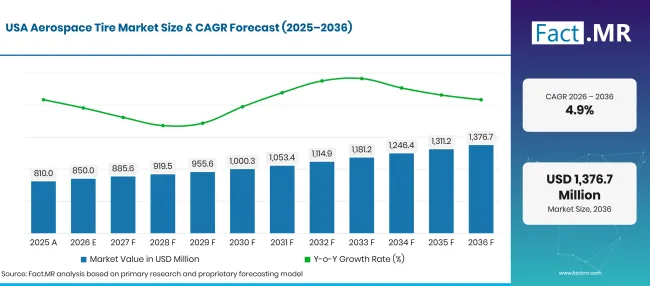
Factmr Aerospace Tire Market Forecast Usa | Source: Fact.MR
Goodyear lists its Danville new-tire plant and several U.S. retread locations. Alongside FAA tire-maintenance guidance, this shows established production and servicing arrangements in the country. The business depends on approved fitments and the condition of tires removed from service, not on a fixed replacement number for every flight. [5] [8]
What differentiates the United Kingdom?
4.42% CAGR. Specialist retreading places casing assessment at the centre of the service offer.
Dunlop Aircraft Tyres has a UK retreading process that includes inspection of each returned casing before release. That screening determines whether a tire can be returned to service or needs replacement. For customers, turnaround time and access to the correct tire are part of the purchasing decision. Retreading income should remain separate from unrelated wheel and brake work. [4]
Why does Japan remain a technically focused market?
3.90% CAGR. A domestic aircraft-tire supplier supports product and service expertise.
Bridgestone maintains an aircraft-tire business with technical support and dedicated products. That provides Japan with an established supplier presence. Customers still purchase against approved aircraft fitments and maintenance arrangements. Bridgestone's international sales and overseas operations should not be presented as domestic Japanese demand. [3]
Who leads the Aerospace Tire Market?
Michelin, Goodyear, Bridgestone and Dunlop Aircraft Tyres have documented aircraft-tire products or retreading services. Michelin's Air X Sky Light work for the Falcon 10X and Goodyear's fitment catalogues show the level of programme detail that matters. Buyers compare approved specifications, product support and service availability, not the global size of the parent tire company. [6] [4] [11] [7] [3]
The supplier field varies by aircraft class and approved tire design. Some broader tire-company names in the comparison have no confirmed current aircraft-tire product in the cited material. Before making a procurement decision, operators need to verify the product, its approved fitment and who will provide technical and replacement support.
Which companies are the key providers?
Verified aircraft-tire examples include Michelin, Goodyear, Bridgestone and Dunlop Aircraft Tyres. The wider comparison set below should not be read as a confirmed list of current aircraft-tire manufacturers. [4] [11] [7] [3]
- Michelin
- Goodyear
- Bridgestone
- Dunlop Aircraft Tyres
- Continental AG
- Pirelli & C. S.p.A.
- Aviation Tires & Treads LLC
- Yokohama Rubber
- Sumitomo Rubber
Bibliography
- [1] Agência Nacional de Aviação Civil. (2026, July 7). Confira a nova edição do Anuário do Transporte Aéreo da Anac.
- [2] Airbus. (2026, January 12). Airbus reports 793 commercial aircraft deliveries in 2025.
- [3] Bridgestone Corporation. (n.d.). Aircraft tires.
- [4] Dunlop Aircraft Tyres. (n.d.). About the retread process.
- [5] Federal Aviation Administration. (2005, April 18). Aircraft tire maintenance and operational practices with Change 1 [Advisory Circular 20-97B].
- [6] Goodyear Aviation. (n.d.-a). Aircraft tire databook: Fitment, sizes and applications.
- [7] Goodyear Aviation. (n.d.-b). Aircraft tire product portfolio.
- [8] Goodyear Aviation. (n.d.-c). Goodyear’s aviation heritage: Manufacturing and retread network.
- [9] Lufthansa Technik. (n.d.). Aircraft MRO and service capabilities.
- [10] Michelin. (n.d.). Michelin launches Air X SKY LIGHT MICHELIN tire, a major breakthrough innovation on the aircraft tire market.
- [11] Michelin. (2026, March 11). World first: Michelin and Dassault Aviation unveil their innovations during the Falcon 10X rollout.
This Report Answers
- Why aircraft fitment and qualification determine the addressable tire supply opportunity.
- How radial and bias constructions coexist across different aircraft applications.
- How OEM purchasing differs from aftermarket tire replacement and retreading.
- What local service capability contributes to country-level commercial opportunities.
- How longer tread life and casing eligibility affect the economics of a tire contract.
What does the Aerospace Tire Market cover?
The market covers tires used on aircraft rather than on airport road vehicles or ground-support equipment. It includes commercial aviation and the military and general aviation categories. Product construction and end-user channel provide separate views of the same tire revenue.
What is included in the scope?
New radial and bias aircraft tires are included. Aftermarket supply covers replacement tires and retreaded aircraft tires where the transaction falls within the tire-product boundary. A retread transaction is counted once for the product supplied, without rebooking the original value of the casing.
What is excluded from the scope?
Wheel assemblies and aircraft braking systems are excluded. Standalone monitoring equipment and maintenance labour fees are outside tire-product revenue. The market also excludes automotive and industrial tires used on airport vehicles, even when the purchaser is an airline or airport operator.
How Was the Analysis Built?
The analysis draws on 120+ sources, 35+ company portfolios, 25+ countries, and more than 20 industry interviews.
- Primary Research: Primary research includes discussions with manufacturers, service providers, technology developers, distributors, end users, and subject-matter experts. These conversations examine purchasing priorities, product adoption, operational challenges, approval requirements, competitive positioning, and the factors that influence wider market acceptance.
- Desk Research: Desk research covers government statistics, regulatory publications, company filings, trade data, technical studies, industry associations, standards, public policy, and other authoritative sources. Every source used in the analysis is documented in the bibliography.
- Market Sizing and Forecasting: Market estimates combine historical performance, demand indicators, pricing and volume trends, segment shares, company participation, country-level growth, adoption patterns, investment activity, and barriers to market expansion.
- Data Validation and Update Cycle: Findings are validated by comparing primary interviews with public data, company activity, regulatory changes, trade patterns, and industry developments. Regular updates review new product launches, capacity changes, partnerships, approvals, and shifts in commercial adoption.
Segmentation
What is the report’s scope and coverage?
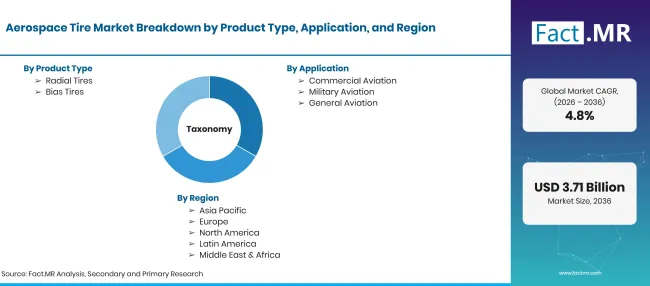
Factmr Aerospace Tire Market Taxonomy | Source: Fact.MR
| Attribute | Details |
|---|---|
| Quantitative Units | USD billion |
| Market Definition | Aircraft tires supplied for commercial, military and general aviation through original-equipment and aftermarket channels. |
| Product Type | Radial Tires; Bias Tires |
| Application | Commercial Aviation; Military Aviation; General Aviation |
| End-User | OEM; Aftermarket |
| Regions Covered | North America; Latin America; Western Europe; Eastern Europe; East Asia; South Asia & Pacific; Middle East & Africa |
| Countries Covered | Germany; Brazil; United States; United Kingdom; Japan |
| Companies Profiled | Michelin; Goodyear; Bridgestone; Dunlop Aircraft Tyres; Continental AG; Pirelli & C. S.p.A.; Aviation Tires & Treads LLC; Yokohama Rubber; Sumitomo Rubber Broader tire-sector comparison set; active aircraft-tire supply must be established for the specific company and product. |
| Forecast Period | 2026 to 2036 |
| Approach | Aircraft fitment review, OEM production context, tire-care guidance and documented manufacturer and retread-service activity. |
Source: Fact.MR analysis. Updated Oct 15, 2026
How is the market segmented?
-
By Product Type:
- Radial Tires
- Bias Tires
-
By Application:
- Commercial Aviation
- Military Aviation
- General Aviation
-
By End-User:
- OEM
- Aftermarket
-
By Region:
- North America
- Latin America
- Western Europe
- Eastern Europe
- East Asia
- South Asia & Pacific
- Middle East & Africa
Frequently Asked Questions
How big is the aerospace tire market in 2026?
What is the CAGR from 2026 to 2036?
Which product type leads?
Which application leads?
Which suppliers have documented aviation capabilities?
Who worked on this report


Preview the report firsthand - request a free sample
Free SampleGet the brochure for pricing and purchase details
Download PDF