- Base Value(2025): 118.4 Bn
- Estimated Value(2026): 124.7 Bn
- Forecast Value (2036): 198.6 Bn
- CAGR (2026 - 2036): 4.8%
Aerospace And Defense MRO Market Forecast and Outlook By Fact.MR
- In 2025, the aerospace and defense MRO market was valued at USD 118.4 billion.
- Based on Fact.MR estimates, demand is estimated to grow to USD 124.7 billion in 2026 and USD 198.6 billion by 2036.
- Fact.MR projects a CAGR of 4.8% during the forecast period.
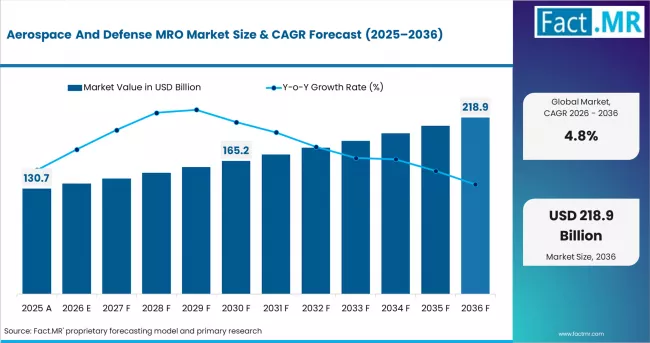
Aerospace And Defense Mro Market Market Value Analysis | Source: Fact.MR
| Metric | Value |
|---|---|
| Estimated Value in 2026 | USD 124.7 billion |
| Forecast Value in 2036 | USD 198.6 billion |
| Forecast CAGR (2026 to 2036) | 4.8% |
Source: Fact.MR analysis. Updated May 14, 2026
Summary of Aerospace And Defense MRO Market
- Market Definition
- The market includes commercial aviation MRO and defense sustainment activities performed to maintain aircraft, systems, and mission-capable assets.
- Demand Drivers
- Boeing expects MRO and modifications to remain the largest commercial services segment and values it at USD 3,180 billion through 2044.
- IATA states that older engines require longer shop visits and that aging fleets raised airline maintenance costs in 2025. [2]
- Defense sustainment remains structurally important because DoD spends tens of billions annually on sustainment and depots are central to readiness.
- Key Segments Analyzed
- By Service Type: Engine Maintenance and Overhaul is estimated to lead with approximately 29% share in 2026, supported by high-cost shop visits and current engine backlogs.
- By Platform Type: Commercial Aircraft are expected to hold approximately 46% share in 2026, driven by large global fleet size and intense utilization.
- By End Use: Civil Aviation Operators are projected to account for approximately 34% share in 2026, supported by recurring maintenance demand across passenger and cargo fleets.
- By Geography: India leads growth at 6.2% CAGR through 2036, supported by fleet growth and services expansion.
- These share values are model-based estimates rather than figures directly published in the cited sources.
- Analyst Opinion at FACT.MR
- Shambhu Nath Jha notes, “This market should be viewed as an asset-availability and sustainment category rather than a repair-services bucket. The value lies in uptime, compliance, fleet life extension, and operational readiness, not just maintenance events.” This is a modeled analyst perspective and not a quoted external statement.
- Strategic Implications
- Invest in engine and component capacity where longer shop visits and parts constraints are creating the strongest pressure.
- Build technical sales capability around turnaround time, fleet availability, and sustainment planning rather than labor-hour pricing alone.
- Position digital and predictive maintenance tools where operators want to reduce unscheduled downtime and better manage parts demand.
The market is projected to generate USD 73.9 billion in absolute opportunity between 2026 and 2036. Growth is being supported by higher aircraft utilization, delayed retirements, fleet-aging effects, engine shop-visit pressure, and continuing defense sustainment demand. IATA states that older engines require longer MRO shop visits and that airlines faced about USD 3.1 billion in additional maintenance costs in 2025 because older aircraft remained in service longer due to delivery delays. [1]
India leads with a projected CAGR of 6.2% through 2036, driven by expanding airline fleets, rising aircraft utilization, and growing aviation services infrastructure. China follows at 5.8%, supported by large commercial fleet scale and increasing demand for maintenance and sustainment services. The United States records 4.9%, with growth anchored in a mature aviation ecosystem and strong defense sustainment activity. Germany grows at 4.4%, driven by structured airline operations and high maintenance standards across fleets. Brazil expands at 4.1%, supported by regional fleet activity and continued need for maintenance across passenger and cargo operations.
Segmental Analysis
Aerospace And Defense MRO Market Analysis by Service Type
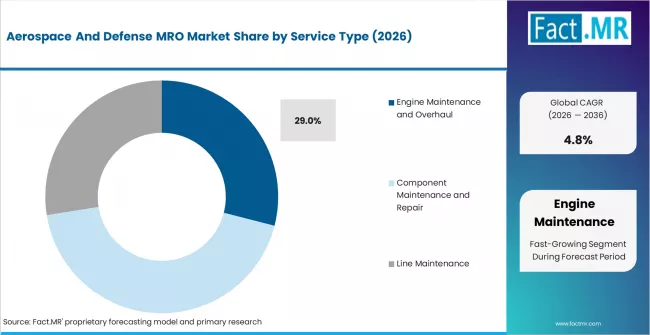
Aerospace And Defense Mro Market Analysis By Service Type | Source: Fact.MR
Engine maintenance and overhaul is estimated to hold approximately 29% share in 2026. This segment leads because engines represent the most cost-intensive and schedule-sensitive maintenance area across commercial fleets, particularly under current parts availability and shop-capacity constraints. International Air Transport Association notes that older engines are now requiring longer MRO shop visits, increasing downtime and planning complexity. Boeing also highlights in its services outlook that MRO demand is closely tied to aircraft utilization and flight cycles, both of which directly support sustained demand for engine maintenance and overhaul activities.
- Engine work leads because shop visits remain costly, time-sensitive, and tightly linked to aircraft availability.
- Component repair remains attractive where operators want lower-cost repair over replacement.
- Modifications gain relevance where aging fleets need efficiency, cabin, or commonality upgrades.
Aerospace And Defense MRO Market Analysis by Platform Type
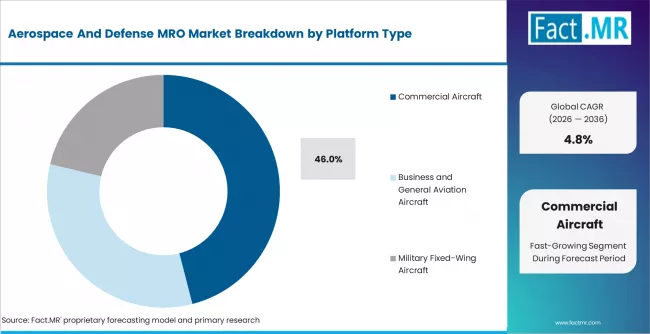
Aerospace And Defense Mro Market Analysis By Platform Type | Source: Fact.MR
Commercial Aircraft are projected to account for approximately 46% share in 2026, as the global commercial fleet is large, heavily utilized, and expected to keep expanding. Boeing states that the active commercial airplane fleet is projected to approach 50,000 aircraft by 2044, up from just over 27,000 in 2024. That keeps commercial line, base, engine, and component maintenance at the center of industry demand.
- Commercial aircraft lead because fleet size and utilization create the broadest recurring MRO base.
- Military fixed-wing aircraft remain important where readiness and depot sustainment are budget-critical.
- Military rotary-wing aircraft gain relevance where high maintenance intensity and mission readiness remain central. [4]
Aerospace And Defense MRO Market Analysis by End Use
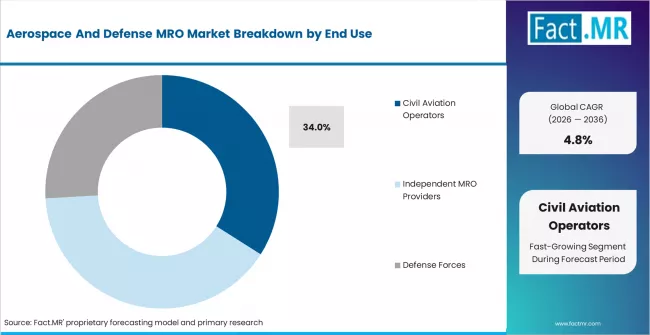
Aerospace And Defense Mro Market Analysis By End Use | Source: Fact.MR
Civil Aviation Operators are projected to account for approximately 34% share in 2026. They lead because airlines and cargo operators directly bear the economic impact of aircraft downtime, maintenance cost, and fleet availability. IATA’s Maintenance Cost Technical Group exists specifically to gather and analyze airline maintenance cost information, which reflects how central maintenance economics are to operators.
- Civil operators lead because aircraft availability and maintenance cost directly affect route economics.
- Independent MROs remain attractive where airlines want capacity outside OEM bottlenecks. [3]
- Defense forces remain important where depot maintenance and sustainment contracts directly support readiness. [5]
Drivers, Restraints, and Opportunities
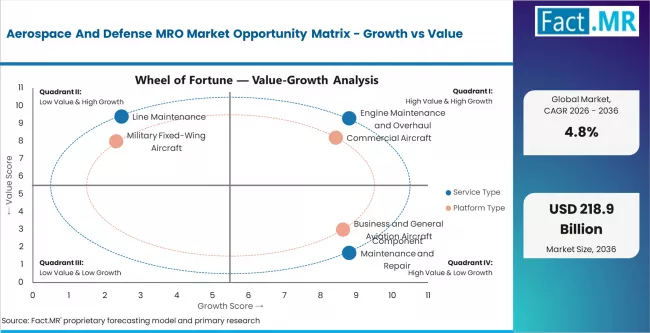
Aerospace And Defense Mro Market Opportunity Matrix Growth Vs Value | Source: Fact.MR
The market is being shaped by fleet-aging pressure, backlog effects, and the growing need to protect uptime across commercial and defense fleets. Structural demand is anchored in utilization-led MRO cycles, delayed retirements, and rising sustainment costs. Boeing says a majority of MRO activity is driven by fleet utilization and cycles. IATA says older fleets are forcing longer maintenance events and higher airline maintenance costs.
The main restraint is capacity and labor. Boeing forecasts demand for 710,000 new maintenance technicians through 2044, while FAA is still funding programs to increase the aviation maintenance workforce pipeline. On the defense side, GAO says deteriorating depot facilities and aging equipment have hurt depot performance and increased maintenance costs. That means suppliers still need to prove turnaround reliability, labor depth, and infrastructure resilience.
- Engine and component capacity remain the clearest opportunity where backlogs are limiting aircraft availability.
- Predictive and digital maintenance create stronger value where operators want fewer disruptions and better parts planning.
- Defense depot modernization offers higher-value opportunity where readiness depends on faster repair throughput and lower sustainment cost growth.
Regional Analysis
The market is assessed across North America, Europe, Asia Pacific, Latin America, and Middle East and Africa, covering 40+ countries with demand profiles shaped by fleet size, airline utilization, military sustainment intensity, technician availability, and service-network depth. The country growth rates below are model-based estimates.
.webp "Top Country Growth Comparison Aerospace And Defense Mro Market Cagr (2026 2036)")
Top Country Growth Comparison Aerospace And Defense Mro Market Cagr (2026 2036) | Source: Fact.MR
| Country | CAGR (2026 to 2036) |
|---|---|
| India | 6.2% |
| China | 5.8% |
| United States | 4.9% |
| Germany | 4.4% |
| Brazil | 4.1% |
Source: Fact.MR analysis. Updated May 14, 2026
North America Aerospace And Defense MRO Market Analysis
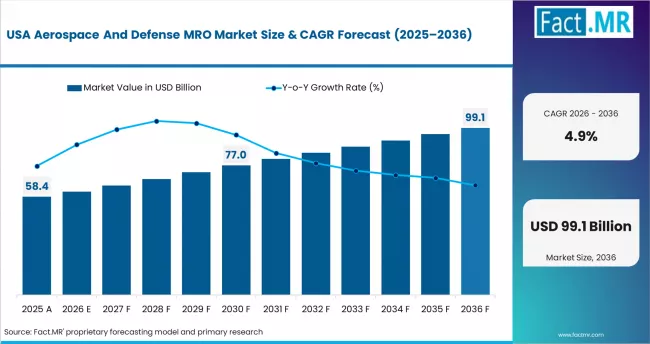
Aerospace And Defense Mro Market Country Value Analysis | Source: Fact.MR
North America remains an important commercial and defense region because it combines a large airline fleet, mature aftermarket networks, and substantial defense sustainment budgets. Demand is supported by both commercial aviation services and ongoing military maintenance requirements.
- United States: Mature airline MRO demand and large defense sustainment activity support growth. The market is projected to expand at a CAGR of 4.9% from 2026 to 2036, driven by strong fleet utilization and continued investment in maintenance and repair infrastructure.
Europe Aerospace and Defense MRO Market Analysis
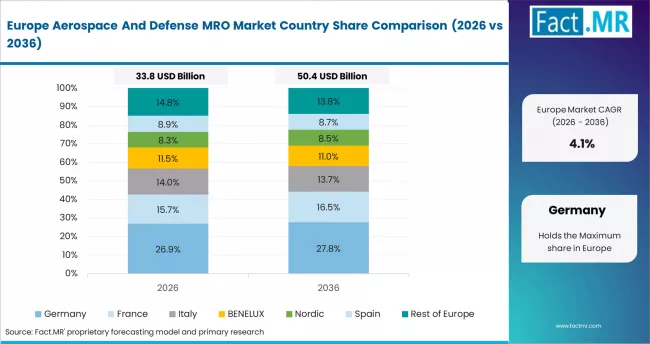
Aerospace And Defense Mro Market Europe Country Market Share Analysis, 2026 & 2036 | Source: Fact.MR
Europe remains a technically managed region where adoption is closely tied to dense airline operations, lease-return discipline, and strong defense sustainment requirements. The region continues to emphasize structured maintenance practices and compliance with operational standards.
- Germany: Strong aviation engineering capability and structured maintenance ecosystems support demand. The market is projected to grow at a CAGR of 4.4% over the foreseen period, driven by airline maintenance requirements, component overhaul activity, and defense sustainment programs.
Asia Pacific and Latin America Aerospace and Defense MRO Market Analysis
Asia Pacific offers the strongest long-term expansion potential because it combines faster fleet growth, rising aviation services demand, and increasing need for skilled maintenance personnel. Latin America adds commercial depth through regional fleet activity and cargo operations.
- India: Fleet growth and aviation services expansion support demand. The market is projected to grow at a CAGR of 6.2% through 2036, driven by increasing airline activity and infrastructure development.
- China: Large fleet size and strong services-market depth support growth. The market is projected to expand at a CAGR of 5.8% by 2036, with continued demand for maintenance, repair, and overhaul services.
- Brazil: Cargo, passenger, and regional fleet support needs sustain demand. The market is projected to grow at a CAGR of 4.1% over the assessment period, supported by airline operations, regional connectivity, and maintenance requirements across diverse aircraft types.
Competitive Aligners for Market Players
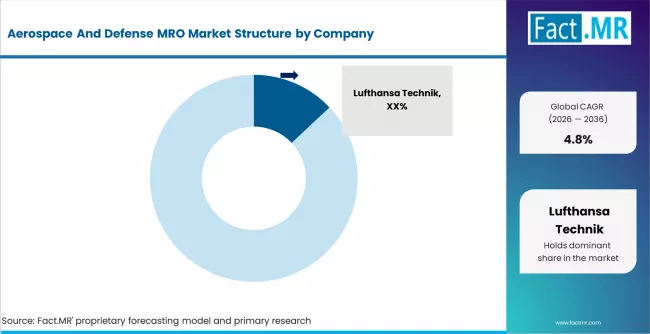
Aerospace And Defense Mro Market Analysis By Company | Source: Fact.MR
The market is moderately concentrated at the engine, airframe, and sustainment-network level, while broader work allocation remains split across airlines, OEMs, independents, and military depots. Competitive strength comes from the ability to combine turnaround speed, technical depth, parts access, and fleet-availability impact. Boeing’s materials emphasize technology-driven MRO, predictive maintenance, USM sourcing, and mobile-first maintenance workflows as major competitive directions.
Competitive advantage is defined by shop capacity, technician availability, digital maintenance capability, parts access, and readiness support. In defense, depot condition and support infrastructure remain material differentiators because poor facilities reduce productivity and increase cost. This competitive framing is an analytical view derived from current industry and government materials rather than a published market-share table.
Key Players
- Lufthansa Technik
- GE Aerospace
- RTX / Pratt & Whitney and Collins Aerospace
- Safran Aircraft Engines
- ST Engineering
- Delta TechOps
- AAR Corp.
- Boeing Global Services
- Lockheed Martin sustainment ecosystem participants
- U.S. military depot and government sustainment ecosystem participants
Bibliography
- [1] Boeing. Commercial Services Market Outlook 2025-2044 and Services Market Outlook materials covering MRO share, market size, and technology-driven MRO.
- [2] U.S. Government Accountability Office. Weapon System Sustainment materials on operating and support cost pressure, and tactical aircraft sustainment spending.
- [3] IATA. Technical operations, lease, and maintenance cost materials covering airline maintenance economics and technical review practices.
- [4] U.S. Government Accountability Office. Military Depots materials on depot readiness, deteriorating facilities, and maintenance cost effects.
- [5] U.S. Department of Defense Inspector General. F-35 sustainment oversight materials describing depot maintenance, supply chain, logistics, and maintenance training.
This Report Addresses
- Strategic intelligence on aerospace and defense MRO demand across commercial fleet support, engine shop visits, military depot sustainment, and modification programs.
- Market forecast from USD 124.7 billion in 2026 to USD 198.6 billion by 2036 at a CAGR of 4.8%.
- Growth opportunity mapping across engine overhaul, component repair, airframe maintenance, depot sustainment, and predictive maintenance tools.
- Segment analysis by service type, platform type, end use, maintenance mode, and region.
- Regional outlook covering North America, Europe, Asia Pacific, Latin America, and Middle East and Africa.
- Competitive analysis of major participants serving commercial aviation MRO, defense sustainment, engine support, and depot maintenance ecosystems.
- Fleet-availability and readiness analysis covering delayed retirements, technician demand, aging assets, depot performance, and sustainment cost pressure.
- Market interpretation built around aircraft utilization, backlog effects, labor needs, digital MRO adoption, and long-cycle defense sustainment demand.
Aerospace And Defense MRO Market Definition
The market covers maintenance, repair, overhaul, modification, and sustainment activities performed on aerospace and defense platforms to maintain airworthiness, mission readiness, lifecycle value, and operational availability. It includes commercial aircraft MRO, military depot maintenance, component repair, engine overhauls, fleet modifications, and sustainment support systems.
Aerospace And Defense MRO Market Inclusions
Covers global and regional forecasts from 2026 to 2036. Includes airframe, engine, and component MRO; line and base maintenance; defense depot sustainment; fleet modifications; aftermarket parts support; repair logistics; and technical maintenance support performed by airlines, OEMs, independent MROs, military depots, and defense contractors.
Aerospace And Defense MRO Market Exclusions
Excludes new aircraft manufacturing, pure spare-parts distribution where MRO execution is not the core role, pilot training-only services, and software-only aviation analytics platforms unless maintenance or sustainment remains the main application. This exclusion logic is an analytical market boundary rather than a quoted source definition.
Aerospace And Defense MRO Market Research Methodology
- Primary Research:Interviews with airline maintenance planners, depot specialists, independent MRO executives, defense sustainment stakeholders, aftermarket parts suppliers, and aviation technical operations teams.
- Desk Research:Uses current Boeing commercial services and technician outlook materials, IATA technical operations and supply chain materials, FAA workforce materials, GAO sustainment and depot readiness reports, and DoD sustainment oversight documents.
- Market-Sizing and Forecasting:Hybrid model using commercial fleet utilization, shop-visit intensity, delayed retirements, technician demand, military operating and support cost pressure, and depot sustainment activity.
- Data Validation and Update Cycle:Validated using Boeing and IATA aviation services materials, FAA workforce program updates, and GAO and DoD sustainment oversight sources.
Segmentation
Scope of Report
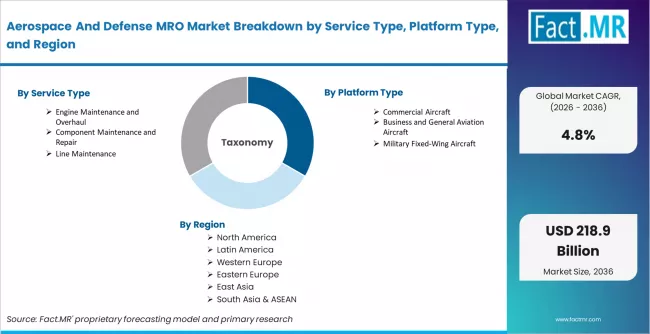
Aerospace And Defense Mro Market Breakdown By Service Type, Platform Type, And Region | Source: Fact.MR
| Attribute | Details |
|---|---|
| Quantitative Units | USD 124.7 billion (2026) to USD 198.6 billion (2036), at a CAGR of 4.8% |
| Market Definition | Maintenance, repair, overhaul, modification, and sustainment activities performed on aerospace and defense platforms to maintain airworthiness, readiness, and lifecycle value |
| Service Type Segmentation | Airframe Heavy Maintenance, Engine Maintenance and Overhaul, Component Maintenance and Repair, Line Maintenance, Modifications and Upgrades, Others |
| Platform Type Segmentation | Commercial Aircraft, Business and General Aviation Aircraft, Military Fixed-Wing Aircraft, Military Rotary-Wing Aircraft, Defense Support Systems, Others |
| End Use Segmentation | Civil Aviation Operators, Independent MRO Providers, OEM-Linked Service Networks, Defense Forces, Government Sustainment Programs, Others |
| Regions Covered | North America, Europe, Asia Pacific, Latin America, Middle East and Africa |
| Countries Covered | United States, Germany, China, India, Brazil, Japan, and 40+ countries |
| Forecast Period | 2026 to 2036 |
| Approach | Hybrid top-down and bottom-up model using commercial fleet utilization, sustainment cost pressure, defense depot activity, labor demand, and technician availability |
Source: Fact.MR analysis. Updated May 14, 2026
Aerospace And Defense MRO Market by Segments
-
By Service Type:
- Airframe Heavy Maintenance
- Engine Maintenance and Overhaul
- Component Maintenance and Repair
- Line Maintenance
- Modifications and Upgrades
- Others
-
By Platform Type:
- Commercial Aircraft
- Business and General Aviation Aircraft
- Military Fixed-Wing Aircraft
- Military Rotary-Wing Aircraft
- Defense Support Systems
- Others
-
By End Use:
- Civil Aviation Operators
- Independent MRO Providers
- OEM-Linked Service Networks
- Defense Forces
- Government Sustainment Programs
- Others
-
By Region:
- North America
- United States
- Canada
- Mexico
- Latin America
- Brazil
- Argentina
- Chile
- Rest of Latin America
- Western Europe
- Germany
- France
- United Kingdom
- Italy
- Spain
- Nordic Countries
- BENELUX
- Rest of Western Europe
- Eastern Europe
- Russia
- Poland
- Hungary
- Balkan and Baltic
- Rest of Eastern Europe
- East Asia
- China
- Japan
- South Korea
- South Asia and Pacific
- India
- ASEAN
- Australia and New Zealand
- Rest of South Asia and Pacific
- Middle East and Africa
- Kingdom of Saudi Arabia
- Other GCC Countries
- Turkey
- South Africa
- Rest of Middle East and Africa
- North America
Frequently Asked Questions
How large is the global aerospace and defense MRO market in 2025?
What will the market size be in 2026?
What is the projected market size by 2036?
What is the expected CAGR from 2026 to 2036?
Which service segment is poised to lead the market?
Which platform segment holds the largest share?
Which region shows the fastest growth?
What is driving demand in the aerospace and defense MRO market?
What is the key challenge in this market?
Who worked on this report


Preview the report firsthand - request a free sample
Free SampleGet the brochure for pricing and purchase details
Download PDF