- Market Value (2025): USD 5.8 Bn
- Estimated Value (2026): USD 6.7 Bn
- Forecast Value (2036): USD 29.8 Bn
- CAGR (2026-2036): 16.1%
What is the Agent Oriented Enterprise Resource Planning Market forecast to be worth by 2036?
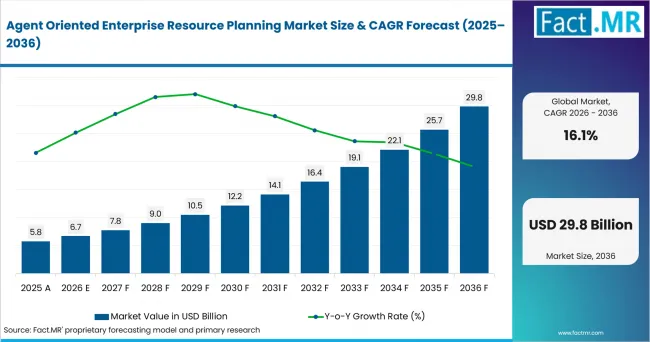
The market is projected to grow from USD 6.7 billion in 2026 to USD 29.8 billion by 2036, registering a CAGR of 16.1%.
- The Agent Oriented Enterprise Resource Planning market reached USD 5.8 billion in 2025.
- Demand is forecast to increase from USD 6.7 billion in 2026 to USD 29.8 billion by 2036.
Agent Oriented Enterprise Resource Planning Market Value Analysis | Source: Fact.MR
What are the defining numbers behind Agent Oriented Enterprise Resource Planning Market growth?
An absolute dollar opportunity of USD 23.1 billion is expected between 2026 and 2036.
- Demand Drivers in the Market
- Enterprise AI adoption is broadening the addressable buyer base. The OECD reported in January 2026 that 20.2% of firms used AI in 2025, more than twice the 2023 level, signaling that the data, integration, and governance foundations agents depend on are now common across large organizations.
- The spending trigger for agent-oriented ERP is narrower than general AI use: a buyer must identify a process where delay, rework, or exception volume has an accountable cost. Finance close and order management meet that test because they are dense, rule-bound, and measured, which makes agent outcomes visible in cycle time and exception counts.
- Suite vendors are converting agent capabilities into packaged, executable ERP workflows. Microsoft announced in May 2025 that new Dynamics 365 ERP agents were available for finance and supplier communication, covering expenses, time entry, and approvals, and SAP showcased agentic capabilities at Sapphire 2026, giving enterprises a low-friction upgrade path.
- Governance tooling is maturing alongside the agents themselves. Workday announced an Agent System of Record in February 2025 to manage agents from Workday and third parties, and ServiceNow launched agentic AI innovations in January 2025, both addressing the control concerns that slow enterprise adoption.
- Cross-system orchestration is expanding the addressable footprint beyond a single ERP suite. IBM and Oracle expanded their partnership in May 2025 to advance agentic AI and hybrid cloud, and Infor unveiled built-for-industry AI agents with its Agentic Orchestrator in October 2025, allowing agents to coordinate work across application estates.
- National policy and statistics programs are normalizing AI deployment in business operations. The U.S. Census Bureau reported in May 2026 that business AI use ranged from 17% to 20% over the prior six months, Statistics Canada reported in June 2026 that 19.2% of businesses used AI to produce goods or deliver services, and Japan’s METI released AI Guidelines for Business Version 1.2 in March 2026.
- Key Segments Analyzed
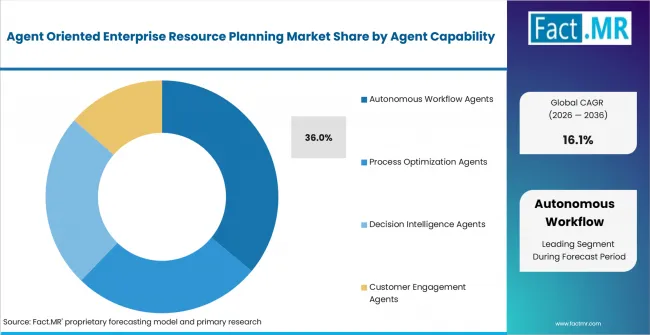
- Autonomous Workflow Agents anchor the Agent Capability segment with a 36.0% share in 2026, as buyers prioritize agents that complete bounded ERP processes rather than only explain data.
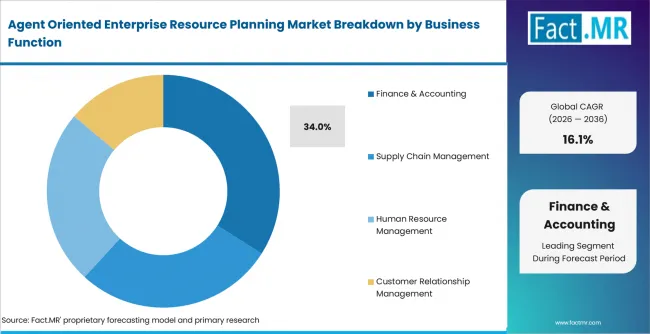
- Finance & Accounting leads the Business Function segment, taking 34.0% of demand in 2026, because its dense rule sets, recurring deadlines, and auditable outputs make agent outcomes measurable.
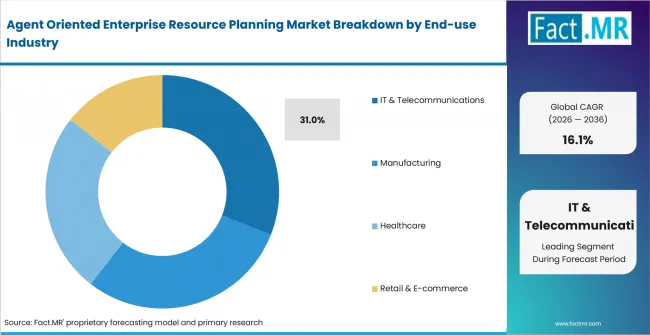
- IT & Telecommunications is the largest End-use Industry at 31.0% in 2026, reflecting early adoption among technology firms that run the highest density of enterprise applications.
- Large Enterprises anchor the Organization Size segment with a 44.0% share in 2026.
- Cloud-native Multi-agent Platform anchors the Deployment Architecture segment with a 37.0% share in 2026.
- Analyst Opinion at Fact.MR
- Shambhu Nath Jha, Sr. Consultant at Fact.MR, opines: “The agent-oriented ERP market is moving from demonstration to deployment as buyers convert bounded finance and ordering processes into governed digital work. The commercial test is no longer conversational quality; it is whether an agent can access transaction rights, apply rules, request approval, and write an outcome back to the system of record without weakening control. Autonomous Workflow Agents already hold 36.0% of the market in 2026, and adoption will keep expanding as vendors package agents for repeatable industry workflows with the identity, auditability, and observability that enterprise estates require.”
- Strategic Implications
- ERP suite vendors should package governed agents for repeatable industry workflows and deploy them through cloud, hybrid, and API-first architectures, so buyers can expand a first use case without rebuilding integration.
- Platform providers should treat identity and data-access design as the primary product surface, because buyers must control data access and transaction rights before granting agents authority over enterprise records.
- Vendors should instrument agent activity with observability and approval checkpoints from day one, since auditability and accountability determine whether a pilot expands across finance, supply chain, and HR workloads.
- Channel and service investment should follow the fastest-growing country markets, including the USA, Germany, and Japan, while adapting packaging to local control and migration expectations.
- Industry-focused vendors should lead with sector process models, such as manufacturing distribution and service workflows, because prebuilt process knowledge shortens time-to-value and lowers integration cost.
How does the Agent Oriented Enterprise Resource Planning Market break down by segment?
The report assesses agent-oriented ERP across Agent Capability, Business Function, End-use Industry, Organization Size, Deployment Architecture, and Region. Agent Capability spans Autonomous Workflow Agents, Process Optimization Agents, Decision Intelligence Agents, and Customer Engagement Agents. Business Function includes Finance & Accounting, Supply Chain Management, Human Resource Management, and Customer Relationship Management. End-use coverage includes IT & Telecommunications, Manufacturing, Healthcare, and Retail & E-commerce. Organization Size covers Large Enterprises, Medium-sized Enterprises, Public Sector Organizations, and Small & Medium Enterprises. Deployment Architecture includes Cloud-native Multi-agent Platform, Hybrid AI Deployment, LLM-integrated ERP Framework, and API-first Integration Layer. The regional view covers USA, Germany, Japan, UK, Canada, Australia, and Singapore.
Why do Autonomous Workflow Agents lead Agent Capability?
Autonomous Workflow Agents is projected to account for a 36.0% share in 2026.
Agent Oriented Enterprise Resource Planning Market Analysis By Agent Capability | Source: Fact.MR
ERP value is created when an agent completes a bounded process rather than only explaining data. These agents can collect context, select a tool, apply business rules, request approval, and write an outcome back to the system of record, a chain that fits reconciliation, order handling, supplier follow-up, and exception routing. Decision or engagement agents remain useful, but their commercial value often depends on a person completing the transaction. Microsoft reported in May 2025 that several ERP agents were available in Dynamics 365 for finance, supply chain, and operations, covering expenses, time entry, and approvals, illustrating the shift toward executable workflow ownership.
Why does Finance & Accounting lead Business Function?
Finance & Accounting is projected to account for a 34.0% share in 2026.
Agent Oriented Enterprise Resource Planning Market Analysis By Business Function | Source: Fact.MR
Finance & Accounting offers dense rule sets, recurring deadlines, and auditable outputs. Reconciliation and close support can be decomposed into tasks with clear inputs, and invoice review, planning, and exception management follow the same pattern. Finance also owns enterprise controls and can compare agent performance against established accuracy, cycle-time, and compliance measures. Supply chain and HR use cases can be equally valuable, but their data often varies more across sites and operating units. Workday stated in February 2025 that its Agent System of Record would manage a fleet of AI agents from Workday and third parties, a governance model that supports the traceable accountability finance teams require.
Why do IT & Telecommunications lead End-use Industry?
IT & Telecommunications is projected to account for a 31.0% share in 2026.
Agent Oriented Enterprise Resource Planning Market Analysis By End Use Industry | Source: Fact.MR
Technology and telecommunications companies run the highest density of enterprise applications, operate large cloud estates, and employ the integration and data teams needed to deploy agents safely, which makes them the earliest large-scale buyers of agent-oriented ERP. Their internal digital transformation programs also double as reference deployments that validate the governance, observability, and write-back controls other industries demand before adoption. As IT and telecom firms standardize agent workflows inside their own finance and operations, they establish the deployment patterns that financial services, manufacturing, and retail subsequently follow.
Why do Large Enterprises lead Organization Size?
Large Enterprises are projected to account for a 44.0% share in 2026.
Large enterprises have the process volume, integration capacity, identity controls, and governance teams needed to move agents from pilot work into production ERP workflows. They can reuse approved patterns across business units after finance, security, and operations teams agree on transaction rights and review limits.
Why does Cloud-native Multi-agent Platform lead Deployment Architecture?
Cloud-native Multi-agent Platform is projected to account for a 37.0% share in 2026.
Cloud-native multi-agent platforms let enterprises connect specialized agents, shared identity controls, observability, and APIs across multiple ERP workflows. Buyers still assess data location, access controls, and approval paths before agents are allowed to write back to systems of record.
What is accelerating Agent Oriented Enterprise Resource Planning Market adoption, and what is holding it back?
Drivers Impact Analysis
| Driver | Relative Impact | Geographic Relevance | Impact Timeline |
|---|---|---|---|
| Enterprises seek to shorten high-volume finance and order workflows where delay, rework, and exception volume carry accountable cost. | High | Global | Near term |
| Broader enterprise AI adoption expands the buyer base for governed agent deployment. | High | Global | Mid term |
| Suite vendors package governed agents into repeatable industry workflows. | Moderate | North America and Europe | Near term |
| Cross-system orchestration extends agent use beyond a single ERP suite. | Moderate | Global | Long term |
Restraints Impact Analysis
| Restraint | Relative Impact | Geographic Relevance | Impact Timeline |
|---|---|---|---|
| Buyers must control data access and transaction rights, making integration and identity design costly. | High | Global | Mid term |
| Auditability and data-quality gaps delay production scale in enterprise settings. | High | Global | Mid term |
| Configuration and integration costs can exceed the value of manual work removed. | Moderate | North America and Europe | Near term |
Which countries are scaling the Agent Oriented Enterprise Resource Planning Market fastest?
- USA is projected to post the highest CAGR at 17.2% through 2036.
- Germany follows at 16.8%, with Japan at 16.3%.
- UK, Canada, Australia, and Singapore are projected to grow at 15.9%, 15.3%, 14.8%, and 14.2%, respectively.
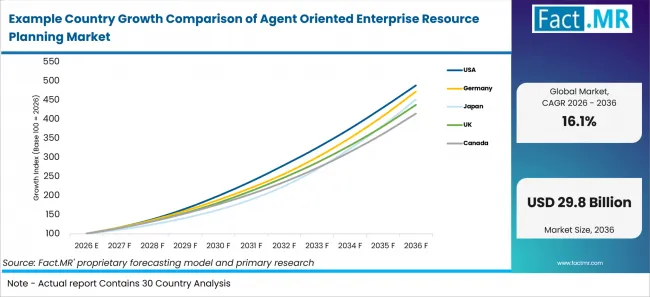
Example Country Growth Comparison Of Agent Oriented Enterprise Resource Planning Market | Source: Fact.MR
Country-wise CAGR Forecast (2026-2036)
| Country | CAGR |
|---|---|
| USA | 17.2% |
| Germany | 16.8% |
| Japan | 16.3% |
| UK | 15.9% |
| Canada | 15.3% |
| Australia | 14.8% |
| Singapore | 14.2% |
What is driving the Agent Oriented Enterprise Resource Planning Market in the USA?
USA is projected to register a 17.2% CAGR through 2036.
U.S. demand centers on finance, procurement, order, and service processes that already run on integrated enterprise platforms. Buyers tend to test permissions, data access, exception handling, and approval paths before allowing agents to complete transactions.
What is driving the Agent Oriented Enterprise Resource Planning Market in Germany?
Germany is projected to register a 16.8% CAGR through 2036.
German manufacturers, distributors, and service organizations are likely to introduce agents around familiar process models before expanding across core operations. Documentation, integration discipline, and clear operating ownership remain central to deployment decisions.
What is driving the Agent Oriented Enterprise Resource Planning Market in Japan?
Japan is projected to register a 16.3% CAGR through 2036.
Japanese enterprises are expected to formalize human review and responsibility boundaries before widening an agent's authority. This favors deployments that keep approvals, audit records, and exception routing visible to operating teams.
What is driving the Agent Oriented Enterprise Resource Planning Market in the UK?
The UK is projected to register a 15.9% CAGR through 2036.
UK buyers are expected to focus on practical automation for back-office work that can be measured against service levels, cycle time, and manual rework. Providers need clear implementation support for connecting agents to existing ERP and data environments.
What is driving the Agent Oriented Enterprise Resource Planning Market in Canada?
Canada is projected to register a 15.3% CAGR through 2036.
Canadian organizations are likely to extend ERP agents where established cloud and data programs can support controlled deployment. Adoption will depend on whether suppliers can show workable integration paths across different operating scales and sectors.
What is driving the Agent Oriented Enterprise Resource Planning Market in Australia?
Australia is projected to register a 14.8% CAGR through 2036.
Australian buyers are expected to assess ERP agents against the operating cost of change, available skills, and a defined business outcome. Early projects will favor bounded workflows where accountability can remain with a named finance, procurement, or operations owner.
What is driving the Agent Oriented Enterprise Resource Planning Market in Singapore?
Singapore is projected to register a 14.2% CAGR through 2036.
Singapore's digital business base supports trials of governed agents across regional operations. Buyers will weigh cross-border data handling, system access, and approval controls before moving from pilot use into transaction execution.
Who leads the Agent Oriented Enterprise Resource Planning Market?
Competition spans ERP-suite vendors, industry-focused ERP providers, and cross-application agent-orchestration platforms. SAP SE, Oracle Corporation, and Microsoft Corporation embed agents close to finance, procurement, supply-chain, and core transaction data. Infor Inc., IFS AB, and Epicor Software Corporation bring agents to manufacturing, distribution, asset, service, and supply-chain processes. Workday, Inc. connects agent governance to people and finance data, while ServiceNow, Inc. and IBM Corporation provide workflow, customer-process, or hybrid orchestration capabilities across enterprise application estates.
Suite vendors compete on access to enterprise records, transaction logic, approvals, and implementation ecosystems. Industry specialists compete on process context and packaged workflows. Cross-application vendors are relevant where buyers need agents to work across ERP and adjacent systems, rather than within one core ERP suite.
Which companies are the key providers?
Key companies profiled in the Agent Oriented Enterprise Resource Planning market include SAP SE, Oracle Corporation, Microsoft Corporation, Infor Inc., IFS AB, Epicor Software Corporation, Workday, Inc., ServiceNow, Inc., and IBM Corporation.
- SAP SE
- Oracle Corporation
- Microsoft Corporation
- Infor Inc.
- IFS AB
- Epicor Software Corporation
- Workday, Inc.
- ServiceNow, Inc.
- IBM Corporation
Bibliography
- Organisation for Economic Co-operation and Development. (2026, January 28). AI use by individuals surges across the OECD as adoption by firms continues to expand.
- SAP SE. (2026, May 12). SAP Sapphire Innovation News Guide 2026.
- Microsoft Corporation. (2025, May 9). A New Era in Business Processes: AI Agents for ERP.
- Infor. (2025, October 9). Infor Unveils Built-for-Industry AI Agents to Revolutionize Operational Workflows.
- IFS. (2025, June 26). IFS Acquires TheLoops to Launch the Industrial AI Workforce.
- Workday. (2025, February 11). The Next Generation of Workforce Management Is Here: Workday Unveils New Agent System of Record.
- ServiceNow. (2025, January 29). ServiceNow Announces New Agentic AI Innovations to Autonomously Solve Complex Enterprise Challenges.
- IBM. (2025, May 6). IBM and Oracle Expand Partnership to Advance Agentic AI and Hybrid Cloud.
- Epicor. (2025, May 6). Epicor Expands AI to Accelerate Productivity at Scale.
- U.S. Census Bureau. (2026, May 26). Large Firms With at Least 20 Employees Biggest AI Users.
- Ministry of Economy, Trade and Industry, Japan. (2026, March 31). AI Guidelines for Business Version 1.2.
- UK Department for Science, Innovation and Technology. (2026, January 29). AI Opportunities Action Plan: One Year On.
- Statistics Canada. (2026, June 11). Analysis on Artificial Intelligence Use by Businesses in Canada, Second Quarter of 2026.
- Australian Bureau of Statistics. (2026, June 25). Characteristics of Australian Business, 2024-25 Financial Year.
- Infocomm Media Development Authority of Singapore. (2026, May 20). Updated Model AI Governance Framework for Agentic AI.
This Report Answers
- The report evaluates Agent Capability, Business Function, End-use Industry, Organization Size, Deployment Architecture, and regional demand for agent-oriented ERP.
- Autonomous Workflow Agents lead Agent Capability with a 36.0% share in 2026, while Finance & Accounting leads Business Function at 34.0%.
- IT & Telecommunications is the leading End-use Industry at 31.0%. Large Enterprises lead Organization Size, and Cloud-native Multi-agent Platform leads Deployment Architecture.
- The regional outlook covers USA, Germany, Japan, UK, Canada, Australia, and Singapore, with country-wise growth forecasts through 2036.
- Competitive analysis assesses ERP-suite vendors, industry-focused providers, and cross-application agent-orchestration platforms active in the category.
What does the Agent Oriented Enterprise Resource Planning Market cover?
The Agent Oriented Enterprise Resource Planning Market covers software, platforms, and related services that use agents to plan, coordinate, and execute governed ERP workflows.
The scope follows Agent Capability, Business Function, End-use Industry, Organization Size, Deployment Architecture, and Region across the 2026-2036 forecast period.
What is included in the scope?
Coverage includes Autonomous Workflow Agents, Process Optimization Agents, Decision Intelligence Agents, and Customer Engagement Agents. It also includes finance and accounting, supply-chain management, human resource management, and customer relationship management use cases; IT & Telecommunications, Manufacturing, Healthcare, and Retail & E-commerce end users; large enterprises, medium-sized enterprises, public sector organizations, and small & medium enterprises; and cloud-native multi-agent platforms, hybrid AI deployment, LLM-integrated ERP frameworks, and API-first integration layers.
What is excluded from the scope?
General-purpose AI tools, unrelated enterprise software, commodity infrastructure, and services not configured for defined agent-oriented ERP workflows are outside scope.
How was the analysis built?
The analysis considers public company disclosures, product documentation, government and regulatory material, industry publications, and market conditions across the defined segments, regions, and forecast period.
What is the report’s scope and coverage?
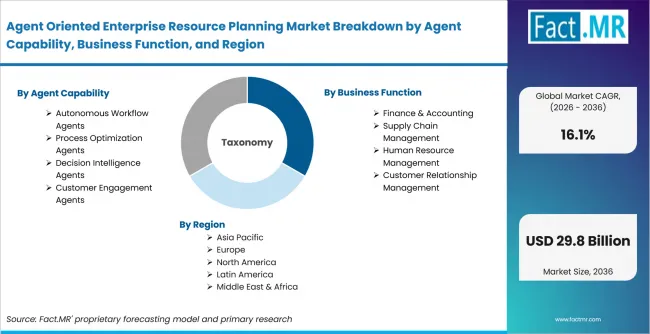
Agent Oriented Enterprise Resource Planning Market Breakdown By Agent Capability, Business Function, And Region | Source: Fact.MR
| Attribute | Details |
|---|---|
| Forecast Period | 2026-2036 |
| Base Year | 2025 |
| Market Value, 2026 | USD 6.7 billion |
| Market Value, 2036 | USD 29.8 billion |
| CAGR, 2026-2036 | 16.1% |
| Absolute Dollar Opportunity | USD 23.1 billion |
| Key Regions Covered | USA, Germany, Japan, UK, Canada, Australia, Singapore, and more than twenty-five additional countries in the full report |
How is the market segmented?
-
Agent Capability:
- Autonomous Workflow Agents
- Financial Process Agents
- Procurement Agents
- Process Optimization Agents
- Inventory Optimization Agents
- Logistics Coordination Agents
- Decision Intelligence Agents
- Workforce Planning Agents
- Performance Analytics Agents
- Customer Engagement Agents
- Sales Automation Agents
- Customer Support Agents
- Autonomous Workflow Agents
-
Business Function:
- Finance & Accounting
- Automated Bookkeeping
- Financial Planning
- Supply Chain Management
- Demand Planning
- Warehouse Operations
- Human Resource Management
- Talent Acquisition
- Employee Experience
- Customer Relationship Management
- Lead Management
- Service Management
- Finance & Accounting
-
End-use Industry:
- IT & Telecommunications
- Software & IT Services
- Telecommunication Providers
- Manufacturing
- Discrete Manufacturing
- Process Manufacturing
- Healthcare
- Hospitals
- Healthcare Providers
- Retail & E-commerce
- Online Retailers
- Brick-and-Mortar Retailers
- IT & Telecommunications
-
Organization Size:
- Large Enterprises
- Global Enterprises
- Multinational Corporations
- Medium-sized Enterprises
- Regional Enterprises
- Growing Businesses
- Public Sector Organizations
- Government Agencies
- Public Enterprises
- Small & Medium Enterprises
- Retail Chains
- Distributors
- Large Enterprises
-
Deployment Architecture:
- Cloud-native Multi-agent Platform
- Microservices Architecture
- Event-driven Architecture
- Hybrid AI Deployment
- On-premises AI Runtime
- Edge-enabled AI Deployment
- LLM-integrated ERP Framework
- Retrieval-Augmented Generation
- Vector Database Integration
- API-first Integration Layer
- Low-code Agent Builder
- Enterprise Knowledge Graph
- Cloud-native Multi-agent Platform
-
Region:
- USA
- Germany
- Japan
- UK
- Canada
- Australia
- Singapore