- Market Value (2025): USD 10.7 Bn
- Estimated Value (2026): USD 12.8 Bn
- Forecast Value (2036): USD 76.4 Bn
- CAGR (2026-2036): 19.6%
What is the Agentic Artificial Intelligence in the Supply Chain and Logistics Market forecast to be worth by 2036?
The market is projected to reach USD 76.7 billion by 2036.
- The Agentic Artificial Intelligence in the Supply Chain and Logistics market reached USD 10.7 billion in 2025.
- Demand is forecast to increase from USD 12.8 billion in 2026 to USD 76.7 billion by 2036.
- The market is projected to expand at a CAGR of 19.6% from 2026 to 2036.
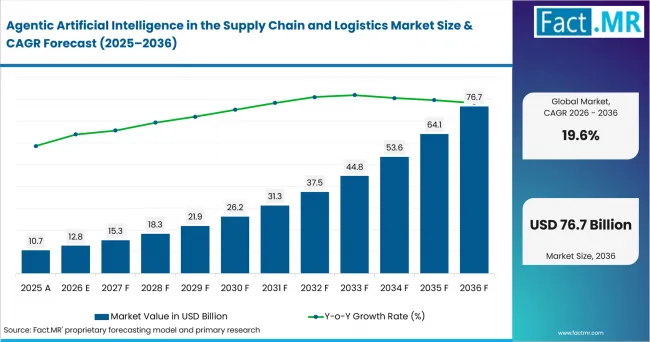
Agentic Artificial Intelligence In The Supply Chain And Logistics Market Value Analysis | Source: Fact.MR
What are the defining numbers behind Agentic Artificial Intelligence in the Supply Chain and Logistics Market growth?
An absolute dollar opportunity of USD 63.9 billion is expected between 2026 and 2036.
- Demand Drivers in the Market
- The primary driver is the gap between event speed and human coordination speed. Ports, carriers, warehouses, suppliers, and customers produce signals continuously, and a delay becomes more expensive when teams must assemble context across separate systems before acting.
- Agentic AI can monitor the flow, compare response options, and trigger an approved action or request a decision from the correct owner, converting fragmented signals into governed decisions rather than relying on manual reconciliation.
- Shared event and data standards are enabling cross-enterprise orchestration. GS1 EPCIS Release 2.0 provides a standards base for supply chain event data, and the EU’s eFTI Regulation implementation in January 2025 supports paperless digital freight data exchange.
- Public programs are building the data foundations. The U.S. Department of Transportation advanced a first-of-its-kind supply chain initiative in March 2024, and the World Bank’s Logistics Performance Index guides where improvements and digital adoption are most needed.
- Vendors are shipping planning and communication agents. Oracle added Fusion Agentic Applications in June 2026, and Microsoft introduced autonomous Dynamics 365 agents in October 2024 including a Supplier Communications Agent designed to confirm purchase-order delivery and preempt delays.
- Regulatory frameworks are raising the need for traceability and risk visibility. Germany’s BAFA issued guidance under the Supply Chain Due Diligence Act in December 2024, and NIST’s AI Risk Management Framework gives buyers a governance reference for deploying agents.
- Key Segments Analyzed
- Logistics Planning Agents anchor the AI Agent Category segment with a 39.0% share in 2026, because they connect demand signals to coordinated execution across multiple downstream processes.
- Route & Fleet Optimization leads the Logistics Function segment, taking 35.0% of demand in 2026, as it turns continuous route, capacity, and delivery data into measurable efficiency gains.
- Third-party Logistics Providers is the dominant End-use Industry at 44.0% in 2026, reflecting their reliance on agentic systems to coordinate multi-client operations.
- Global Logistics Enterprises lead the Organization Type segment with a 46.0% share in 2026, as their scale justifies the integration and control investment agents require.
- Cloud-native AI Agents anchor the Deployment Framework segment with a 48.0% share in 2026.
- Analyst Opinion at Fact.MR
- Shambhu Nath Jha, Sr. Consultant at Fact.MR, opines: “Supply-chain agents create value when they can combine a disruption signal with the operating rules that determine who can act and what can be changed. The practical test is not a fluent recommendation. It is whether the system can compare available capacity, inventory, service commitments, and partner constraints, then produce an approved next step with a clear owner. Vendors that connect planning logic to execution evidence will be better positioned for production use.”
- Strategic Implications
- Enterprise application and cloud vendors should make shared event standards and digital freight rules part of their agent design, so agents can coordinate across enterprise boundaries and partners.
- Domain vendors should lead with planning depth and network visibility, since workflow specificity and operational data context are the entry point for logistics buyer trust.
- Buyers should define where an agent may recommend, communicate, or execute, because fragmented data and unclear authority limits are the main barrier to production deployment.
- Channel and service investment should follow the fastest-growing country markets, including the USA, Germany, and Singapore, while adapting to local traceability and port-system strengths.
- Transformation partners should assemble the data layer and change controls around a chosen platform, because contracts often combine a cloud platform, a domain product, and a systems integrator.
How does the Agentic Artificial Intelligence in the Supply Chain and Logistics Market break down by segment?
The report evaluates AI Agent Category, Logistics Function, End-use Industry, Organization Type, Deployment Framework, and Region. AI Agent Category includes Logistics Planning Agents, Warehouse Intelligence Agents, Supply Chain Visibility Agents, and Procurement Intelligence Agents. Logistics Function covers Route & Fleet Optimization, Warehouse Automation, Shipment Tracking, and Supplier Management. End-use Industry includes Third-party Logistics Providers, Warehousing & Distribution, Manufacturing, and Healthcare Logistics. Organization Type covers Global Logistics Enterprises, Warehouse Operators, Manufacturing Enterprises, and Healthcare Organizations. Deployment Framework includes Cloud-native AI Agents, Hybrid AI Infrastructure, Multi-agent Orchestration, and Foundation Model Integration. The regional structure follows North America, Latin America, Western Europe, Eastern Europe, East Asia, South Asia and Pacific, and Middle East & Africa.
Why do Logistics Planning Agents lead AI Agent Category?
Logistics Planning Agents is projected to account for a 39.0% share in 2026.
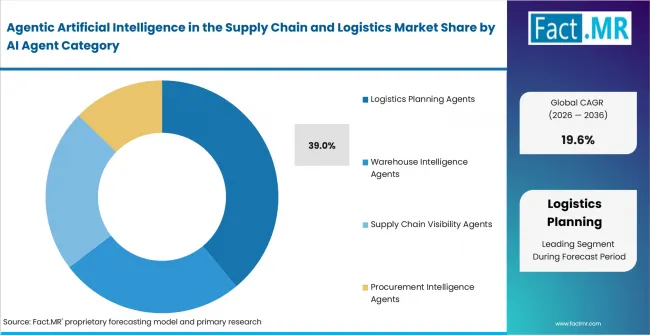
Agentic Artificial Intelligence In The Supply Chain And Logistics Market Analysis By Ai Agent Category | Source: Fact.MR
Logistics Planning Agents sit upstream of daily execution. They compare demand and capacity before assigning an action, account for inventory and service constraints, and let one agent influence several downstream processes without replacing every operating system. The category benefits from frequent exception cycles, since delays and stock risks create repeated decisions that are costly to coordinate manually. Planning agents lead when they can reconcile TMS, WMS, ERP, and partner feeds, and they lose value when master data is inconsistent or business rules remain undocumented. Oracle announced in June 2026 that its Inventory Planning Command Center and related Fusion Agentic Applications can identify inventory risks and progress work inside established application guardrails.
Why does Route & Fleet Optimization lead Logistics Function?
Route & Fleet Optimization is projected to account for a 35.0% share in 2026.
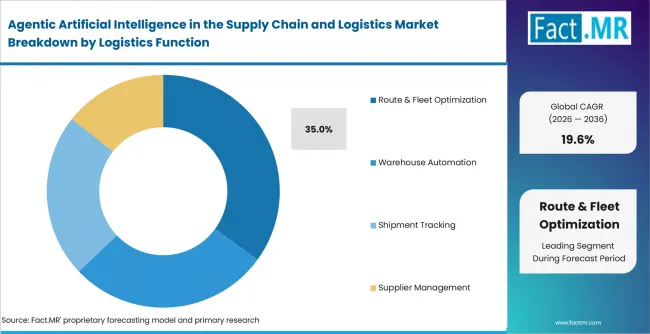
Agentic Artificial Intelligence In The Supply Chain And Logistics Market Analysis By Logistics Function | Source: Fact.MR
Route and fleet optimization turns continuous data about demand, capacity, traffic, and delivery windows into directly measurable efficiency, fuel, and on-time gains. Agents can rebalance routes, flag asset constraints, and propose dispatch changes under cost and service policies, then escalate the highest-risk decisions to a planner. This function has clear performance metrics, which makes validation easier and gives buyers a faster business case than broader planning use cases. It is also a frequent, high-volume workflow, so improvements repeat daily and produce the recurring return that supports continued agent spend.
Why do Third-party Logistics Providers lead End-use Industry?
Third-party Logistics Providers is projected to account for a 44.0% share in 2026.
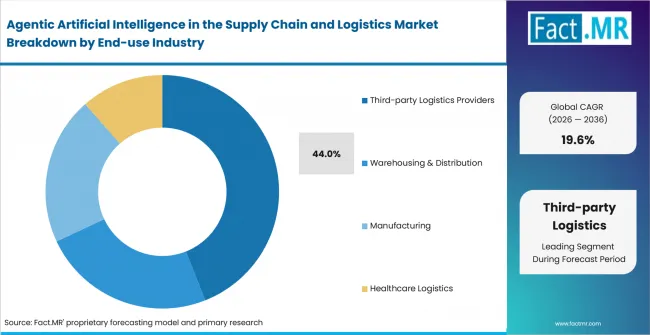
Agentic Artificial Intelligence In The Supply Chain And Logistics Market Analysis By End Use Industry | Source: Fact.MR
Third-party logistics providers lead the End-use Industry because they coordinate multiple shippers, networks, and service expectations within one operation, which creates the highest volume of cross-system work that agents can reconcile. They run many clients’ freight on shared assets and systems, so a single orchestration layer can improve utilization across accounts. They also bear acute margin and service pressure, giving them a direct incentive to adopt planning and route optimization agents that cut exception handling and improve asset use. Their multi-client scale justifies the integration cost and provides the recurring workloads that support agent deployment.
Why do Global Logistics Enterprises lead Organization Type?
Global Logistics Enterprises is projected to account for a 46.0% share in 2026.
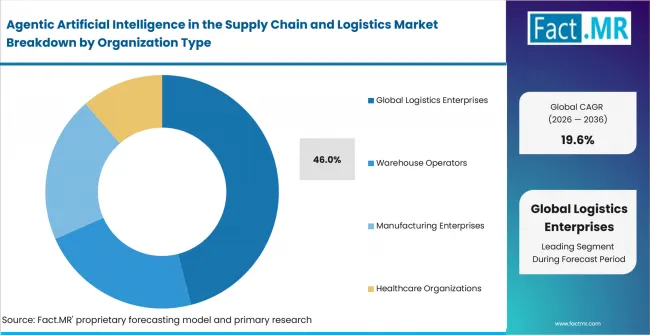
Agentic Artificial Intelligence In The Supply Chain And Logistics Market Analysis By Organization Type | Source: Fact.MR
Global logistics enterprises have the transaction volume and systems coverage needed to justify agent deployment. Their networks span regions and business units, creating a strong case for agents that can apply common policy while adapting to local constraints. Large enterprises also have more internal data than smaller operators, supporting richer context and more reliable evaluation. The barrier is governance complexity: a global buyer must define where an agent may recommend, communicate, or execute, and manage identity and data residency across jurisdictions. Microsoft introduced autonomous Dynamics 365 agents in October 2024, with a Supplier Communications Agent designed to confirm purchase-order delivery and preempt delays for procurement teams.
Why do Cloud-native AI Agents lead Deployment Framework?
Cloud-native AI Agents are projected to account for a 48.0% share in 2026.
Cloud-native agents can connect event data, planning applications, partner APIs, and shared policy services without forcing every participant onto one local system. Buyers still assess data access, integration reliability, and approval paths before an agent can change a planning or execution workflow.
What is accelerating Agentic Artificial Intelligence in the Supply Chain and Logistics Market adoption, and what is holding it back?
Drivers Impact Analysis
| Driver | Relative Impact | Geographic Relevance | Impact Timeline |
|---|---|---|---|
| Event speed outpaces human coordination across ports, carriers, warehouses, and suppliers. | High | Global | Near term |
| Shared event and data standards support cross-enterprise orchestration. | High | Global | Mid term |
| Route and fleet optimization provides measurable efficiency and on-time performance data. | High | Global | Near term |
| Public programs and traceability requirements raise demand for supply-chain visibility. | Moderate | North America, Europe, and Asia Pacific | Long term |
Source: Fact.MR analysis. Updated Aug 10, 2026
Restraints Impact Analysis
| Restraint | Relative Impact | Geographic Relevance | Impact Timeline |
|---|---|---|---|
| Fragmented data and unclear authority delay production use. | High | Global | Mid term |
| Inconsistent master data and undocumented business rules reduce agent reliability. | High | Global | Near term |
| Execution authority and data residency add governance complexity across jurisdictions. | Moderate | North America and Europe | Long term |
Source: Fact.MR analysis. Updated Aug 10, 2026
Which countries are scaling the Agentic Artificial Intelligence in the Supply Chain and Logistics Market fastest?
- USA is projected to post the highest CAGR at 21.5% through 2036.
- Germany, Singapore, Japan, Canada, UK, and Australia follow at 20.8%, 20.1%, 19.3%, 18.6%, 17.9%, and 17.2%, respectively.
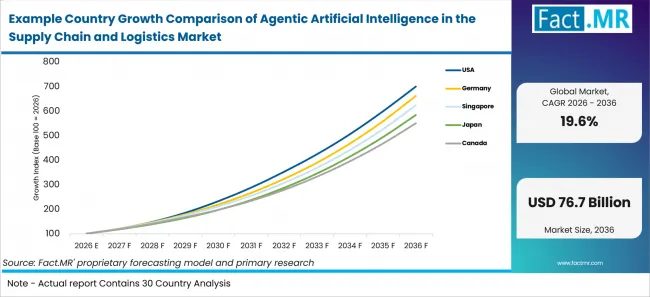
Example Country Growth Comparison Of Agentic Artificial Intelligence In The Supply Chain And Logistics Market | Source: Fact.MR
Country-wise CAGR Forecast (2026-2036)
| Country | CAGR |
|---|---|
| USA | 21.5% |
| Germany | 20.8% |
| Singapore | 20.1% |
| Japan | 19.3% |
| Canada | 18.6% |
| UK | 17.9% |
| Australia | 17.2% |
Source: Fact.MR analysis. Updated Aug 10, 2026
What is driving the Agentic Artificial Intelligence in the Supply Chain and Logistics Market in the USA?
USA is projected to register a 21.5% CAGR through 2036.
U.S. buyers are likely to start where port, carrier, warehouse, and purchase-order events already feed operational planning. The key requirement is a system that can relate a disruption to available capacity and a named response owner.
What is driving the Agentic Artificial Intelligence in the Supply Chain and Logistics Market in Germany?
Germany is projected to register a 20.8% CAGR through 2036.
German industrial buyers are expected to favor supply-chain agents that retain traceability across supplier, compliance, and production workflows. Deployment will depend on whether the system preserves evidence for a risk decision and supports established control processes.
What is driving the Agentic Artificial Intelligence in the Supply Chain and Logistics Market in Singapore?
Singapore is projected to register a 20.1% CAGR through 2036.
Singapore's port and maritime operations can support agent use where shared event data helps coordinate vessel, terminal, and logistics decisions. Buyers will assess data access, partner integration, and the authority assigned to an automated response.
What is driving the Agentic Artificial Intelligence in the Supply Chain and Logistics Market in Japan?
Japan is projected to register a 19.3% CAGR through 2036.
Japanese logistics organizations are expected to concentrate on bounded automation that helps teams manage labor constraints without weakening operational safety. Early implementations will favor planning and exception workflows that can be reviewed before execution.
What is driving the Agentic Artificial Intelligence in the Supply Chain and Logistics Market in Canada?
Canada is projected to register an 18.6% CAGR through 2036.
Canadian buyers operating long multimodal corridors need visibility when weather or infrastructure disruptions affect a route. Agentic tools gain relevance when they bring transport, inventory, and partner data into an actionable exception workflow.
What is driving the Agentic Artificial Intelligence in the Supply Chain and Logistics Market in the UK?
The UK is projected to register a 17.9% CAGR through 2036.
UK freight operators are likely to compare agentic products against measurable operating results, including route performance, service reliability, and manual workload. Suppliers need evidence that a pilot can work in a live partner network.
What is driving the Agentic Artificial Intelligence in the Supply Chain and Logistics Market in Australia?
Australia is projected to register a 17.2% CAGR through 2036.
Australian buyers manage long distances, uneven network density, and varying transport conditions across road and rail. Early demand will favor visibility and planning workflows that help teams address a disruption before it becomes a delivery failure.
Who leads the Agentic Artificial Intelligence in the Supply Chain and Logistics Market?
The competitive landscape divides into three strategic positions. Enterprise application and cloud providers place agents close to operational data and transaction systems, with access to identity and integration services. Supply chain domain and physical AI providers compete through planning depth and network visibility, with simulation and warehouse execution providing further differentiation. Transformation firms connect these components to customer processes and data estates, with implementation reach and change management as their advantage.
Enterprise application and cloud platforms: Microsoft Corporation, Amazon Web Services, Inc., Google LLC, Oracle Corporation, IBM Corporation, and SAP SE. Supply chain domain and physical AI platforms: NVIDIA Corporation and Blue Yonder Group, Inc. Transformation and integration services: Accenture plc, Infosys Limited, and Wipro Limited.
Which companies are the key providers?
Key companies profiled in the Agentic Artificial Intelligence in the Supply Chain and Logistics market include Microsoft Corporation, Amazon Web Services, Inc., Google LLC, Oracle Corporation, IBM Corporation, SAP SE, NVIDIA Corporation, Blue Yonder Group, Inc., Accenture plc, Infosys Limited, and Wipro Limited.
- Microsoft Corporation
- Amazon Web Services, Inc.
- Google LLC
- Oracle Corporation
- IBM Corporation
- SAP SE
- NVIDIA Corporation
- Blue Yonder Group, Inc.
- Accenture plc
- Infosys Limited
- Wipro Limited
Bibliography
- World Bank. (2023, April 21). World Bank Releases Logistics Performance Index 2023.
- National Institute of Standards and Technology. (2023, January 26). AI Risk Management Framework.
- GS1. (2022, June 22). GS1 Standards Repository: EPCIS Standard Release 2.0.
- European Commission. (2025, January 9). Towards Paperless Freight Transport: EU Takes a Step Forward with eFTI Regulation Implementation.
- U.S. Department of Transportation. (2024, March 20). Biden-Harris Administration Announces New Milestone in First-of-its-Kind Supply Chain Initiative.
- German Federal Office for Economic Affairs and Export Control. (2024, December 13). Supply Chain Due Diligence Act: BAFA Publishes New Guidance.
- Maritime and Port Authority of Singapore. (2025, March 5). Driving Growth and Innovation to Strengthen Maritime Competitiveness and Resilience.
- Japan Ministry of Economy, Trade and Industry. (2025, February 26). Future Vision for Autonomous Delivery Robots.
- Transport Canada. (2025, June 17). Transportation in Canada 2024: Trends and Outlook.
- UK Department for Transport. (2024, May 1). £1.8 Million Boost for Innovation to Decarbonise Freight.
- Australian Department of Infrastructure, Transport, Regional Development, Communications and the Arts. (2025, August 22). Updated National Freight and Supply Chain Strategy Released.
- Microsoft. (2024, October 21). Transform Work with Autonomous Agents Across Your Business Processes.
- Oracle. (2026, June 29). Oracle Adds New Fusion Agentic Applications to Help Customers Improve Supply Chain Performance.
This Report Answers
- The report evaluates AI Agent Category, Logistics Function, End-use Industry, Organization Type, Deployment Framework, and regional demand for agentic supply-chain and logistics systems.
- Logistics Planning Agents lead AI Agent Category with a 39.0% share in 2026, while Route & Fleet Optimization leads Logistics Function at 35.0%.
- Third-party Logistics Providers lead End-use Industry at 44.0%. Global Logistics Enterprises lead Organization Type, and Cloud-native AI Agents lead Deployment Framework.
- The regional outlook covers USA, Germany, Singapore, Japan, Canada, UK, and Australia, with country-wise forecasts through 2036.
- Competitive analysis assesses enterprise application, cloud, supply-chain domain, physical-AI, and transformation providers active in the category.
What does the Agentic Artificial Intelligence in the Supply Chain and Logistics Market cover?
The Agentic Artificial Intelligence in the Supply Chain and Logistics Market covers software, platforms, and services that use AI agents to plan, coordinate, monitor, and execute governed supply-chain and logistics workflows.
The scope follows AI Agent Category, Logistics Function, End-use Industry, Organization Type, Deployment Framework, and Region across the 2026-2036 forecast period.
What is included in the scope?
Coverage includes Logistics Planning, Warehouse Intelligence, Supply Chain Visibility, and Procurement Intelligence Agents; Route & Fleet Optimization, Warehouse Automation, Shipment Tracking, and Supplier Management functions; third-party logistics providers, warehousing and distribution, manufacturing, and healthcare logistics users; global logistics enterprises, warehouse operators, manufacturing enterprises, and healthcare organizations; and cloud-native agents, hybrid AI infrastructure, multi-agent orchestration, and foundation-model integration.
What is excluded from the scope?
General-purpose AI software, unrelated transport hardware, commodity cloud infrastructure, and services not configured for defined supply-chain or logistics workflows are outside scope.
How was the analysis built?
The analysis considers public company disclosures, product documentation, standards and government material, industry publications, and market conditions across the defined segments, regions, and forecast period.
Segmentation
What is the report’s scope and coverage?
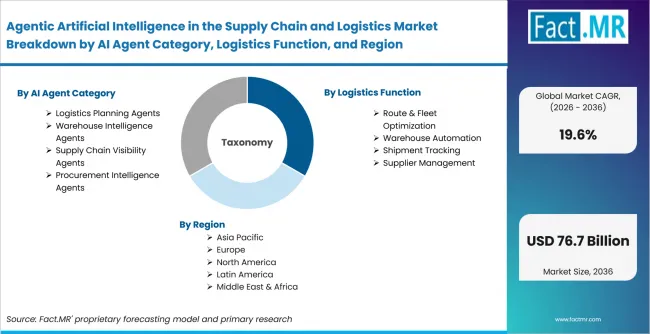
Agentic Artificial Intelligence In The Supply Chain And Logistics Market Breakdown By Ai Agent Category, Logistics Function, And Region | Source: Fact.MR
| Attribute | Details |
|---|---|
| Forecast Period | 2026-2036 |
| Base Year | 2025 |
| Market Value, 2026 | USD 12.8 billion |
| Market Value, 2036 | USD 76.7 billion |
| CAGR, 2026-2036 | 19.6% |
| Absolute Dollar Opportunity | USD 63.9 billion |
| Key Regions Covered | USA, Germany, Singapore, Japan, Canada, UK, Australia, and more than twenty-five additional countries in the full report |
Source: Fact.MR analysis. Updated Aug 10, 2026
How is the market segmented?
-
AI Agent Category:
- Logistics Planning Agents
- Route Optimization Agents
- Fleet Scheduling Agents
- Warehouse Intelligence Agents
- Picking & Packing Agents
- Autonomous Inventory Agents
- Supply Chain Visibility Agents
- Real-time Tracking Agents
- Exception Management Agents
- Procurement Intelligence Agents
- Supplier Evaluation Agents
- Purchase Recommendation Agents
- Logistics Planning Agents
-
Logistics Function:
- Route & Fleet Optimization
- Dynamic Route Planning
- Fleet Dispatching
- Warehouse Automation
- Inventory Replenishment
- Storage Optimization
- Shipment Tracking
- Order Visibility
- Disruption Alerts
- Supplier Management
- Contract Compliance
- Procurement Automation
- Route & Fleet Optimization
-
End-use Industry:
- Third-party Logistics Providers
- Freight & Transportation
- Shipping & Maritime
- Warehousing & Distribution
- E-commerce Fulfillment
- Retail Logistics
- Manufacturing
- Automotive Manufacturing
- Industrial Manufacturing
- Healthcare Logistics
- Pharmaceutical Distribution
- Cold Chain Logistics
- Third-party Logistics Providers
-
Organization Type:
- Global Logistics Enterprises
- International Logistics Companies
- Shipping Companies
- Warehouse Operators
- Fulfillment Centers
- Retail Distribution Centers
- Manufacturing Enterprises
- Global Manufacturers
- Industrial Enterprises
- Healthcare Organizations
- Pharmaceutical Companies
- Healthcare Distributors
- Global Logistics Enterprises
-
Deployment Framework:
- Cloud-native AI Agents
- Public Cloud
- Private Cloud
- Hybrid AI Infrastructure
- On-premises Deployment
- Edge-enabled AI
- Multi-agent Orchestration
- Agent Coordination Layer
- Context-aware AI
- Foundation Model Integration
- Knowledge Graph Integration
- Vector-based Retrieval
- Cloud-native AI Agents
-
Region:
- North America
- Latin America
- Western Europe
- Eastern Europe
- East Asia
- South Asia and Pacific
- Middle East & Africa
Frequently Asked Questions
What is the Agentic Artificial Intelligence in the Supply Chain and Logistics market size in 2026?
At what CAGR is the Agentic Artificial Intelligence in the Supply Chain and Logistics market expected to grow?
What is the projected Agentic Artificial Intelligence in the Supply Chain and Logistics market size by 2036?
Which country leads the Agentic Artificial Intelligence in the Supply Chain and Logistics market?
Which is the leading segment in the Agentic Artificial Intelligence in the Supply Chain and Logistics market?
What is driving growth in the Agentic Artificial Intelligence in the Supply Chain and Logistics Market?
Who are the key players in the Agentic Artificial Intelligence in the Supply Chain and Logistics Market?
Who worked on this report


Preview the report firsthand - request a free sample
Free SampleGet the brochure for pricing and purchase details
Download PDF