- Market Value (2025): USD 2.3 Bn
- Estimated Value (2026): USD 2.8 Bn
- Forecast Value (2036): USD 18.7 Bn
- CAGR (2026-2036): 20.9%
What is the Agentic Artificial Intelligence Applications in Vector Database Market forecast to be worth by 2036?
The market is projected to reach USD 18.7 billion by 2036.
- The Agentic Artificial Intelligence Applications in Vector Database market reached USD 2.3 billion in 2025.
- Demand is forecast to increase from USD 2.8 billion in 2026 to USD 18.7 billion by 2036.
- The market is forecast to expand at a CAGR of 20.9% from 2026 to 2036.
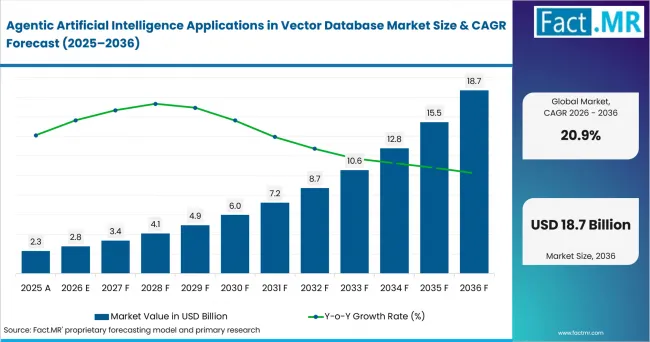
Agentic Artificial Intelligence Applications In Vector Database Market Value Analysis | Source: Fact.MR
What are the defining numbers behind Agentic Artificial Intelligence Applications in Vector Database Market growth?
An absolute dollar opportunity of USD 15.8 billion is expected between 2026 and 2036.
- Demand Drivers in the Market
- Rapid enterprise AI adoption is expanding the installed base for agentic applications. Stanford HAI reported that organizational AI adoption reached 88% in 2025, while U.S. Census Bureau, Eurostat and UK ONS data all show continued growth in business AI use. As more enterprises deploy AI across business functions, the addressable base for retrieval infrastructure and vector databases expands.
- The shift from conversational AI to agents that perform multi-step work is increasing retrieval intensity. MIT Sloan describes agentic AI as systems that can perceive, reason and act with limited supervision. Research on Agentic RAG shows that these systems repeatedly alternate between reasoning and retrieval instead of relying on a single search. More retrieval cycles per task increase the importance of scalable vector search.
- Enterprises need AI systems to use proprietary and frequently changing information that is absent from model training data. ACL research on enterprise RAG highlights the use of frequently updated corporate repositories for internal AI applications, while NIST research shows how retrieval can inject relevant external context into generative AI. This creates direct demand for systems that can index and retrieve organization-specific knowledge.
- Growth in unstructured enterprise data is increasing the need for embedding-based search. Vector database research published through VLDB and ACM identifies LLMs and other data-intensive applications as key forces behind demand for scalable storage and similarity search across text, images and other unstructured information. Vector databases become more useful as enterprises need semantic retrieval across content that does not fit conventional keyword or relational queries.
- AI deployment is moving into more business functions and knowledge-intensive sectors. U.S. Census research found particularly high AI use among very large firms in information, professional services and finance, while Eurostat shows the strongest adoption in information and communication and professional, scientific and technical services. These sectors manage large knowledge repositories and are natural early adopters of retrieval-dependent agent workflows.
- The need for more accurate and grounded AI outputs is increasing investment in retrieval quality. Research from NIST and ACL treats retrieval relevance and grounded generation as core requirements for RAG systems. Academic evaluations also show that relevance, factual accuracy and faithfulness depend heavily on the quality of retrieved context. This supports demand for vector search, hybrid retrieval and reranking capabilities as AI applications move into production
- Key Segments Analyzed
- By Solution Type: AI Agent Platforms account for 41.0% of the market in 2026. Academic work on Agentic RAG shows that modern agents increasingly coordinate retrieval as part of multi-step task execution.
- By Agentic AI Function: Knowledge Retrieval accounts for 38.0% of the market in 2026. Research on enterprise Agentic RAG further shows that iterative search and document navigation materially improve performance over single-shot retrieval.
- By End-use Industry: Information Technology accounts for 42.0% of the market in 2026. OECD evidence links AI adoption closely to digital intensity. These characteristics make IT companies early users of semantic search, RAG and vector-based application infrastructure.
- By Organization Type: Large Enterprises account for 45.0% of the market in 2026. U.S. Census data show that 37% of firms with at least 250 employees were using AI in business operations in 2026.
- Cloud-native Vector Database anchors the Vector Database Architecture segment with a 39.0% share in 2026.
- Analyst Opinion at Fact.MR
- Shambhu Nath Jha, Senior Consultant at Fact.MR, states, “Demand for agentic artificial intelligence applications in vector databases is expanding as enterprises move agents from controlled pilots into workflows that depend on current, permission-aware business context.”
- Strategic Implications
- Suppliers should prioritise AI Agent Platforms because they account for 41.0% of Solution Type demand in 2026 and are becoming the control layer through which reasoning, retrieval and tool execution are coordinated. Berkeley research on agentic enterprises shows that AI agents increasingly operate across workflows rather than as isolated applications, making orchestration and governed interaction central to deployment.
- Commercial investment should be weighted toward the USA, Singapore and Germany because they record the three fastest country CAGRs in the supplied forecast. Germany also benefits from expanding European AI infrastructure, including the AI Factories program, which is intended to support development and deployment of AI applications across sectors. Country strategies should therefore reflect differences in available infrastructure and governance conditions instead of using one standard deployment model.
- Product roadmaps should support hybrid retrieval, reranking and cost-aware retrieval orchestration. Experimental research on budget-constrained agentic search finds that hybrid lexical and dense retrieval with lightweight reranking can improve accuracy, while additional searches create measurable cost trade-offs. This favors platforms that can optimize retrieval depth rather than simply increasing query volume.
- Vendors need stronger controls around the data and permissions available to agents. CISA and its international partners emphasize securing the data used by AI systems because data integrity directly affects trustworthy outputs. Berkeley research similarly identifies credential exposure and unauthorized agent access as emerging enterprise security problems.
- Evaluation should move beyond whether an agent completes a demonstration successfully. Research from Berkeley and recent agent-evaluation studies shows the need to test agent behavior under realistic failure conditions and evaluate performance across system, trace and individual action levels. Providers that make evaluation and monitoring easier to operate are therefore better positioned for production deployments.
- Differentiation is likely to shift toward integration reliability, security and operational control as basic retrieval capabilities become easier to obtain. ENISA stresses the need for specific measures to maintain trustworthy and secure AI systems, while Carnegie Mellon highlights governed tool interfaces, memory controls and trace-based debugging as core requirements for production agent systems.
- Country-level Growth Outlook
- At 22.4%, the USA is likely to gain traction, supported by deeper enterprise AI deployment and a larger base of production agent workloads.
- Singapore follows at 21.8%, with agentic AI governance giving enterprises a clearer path from experimentation to deployment.
- Germany reaches 21.2%, helped by stronger AI infrastructure and growing access to compute capacity for enterprise applications.
- Japan records 20.6%, where updated government guidance is reducing uncertainty around how businesses adopt and govern AI systems.
- Canada stands at 19.9%, with public-sector AI initiatives helping create a more structured environment for responsible enterprise adoption.
How does the Agentic Artificial Intelligence Applications in Vector Database Market break down by segment?
The market is structured across five analytical dimensions plus region. AI Agent Platforms leads the Solution Type segment. Knowledge Retrieval leads the Agentic AI Function segment. Information Technology leads the End-use Industry segment. Large Enterprises leads the Organization Type segment. Cloud-native Vector Database leads the Vector Database Architecture segment. Regionally, USA, Singapore, Germany, Japan, Canada, UK, Australia anchor the demand base.
Why do AI Agent Platforms lead Solution Type?
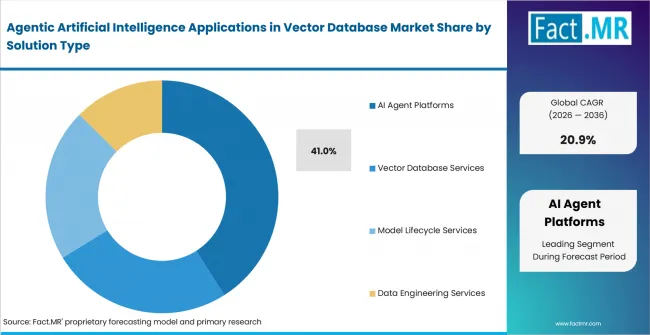
Agentic Artificial Intelligence Applications In Vector Database Market Analysis By Solution Type | Source: Fact.MR
- AI Agent Platforms are projected to account for a 41.0% share in 2026.
- AI Agent Platforms lead because they combine retrieval with agent execution in a common operating layer. Enterprises can connect vector data with planning, tool use and memory without building every orchestration component separately. This reduces the engineering effort required to move retrieval-backed agents from experimentation into production workflows.
- Pinecone announced the general availability of Pinecone Assistant in January 2025, with managed capabilities covering file processing, embedding, query planning, vector search, model orchestration and reranking. This type of integrated platform supports demand from buyers seeking a more deployable route to enterprise agent applications.
Why does Knowledge Retrieval lead Agentic AI Function?
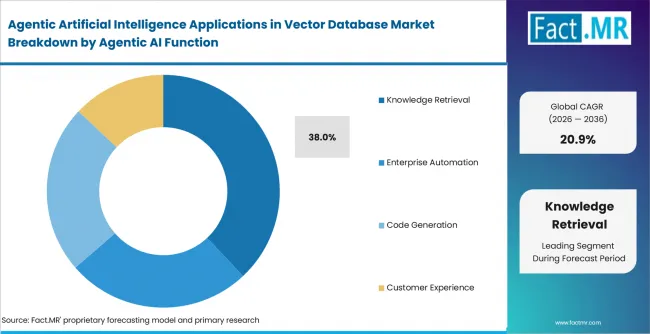
Agentic Artificial Intelligence Applications In Vector Database Market Analysis By Agentic Ai Function | Source: Fact.MR
- Knowledge Retrieval is projected to account for a 38.0% share in 2026.
- Knowledge Retrieval leads as enterprise agents need access to current internal information before they can answer questions or choose actions reliably. Retrieval systems connect agents with approved documents and application data while allowing organizations to retain control over which sources are searched.
- Weaviate's Query Agent illustrates this operating model by translating natural-language questions into searches and aggregations across one or more collections. The ability to select filters and retrieval operations dynamically increases the role of the vector database from storage infrastructure to an active part of agent execution.
Why does Information Technology lead End-use Industry?
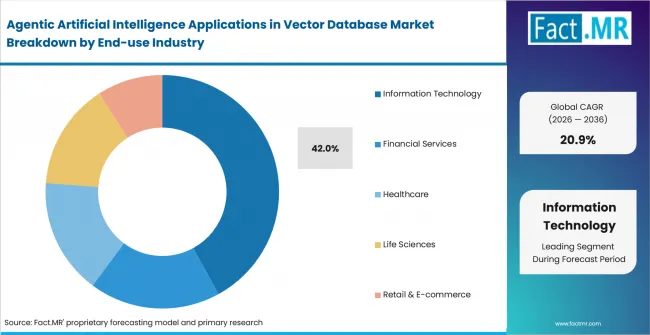
Agentic Artificial Intelligence Applications In Vector Database Market Analysis By End Use Industry | Source: Fact.MR
- Information Technology is projected to account for a 42.0% share in 2026.
- Information Technology leads as software and technology companies already operate the application infrastructure required to integrate vector retrieval with AI products. Common use cases include developer assistance, internal knowledge systems, technical support and software workflows where agents must retrieve information before completing a task.
- Technology organizations also have greater access to AI engineering skills required to test retrieval quality, permission controls and agent behaviour before deployment. This lowers the implementation barrier compared with industries where data remains more fragmented or where AI infrastructure is still being established.
Why do Large Enterprises lead Organization Type?
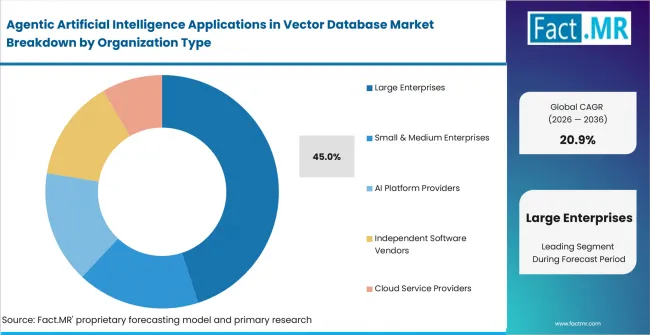
Agentic Artificial Intelligence Applications In Vector Database Market Analysis By Organization Type | Source: Fact.MR
- Large Enterprises are projected to account for a 45.0% share in 2026.
- Large enterprises lead because their data environments create a stronger economic case for dedicated retrieval infrastructure. They often operate several repositories with separate access policies and retention requirements, while production agents require more formal evaluation and monitoring than small experimental deployments.
- U.S. Census Bureau data published in May 2026 reported AI use among 37% of firms with at least 250 employees, indicating deeper operational adoption among larger organizations. These buyers are also more likely to require private networking, multi-region deployment and defined service levels.
- AWS announced Amazon S3 Vectors in July 2025 with purpose-built vector APIs and integration with Amazon Bedrock Knowledge Bases. The development shows how vector retrieval is being embedded into enterprise cloud infrastructure used by organizations operating AI workloads at scale.
What is accelerating Agentic Artificial Intelligence Applications in Vector Database Market adoption, and what is holding it back?
Drivers Impact Analysis
| Factor | (~) % Impact on CAGR | Geographic Relevance | Impact Timeline |
|---|---|---|---|
| Enterprise AI agents require fresh, permission-aware context | +1.8% | Global | Near Term |
| Multi-step agents can trigger repeated retrieval during one business task | +1.4% | Global | Near Term |
| Low-latency vector search reduces delay in interactive agent workflows | +1.1% | Global | Mid Term |
| Managed retrieval reduces data-preparation and orchestration burden | +0.9% | Global | Mid Term |
Source: Fact.MR analysis. Updated Aug 10, 2026
Restraints Impact Analysis
| Factor | (~) % Impact on CAGR | Geographic Relevance | Impact Timeline |
|---|---|---|---|
| Retrieval quality can degrade when enterprise content is incomplete or poorly indexed | -1.0% | Global | Near Term |
| Security and permission failures can expose unauthorized context to agents | -0.9% | Global | Near Term |
| Repeated retrieval and model calls can make production query economics unpredictable | -0.7% | Global | Mid Term |
Source: Fact.MR analysis. Updated Aug 10, 2026
Which countries are scaling the Agentic Artificial Intelligence Applications in Vector Database Market fastest?
- The USA is forecast to grow at 22.4% CAGR as large enterprises move AI from experimentation into business operations, increasing demand for retrieval infrastructure that can connect agents with governed enterprise data. The U.S. Census Bureau reported that 37% of firms with at least 250 employees were using AI in business operations in 2026.
- Singapore is projected to expand at 21.8% CAGR as enterprises deploy more autonomous AI systems within a governance environment designed specifically for agentic AI. IMDA updated its Model AI Governance Framework for Agentic AI in May 2026 with additional practices for systems that can access information and perform actions.
- Germany is forecast to grow at 21.2% CAGR as enterprise AI adoption develops alongside domestic computing infrastructure and requirements around controlled data deployment. Germany was among the countries selected to host an AI Factory in the European Commission's second funding wave announced in March 2025.
- Japan is projected to advance at 20.6% CAGR as enterprises integrate AI within established governance and operational-control processes. METI's AI Guidelines for Business Version 1.2 provide a framework for organizations developing and using AI, increasing the relevance of traceable retrieval and controlled data access.
- Canada is forecast to grow at 19.9% CAGR as public and private organizations develop agentic AI within a policy environment that emphasizes security and accountability. The Government of Canada's Guide on the Use of Agentic Artificial Intelligence calls for privacy, security and legal expertise to be involved when agentic systems are piloted or deployed.
- The UK is projected to expand at 19.3% CAGR as government policy continues to support broader AI deployment while enterprise buyers evaluate how agents can be introduced into operational systems. The government's January 2026 review of the AI Opportunities Action Plan documents continued implementation across public-sector and economic initiatives.
- Australia is forecast to grow at 18.7% CAGR as enterprises move from AI pilots toward controlled production use. Australia's Voluntary AI Safety Standard provides practical guidance covering governance and ongoing system testing, supporting demand for retrieval architectures that can enforce data access and provide observable performance.
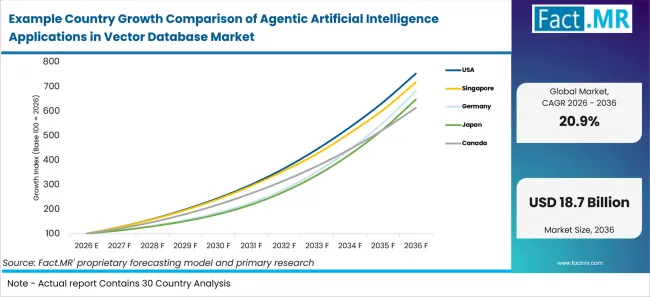
Example Country Growth Comparison Of Agentic Artificial Intelligence Applications In Vector Database Market | Source: Fact.MR
Country-wise CAGR Forecast, 2026-2036
| Country | CAGR |
|---|---|
| USA | 22.4% |
| Singapore | 21.8% |
| Germany | 21.2% |
| Japan | 20.6% |
| Canada | 19.9% |
| UK | 19.3% |
| Australia | 18.7% |
Source: Fact.MR analysis. Updated Aug 10, 2026
What is driving the Agentic Artificial Intelligence Applications in Vector Database Market in the USA?
The USA is projected to register a 22.4% CAGR through 2036.
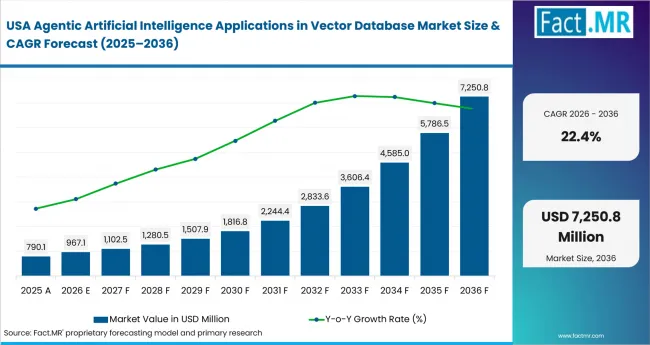
Agentic Artificial Intelligence Applications In Vector Database Market Country Value Analysis | Source: Fact.MR
- Large enterprises provide an early commercial base for agentic retrieval because they have the data volumes and engineering resources required to move agents into operational workflows. The U.S. Census Bureau reported in May 2026 that 37% of firms with at least 250 employees were already using AI in business operations.
- As these deployments connect with proprietary records, agents require retrieval systems that can find current information while preserving access controls. This supports spending on vector search, retrieval orchestration and enterprise context services integrated with existing cloud and application environments.
What is driving the Agentic Artificial Intelligence Applications in Vector Database Market in Singapore?
Singapore is projected to register a 21.8% CAGR through 2036.
- Singapore combines enterprise AI deployment with governance designed specifically for autonomous systems. IMDA updated its Model AI Governance Framework for Agentic AI in May 2026 after its initial January launch.
- The framework addresses risks associated with agents accessing data and performing actions. This increases the importance of controlled retrieval, identity enforcement and traceability when vector databases are connected to production agents.
What is driving the Agentic Artificial Intelligence Applications in Vector Database Market in Germany?
Germany is projected to register a 21.2% CAGR through 2036.
- Germany is expanding domestic AI infrastructure while enterprises evaluate deployment within data-sensitive industrial environments. The European Commission's second wave of AI Factories, announced in March 2025, included a German facility.
- Vector-database demand therefore extends beyond public-cloud experimentation. Enterprises require retrieval systems that can integrate with existing data environments while supporting deployment controls required for regulated and industrial workloads.
What is driving the Agentic Artificial Intelligence Applications in Vector Database Market in Japan?
Japan is projected to register a 20.6% CAGR through 2036.
- Japanese enterprises are scaling AI within established governance and risk-management processes. METI's AI Guidelines for Business Version 1.2 provide guidance for organizations developing and using AI systems.
- As agents gain greater autonomy, enterprises need to control which information can be retrieved and retain visibility into how context reaches the model. This supports vector infrastructure with permission controls and traceable retrieval workflows.
What is driving the Agentic Artificial Intelligence Applications in Vector Database Market in Canada?
Canada is projected to register a 19.9% CAGR through 2036.
- Canada is developing more specific governance for agentic systems as AI moves beyond content generation toward systems capable of taking actions. Federal guidance on agentic AI calls for organizations to involve privacy, security and legal specialists early when such systems are piloted or deployed.
- This strengthens the use case for retrieval architectures that separate enterprise context from the underlying model and preserve access restrictions when agents interact with internal information.
What is driving the Agentic Artificial Intelligence Applications in Vector Database Market in the UK?
The UK is projected to register a 19.3% CAGR through 2036.
- The UK continues to support AI deployment through the AI Opportunities Action Plan. The government's January 2026 progress report documents implementation across infrastructure and public-sector adoption initiatives.
- As deployments move into operational use, enterprises require retrieval systems that can demonstrate context quality and permission enforcement. Vector-database providers therefore compete increasingly on production controls rather than search performance alone.
What is driving the Agentic Artificial Intelligence Applications in Vector Database Market in Australia?
Australia is projected to register an 18.7% CAGR through 2036.
- Australian organizations are adopting AI within a policy environment that emphasizes responsible deployment. The government's Voluntary AI Safety Standard provides practical guidance for organizations using AI, including system testing and monitoring.
- For agentic applications, this places greater importance on controlled access to enterprise information and measurable retrieval performance. Vector infrastructure that can support governance while remaining compatible with cloud deployments is therefore better aligned with production use.
Who leads the Agentic Artificial Intelligence Applications in Vector Database Market?
- Pinecone Systems, Inc., Weaviate B.V. and Zilliz Corporation compete through vector-native retrieval infrastructure designed around AI and agent workflows. Pinecone Assistant connects managed vector retrieval with agentic applications, while Weaviate's Query Agent can plan searches across collections. Zilliz Cloud provides managed Milvus infrastructure with vector, full-text and hybrid retrieval capabilities.
- MongoDB, Inc., Elastic N.V. and Redis Ltd. approach the market from broader data platforms. MongoDB combines operational data with vector and full-text retrieval for agentic RAG. Elastic connects its search infrastructure with Agent Builder, while Redis has expanded its platform with Vector Sets and agent-oriented memory capabilities. These architectures appeal to organizations that want retrieval closer to data already used by production applications.
- Oracle Corporation, Microsoft Corporation and Amazon Web Services, Inc. compete through broader enterprise cloud and database relationships. Oracle, for example, connects its enterprise AI agent environment with vector stores and database retrieval. These providers can position retrieval alongside identity controls and existing enterprise infrastructure, which can reduce integration work for customers already operating within their ecosystems.
- Competition therefore depends on retrieval quality under real enterprise workloads. Buyers assess hybrid search and reranking alongside permission enforcement and deployment flexibility. Agent observability and query economics also become more important because a single multi-step task may trigger several retrieval operations before an agent produces an output.
- DataStax should be treated carefully in the company analysis. IBM announced its acquisition of DataStax in 2025, and current DataStax documentation identifies products that were renamed following IBM's acquisition. The company can remain in the supplied company list, but its current ownership should be stated rather than presenting it as an independent competitor.
Which companies are the key providers?
Key companies include Pinecone Systems, Inc.; Weaviate B.V.; Zilliz Corporation; MongoDB, Inc.; DataStax, Inc. (now part of IBM); Elastic N.V.; Redis Ltd.; Oracle Corporation; Microsoft Corporation; and Amazon Web Services, Inc.
- Pinecone Systems, Inc.
- Weaviate B.V.
- Zilliz Corporation
- MongoDB, Inc.
- DataStax, Inc. (now part of IBM)
- Elastic N.V.
- Redis Ltd.
- Oracle Corporation
- Microsoft Corporation
- Amazon Web Services, Inc.
Bibliography
- U.S. Census Bureau. (2026). Large Firms With at Least 20 Employees Biggest AI Users. U.S. Department of Commerce.
- Infocomm Media Development Authority. (2026). Model AI Governance Framework for Agentic AI, Version 1.5. Government of Singapore.
- European Commission. (2026). AI Act: Regulatory Framework for Artificial Intelligence. European Union.
- European Commission. (2025). Second Wave of AI Factories Set to Drive EU-wide Innovation. European Union.
- Ministry of Economy, Trade and Industry, Japan. (2026). AI Guidelines for Business Version 1.2. Government of Japan.
- Government of Canada. (2026). Guide on the Use of Agentic Artificial Intelligence. Treasury Board of Canada Secretariat.
- UK Department for Science, Innovation and Technology. (2026). AI Opportunities Action Plan: One Year On. UK Government.
- Australian Department of Industry, Science and Resources. (2024). Voluntary AI Safety Standard. Australian Government.
- National Institute of Standards and Technology. (2024). Artificial Intelligence Risk Management Framework: Generative Artificial Intelligence Profile. U.S. Department of Commerce.
- Pinecone Systems, Inc. (2025). Pinecone Assistant Is Generally Available.
- Weaviate B.V. (2025). Introducing the Weaviate Query Agent.
- MongoDB, Inc. (2025). MongoDB Announces Acquisition of Voyage AI.
- Microsoft Corporation. (2025). Azure AI Foundry: Your AI App and Agent Factory.
- Amazon Web Services, Inc. (2025). Announcing Amazon S3 Vectors in Preview.
- Zilliz Corporation. (2025). Zilliz Cloud Release Notes: Milvus 2.5 Public Preview.
- Redis Ltd. (2025). Introducing LangCache and Vector Sets for AI Applications.
- Elastic N.V. (2026). Agent Builder Now Generally Available.
- Oracle Corporation. (2025). OCI Generative AI Agents Platform Adds New Tools.
- IBM. (2025). IBM to Acquire DataStax, Deepening watsonx Capabilities and Addressing Generative AI Data Needs for the Enterprise.
This Report Answers
- The report evaluates demand for agentic AI applications using vector databases across Solution Type, Agentic AI Function, End-use Industry, Organization Type and Vector Database Architecture.
- Segment analysis identifies the leading categories within each main segment.
- Country analysis compares growth across the USA, Singapore, Germany, Japan, Canada, the UK and Australia.
- Competitive analysis reviews vector-native specialists alongside broader data-platform and enterprise cloud providers.
- The scope distinguishes agentic AI applications using vector databases from adjacent AI infrastructure, general-purpose databases and unrelated enterprise software.
What does the Agentic Artificial Intelligence Applications in Vector Database Market cover?
The Agentic Artificial Intelligence Applications in Vector Database Market covers vector retrieval infrastructure and associated platforms used by AI agents to access relevant context from enterprise data.
- The market includes solutions that allow agents to retrieve information from indexed documents or application data before answering questions or performing tasks. Retrieval may be combined with query planning, reranking, hybrid search, orchestration and access controls when these capabilities form part of the agentic retrieval workflow.
What is included in the scope?
The scope includes vector database and retrieval capabilities used within agentic AI applications where enterprise or application data must be retrieved dynamically during task execution.
- It includes AI Agent Platforms and Knowledge Retrieval applications serving Information Technology and other assessed industries. Demand from Large Enterprises and other organization categories is included where vector retrieval forms part of an operational agent architecture.
- Managed cloud services and enterprise deployments are included when vector retrieval supports AI-agent access to proprietary or application-specific information.
What is excluded from the scope?
The scope excludes conventional databases or search systems used without an agentic AI retrieval workflow.
- Standalone generative AI applications that rely entirely on model knowledge without retrieving external context are outside the market. General-purpose database infrastructure is excluded when vector capabilities are not used for agent retrieval or related AI applications.
- Model training infrastructure and unrelated AI software are also excluded unless vector retrieval forms a direct part of the agentic application.
How Was the Analysis Built?
The analysis combines structured desk research, company and product mapping and expert validation across the agentic AI and vector-database ecosystem.
- Primary Research: Interviews and expert discussions with enterprise AI teams, data-platform specialists, software providers and technology buyers assess retrieval requirements, deployment preferences, security concerns and purchasing criteria.
- Desk Research: Research covers government AI policy, public-sector guidance, company product documentation and technical material related to vector databases, enterprise retrieval and agentic AI.
- Market Sizing and Forecasting: Estimates consider enterprise AI adoption, vector-retrieval deployment, agent workload requirements, organization size and country-level adoption patterns. Top-down market indicators are reconciled with bottom-up supplier and use-case analysis.
- Data Validation and Update Cycle: Findings are cross-checked against company activity and authoritative public evidence. Updates review changes in agent platforms, vector retrieval capabilities, acquisitions and enterprise AI governance.
Segmentation
What is the report's scope and coverage?
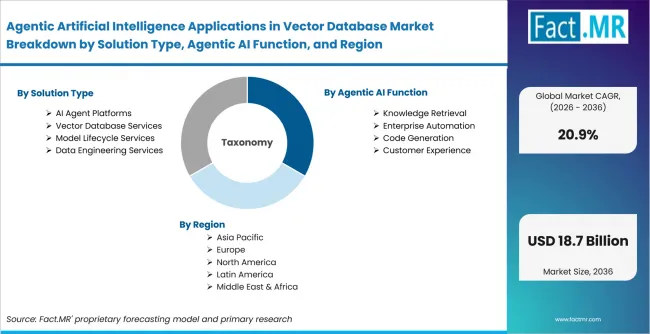
Agentic Artificial Intelligence Applications In Vector Database Market Breakdown By Solution Type, Agentic Ai Function, And Region | Source: Fact.MR
| Attribute | Details |
| Quantitative Units | USD 2.8 billion in 2026 to USD 18.6 billion by 2036, at a 20.9% CAGR |
| Market Definition | Agentic artificial intelligence applications using vector database infrastructure to retrieve enterprise context and support agent reasoning, decision-making and workflow execution |
| Segments Covered | Solution Type; Agentic AI Function; End-use Industry; Organization Type; Vector Database Architecture |
| Regions Covered | North America; Europe; East Asia; South Asia & Oceania; and other regions assessed in the full study |
| Countries Covered | USA; Singapore; Germany; Japan; Canada; UK; Australia |
| Key Companies Profiled | Pinecone Systems, Inc.; Weaviate B.V.; Zilliz Corporation; MongoDB, Inc.; Elastic N.V.; and others |
| Forecast Period | 2026 to 2036 |
| Base Year | 2025 |
| Market Value, 2026 | USD 2.8 billion |
| Market Value, 2036 | USD 18.6 billion |
| Absolute Dollar Opportunity | USD 15.8 billion |
| Approach | Hybrid top-down and bottom-up market assessment |
Source: Fact.MR analysis. Updated Aug 10, 2026
How is the market segmented?
-
Solution Type
- AI Agent Platforms
- Autonomous AI Agents
- Multi-agent Orchestration
- Vector Database Services
- Deployment & Integration
- Managed Operations
- Model Lifecycle Services
- Model Fine-tuning
- Model Monitoring
- Data Engineering Services
- Data Preparation
- Data Vectorization
- AI Agent Platforms
-
Agentic AI Function
- Knowledge Retrieval
- RAG Workflows
- Context-aware Search
- Enterprise Automation
- Intelligent Process Automation
- Digital Employee Assistants
- Code Generation
- Developer Copilots
- Software Engineering Agents
- Customer Experience
- Intelligent Customer Support
- Virtual Sales Assistants
- Knowledge Retrieval
-
End-use Industry
- Information Technology
- Software Development
- Cloud Computing
- Financial Services
- Banking & Insurance
- Investment Management
- Healthcare
- Hospitals & Clinics
- Life Sciences
- Retail & E-commerce
- Online Retailers
- Brick-and-Mortar Retailers
- Information Technology
-
Organization Type
- Large Enterprises
- Global Technology Companies
- AI-native Startups
- Small & Medium Enterprises
- Research Organizations
- Public Sector Organizations
- AI Platform Providers
- System Integrators
- Independent Software Vendors
- Cloud Service Providers
- Digital Commerce Platforms
- Enterprise Commerce Teams
- Large Enterprises
-
Vector Database Architecture
- Cloud-native Vector Database
- Serverless Architecture
- Distributed Storage Engine
- Hybrid Deployment
- Managed Cloud Database
- Multi-cloud Infrastructure
- Embedding Optimization Engine
- Vector Compression Layer
- Hybrid Indexing Framework
- Real-time Indexing Engine
- Low-latency Retrieval Engine
- Semantic Search Optimization
- Cloud-native Vector Database
-
Region
- North America
- Latin America
- Western Europe
- Eastern Europe
- East Asia
- South Asia and Pacific
- Middle East & Africa
Frequently Asked Questions
How big is the Agentic Artificial Intelligence Applications in Vector Database Market in 2026?
What is the CAGR of the Agentic Artificial Intelligence Applications in Vector Database Market from 2026 to 2036?
How much will the Agentic Artificial Intelligence Applications in Vector Database Market add between 2026 and 2036?
Which Solution Type leads the market?
Which Agentic AI Function leads the market?
Which End-use Industry leads the market?
Which Organization Type leads the market?
Which country records the highest listed CAGR?
Who worked on this report


Preview the report firsthand - request a free sample
Free SampleGet the brochure for pricing and purchase details
Download PDF