- Market Value (2025): USD 0.4 Bn
- Estimated Value (2026): USD 0.6 Bn
- Forecast Value (2036): USD 23.0 Bn
- CAGR (2026-2036): 44.0%
What is the AI agent audit & assurance services market forecast to be worth by 2036?
- The AI agent audit and assurance services market crossed a valuation of USD 0.4 billion in 2025.
- Demand is set to rise from USD 0.6 billion in 2026 to USD 23.0 billion by 2036.
- The market is forecast to record 44.0% CAGR from 2026 to 2036 as enterprises need independent testing before autonomous AI agents enter live workflows.
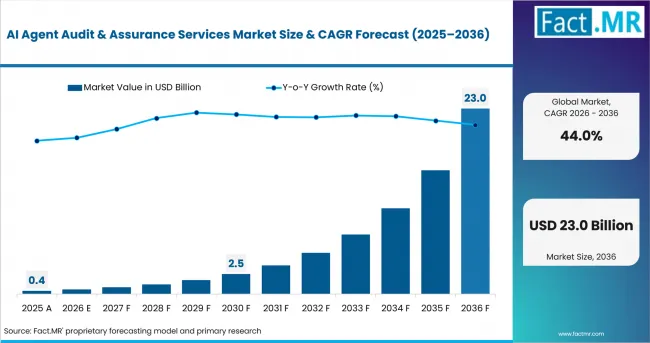
Ai Agent Audit & Assurance Services Market Value Analysis | Source: Fact.MR
Summary of AI Agent Audit & Assurance Services Market
- Demand Drivers in the Market
- Guardian Agent Spend: Guardian agent technologies are expected to capture 10% to 15% of agentic AI markets by 2030. This supports demand for controls that monitor autonomous agents.
- Regulatory Pressure: Risk-based AI rules are raising the need for audit support across higher-risk AI uses.
- Assurance Commercialization: Third-party AI assurance services are becoming more commercialized as enterprises seek stronger validation before deployment.
- Key Segments Analyzed
- By Service Type: Runtime assurance monitoring is expected to hold 31.0% share in 2026 because agents need review after deployment.
- By Audit Scope: Compliance audit is likely to account for 29.0% share in 2026 as regulated firms need evidence before rollout.
- By Delivery Model: Independent third-party audit is projected to capture 37.0% share in 2026 since external attestation supports risk review.
- By Enterprise Size: Large enterprises are anticipated to hold 81.0% share in 2026 because complex workflows create stronger assurance needs.
- By End Use: BFSI is expected to represent 27.0% share in 2026 because banks need audit trails before agents affect regulated workflows.
- By Geography: The United States is projected to grow at 46.8% CAGR through 2036 as enterprise AI scale raises assurance demand.
- Analyst Opinion at Fact.MR
- Shambhu Nath Jha, Senior Analyst at Fact.MR, states, “AI agent assurance will become the control point between experimentation and live deployment. Demand will be strongest among firms that cannot allow agents to act on trust alone. Auditability and clear scope boundaries will decide which agents move into production.”
- Strategic Implications
- Audit Readiness: AI governance heads should create agent records before requesting external assurance.
- Runtime Evidence: Internal audit teams need logs that show agent decisions and tool actions.
- Insurance Review: Risk leaders should prepare third-party assurance files for high-autonomy agent use cases.
| Metric | Details |
|---|---|
| Industry Size 2026 | USD 0.6 billion |
| Industry Value 2036 | USD 23.0 billion |
| CAGR 2026 to 2036 | 44.0% |
Source: Fact.MR analysis. Updated Jun 18, 2026
AI agent assurance is becoming a permission layer for enterprise AI. Internal pilots can move quickly, but production agents need stronger evidence before they gain access to systems and data. This supports demand for audit services that test compliance and scope drift.
The United States is projected to record 46.8% CAGR from 2026 to 2036 as AI platform adoption raises third-party assurance demand. The United Kingdom is likely to post 45.2% CAGR as financial firms require stronger audit records. Germany is set to advance at 43.9% CAGR because EU AI Act compliance supports documentation and testing. Singapore is forecast at 42.7% CAGR by 2036 as regulated digital firms adopt AI governance controls. Japan is expected to register 41.5% CAGR as enterprise trust reviews shape agent deployment.
How does the AI agent audit & assurance services market break down by segment?
AI Agent Audit & Assurance Services Market Analysis by Service Type
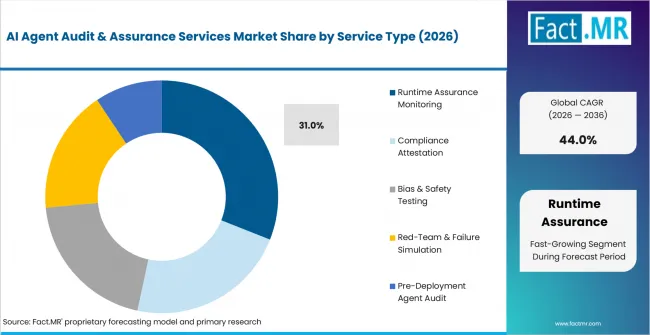
Ai Agent Audit & Assurance Services Market Analysis By Service Type | Source: Fact.MR
Runtime assurance monitoring leads because agent risk continues after launch. Autonomous agents can drift in scope as prompts and access rules change. The segment is expected to hold 31.0% share in 2026. Pre-deployment audit supports approval before production. Red-team simulation tests failure paths. Compliance attestation helps boards review evidence before wider rollout.
- Runtime Review: Monitoring services check agent actions after launch and identify unsafe changes.
- Pre-Launch Audit: Pre-deployment audits test agent scope before access to live systems.
- Failure Simulation: Red-team services test prompt attacks and unsafe tool-use paths.
AI Agent Audit & Assurance Services Market Analysis by Audit Scope
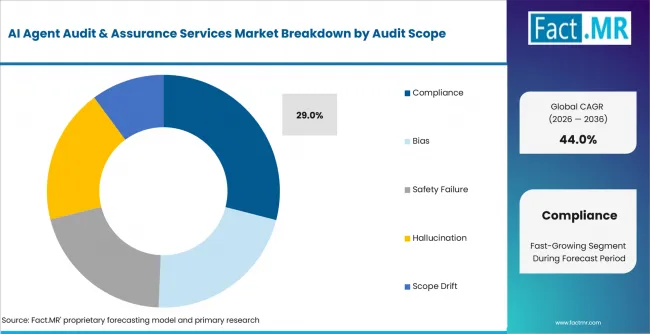
Ai Agent Audit & Assurance Services Market Analysis By Audit Scope | Source: Fact.MR
Compliance audit is likely to account for 29.0% share in 2026 as regulated firms need evidence before agent rollout. Bias testing supports HR and credit workflows. Safety failure review checks whether agents can take harmful action. Hallucination audits test unsupported outputs in decision-support use cases. Scope drift review checks whether agents move beyond approved instructions.
- Compliance Proof: Compliance audit leads because enterprises need structured records for regulation and board review.
- Bias Testing: Bias audits review unfair outcomes in customer and employee workflows.
- Scope Drift: Scope checks detect agents acting outside approved tasks or access limits.
AI Agent Audit & Assurance Services Market Analysis by Delivery Model
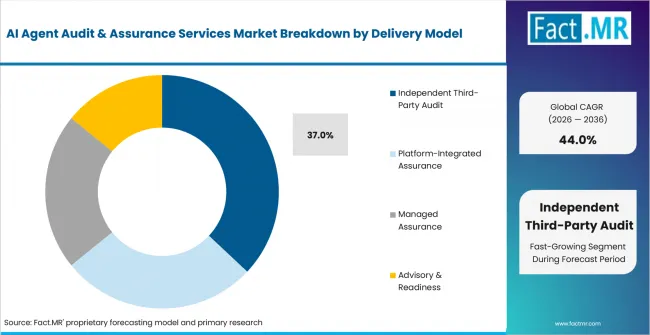
Ai Agent Audit & Assurance Services Market Analysis By Delivery Model | Source: Fact.MR
Independent third-party audit is projected to capture 37.0% share in 2026 because external attestation supports board and insurer confidence. Platform-integrated assurance helps enterprises monitor agents inside existing AI systems. Managed assurance supports recurring review after deployment. Advisory services prepare policies and evidence files before audit. Independent audit leads because self-certification may not satisfy high-risk stakeholders.
- Third-Party Proof: Independent audits give boards a stronger evidence base for agent approval.
- Managed Assurance: Managed services support recurring checks as agents and workflows change.
- Platform Evidence: Integrated assurance tools collect logs that support formal review.
AI Agent Audit & Assurance Services Market Analysis by Enterprise Size
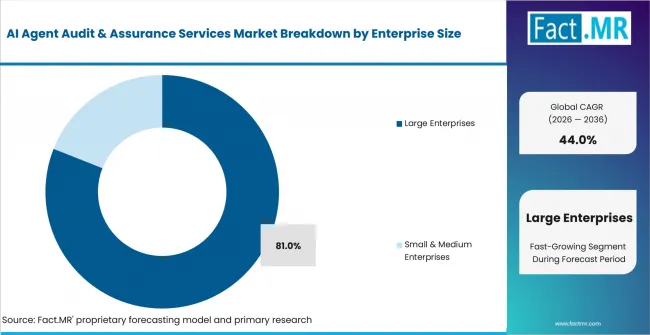
Ai Agent Audit & Assurance Services Market Analysis By Enterprise Size | Source: Fact.MR
Large enterprises lead because they deploy agents across more systems and risk functions. These firms have deeper exposure to regulatory review and litigation. The segment is anticipated to hold 81.0% share in 2026 because large enterprises need assurance before agents touch customer data or financial workflows. Small and medium enterprises will adopt through packaged audit templates.
- Large Enterprise Demand: Large firms need stronger proof before agents access regulated workflows.
- SME Adoption: Smaller firms adopt packaged audits after insurers or customers request evidence.
- Board Oversight: Enterprise boards need audit files that explain agent scope and control limits.
AI Agent Audit & Assurance Services Market Analysis by End Use
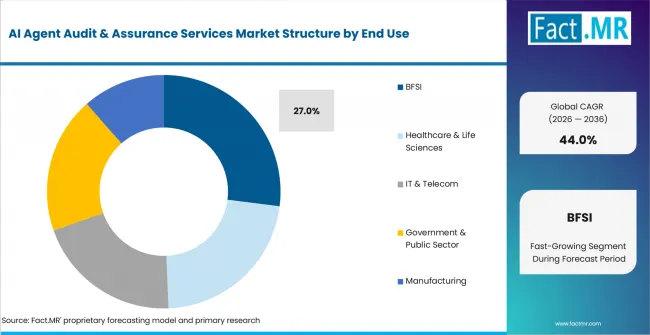
Ai Agent Audit & Assurance Services Market Analysis By End Use | Source: Fact.MR
BFSI is expected to represent 27.0% share in 2026 because banks need audit trails before agents affect regulated workflows. Healthcare and life sciences need assurance before agents touch clinical support or patient data processes. IT and telecom firms need tests for service agents. Government agencies require careful review before citizen-facing use. Manufacturing demand will grow through quality and supplier workflow agents.
- BFSI Assurance: BFSI leads because agent output must be traceable and reviewable.
- Healthcare Controls: Healthcare firms need patient-data safeguards before agent deployment.
- Public Sector Review: Public agencies need assurance before agents support citizen services.
What is accelerating AI agent audit & assurance services adoption, and what is holding it back?
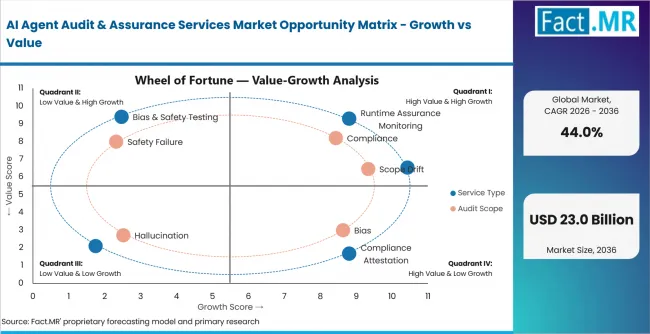
Ai Agent Audit & Assurance Services Market Opportunity Matrix Growth Vs Value | Source: Fact.MR
The main driver is the rise of autonomous AI agents that can act across enterprise systems. NIST’s GenAI Profile supports structured risk identification for generative AI systems. [1] This creates stronger demand for audit and assurance services that check agent behavior, access control and decision reliability before wider deployment.
The main restraint is the lack of consistent agent audit methods. Traditional model validation often tests a static model. AI agents need review across prompts, tools, memory and escalation paths. Enterprises may delay external assurance if audit criteria are unclear. Service providers must convert regulatory language into repeatable test procedures. This gap creates demand for assurance playbooks but slows early standardization.
Opportunities in the AI Agent Audit & Assurance Services Market
- Pre-Deployment Attestation: Audit firms can certify high-risk agents before production use.
- Runtime Assurance: Providers can monitor agent actions and issue recurring control reports.
- Insurer-Ready Evidence: Assurance providers can package control records for cyber and technology risk reviews.
Which countries are scaling AI agent audit & assurance services demand fastest?
Based on regional analysis, the AI agent audit and assurance services market is segmented into North America, Western Europe, South Asia and Pacific, East Asia, and other regions.
.webp "Top Country Growth Comparison Ai Agent Audit & Assurance Services Market Cagr (2026 2036)")
Top Country Growth Comparison Ai Agent Audit & Assurance Services Market Cagr (2026 2036) | Source: Fact.MR
| Country | CAGR 2026 to 2036 |
|---|---|
| United States | 46.8% |
| United Kingdom | 45.2% |
| Germany | 43.9% |
| Singapore | 42.7% |
| Japan | 41.5% |
Source: Fact.MR analysis. Updated Jun 18, 2026
Source: Fact.MR directional estimate and primary research model
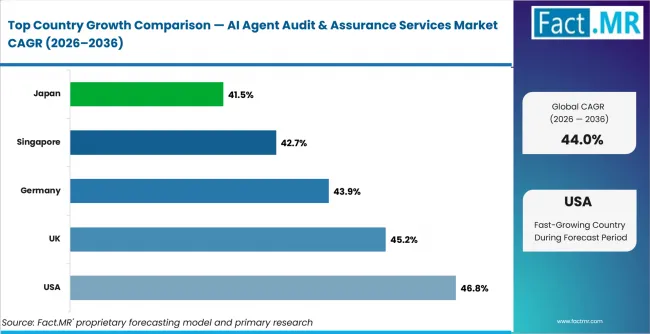
Ai Agent Audit & Assurance Services Market Cagr Analysis By Country | Source: Fact.MR
North America AI Agent Audit & Assurance Services Market Analysis
North America demand is led by the United States. AI adoption is moving from pilots toward production agents. Audit firms and governance platforms are building assurance offerings for enterprise AI control.
- United States: The United States is projected to record 46.8% CAGR through 2036 as AI agents move into regulated enterprise workflows. Large banks and technology companies need third-party proof before agents access customer records or business systems. Gartner’s guardian agent forecast supports the oversight-spend case [2]. Growth will favor providers that combine technical testing with formal audit evidence. Insurance reviews and board risk committees will support recurring assurance demand.
The United States will favor audit firms and AI governance platforms with repeatable testing methods. Runtime review will become a recurring service line.
Western Europe AI Agent Audit & Assurance Services Market Analysis
Western Europe demand is led by the United Kingdom and Germany. AI Act obligations and financial-sector governance support early assurance demand. Firms need proof before agents enter customer or employee workflows.
- United Kingdom: The United Kingdom is likely to post 45.2% CAGR by 2036 as banks and professional services firms test agentic AI under strict internal review. UK enterprises will need independent audit records before agents act in compliance or customer operations. Audit firms have a strong local base and can convert existing assurance relationships into AI agent review services. Demand will favor providers that offer pre-deployment tests and post-launch monitoring. Board committees will ask for evidence that agents stay within approved scope and escalation rules.
- Germany: Germany is set to advance at 43.9% CAGR over the forecast period because EU AI Act compliance will push stronger documentation and testing. Industrial firms and banks will need agent audit records before connecting agents to operational data or customer systems. The European Commission describes the AI Act as a risk-based legal framework for developers and deployers [3]. German enterprises will favor structured methods and clear technical documentation. External assurance will grow as firms seek proof for compliance teams and insurers. Adoption will be careful but commercially deep.
South Asia and Pacific AI Agent Audit & Assurance Services Market Analysis
South Asia and Pacific demand is led by Singapore among the selected country set. Financial services, government digital programs and regional technology hubs create early assurance need.
- Singapore: Singapore is forecast at 42.7% CAGR through 2036 as regulated digital firms adopt agent testing for finance and public-service workflows. AI governance maturity supports demand for audit-ready evidence before deployment. Regional banks will need assurance for agents that review documents or interact with customers. Consulting firms can package audit frameworks for ASEAN headquarters based in Singapore. Growth will favor providers that combine regulatory understanding with technical testing.
East Asia AI Agent Audit & Assurance Services Market Analysis
East Asia demand is supported by Japan’s trust-led enterprise culture and cautious adoption of autonomous systems. Audit evidence will be important for regulated firms and industrial technology users.
- Japan: Japan is expected to register 41.5% CAGR from 2026 to 2036 as enterprises adopt AI agents carefully across finance, manufacturing and service operations. Japan’s AI Safety Institute stated on March 28, 2025 that AI safety evaluation can help developers and providers confirm whether preventive measures are effective, with evaluation perspectives covering fairness, privacy protection, security, transparency, robustness, data quality and verifiability [4]. Japanese firms will require strong documentation before agents gain access to customer or operational data.
Who leads the AI agent audit & assurance services market landscape?
Ai Agent Audit & Assurance Services Market Analysis By Company | Source: Fact.MR
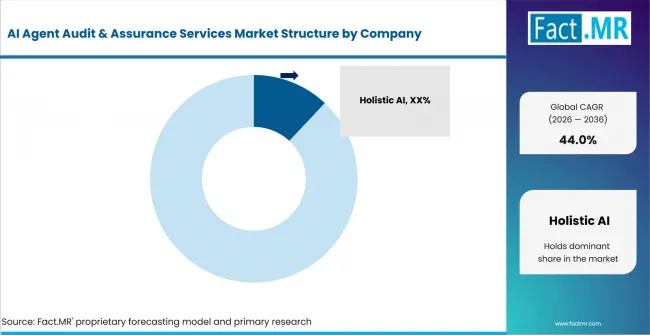
The AI agent audit and assurance services market includes audit firms, AI governance platforms, certification bodies and specialist testing providers. PwC supports AI assurance through independent services that review AI governance frameworks, control environments, monitoring procedures, testing practices, data sourcing and risks such as bias or drift [5]. Demand is rising as enterprises need evidence-based assurance before scaling AI systems. Credo AI and Holistic AI support governance evidence and risk review.
Competition is centered on evidence quality and method repeatability. Big audit firms compete through board access and assurance credibility. AI governance platforms compete through continuous monitoring and control records. Certification bodies compete through AI management system audits. Specialist testing firms compete through red-team depth and failure simulation.
By 2036, supplier strength will come from agent-specific audit methods. Providers must test prompts, tool access, memory behavior and scope limits. Firms that can issue board-ready reports and insurer-ready evidence can support repeat assurance programs. Providers that combine technical testing with compliance mapping and runtime monitoring can improve customer acceptance.
Which companies are the key players?
- Holistic AI
- BABL AI
- Credo AI
- PwC
- EY
- Luminos
Bibliography
- [1] Autio, C., Schwartz, R., Dunietz, J., Jain, S., Stanley, M., Tabassi, E., Hall, P., & Roberts, K. (2024, July 26). Artificial Intelligence Risk Management Framework: Generative Artificial Intelligence Profile (NIST AI 600-1). National Institute of Standards and Technology.
- [2] Gartner. (2025, June 11). Gartner predicts that guardian agents will capture 10-15% of the agentic AI market by 2030.
- [3] European Commission. (2026, May 11). AI Act. Shaping Europe’s Digital Future.
- [4] Japan AI Safety Institute. (2025, March 28). Guide to Evaluation Perspectives on AI Safety: Version 1.10.
- [5] PwC. (2025, June 3). PwC launches first-to-market solution to provide assurance For AI.
This Report Addresses
- Strategic intelligence on AI agent audit and assurance services across service type, audit scope and delivery model.
- Forecast mapping from USD 0.6 billion in 2026 to USD 23.0 billion by 2036.
- Segment analysis covering runtime assurance, compliance audit and independent third-party audit.
- Regional outlook covering the United States, United Kingdom, Germany, Singapore and Japan.
- Competitive analysis of audit firms, AI governance platforms and certification bodies.
- Service opportunity review across pre-deployment audit, runtime assurance and compliance attestation.
- Verified catalyst review based on guardian agent oversight demand and regulatory pressure.
What does the AI agent audit & assurance services market cover?
The AI agent audit and assurance services market covers independent services that test and review autonomous AI agents before and after deployment. These services examine compliance posture and scope drift. The market differs from AI governance software because it focuses on external review and formal assurance evidence.
AI Agent Audit & Assurance Services Market Inclusions
The scope includes pre-deployment testing and compliance attestation. It includes audit readiness services for AI agents used in finance and customer workflows. Independent audit firms and AI assurance specialists are included.
AI Agent Audit & Assurance Services Market Exclusions
The scope excludes general AI consulting without an audit output. It excludes standard cybersecurity testing unless the service reviews AI agent behavior. It excludes software-only monitoring tools without assurance delivery. Basic chatbot testing is outside scope because the market focuses on autonomous agents that plan actions or use enterprise tools.
AI Agent Audit & Assurance Services Market Research Methodology
- Primary Research:
- Primary research includes interviews with AI governance heads and internal audit leaders. CISO teams and model risk managers were reviewed separately.
- Desk Research:
- Desk research reviews AI risk frameworks and regulatory guidance. Provider announcements and assurance service pages support competitive validation.
- Market-Sizing and Forecasting:
- Market estimates are developed through enterprise AI adoption signals and regional validation.
- Data Validation and Update Cycle:
- Forecasts are checked through provider activity and official catalyst tracking.
Segmentation
What is the report’s scope and coverage?
Ai Agent Audit & Assurance Services Market Breakdown By Service Type, Audit Scope, And Region | Source: Fact.MR
| Attribute | Details |
|---|---|
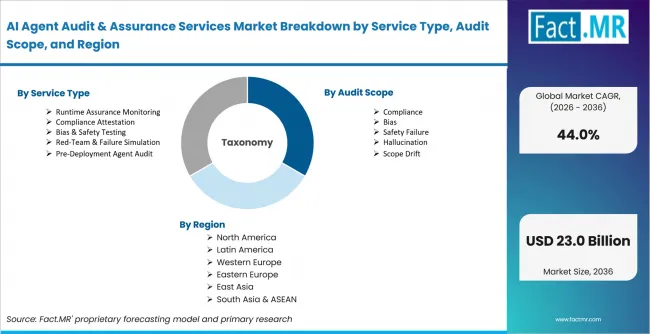
| Quantitative Units | USD 0.6 billion in 2026 to USD 23.0 billion by 2036 at 44.0% CAGR |
| Market Definition | Independent audit and assurance services for autonomous AI agents before and after deployment |
| Service Type | Pre-Deployment Agent Audit, Runtime Assurance Monitoring, Compliance Attestation, Bias & Safety Testing, Red-Team & Failure Simulation |
| Audit Scope | Compliance, Bias, Safety Failure, Hallucination, Scope Drift |
| Delivery Model | Independent Third-Party Audit, Platform-Integrated Assurance, Managed Assurance, Advisory & Readiness |
| Enterprise Size | Large Enterprises, Small & Medium Enterprises |
| End Use | BFSI, Healthcare & Life Sciences, IT & Telecom, Government & Public Sector, Manufacturing |
| Regions Covered | North America, Western Europe, South Asia and Pacific, East Asia, Other Regions |
| Countries Covered | United States, United Kingdom, Germany, Singapore, Japan |
| Key Companies Profiled | Holistic AI, BABL AI, Credo AI, PwC, EY, Luminos |
| Forecast Period | 2026 to 2036 |
| Approach | Hybrid top-down and bottom-up approach using guardian-agent oversight demand, regulated-sector adoption, assurance service intensity and provider validation |
Source: Fact.MR analysis. Updated Jun 18, 2026
How is the market segmented?
-
By Service Type:
- Pre-Deployment Agent Audit
- Runtime Assurance Monitoring
- Compliance Attestation
- Bias & Safety Testing
- Red-Team & Failure Simulation
-
By Audit Scope:
- Compliance
- Bias
- Safety Failure
- Hallucination
- Scope Drift
-
By Delivery Model:
- Independent Third-Party Audit
- Platform-Integrated Assurance
- Managed Assurance
- Advisory & Readiness
-
By Enterprise Size:
- Large Enterprises
- Small & Medium Enterprises
-
By End Use:
- BFSI
- Healthcare & Life Sciences
- IT & Telecom
- Government & Public Sector
- Manufacturing
-
By Region:
- North America
- United States
- Canada
- Western Europe
- United Kingdom
- Germany
- France
- Netherlands
- Spain
- South Asia and Pacific
- Singapore
- India
- Australia and New Zealand
- East Asia
- Japan
- South Korea
- China
- Other Regions
- Latin America
- Middle East and Africa
- North America
Frequently Asked Questions
What is the AI Agent Audit & Assurance Services Market size in 2026?
What will the AI Agent Audit & Assurance Services Market be worth by 2036?
What CAGR is projected for the AI Agent Audit & Assurance Services Market?
Which service type leads the market?
Which country grows fastest in the market?
How does the United Kingdom perform in this market?
How does Germany perform in this market?
How does Singapore perform in this market?
How does Japan perform in this market?
Why is third-party assurance needed?
What restrains the market?
What is the main opportunity in this market?
Who worked on this report


Preview the report firsthand - request a free sample
Free SampleGet the brochure for pricing and purchase details
Download PDF