- Market Value (2025): USD 8.7 Bn
- Estimated Value (2026): USD 10.4 Bn
- Forecast Value (2036): USD 61.8 Bn
- CAGR (2026-2036): 19.5%
What is the Agentic Artificial Intelligence in Telecommunications and Network Management Market forecast to be worth by 2036?
The market is projected to grow from USD 10.4 billion in 2026 to USD 61.8 billion by 2036, registering a CAGR of 19.5%.
- The Agentic Artificial Intelligence in Telecommunications and Network Management market reached USD 8.7 billion in 2025.
- Demand is forecast to increase from USD 10.4 billion in 2026 to USD 61.8 billion by 2036.
- The market is forecast to expand at a CAGR of 19.5% from 2026 to 2036.
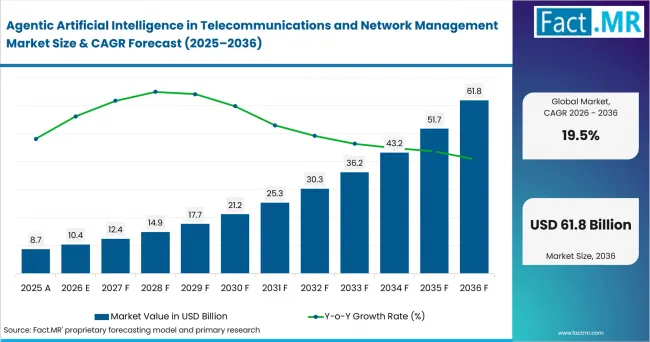
Agentic Artificial Intelligence In Telecommunications And Network Management Market Value Analysis | Source: Fact.MR
What are the defining numbers behind Agentic Artificial Intelligence in Telecommunications and Network Management Market growth?
An absolute dollar opportunity of USD 51.4 billion is expected between 2026 and 2036.
- Demand Drivers in the Market
- The main driver is the widening gap between network complexity and available engineering attention. Operators now manage radio and core domains with cloud platforms and external service dependencies, creating more conditions than teams can monitor manually.
- Agentic systems add value when they coordinate tools across operational tasks instead of producing a standalone recommendation. Buyers respond by funding operations agents and data connectors that shorten diagnosis, and they can redirect scarce specialists toward policy design and exceptional incidents.
- Industry bodies are documenting practical use cases. The GSMA AI Use Case Library documented uses for AI in energy management and service optimization in March 2025, and the Global Coalition on Telecommunications issued principles on AI adoption in January 2025.
- Standards provide a reference for closed-loop automation. The ETSI Zero-touch Network and Service Management framework gives operators a standards-based approach for intent and automation, and ITU-T published requirements for deploying and assessing generative AI models in telecom networks in March 2025.
- Vendors are shipping network agents. Cisco introduced AgenticOps in June 2025 to combine agents with network telemetry and domain automation, Google Cloud described its Autonomous Network Operations framework in June 2025, and Nokia upgraded its autonomous networks portfolio with agentic AI in June 2026.
- Public investment is expanding the funding base. NTIA reported in May 2025 that 94 applications sought nearly USD 3 billion for software-led wireless innovation in the United States, and South Korea’s 2025 MSIT budget plan funds network AI research.
- Key Segments Analyzed
- Network Operations Agents anchor the AI Agent Function segment with a 38.0% share in 2026, because fault triage and service assurance are frequent workflows with observable outcomes.
- Network Performance Optimization leads the Network Application segment, taking 36.0% of demand in 2026, as operators can tie agent recommendations to throughput and service-level measures.
- Telecommunication Service Providers is the dominant End-use Segment at 48.0% in 2026, reflecting the scale of operator investment in network automation.
- Tier-1 Telecom Operators lead the Organization Type segment with a 45.0% share in 2026, because they can spread integration costs across large network footprints.
- Cloud-native AI Agents lead the Deployment Architecture segment at 47.0% in 2026, as operators need elastic inference and shared context across distributed applications.
- Analyst Opinion at Fact.MR
- Shambhu Nath Jha, Sr. Consultant at Fact.MR, opines: “Network operators buy agentic AI when it can shorten fault isolation or improve service assurance without bypassing live-network controls. The useful product connects telemetry, topology, policy, and approved workflows so an engineer can see why an action is recommended and decide when automation is allowed. Vendors that help teams validate a change, record the outcome, and carry lessons into the next incident will be better positioned for production deployment.”
- Strategic Implications
- Network equipment vendors should connect agent layers to radio and core telemetry, because domain context and installed operations software are the entry point for operator trust.
- Compute and cloud providers should deliver elastic inference with workload-placement, identity, and audit controls, since operators require consistent governance across clouds and edge locations.
- Vendors should design modular agents with policy enforcement that can extend automation from one domain into end-to-end operations, generating recurring revenue across high-usage segments.
- Channel and service investment should follow the fastest-growing country markets, including the USA, UK, and South Korea, while adapting to local testbeds and regulation.
- Providers should invest in data-layer assembly and change controls, because buyers purchase an operating model that joins compute and network context with integration support rather than an isolated agent.
How does the Agentic Artificial Intelligence in Telecommunications and Network Management Market break down by segment?
The report evaluates AI Agent Function, Network Application, End-use Segment, Organization Type, Deployment Architecture, and Region. AI Agent Function includes Network Operations Agents, Security Intelligence Agents, Resource Optimization Agents, and Customer Experience Agents. Network Application covers Network Performance Optimization, Network Threat Detection, Spectrum Management, and Customer Support Automation. End-use Segment includes Telecommunication Service Providers, Network Infrastructure Vendors, Enterprise Networks, and Telecommunications Consulting. Organization Type covers Tier-1 Telecom Operators, Telecom Equipment Manufacturers, Large Enterprises, and System Integrators. Deployment Architecture includes Cloud-native AI Agents, Hybrid AI Infrastructure, Multi-agent Orchestration, and Foundation Model Integration. The regional structure follows North America, Latin America, Western Europe, Eastern Europe, East Asia, South Asia and Pacific, and Middle East & Africa.
Why do Network Operations Agents lead AI Agent Function?
Network Operations Agents is projected to account for a 38.0% share in 2026.
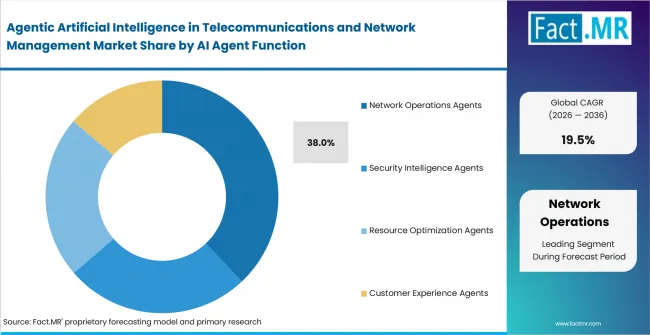
Agentic Artificial Intelligence In Telecommunications And Network Management Market Analysis By Ai Agent Function | Source: Fact.MR
Network Operations Agents lead because fault triage and service assurance are frequent workflows with observable outcomes. These agents can combine alarms and topology data, then suggest a sequence of checks or actions. The ETSI Zero-touch Network and Service Management framework gives operators a standards-based reference for intent and closed-loop automation, reducing the distance between an agent pilot and an existing operations process. Daily use produces repeatable feedback on false alarms and action quality, which supports renewal and expansion into adjacent assurance tasks. Cisco introduced AgenticOps in June 2025 to combine agents with network telemetry and domain automation across operations tasks.
Why does Network Performance Optimization lead Network Application?
Network Performance Optimization is projected to account for a 36.0% share in 2026.
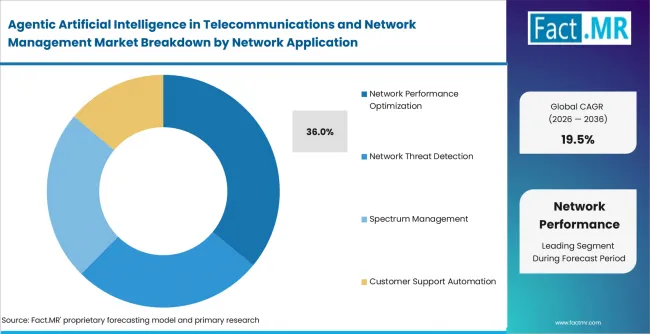
Agentic Artificial Intelligence In Telecommunications And Network Management Market Analysis By Network Application | Source: Fact.MR
Network Performance Optimization leads because operators can tie agent recommendations to throughput and service-level measures. Traffic engineering and quality monitoring provide continuous data that supports iterative learning under policy constraints. The ITU-T guidance on generative AI in telecom networks places assessment and deployment requirements around model use in network environments, so buyers can evaluate accuracy and operational risk against a defined task. Optimization programs often expand before fully autonomous remediation because recommendations can first pass through engineering approval, a staged path that protects service quality while building an evidence base for later automation.
Why do Telecommunication Service Providers lead End-use Segment?
Telecommunication Service Providers is projected to account for a 48.0% share in 2026.
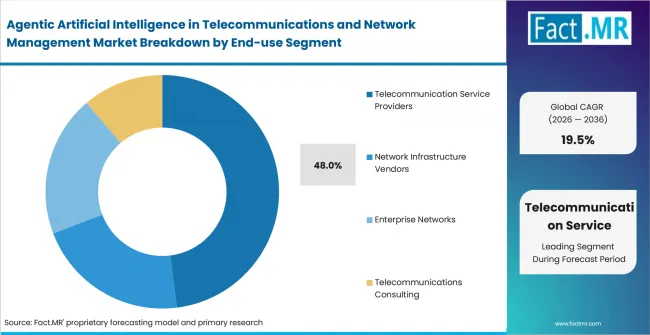
Agentic Artificial Intelligence In Telecommunications And Network Management Market Analysis By End Use Segment | Source: Fact.MR
Telecommunication service providers lead the End-use Segment because they operate the networks where reliability, capacity, and customer experience are measured directly against revenue. They manage multi-vendor radio and core domains, run cloud-native operations platforms, and face constant traffic and spectrum pressure, making them the earliest and largest buyers of agents that shorten fault isolation and capacity decisions. Their engineering teams are the ones adopting the ETSI Zero-touch framework and ITU-T guidance, and they fund the data-layer integration that agents depend on. Google Cloud described its Autonomous Network Operations framework in June 2025 with agents for radio and cross-domain operations, illustrating the operator-centric pattern.
Why do Tier-1 Telecom Operators lead Organization Type?
Tier-1 Telecom Operators is projected to account for a 45.0% share in 2026.
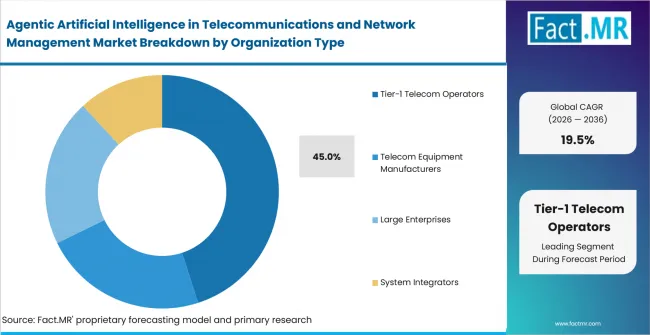
Agentic Artificial Intelligence In Telecommunications And Network Management Market Analysis By Organization Type | Source: Fact.MR
Tier-1 operators can spread integration costs across large subscriber and network footprints, and their scale creates the strongest need for cross-domain coordination. These organizations can fund data engineering and policy design before the benefits appear and can negotiate platform support across several vendors, so a common orchestration layer serves more than one business unit. Smaller operators face the same operational pressure but often prefer managed services or predefined agents because specialist staffing and model governance carry a higher cost per network element. NTIA reported in May 2025 that 94 applications sought nearly USD 3 billion for software-led wireless innovation in the United States, underscoring the scale of Tier-1-led network modernization.
Why do Cloud-native AI Agents lead Deployment Architecture?
Cloud-native AI Agents is projected to account for a 47.0% share in 2026.
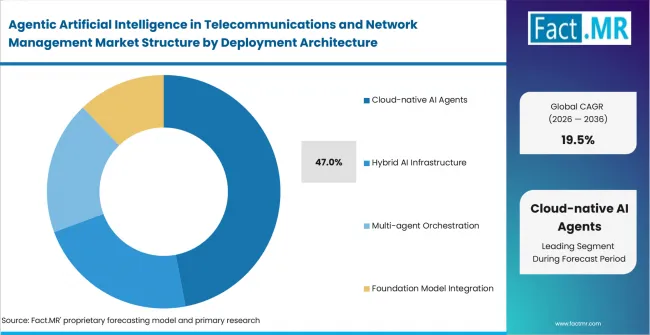
Agentic Artificial Intelligence In Telecommunications And Network Management Market Analysis By Deployment Architecture | Source: Fact.MR
Cloud-native AI Agents lead because telecom teams need elastic inference and shared context across distributed applications. Containerized deployment fits the architecture of newer core and operations platforms, and public cloud supports fast access to models while private cloud preserves control over sensitive telemetry. Hybrid patterns connect those environments with edge execution. The GSMA AI Transformation Blueprint identifies cloud-native infrastructure and data governance as core conditions for telecom AI. Buyers still require workload placement rules before agents can act on production systems, plus a consistent identity and audit model across clouds and edge locations. NVIDIA launched AI Aerial in September 2024 to support AI-RAN development across accelerated computing infrastructure.
What is accelerating Agentic Artificial Intelligence in Telecommunications and Network Management Market adoption, and what is holding it back?
Drivers Impact Analysis
| Driver | Relative Impact | Geographic Relevance | Impact Timeline |
|---|---|---|---|
| Operators need faster fault isolation and capacity decisions across cloud-native and multi-vendor networks. | High | Global | Near term |
| Standards and guidance provide a reference for governed closed-loop automation. | Moderate | North America, Europe, and Asia Pacific | Mid term |
| Vendors ship network agents with domain telemetry and operations integration. | High | Global | Near term |
| Public investment and wireless-innovation funding expand the modernization base. | Moderate | North America, Europe, and Asia Pacific | Long term |
Source: Fact.MR analysis. Updated Aug 10, 2026
Restraints Impact Analysis
| Restraint | Relative Impact | Geographic Relevance | Impact Timeline |
|---|---|---|---|
| Operators must trust an agent before it proposes or makes a live-network change. | High | Global | Mid term |
| Fragmented telemetry and strict security controls keep human approval in the loop. | High | Global | Near term |
| Data-layer assembly and change controls across multi-vendor estates raise integration cost. | Moderate | North America and Europe | Mid term |
Source: Fact.MR analysis. Updated Aug 10, 2026
Which countries are scaling the Agentic Artificial Intelligence in Telecommunications and Network Management Market fastest?
- USA is projected to post the highest CAGR at 21.2% through 2036.
- UK, South Korea, Japan, Germany, Canada, and Australia follow at 20.5%, 19.8%, 19.1%, 18.3%, 17.7%, and 17.0%, respectively.
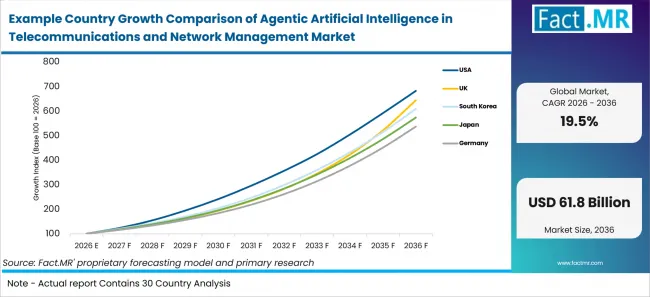
Example Country Growth Comparison Of Agentic Artificial Intelligence In Telecommunications And Network Management Market | Source: Fact.MR
Country-wise CAGR Forecast (2026-2036)
| Country | CAGR |
|---|---|
| USA | 21.2% |
| UK | 20.5% |
| South Korea | 19.8% |
| Japan | 19.1% |
| Germany | 18.3% |
| Canada | 17.7% |
| Australia | 17.0% |
Source: Fact.MR analysis. Updated Aug 10, 2026
What is driving the Agentic Artificial Intelligence in Telecommunications and Network Management Market in the USA?
USA is projected to register a 21.2% CAGR through 2036.
U.S. operators are likely to deploy agents first in software-defined and multi-vendor environments where fault, capacity, and service-assurance work already produces large volumes of telemetry. The country value chart shows USD 26.2 billion in 2036.
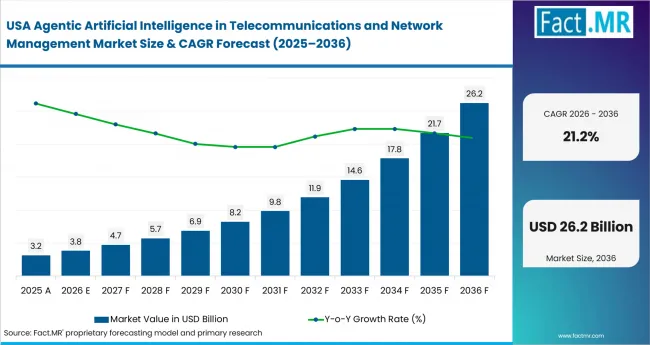
Agentic Artificial Intelligence In Telecommunications And Network Management Market Country Value Analysis | Source: Fact.MR
What is driving the Agentic Artificial Intelligence in Telecommunications and Network Management Market in the UK?
The UK is projected to register a 20.5% CAGR through 2036.
UK operators are expected to examine agent deployments against resilience, service-quality, and change-management requirements. Suppliers need to make clear how the system identifies a network problem, proposes a response, and retains human control where it matters.
What is driving the Agentic Artificial Intelligence in Telecommunications and Network Management Market in South Korea?
South Korea is projected to register a 19.8% CAGR through 2036.
South Korean operators and vendors can use advanced mobile-network environments to test agents for radio, core, and service workflows. Deployments will depend on whether models can work with real network context and existing engineering processes.
What is driving the Agentic Artificial Intelligence in Telecommunications and Network Management Market in Japan?
Japan is projected to register a 19.1% CAGR through 2036.
Japanese operators are likely to place high weight on interoperability, reliability, and trusted control. Early projects will favor bounded use cases where engineers can validate a recommendation before it affects a production network.
What is driving the Agentic Artificial Intelligence in Telecommunications and Network Management Market in Germany?
Germany is projected to register an 18.3% CAGR through 2036.
German demand is likely to center on network modernization programs that also require traceable operating controls. Providers need to show that agentic workflows can work across vendor estates without obscuring accountability for a change.
What is driving the Agentic Artificial Intelligence in Telecommunications and Network Management Market in Canada?
Canada is projected to register a 17.7% CAGR through 2036.
Canadian operators are expected to introduce agents where cloud, data, and network programs can support controlled automation. Integration flexibility matters because buyers may need to work across regional operating footprints and technology partners.
What is driving the Agentic Artificial Intelligence in Telecommunications and Network Management Market in Australia?
Australia is projected to register a 17.0% CAGR through 2036.
Australian operators are likely to prioritize service assurance and escalation workflows that reduce manual review without weakening customer-impact controls. Vendors will need clear operating evidence before automation is widened across the network.
Who leads the Agentic Artificial Intelligence in Telecommunications and Network Management Market?
Competition is organized around three linked roles. Compute and cloud providers supply models, agent tooling, data services, and scalable inference. Network equipment companies connect those capabilities to radio and core controls, with domain telemetry and installed operations software as their advantage. Service firms assemble the data layer and change controls around a chosen platform and take responsibility for workflow redesign and adoption.
AI compute and cloud agent platforms: NVIDIA Corporation, Microsoft Corporation, Google LLC, IBM Corporation, and Amazon Web Services, Inc. Network infrastructure and autonomous operations: Cisco Systems, Inc., Ericsson AB, Nokia Corporation, and Huawei Technologies Co., Ltd. Integration and managed transformation: Accenture plc and Wipro Limited.
Which companies are the key providers?
Key companies profiled in the Agentic Artificial Intelligence in Telecommunications and Network Management market include NVIDIA Corporation, Microsoft Corporation, Google LLC, IBM Corporation, Amazon Web Services, Inc., Cisco Systems, Inc., Ericsson AB, Nokia Corporation, Huawei Technologies Co., Ltd., Accenture plc, and Wipro Limited.
- NVIDIA Corporation
- Microsoft Corporation
- Google LLC
- IBM Corporation
- Amazon Web Services, Inc.
- Cisco Systems, Inc.
- Ericsson AB
- Nokia Corporation
- Huawei Technologies Co., Ltd.
- Accenture plc
- Wipro Limited
Bibliography
- International Telecommunication Union. (2025, March). Potential requirements and methodology for deploying and assessing generative AI models in telecom networks.
- European Telecommunications Standards Institute. (2023, October 5). ETSI’s Zero-touch Network and Service Management group renewed for two years.
- GSMA. (2025, March 20). How the GSMA AI Use Case Library is helping telecoms deploy AI at scale.
- Global Coalition on Telecommunications. (2025, January 16). Principles on AI adoption in the telecommunications industry.
- National Telecommunications and Information Administration. (2025, May 8). More than 90 applications requesting nearly USD 3 billion submitted to the Wireless Innovation Fund’s third round.
- Ofcom. (2024, September 5). Network and service resilience guidance.
- Ministry of Science and ICT, Republic of Korea. (2024, August). 2025 MSIT budget plan.
- National Institute of Information and Communications Technology. (2025, March 31). NICT and Fraunhofer HHI launch Optical Testbed Dataspace.
- Federal Ministry for Digital Transformation and Government Modernisation, Germany. (2025, May 28). Accelerating telecommunications network build-out.
- Innovation, Science and Economic Development Canada. (2024, December 9). Federal government strengthens Canada’s telecommunications ecosystem.
- Australian Communications and Media Authority. (2025, February). Proposed amendments to the Telecommunications Consumer Complaints Handling Industry Standard.
- NVIDIA Corporation. (2024, September 18). NVIDIA AI Aerial launches to transform wireless networks with AI-RAN.
- Cisco Systems, Inc. (2025, June 10). Network operations for the AI age.
- Accenture plc. (2026, February 24). Accenture acquires advanced AI technology to help communications companies accelerate autonomous network journeys.
- Nokia Corporation. (2026, June 23). Nokia advances autonomous networks portfolio with upgraded agentic AI capabilities.
- Google Cloud. (2025, June 12). Autonomous Network Operations Framework: Unlock Predictable and High-performing Networks.
This Report Answers
- The report evaluates AI Agent Function, Network Application, End-use Segment, Organization Type, Deployment Architecture, and regional demand for agentic telecom network management.
- Network Operations Agents lead AI Agent Function with a 38.0% share in 2026, and Network Performance Optimization leads Network Application at 36.0%.
- Telecommunication Service Providers lead End-use Segment at 48.0%. Tier-1 Telecom Operators lead Organization Type, while Cloud-native AI Agents lead Deployment Architecture.
- The regional outlook covers USA, UK, South Korea, Japan, Germany, Canada, and Australia, with country-wise forecasts through 2036.
- Competitive analysis assesses cloud, network-infrastructure, and integration providers active in agentic network operations.
What does the Agentic Artificial Intelligence in Telecommunications and Network Management Market cover?
The Agentic Artificial Intelligence in Telecommunications and Network Management Market covers platforms, software, and services that use AI agents to diagnose, optimize, coordinate, and govern network operations across radio, core, cloud, and service domains.
The scope follows AI Agent Function, Network Application, End-use Segment, Organization Type, Deployment Architecture, and Region across the 2026-2036 forecast period.
What is included in the scope?
Coverage includes Network Operations, Security Intelligence, Resource Optimization, and Customer Experience Agents; Network Performance Optimization, Network Threat Detection, Spectrum Management, and Customer Support Automation applications; telecommunication service providers, network infrastructure vendors, enterprise networks, and telecommunications consulting; Tier-1 telecom operators, equipment manufacturers, large enterprises, and system integrators; and cloud-native agents, hybrid AI infrastructure, multi-agent orchestration, and foundation-model integration.
What is excluded from the scope?
General-purpose AI software, unrelated network hardware, commodity cloud infrastructure, and services not configured for telecom network-management workflows are outside scope.
How was the analysis built?
The analysis considers public company disclosures, product documentation, standards and government material, industry publications, and market conditions across the defined segments, regions, and forecast period.
Segmentation
What is the report’s scope and coverage?
| Attribute | Details |
|---|---|
| Forecast Period | 2026-2036 |
| Base Year | 2025 |
| Market Value, 2026 | USD 10.4 billion |
| Market Value, 2036 | USD 61.8 billion |
| CAGR, 2026-2036 | 19.5% |
| Absolute Dollar Opportunity | USD 51.4 billion |
| Key Regions Covered | USA, UK, South Korea, Japan, Germany, Canada, Australia, and more than twenty-five additional countries in the full report |
Source: Fact.MR analysis. Updated Aug 10, 2026
How is the market segmented?
-
AI Agent Function
- Network Operations Agents
- Fault Detection Agents
- Service Assurance Agents
- Security Intelligence Agents
- Cyber Defense Agents
- Incident Response Agents
- Resource Optimization Agents
- Capacity Planning Agents
- Energy Optimization Agents
- Customer Experience Agents
- Service Desk Agents
- Churn Prediction Agents
- Network Operations Agents
-
Network Application
- Network Performance Optimization
- Traffic Engineering
- Quality of Service Monitoring
- Network Threat Detection
- Anomaly Detection
- DDoS Mitigation
- Spectrum Management
- Radio Resource Allocation
- Base Station Optimization
- Customer Support Automation
- Billing & Account Management
- Personalized Service Recommendations
- Network Performance Optimization
-
End-use Segment
- Telecommunication Service Providers
- Mobile Network Operators
- Fixed Network Operators
- Network Infrastructure Vendors
- Data Center Operators
- Cloud Communication Providers
- Enterprise Networks
- Private 5G Networks
- Smart City Infrastructure
- Telecommunications Consulting
- Managed Network Services
- Digital Connectivity Services
- Telecommunication Service Providers
-
Organization Type
- Tier-1 Telecom Operators
- National Telecom Providers
- Regional Telecom Operators
- Telecom Equipment Manufacturers
- Hyperscale Operators
- Managed Service Providers
- Large Enterprises
- Industrial Enterprises
- Government Agencies
- System Integrators
- Communication Service Providers
- Enterprise Customers
- Tier-1 Telecom Operators
-
Deployment Architecture
- Cloud-native AI Agents
- Public Cloud
- Private Cloud
- Hybrid AI Infrastructure
- On-premises Deployment
- Edge-enabled AI
- Multi-agent Orchestration
- Agent Coordination Layer
- Context-aware AI
- Foundation Model Integration
- Knowledge Graph Integration
- Vector-based Retrieval
- Cloud-native AI Agents
-
Region
- North America
- Latin America
- Western Europe
- Eastern Europe
- East Asia
- South Asia and Pacific
- Middle East & Africa
Frequently Asked Questions
What is the Agentic Artificial Intelligence in Telecommunications and Network Management market size in 2026?
The market is valued at USD 10.4 billion in 2026.
What is the projected Agentic Artificial Intelligence in Telecommunications and Network Management market size by 2036?
Which country leads the Agentic Artificial Intelligence in Telecommunications and Network Management market?
Which is the leading segment in the Agentic Artificial Intelligence in Telecommunications and Network Management market?
What is driving growth in the Agentic Artificial Intelligence in Telecommunications and Network Management Market?
Who are the key players in the Agentic Artificial Intelligence in Telecommunications and Network Management Market?
Who worked on this report


Preview the report firsthand - request a free sample
Free SampleGet the brochure for pricing and purchase details
Download PDF