AI Sports Officiating Market Size, Share, Growth and Forecast (2026 - 2036)
The AI Sports Officiating Market is segmented by Technology, by Sport, by Application, by Buyer Type, by Deployment Model, by Revenue Model, by Venue Tier, and by Region. Forecast for 2026 to 2036.
What is the AI sports officiating market forecast to be worth by 2036?
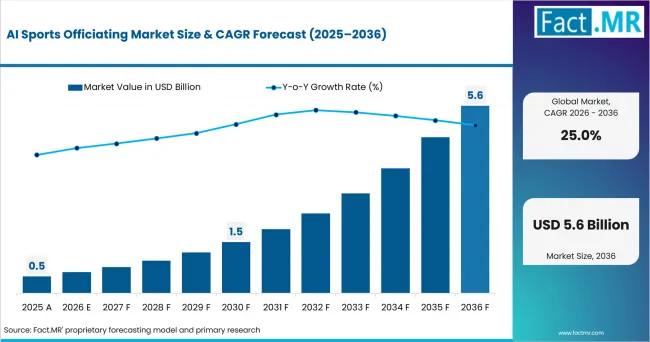
USD 0.6 billion in 2026 to USD 5.6 billion by 2036, at 25.0% CAGR.
- The AI sports officiating market crossed a valuation of USD 0.5 billion in 2025.
- Demand is expected to increase from USD 0.6 billion in 2026 to USD 5.6 billion by 2036.
- The forecast reflects an early-stage service curve because league deployment is moving from tournament use toward season-long contracts.
What are the defining numbers behind AI sports officiating growth?
USD 5.0 billion absolute opportunity by 2036. United States, United Kingdom and Germany lead the country view.
- Demand Drivers in the Market
- Leagues need faster review decisions because long stoppages reduce match flow and create visible broadcast frustration.
- Football buyers are moving from manual offside line drawing toward camera and ball tracking that produces a review-ready decision.
- Tennis and baseball now give suppliers repeatable buying models because line calling and strike-zone review are moving into regular competition.
- Venue owners need certified systems that can feed officials, scoreboards and broadcasters without creating separate data workflows.
- Key Segments Analyzed
- By Technology: Computer Vision is expected to account for 46.0% of the market share in 2026, as football and tennis deployments depend on optical tracking before sensor-only systems are accepted by referees.
- By Sport: Football is projected to capture 35.0% of the market in 2026, driven by semi-automated offside and goal-line decisions across top-tier competitions.
- By Application: Offside Calls are estimated to hold 31.0% share in 2026, owing to certified virtual line workflows and the direct effect of offside decisions on match results.
- By Buyer Type: Professional Leagues are likely to represent 48.0% of the market in 2026, supported by centralized procurement and repeated match-day use across full seasons.
- By Deployment Model: Venue-installed systems are forecast to secure 42.0% share in 2026 as permanent camera calibration remains required for top stadiums and ballparks.
- By Revenue Model: Multi-Year Contracts are anticipated to contribute 44.0% of total market revenue in 2026, reflecting league preference for recurring support instead of one-event purchases.
- By Venue Tier: Tier-One Stadiums are set to account for 39.0% of the market share in 2026, since certified camera placement and broadcast integration are easier to justify at high-audience venues.
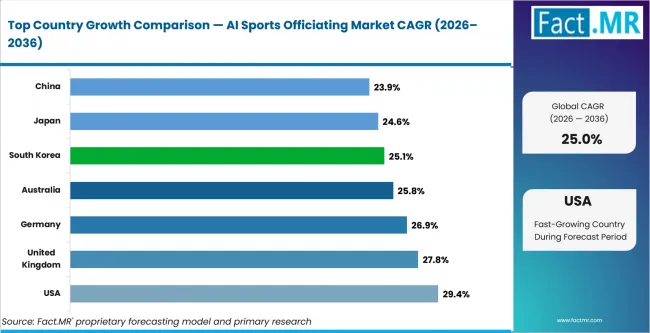
- By Geography: The United States is expected to register a CAGR of 29.4% through 2036, supported by baseball ABS deployment and football line-to-gain automation.
- Analyst Opinion
- Shambhu Nath Jha, Senior Analyst at Fact.MR, states, "Officiating technology is becoming the evidence layer behind the referee. I see buyers asking where the ball was and which body point mattered. They also ask whether the system can explain the call to fans in seconds."
- Strategic Implications
- Leagues should define whether the system recommends a call or only supports referee review before procurement begins.
- Venue operators need camera placement, calibration and backup workflows planned before season-wide rollout.
- Technology providers should build proof around decision speed, false alert handling and federation certification.
- Broadcasters can use official decision graphics only when league rules and data rights are clearly assigned.
Officiating automation becomes billable when a league needs rule-specific evidence during live play. Premier League semi-automated offside uses up to 30 cameras and several cameras capture footage at 100 frames per second. Major League Baseball automated ball-strike testing across 288 spring training games showed 4.1 challenges per game and 13.8 seconds per challenge. Football and tennis have moved the buying base beyond one-event trials. The Association of Tennis Professionals moved tour events to electronic line calling from 2025. Major League Baseball placed automated ball-strike review into the 2026 season while the National Football League moved line-to-gain measurement toward Hawk-Eye.
The United States is projected to record a 29.4% CAGR through 2036 as baseball ABS rollout and football line‑to‑gain automation expand. The United Kingdom is likely to post a 27.8% CAGR because Premier League semi‑automated offside and electronic line calling scale. Germany is expected to register a 26.9% CAGR as football technology standards and connected‑ball expertise support adoption. Australia is forecast to advance at a 25.8% CAGR as electronic line calling in tennis expands across major events. South Korea is set to record a 25.1% CAGR as baseball officiating pilots and connected venues drive demand. Japan is anticipated to grow at a 24.6% CAGR as baseball automation and tournament‑grade operations increase uptake. China is likely to register a 23.9% CAGR as venue modernization supports camera‑based officiating systems.
How does the AI sports officiating market break down by segment?
Computer Vision leads at 46.0%. Professional Leagues follow with 48.0% share in 2026.
Which technology dominates?
Computer Vision holds 46.0% share in 2026.
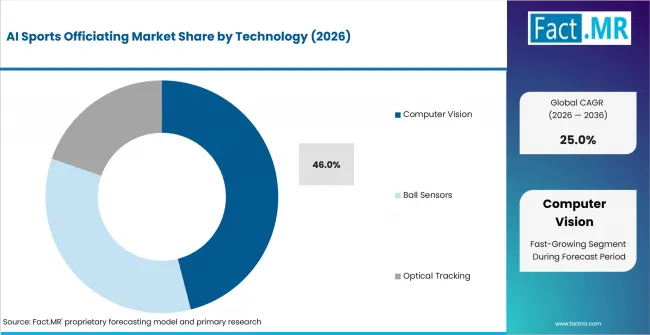
Computer Vision is expected to hold 46.0% share in 2026 because most certified decisions require camera evidence before referee approval. Offside, line-call and strike-zone workflows depend on tracking accuracy at the ball and player level. This keeps tracking-data suppliers close to officiating buyers when their data can support a rule decision.
Which sport dominates?
Football holds 35.0% share in 2026.
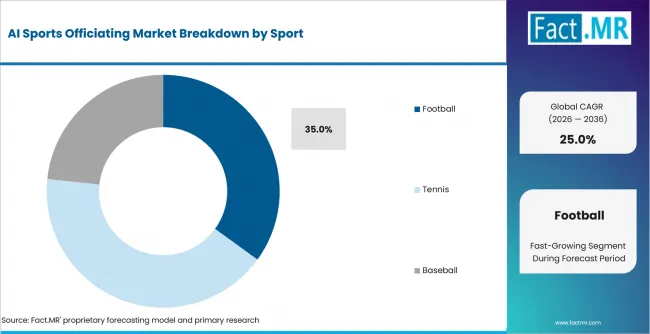
Football is projected to account for 35.0% share in 2026 because semi-automated offside has a clear certification route. Goal-line decisions and connected balls also make football one of the deepest markets for officiating automation. This links officiating technology with connected match equipment when the ball becomes part of the decision system.
Which application dominates?
Offside Calls hold 31.0% share in 2026.
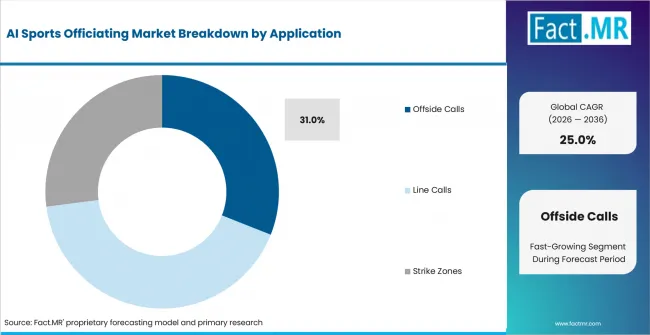
Offside Calls are forecast to account for 31.0% share in 2026 because every close decision needs a consistent body-point and ball-contact reference. Semi-automated systems shorten the setup work that replay operators previously handled manually. The same logic turns camera feeds into measurement inputs instead of only replay footage.
Which buyer type dominates?
Professional Leagues hold 48.0% share in 2026.
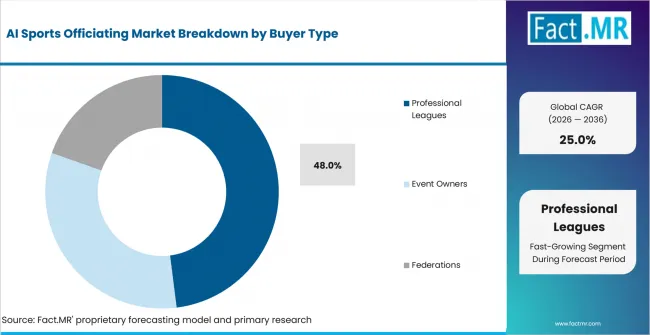
Professional Leagues are likely to capture 48.0% share in 2026 because centralized rights holders buy technology for full seasons. Clubs may host the equipment but league offices usually decide the standard. Stadium procurement also supports synchronized camera systems because each venue needs views that can be audited.
Which deployment model dominates?
Venue Installed systems hold 42.0% share in 2026.
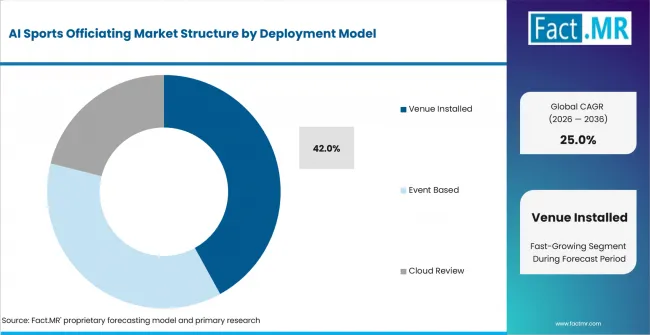
Venue Installed systems are estimated to hold 42.0% share in 2026 because calibrated camera positions are needed before automated decisions can be trusted. Temporary tournament systems work well for limited events but season-long use favors fixed installations. The measurement requirement depends on depth and body-point location when a close call is reviewed.
Which revenue model dominates?
Multi-Year Contracts hold 44.0% share in 2026.
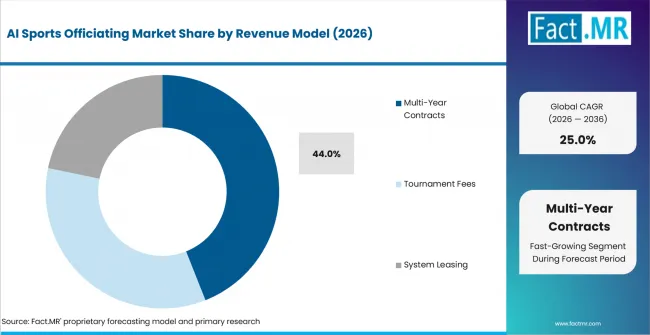
Multi-Year Contracts are expected to hold 44.0% share in 2026 because leagues want service continuity across every match window. Providers bundle hardware upkeep, calibration and match-day support into recurring terms. This contract logic works because officials need searchable footage and event records after each review.
Which venue tier dominates?
Tier-One Stadiums hold 39.0% share in 2026.
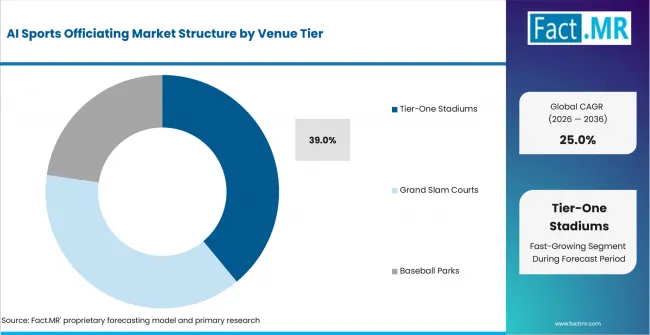
Tier-One Stadiums are projected to hold 39.0% share in 2026 because premium venues can absorb camera installation and dedicated support costs first. These sites also face higher broadcast scrutiny when a call is disputed. Officiating data may later support training and safety review when player-position context is reused outside match decisions.
What is accelerating AI sports officiating demand, and what is holding it back?
League deployment and certification support demand. Venue cost and referee acceptance restrain wider use.

Professional sport is moving from replay-only support toward systems that detect the decision point. Football uses offside automation because manual line drawing takes time and creates visible disagreement. Tennis and baseball show another route because line calls and strike-zone challenges can be limited to specific decision types. Leagues can justify spend when the system lowers stoppage time and produces a clear visual for fans.
Expansion is limited by the cost of stadium calibration and the need to keep human officials accountable for final decisions. A system failure during a live event can damage league trust faster than an ordinary data outage. Smaller leagues also face lower broadcast revenue and cannot always pay for permanent camera arrays. Suppliers need lower-cost tiers and clear appeal workflows before the market reaches second-tier competitions.
Where do the biggest AI sports officiating opportunities sit?
Semi-automated offside, strike-zone challenges and fan-facing decision graphics.
- Semi-Automated Offside: Providers can sell cameras and ball tracking to leagues that need faster video assistant referee decisions. Virtual lines and match-day support extend the same package.
- Strike-Zone Challenges: Baseball creates a repeatable model where players challenge selected calls while the human umpire remains central to game control.
- Fan Decision Graphics: 360-degree camera feeds can support official visuals only after the referee confirms the system result and the league clears broadcast rights.
Which countries are scaling AI sports officiating fastest?
United States 29.4% CAGR, United Kingdom 27.8% CAGR, Germany 26.9% CAGR, Australia 25.8% CAGR, South Korea 25.1% CAGR, Japan 24.6% CAGR, China 23.9% CAGR
Based on regional analysis, the AI sports officiating market is segmented into North America, Europe, Asia Pacific, Latin America, and Middle East & Africa.
.webp)
| Country | CAGR |
|---|---|
| United States | 29.4% |
| United Kingdom | 27.8% |
| Germany | 26.9% |
| Australia | 25.8% |
| South Korea | 25.1% |
| Japan | 24.6% |
| China | 23.9% |

What powers the United States lead?
29.4% CAGR, supported by baseball ABS and football line-to-gain automation.
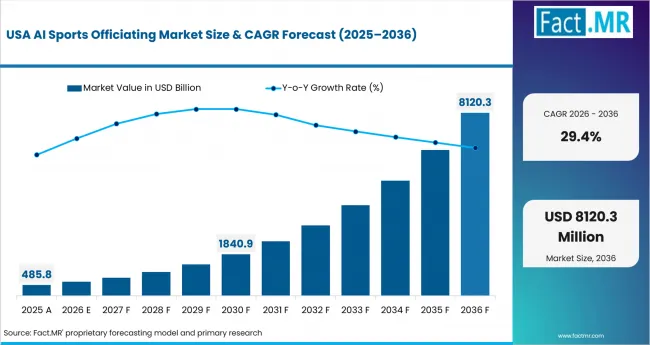
The United States has the deepest near-term route because two large sports are moving officiating automation into regular competition. Major League Baseball placed automated ball-strike challenges into the 2026 season and the National Football League moved Hawk-Eye virtual measurement into the 2025 season. Suppliers that can support centralized review rooms and local venue equipment should gain earlier contract access.
Why does the United Kingdom matter?
27.8% CAGR, driven by Premier League offside deployment and tennis line-calling depth.
The United Kingdom is a reference market because the Premier League introduced semi-automated offside technology after non-live testing and FA Cup live operation. Wimbledon also moved toward live electronic line calling from 2025. Buyers in the country compare decision speed, fan graphics and referee approval steps before they expand contracts.
What supports Germany’s outlook?
26.9% CAGR, attributable to football technology standards and supplier engineering depth.
Germany benefits from European football deployment and supplier links to connected match-ball systems. UEFA tournament use shows how ball sensors and optical tracking can work inside official decision workflows. Growth is below the United States because domestic league deployment is more football-centered and less diversified across sport codes.
How is Australia scaling demand?
25.8% CAGR, driven by Grand Slam tennis and event-led procurement.
Australia scales through tennis because the Australian Open uses electronic line calling across match courts. Event owners can justify systems when a Grand Slam needs consistent decisions across many courts. The market remains event-heavy, so supplier revenue depends on tournament support and repeat seasonal service.
What makes South Korea important?
25.1% CAGR, supported by baseball demand and connected venue infrastructure.

South Korea has a commercial pathway through baseball and high-connectivity venues. The country has buyers that can test strike-zone and replay support inside televised sport. Faster growth depends on federation approval because suppliers need official rules before club-level buyers can commit.
Why is Japan a relevant commercial market?
24.6% CAGR, led by baseball scale and tournament-grade venue operations.

Japan has a deep baseball base and a buyer culture that values controlled decision processes. Tennis and football add event opportunities, while baseball offers the clearest domestic use case for automated zone review. Local adoption should favor suppliers that can document accuracy and explain decisions in Japanese broadcast formats.
How does China create a long-term role?
23.9% CAGR, backed by venue modernization and multi-sport event infrastructure.
China is a longer-cycle opportunity because large venues and event infrastructure can support camera-based officiating systems. Procurement is likely to begin with football, tennis and multi-sport events before league-wide use expands. Supplier access depends on local data rules and the ability to support domestic system integration.
Who leads the AI sports officiating landscape?
Hawk-Eye Innovations, Genius Sports and KINEXON Sports & Media lead through certified systems and league deployment.

Competition is split between officiating specialists and sports data firms that can convert tracking evidence into a referee decision. Buyers compare providers on certification status and decision speed. Venue calibration and broadcast integration also matter. Data rights and league trust matter because officiating evidence can affect betting integrity and post-match disputes.
Hawk-Eye Innovations has the broadest visible footprint through tennis and football. Baseball and American football decision systems add further reach. Genius Sports gained a clear football route through the Premier League semi-automated offside rollout. KINEXON Sports & Media supports connected ball and player tracking use cases where sensor signals complement camera evidence.
Bolt6 is building tennis credibility through electronic line calling at the Australian Open and other tour events. Sportec Solutions serves video assistant referee and officiating workflows in football. Training data quality is also becoming a supplier differentiator because synthetic data generation for industrial vision can help test edge cases before match deployment.
Providers that prove certified accuracy and live-event reliability should be better placed through 2036. Larger data companies can add officiating services around league rights and sports betting integrity needs. Smaller specialists can win where the buyer needs a narrow call type and lower venue complexity.
Which companies are the key players?
Hawk-Eye Innovations, Genius Sports and KINEXON Sports and Media are key players. Bolt6, Sportradar, Sportec Solutions and Riedel Communications are also profiled.
- Hawk-Eye Innovations
- Genius Sports
- KINEXON Sports & Media
- Bolt6
- Sportradar
- Sportec Solutions
- Riedel Communications
How is the market segmented?
-
By Technology:
- Computer Vision
- Ball Sensors
- Optical Tracking
- Audio Review
- Hybrid Systems
-
By Sport:
- Football
- Tennis
- Baseball
- Cricket
- American Football
-
By Application:
- Offside Calls
- Line Calls
- Strike Zones
- Goal Decisions
- Boundary Reviews
-
By Buyer Type:
- Professional Leagues
- Event Owners
- Federations
- Broadcasters
- Venue Operators
-
By Deployment Model:
- Venue Installed
- Event Based
- Cloud Review
- Mobile Systems
-
By Revenue Model:
- Multi-Year Contracts
- Tournament Fees
- System Leasing
- Data Licensing
-
By Venue Tier:
- Tier-One Stadiums
- Grand Slam Courts
- Baseball Parks
- National Arenas
- College Venues
-
By Region:
- North America
- United States
- Canada
- Mexico
- Latin America
- Brazil
- Argentina
- Rest of Latin America
- Europe
- Germany
- United Kingdom
- France
- Italy
- Spain
- Rest of Europe
- Asia Pacific
- China
- India
- Japan
- South Korea
- ASEAN
- Australia
- Middle East & Africa
- GCC Countries
- South Africa
- UAE
- Rest of Middle East & Africa
- North America
Bibliography
- [1] Association of Tennis Professionals. (2024, October 9). Wimbledon embraces live electronic line calling. Association of Tennis Professionals.
- [2] Australian Open. (2026, January 27). AO Ventures announces first investments, backing innovation at AO and beyond. Australian Open.
- [3] Fédération Internationale de Football Association. (2025, December 22). FIFA uses FIFA Intercontinental Cup 2025 to further test and refine football technology. FIFA.
- [4] Fédération Internationale de Football Association. (2026, February 10). Testing criteria for semi-automated offside technology systems. FIFA.
- [5] Fédération Internationale de Football Association. (2026, February 17). FIFA Quality Programme for VAR technology. FIFA.
- [6] Genius Sports Group. (2025, April 1). Premier League to bring in semi-automated offside technology on 12 April after non-live testing and live operation in FA Cup. Genius Sports.
- [7] Hawk-Eye Innovations. (2025, March 31). Sony’s Hawk-Eye Innovations selected by the NFL to revolutionize line-to-gain measurements. Hawk-Eye Innovations.
- [8] International Tennis Federation. (2026, February 16). PlayReplay electronic line calling system gets real-time silver status. International Tennis Federation.
- [9] Major League Baseball. (2026, April 13). Everything you need to know about the new ABS Challenge System. Major League Baseball.
- [10] Premier League. (2025, April 12). Semi-automated offside technology: What you need to know. Premier League.
- [11] Riedel Communications. (2025, July 2). Riedel Communications launches RefSuite ecosystem for sports officiating, coaching, and production. Riedel Communications.
- [12] Sportec Solutions. (2025, September 5). Officiating. Sportec Solutions.
- [13] Deltatre. (2024, February 22). Sportec Solutions named VAR technology provider for Major League Soccer until 2030. Deltatre.
- [14] Union of European Football Associations. (2024, May 10). Football technologies at UEFA EURO 2024. UEFA.
- [15] Adidas AG. (2024, December 12). A triad of excellence: The team behind the UEFA Women’s EURO 2025 match ball. Adidas.
This Report Addresses
Strategic intelligence on AI sports officiating across technology and sport. Application and buyer type are also covered.
- Segment analysis covering Computer Vision and Football. Offside Calls, Professional Leagues and Venue Installed systems are also assessed.
- Regional outlook covering United States and United Kingdom. Germany and Australia are also assessed. South Korea, Japan and China complete the country view.
- Competitive analysis of Hawk-Eye Innovations and Genius Sports. KINEXON Sports & Media and Bolt6 are also profiled. Sportradar, Sportec Solutions and Riedel Communications complete the company set.
- Service assessment covering certified offside workflows and electronic line calling. Strike-zone review and line-to-gain measurement are also covered.
- Technology assessment covering camera arrays and connected balls. Mesh tracking, video assistant referee tools and decision graphics are also assessed.
- Source-led market sizing using league deployments and provider portfolios. Public rules and official company disclosures were also reviewed.
What does the AI sports officiating market cover?
Computer vision, connected ball and sensor systems used to support or automate officiating calls in live sport.
The AI sports officiating market covers paid technology and service revenue tied to rule decisions. It covers offside detection and electronic line calling. Strike-zone review, goal-line systems and boundary review are also included. Decision graphics and calibration services are included when bundled with officiating delivery.
What is included in the scope?
Offside automation and electronic line calling are included. Strike-zone review, goal decisions and decision support services are also included.
The scope includes camera-based officiating systems for football and tennis. Baseball, cricket and American football are also covered. It also includes connected balls and optical tracking. Operator stations, replay-room software and certified event support are included with venue calibration.
What is excluded from the scope?
General sports analytics, wearable coaching tools and broadcast graphics sold without officiating use are excluded.
The scope excludes ordinary performance analysis platforms when they are not used for referee decisions. It also excludes betting data feeds, coaching dashboards and consumer video tools. Stadium camera hardware is excluded unless the hardware is sold as part of a certified officiating workflow.
How was the analysis built?
120+ sources and 50+ company or federation pages. 25+ countries were checked with 20+ expert inputs.
- Primary Research:
- Interviews covered league technology teams and officiating consultants. Venue integrators and sports data suppliers were also reviewed.
- Desk Research:
- Desk research reviewed federation standards and league technology pages. Company newsrooms, official tournament pages and product certification material were checked.
- Market-Sizing and Forecasting:
- Forecasting used provider counts and known league deployments. System fees, tournament support charges and multi-year contract assumptions supported the model.
- Data Validation and Update Cycle:
- Estimates were checked against FIFA certification rules and Premier League use. MLB ABS deployment, NFL line-to-gain measurement and tennis line-calling evidence were also reviewed.
What is the report’s scope and coverage?

| Attribute | Details |
|---|---|
| Quantitative Units | USD Billion in 2026 to USD Billion by 2036 at CAGR |
| Market Definition | Computer-vision, connected-ball and sensor-based systems used to support or automate officiating calls in live sport |
| Technology | Computer Vision, Ball Sensors, Optical Tracking, Audio Review, Hybrid Systems |
| Sport | Football, Tennis, Baseball, Cricket, American Football |
| Application | Offside Calls, Line Calls, Strike Zones, Goal Decisions, Boundary Reviews |
| Buyer Type | Professional Leagues, Event Owners, Federations, Broadcasters, Venue Operators |
| Deployment Model | Venue Installed, Event Based, Cloud Review, Mobile Systems |
| Revenue Model | Multi-Year Contracts, Tournament Fees, System Leasing, Data Licensing |
| Venue Tier | Tier-One Stadiums, Grand Slam Courts, Baseball Parks, National Arenas, College Venues |
| Regions Covered | North America, Europe, Asia Pacific, Latin America, Middle East & Africa |
| Countries Covered | United States, United Kingdom, Germany, Australia, South Korea, Japan and China |
| Key Companies Profiled | Hawk-Eye Innovations, Genius Sports, KINEXON Sports & Media, Bolt6, Sportradar, Sportec Solutions and Riedel Communications |
| Forecast Period | 2026 to 2036 |
| Approach | Hybrid top-down and bottom-up approach using league deployments, provider counts, certification rules, support-fee assumptions and company validation |
- Frequently Asked Questions -
How large is the AI Sports Officiating market expected to be in the near term?
The market is in an early but expanding phase, supported by league level deployments across football, tennis, and baseball, which provide a strong foundation for broader adoption.
What is the long term outlook for the AI Sports Officiating market?
The long term outlook is highly positive as more professional leagues and tournaments move toward contracting certified, technology assisted decision systems as part of standard officiating workflows.
How fast is the AI Sports Officiating market expected to grow?
The market is anticipated to grow rapidly, driven by increased venue installations, regular season usage, and recurring support across major sporting events.
Which technology is expected to dominate AI sports officiating solutions?
Computer vision technology is expected to dominate due to its critical role in offside detection, line calling, goal validation, and strike zone assessment where visual proof is essential.
Which sport is expected to lead adoption of AI officiating systems?
Football is expected to remain the leading sport for adoption, as semi automated offside systems already have established certification pathways and are increasingly integrated into top tier leagues.
Which country is expected to demonstrate the strongest growth momentum?
The United States is expected to show strong momentum, supported by the rollout of automated ball strike systems in baseball and technology assisted measurement tools in football.
What is the growth outlook for the United Kingdom?
The United Kingdom shows solid growth prospects, driven by the continued use of semi automated offside technology across professional football leagues and tournaments.
How is Germany contributing to market development?
Germany plays a significant role through UEFA tournament usage, advanced officiating standards, and expertise in connected ball and sensor enabled technologies that support supplier readiness.
What role does Australia play in the AI Sports Officiating market?
Australia serves as a key testing and validation market, particularly in tennis, where electronic line calling systems are widely used during major international tournaments.
What is the primary factor driving market expansion?
Market expansion is primarily driven by league demand for faster decisions, improved accuracy, and clearer evidence during disputed live play situations.
What is the main challenge facing AI Sports Officiating adoption?
Adoption is constrained by high certification requirements, venue calibration complexity, and the need to balance automated decision systems with referee authority and acceptance.
Table of Content
- Key Takeaways
- Market Size and CAGR
- Top Growth Driver
- Fastest Growing Segment
- Leading Region
- Key Companies
- Emerging Opportunities
- Executive Summary
- Global Market Outlook
- Demand-side Trends
- Supply-side Trends
- Technology Roadmap Analysis
- Analysis and Recommendations
- Analyst Perspective (What is happening? Why now? What should investors know?)
- Key Questions Answered
- How large is the market?
- What is the CAGR?
- What are key trends?
- Which region dominates?
- Who are the leaders?
- Market Overview
- Market Coverage / Taxonomy
- Market Definition / Scope / Limitations
- Research Methodology
- Chapter Orientation
- Analytical Lens and Working Hypotheses
- Market Structure, Signals, and Trend Drivers
- Benchmarking and Cross-market Comparability
- Market Sizing, Forecasting, and Opportunity Mapping
- Research Design and Evidence Framework
- Desk Research Programme (Secondary Evidence)
- Expert Input and Fieldwork (Primary Evidence)
- Tooling, Models, and Reference Databases
- Data Engineering and Model Build
- Quality Assurance and Audit Trail
- Market Background
- Market Dynamics (Drivers, Restraints, Opportunity, Trends)
- Scenario Forecast (Optimistic, Likely, Conservative)
- Impact Analysis
- AI Impact
- Sustainability Impact
- Regulatory Impact
- Technology Impact
- Consumer / Buyer Analysis
- Purchase Drivers
- Adoption Barriers
- Buyer Journey
- Opportunity Map Analysis
- Product Life Cycle Analysis
- Supply Chain Analysis
- Investment Feasibility Matrix
- Value Chain Analysis
- PESTLE and Porter's Analysis
- Regulatory Landscape
- Regional Parent Market Outlook
- Production and Consumption Statistics
- Import and Export Statistics
- Global Market Analysis and Forecast, 2021 to 2036
- Historical Market Size Value (USD Million) Analysis, 2021 to 2025
- Current and Future Market Size Value (USD Million) Projections, 2026 to 2036
- Y-o-Y Growth Trend Analysis
- Absolute $ Opportunity Analysis
- Global Market Pricing Analysis, 2021 to 2036
- Global Market Analysis and Forecast, By Technology, 2021 to 2036
- Introduction / Key Findings
- Historical Market Size Value (USD Million) Analysis By Technology, 2021 to 2025
- Current and Future Market Size Value (USD Million) Analysis and Forecast By Technology, 2026 to 2036
- Computer Vision
- Ball Sensors
- Optical Tracking
- Computer Vision
- Y-o-Y Growth Trend Analysis By Technology, 2021 to 2025
- Absolute $ Opportunity Analysis By Technology, 2026 to 2036
- Global Market Analysis and Forecast, By Sport, 2021 to 2036
- Introduction / Key Findings
- Historical Market Size Value (USD Million) Analysis By Sport, 2021 to 2025
- Current and Future Market Size Value (USD Million) Analysis and Forecast By Sport, 2026 to 2036
- Football
- Tennis
- Baseball
- Football
- Y-o-Y Growth Trend Analysis By Sport, 2021 to 2025
- Absolute $ Opportunity Analysis By Sport, 2026 to 2036
- Global Market Analysis and Forecast, By Application, 2021 to 2036
- Introduction / Key Findings
- Historical Market Size Value (USD Million) Analysis By Application, 2021 to 2025
- Current and Future Market Size Value (USD Million) Analysis and Forecast By Application, 2026 to 2036
- Offside Calls
- Line Calls
- Strike Zones
- Offside Calls
- Y-o-Y Growth Trend Analysis By Application, 2021 to 2025
- Absolute $ Opportunity Analysis By Application, 2026 to 2036
- Global Market Analysis and Forecast, By Buyer Type, 2021 to 2036
- Introduction / Key Findings
- Historical Market Size Value (USD Million) Analysis By Buyer Type, 2021 to 2025
- Current and Future Market Size Value (USD Million) Analysis and Forecast By Buyer Type, 2026 to 2036
- Professional Leagues
- Event Owners
- Federations
- Professional Leagues
- Y-o-Y Growth Trend Analysis By Buyer Type, 2021 to 2025
- Absolute $ Opportunity Analysis By Buyer Type, 2026 to 2036
- Global Market Analysis and Forecast, By Deployment Model, 2021 to 2036
- Introduction / Key Findings
- Historical Market Size Value (USD Million) Analysis By Deployment Model, 2021 to 2025
- Current and Future Market Size Value (USD Million) Analysis and Forecast By Deployment Model, 2026 to 2036
- Venue Installed
- Event Based
- Cloud Review
- Venue Installed
- Y-o-Y Growth Trend Analysis By Deployment Model, 2021 to 2025
- Absolute $ Opportunity Analysis By Deployment Model, 2026 to 2036
- Global Market Analysis and Forecast, By Revenue Model
- Introduction / Key Findings
- Historical Market Size Value (USD Million) Analysis By Revenue Model, 2021 to 2025
- Current and Future Market Size Value (USD Million) Analysis and Forecast By Revenue Model, 2026 to 2036
- Multi-Year Contracts
- Tournament Fees
- System Leasing
- Multi-Year Contracts
- Y-o-Y Growth Trend Analysis By Revenue Model, 2021 to 2025
- Absolute $ Opportunity Analysis By Revenue Model, 2026 to 2036
- Global Market Analysis and Forecast, By Venue Tier
- Introduction / Key Findings
- Historical Market Size Value (USD Million) Analysis By Venue Tier, 2021 to 2025
- Current and Future Market Size Value (USD Million) Analysis and Forecast By Venue Tier, 2026 to 2036
- Tier-One Stadiums
- Grand Slam Courts
- Baseball Parks
- Tier-One Stadiums
- Y-o-Y Growth Trend Analysis By Venue Tier, 2021 to 2025
- Absolute $ Opportunity Analysis By Venue Tier, 2026 to 2036
- Global Market Analysis and Forecast, By Region, 2021 to 2036
- Introduction
- Historical Market Size Value (USD Million) Analysis By Region, 2021 to 2025
- Current Market Size Value (USD Million) Analysis and Forecast By Region, 2026 to 2036
- North America
- Latin America
- Western Europe
- Eastern Europe
- East Asia
- South Asia and Pacific
- Middle East & Africa
- Market Attractiveness Analysis By Region
- North America Market Analysis and Forecast, By Country, 2021 to 2036
- Historical Market Size Value (USD Million) Trend Analysis By Market Taxonomy, 2021 to 2025
- Market Size Value (USD Million) Forecast By Market Taxonomy, 2026 to 2036
- By Country
- USA
- Canada
- Mexico
- By Technology
- By Sport
- By Application
- By Buyer Type
- By Deployment Model
- By Revenue Model
- By Venue Tier
- By Country
- Market Attractiveness Analysis
- By Country
- By Technology
- By Sport
- By Application
- By Buyer Type
- By Deployment Model
- By Revenue Model
- By Venue Tier
- Key Takeaways
- Latin America Market Analysis and Forecast, By Country
- Historical Market Size Value (USD Million) Trend Analysis By Market Taxonomy, 2021 to 2025
- Market Size Value (USD Million) Forecast By Market Taxonomy, 2026 to 2036
- By Country
- Brazil
- Chile
- Rest of Latin America
- By Technology
- By Sport
- By Application
- By Buyer Type
- By Deployment Model
- By Revenue Model
- By Venue Tier
- By Country
- Market Attractiveness Analysis
- By Country
- By Technology
- By Sport
- By Application
- By Buyer Type
- By Deployment Model
- By Revenue Model
- By Venue Tier
- Key Takeaways
- Western Europe Market Analysis and Forecast, By Country
- Historical Market Size Value (USD Million) Trend Analysis By Market Taxonomy, 2021 to 2025
- Market Size Value (USD Million) Forecast By Market Taxonomy, 2026 to 2036
- By Country
- Germany
- UK
- Italy
- Spain
- France
- Nordic
- BENELUX
- Rest of Western Europe
- By Technology
- By Sport
- By Application
- By Buyer Type
- By Deployment Model
- By Revenue Model
- By Venue Tier
- By Country
- Market Attractiveness Analysis
- By Country
- By Technology
- By Sport
- By Application
- By Buyer Type
- By Deployment Model
- By Revenue Model
- By Venue Tier
- Key Takeaways
- Eastern Europe Market Analysis and Forecast, By Country
- Historical Market Size Value (USD Million) Trend Analysis By Market Taxonomy, 2021 to 2025
- Market Size Value (USD Million) Forecast By Market Taxonomy, 2026 to 2036
- By Country
- Russia
- Poland
- Hungary
- Balkan & Baltic
- Rest of Eastern Europe
- By Technology
- By Sport
- By Application
- By Buyer Type
- By Deployment Model
- By Revenue Model
- By Venue Tier
- By Country
- Market Attractiveness Analysis
- By Country
- By Technology
- By Sport
- By Application
- By Buyer Type
- By Deployment Model
- By Revenue Model
- By Venue Tier
- Key Takeaways
- East Asia Market Analysis and Forecast, By Country
- Historical Market Size Value (USD Million) Trend Analysis By Market Taxonomy, 2021 to 2025
- Market Size Value (USD Million) Forecast By Market Taxonomy, 2026 to 2036
- By Country
- China
- Japan
- South Korea
- By Technology
- By Sport
- By Application
- By Buyer Type
- By Deployment Model
- By Revenue Model
- By Venue Tier
- By Country
- Market Attractiveness Analysis
- By Country
- By Technology
- By Sport
- By Application
- By Buyer Type
- By Deployment Model
- By Revenue Model
- By Venue Tier
- Key Takeaways
- South Asia and Pacific Market Analysis and Forecast, By Country
- Historical Market Size Value (USD Million) Trend Analysis By Market Taxonomy, 2021 to 2025
- Market Size Value (USD Million) Forecast By Market Taxonomy, 2026 to 2036
- By Country
- India
- ASEAN
- Australia & New Zealand
- Rest of South Asia and Pacific
- By Technology
- By Sport
- By Application
- By Buyer Type
- By Deployment Model
- By Revenue Model
- By Venue Tier
- By Country
- Market Attractiveness Analysis
- By Country
- By Technology
- By Sport
- By Application
- By Buyer Type
- By Deployment Model
- By Revenue Model
- By Venue Tier
- Key Takeaways
- Middle East & Africa Market Analysis and Forecast, By Country
- Historical Market Size Value (USD Million) Trend Analysis By Market Taxonomy, 2021 to 2025
- Market Size Value (USD Million) Forecast By Market Taxonomy, 2026 to 2036
- By Country
- Kingdom of Saudi Arabia
- Other GCC Countries
- Turkiye
- South Africa
- Other African Union
- Rest of Middle East & Africa
- By Technology
- By Sport
- By Application
- By Buyer Type
- By Deployment Model
- By Revenue Model
- By Venue Tier
- By Country
- Market Attractiveness Analysis
- By Country
- By Technology
- By Sport
- By Application
- By Buyer Type
- By Deployment Model
- By Revenue Model
- By Venue Tier
- Key Takeaways
- Key Countries Market Analysis
- USA
- Pricing Analysis
- Market Share Analysis, 2025
- By Technology
- By Sport
- By Application
- By Buyer Type
- By Deployment Model
- By Revenue Model
- By Venue Tier
- Canada
- Pricing Analysis
- Market Share Analysis, 2025
- By Technology
- By Sport
- By Application
- By Buyer Type
- By Deployment Model
- By Revenue Model
- By Venue Tier
- Mexico
- Pricing Analysis
- Market Share Analysis, 2025
- By Technology
- By Sport
- By Application
- By Buyer Type
- By Deployment Model
- By Revenue Model
- By Venue Tier
- Brazil
- Pricing Analysis
- Market Share Analysis, 2025
- By Technology
- By Sport
- By Application
- By Buyer Type
- By Deployment Model
- By Revenue Model
- By Venue Tier
- Chile
- Pricing Analysis
- Market Share Analysis, 2025
- By Technology
- By Sport
- By Application
- By Buyer Type
- By Deployment Model
- By Revenue Model
- By Venue Tier
- Germany
- Pricing Analysis
- Market Share Analysis, 2025
- By Technology
- By Sport
- By Application
- By Buyer Type
- By Deployment Model
- By Revenue Model
- By Venue Tier
- UK
- Pricing Analysis
- Market Share Analysis, 2025
- By Technology
- By Sport
- By Application
- By Buyer Type
- By Deployment Model
- By Revenue Model
- By Venue Tier
- Italy
- Pricing Analysis
- Market Share Analysis, 2025
- By Technology
- By Sport
- By Application
- By Buyer Type
- By Deployment Model
- By Revenue Model
- By Venue Tier
- Spain
- Pricing Analysis
- Market Share Analysis, 2025
- By Technology
- By Sport
- By Application
- By Buyer Type
- By Deployment Model
- By Revenue Model
- By Venue Tier
- France
- Pricing Analysis
- Market Share Analysis, 2025
- By Technology
- By Sport
- By Application
- By Buyer Type
- By Deployment Model
- By Revenue Model
- By Venue Tier
- India
- Pricing Analysis
- Market Share Analysis, 2025
- By Technology
- By Sport
- By Application
- By Buyer Type
- By Deployment Model
- By Revenue Model
- By Venue Tier
- ASEAN
- Pricing Analysis
- Market Share Analysis, 2025
- By Technology
- By Sport
- By Application
- By Buyer Type
- By Deployment Model
- By Revenue Model
- By Venue Tier
- Australia & New Zealand
- Pricing Analysis
- Market Share Analysis, 2025
- By Technology
- By Sport
- By Application
- By Buyer Type
- By Deployment Model
- By Revenue Model
- By Venue Tier
- China
- Pricing Analysis
- Market Share Analysis, 2025
- By Technology
- By Sport
- By Application
- By Buyer Type
- By Deployment Model
- By Revenue Model
- By Venue Tier
- Japan
- Pricing Analysis
- Market Share Analysis, 2025
- By Technology
- By Sport
- By Application
- By Buyer Type
- By Deployment Model
- By Revenue Model
- By Venue Tier
- South Korea
- Pricing Analysis
- Market Share Analysis, 2025
- By Technology
- By Sport
- By Application
- By Buyer Type
- By Deployment Model
- By Revenue Model
- By Venue Tier
- Russia
- Pricing Analysis
- Market Share Analysis, 2025
- By Technology
- By Sport
- By Application
- By Buyer Type
- By Deployment Model
- By Revenue Model
- By Venue Tier
- Poland
- Pricing Analysis
- Market Share Analysis, 2025
- By Technology
- By Sport
- By Application
- By Buyer Type
- By Deployment Model
- By Revenue Model
- By Venue Tier
- Hungary
- Pricing Analysis
- Market Share Analysis, 2025
- By Technology
- By Sport
- By Application
- By Buyer Type
- By Deployment Model
- By Revenue Model
- By Venue Tier
- Kingdom of Saudi Arabia
- Pricing Analysis
- Market Share Analysis, 2025
- By Technology
- By Sport
- By Application
- By Buyer Type
- By Deployment Model
- By Revenue Model
- By Venue Tier
- Turkiye
- Pricing Analysis
- Market Share Analysis, 2025
- By Technology
- By Sport
- By Application
- By Buyer Type
- By Deployment Model
- By Revenue Model
- By Venue Tier
- South Africa
- Pricing Analysis
- Market Share Analysis, 2025
- By Technology
- By Sport
- By Application
- By Buyer Type
- By Deployment Model
- By Revenue Model
- By Venue Tier
- USA
- Market Structure Analysis
- Competition Dashboard
- Competition Benchmarking
- Market Share Analysis of Top Players
- By Regional
- By Technology
- By Sport
- By Application
- By Buyer Type
- By Deployment Model
- By Revenue Model
- By Venue Tier
- Emerging Startups
- Innovation Benchmarking
- Competition Analysis
- Competition Deep Dive
- Hawk-Eye Innovations
- Overview
- Product Portfolio
- Profitability by Market Segments (Product/Age /Sales Channel/Region)
- Sales Footprint
- Strategy Overview
- Marketing Strategy
- Product Strategy
- Channel Strategy
- Genius Sports
- KINEXON Sports & Media
- Bolt6
- Sportradar
- Sportec Solutions
- Riedel Communications
- Hawk-Eye Innovations
- Competition Deep Dive
- Case Studies
- Success Stories
- Recent Developments
- Assumptions & Acronyms Used
List Of Table
- Table 1: Global Market Value (USD Million) Forecast by Region, 2021 to 2036
- Table 2: Global Market Value (USD Million) Forecast by Technology, 2021 to 2036
- Table 3: Global Market Value (USD Million) Forecast by Sport, 2021 to 2036
- Table 4: Global Market Value (USD Million) Forecast by Application, 2021 to 2036
- Table 5: Global Market Value (USD Million) Forecast by Buyer Type, 2021 to 2036
- Table 6: Global Market Value (USD Million) Forecast by Deployment Model, 2021 to 2036
- Table 7: Global Market Value (USD Million) Forecast by Revenue Model, 2021 to 2036
- Table 8: Global Market Value (USD Million) Forecast by Venue Tier, 2021 to 2036
- Table 9: Global Market Value (USD Million) Forecast by Venue Tier, 2021 to 2036
- Table 10: North America Market Value (USD Million) Forecast by Country, 2021 to 2036
- Table 11: North America Market Value (USD Million) Forecast by Technology, 2021 to 2036
- Table 12: North America Market Value (USD Million) Forecast by Sport, 2021 to 2036
- Table 13: North America Market Value (USD Million) Forecast by Application, 2021 to 2036
- Table 14: North America Market Value (USD Million) Forecast by Buyer Type, 2021 to 2036
- Table 15: North America Market Value (USD Million) Forecast by Deployment Model, 2021 to 2036
- Table 16: North America Market Value (USD Million) Forecast by Revenue Model, 2021 to 2036
- Table 17: North America Market Value (USD Million) Forecast by Venue Tier, 2021 to 2036
- Table 18: Latin America Market Value (USD Million) Forecast by Country, 2021 to 2036
- Table 19: Latin America Market Value (USD Million) Forecast by Technology, 2021 to 2036
- Table 20: Latin America Market Value (USD Million) Forecast by Sport, 2021 to 2036
- Table 21: Latin America Market Value (USD Million) Forecast by Application, 2021 to 2036
- Table 22: Latin America Market Value (USD Million) Forecast by Buyer Type, 2021 to 2036
- Table 23: Latin America Market Value (USD Million) Forecast by Deployment Model, 2021 to 2036
- Table 24: Latin America Market Value (USD Million) Forecast by Revenue Model, 2021 to 2036
- Table 25: Latin America Market Value (USD Million) Forecast by Venue Tier, 2021 to 2036
- Table 26: Western Europe Market Value (USD Million) Forecast by Country, 2021 to 2036
- Table 27: Western Europe Market Value (USD Million) Forecast by Technology, 2021 to 2036
- Table 28: Western Europe Market Value (USD Million) Forecast by Sport, 2021 to 2036
- Table 29: Western Europe Market Value (USD Million) Forecast by Application, 2021 to 2036
- Table 30: Western Europe Market Value (USD Million) Forecast by Buyer Type, 2021 to 2036
- Table 31: Western Europe Market Value (USD Million) Forecast by Deployment Model, 2021 to 2036
- Table 32: Western Europe Market Value (USD Million) Forecast by Revenue Model, 2021 to 2036
- Table 33: Western Europe Market Value (USD Million) Forecast by Venue Tier, 2021 to 2036
- Table 34: Eastern Europe Market Value (USD Million) Forecast by Country, 2021 to 2036
- Table 35: Eastern Europe Market Value (USD Million) Forecast by Technology, 2021 to 2036
- Table 36: Eastern Europe Market Value (USD Million) Forecast by Sport, 2021 to 2036
- Table 37: Eastern Europe Market Value (USD Million) Forecast by Application, 2021 to 2036
- Table 38: Eastern Europe Market Value (USD Million) Forecast by Buyer Type, 2021 to 2036
- Table 39: Eastern Europe Market Value (USD Million) Forecast by Deployment Model, 2021 to 2036
- Table 40: Eastern Europe Market Value (USD Million) Forecast by Revenue Model, 2021 to 2036
- Table 41: Eastern Europe Market Value (USD Million) Forecast by Venue Tier, 2021 to 2036
- Table 42: East Asia Market Value (USD Million) Forecast by Country, 2021 to 2036
- Table 43: East Asia Market Value (USD Million) Forecast by Technology, 2021 to 2036
- Table 44: East Asia Market Value (USD Million) Forecast by Sport, 2021 to 2036
- Table 45: East Asia Market Value (USD Million) Forecast by Application, 2021 to 2036
- Table 46: East Asia Market Value (USD Million) Forecast by Buyer Type, 2021 to 2036
- Table 47: East Asia Market Value (USD Million) Forecast by Deployment Model, 2021 to 2036
- Table 48: East Asia Market Value (USD Million) Forecast by Revenue Model, 2021 to 2036
- Table 49: East Asia Market Value (USD Million) Forecast by Venue Tier, 2021 to 2036
- Table 50: South Asia and Pacific Market Value (USD Million) Forecast by Country, 2021 to 2036
- Table 51: South Asia and Pacific Market Value (USD Million) Forecast by Technology, 2021 to 2036
- Table 52: South Asia and Pacific Market Value (USD Million) Forecast by Sport, 2021 to 2036
- Table 53: South Asia and Pacific Market Value (USD Million) Forecast by Application, 2021 to 2036
- Table 54: South Asia and Pacific Market Value (USD Million) Forecast by Buyer Type, 2021 to 2036
- Table 55: South Asia and Pacific Market Value (USD Million) Forecast by Deployment Model, 2021 to 2036
- Table 56: South Asia and Pacific Market Value (USD Million) Forecast by Revenue Model, 2021 to 2036
- Table 57: South Asia and Pacific Market Value (USD Million) Forecast by Venue Tier, 2021 to 2036
- Table 58: Middle East & Africa Market Value (USD Million) Forecast by Country, 2021 to 2036
- Table 59: Middle East & Africa Market Value (USD Million) Forecast by Technology, 2021 to 2036
- Table 60: Middle East & Africa Market Value (USD Million) Forecast by Sport, 2021 to 2036
- Table 61: Middle East & Africa Market Value (USD Million) Forecast by Application, 2021 to 2036
- Table 62: Middle East & Africa Market Value (USD Million) Forecast by Buyer Type, 2021 to 2036
- Table 63: Middle East & Africa Market Value (USD Million) Forecast by Deployment Model, 2021 to 2036
- Table 64: Middle East & Africa Market Value (USD Million) Forecast by Revenue Model, 2021 to 2036
- Table 65: Middle East & Africa Market Value (USD Million) Forecast by Venue Tier, 2021 to 2036
List Of Figures
- Figure 1: Global Market Pricing Analysis
- Figure 2: Global Market Value (USD Million) Forecast 2021-2036
- Figure 3: Global Market Value Share and BPS Analysis by Technology, 2026 and 2036
- Figure 4: Global Market Y-o-Y Growth Comparison by Technology, 2026-2036
- Figure 5: Global Market Attractiveness Analysis by Technology
- Figure 6: Global Market Value Share and BPS Analysis by Sport, 2026 and 2036
- Figure 7: Global Market Y-o-Y Growth Comparison by Sport, 2026-2036
- Figure 8: Global Market Attractiveness Analysis by Sport
- Figure 9: Global Market Value Share and BPS Analysis by Application, 2026 and 2036
- Figure 10: Global Market Y-o-Y Growth Comparison by Application, 2026-2036
- Figure 11: Global Market Attractiveness Analysis by Application
- Figure 12: Global Market Value Share and BPS Analysis by Buyer Type, 2026 and 2036
- Figure 13: Global Market Y-o-Y Growth Comparison by Buyer Type, 2026-2036
- Figure 14: Global Market Attractiveness Analysis by Buyer Type
- Figure 15: Global Market Value Share and BPS Analysis by Deployment Model, 2026 and 2036
- Figure 16: Global Market Y-o-Y Growth Comparison by Deployment Model, 2026-2036
- Figure 17: Global Market Attractiveness Analysis by Deployment Model
- Figure 18: Global Market Value Share and BPS Analysis by Revenue Model, 2026 and 2036
- Figure 19: Global Market Y-o-Y Growth Comparison by Revenue Model, 2026-2036
- Figure 20: Global Market Attractiveness Analysis by Revenue Model
- Figure 21: Global Market Value Share and BPS Analysis by Venue Tier, 2026 and 2036
- Figure 22: Global Market Y-o-Y Growth Comparison by Venue Tier, 2026-2036
- Figure 23: Global Market Attractiveness Analysis by Venue Tier
- Figure 24: Global Market Value (USD Million) Share and BPS Analysis by Region, 2026 and 2036
- Figure 25: Global Market Y-o-Y Growth Comparison by Region, 2026-2036
- Figure 26: Global Market Attractiveness Analysis by Region
- Figure 27: North America Market Incremental Dollar Opportunity, 2026-2036
- Figure 28: Latin America Market Incremental Dollar Opportunity, 2026-2036
- Figure 29: Western Europe Market Incremental Dollar Opportunity, 2026-2036
- Figure 30: Eastern Europe Market Incremental Dollar Opportunity, 2026-2036
- Figure 31: East Asia Market Incremental Dollar Opportunity, 2026-2036
- Figure 32: South Asia and Pacific Market Incremental Dollar Opportunity, 2026-2036
- Figure 33: Middle East & Africa Market Incremental Dollar Opportunity, 2026-2036
- Figure 34: North America Market Value Share and BPS Analysis by Country, 2026 and 2036
- Figure 35: North America Market Value Share and BPS Analysis by Technology, 2026 and 2036
- Figure 36: North America Market Y-o-Y Growth Comparison by Technology, 2026-2036
- Figure 37: North America Market Attractiveness Analysis by Technology
- Figure 38: North America Market Value Share and BPS Analysis by Sport, 2026 and 2036
- Figure 39: North America Market Y-o-Y Growth Comparison by Sport, 2026-2036
- Figure 40: North America Market Attractiveness Analysis by Sport
- Figure 41: North America Market Value Share and BPS Analysis by Application, 2026 and 2036
- Figure 42: North America Market Y-o-Y Growth Comparison by Application, 2026-2036
- Figure 43: North America Market Attractiveness Analysis by Application
- Figure 44: North America Market Value Share and BPS Analysis by Buyer Type, 2026 and 2036
- Figure 45: North America Market Y-o-Y Growth Comparison by Buyer Type, 2026-2036
- Figure 46: North America Market Attractiveness Analysis by Buyer Type
- Figure 47: North America Market Value Share and BPS Analysis by Deployment Model, 2026 and 2036
- Figure 48: North America Market Y-o-Y Growth Comparison by Deployment Model, 2026-2036
- Figure 49: North America Market Attractiveness Analysis by Deployment Model
- Figure 50: North America Market Value Share and BPS Analysis by Revenue Model, 2026 and 2036
- Figure 51: North America Market Y-o-Y Growth Comparison by Revenue Model, 2026-2036
- Figure 52: North America Market Attractiveness Analysis by Revenue Model
- Figure 53: North America Market Value Share and BPS Analysis by Venue Tier, 2026 and 2036
- Figure 54: North America Market Y-o-Y Growth Comparison by Venue Tier, 2026-2036
- Figure 55: North America Market Attractiveness Analysis by Venue Tier
- Figure 56: Latin America Market Value Share and BPS Analysis by Country, 2026 and 2036
- Figure 57: Latin America Market Value Share and BPS Analysis by Technology, 2026 and 2036
- Figure 58: Latin America Market Y-o-Y Growth Comparison by Technology, 2026-2036
- Figure 59: Latin America Market Attractiveness Analysis by Technology
- Figure 60: Latin America Market Value Share and BPS Analysis by Sport, 2026 and 2036
- Figure 61: Latin America Market Y-o-Y Growth Comparison by Sport, 2026-2036
- Figure 62: Latin America Market Attractiveness Analysis by Sport
- Figure 63: Latin America Market Value Share and BPS Analysis by Application, 2026 and 2036
- Figure 64: Latin America Market Y-o-Y Growth Comparison by Application, 2026-2036
- Figure 65: Latin America Market Attractiveness Analysis by Application
- Figure 66: Latin America Market Value Share and BPS Analysis by Buyer Type, 2026 and 2036
- Figure 67: Latin America Market Y-o-Y Growth Comparison by Buyer Type, 2026-2036
- Figure 68: Latin America Market Attractiveness Analysis by Buyer Type
- Figure 69: Latin America Market Value Share and BPS Analysis by Deployment Model, 2026 and 2036
- Figure 70: Latin America Market Y-o-Y Growth Comparison by Deployment Model, 2026-2036
- Figure 71: Latin America Market Attractiveness Analysis by Deployment Model
- Figure 72: Latin America Market Value Share and BPS Analysis by Revenue Model, 2026 and 2036
- Figure 73: Latin America Market Y-o-Y Growth Comparison by Revenue Model, 2026-2036
- Figure 74: Latin America Market Attractiveness Analysis by Revenue Model
- Figure 75: Latin America Market Value Share and BPS Analysis by Venue Tier, 2026 and 2036
- Figure 76: Latin America Market Y-o-Y Growth Comparison by Venue Tier, 2026-2036
- Figure 77: Latin America Market Attractiveness Analysis by Venue Tier
- Figure 78: Western Europe Market Value Share and BPS Analysis by Country, 2026 and 2036
- Figure 79: Western Europe Market Value Share and BPS Analysis by Technology, 2026 and 2036
- Figure 80: Western Europe Market Y-o-Y Growth Comparison by Technology, 2026-2036
- Figure 81: Western Europe Market Attractiveness Analysis by Technology
- Figure 82: Western Europe Market Value Share and BPS Analysis by Sport, 2026 and 2036
- Figure 83: Western Europe Market Y-o-Y Growth Comparison by Sport, 2026-2036
- Figure 84: Western Europe Market Attractiveness Analysis by Sport
- Figure 85: Western Europe Market Value Share and BPS Analysis by Application, 2026 and 2036
- Figure 86: Western Europe Market Y-o-Y Growth Comparison by Application, 2026-2036
- Figure 87: Western Europe Market Attractiveness Analysis by Application
- Figure 88: Western Europe Market Value Share and BPS Analysis by Buyer Type, 2026 and 2036
- Figure 89: Western Europe Market Y-o-Y Growth Comparison by Buyer Type, 2026-2036
- Figure 90: Western Europe Market Attractiveness Analysis by Buyer Type
- Figure 91: Western Europe Market Value Share and BPS Analysis by Deployment Model, 2026 and 2036
- Figure 92: Western Europe Market Y-o-Y Growth Comparison by Deployment Model, 2026-2036
- Figure 93: Western Europe Market Attractiveness Analysis by Deployment Model
- Figure 94: Western Europe Market Value Share and BPS Analysis by Revenue Model, 2026 and 2036
- Figure 95: Western Europe Market Y-o-Y Growth Comparison by Revenue Model, 2026-2036
- Figure 96: Western Europe Market Attractiveness Analysis by Revenue Model
- Figure 97: Western Europe Market Value Share and BPS Analysis by Venue Tier, 2026 and 2036
- Figure 98: Western Europe Market Y-o-Y Growth Comparison by Venue Tier, 2026-2036
- Figure 99: Western Europe Market Attractiveness Analysis by Venue Tier
- Figure 100: Eastern Europe Market Value Share and BPS Analysis by Country, 2026 and 2036
- Figure 101: Eastern Europe Market Value Share and BPS Analysis by Technology, 2026 and 2036
- Figure 102: Eastern Europe Market Y-o-Y Growth Comparison by Technology, 2026-2036
- Figure 103: Eastern Europe Market Attractiveness Analysis by Technology
- Figure 104: Eastern Europe Market Value Share and BPS Analysis by Sport, 2026 and 2036
- Figure 105: Eastern Europe Market Y-o-Y Growth Comparison by Sport, 2026-2036
- Figure 106: Eastern Europe Market Attractiveness Analysis by Sport
- Figure 107: Eastern Europe Market Value Share and BPS Analysis by Application, 2026 and 2036
- Figure 108: Eastern Europe Market Y-o-Y Growth Comparison by Application, 2026-2036
- Figure 109: Eastern Europe Market Attractiveness Analysis by Application
- Figure 110: Eastern Europe Market Value Share and BPS Analysis by Buyer Type, 2026 and 2036
- Figure 111: Eastern Europe Market Y-o-Y Growth Comparison by Buyer Type, 2026-2036
- Figure 112: Eastern Europe Market Attractiveness Analysis by Buyer Type
- Figure 113: Eastern Europe Market Value Share and BPS Analysis by Deployment Model, 2026 and 2036
- Figure 114: Eastern Europe Market Y-o-Y Growth Comparison by Deployment Model, 2026-2036
- Figure 115: Eastern Europe Market Attractiveness Analysis by Deployment Model
- Figure 116: Eastern Europe Market Value Share and BPS Analysis by Revenue Model, 2026 and 2036
- Figure 117: Eastern Europe Market Y-o-Y Growth Comparison by Revenue Model, 2026-2036
- Figure 118: Eastern Europe Market Attractiveness Analysis by Revenue Model
- Figure 119: Eastern Europe Market Value Share and BPS Analysis by Venue Tier, 2026 and 2036
- Figure 120: Eastern Europe Market Y-o-Y Growth Comparison by Venue Tier, 2026-2036
- Figure 121: Eastern Europe Market Attractiveness Analysis by Venue Tier
- Figure 122: East Asia Market Value Share and BPS Analysis by Country, 2026 and 2036
- Figure 123: East Asia Market Value Share and BPS Analysis by Technology, 2026 and 2036
- Figure 124: East Asia Market Y-o-Y Growth Comparison by Technology, 2026-2036
- Figure 125: East Asia Market Attractiveness Analysis by Technology
- Figure 126: East Asia Market Value Share and BPS Analysis by Sport, 2026 and 2036
- Figure 127: East Asia Market Y-o-Y Growth Comparison by Sport, 2026-2036
- Figure 128: East Asia Market Attractiveness Analysis by Sport
- Figure 129: East Asia Market Value Share and BPS Analysis by Application, 2026 and 2036
- Figure 130: East Asia Market Y-o-Y Growth Comparison by Application, 2026-2036
- Figure 131: East Asia Market Attractiveness Analysis by Application
- Figure 132: East Asia Market Value Share and BPS Analysis by Buyer Type, 2026 and 2036
- Figure 133: East Asia Market Y-o-Y Growth Comparison by Buyer Type, 2026-2036
- Figure 134: East Asia Market Attractiveness Analysis by Buyer Type
- Figure 135: East Asia Market Value Share and BPS Analysis by Deployment Model, 2026 and 2036
- Figure 136: East Asia Market Y-o-Y Growth Comparison by Deployment Model, 2026-2036
- Figure 137: East Asia Market Attractiveness Analysis by Deployment Model
- Figure 138: East Asia Market Value Share and BPS Analysis by Revenue Model, 2026 and 2036
- Figure 139: East Asia Market Y-o-Y Growth Comparison by Revenue Model, 2026-2036
- Figure 140: East Asia Market Attractiveness Analysis by Revenue Model
- Figure 141: East Asia Market Value Share and BPS Analysis by Venue Tier, 2026 and 2036
- Figure 142: East Asia Market Y-o-Y Growth Comparison by Venue Tier, 2026-2036
- Figure 143: East Asia Market Attractiveness Analysis by Venue Tier
- Figure 144: South Asia and Pacific Market Value Share and BPS Analysis by Country, 2026 and 2036
- Figure 145: South Asia and Pacific Market Value Share and BPS Analysis by Technology, 2026 and 2036
- Figure 146: South Asia and Pacific Market Y-o-Y Growth Comparison by Technology, 2026-2036
- Figure 147: South Asia and Pacific Market Attractiveness Analysis by Technology
- Figure 148: South Asia and Pacific Market Value Share and BPS Analysis by Sport, 2026 and 2036
- Figure 149: South Asia and Pacific Market Y-o-Y Growth Comparison by Sport, 2026-2036
- Figure 150: South Asia and Pacific Market Attractiveness Analysis by Sport
- Figure 151: South Asia and Pacific Market Value Share and BPS Analysis by Application, 2026 and 2036
- Figure 152: South Asia and Pacific Market Y-o-Y Growth Comparison by Application, 2026-2036
- Figure 153: South Asia and Pacific Market Attractiveness Analysis by Application
- Figure 154: South Asia and Pacific Market Value Share and BPS Analysis by Buyer Type, 2026 and 2036
- Figure 155: South Asia and Pacific Market Y-o-Y Growth Comparison by Buyer Type, 2026-2036
- Figure 156: South Asia and Pacific Market Attractiveness Analysis by Buyer Type
- Figure 157: South Asia and Pacific Market Value Share and BPS Analysis by Deployment Model, 2026 and 2036
- Figure 158: South Asia and Pacific Market Y-o-Y Growth Comparison by Deployment Model, 2026-2036
- Figure 159: South Asia and Pacific Market Attractiveness Analysis by Deployment Model
- Figure 160: South Asia and Pacific Market Value Share and BPS Analysis by Revenue Model, 2026 and 2036
- Figure 161: South Asia and Pacific Market Y-o-Y Growth Comparison by Revenue Model, 2026-2036
- Figure 162: South Asia and Pacific Market Attractiveness Analysis by Revenue Model
- Figure 163: South Asia and Pacific Market Value Share and BPS Analysis by Venue Tier, 2026 and 2036
- Figure 164: South Asia and Pacific Market Y-o-Y Growth Comparison by Venue Tier, 2026-2036
- Figure 165: South Asia and Pacific Market Attractiveness Analysis by Venue Tier
- Figure 166: Middle East & Africa Market Value Share and BPS Analysis by Country, 2026 and 2036
- Figure 167: Middle East & Africa Market Value Share and BPS Analysis by Technology, 2026 and 2036
- Figure 168: Middle East & Africa Market Y-o-Y Growth Comparison by Technology, 2026-2036
- Figure 169: Middle East & Africa Market Attractiveness Analysis by Technology
- Figure 170: Middle East & Africa Market Value Share and BPS Analysis by Sport, 2026 and 2036
- Figure 171: Middle East & Africa Market Y-o-Y Growth Comparison by Sport, 2026-2036
- Figure 172: Middle East & Africa Market Attractiveness Analysis by Sport
- Figure 173: Middle East & Africa Market Value Share and BPS Analysis by Application, 2026 and 2036
- Figure 174: Middle East & Africa Market Y-o-Y Growth Comparison by Application, 2026-2036
- Figure 175: Middle East & Africa Market Attractiveness Analysis by Application
- Figure 176: Middle East & Africa Market Value Share and BPS Analysis by Buyer Type, 2026 and 2036
- Figure 177: Middle East & Africa Market Y-o-Y Growth Comparison by Buyer Type, 2026-2036
- Figure 178: Middle East & Africa Market Attractiveness Analysis by Buyer Type
- Figure 179: Middle East & Africa Market Value Share and BPS Analysis by Deployment Model, 2026 and 2036
- Figure 180: Middle East & Africa Market Y-o-Y Growth Comparison by Deployment Model, 2026-2036
- Figure 181: Middle East & Africa Market Attractiveness Analysis by Deployment Model
- Figure 182: Middle East & Africa Market Value Share and BPS Analysis by Revenue Model, 2026 and 2036
- Figure 183: Middle East & Africa Market Y-o-Y Growth Comparison by Revenue Model, 2026-2036
- Figure 184: Middle East & Africa Market Attractiveness Analysis by Revenue Model
- Figure 185: Middle East & Africa Market Value Share and BPS Analysis by Venue Tier, 2026 and 2036
- Figure 186: Middle East & Africa Market Y-o-Y Growth Comparison by Venue Tier, 2026-2036
- Figure 187: Middle East & Africa Market Attractiveness Analysis by Venue Tier
- Figure 188: Global Market - Tier Structure Analysis
- Figure 189: Global Market - Company Share Analysis