- Base Value(2026): 800.0 Mn
- Forecast Value (2036): 8900.0 Mn
- CAGR (2036): 27.5%
Synthetic Data Generation for Industrial Vision Market Forecast and Outlook By Fact.MR
The synthetic data generation for industrial vision market reached USD 600.0 million in 2025. Fact MR estimates the market will expand to USD 800.0 million in 2026 and attain USD 8,900.0 million by 2036. The market is forecast to register a CAGR of 27.5% across the assessment period.
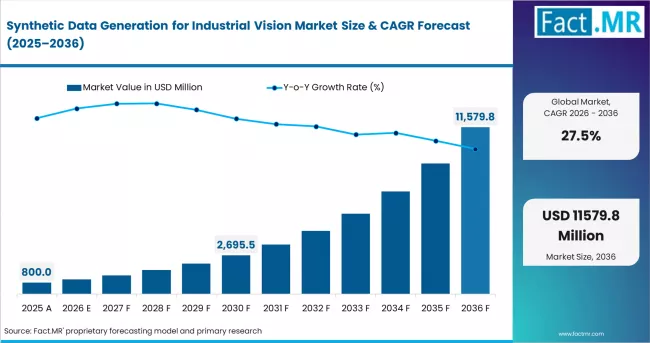
Synthetic Data Generation For Industrial Vision Market Market Value Analysis | Source: Fact.MR
Synthetic Data Generation for Industrial Vision Market
| Metric | Details |
|---|---|
| Industry Size (2026E) | USD 800.0 million |
| Industry Value (2036F) | USD 8,900.0 million |
| CAGR (2026 to 2036) | 27.5% |
Source: Fact.MR analysis. Updated Apr 21, 2026
Summary of the Synthetic Data Generation for Industrial Vision Market
- Market Definition
- The market comprises software platforms and simulation technologies used to generate artificial visual datasets including images, videos, and 3D environments for training industrial computer vision algorithms applied in automated inspection, robotics guidance, object recognition, and process monitoring across manufacturing environments.
- Demand Drivers
- Increasing adoption of artificial intelligence vision systems requiring large labeled datasets for model training across industrial automation environments.
- Rising need to reduce dependency on manual data collection and annotation processes for defect detection model development.
- Growing use of simulation engines enabling generation of rare defect scenarios difficult to capture in real production environments.
- Expansion of AI-enabled quality inspection systems requiring scalable synthetic image datasets for algorithm optimization.
- Increasing integration of 3D rendering and generative models supporting development of machine vision training pipelines.
- Rising requirement for domain-diverse training datasets supporting improved accuracy of industrial visual analytics systems.
- Key Segments Analyzed
- Data Type: Image data leads with 46% share supported by demand for visual datasets used in inspection model training.
- Application: Quality inspection accounts for 34% share driven by need for automated defect recognition across manufacturing workflows.
- Technology Role: GAN models, diffusion models, and simulation engines enable scalable creation of annotated datasets.
- AI Function: Synthetic data platforms support training of object detection, classification, and anomaly recognition algorithms.
- Geography: North America, Europe, and Asia Pacific demonstrate strong adoption supported by expansion of industrial AI infrastructure.
- Analyst Opinion at Fact MR
- Shambhu Nath Jha, Principal Consultant, Fact MR, opines, 'In this updated edition of the Synthetic Data Generation for Industrial Vision Market report, simulation-driven datasets are increasingly integrated within industrial AI development workflows to improve model accuracy and reduce dependency on physical defect data collection through 2036.'
- Strategic Implications or Executive Takeaways
- Invest in simulation engine capability supporting scalable creation of labeled datasets for machine vision model training.
- Strengthen generative AI framework capability supporting photorealistic defect scenario generation across industrial inspection workflows.
- Improve dataset variability supporting robust model training across lighting, geometry, and material condition variations.
- Expand integration capability supporting compatibility with industrial automation software and AI development platforms.
- Focus on data generation efficiency supporting reduction of manual annotation cost across machine learning training pipelines.
- Enhance collaboration with industrial automation providers supporting optimized deployment of AI-enabled visual inspection solutions.
- Methodology
- Primary interviews conducted with AI software developers, industrial automation companies, and computer vision solution providers.
- Benchmarked against industrial AI deployment indicators influencing adoption of synthetic training datasets.
- Evaluated simulation technology trends supporting creation of labeled datasets for defect detection algorithms.
- Hybrid modeling applied combining top down industrial automation AI adoption assessment with bottom up synthetic dataset utilization benchmarking.
- Validation conducted using supplier level software deployment indicators across machine vision development environments.
- Peer review applied using Fact MR analytical frameworks linking AI dataset generation capability with industrial computer vision adoption trends.
A CAGR of 27.5% indicates highly transformational expansion driven by demand for scalable datasets to train industrial vision models without physical image collection constraints. Growth is supported by simulation efficiency and data labeling cost reduction, while constraints persist from model validation requirements and domain transfer accuracy limitations.
China leads with a projected CAGR of 29.6%, supported by increasing use of simulated datasets for training machine vision algorithms across automated manufacturing environments. India follows with a CAGR of 28.9%, driven by expanding deployment of AI training datasets across industrial inspection and robotics vision applications. The United Kingdom records a CAGR of 28.1%, reflecting steady adoption of virtual data generation tools across computer vision model development workflows. Germany shows a CAGR of 27.8%, supported by consistent integration of synthetic image datasets across industrial automation analytics systems. The United States records the slowest growth at 27.5%, reflecting a relatively mature AI development ecosystem tied to replacement demand within established machine vision model training infrastructures.
Segmental Analysis
Synthetic Data Generation for Industrial Vision Market Analysis by Data Type
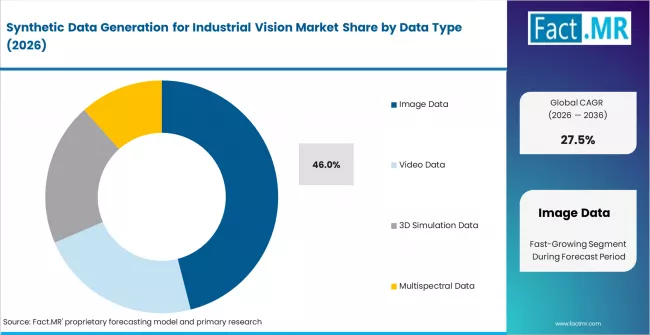
Synthetic Data Generation For Industrial Vision Market Analysis By Data Type | Source: Fact.MR
- Market Overview: Based on Fact MR assessment, image data is projected to account for 46% share of the synthetic data generation for industrial vision market in 2026. Synthetic image datasets are generated through simulation engines replicating lighting conditions, surface textures, and object geometries required for training machine vision models used in industrial inspection workflows. Image synthesis frameworks enable creation of labeled datasets supporting defect recognition across manufacturing environments requiring controlled representation of scratches, dents, misalignment, and dimensional variation patterns. Artificial image generation supports development of computer vision algorithms requiring large scale annotated data across varied production scenarios.
- Demand Drivers:
- Training Data Requirements: Synthetic image datasets support development of machine vision models requiring structured representation of industrial defect characteristics.
- Annotation Efficiency Parameters: Generated image data enables automated labeling of object features supporting reduction of manual dataset preparation effort.
- Scenario Variability Needs: Simulation environments enable creation of varied image conditions supporting robustness of industrial vision model performance.
Synthetic Data Generation for Industrial Vision Market Analysis by Application
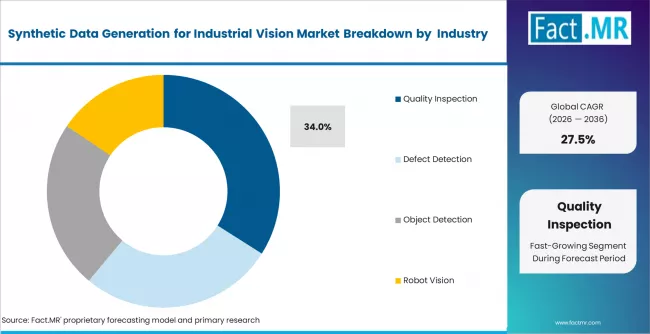
Synthetic Data Generation For Industrial Vision Market Analysis By Application | Source: Fact.MR
- Market Overview: Quality inspection is estimated to hold 34% share of the synthetic data generation for industrial vision market in 2026, supported by requirement for training computer vision models detecting manufacturing defects across production lines requiring consistent inspection accuracy. Synthetic datasets support recognition of surface irregularities, dimensional deviation, and assembly inconsistencies across automated inspection systems integrated within industrial manufacturing workflows. Vision model training frameworks utilize synthetic data to simulate defect occurrence scenarios enabling improvement of inspection reliability across production environments requiring controlled product quality verification performance.
- Demand Drivers:
- Defect Detection Requirements: Synthetic datasets support training of inspection algorithms identifying structural irregularities across manufactured components.
- Model Accuracy Parameters: Artificial image generation enables representation of varied defect scenarios improving reliability of automated quality inspection systems.
- Process Optimization Needs: Vision model development supported by synthetic data contributes to consistent product inspection performance across industrial manufacturing workflows.
Key Dynamics
Synthetic Data Generation for Industrial Vision Market Drivers, Restraints, and Opportunities
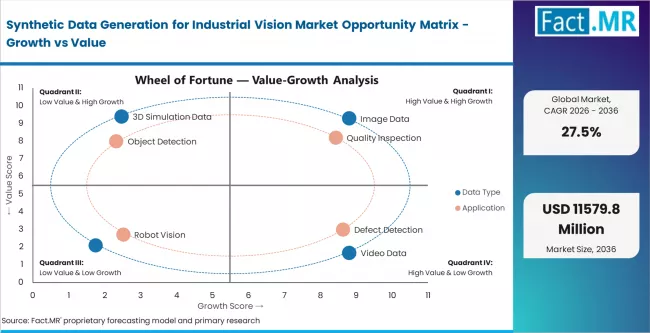
Synthetic Data Generation For Industrial Vision Market Opportunity Matrix Growth Vs Value | Source: Fact.MR
FMR analysts observe that historical computer vision deployment in manufacturing has been constrained by limited availability of labeled defect datasets, particularly for rare fault conditions such as micro-cracks, surface anomalies, and wear patterns. The present market size reflects a structural transition from manual image annotation toward simulation-based data generation platforms capable of producing high-volume labeled datasets for training inspection algorithms. Structural reality indicates a growth-phase software infrastructure market because industrial AI models require large, diverse training datasets that are often impractical to capture in real production environments due to downtime cost and defect rarity. Synthetic data enables scalable generation of annotated images and 3D scenes that accelerate deployment of automated quality inspection and predictive maintenance systems.
The current structural shift reflects declining dependence on purely real-world training datasets as generative simulation platforms produce statistically representative defect variations across lighting, geometry, and material conditions. Higher software subscription costs for simulation engines are offset by reduced manual labeling expense and faster model training cycles, enabling improved deployment economics despite lower physical data acquisition volumes. Value growth remains tied to expansion of AI-enabled machine vision use cases across industrial automation environments requiring robust anomaly detection capability.
- Data Scarcity Constraint: Synthetic datasets address limited availability of labeled defect images, enabling balanced training data for industrial inspection models where real failure events occur infrequently.
- Privacy Compliance Demand: GDPR and enterprise data governance policies encourage synthetic dataset generation that replicates statistical characteristics without exposing proprietary manufacturing imagery.
- North America AI Base: United States leads adoption due to concentration of industrial AI developers and machine vision integrators deploying scalable training pipelines for automated inspection systems.
Regional Analysis
The Synthetic Data Generation for Industrial Vision Market is assessed across North America, Europe, and Asia Pacific, segmented by country-level demand in machine vision model training datasets, defect detection simulation, digital manufacturing inspection algorithms, and AI-driven visual analytics development. Regional demand reflects expansion of computer vision deployment and need for scalable training datasets. The full report offers market attractiveness analysis.
.webp "Top Country Growth Comparison Synthetic Data Generation For Industrial Vision Market Cagr (2026 2036)")
Top Country Growth Comparison Synthetic Data Generation For Industrial Vision Market Cagr (2026 2036) | Source: Fact.MR
CAGR Table of Synthetic Data Generation for Industrial Vision Market
| Country | CAGR (2026–2036) |
|---|---|
| China | 29.6% |
| India | 28.9% |
| United Kingdom | 28.1% |
| Germany | 27.8% |
| United States | 27.5% |
Source: Fact.MR analysis. Updated Apr 21, 2026
Source: Fact MR analysis, based on proprietary forecasting model and primary research
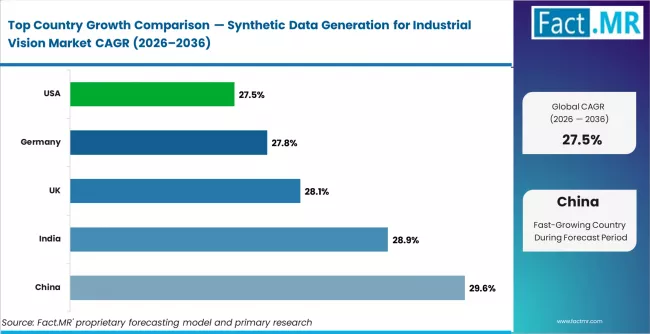
Synthetic Data Generation For Industrial Vision Market Cagr Analysis By Country | Source: Fact.MR
Asia Pacific
Asia Pacific functions as the industrial AI dataset development hub, supported by rapid adoption of machine vision systems and expansion of automated inspection technologies. Siemens AG strengthens industrial simulation software capability. Cognex Corporation expands AI-based visual inspection development tools. Datagen Technologies Ltd. supports synthetic image dataset generation platforms.
- China: China is projected to record 29.6% CAGR in synthetic data generation for industrial vision through 2036. Artificial Intelligence industry development plan update (MIIT, March 2024) supports training dataset generation for machine vision systems. Datagen Technologies Ltd. expanded synthetic visual dataset platform capability (June 2023).
- India: Adoption of synthetic data generation for industrial vision in India is forecast to grow at 28.9% CAGR through 2036. National AI Mission implementation update (Ministry of Electronics and Information Technology, January 2024) supports development of machine learning datasets for industrial automation. Tata Consultancy Services Limited expanded AI training data engineering capability (May 2023).
Europe
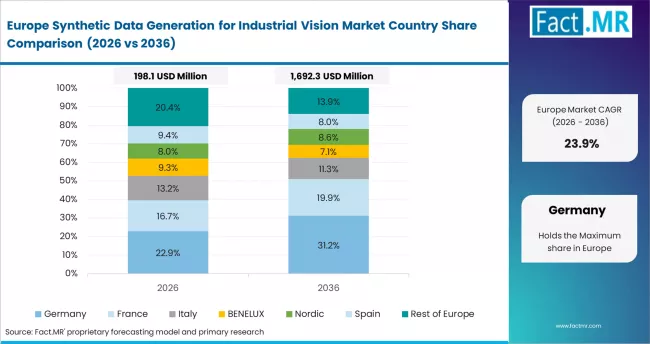
Synthetic Data Generation For Industrial Vision Market Europe Country Market Share Analysis, 2026 & 2036 | Source: Fact.MR
Europe operates as the industrial simulation modelling engineering center, supported by Industry 4.0 frameworks and strong adoption of AI-based inspection technologies. Dassault Systèmes SE strengthens digital twin dataset simulation capability. Siemens AG expands industrial computer vision development platforms. Cognex Corporation supports AI-enabled inspection model optimization.
- United Kingdom: Deployment of synthetic data generation for industrial vision in United Kingdom is expected to expand at 28.1% CAGR through 2036. UK National AI Strategy implementation update (Department for Science, Innovation and Technology, February 2024) supports machine vision model training innovation. Dassault Systèmes SE expanded simulation-based dataset modelling capability (July 2023).
- Germany: Germany is anticipated to observe 27.8% CAGR in synthetic data generation for industrial vision through 2036. Plattform Industrie 4.0 digital simulation initiative update (BMWK, October 2023) supports virtual dataset modelling adoption. Siemens AG expanded AI-enabled industrial simulation software capability (April 2023).
North America
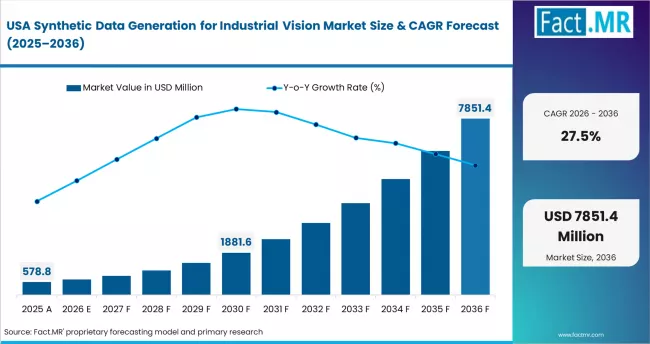
Synthetic Data Generation For Industrial Vision Market Country Value Analysis | Source: Fact.MR
North America represents the industrial AI training dataset commercialization environment, supported by expansion of deep learning vision systems and integration of synthetic data into automated inspection workflows. NVIDIA Corporation strengthens AI simulation platform capability. Cognex Corporation expands deep learning visual inspection tools. Rockwell Automation Inc. supports AI-driven manufacturing analytics integration.
- United States: The United States is forecast to witness 27.5% CAGR in synthetic data generation for industrial vision through 2036. National Artificial Intelligence Initiative programme update (NIST, April 2024) supports synthetic dataset development for industrial machine vision applications. NVIDIA Corporation expanded simulation-driven AI training platform capability (August 2023).
Fact MR's analysis of synthetic data generation for industrial vision market in global regions consists of country-wise assessment that includes China, India, United Kingdom, Germany, and United States. Readers can find AI dataset development trends, machine vision training innovations, industrial simulation adoption signals, and competitive positioning across key markets.
Competitive Landscape
Competitive Structure and Buyer Dynamics in the Synthetic Data Generation for Industrial Vision Market
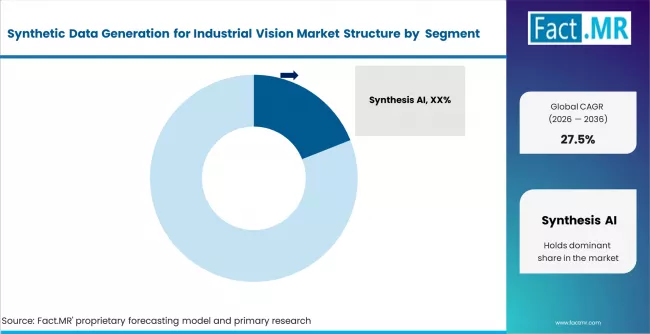
Synthetic Data Generation For Industrial Vision Market Analysis By Company | Source: Fact.MR
The competitive structure of the Synthetic Data Generation for Industrial Vision Market is moderately fragmented, with AI software developers and simulation platform providers participating across training data generation for machine vision models. Companies such as NVIDIA Corporation, Unity Technologies, Datagen Technologies Ltd., Parallel Domain Inc., Rendered.ai, and Synthesis AI maintain strong positions through simulation engines and synthetic image generation platforms used to train computer vision algorithms. Additional participants including Gretel Labs Inc., Mostly AI Inc., AI.Reverie Inc., and Neurolabs Ltd. contribute through data generation tools designed to support model accuracy and reduce dependence on real world labeled datasets. Competition is primarily influenced by dataset realism, scalability of simulation environments, annotation automation capability, and compatibility with machine learning training pipelines.
Several companies maintain structural advantages through proprietary simulation engines and strong expertise in artificial intelligence model training workflows. Firms such as NVIDIA Corporation and Unity Technologies benefit from established 3D simulation platforms supporting photorealistic synthetic dataset creation. Datagen Technologies Ltd. and Parallel Domain Inc. maintain advantages through specialized tools designed for industrial inspection and autonomous perception model development. Industrial AI developers often evaluate multiple data generation providers to reduce dependence on a single simulation platform and maintain model training flexibility. Procurement decisions assess dataset accuracy, scalability, and integration capability, moderating supplier pricing leverage across synthetic training data applications.
Key Players of the Synthetic Data Generation for Industrial Vision Market
- Synthesis AI
- Datagen Technologies Ltd.
- Gretel Labs Inc.
- Mostly AI Inc.
- Rendered.ai
- Parallel Domain Inc.
- AI.Reverie Inc.
- Neurolabs Ltd.
- Unity Technologies
- NVIDIA Corporation
Bibliographies
- [1] Federal Ministry for Economic Affairs and Climate Action. (2023, October). Plattform Industrie 4.0 digital simulation initiative update. Government of Germany.
- [2] Ministry of Electronics and Information Technology. (2024, January). National AI mission implementation update. Government of India.
- [3] Ministry of Industry and Information Technology. (2024, March). Artificial intelligence industry development plan update. Government of China.
- [4] National Institute of Standards and Technology. (2024, April). National artificial intelligence initiative programme update. U.S. Department of Commerce.
- [5] Department for Science Innovation and Technology. (2024, February). UK national AI strategy implementation update. UK Government.
- [6] NVIDIA Corporation. (2023, August). Simulation driven AI training platform capability expansion. NVIDIA Corporation.
- [7] Siemens AG. (2023, April). AI enabled industrial simulation software capability expansion. Siemens AG.
- [8] Tata Consultancy Services Limited. (2023, May). AI training data engineering capability expansion. Tata Consultancy Services Limited.
- [9] Dassault Systèmes SE. (2023, July). Simulation based dataset modelling capability expansion. Dassault Systèmes SE.
This Report Addresses
- Market size forecasts for 2026 to 2036 based on adoption of artificial datasets supporting machine vision model training across automated inspection and robotics environments.
- Opportunity mapping across image datasets, video datasets, 3D simulation environments, and multispectral data generation technologies supporting industrial visual analytics development.
- Segment and regional forecasts covering quality inspection, defect detection, object recognition, robot vision guidance, and process monitoring applications across industrial automation workflows.
- Competition benchmarking based on dataset realism accuracy, scalability of simulation engines, annotation automation capability, and compatibility with deep learning model training pipelines.
- Governance assessment covering synthetic dataset validation requirements, intellectual property protection considerations, and enterprise data handling frameworks influencing adoption of simulated training data.
- Report delivery in PDF, Excel, PPT, and dashboard formats supporting AI developers, industrial automation companies, and computer vision solution providers.
- Technology risk evaluation covering domain transfer accuracy limitations, simulation parameter sensitivity, computational resource requirements, and integration complexity across industrial AI model development workflows.
Synthetic Data Generation for Industrial Vision Market Definition
The Synthetic Data Generation for Industrial Vision Market includes software platforms and simulation tools that create artificial images, videos, and labeled datasets used to train machine vision algorithms for quality inspection, object detection, defect identification, and robotic guidance in manufacturing environments where real image data is limited or costly to collect.
Synthetic Data Generation for Industrial Vision Market Inclusions
The report includes global and regional market size estimates, forecast analysis, and segmentation by data generation method such as simulation, generative AI, and 3D rendering, application area, end use industry, pricing structure, and integration with industrial computer vision and automation platforms.
Synthetic Data Generation for Industrial Vision Market Exclusions
The scope excludes general AI training datasets not related to visual industrial environments, conventional machine vision hardware without synthetic dataset capability, data annotation services not using artificial data generation, and simulation software not applied to vision model training.
Synthetic Data Generation for Industrial Vision Market Research Methodology
- Primary Research: Interviews were conducted with computer vision software providers, industrial automation companies, AI developers, system integrators, and manufacturing technology specialists.
- Desk Research: Public sources included AI research publications, company technical documentation, patent literature, and academic studies on synthetic dataset generation for machine vision models.
- Market-Sizing and Forecasting: A hybrid model combining top-down industrial AI adoption evaluation and bottom-up analysis of synthetic data software deployment across vision based automation applications was applied.
- Data Validation and Update Cycle: Outputs were validated through cross comparison of vendor data, expert consultation, and periodic monitoring of industrial AI training dataset development trends.
Segmentation
Report Scope
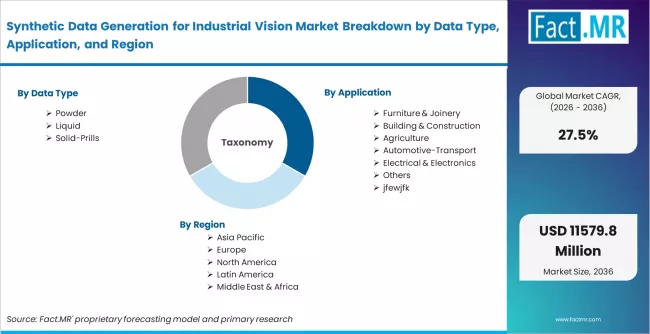
Synthetic Data Generation For Industrial Vision Market Breakdown By Data Type, Application, And Region | Source: Fact.MR
| Metric | Value |
|---|---|
| Quantitative Units | USD 800.0 million (2026) to USD 8,900.0 million (2036), at a CAGR of 27.5% |
| Market Definition | The synthetic data generation for industrial vision market includes artificial data creation technologies used to simulate labeled visual datasets for training, validation, and optimization of computer vision algorithms deployed in industrial automation and robotics systems. |
| Data Type Segmentation | Image data, Video data, 3D simulation data, Multispectral data |
| Application Segmentation | Quality inspection, Defect detection, Object detection, Robot vision, Process monitoring |
| Technology Segmentation | GAN models, Diffusion models, Simulation engines, 3D rendering |
| Regions Covered | North America, Latin America, Europe, East Asia, South Asia, Oceania, Middle East and Africa |
| Countries Covered | United States, Canada, Germany, France, United Kingdom, Netherlands, Sweden, Israel, China, Japan, South Korea, India, Singapore, Australia, Brazil, Mexico, United Arab Emirates, South Africa, and 40+ countries |
| Key Companies Profiled | Synthesis AI, Datagen Technologies Ltd., Gretel Labs Inc., Mostly AI Inc., Rendered.ai, Parallel Domain Inc., AI.Reverie Inc., Neurolabs Ltd., Unity Technologies, NVIDIA Corporation |
| Forecast Period | 2026 to 2036 |
| Approach | Hybrid top-down and bottom-up market estimation based on industrial computer vision adoption trends, AI training dataset demand benchmarking, simulation software deployment rates, automation quality inspection investment patterns, and validation through primary interviews with AI platform providers, industrial automation companies, and computer vision solution developers. |
Source: Fact.MR analysis. Updated Apr 21, 2026
Synthetic Data Generation for Industrial Vision Market Key Segments
-
Data Type:
- Image Data
- Video Data
- 3D Simulation Data
- Multispectral Data
-
Application:
- Quality Inspection
- Defect Detection
- Object Detection
- Robot Vision
- Process Monitoring
-
Technology:
- GAN Models
- Diffusion Models
- Simulation Engines
- 3D Rendering
-
Region:
- North America
- USA
- Canada
- Mexico
- Latin America
- Brazil
- Chile
- Rest of Latin America
- Western Europe
- Germany
- UK
- Italy
- Spain
- France
- Nordic
- BENELUX
- Rest of Western Europe
- Eastern Europe
- Russia
- Poland
- Hungary
- Balkan & Baltic
- Rest of Eastern Europe
- East Asia
- China
- Japan
- South Korea
- South Asia and Pacific
- India
- ASEAN
- Australia & New Zealand
- Rest of South Asia and Pacific
- Middle East & Africa
- Kingdom of Saudi Arabia
- Other GCC Countries
- Turkiye
- South Africa
- Other African Union
- Rest of Middle East & Africa
- North America
Frequently Asked Questions
How large is the demand for Synthetic Data Generation for Industrial Vision in the global market in 2026?
What will be the market size of Synthetic Data Generation for Industrial Vision in the global market by 2036?
What is the expected demand growth for Synthetic Data Generation for Industrial Vision in the global market between 2026 and 2036?
Which company is identified as a leading provider in the Synthetic Data Generation for Industrial Vision market?
Which data type segment is projected to dominate synthetic data adoption by 2026?
Why is synthetic image data widely used in industrial vision applications?
What is driving demand for synthetic data generation platforms in China?
What is the growth outlook for the Synthetic Data Generation for Industrial Vision market in China?
Why is India an important market for synthetic industrial data platforms?
What is the growth outlook for the Synthetic Data Generation for Industrial Vision market in India?
How is demand for synthetic data generation evolving in the United Kingdom industrial AI sector?
What is the growth outlook for the Synthetic Data Generation for Industrial Vision market in the United Kingdom?
What is the growth outlook for the Synthetic Data Generation for Industrial Vision market in Germany?
How is the United States positioned in the Synthetic Data Generation for Industrial Vision market?
What is the growth outlook for the Synthetic Data Generation for Industrial Vision market in the United States?
What is synthetic data generation for industrial vision and what is it mainly used for?
What does the Synthetic Data Generation for Industrial Vision market include in this report?
What applications are included in the scope of the Synthetic Data Generation for Industrial Vision market?
What is excluded from the scope of the Synthetic Data Generation for Industrial Vision market report?
What does market forecast mean in the Synthetic Data Generation for Industrial Vision market report?
How is the Synthetic Data Generation for Industrial Vision market forecast developed in this report?
What does primary validation indicate in the Synthetic Data Generation for Industrial Vision market analysis?
Who worked on this report


Preview the report firsthand - request a free sample
Free SampleGet the brochure for pricing and purchase details
Download PDF