Strength Training Studios Market Size, Share, Growth and Forecast (2026 - 2036)
The Strength Training Studios Market is segmented by Service Type, by Training Format, by Customer Type, by Revenue Model, by Studio Size, by Booking Channel, by End Use, and Region. Forecast for 2026 to 2036.
What is the strength training studios market forecast to be worth by 2036?
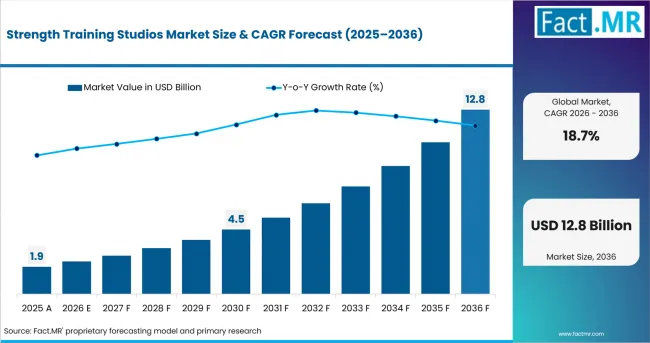
USD 2.3 billion in 2026 to USD 12.8 billion by 2036, at 18.7% CAGR.
- The strength training studios market crossed a valuation of USD 1.9 billion in 2025.
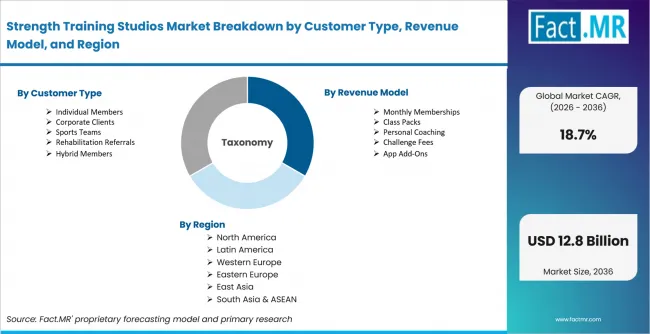
- Demand is expected to rise from USD 2.3 billion in 2026 to USD 12.8 billion by 2036.
- The market is forecast to record 18.7% CAGR from 2026 to 2036 as coached lifting, fitness racing and measurable strength programs gain share inside paid fitness.
What are the defining numbers behind strength training studios growth?
USD 10.5 billion absolute opportunity by 2036. India, Australia and the United States lead the country view.
- Demand Drivers in the Market
- Strength programming now carries its own membership logic because members pay for progression, coach correction and planned load increases.
- Fitness racing creates a clear use case for sleds, carries and mixed strength blocks inside studios.
- Women-focused lifting formats are widening the buyer base because many members prefer coached rooms over open gym floors.
- Older adults are using strength training as a practical route to mobility, balance and daily function.
- App booking and progress tracking support retention because members can see load history and attendance patterns.
- Key Segments Analyzed
- By Customer Type: Individual Members are expected to account for 56.0% share in 2026 because recurring consumer memberships fund most studio capacity.
- By Revenue Model: Monthly Memberships are projected to hold 52.0% share in 2026 because operators need predictable cash flow to cover coaches and rent.
- By Booking Channel: App Booking is estimated to capture 47.0% share in 2026 as studios use waitlists, session caps and reminders to protect class utilization.
- By Training Format: Small Group Sessions are forecast to hold 44.0% share in 2026 because the model balances coach attention with workable unit economics.
- By End Use: Strength Progression is anticipated to represent 42.0% share in 2026 because measured load increases are the clearest member outcome.
- By Studio Size: Micro Studios are likely to hold 41.0% share in 2026 because compact footprints reduce lease exposure and fit dense urban areas.
- By Service Type: Barbell Coaching is expected to contribute 39.0% share in 2026 because technique correction and planned programming are central to the offer.
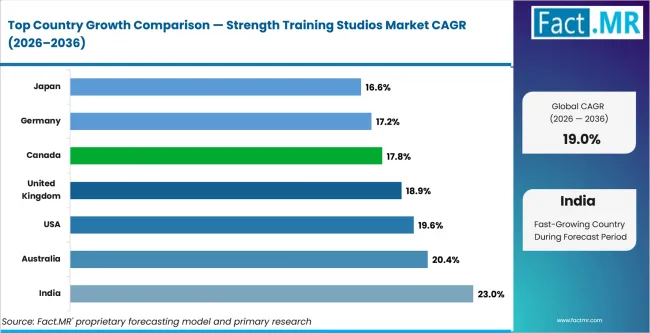
- By Geography: India is expected to record 23.0% CAGR through 2036 because paid fitness penetration remains low and premium studios are expanding in large cities.
- Analyst Opinion
- Shambhu Nath Jha, Principal Analyst at Fact.MR states, "I see strength studios winning when they make progress simple to understand. A member should know what was lifted, why it changed and what the next session is meant to improve."
- Strategic Implications
- Studio operators should price coaching quality separately from gym access because members pay for correction and accountability.
- Franchise systems need trainer certification, class programming and equipment standards before fast site rollout.
- Equipment suppliers can gain repeat orders by designing racks and sled lanes for small rooms with heavy daily use.
- Investors should test retention and coach capacity before valuing a studio roll-up on location count alone.
Boutique studios that sell coached barbell training and progressive-overload programs form the core of this market. Demand for studios that help members improve form, load selection and training consistency.
India is projected to record 23.0% CAGR through 2036 as low paid-fitness penetration and new center additions support faster rollout. Australia is expected to expand at 20.4% CAGR because active adults are shifting toward coached private fitness formats. The United States is forecast to grow at 19.6% CAGR as large metro gym membership and paid coaching habits support studio demand. The United Kingdom is expected to advance at 18.9% CAGR as active adults seek structured lifting programs. Canada is projected to rise at 17.8% CAGR as urban fitness routines and winter indoor training support recurring memberships.
How does the strength training studios market break down by segment?
Individual Members lead at 56.0%. Monthly Memberships follow with 52.0% share in 2026.
Which customer type dominates?
Individual Members hold 56.0% share in 2026.
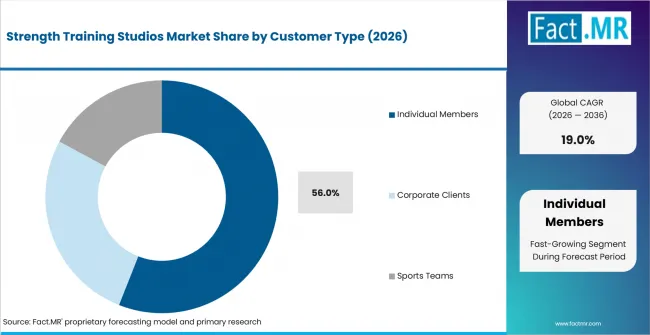
Individual Members are estimated to represent 56.0% share in 2026 because consumer memberships remain the main revenue base for boutique gyms. This puts strength studios near the health and fitness club value chain but separates them through coach-led progression. Corporate and clinical buyers add volume later but usually require longer sales cycles.
Which revenue model dominates?
Monthly Memberships hold 52.0% share in 2026.
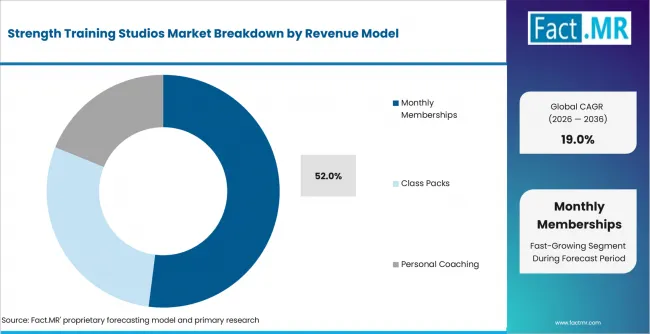
Monthly Memberships are anticipated to capture 52.0% share in 2026 because operators need recurring receipts to cover coaches, leases and software. Sensor-enabled stations relate to connected fitness equipment when operators use load history to keep member progress visible. Class packs remain useful for trials but provide weaker revenue visibility.
Which booking channel dominates?
App Booking holds 47.0% share in 2026.
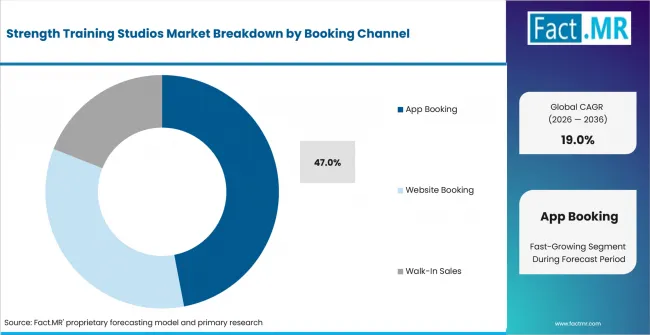
App Booking is forecast to account for 47.0% share in 2026 because class caps, waitlists and reminders are central to small-room economics. Hybrid bookings overlap with the home fitness app category when studios extend programs between coached sessions. The booking layer also helps owners identify members who are at risk of leaving.
Which training format dominates?
Small Group Sessions hold 44.0% share in 2026.
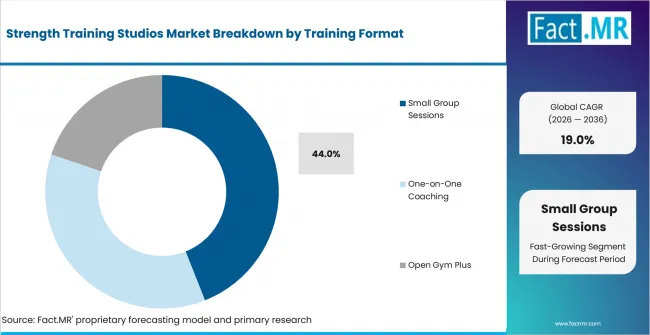
Small Group Sessions are projected to account for 44.0% share in 2026 because one coach can manage technique and energy without losing program control. Equipment planning connects this format with functional fitness equipment because sleds, racks and kettlebells need to survive repeated group use. The format also gives operators more revenue per hour than one-on-one sessions.
Which end use dominates?
Strength Progression holds 42.0% share in 2026.
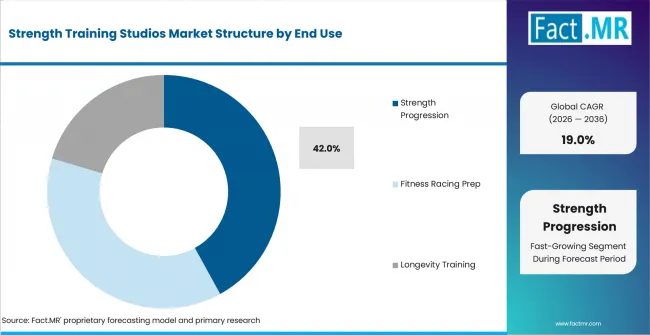
Strength Progression is expected to contribute 42.0% share in 2026 because members want visible improvement in loads, form and training confidence. The same upgrade cycle connects studios with gym equipment replacement spending when barbells, benches and racks face daily use. Fitness racing and body-composition programs grow from that base.
Which studio size dominates?
Micro Studios hold 41.0% share in 2026.
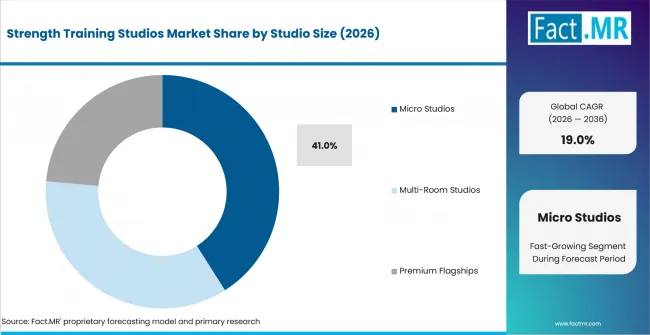
Micro Studios are likely to hold 41.0% share in 2026 because compact formats fit dense neighborhoods and second-floor retail sites. Connected performance checks bring the model closer to connected sports equipment used for rep counting and form feedback. The main limit is crowding when operators add too many stations to protect margins.
Which service type dominates?
Barbell Coaching holds 39.0% share in 2026.
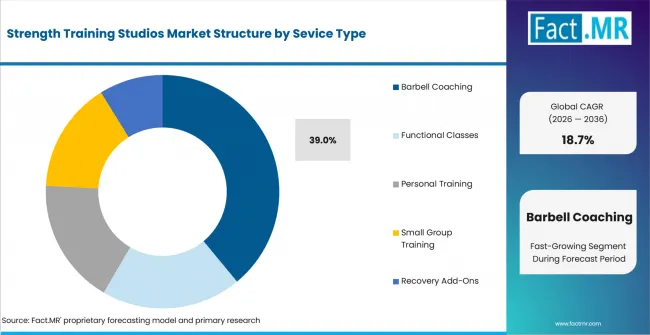
Barbell Coaching is expected to hold 39.0% share in 2026 because technique correction is difficult to replace with a screen or open floor access. Studios that serve event-driven members can also connect training blocks with sports nutrition purchases when athletes plan recovery and race preparation. Functional classes and personal training remain important but carry less category identity.
What is accelerating strength training studios demand, and what is holding it back?
Measured progression, fitness racing and longevity programs support demand. Trainer supply, real-estate cost and retention discipline restrain wider use.
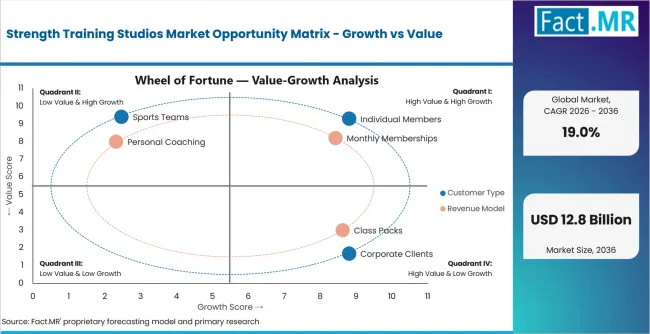
Strength studios are gaining paid members because the customer problem is specific. Members want to learn how to lift, improve without guessing and stay accountable between sessions. Fitness racing adds another reason to pay because events reward sled pushes, carries and mixed strength endurance.
Expansion is constrained by the economics of coaching. A studio needs enough qualified trainers to keep sessions safe and personal. Rent also matters because strength rooms require load-bearing floors, open movement space and durable equipment. Churn can damage the model when members do not see progress quickly enough.
Where do the biggest strength training studios opportunities sit?
Progressive-overload coaching, fitness racing preparation and women-focused strength programs.
- Progressive-Overload Coaching: Providers can sell structured lifting plans when members want clear targets, session records and coach feedback. The app layer may connect with a fitness application when workouts continue outside the studio.
- Fitness Racing Prep: Studios can package sled lanes, carries and rowing blocks into event-preparation programs. This creates seasonal campaigns that do not depend only on monthly membership sales.
- Women-Focused Strength: Operators can win new members by offering technique-first rooms, coach education and beginner blocks that reduce open-gym discomfort. Progress checks may use wireless health and fitness devices when members track heart rate and recovery between sessions.
Which countries are scaling strength training studios fastest?
India 23.0% and Australia 20.4% lead the country view. United States 19.6%, United Kingdom 18.9% and Canada 17.8% follow. Germany 17.2% and Japan 16.6% complete the top seven.
Based on regional analysis, the strength training studios market is segmented into North America and Europe. Asia Pacific is also covered. Latin America and Middle East and Africa complete the regional scope.
.webp)
| Country | CAGR |
|---|---|
| India | 23.0% |
| Australia | 20.4% |
| United States | 19.6% |
| United Kingdom | 18.9% |
| Canada | 17.8% |
| Germany | 17.2% |
| Japan | 16.6% |

What powers India’s lead?
23.0% CAGR, driven by low paid-fitness penetration and new center additions.
India starts from low commercial fitness penetration, which gives premium strength studios room to educate first-time paid members. The Health and Fitness Association and Deloitte India estimated 12.3 million fitness facility members in 2024. Operators that price beginner coaching clearly can scale faster than premium personal training alone. India is expected to expand at 23.0% CAGR through 2036 because low penetration and city-led supply growth reinforce each other.
How does Australia support premium strength studios?
20.4% CAGR, driven by gym use among women and flexible participation habits.
Australia has a participation culture that favors private fitness facilities and flexible training formats. The Australian Sports Commission reported that 85.0% of adults were active in its 2025 participation review. Strength studios can benefit when active adults want a coach upgrade from self-directed floor access. Australia is forecast to grow at 20.4% CAGR through 2036 because high activity levels support premium room formats.
What supports the United States outlook?
19.6% CAGR, supported by large metro gym membership and paid coaching habits.
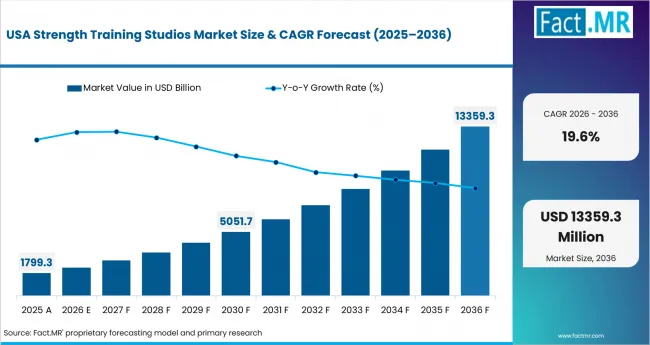
United States buyers compare coach credentials, class times and visible progress before paying a premium studio fee. The Office of Disease Prevention and Health Promotion reported that 32.9% of adults performed muscle-strengthening activity on two or more days each week in 2024. Studios can use that base to sell technique and accountability rather than access. Suppliers with trainer education and retention systems should gain steadier site economics.
Why does the United Kingdom matter?
18.9% CAGR, backed by record active-adult levels and boutique studio density.
The United Kingdom is shaped by dense city markets where members can switch between gyms, studios and sport clubs. Sport England reported that 64.6% of adults in England met the recommended activity level during the November 2024 to November 2025 period. Strength studios can benefit when active adults want a coached upgrade from self-directed gym use. Faster volume depends on keeping monthly prices below the point where members return to budget clubs.
How is Canada positioned?
17.8% CAGR, supported by urban fitness habits and winter indoor training.
Canada’s climate and urban work patterns give indoor studios a steady role during colder months. Statistics Canada reported that 39.0% of Canadian adults engaged in strength training on at least two days in the week before the 2022 to 2024 survey. Strength studios can serve members who want a structured indoor routine when outdoor activity drops. This creates channel demand for app-based scheduling and recurring membership packages.
What makes Germany relevant?
17.2% CAGR, led by chain facility scale and health-oriented gym members.
Germany has a large fitness club base that can support both independent studios and club-inside-club strength rooms. DSSV reported 11.71 million members across fitness and health facilities at the end of 2024. The same structure gives strength concepts a clear upgrade path from general membership to coached lifting. Growth is limited by trainer availability and member price sensitivity outside the largest cities.
Why is Japan a useful commercial market?
16.6% CAGR, backed by older-adult strength participation and commuter-area studios.
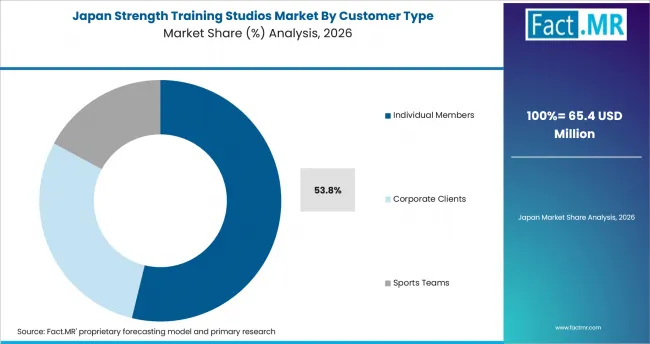
Japan’s opportunity is tied to age, daily function and small-footprint locations near commuter routes. The Sasakawa Sports Foundation estimated 16.75 million adults took part in weight training in its 2024 National Sports-Life Survey. Studios can design beginner lifting, balance and posture programs for members who need confidence before joining open gym floors. Japan is expected to post 16.6% CAGR through 2036 because age-related strength needs support compact coaching formats.
Who leads the strength training studios landscape?
Ultimate Performance, F45 Training and Body Fit Training lead through coaching systems and international studio footprints. HYROX adds a competition-led route.
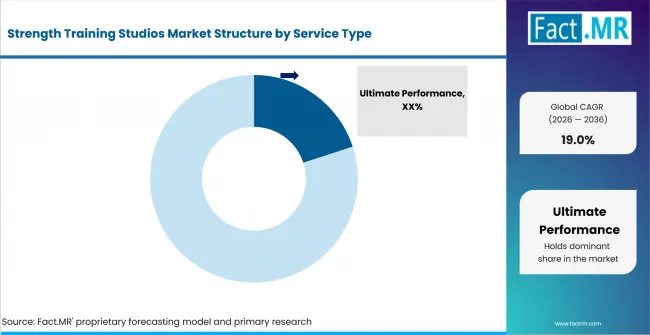
Ultimate Performance competes from a premium personal training position, with measurable transformation programs and high coach accountability. F45 Training competes through repeatable group programming under FIT House of Brands. Body Fit Training gives Xponential Fitness a strength and conditioning format with repeatable group sessions.
Capability matters more than location count in this category. Buyers compare trainer certification, program design and visible progress tracking before they commit. Apparel and community programs can add revenue, which connects some operators with performance apparel when branded products support member identity.
HYROX changes competition because it gives studios an external goal and a calendar-based reason to train. F45 Training extended its global gym partnership with HYROX across 12 events in 2026. This helps studios sell race-prep blocks that are easier to explain than ordinary high-intensity classes.
Barriers are practical rather than technical. Operators need floor layouts that support heavy lifts, sled work and safe traffic flow. Providers that can standardize coaching, equipment layout and retention routines should be better placed through 2036.
Which companies are the key players?
Ultimate Performance, F45 Training and Body Fit Training are key players. Barry’s, Life Time Group Holdings and MADabolic are also profiled. HYROX completes the company set.
- Ultimate Performance
- F45 Training
- Body Fit Training
- Barry’s
- Life Time Group Holdings
- MADabolic
- HYROX
Bibliography
- [1] Health & Fitness Association. (2025, August 18). 2025 Global Fitness Industry Report shows record growth and what’s next for the market. Health & Fitness Association.
- [2] Health & Fitness Association. (2025, October 30). How 77 million fitness members work out: New HFA data reveals shifting equipment, training, and membership trends. Health & Fitness Association.
- [3] Health & Fitness Association and Deloitte India. (2025, September 9). India Fitness Market Report 2025. Health & Fitness Association.
- [4] American College of Sports Medicine. (2024, October 22). ACSM announces top fitness trends for 2025. American College of Sports Medicine.
- [5] Office of Disease Prevention and Health Promotion. (2026). Increase the proportion of adults who do enough muscle-strengthening activity. Office of Disease Prevention and Health Promotion.
- [6] National Center for Health Statistics. (2026, April 7). Aerobic physical activity among adults aged 18 and older: United States, 2024. Centers for Disease Control and Prevention.
- [7] Sport England. (2026, April 23). Active Lives Adult Survey November 2024 to November 2025 report. Sport England.
- [8] Australian Sports Commission. (2025, May 30). Australians are redefining the way they play. Australian Sports Commission.
- [9] Statistics Canada. (2025, October 17). Directly measured physical activity and sedentary time in Canada: New results from the Canadian Health Measures Survey, 2022 to 2024. Statistics Canada.
- [10] DSSV e.V. (2025, March 26). Eckdaten 2025. DSSV e.V.
- [11] Sasakawa Sports Foundation. (2024, December 31). The 2024 SSF National Sports-Life Survey: Executive summary. Sasakawa Sports Foundation.
- [12] Life Time Group Holdings, Inc. (2025, December 30). 2026 Life Time Wellness Survey results are in. Life Time Group Holdings, Inc.
- [13] Xponential Fitness, Inc. (2026, February 26). Xponential Fitness announces fourth quarter and full year 2025 financial results. Xponential Fitness, Inc.
- [14] FIT House of Brands. (2026, March 11). F45 Training extends global gym partnership with HYROX. FIT House of Brands.
- [15] Xponential Fitness, Inc. (2026, May 18). Xponential Fitness, Inc. announces appointment of Danielle Darby as chief operating officer. Xponential Fitness, Inc.
This Report Addresses
- Strategic intelligence on Strength Training Studios Market across Service Type, Training Format, Customer Type and Revenue Model.
- Segment analysis covering Individual Members, Monthly Memberships, App Booking, Small Group Sessions and Strength Progression.
- Regional outlook covering India, Australia, United States, United Kingdom, Canada, Germany and Japan.
- Competitive analysis of Ultimate Performance, F45 Training and Body Fit Training as key players. Barry’s, Life Time Group Holdings and MADabolic are also profiled.
- Service assessment covering Barbell Coaching, Functional Classes, Personal Training, Small Group Training and Recovery Add-Ons.
- Policy assessment covering public physical activity guidelines, adult muscle-strengthening targets and activity participation benchmarks.
- Source-led market sizing using provider counts, studio revenue assumptions, fitness participation data, company releases and interview validation.
What does the strength training studios market cover?
Boutique studios that sell coached barbell, functional strength and progressive-overload training programs.
The market covers paid studios where strength coaching is the main product. It includes small group classes, personal strength coaching and structured race-prep programs. Studios may operate as independent units, franchise locations or club-inside-club concepts when the strength program has its own pricing and coach allocation.
What is included in the scope?
Coached studio memberships and strength classes are included. Personal coaching, challenge fees and paid hybrid programs are also included.
The scope includes barbell coaching, functional strength circuits and small group training. It also covers performance testing, body-composition programs and recovery add-ons when sold by strength-led studios. App booking, member progress tracking and trainer-led program design are included when tied to paid studio access.
What is excluded from the scope?
General gym access, home equipment sales and unsupervised fitness apps are excluded.
The scope excludes ordinary gym memberships where strength training is only one floor-area use. It also excludes home workout subscriptions, personal trainer marketplaces and equipment retail. Sports performance centers are excluded unless they sell repeat consumer strength memberships in a studio format.
How was the analysis built?
120+ sources and 55+ company or association pages were checked. 30+ countries were reviewed with 22+ expert interviews.
- Primary Research: Interviews covered boutique studio owners and strength coaches. Franchise operators, gym equipment suppliers and paid membership software vendors were also included.
- Desk Research: Desk research reviewed government health pages and fitness association releases. Company investor materials and official studio pages were checked for current activity.
- Market-Sizing and Forecasting: Forecasting used provider counts and revenue per studio assumptions. Average membership prices and site rollout plans supported the model.
- Data Validation and Update Cycle: Estimates were reconciled against Health and Fitness Association data, Sport England activity data and Australian Sports Commission participation evidence. Company disclosures from Life Time, Xponential Fitness and FIT House of Brands were also reviewed.
What is the report’s scope and coverage?
| Attribute | Details |
|---|---|
| Quantitative Units | USD Billion in 2026 to USD Billion by 2036 at CAGR |
| Market Definition | Coached boutique studios built around barbell, functional strength and progressive-overload training programs |
| Service Type | Barbell Coaching, Functional Classes, Personal Training, Small Group Training, Recovery Add-Ons |
| Training Format | Small Group Sessions, One-on-One Coaching, Open Gym Plus, Challenge Programs, Race Prep |
| Customer Type | Individual Members, Corporate Clients, Sports Teams, Rehabilitation Referrals, Hybrid Members |
| Revenue Model | Monthly Memberships, Class Packs, Personal Coaching, Challenge Fees, App Add-Ons |
| Studio Size | Micro Studios, Multi-Room Studios, Premium Flagships, Franchise Units, Club-Inside-Club |
| Booking Channel | App Booking, Website Booking, Walk-In Sales, Corporate Booking, Partner Referrals |
| End Use | Strength Progression, Fitness Racing Prep, Longevity Training, Body Composition, Injury Prevention |
| Regions Covered | North America, Europe, Asia Pacific, Latin America, Middle East and Africa |
| Countries Covered | India, Australia, United States, United Kingdom, Canada, Germany and Japan |
| Key Companies Profiled | Ultimate Performance, F45 Training, Body Fit Training, Barry’s, Life Time Group Holdings, MADabolic and HYROX |
| Forecast Period | 2026 to 2036 |
| Approach | Hybrid top-down and bottom-up approach using provider counts, studio revenue assumptions, participation data, company disclosures and interview validation |
How is the market segmented?
-
By Service Type:
- Barbell Coaching
- Functional Classes
- Personal Training
- Small Group Training
- Recovery Add-Ons
-
By Training Format:
- Small Group Sessions
- One-on-One Coaching
- Open Gym Plus
- Challenge Programs
- Race Prep
-
By Customer Type:
- Individual Members
- Corporate Clients
- Sports Teams
- Rehabilitation Referrals
- Hybrid Members
-
By Revenue Model:
- Monthly Memberships
- Class Packs
- Personal Coaching
- Challenge Fees
- App Add-Ons
-
By StudiSize:
- Micro Studios
- Multi-Room Studios
- Premium Flagships
- Franchise Units
- Club-Inside-Club
-
By Booking Channel:
- App Booking
- Website Booking
- Walk-In Sales
- Corporate Booking
- Partner Referrals
-
By End Use:
- Strength Progression
- Fitness Racing Prep
- Longevity Training
- Body Composition
- Injury Prevention
-
By Region:
- North America
- United States
- Canada
- Mexico
- Latin America
- Brazil
- Argentina
- Rest of Latin America
- Europe
- Germany
- United Kingdom
- France
- Italy
- Spain
- Rest of Europe
- Asia Pacific
- China
- India
- Japan
- South Korea
- ASEAN
- Australia
- Middle East & Africa
- GCC Countries
- South Africa
- UAE
- Rest of Middle East & Africa
- North America
- Frequently Asked Questions -
How large is the Strength Training Studios Market expected to be in the near term?
The market is expanding as coached strength programs move from general gym floors into dedicated studio formats.
What is the long term outlook for the Strength Training Studios Market?
The outlook remains strong as demand grows for measurable strength improvement, technique coaching, and structured progression.
How fast is the Strength Training Studios Market expected to grow?
Growth is driven by increased participation in coached lifting, fitness racing, and accountability based training models.
Which countries are key markets for strength training studios?
India, Australia, the United States, the United Kingdom, Canada, Germany, and Japan are key markets.
What supports India’s rapid expansion?
Low paid fitness penetration and rapid studio rollout support India’s strong expansion trajectory.
Why is Australia an important market?
High adult activity levels and preference for coached private fitness formats support studio growth.
How does the United States contribute to market development?
Large metro gym participation and established paid coaching habits sustain demand for strength studios.
What limits wider market expansion?
Trainer availability, real estate costs, and retention discipline constrain faster scaling.
Who are the leading companies in the market?
Leading players include Ultimate Performance, F45 Training, Body Fit Training, Barry’s, Life Time Group Holdings, MADabolic, and HYROX.
Table of Content
- Key Takeaways
- Market Size and CAGR
- Top Growth Driver
- Fastest Growing Segment
- Leading Region
- Key Companies
- Emerging Opportunities
- Executive Summary
- Global Market Outlook
- Demand-side Trends
- Supply-side Trends
- Technology Roadmap Analysis
- Analysis and Recommendations
- Analyst Perspective (What is happening? Why now? What should investors know?)
- Key Questions Answered
- How large is the market?
- What is the CAGR?
- What are key trends?
- Which region dominates?
- Who are the leaders?
- Market Overview
- Market Coverage / Taxonomy
- Market Definition / Scope / Limitations
- Research Methodology
- Chapter Orientation
- Analytical Lens and Working Hypotheses
- Market Structure, Signals, and Trend Drivers
- Benchmarking and Cross-market Comparability
- Market Sizing, Forecasting, and Opportunity Mapping
- Research Design and Evidence Framework
- Desk Research Programme (Secondary Evidence)
- Expert Input and Fieldwork (Primary Evidence)
- Tooling, Models, and Reference Databases
- Data Engineering and Model Build
- Quality Assurance and Audit Trail
- Market Background
- Market Dynamics (Drivers, Restraints, Opportunity, Trends)
- Scenario Forecast (Optimistic, Likely, Conservative)
- Impact Analysis
- AI Impact
- Sustainability Impact
- Regulatory Impact
- Technology Impact
- Consumer / Buyer Analysis
- Purchase Drivers
- Adoption Barriers
- Buyer Journey
- Opportunity Map Analysis
- Product Life Cycle Analysis
- Supply Chain Analysis
- Investment Feasibility Matrix
- Value Chain Analysis
- PESTLE and Porter's Analysis
- Regulatory Landscape
- Regional Parent Market Outlook
- Production and Consumption Statistics
- Import and Export Statistics
- Global Market Analysis and Forecast, 2021 to 2036
- Historical Market Size Value (USD Million) Analysis, 2021 to 2025
- Current and Future Market Size Value (USD Million) Projections, 2026 to 2036
- Y-o-Y Growth Trend Analysis
- Absolute $ Opportunity Analysis
- Global Market Pricing Analysis, 2021 to 2036
- Global Market Analysis and Forecast, By Customer Type, 2021 to 2036
- Introduction / Key Findings
- Historical Market Size Value (USD Million) Analysis By Customer Type, 2021 to 2025
- Current and Future Market Size Value (USD Million) Analysis and Forecast By Customer Type, 2026 to 2036
- Individual Members
- Corporate Clients
- Sports Teams
- Individual Members
- Y-o-Y Growth Trend Analysis By Customer Type, 2021 to 2025
- Absolute $ Opportunity Analysis By Customer Type, 2026 to 2036
- Global Market Analysis and Forecast, By Revenue Model, 2021 to 2036
- Introduction / Key Findings
- Historical Market Size Value (USD Million) Analysis By Revenue Model, 2021 to 2025
- Current and Future Market Size Value (USD Million) Analysis and Forecast By Revenue Model, 2026 to 2036
- Monthly Memberships
- Class Packs
- Personal Coaching
- Monthly Memberships
- Y-o-Y Growth Trend Analysis By Revenue Model, 2021 to 2025
- Absolute $ Opportunity Analysis By Revenue Model, 2026 to 2036
- Global Market Analysis and Forecast, By Booking Channel, 2021 to 2036
- Introduction / Key Findings
- Historical Market Size Value (USD Million) Analysis By Booking Channel, 2021 to 2025
- Current and Future Market Size Value (USD Million) Analysis and Forecast By Booking Channel, 2026 to 2036
- App Booking
- Website Booking
- Walk-In Sales
- App Booking
- Y-o-Y Growth Trend Analysis By Booking Channel, 2021 to 2025
- Absolute $ Opportunity Analysis By Booking Channel, 2026 to 2036
- Global Market Analysis and Forecast, By Training Format, 2021 to 2036
- Introduction / Key Findings
- Historical Market Size Value (USD Million) Analysis By Training Format, 2021 to 2025
- Current and Future Market Size Value (USD Million) Analysis and Forecast By Training Format, 2026 to 2036
- Small Group Sessions
- One-on-One Coaching
- Open Gym Plus
- Small Group Sessions
- Y-o-Y Growth Trend Analysis By Training Format, 2021 to 2025
- Absolute $ Opportunity Analysis By Training Format, 2026 to 2036
- Global Market Analysis and Forecast, By End Use, 2021 to 2036
- Introduction / Key Findings
- Historical Market Size Value (USD Million) Analysis By End Use, 2021 to 2025
- Current and Future Market Size Value (USD Million) Analysis and Forecast By End Use, 2026 to 2036
- Strength Progression
- Fitness Racing Prep
- Longevity Training
- Strength Progression
- Y-o-Y Growth Trend Analysis By End Use, 2021 to 2025
- Absolute $ Opportunity Analysis By End Use, 2026 to 2036
- Global Market Analysis and Forecast, By Studio Size
- Introduction / Key Findings
- Historical Market Size Value (USD Million) Analysis By Studio Size, 2021 to 2025
- Current and Future Market Size Value (USD Million) Analysis and Forecast By Studio Size, 2026 to 2036
- Micro Studios
- Multi-Room Studios
- Premium Flagships
- Micro Studios
- Y-o-Y Growth Trend Analysis By Studio Size, 2021 to 2025
- Absolute $ Opportunity Analysis By Studio Size, 2026 to 2036
- Global Market Analysis and Forecast, By Service Type
- Introduction / Key Findings
- Historical Market Size Value (USD Million) Analysis By Service Type, 2021 to 2025
- Current and Future Market Size Value (USD Million) Analysis and Forecast By Service Type, 2026 to 2036
- Barbell Coaching
- Functional Classes
- Personal Training
- Barbell Coaching
- Y-o-Y Growth Trend Analysis By Service Type, 2021 to 2025
- Absolute $ Opportunity Analysis By Service Type, 2026 to 2036
- Global Market Analysis and Forecast, By Region, 2021 to 2036
- Introduction
- Historical Market Size Value (USD Million) Analysis By Region, 2021 to 2025
- Current Market Size Value (USD Million) Analysis and Forecast By Region, 2026 to 2036
- North America
- Latin America
- Western Europe
- Eastern Europe
- East Asia
- South Asia and Pacific
- Middle East & Africa
- Market Attractiveness Analysis By Region
- North America Market Analysis and Forecast, By Country, 2021 to 2036
- Historical Market Size Value (USD Million) Trend Analysis By Market Taxonomy, 2021 to 2025
- Market Size Value (USD Million) Forecast By Market Taxonomy, 2026 to 2036
- By Country
- USA
- Canada
- Mexico
- By Customer Type
- By Revenue Model
- By Booking Channel
- By Training Format
- By End Use
- By Studio Size
- By Service Type
- By Country
- Market Attractiveness Analysis
- By Country
- By Customer Type
- By Revenue Model
- By Booking Channel
- By Training Format
- By End Use
- By Studio Size
- By Service Type
- Key Takeaways
- Latin America Market Analysis and Forecast, By Country
- Historical Market Size Value (USD Million) Trend Analysis By Market Taxonomy, 2021 to 2025
- Market Size Value (USD Million) Forecast By Market Taxonomy, 2026 to 2036
- By Country
- Brazil
- Chile
- Rest of Latin America
- By Customer Type
- By Revenue Model
- By Booking Channel
- By Training Format
- By End Use
- By Studio Size
- By Service Type
- By Country
- Market Attractiveness Analysis
- By Country
- By Customer Type
- By Revenue Model
- By Booking Channel
- By Training Format
- By End Use
- By Studio Size
- By Service Type
- Key Takeaways
- Western Europe Market Analysis and Forecast, By Country
- Historical Market Size Value (USD Million) Trend Analysis By Market Taxonomy, 2021 to 2025
- Market Size Value (USD Million) Forecast By Market Taxonomy, 2026 to 2036
- By Country
- Germany
- UK
- Italy
- Spain
- France
- Nordic
- BENELUX
- Rest of Western Europe
- By Customer Type
- By Revenue Model
- By Booking Channel
- By Training Format
- By End Use
- By Studio Size
- By Service Type
- By Country
- Market Attractiveness Analysis
- By Country
- By Customer Type
- By Revenue Model
- By Booking Channel
- By Training Format
- By End Use
- By Studio Size
- By Service Type
- Key Takeaways
- Eastern Europe Market Analysis and Forecast, By Country
- Historical Market Size Value (USD Million) Trend Analysis By Market Taxonomy, 2021 to 2025
- Market Size Value (USD Million) Forecast By Market Taxonomy, 2026 to 2036
- By Country
- Russia
- Poland
- Hungary
- Balkan & Baltic
- Rest of Eastern Europe
- By Customer Type
- By Revenue Model
- By Booking Channel
- By Training Format
- By End Use
- By Studio Size
- By Service Type
- By Country
- Market Attractiveness Analysis
- By Country
- By Customer Type
- By Revenue Model
- By Booking Channel
- By Training Format
- By End Use
- By Studio Size
- By Service Type
- Key Takeaways
- East Asia Market Analysis and Forecast, By Country
- Historical Market Size Value (USD Million) Trend Analysis By Market Taxonomy, 2021 to 2025
- Market Size Value (USD Million) Forecast By Market Taxonomy, 2026 to 2036
- By Country
- China
- Japan
- South Korea
- By Customer Type
- By Revenue Model
- By Booking Channel
- By Training Format
- By End Use
- By Studio Size
- By Service Type
- By Country
- Market Attractiveness Analysis
- By Country
- By Customer Type
- By Revenue Model
- By Booking Channel
- By Training Format
- By End Use
- By Studio Size
- By Service Type
- Key Takeaways
- South Asia and Pacific Market Analysis and Forecast, By Country
- Historical Market Size Value (USD Million) Trend Analysis By Market Taxonomy, 2021 to 2025
- Market Size Value (USD Million) Forecast By Market Taxonomy, 2026 to 2036
- By Country
- India
- ASEAN
- Australia & New Zealand
- Rest of South Asia and Pacific
- By Customer Type
- By Revenue Model
- By Booking Channel
- By Training Format
- By End Use
- By Studio Size
- By Service Type
- By Country
- Market Attractiveness Analysis
- By Country
- By Customer Type
- By Revenue Model
- By Booking Channel
- By Training Format
- By End Use
- By Studio Size
- By Service Type
- Key Takeaways
- Middle East & Africa Market Analysis and Forecast, By Country
- Historical Market Size Value (USD Million) Trend Analysis By Market Taxonomy, 2021 to 2025
- Market Size Value (USD Million) Forecast By Market Taxonomy, 2026 to 2036
- By Country
- Kingdom of Saudi Arabia
- Other GCC Countries
- Turkiye
- South Africa
- Other African Union
- Rest of Middle East & Africa
- By Customer Type
- By Revenue Model
- By Booking Channel
- By Training Format
- By End Use
- By Studio Size
- By Service Type
- By Country
- Market Attractiveness Analysis
- By Country
- By Customer Type
- By Revenue Model
- By Booking Channel
- By Training Format
- By End Use
- By Studio Size
- By Service Type
- Key Takeaways
- Key Countries Market Analysis
- USA
- Pricing Analysis
- Market Share Analysis, 2025
- By Customer Type
- By Revenue Model
- By Booking Channel
- By Training Format
- By End Use
- By Studio Size
- By Service Type
- Canada
- Pricing Analysis
- Market Share Analysis, 2025
- By Customer Type
- By Revenue Model
- By Booking Channel
- By Training Format
- By End Use
- By Studio Size
- By Service Type
- Mexico
- Pricing Analysis
- Market Share Analysis, 2025
- By Customer Type
- By Revenue Model
- By Booking Channel
- By Training Format
- By End Use
- By Studio Size
- By Service Type
- Brazil
- Pricing Analysis
- Market Share Analysis, 2025
- By Customer Type
- By Revenue Model
- By Booking Channel
- By Training Format
- By End Use
- By Studio Size
- By Service Type
- Chile
- Pricing Analysis
- Market Share Analysis, 2025
- By Customer Type
- By Revenue Model
- By Booking Channel
- By Training Format
- By End Use
- By Studio Size
- By Service Type
- Germany
- Pricing Analysis
- Market Share Analysis, 2025
- By Customer Type
- By Revenue Model
- By Booking Channel
- By Training Format
- By End Use
- By Studio Size
- By Service Type
- UK
- Pricing Analysis
- Market Share Analysis, 2025
- By Customer Type
- By Revenue Model
- By Booking Channel
- By Training Format
- By End Use
- By Studio Size
- By Service Type
- Italy
- Pricing Analysis
- Market Share Analysis, 2025
- By Customer Type
- By Revenue Model
- By Booking Channel
- By Training Format
- By End Use
- By Studio Size
- By Service Type
- Spain
- Pricing Analysis
- Market Share Analysis, 2025
- By Customer Type
- By Revenue Model
- By Booking Channel
- By Training Format
- By End Use
- By Studio Size
- By Service Type
- France
- Pricing Analysis
- Market Share Analysis, 2025
- By Customer Type
- By Revenue Model
- By Booking Channel
- By Training Format
- By End Use
- By Studio Size
- By Service Type
- India
- Pricing Analysis
- Market Share Analysis, 2025
- By Customer Type
- By Revenue Model
- By Booking Channel
- By Training Format
- By End Use
- By Studio Size
- By Service Type
- ASEAN
- Pricing Analysis
- Market Share Analysis, 2025
- By Customer Type
- By Revenue Model
- By Booking Channel
- By Training Format
- By End Use
- By Studio Size
- By Service Type
- Australia & New Zealand
- Pricing Analysis
- Market Share Analysis, 2025
- By Customer Type
- By Revenue Model
- By Booking Channel
- By Training Format
- By End Use
- By Studio Size
- By Service Type
- China
- Pricing Analysis
- Market Share Analysis, 2025
- By Customer Type
- By Revenue Model
- By Booking Channel
- By Training Format
- By End Use
- By Studio Size
- By Service Type
- Japan
- Pricing Analysis
- Market Share Analysis, 2025
- By Customer Type
- By Revenue Model
- By Booking Channel
- By Training Format
- By End Use
- By Studio Size
- By Service Type
- South Korea
- Pricing Analysis
- Market Share Analysis, 2025
- By Customer Type
- By Revenue Model
- By Booking Channel
- By Training Format
- By End Use
- By Studio Size
- By Service Type
- Russia
- Pricing Analysis
- Market Share Analysis, 2025
- By Customer Type
- By Revenue Model
- By Booking Channel
- By Training Format
- By End Use
- By Studio Size
- By Service Type
- Poland
- Pricing Analysis
- Market Share Analysis, 2025
- By Customer Type
- By Revenue Model
- By Booking Channel
- By Training Format
- By End Use
- By Studio Size
- By Service Type
- Hungary
- Pricing Analysis
- Market Share Analysis, 2025
- By Customer Type
- By Revenue Model
- By Booking Channel
- By Training Format
- By End Use
- By Studio Size
- By Service Type
- Kingdom of Saudi Arabia
- Pricing Analysis
- Market Share Analysis, 2025
- By Customer Type
- By Revenue Model
- By Booking Channel
- By Training Format
- By End Use
- By Studio Size
- By Service Type
- Turkiye
- Pricing Analysis
- Market Share Analysis, 2025
- By Customer Type
- By Revenue Model
- By Booking Channel
- By Training Format
- By End Use
- By Studio Size
- By Service Type
- South Africa
- Pricing Analysis
- Market Share Analysis, 2025
- By Customer Type
- By Revenue Model
- By Booking Channel
- By Training Format
- By End Use
- By Studio Size
- By Service Type
- USA
- Market Structure Analysis
- Competition Dashboard
- Competition Benchmarking
- Market Share Analysis of Top Players
- By Regional
- By Customer Type
- By Revenue Model
- By Booking Channel
- By Training Format
- By End Use
- By Studio Size
- By Service Type
- Emerging Startups
- Innovation Benchmarking
- Competition Analysis
- Competition Deep Dive
- Ultimate Performance
- Overview
- Product Portfolio
- Profitability by Market Segments (Product/Age /Sales Channel/Region)
- Sales Footprint
- Strategy Overview
- Marketing Strategy
- Product Strategy
- Channel Strategy
- F45 Training
- Body Fit Training
- Barry’s
- Life Time Group Holdings
- MADabolic
- HYROX
- Ultimate Performance
- Competition Deep Dive
- Case Studies
- Success Stories
- Recent Developments
- Assumptions & Acronyms Used
List Of Table
- Table 1: Global Market Value (USD Million) Forecast by Region, 2021 - 2036
- Table 2: Global Market Value (USD Million) Forecast by Customer Type, 2021 - 2036
- Table 3: Global Market Value (USD Million) Forecast by Revenue Model, 2021 - 2036
- Table 4: Global Market Value (USD Million) Forecast by Booking Channel, 2021 - 2036
- Table 5: Global Market Value (USD Million) Forecast by Training Format, 2021 - 2036
- Table 6: Global Market Value (USD Million) Forecast by End Use, 2021 - 2036
- Table 7: Global Market Value (USD Million) Forecast by Studio Size, 2021 - 2036
- Table 8: Global Market Value (USD Million) Forecast by Service Type, 2021 - 2036
- Table 9: Global Market rma_anu Forecast by Service Type, 2021 - 2036
- Table 10: North America Market Value (USD Million) Forecast by Country, 2021 - 2036
- Table 11: North America Market Value (USD Million) Forecast by Customer Type, 2021 - 2036
- Table 12: North America Market Value (USD Million) Forecast by Revenue Model, 2021 - 2036
- Table 13: North America Market Value (USD Million) Forecast by Booking Channel, 2021 - 2036
- Table 14: North America Market Value (USD Million) Forecast by Training Format, 2021 - 2036
- Table 15: North America Market Value (USD Million) Forecast by End Use, 2021 - 2036
- Table 16: North America Market Value (USD Million) Forecast by Studio Size, 2021 - 2036
- Table 17: North America Market Value (USD Million) Forecast by Service Type, 2021 - 2036
- Table 18: Latin America Market Value (USD Million) Forecast by Country, 2021 - 2036
- Table 19: Latin America Market Value (USD Million) Forecast by Customer Type, 2021 - 2036
- Table 20: Latin America Market Value (USD Million) Forecast by Revenue Model, 2021 - 2036
- Table 21: Latin America Market Value (USD Million) Forecast by Booking Channel, 2021 - 2036
- Table 22: Latin America Market Value (USD Million) Forecast by Training Format, 2021 - 2036
- Table 23: Latin America Market Value (USD Million) Forecast by End Use, 2021 - 2036
- Table 24: Latin America Market Value (USD Million) Forecast by Studio Size, 2021 - 2036
- Table 25: Latin America Market Value (USD Million) Forecast by Service Type, 2021 - 2036
- Table 26: Western Europe Market Value (USD Million) Forecast by Country, 2021 - 2036
- Table 27: Western Europe Market Value (USD Million) Forecast by Customer Type, 2021 - 2036
- Table 28: Western Europe Market Value (USD Million) Forecast by Revenue Model, 2021 - 2036
- Table 29: Western Europe Market Value (USD Million) Forecast by Booking Channel, 2021 - 2036
- Table 30: Western Europe Market Value (USD Million) Forecast by Training Format, 2021 - 2036
- Table 31: Western Europe Market Value (USD Million) Forecast by End Use, 2021 - 2036
- Table 32: Western Europe Market Value (USD Million) Forecast by Studio Size, 2021 - 2036
- Table 33: Western Europe Market Value (USD Million) Forecast by Service Type, 2021 - 2036
- Table 34: Eastern Europe Market Value (USD Million) Forecast by Country, 2021 - 2036
- Table 35: Eastern Europe Market Value (USD Million) Forecast by Customer Type, 2021 - 2036
- Table 36: Eastern Europe Market Value (USD Million) Forecast by Revenue Model, 2021 - 2036
- Table 37: Eastern Europe Market Value (USD Million) Forecast by Booking Channel, 2021 - 2036
- Table 38: Eastern Europe Market Value (USD Million) Forecast by Training Format, 2021 - 2036
- Table 39: Eastern Europe Market Value (USD Million) Forecast by End Use, 2021 - 2036
- Table 40: Eastern Europe Market Value (USD Million) Forecast by Studio Size, 2021 - 2036
- Table 41: Eastern Europe Market Value (USD Million) Forecast by Service Type, 2021 - 2036
- Table 42: East Asia Market Value (USD Million) Forecast by Country, 2021 - 2036
- Table 43: East Asia Market Value (USD Million) Forecast by Customer Type, 2021 - 2036
- Table 44: East Asia Market Value (USD Million) Forecast by Revenue Model, 2021 - 2036
- Table 45: East Asia Market Value (USD Million) Forecast by Booking Channel, 2021 - 2036
- Table 46: East Asia Market Value (USD Million) Forecast by Training Format, 2021 - 2036
- Table 47: East Asia Market Value (USD Million) Forecast by End Use, 2021 - 2036
- Table 48: East Asia Market Value (USD Million) Forecast by Studio Size, 2021 - 2036
- Table 49: East Asia Market Value (USD Million) Forecast by Service Type, 2021 - 2036
- Table 50: South Asia and Pacific Market Value (USD Million) Forecast by Country, 2021 - 2036
- Table 51: South Asia and Pacific Market Value (USD Million) Forecast by Customer Type, 2021 - 2036
- Table 52: South Asia and Pacific Market Value (USD Million) Forecast by Revenue Model, 2021 - 2036
- Table 53: South Asia and Pacific Market Value (USD Million) Forecast by Booking Channel, 2021 - 2036
- Table 54: South Asia and Pacific Market Value (USD Million) Forecast by Training Format, 2021 - 2036
- Table 55: South Asia and Pacific Market Value (USD Million) Forecast by End Use, 2021 - 2036
- Table 56: South Asia and Pacific Market Value (USD Million) Forecast by Studio Size, 2021 - 2036
- Table 57: South Asia and Pacific Market Value (USD Million) Forecast by Service Type, 2021 - 2036
- Table 58: Middle East & Africa Market Value (USD Million) Forecast by Country, 2021 - 2036
- Table 59: Middle East & Africa Market Value (USD Million) Forecast by Customer Type, 2021 - 2036
- Table 60: Middle East & Africa Market Value (USD Million) Forecast by Revenue Model, 2021 - 2036
- Table 61: Middle East & Africa Market Value (USD Million) Forecast by Booking Channel, 2021 - 2036
- Table 62: Middle East & Africa Market Value (USD Million) Forecast by Training Format, 2021 - 2036
- Table 63: Middle East & Africa Market Value (USD Million) Forecast by End Use, 2021 - 2036
- Table 64: Middle East & Africa Market Value (USD Million) Forecast by Studio Size, 2021 - 2036
- Table 65: Middle East & Africa Market Value (USD Million) Forecast by Service Type, 2021 - 2036
List Of Figures
- Figure 1: Global Market Pricing Analysis
- Figure 2: Global Market Value (USD Million) Forecast 2021-2036
- Figure 3: Global Market Value Share and BPS Analysis by Customer Type, 2026 and 2036
- Figure 4: Global Market Y-o-Y Growth Comparison by Customer Type, 2026-2036
- Figure 5: Global Market Attractiveness Analysis by Customer Type
- Figure 6: Global Market Value Share and BPS Analysis by Revenue Model, 2026 and 2036
- Figure 7: Global Market Y-o-Y Growth Comparison by Revenue Model, 2026-2036
- Figure 8: Global Market Attractiveness Analysis by Revenue Model
- Figure 9: Global Market Value Share and BPS Analysis by Booking Channel, 2026 and 2036
- Figure 10: Global Market Y-o-Y Growth Comparison by Booking Channel, 2026-2036
- Figure 11: Global Market Attractiveness Analysis by Booking Channel
- Figure 12: Global Market Value Share and BPS Analysis by Training Format, 2026 and 2036
- Figure 13: Global Market Y-o-Y Growth Comparison by Training Format, 2026-2036
- Figure 14: Global Market Attractiveness Analysis by Training Format
- Figure 15: Global Market Value Share and BPS Analysis by End Use, 2026 and 2036
- Figure 16: Global Market Y-o-Y Growth Comparison by End Use, 2026-2036
- Figure 17: Global Market Attractiveness Analysis by End Use
- Figure 18: Global Market Value Share and BPS Analysis by Studio Size, 2026 and 2036
- Figure 19: Global Market Y-o-Y Growth Comparison by Studio Size, 2026-2036
- Figure 20: Global Market Attractiveness Analysis by Studio Size
- Figure 21: Global Market Value Share and BPS Analysis by Service Type, 2026 and 2036
- Figure 22: Global Market Y-o-Y Growth Comparison by Service Type, 2026-2036
- Figure 23: Global Market Attractiveness Analysis by Service Type
- Figure 24: Global Market Value (USD Million) Share and BPS Analysis by Region, 2026 and 2036
- Figure 25: Global Market Y-o-Y Growth Comparison by Region, 2026-2036
- Figure 26: Global Market Attractiveness Analysis by Region
- Figure 27: North America Market Incremental Dollar Opportunity, 2026-2036
- Figure 28: Latin America Market Incremental Dollar Opportunity, 2026-2036
- Figure 29: Western Europe Market Incremental Dollar Opportunity, 2026-2036
- Figure 30: Eastern Europe Market Incremental Dollar Opportunity, 2026-2036
- Figure 31: East Asia Market Incremental Dollar Opportunity, 2026-2036
- Figure 32: South Asia and Pacific Market Incremental Dollar Opportunity, 2026-2036
- Figure 33: Middle East & Africa Market Incremental Dollar Opportunity, 2026-2036
- Figure 34: North America Market Value Share and BPS Analysis by Country, 2026 and 2036
- Figure 35: North America Market Value Share and BPS Analysis by Customer Type, 2026 and 2036
- Figure 36: North America Market Y-o-Y Growth Comparison by Customer Type, 2026-2036
- Figure 37: North America Market Attractiveness Analysis by Customer Type
- Figure 38: North America Market Value Share and BPS Analysis by Revenue Model, 2026 and 2036
- Figure 39: North America Market Y-o-Y Growth Comparison by Revenue Model, 2026-2036
- Figure 40: North America Market Attractiveness Analysis by Revenue Model
- Figure 41: North America Market Value Share and BPS Analysis by Booking Channel, 2026 and 2036
- Figure 42: North America Market Y-o-Y Growth Comparison by Booking Channel, 2026-2036
- Figure 43: North America Market Attractiveness Analysis by Booking Channel
- Figure 44: North America Market Value Share and BPS Analysis by Training Format, 2026 and 2036
- Figure 45: North America Market Y-o-Y Growth Comparison by Training Format, 2026-2036
- Figure 46: North America Market Attractiveness Analysis by Training Format
- Figure 47: North America Market Value Share and BPS Analysis by End Use, 2026 and 2036
- Figure 48: North America Market Y-o-Y Growth Comparison by End Use, 2026-2036
- Figure 49: North America Market Attractiveness Analysis by End Use
- Figure 50: North America Market Value Share and BPS Analysis by Studio Size, 2026 and 2036
- Figure 51: North America Market Y-o-Y Growth Comparison by Studio Size, 2026-2036
- Figure 52: North America Market Attractiveness Analysis by Studio Size
- Figure 53: North America Market Value Share and BPS Analysis by Service Type, 2026 and 2036
- Figure 54: North America Market Y-o-Y Growth Comparison by Service Type, 2026-2036
- Figure 55: North America Market Attractiveness Analysis by Service Type
- Figure 56: Latin America Market Value Share and BPS Analysis by Country, 2026 and 2036
- Figure 57: Latin America Market Value Share and BPS Analysis by Customer Type, 2026 and 2036
- Figure 58: Latin America Market Y-o-Y Growth Comparison by Customer Type, 2026-2036
- Figure 59: Latin America Market Attractiveness Analysis by Customer Type
- Figure 60: Latin America Market Value Share and BPS Analysis by Revenue Model, 2026 and 2036
- Figure 61: Latin America Market Y-o-Y Growth Comparison by Revenue Model, 2026-2036
- Figure 62: Latin America Market Attractiveness Analysis by Revenue Model
- Figure 63: Latin America Market Value Share and BPS Analysis by Booking Channel, 2026 and 2036
- Figure 64: Latin America Market Y-o-Y Growth Comparison by Booking Channel, 2026-2036
- Figure 65: Latin America Market Attractiveness Analysis by Booking Channel
- Figure 66: Latin America Market Value Share and BPS Analysis by Training Format, 2026 and 2036
- Figure 67: Latin America Market Y-o-Y Growth Comparison by Training Format, 2026-2036
- Figure 68: Latin America Market Attractiveness Analysis by Training Format
- Figure 69: Latin America Market Value Share and BPS Analysis by End Use, 2026 and 2036
- Figure 70: Latin America Market Y-o-Y Growth Comparison by End Use, 2026-2036
- Figure 71: Latin America Market Attractiveness Analysis by End Use
- Figure 72: Latin America Market Value Share and BPS Analysis by Studio Size, 2026 and 2036
- Figure 73: Latin America Market Y-o-Y Growth Comparison by Studio Size, 2026-2036
- Figure 74: Latin America Market Attractiveness Analysis by Studio Size
- Figure 75: Latin America Market Value Share and BPS Analysis by Service Type, 2026 and 2036
- Figure 76: Latin America Market Y-o-Y Growth Comparison by Service Type, 2026-2036
- Figure 77: Latin America Market Attractiveness Analysis by Service Type
- Figure 78: Western Europe Market Value Share and BPS Analysis by Country, 2026 and 2036
- Figure 79: Western Europe Market Value Share and BPS Analysis by Customer Type, 2026 and 2036
- Figure 80: Western Europe Market Y-o-Y Growth Comparison by Customer Type, 2026-2036
- Figure 81: Western Europe Market Attractiveness Analysis by Customer Type
- Figure 82: Western Europe Market Value Share and BPS Analysis by Revenue Model, 2026 and 2036
- Figure 83: Western Europe Market Y-o-Y Growth Comparison by Revenue Model, 2026-2036
- Figure 84: Western Europe Market Attractiveness Analysis by Revenue Model
- Figure 85: Western Europe Market Value Share and BPS Analysis by Booking Channel, 2026 and 2036
- Figure 86: Western Europe Market Y-o-Y Growth Comparison by Booking Channel, 2026-2036
- Figure 87: Western Europe Market Attractiveness Analysis by Booking Channel
- Figure 88: Western Europe Market Value Share and BPS Analysis by Training Format, 2026 and 2036
- Figure 89: Western Europe Market Y-o-Y Growth Comparison by Training Format, 2026-2036
- Figure 90: Western Europe Market Attractiveness Analysis by Training Format
- Figure 91: Western Europe Market Value Share and BPS Analysis by End Use, 2026 and 2036
- Figure 92: Western Europe Market Y-o-Y Growth Comparison by End Use, 2026-2036
- Figure 93: Western Europe Market Attractiveness Analysis by End Use
- Figure 94: Western Europe Market Value Share and BPS Analysis by Studio Size, 2026 and 2036
- Figure 95: Western Europe Market Y-o-Y Growth Comparison by Studio Size, 2026-2036
- Figure 96: Western Europe Market Attractiveness Analysis by Studio Size
- Figure 97: Western Europe Market Value Share and BPS Analysis by Service Type, 2026 and 2036
- Figure 98: Western Europe Market Y-o-Y Growth Comparison by Service Type, 2026-2036
- Figure 99: Western Europe Market Attractiveness Analysis by Service Type
- Figure 100: Eastern Europe Market Value Share and BPS Analysis by Country, 2026 and 2036
- Figure 101: Eastern Europe Market Value Share and BPS Analysis by Customer Type, 2026 and 2036
- Figure 102: Eastern Europe Market Y-o-Y Growth Comparison by Customer Type, 2026-2036
- Figure 103: Eastern Europe Market Attractiveness Analysis by Customer Type
- Figure 104: Eastern Europe Market Value Share and BPS Analysis by Revenue Model, 2026 and 2036
- Figure 105: Eastern Europe Market Y-o-Y Growth Comparison by Revenue Model, 2026-2036
- Figure 106: Eastern Europe Market Attractiveness Analysis by Revenue Model
- Figure 107: Eastern Europe Market Value Share and BPS Analysis by Booking Channel, 2026 and 2036
- Figure 108: Eastern Europe Market Y-o-Y Growth Comparison by Booking Channel, 2026-2036
- Figure 109: Eastern Europe Market Attractiveness Analysis by Booking Channel
- Figure 110: Eastern Europe Market Value Share and BPS Analysis by Training Format, 2026 and 2036
- Figure 111: Eastern Europe Market Y-o-Y Growth Comparison by Training Format, 2026-2036
- Figure 112: Eastern Europe Market Attractiveness Analysis by Training Format
- Figure 113: Eastern Europe Market Value Share and BPS Analysis by End Use, 2026 and 2036
- Figure 114: Eastern Europe Market Y-o-Y Growth Comparison by End Use, 2026-2036
- Figure 115: Eastern Europe Market Attractiveness Analysis by End Use
- Figure 116: Eastern Europe Market Value Share and BPS Analysis by Studio Size, 2026 and 2036
- Figure 117: Eastern Europe Market Y-o-Y Growth Comparison by Studio Size, 2026-2036
- Figure 118: Eastern Europe Market Attractiveness Analysis by Studio Size
- Figure 119: Eastern Europe Market Value Share and BPS Analysis by Service Type, 2026 and 2036
- Figure 120: Eastern Europe Market Y-o-Y Growth Comparison by Service Type, 2026-2036
- Figure 121: Eastern Europe Market Attractiveness Analysis by Service Type
- Figure 122: East Asia Market Value Share and BPS Analysis by Country, 2026 and 2036
- Figure 123: East Asia Market Value Share and BPS Analysis by Customer Type, 2026 and 2036
- Figure 124: East Asia Market Y-o-Y Growth Comparison by Customer Type, 2026-2036
- Figure 125: East Asia Market Attractiveness Analysis by Customer Type
- Figure 126: East Asia Market Value Share and BPS Analysis by Revenue Model, 2026 and 2036
- Figure 127: East Asia Market Y-o-Y Growth Comparison by Revenue Model, 2026-2036
- Figure 128: East Asia Market Attractiveness Analysis by Revenue Model
- Figure 129: East Asia Market Value Share and BPS Analysis by Booking Channel, 2026 and 2036
- Figure 130: East Asia Market Y-o-Y Growth Comparison by Booking Channel, 2026-2036
- Figure 131: East Asia Market Attractiveness Analysis by Booking Channel
- Figure 132: East Asia Market Value Share and BPS Analysis by Training Format, 2026 and 2036
- Figure 133: East Asia Market Y-o-Y Growth Comparison by Training Format, 2026-2036
- Figure 134: East Asia Market Attractiveness Analysis by Training Format
- Figure 135: East Asia Market Value Share and BPS Analysis by End Use, 2026 and 2036
- Figure 136: East Asia Market Y-o-Y Growth Comparison by End Use, 2026-2036
- Figure 137: East Asia Market Attractiveness Analysis by End Use
- Figure 138: East Asia Market Value Share and BPS Analysis by Studio Size, 2026 and 2036
- Figure 139: East Asia Market Y-o-Y Growth Comparison by Studio Size, 2026-2036
- Figure 140: East Asia Market Attractiveness Analysis by Studio Size
- Figure 141: East Asia Market Value Share and BPS Analysis by Service Type, 2026 and 2036
- Figure 142: East Asia Market Y-o-Y Growth Comparison by Service Type, 2026-2036
- Figure 143: East Asia Market Attractiveness Analysis by Service Type
- Figure 144: South Asia and Pacific Market Value Share and BPS Analysis by Country, 2026 and 2036
- Figure 145: South Asia and Pacific Market Value Share and BPS Analysis by Customer Type, 2026 and 2036
- Figure 146: South Asia and Pacific Market Y-o-Y Growth Comparison by Customer Type, 2026-2036
- Figure 147: South Asia and Pacific Market Attractiveness Analysis by Customer Type
- Figure 148: South Asia and Pacific Market Value Share and BPS Analysis by Revenue Model, 2026 and 2036
- Figure 149: South Asia and Pacific Market Y-o-Y Growth Comparison by Revenue Model, 2026-2036
- Figure 150: South Asia and Pacific Market Attractiveness Analysis by Revenue Model
- Figure 151: South Asia and Pacific Market Value Share and BPS Analysis by Booking Channel, 2026 and 2036
- Figure 152: South Asia and Pacific Market Y-o-Y Growth Comparison by Booking Channel, 2026-2036
- Figure 153: South Asia and Pacific Market Attractiveness Analysis by Booking Channel
- Figure 154: South Asia and Pacific Market Value Share and BPS Analysis by Training Format, 2026 and 2036
- Figure 155: South Asia and Pacific Market Y-o-Y Growth Comparison by Training Format, 2026-2036
- Figure 156: South Asia and Pacific Market Attractiveness Analysis by Training Format
- Figure 157: South Asia and Pacific Market Value Share and BPS Analysis by End Use, 2026 and 2036
- Figure 158: South Asia and Pacific Market Y-o-Y Growth Comparison by End Use, 2026-2036
- Figure 159: South Asia and Pacific Market Attractiveness Analysis by End Use
- Figure 160: South Asia and Pacific Market Value Share and BPS Analysis by Studio Size, 2026 and 2036
- Figure 161: South Asia and Pacific Market Y-o-Y Growth Comparison by Studio Size, 2026-2036
- Figure 162: South Asia and Pacific Market Attractiveness Analysis by Studio Size
- Figure 163: South Asia and Pacific Market Value Share and BPS Analysis by Service Type, 2026 and 2036
- Figure 164: South Asia and Pacific Market Y-o-Y Growth Comparison by Service Type, 2026-2036
- Figure 165: South Asia and Pacific Market Attractiveness Analysis by Service Type
- Figure 166: Middle East & Africa Market Value Share and BPS Analysis by Country, 2026 and 2036
- Figure 167: Middle East & Africa Market Value Share and BPS Analysis by Customer Type, 2026 and 2036
- Figure 168: Middle East & Africa Market Y-o-Y Growth Comparison by Customer Type, 2026-2036
- Figure 169: Middle East & Africa Market Attractiveness Analysis by Customer Type
- Figure 170: Middle East & Africa Market Value Share and BPS Analysis by Revenue Model, 2026 and 2036
- Figure 171: Middle East & Africa Market Y-o-Y Growth Comparison by Revenue Model, 2026-2036
- Figure 172: Middle East & Africa Market Attractiveness Analysis by Revenue Model
- Figure 173: Middle East & Africa Market Value Share and BPS Analysis by Booking Channel, 2026 and 2036
- Figure 174: Middle East & Africa Market Y-o-Y Growth Comparison by Booking Channel, 2026-2036
- Figure 175: Middle East & Africa Market Attractiveness Analysis by Booking Channel
- Figure 176: Middle East & Africa Market Value Share and BPS Analysis by Training Format, 2026 and 2036
- Figure 177: Middle East & Africa Market Y-o-Y Growth Comparison by Training Format, 2026-2036
- Figure 178: Middle East & Africa Market Attractiveness Analysis by Training Format
- Figure 179: Middle East & Africa Market Value Share and BPS Analysis by End Use, 2026 and 2036
- Figure 180: Middle East & Africa Market Y-o-Y Growth Comparison by End Use, 2026-2036
- Figure 181: Middle East & Africa Market Attractiveness Analysis by End Use
- Figure 182: Middle East & Africa Market Value Share and BPS Analysis by Studio Size, 2026 and 2036
- Figure 183: Middle East & Africa Market Y-o-Y Growth Comparison by Studio Size, 2026-2036
- Figure 184: Middle East & Africa Market Attractiveness Analysis by Studio Size
- Figure 185: Middle East & Africa Market Value Share and BPS Analysis by Service Type, 2026 and 2036
- Figure 186: Middle East & Africa Market Y-o-Y Growth Comparison by Service Type, 2026-2036
- Figure 187: Middle East & Africa Market Attractiveness Analysis by Service Type
- Figure 188: Global Market - Tier Structure Analysis
- Figure 189: Global Market - Company Share Analysis