- Base Value(2026): 114.6 Mn
- Forecast Value (2036): 258.9 Mn
- CAGR (2036): 9.4%
Ball Picking Robot Market Forecast and Outlook 2026 to 2036
In 2025, the global ball picking robot market was valued at approximately USD 104.8 million, slightly adjusted from baseline estimates. Based on Fact.MR analysis, demand for ball picking robots is estimated to reach around USD 114.6 million in 2026 and expand to nearly USD 258.9 million by 2036, registering a CAGR of 9.4% during the forecast period. Growth reflects rising participation in racquet sports and golf, alongside increasing demand for automated training aids that reduce manual ball collection time. As Haitham Eletrabi, Co-founder and CEO of Tennibot, stated,“The excitement around racquet sports is palpable, and now players can bring the most realistic and intelligent ball machine ever created into their own training sessions. The Partner doesn't just fire balls - it learns from you, adapts to you and makes practice feel like match play.” [1] Fact.MR analysis interprets this as a signal of broader movement toward intelligent, AI-enabled training robotics.
The market is projected to add roughly USD 154.1 million in incremental value over the forecast window, reflecting high-growth adoption in both professional academies and recreational facilities. Early-period expansion is supported by tennis academies and golf driving ranges seeking operational efficiency. Mid-period growth aligns with rising adoption in public courts and educational institutions. In later years, value realization is increasingly influenced by AI-driven learning capabilities, subscription-based software updates, and integrated analytics features rather than hardware sales alone.
China leads growth at 12.7% CAGR, supported by rapid expansion of sports infrastructure. India follows at 11.8%, driven by growing middle-class participation in tennis and golf. Germany records 10.8%, reflecting structured training academy demand. The United States posts 8.9%, supported by established golf and tennis markets, while the United Kingdom at 8.0% remains driven by recreational club adoption and facility modernization.
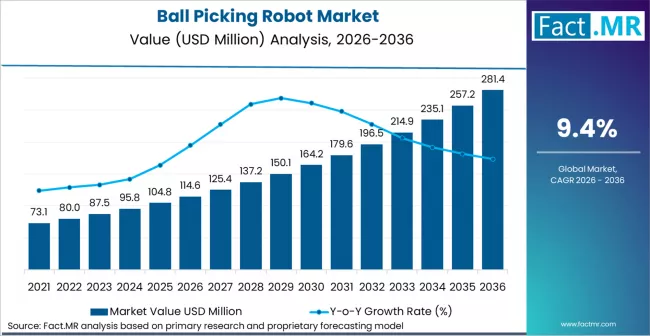
Ball Picking Robot Market Market Value Analysis | Source: Fact.MR
Ball Picking Robot Market
| Metric | Value |
|---|---|
| Market Value (2026) | USD 114.6 million |
| Forecast Value (2036) | USD 258.9 million |
| Forecast CAGR (2026-2036) | 9.4% |
Source: Fact.MR analysis. Updated Feb 27, 2026
Summary of Ball Picking Robot Market
- Market definition
- The ball picking robot market comprises autonomous and semi-autonomous robotic systems designed to collect sports balls from courts and driving ranges, improving operational efficiency and reducing manual labor in training facilities.
- Demand Drivers
- Rising participation in tennis and golf is increasing demand for automated collection systems that reduce downtime during intensive practice sessions.
- Sports academies and commercial driving ranges are adopting robotics to substitute repetitive manual labor and lower operating costs.
- Integration of AI-enabled navigation, object detection, and performance analytics is encouraging facilities to upgrade from basic mechanical retrievers to intelligent robotic platforms.
- Key Segments Analyzed
- Sports type: Tennis ball picking robots lead with approximately 65% share due to high ball dispersion and structured coaching environments.
- Application: Professional athletes and academies account for nearly 60% share, reflecting frequent training schedules and productivity requirements.
- Geography: Asia Pacific represents the fastest-growing region, driven by rapid sports infrastructure expansion in China and India.
- Analyst Opinion at Fact.MR
- Shambhu Nath Jha, Principal Consultant at Fact.MR, opines, ‘CXOs will find this report useful for understanding how automation economics, AI-enabled navigation capability, and facility modernization trends are reshaping procurement decisions in sports robotics.’
- Strategic Implications / Executive Takeaways
- Manufacturers should prioritize AI-driven autonomy and battery optimization to differentiate in high-usage environments.
- Partnerships with sports academies and golf range operators can accelerate recurring sales and software-based revenue models.
- Expansion strategies should target emerging Asian markets where sports infrastructure investment and labor cost pressures intersect.
- Methodology
- Market estimates are derived from sports facility counts, automation penetration rates, and average unit pricing trends across regions.
- Regulatory and safety validation references.
Ball Picking Robot Market Definition
The ball picking robot market covers autonomous or semi-autonomous robotic systems designed to collect sports balls from fields, courts, or practice ranges. These robots use electric drive systems, sensors, and mechanical collection mechanisms to gather balls and transport them for reuse. They are commonly deployed in golf driving ranges, tennis courts, and training facilities to reduce manual labor and improve operational efficiency. Product safety, workplace equipment use, and machinery standards are governed by regulatory frameworks such as those issued by the US Occupational Safety and Health Administration and machinery safety guidance referenced by the National Institute of Standards and Technology. [2]
Ball Picking Robot Market Inclusions
The report provides global and regional market size estimates in volume and value with a forecast from 2026 to 2036. Segmentation includes robot type such as fully autonomous and remote controlled units, application across golf ranges and tennis facilities, and end use by sports academies and recreational venues. Regional demand patterns and pricing trends are included.
Ball Picking Robot Market Exclusions
The scope excludes manual ball collection carts, standard utility vehicles, and multi-purpose service robots not specifically designed for ball retrieval. Sports equipment such as balls, rackets, and training gear is not included. Facility management services, repair contracts, software development platforms, and prototype robotics systems without commercial deployment are outside the scope.
Ball Picking Robot Market Research Methodology
- Primary Research: Interviews were conducted with robotics manufacturers, sports facility operators, equipment distributors, and maintenance providers.
- Desk Research: Desk research reviewed workplace equipment safety regulations issued by the US Occupational Safety and Health Administration and machinery safety and technology standards referenced by the National Institute of Standards and Technology, along with company disclosures.
- Market Sizing and Forecasting: Estimates were developed using sports facility counts, automation adoption rates, equipment replacement cycles, and average unit pricing.
- Data Validation and Update Cycle: Data was cross checked against trade statistics, procurement disclosures, regulatory documentation, and manufacturer shipment information before updates were finalized.
Segmental Analysis
Ball Picking Robot Market Analysis by Sports Type
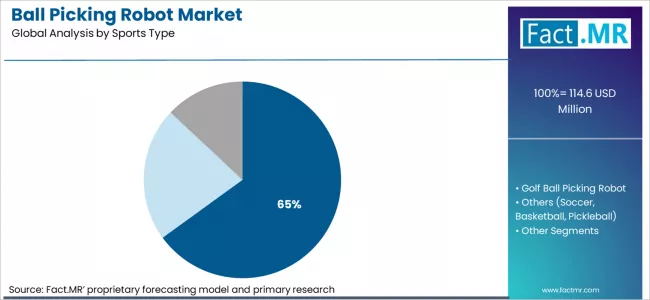
Ball Picking Robot Market Analysis By Sports Type | Source: Fact.MR
Based on Fact.MR analysis, consumption of tennis ball picking robots is estimated to hold 65% share of the global ball picking robot market. Fact.MR analysts note tennis applications lead due to high ball dispersion during practice sessions and structured training programs. As per Fact.MR, this sports type addresses coaching efficiency, reduced manual collection effort, and optimized court time utilization across professional academies, clubs, and training centers worldwide today supporting automated practice environments and productivity improvements in organized sports facilities globally.
- Facility standards: Sports facility safety and equipment use follow national recreation and sports guidelines.
- Training intensity: Fact.MR analysts note tennis training generates large volumes of scattered balls.
- Automation demand: Robots reduce manual labor during repetitive collection cycles.
Ball Picking Robot Market Analysis by Application
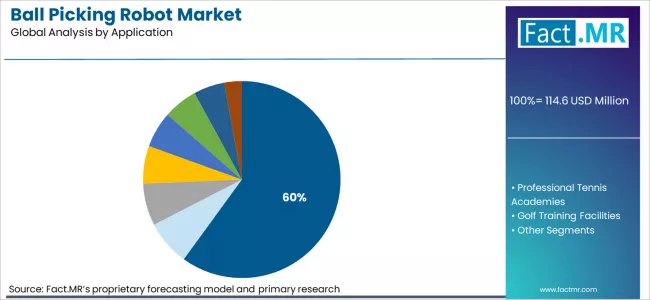
Ball Picking Robot Market Analysis By Application | Source: Fact.MR
Based on Fact.MR analysis, consumption of ball picking robots by professional athletes is estimated to hold 60% share of the global market. Fact.MR analysts note professional usage leads due to high frequency training schedules and structured performance programs. As per Fact.MR, this application addresses operational efficiency, minimized interruption during drills, and improved session productivity across tennis academies, golf training facilities, and competitive tournament environments worldwide today supporting intensive practice regimens and performance optimization initiatives.
- Sports program oversight: Organized sports facilities operate under national recreation and institutional safety frameworks. [3]
- High utilization: Fact.MR analysts note professional environments require repeated ball retrieval.
- Performance focus: Automation supports uninterrupted training sessions.
Ball Picking Robot Market Drivers, Restraints, And Opportunities
Fact.MR analysis indicates that the ball picking robot market exists as a specialised industrial automation and robotics segment focused on tasks requiring repetitive object retrieval, sorting, and placement in manufacturing, warehousing, and logistics operations. As per Fact.MR assessment, adoption of ball picking robots is influenced by industrial automation guidelines and safety standards such as those outlined by the U.S. Occupational Safety and Health Administration (OSHA) machine guarding and robot system safety standards, which establish criteria for safe integration of robotic equipment in workcells and help define risk mitigation practices when deploying automated picking systems in proximity to workers. [4] Fact.MR analysts observe that the current market size is driven by growing demand for efficiency, labour shortage mitigation, and error-free retrieval processes in industries such as food and beverages, pharmaceuticals, logistics fulfilment, and consumer goods assembly.
Fact.MR is of the opinion that current market dynamics reflect a transition toward more intelligent and perception-driven ball picking solutions that combine advanced vision systems, machine learning, and adaptive gripping mechanisms. Based on Fact.MR assessment, basic programmable picking robots remain prevalent in simpler applications where the range of target object variability is limited, but demand is increasing in segments where 3D vision, AI-assisted object recognition, and adaptive end-effectors are specified to handle diverse ball shapes, sizes, and materials at higher throughputs. Advanced ball picking robot systems generally command higher per-unit pricing because of sensor integration, algorithm development, and real-time control systems, meaning realised market value can grow even where shipment volumes expand at a measured pace. Fact.MR analysis suggests that this interplay between automation sophistication and premium system placement will shape near-term market progression.
- Industrial safety and integration standards: Fact.MR analysts note that frameworks such as the OSHA machine guarding and robot system safety standards influence design, deployment, and operational planning for ball picking robots in automated workcells. [5]
- Shift to intelligent perception systems: Based on Fact.MR assessment, adoption of advanced vision, AI-assisted guidance, and adaptive gripping supports demand for ball picking robots that handle diverse object profiles and reduce manual intervention.
- Asia Pacific automation growth: Fact.MR opines that increasing automation investments in China, India, and Southeast Asia support regional uptake of ball picking robots across logistics, manufacturing, and e-commerce fulfilment operations.
Regional Analysis
Based on regional assessment, the ball picking robot sector is analyzed across North America, Europe, East Asia, South Asia, and other key sports automation markets, spanning more than 40 countries. Regional performance varies according to adoption of automated sports training equipment, expansion of golf driving ranges and sports academies, labor cost considerations, and integration of robotics in recreational and commercial sports facilities.
Ball Picking Robot Market CAGR Analysis by Country (2026-2036)
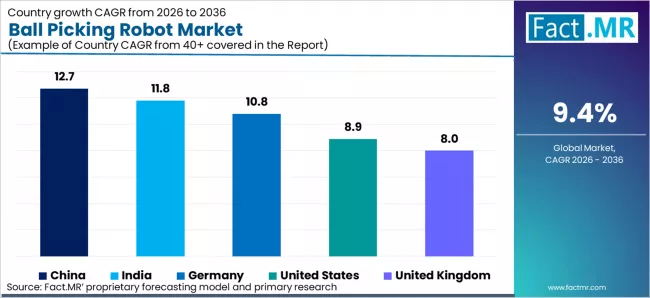
Ball Picking Robot Market Cagr Analysis By Country | Source: Fact.MR
| Country | CAGR |
|---|---|
| China | 12.7% |
| India | 11.8% |
| Germany | 10.8% |
| United States | 8.9% |
| United Kingdom | 8.0% |
Source: Fact.MR analysis. Updated Feb 27, 2026
Source: Fact.MR analysis, based on proprietary forecasting models and primary research.
Outlook On Ball Picking Robot Demand in Asia Pacific
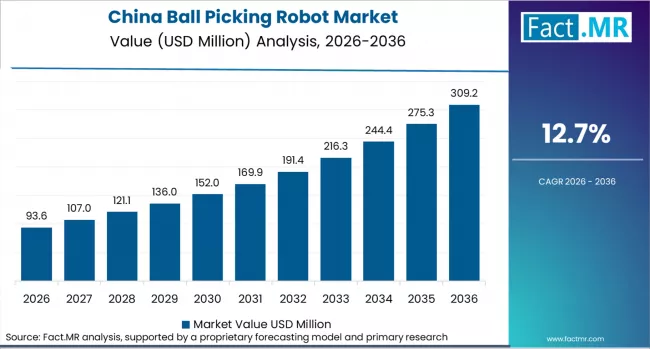
Ball Picking Robot Market Country Value Analysis | Source: Fact.MR
Asia Pacific shows strong demand for ball picking robots supported by expansion of golf driving ranges sports academies and commercial recreation centers. Adoption is shaped by labor cost considerations automation preference and facility modernization. China and India anchor regional sales through urban leisure infrastructure and private sports investments. Procurement emphasizes battery life terrain adaptability and maintenance efficiency. Market growth reflects rising participation in golf training programs and increased automation within sports facility operations across metropolitan areas regionwide.
- China: Demand for ball picking robots in China is projected to rise at 12.7% CAGR through 2036. Growth reflects expansion of golf driving ranges and automation within sports training facilities, as per Fact.MR.
- India: Demand for ball picking robots in India is projected to rise at 11.8% CAGR through 2036. Usage reflects modernization of golf academies and increased adoption of automated facility equipment, according to Fact.MR.
Fact.MR’s analysis of the Ball Picking Robot Market in Asia Pacific consists of country-wise assessment that includes China and India. Readers can find sports infrastructure and automation adoption insights.
Analysis On Ball Picking Robot Sales In Europe
Europe demonstrates steady ball picking robot sales shaped by established golf club networks and facility efficiency requirements. Adoption is influenced by labor optimization weather durability and maintenance cost control. Germany and the United Kingdom contribute through structured golf club operations and private training centers. Procurement emphasizes reliability terrain compatibility and service support. Market growth reflects replacement demand and incremental automation within sports facilities rather than new course development across mature European golf markets regionwide annually.
- Germany: Demand for ball picking robots in Germany is projected to rise at 10.8% CAGR through 2036. Sales reflect automation upgrades within golf clubs and training facilities, as per Fact.MR.
- United Kingdom: Demand for ball picking robots in the United Kingdom is projected to rise at 8.0% CAGR through 2036. Usage reflects efficiency improvements across established golf range operations, according to Fact.MR.
Fact.MR’s analysis of the Ball Picking Robot Market in Europe consists of country-wise assessment that includes Germany and the United Kingdom. Readers can find facility modernization and automation insights.
Demand For Ball Picking Robots In North America
North America shows consistent demand for ball picking robots supported by extensive golf participation commercial driving ranges and private club networks. Sales are driven by automation of routine maintenance and labor cost management. The United States anchors regional volume through large golf facility concentration and organized club operations. Procurement favors durable robotic platforms and long service intervals. Market growth reflects steady replacement demand and gradual automation across training centers and recreational golf venues nationwide.
- United States: Demand for ball picking robots in the United States is projected to rise at 8.9% CAGR through 2036. Adoption reflects automation of golf range maintenance and labor efficiency initiatives, as per Fact.MR.
Fact.MR’s analysis of the Ball Picking Robot Market in North America consists of country-wise assessment that includes the United States. Readers can find automation and facility operation references.
Competitive Landscape of Ball Picking Robot Market
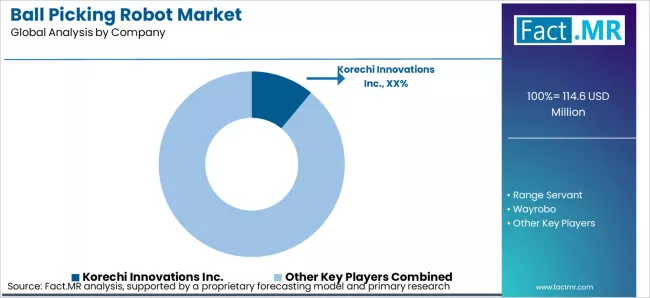
Ball Picking Robot Market Analysis By Company | Source: Fact.MR
As per Fact.MR analysis, the 2026 ball picking robot market is defined by validated operational efficiency, autonomous navigation, and multi-sport compatibility, which determine competitive advantage. Korechi Innovations Inc. and Range Servant lead with high-precision robotic systems capable of continuous ball collection, which strengthens adoption among professional tennis and multi-court facilities. Wayrobo and Tennibot focus on validated battery life and terrain adaptability, which improves reliability and reduces maintenance downtime. Relox Robotics and ECHO Robotics provide compact, agile robots with documented object detection accuracy, which enhances performance in confined or uneven courts. GroundTech and Steele Robotics emphasize modular design and multi-sport functionality, which increases versatility for training centers and schools. Schaeffler Technologies and Vive Tennis deliver robots with proven durability and validated drive mechanisms, which supports high-frequency use and reduces operational failures. Spinshot Sports, Lobster Sports, Sports Tutor, Deuce Court Systems, and Pickleball Robots offer verified precision and autonomous path-planning systems, which improve efficiency for recreational and competitive applications. Across the market, validated performance, autonomous reliability, and multi-sport compatibility form enduring competitive moats, reducing reliance on pricing or isolated product claims.
Recent Industry Developments
- Husqvarna Enters Market via Exclusive European Partnership: In January 2026, global turf giant Husqvarna announced an exclusive distribution agreement with Relox Robotics. Husqvarna will now be the sole provider of the "Range Picker™" across Europe, integrating autonomous ball collection with their existing robotic mowing fleets. This move signals a major shift toward "all-in-one" autonomous facility management for golf courses. [6]
- Roboranger Introduces AI "Auto-Dumping" for North American Ranges: Unveiled at the 2026 PGA Show in late January, the next-gen Roboranger now features an integrated "auto-drop grate system." This allows the robot to autonomously collect up to 3,500 balls, navigate to a wash station, and dump them without any human intervention. Currently operating at over 60 North American facilities, this update targets the "fully hands-off" operational goal for high-volume driving ranges.[7]
Key Players in Ball Picking Robot Market
- Korechi Innovations Inc.
- Range Servant
- Wayrobo
- Tennibot
- Relox Robotics
- ECHO Robotics
- GroundTech
- Steele Robotics
- Schaeffler Technologies AG & Co. KG
- Vive Tennis
- Spinshot Sports
- Lobster Sports
- Sports Tutor
- Deuce Court Systems
- Pickleball Robots Inc.
Bibliography
- [1] Tennibot. (2024). Tennibot announces launch of AI-powered Partner ball machine with adaptive learning capabilities [Corporate announcement]. Tennibot.
- [2] U.S. Occupational Safety and Health Administration. (2024). Laws and regulations. U.S. Department of Labor.
National Institute of Standards and Technology. (2024). Robotics and intelligent systems safety and standards guidance. U.S. Department of Commerce. - [3] U.S. Department of Education. (2024). Physical education and school sports program oversight. U.S. Department of Education.
- [4] U.S. Occupational Safety and Health Administration. (2024). Robotics and machine guarding safety standards. U.S. Department of Labor.
- [5] U.S. Occupational Safety and Health Administration. (2024). Robot system safety and workplace integration guidance. U.S. Department of Labor.
- [6] Husqvarna Group. (2026). Husqvarna enters exclusive European distribution partnership with Relox Robotics for autonomous golf range ball picking solution [Corporate announcement]. Husqvarna Group.
- [7] Roboranger. (2026). Roboranger unveils next-generation AI autonomous range picker at the 2026 PGA Show [Product announcement]. Roboranger.
This Report Addresses
- Market intelligence to enable structured strategic decision-making across mature and emerging sports automation markets
- Market size estimation and 10-year revenue forecasts from 2026 to 2036, supported by validated sports facility counts, automation penetration rates, and pricing benchmarks
- Growth opportunity mapping across sports types and applications, with emphasis on tennis and golf training environments
- Segment and regional revenue forecasts covering autonomous and semi-autonomous robot platforms across major geographic markets
- Competition strategy assessment including autonomous navigation capability, battery endurance, terrain adaptability, and multi-sport compatibility benchmarking
- Technology roadmap tracking including AI-enabled object detection, adaptive navigation systems, auto-docking and dumping functions, and subscription-based software analytics
- Regulatory impact analysis covering workplace equipment safety frameworks under the Occupational Safety and Health Administration and robotics and machinery guidance referenced by the National Institute of Standards and Technology
- Market report delivery in PDF, Excel, PPT, and interactive dashboard formats for executive, operational, and facility management use
Segmentation
Scope of the Report
| Metric | Value |
|---|---|
| Quantitative Units | USD 114.6 million (2026) to USD 258.9 million (2036), CAGR 9.4% |
| Market Definition | The ball picking robot market covers autonomous and semi-autonomous robots designed to collect sports balls from courts, fields, or driving ranges. Platforms use electric drive systems, sensors, and mechanical collection mechanisms to retrieve and transport balls for reuse. Applications span tennis courts, golf ranges, recreational clubs, and training facilities. Safety, operational standards, and robotics integration are governed by US OSHA regulations and NIST machinery and robot system safety guidance. |
| Sports Type Segmentation | Tennis Ball Picking Robot, Golf Ball Picking Robot, Others (Soccer, Basketball, Pickleball) |
| Application Segmentation | Professional Athletes, Professional Tennis Academies, Golf Training Facilities, Professional Tournaments, Ordinary Players, Recreational Clubs, Public Courts, Educational Institutions |
| Regions Covered | Asia Pacific, Europe, North America, Latin America, Middle East & Africa |
| Countries Covered | China, India, Japan, South Korea, Indonesia, Australia & New Zealand, Germany, Italy, France, United Kingdom, Spain, Benelux, Nordics, Central & Eastern Europe, United States, Canada, Mexico, Brazil, Argentina, Chile, Kingdom of Saudi Arabia, United Arab Emirates, South Africa, Turkey |
| Key Companies Profiled | Korechi Innovations Inc., Range Servant, Wayrobo, Tennibot, Relox Robotics, ECHO Robotics, GroundTech, Steele Robotics, Schaeffler Technologies AG & Co. KG, Vive Tennis, Spinshot Sports, Lobster Sports, Sports Tutor, Deuce Court Systems, Pickleball Robots Inc. |
| Forecast Period | 2026 to 2036 |
| Approach | Market sizing and forecasting based on sports facility counts, automation adoption rates, training program intensity, robot type adoption (autonomous vs remote-controlled), and unit pricing. Data validated via interviews with facility operators, robotics manufacturers, and distributors. |
Source: Fact.MR analysis. Updated Feb 27, 2026
Ball Picking Robot Market Analysis by Segments
-
Sports Type :
- Tennis Ball Picking Robot
- Golf Ball Picking Robot
- Others (Soccer, Basketball, Pickleball)
-
Application :
- Professional Athletes
- Professional Tennis Academies
- Golf Training Facilities
- Professional Tournaments
- Ordinary Players
- Recreational Clubs
- Public Courts
- Educational Institutions
-
Region :
- Asia Pacific
- India
- China
- Japan
- South Korea
- Indonesia
- Australia & New Zealand
- ASEAN
- Rest of Asia Pacific
- Europe
- Germany
- Italy
- France
- United Kingdom
- Spain
- Benelux
- Nordics
- Central & Eastern Europe
- Rest of Europe
- North America
- United States
- Canada
- Mexico
- Latin America
- Brazil
- Argentina
- Chile
- Rest of Latin America
- Middle East & Africa
- Kingdom of Saudi Arabia
- United Arab Emirates
- South Africa
- Turkey
- Rest of Middle East & Africa
- Asia Pacific
Frequently Asked Questions
How large is the ball picking robot market in 2026?
What will the ball picking robot market size be by 2036?
What is the expected CAGR of the ball picking robot market during 2026–2036?
How much incremental value will the market add between 2026 and 2036?
What structural factors are influencing the ball picking robot market?
Which sports type accounts for the largest share of the market?
Why do tennis applications dominate the market?
Which application segment holds the leading share?
Why do professional environments lead adoption?
Which region is growing the fastest in the ball picking robot market?
What is the projected growth rate for China?
How fast is the market expected to grow in India?
What is the expected growth rate in Germany?
How is the United States market expected to perform?
What is the projected growth rate for the United Kingdom?
What is driving early-period growth in the market?
What supports mid-period expansion in the forecast window?
What influences long-term value realization in the market?
Why is AI integration important in this market?
What defines the long-term outlook for the ball picking robot market?
Who worked on this report


Preview the report firsthand - request a free sample
Free SampleGet the brochure for pricing and purchase details
Download PDF