- Market Value (2025): USD 1.82 Bn
- Estimated Value (2026): USD 1.91 Bn
- Forecast Value (2036): USD 3.15 Bn
- CAGR (2026-2036): 5.1%
What is the Air Regulation Damper Market forecast to be worth by 2036?
USD 1.9 billion in 2026 to USD 3.2 billion by 2036 at a 5.1% CAGR.
- The air regulation damper market was valued at USD 1.82 billion in 2025. Spending included airflow-control equipment for commercial buildings and HVAC systems, with motorized models forming an important part of demand.
- Fact.MR estimates that market revenue is estimated at USD 1.91 billion in 2026 and projected to reach USD 3.15 billion by 2036 as contractors specify new dampers for ventilation upgrades and building construction.
- The market is forecast to expand at a 5.1% CAGR from 2026 to 2036, supported by motorized airflow controls and replacement of worn duct components.
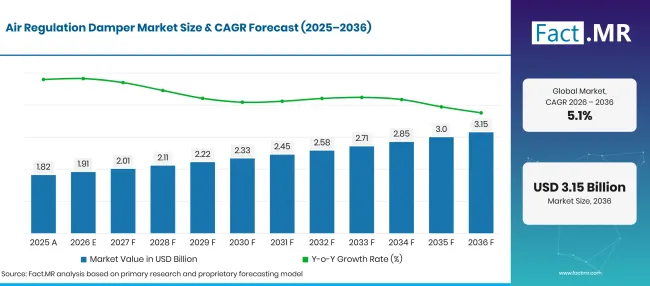
Air Regulation Damper Market Forecast Global | Source: Fact.MR
| Year | Basis | Market Value (USD billion) |
|---|---|---|
| 2025 | Actual | 1.82 |
| 2026 | Estimate | 1.91 |
| 2036 | Forecast | 3.15 |
| 2026 to 2036 | CAGR | 5.1% |
Source: Fact.MR analysis. Updated Nov 2, 2026
What are the defining numbers behind Air Regulation Damper Market growth?
Between 2026 and 2036, annual market value is projected to increase by USD 1.3 billion.
- Demand Drivers in the Market
- Building automation teams need dampers that respond to occupancy schedules and ventilation signals. Motorized blades let building controllers adjust airflow across duct branches as operating conditions change.
- Facilities departments replace older dampers when worn linkages and seized blades prevent a ventilation system from meeting the intended airflow settings.
- Construction activity creates opportunities for packaged air-handling equipment and separately specified dampers.
- Air-handling designers also consider how many zones must be controlled independently. Dividing a large system into manageable branches increases the number of control points that require suitable damper sizing and commissioning.
- Key Segments Analyzed
- By Type: Motorized Dampers account for 56.7% of 2026 value as automated HVAC controls require repeatable blade movement.
- By Application: Commercial buildings lead with 44.2% of 2026 sales, reflecting multiple ventilation zones and frequent airflow adjustments.
- By Material: Steel makes up 41.8% of 2026 demand where duct compatibility and mechanical strength guide selection.
- By End-User: HVAC Systems represent 78.6% of 2026 demand because most installations regulate supply or exhaust air in buildings.
- Analyst Opinion at Fact.MR
- Shambhu Nath Jha, Principal Consultant at Fact.MR, states, “Buyers assess a damper by how reliably it responds throughout the building control sequence. Buyers should assess leakage ratings, actuator accessibility, and commissioning requirements together when evaluating products.”
- Strategic Implications
- Damper manufacturers should publish clear airflow and leakage test information so specifiers can compare products against the intended duct conditions.
- Building-control integrators should verify actuator compatibility before installation and commission the fully assembled control point under normal operating conditions.
- Facility managers should track sticking blades and failed actuators during maintenance because poor positioning can undermine zone-level ventilation control.
- Mechanical contractors should check access panels early in the project so damper motors and linkages remain reachable after ceilings are closed.
Japan is forecast to record a 6.4% CAGR through 2036, followed by Brazil at 5.8% and the USA at 5.2%. The UK is projected at 4.9%, while Germany is projected to grow at 4.4%. Differences reflect the mix of retrofit work, commercial building activity and demand for automated duct control.
How does the Air Regulation Damper Market break down by segment?
Motorized Dampers account for 56.7% by Type; Commercial applications hold 44.2%; Steel accounts for 41.8%; and HVAC Systems contribute 78.6%.
Which Type dominates?
Motorized Dampers account for 56.7% of 2026 market value.
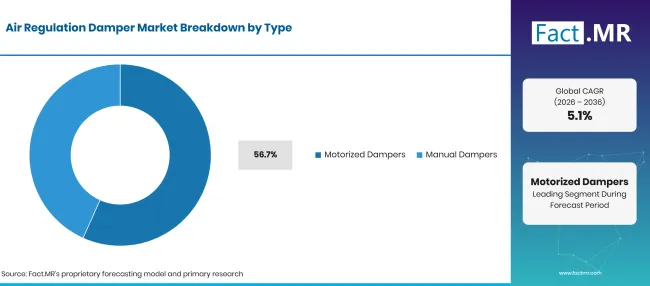
Air Regulation Damper Market Breakdown Type | Source: Fact.MR
| Which Type dominates | Share (2026) |
|---|---|
| Motorized Dampers (Leading segment) | 56.7% |
| Other segments combined | 43.3% |
| Total | 100.0% |
Source: Fact.MR analysis. Updated Nov 2, 2026
Motorized dampers receive signals from thermostats or building controllers and move blades to adjust the air supply. Their value lies in repeatable positioning across changing operating conditions. A manual damper instead provides a fixed balancing point and suits duct branches where airflow rarely changes. Engineers must check actuator torque against damper size and system pressure. Control panels also need an appropriate fail-position strategy for each service.
What leads the Application segment?
Commercial accounts for 44.2% of 2026 market value.
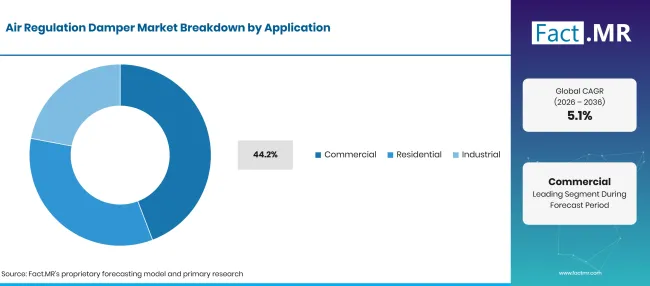
Air Regulation Damper Market Breakdown Application | Source: Fact.MR
| What leads the Application segment | Share (2026) |
|---|---|
| Commercial (Leading segment) | 44.2% |
| Other segments combined | 55.8% |
| Total | 100.0% |
Source: Fact.MR analysis. Updated Nov 2, 2026
Commercial buildings use dampers across air-handling units and distributed duct branches. Offices and public facilities often have separate zones with changing occupancy and ventilation needs. Residential installers generally favor simpler and smaller assemblies, although controlled fresh-air equipment creates selected opportunities. Industrial facilities may need additional resistance to dust or temperature. For commercial projects, the choice of damper influences commissioning time and access for maintenance after the building opens.
How does Material shape demand?
Steel accounts for 41.8% of 2026 market value.
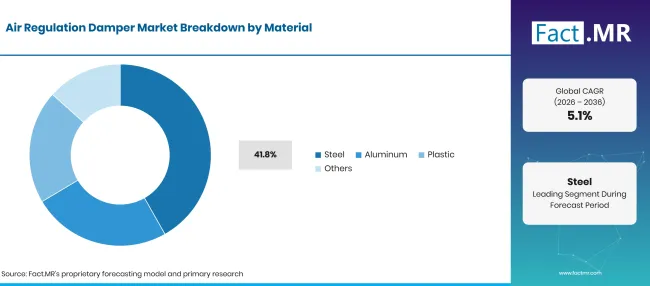
Air Regulation Damper Market Breakdown Material | Source: Fact.MR
| How does Material shape demand | Share (2026) |
|---|---|
| Steel (Leading segment) | 41.8% |
| Other segments combined | 58.2% |
| Total | 100.0% |
Source: Fact.MR analysis. Updated Nov 2, 2026
Steel dampers fit many conventional duct arrangements and offer a familiar construction choice for building contractors. Aluminum versions are useful where corrosion exposure or weight becomes more important to the design. Plastic and other materials serve narrower operating conditions and should be chosen after checking temperature and chemical compatibility. Material choice also affects blade stiffness and how the assembly responds to pressure.
Which End-User category holds the larger share?
HVAC Systems account for 78.6% of 2026 market value.
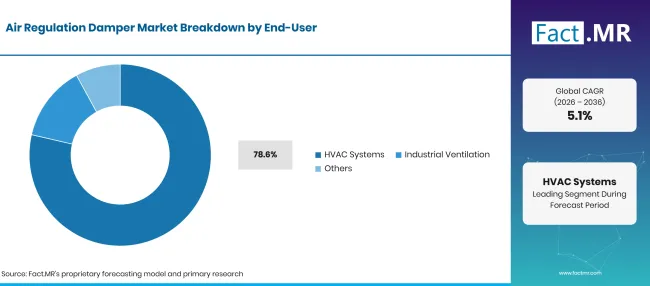
Air Regulation Damper Market Breakdown End User | Source: Fact.MR
| Which End-User category holds the larger share | Share (2026) |
|---|---|
| HVAC Systems (Leading segment) | 78.6% |
| Other segments combined | 21.4% |
| Total | 100.0% |
Source: Fact.MR analysis. Updated Nov 2, 2026
HVAC systems use volume-control dampers for supply, return and outdoor-air regulation. Their function connects directly to occupant comfort and ventilation operating schedules. Industrial ventilation systems place different demands on blades and seals where air may carry contaminants or operate at higher temperatures.
What is accelerating Air Regulation Damper Market adoption, and what is holding it back?
Demand will advance with motorized ventilation controls, commercial building upgrades and replacement of aging damper assemblies. Low-leakage designs and retrofit-ready actuators offer added room for sales. Higher control costs, difficult duct access and construction budget pressure may slow installation decisions.
Drivers Impact Analysis
| Driver | (~) % IMPACT ON CAGR | Geographic relevance | Timeline |
|---|---|---|---|
| Zone-level automated ventilation | 5.1% | Japan; USA; UK | Medium term |
| Commercial construction and upgrades | 5.1% | USA; Brazil; UK | Medium term |
| Airflow balancing and leakage requirements | 5.1% | Germany; Japan | Short term |
| Replacement of aging control assemblies | 5.1% | Europe; North America | Medium term |
Source: Fact.MR analysis. Updated Nov 2, 2026
Opportunity Impact Analysis
| Opportunity | (~) % IMPACT ON CAGR | Geographic relevance | Timeline |
|---|---|---|---|
| Low-leakage control assemblies | 5.1% | Europe; USA | Medium term |
| Actuator-ready retrofit designs | 5.1% | Global | Short term |
| Harsh-environment constructions | 5.1% | Industrial regions | Long term |
Source: Fact.MR analysis. Updated Nov 2, 2026
Restraints Impact Analysis
| Restraint | (~) % IMPACT ON CAGR | Geographic relevance | Timeline |
|---|---|---|---|
| Added actuator and controls expense | 5.1% | Global | Short term |
| Limited access in retrofit ductwork | 5.1% | Mature building stock | Medium term |
| Construction cost pressure | 5.1% | Brazil; Europe | Short term |
Source: Fact.MR analysis. Updated Nov 2, 2026
Which countries are scaling the Air Regulation Damper Market through 2036?
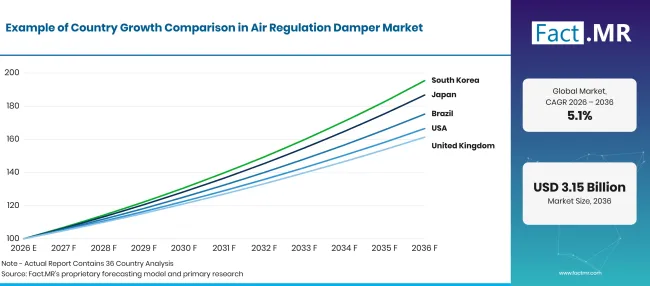
Air Regulation Damper Market Growth Index | Source: Fact.MR
| Country | CAGR (2026 to 2036) |
|---|---|
| Japan | 6.4% |
| Brazil | 5.8% |
| USA | 5.2% |
| UK | 4.9% |
| Germany | 4.4% |
Source: Fact.MR analysis. Updated Nov 2, 2026
How is Japan developing air regulation damper demand?
6.4% CAGR, linked to controlled ventilation upgrades.
In Japan, compact actuator assemblies help building operators adjust ventilation during changing occupancy schedules. Air-handling equipment manufacturers can specify damper assemblies for packaged control arrangements. Engineers favor dependable actuator positioning where mechanical plant space is limited. New construction creates further scope for duct-level control when project specifications call for zoned air delivery.
How is Brazil developing air regulation damper demand?
5.8% CAGR, shaped by commercial building investment.
Brazilian mechanical contractors consider installation costs and local servicing capacity when specifying dampers for new air-handling systems. IBGE reported GDP growth of 2.3% in Brazil during 2025 [3]. Constraints include IBGE reported that employment in Brazil’s construction sector fell by 3.9% in 2025 compared with 2024 [4].
How is the USA developing air regulation damper demand?
5.2% CAGR, reflecting varied commercial HVAC requirements.
American mechanical contractors select dampers for varied commercial air-handling layouts and existing building automation systems. Commercial facilities frequently require separate airflow controls for rooms with different operating schedules. Product portfolios offer measured low-leakage variants for demanding intake conditions.
How is the UK developing air regulation damper demand?
4.9% CAGR, connected to the commercial renovation cycle.
UK retrofit work often begins with the condition of existing ducts and the available space for service access. The Office for National Statistics reported that construction new work in Great Britain rose by 1.9% to GBP 139,106 million in 2025 [2]. Air-handling service programs provide routes to replace worn manual assemblies. Constraints include ONS reported a 1.0% fall in total construction output in Great Britain in the three months to August 2026 [5].
How is Germany developing air regulation damper demand?
4.4% CAGR, connected to measured building controls.
Germany places emphasis on documented airflow performance and reliable integration with building-control systems. German mechanical contractors routinely specify equipment to fit defined duct and airflow conditions. Eurostat reported that building permits across the EU covered approximately 1.64 million dwellings in 2025 [7]. Constraints include Eurostat reported that output in the euro-area construction-of-buildings subsector declined by 6.4% in July 2026 compared with July 2025 [6]. This wider indicator suggests a cautious new-build environment.
Who competes in the Air Regulation Damper Market?
Suppliers compete through the range of control blades and frames available for different duct duties. Greenheck lists manual and automatic control damper configurations with published airflow and leakage performance specifications [1].
Ruskin operates within Johnson Controls, while TROX offers ventilation control components for building installations. Lindab and Systemair address air distribution and ventilation equipment needs. Nailor Industries, Pottorff, Halton Group, Price Industries and TAMCO Dampers round out the named competitive set. Purchase decisions depend on technical fit and service coverage rather than unsupported company share rankings.
Which companies are the key providers?
Key companies include Greenheck Fan Corporation; Ruskin Company (Air Distribution Technologies); TROX GmbH; Lindab International AB; Systemair AB; Nailor Industries Inc.; Pottorff; Halton Group; Price Industries; TAMCO Dampers (SPX Technologies).
- Greenheck Fan Corporation
- Ruskin Company (Air Distribution Technologies)
- TROX GmbH
- Lindab International AB
- Systemair AB
- Nailor Industries Inc.
- Pottorff
- Halton Group
- Price Industries
- TAMCO Dampers (SPX Technologies)
Bibliography
- [1] Greenheck. (n.d.). Control
- [2] Office for National Statistics. (2026, October 23). Construction statistics, Great Britain: 2025
- [3] Instituto Brasileiro de Geografia e Estatística. (2026, March 3). PIB cresce 2,3% em 2025 e fecha o ano em R$ 12,7 trilhões
- [4] Instituto Brasileiro de Geografia e Estatística. (2026, January 30). Continuous PNAD: In 2025, annual unemployment rate was 5.6% whereas underutilization rate hit 14.5%
- [5] Office for National Statistics. (2026, October 15). Construction output in Great Britain: August 2026
- [6] Eurostat. (2026, September 18). Production in construction stable in the euro area and down by 0.3% in the EU
- [7] Eurostat. (2026, April 10). Building permit index overview. Statistics Explained
This Report Answers
- The report compares motorized and manual dampers by control use and maintenance needs.
- Application analysis explains commercial ventilation requirements against residential and industrial uses.
- Material coverage reviews the role of steel and the alternatives for different air streams.
- Country analysis compares Japan, Brazil, USA, UK and Germany using their respective forecast growth rates.
- Competitive coverage identifies suppliers of damper and ventilation-control equipment without assigning company shares.
What does the Air Regulation Damper Market cover?
The market covers dampers whose main purpose is regulating air movement within building and industrial ventilation networks. Its equipment boundary includes manually positioned and motorized blade assemblies used to balance flow or adjust duct supply. Specifications differ according to pressure, leakage and intended service.
What is included in the scope?
Commercial and residential HVAC dampers fall within the scope when they regulate the movement of air.
Industrial ventilation products are included where the assembly provides airflow adjustment or shutoff. Frames, blades and integral actuation features are considered as part of the applicable damper assembly.
What is excluded from the scope?
Standalone fans, filters and complete air-handling systems are excluded from the damper revenue boundary. Fire and smoke dampers designed solely for life safety are treated separately when their primary function is not air regulation. Control software and independent building management services are outside equipment sales.
How Was the Analysis Built?
The analysis draws on 120+ sources, 35+ company portfolios, 25+ countries, and more than 20 industry interviews.
- Primary Research: Primary research includes discussions with manufacturers, service providers, technology developers, distributors, end users, and subject-matter experts. These conversations examine purchasing priorities, product adoption, operational challenges, approval requirements, competitive positioning, and the factors that influence wider market acceptance.
- Desk Research: Desk research covers government statistics, regulatory publications, company filings, trade data, technical studies, industry associations, standards, public policy, and other authoritative sources. Every source used in the analysis is documented in the bibliography.
- Market Sizing and Forecasting: Market estimates combine historical performance, demand indicators, pricing and volume trends, segment shares, company participation, country-level growth, adoption patterns, investment activity, and barriers to market expansion.
- Data Validation and Update Cycle: Findings are validated by comparing primary interviews with public data, company activity, regulatory changes, trade patterns, and industry developments. Regular updates review new product launches, capacity changes, partnerships, approvals, and shifts in commercial adoption.
Segmentation
What is the report’s scope and coverage?
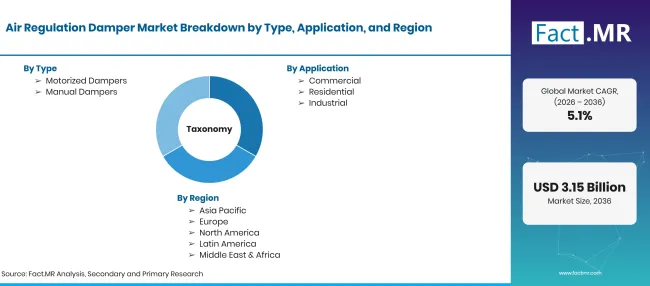
Air Regulation Damper Market Taxonomy | Source: Fact.MR
| Attribute | Details |
|---|---|
| Quantitative Units | USD billion |
| Market Definition | Dampers used to vary, balance or shut off airflow in HVAC and industrial ventilation duct systems |
| Type | Motorized Dampers; Manual Dampers |
| Application | Commercial; Residential; Industrial |
| Material | Steel; Aluminum; Plastic; Others |
| End-User | HVAC Systems; Industrial Ventilation; Others |
| Regions Covered | North America; Latin America; Western Europe; Eastern Europe; East Asia; South Asia & Pacific; Middle East & Africa |
| Countries Covered | Japan; Brazil; USA; UK; Germany |
| Companies Profiled | Greenheck Fan Corporation; Ruskin Company (Air Distribution Technologies); TROX GmbH; Lindab International AB; Systemair AB; Nailor Industries Inc.; Pottorff; Halton Group; Price Industries; TAMCO Dampers (SPX Technologies). |
| Forecast Period | 2026 to 2036 |
| Approach | Assessment of HVAC specifications, company product portfolios and official construction indicators |
Source: Fact.MR analysis. Updated Nov 2, 2026
How is the market segmented?
-
By Type
- Motorized Dampers
- Manual Dampers
-
By Application
- Commercial
- Residential
- Industrial
-
By Material
- Steel
- Aluminum
- Plastic
- Others
-
By End-User
- HVAC Systems
- Industrial Ventilation
- Others
-
By Region
- North America
- Latin America
- Western Europe
- Eastern Europe
- East Asia
- South Asia & Pacific
- Middle East & Africa
Frequently Asked Questions
How big is the air regulation damper market in 2026?
What CAGR applies to the air regulation damper market?
Which damper type has the larger share?
What is the commercial application share?
Who are the main companies in the air regulation damper market?
Who worked on this report


Preview the report firsthand - request a free sample
Free SampleGet the brochure for pricing and purchase details
Download PDF