- Market Value (2025): USD 130.9 Mn
- Estimated Value (2026): USD 141.0 Mn
- Forecast Value (2036): USD 296.5 Mn
- CAGR (2026-2036):7.7%
What is the Alpha-Tocotrienol Market forecast to be worth by 2036?
USD 141.0 million in 2026 to USD 296.5 million by 2036 at a 7.7% CAGR.
- Fact.MR estimates, the alpha-tocotrienol market was valued at USD 130.9 million in 2025.
- Revenue is projected to reach from USD 141.0 million in 2026 to USD 296.5 million by 2036 as supplement brands and specialty formulators consider more products containing documented tocotrienol ingredients.
- The forecast indicates a 7.7% CAGR between 2026 and 2036. Suppliers must be able to demonstrate ingredient purity and the alpha-tocotrienol concentration in each commercial grade.
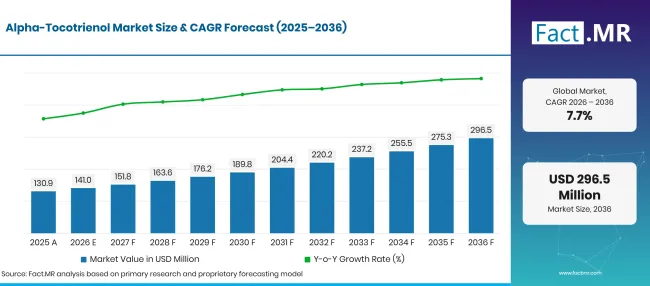
Alpha Tocotrienol Market Forecast Global | Source: Fact.MR
| Year | Basis | Market Value (USD million) |
|---|---|---|
| 2025 | Actual | 130.9 |
| 2026 | Estimate | 141.0 |
| 2036 | Forecast | 296.5 |
| CAGR 2026 to 2036 | Forecast period | 7.7% |
Source: Fact.MR analysis. Updated Nov 2, 2026
What are the defining numbers behind Alpha-Tocotrienol Market growth?
The market is projected to add USD 155.5 million by 2036, with natural-source materials and dietary supplements representing significant demand categories.
- Demand Drivers in the Market
- Ingredient formulators need an exact isomer profile when selecting natural tocotrienol extracts. A palm-derived concentrate may carry several tocotrienols alongside tocopherols.
- Supplement brands increasingly rely on channels where shoppers compare labels before ordering.
- Online retail gives niche nutritional ingredients access to customers beyond local specialty shops.
- Online platforms expose supplement labels and health claims to closer review. On September 9, 2026, Brazil’s Anvisa ordered recalls of irregular dietary supplements, including products lacking adequate stability studies for declared shelf lives [6].
- Key Segments Analyzed
- By Source: Natural is projected to account for 68.4% of 2026 market value, reflecting commercial use of palm-based tocotrienol extracts with documented isomer profiles.
- By Application: Dietary Supplements represent 38.2% of 2026 value, as capsule and other nutritional formats provide a practical route for specialty vitamin E ingredients.
- By Sales Channel: Online Retail leads with 41.7% of 2026 value. Product comparison and direct ordering are useful for specialist supplements with detailed labels.
- Analyst Opinion at Fact.MR
- Shambhu Nath Jha, Principal Consultant at Fact.MR, states, “Alpha-tocotrienol suppliers compete on more than ingredient availability. Buyers need clear isomer identification, reliable assay data and consistent batch quality before using the material in supplements or cosmetics. Companies that explain composition clearly and support customers with technical documentation will be better placed as specialist formulations expand.”
- Strategic Implications
- Extract manufacturers should state the alpha-tocotrienol concentration separately from total tocotrienol content so customers can compare functional ingredient specifications.
- Supplement brands should review finished-product labels and the evidence behind intended claims before entering additional national markets.
- Distributors can make technical documents easier to obtain online so specialist customers assess batch quality before negotiating supply.
- Cosmetic formulators should test ingredient stability in the final formulation instead of relying on general claims about the wider vitamin E family.
Germany leads the Alpha-Tocotrienol Market with an 8.6% CAGR, as ingredient verification and online comparison support specialist supplement sales. Brazil follows at 7.9%, with documentation requirements and channel development shaping product launches. The USA is forecast at 7.1%, supported by specialty supplements and online access. The UK is forecast to grow at 6.4% through specialist nutrition retail and digital product comparison. Japan completes the group at 5.6%, with precise formulations and established e-commerce channels supporting adoption.
How does the Alpha-Tocotrienol Market break down by segment?
Natural source accounts for 68.4%; Dietary Supplements for 38.2%; and Online Retail for 41.7% of 2026 value.
Which Source leads alpha-tocotrienol sales?
Natural source accounts for 68.4% of 2026 value.
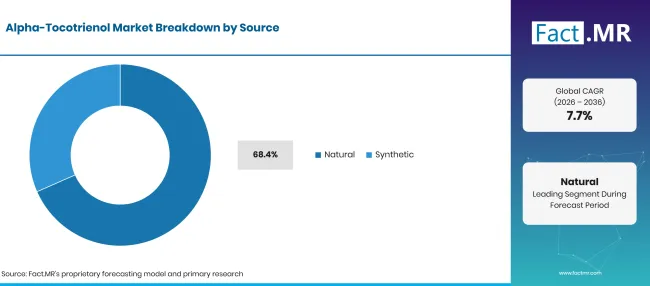
Alpha Tocotrienol Market Breakdown Source | Source: Fact.MR
| Source | Share (2026) |
|---|---|
| Natural (Leading segment) | 68.4% |
| Other segments combined | 31.6% |
| Total | 100.0% |
Source: Fact.MR analysis. Updated Nov 2, 2026
Natural alpha-tocotrienol is associated most clearly with palm-derived tocotrienol fractions. Extractors must separate and characterize the relevant compounds because mixed vitamin E oils contain several isomers. Source identification is therefore a technical sales issue as well as a label choice.
What leads the Application segment?
Dietary Supplements lead with 38.2% of 2026 value.
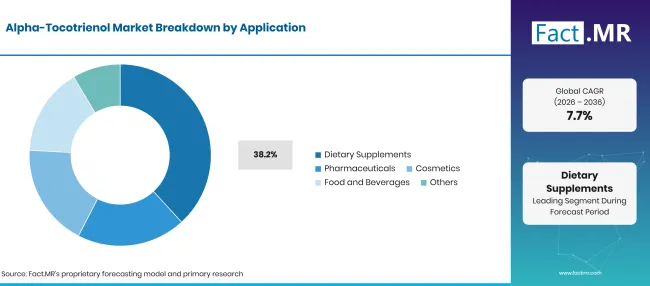
Alpha Tocotrienol Market Breakdown Application | Source: Fact.MR
| Application | Share (2026) |
|---|---|
| Dietary Supplements (Leading segment) | 38.2% |
| Other segments combined | 61.8% |
| Total | 100.0% |
Source: Fact.MR analysis. Updated Nov 2, 2026
Fact.MR estimates that dietary supplements provide a route to market through softgels and other delivery forms that handle fat-soluble compounds. Ingredient developers must still assess dispersion and shelf-life behavior in each formula. Pharmaceuticals form a distinct application where claims and manufacturing controls require additional evidence. Cosmetics present another outlet for formulated tocotrienol extracts, while food and beverages depend on ingredient compatibility and national rules. A full-spectrum tocotrienol ingredient was the subject of PhytoGaia’s December 2025 cosmetics agreement [8]. That announcement concerns the broader tocotrienol family, so isomer-level specifications remain necessary when analyzing alpha-tocotrienol.
How does Sales Channel shape purchasing?
Online Retail represents 41.7% of 2026 value.
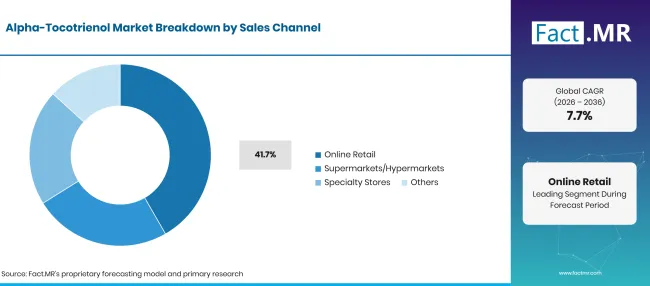
Alpha Tocotrienol Market Breakdown Sales Channel | Source: Fact.MR
| Sales Channel | Share (2026) |
|---|---|
| Online Retail (Leading segment) | 41.7% |
| Other segments combined | 58.3% |
| Total | 100.0% |
Source: Fact.MR analysis. Updated Nov 2, 2026
Online channels make specialist products easier to find and compare. The ability to publish ingredient lists and technical explanations also helps smaller supplement brands reach informed customers. Supermarkets and hypermarkets supply established nutrition products where shoppers seek convenience and familiar packaging. Specialty stores give more room for detailed explanations of uncommon ingredient forms. Eurostat reported that 78% of EU internet users made an online purchase during 2025 [5].
What is accelerating Alpha-Tocotrienol Market adoption, and what is holding it back?
Ingredient traceability and supplement use support sales; product identity and claims compliance create commercial limits.
Drivers Impact Analysis
| DRIVER | MARKET CAGR (2026–2036) | GEOGRAPHIC RELEVANCE | IMPACT TIMELINE |
|---|---|---|---|
| Demand for documented natural extracts | 7.7% | Global | Medium term |
| Specialty dietary supplement formulations | 7.7% | USA, Germany, UK | Medium term |
| Online access to niche products | 7.7% | Global | Short term |
| Supplier assay and traceability capability | 7.7% | Global | Long term |
| Cosmetic ingredient development | 7.7% | East Asia, Europe | Long term |
Source: Fact.MR analysis. Updated Nov 2, 2026
Opportunity Impact Analysis
| OPPORTUNITY | MARKET CAGR (2026–2036) | GEOGRAPHIC RELEVANCE | IMPACT TIMELINE |
|---|---|---|---|
| Traceable palm extract portfolios | 7.7% | Asia, Europe | Medium term |
| Clearly labelled specialty supplements | 7.7% | USA, Germany | Medium term |
| Online technical education | 7.7% | Global | Medium term |
| Cosmetic formulation partnerships | 7.7% | Asia, Europe | Medium term |
Source: Fact.MR analysis. Updated Nov 2, 2026
Restraints Impact Analysis
| RESTRAINT | MARKET CAGR (2026–2036) | GEOGRAPHIC RELEVANCE | IMPACT TIMELINE |
|---|---|---|---|
| Confusion between vitamin E forms | 7.7% | Global | Short term |
| Stability and shelf-life requirements | 7.7% | Brazil, Global | Medium term |
| Health-claim restrictions | 7.7% | Brazil, Europe | Short term |
| Cost of detailed ingredient testing | 7.7% | Global | Long term |
Source: Fact.MR analysis. Updated Nov 2, 2026
Which countries are scaling the Alpha-Tocotrienol Market through 2036?
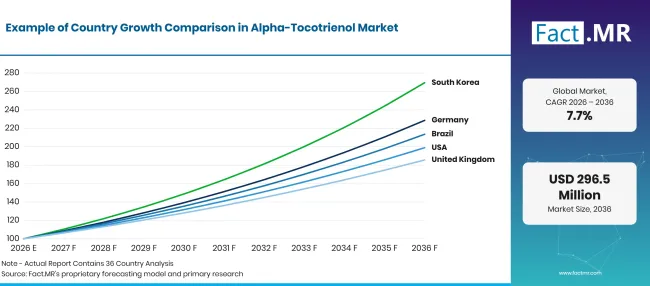
Alpha Tocotrienol Market Growth Index | Source: Fact.MR
| Country | CAGR (2026 to 2036) |
|---|---|
| Germany | 8.6% |
| Brazil | 7.9% |
| USA | 7.1% |
| UK | 6.4% |
| Japan | 5.6% |
Source: Fact.MR analysis. Updated Nov 2, 2026
What supports Germany’s alpha-tocotrienol outlook?
8.6% CAGR, with ingredient scrutiny and online comparison shaping commercial access.
German supplement brands can use specialist retailers and online listings to explain the composition of alpha-tocotrienol extracts. Destatis described widespread online shopping in August 2026 [1]. Suppliers that disclose assay methods and traceable sourcing can make comparisons easier for German formulators. Cosmetic brands may also test palm-derived tocotrienol fractions when their technical files identify the exact ingredient.
What shapes alpha-tocotrienol adoption in Brazil?
7.9% CAGR, subject to supplement documentation and channel development.
Fact.MR estimates that Brazilian product developers need clear information on ingredient identity before launching supplements containing specialized vitamin E fractions. Anvisa updated its supplement questions-and-answers guidance in January 2025 [9]. In March 2026 Anvisa ordered the withdrawal of irregular supplements following compliance concerns [7]. Firms need to assess what those rules mean for each finished product without assuming that an unrelated enforcement action involved alpha-tocotrienol.
How is the USA developing demand?
7.1% CAGR, supported by specialty supplements and online product access.
US supplement manufacturers can distinguish alpha-tocotrienol products through clear isomer identification and verified content in the finished formulation. In August 2026 the US Census Bureau released second-quarter e-commerce statistics covering retail activity [2]. Ingredient distributors can support customers with assays and formulation information. Cosmetic developers offer another testing route where the product category is clearly defined.
What is supporting the UK outlook?
6.4% CAGR, with online comparison and specialist nutrition retail as the principal routes.
British shoppers can compare specialized vitamin E supplements through online listings and nutrition retailers. The Office for National Statistics released its September 2026 retail sales bulletin in October 2026 [3]. UK formulators face an added documentation burden when a product uses an unfamiliar vitamin E isomer.
How is Japan scaling alpha-tocotrienol use?
5.6% CAGR, with precise formulations and established e-commerce routes influencing access.
Japan has established online channels that can help specialized nutrition products reach customers seeking detailed ingredient descriptions. METI published its FY2024 e-commerce market survey in August 2025 [4]. Japanese ingredient businesses may need more testing and documentation for less familiar vitamin E fractions. Product descriptions must suit the relevant food category and its labeling rules.
Who competes in the Alpha-Tocotrienol Market?
Competition spans ingredient extractors, distributors and analytical providers. ExcelVite markets palm-based tocotrienol complexes through its EVNol product family, while KLK OLEO’s Davos Life Science describes tocotrienol-rich palm fractions with traceable upstream sourcing.
Other named companies serve different parts of the wider tocotrienol supply chain. Some provide finished nutritional ingredients, while laboratory suppliers address analytical demand and reference materials.
Which companies are the key providers?
Key companies include ExcelVite Sdn. Bhd.; KLK OLEO (Davos Life Science); Vance Group Ltd.; SourceOne Global Partners LLC; SOP Nutraceuticals Sdn. Bhd.; Orochem Technologies Inc.; Cayman Chemical Company; PhytoGaia Sdn. Bhd.; SD Guthrie International Nutrition Sdn. Bhd.; Oryza Oil & Fat Chemical Co., Ltd.
- ExcelVite Sdn. Bhd.
- KLK OLEO (Davos Life Science)
- Vance Group Ltd.
- SourceOne Global Partners LLC
- SOP Nutraceuticals Sdn. Bhd.
- Orochem Technologies Inc.
- Cayman Chemical Company
- PhytoGaia Sdn. Bhd.
- SD Guthrie International Nutrition Sdn. Bhd.
- Oryza Oil & Fat Chemical Co., Ltd.
Bibliography
- [1] Statistisches Bundesamt (Destatis). (2026, August 25). Online-Shopping in Deutschland und der Europäischen Union
- [2] U.S. Census Bureau. (2026, August 18). Quarterly retail e-commerce sales: Second quarter 2026
- [3] Office for National Statistics. (2026, October 23). Retail sales, Great Britain: September 2026.
- [4] Ministry of Economy, Trade and Industry. (2025, August 26). Results of FY2024 E-Commerce Market Survey Compiled.
- [5] Eurostat. (2026, April 23). Digitalisation in Europe – 2026 edition
- [6] Agência Nacional de Vigilância Sanitária. (2026, September 9). Anvisa determina recolhimento de suplementos alimentares.
- [7] Agência Nacional de Vigilância Sanitária. (2026, March 10). Anvisa determina o recolhimento de suplementos alimentares irregulares
- [8] PhytoGaia. (2025, December 15). PhytoGaia and Perfect (China) form partnership to use TocoGaia® in cosmetic products
- [9] Agência Nacional de Vigilância Sanitária. (2025, January 16). Anvisa atualiza perguntas e respostas sobre suplementos alimentares
This Report Answers
- The report explains how natural and synthetic categories differ when ingredient identity and alpha-tocotrienol content are evaluated.
- Application analysis considers supplement formulation alongside pharmaceutical and cosmetic uses that require their own technical evidence.
- Channel analysis describes how online retail, supermarkets and specialty stores differ in product discovery and customer information.
- Country analysis compares Germany, Brazil, the USA, the UK and Japan using the specified 2026 to 2036 growth rates.
- Competitive discussion distinguishes mixed tocotrienol extract producers from laboratory and distribution businesses.
What does the Alpha-Tocotrienol Market cover?
The report covers the specified market for alpha-tocotrienol in commercially relevant ingredient forms and end-use categories. An alpha-tocotrienol claim is treated as an isomer-specific statement.
What is included in the scope?
Natural or synthetic alpha-tocotrienol offerings intended for the stated application groups are covered. Online and offline sales channels are assessed for relevant ingredients and finished product categories.
What is excluded from the scope?
Alpha-tocopherol sales and unrelated vitamin E compounds are outside the alpha-tocotrienol boundary. General tocotrienol blend revenue should not automatically be assigned to this market without evidence of the alpha isomer.
How Was the Analysis Built?
The analysis draws on 120+ sources, 35+ company portfolios, 25+ countries, and more than 20 industry interviews.
- Primary Research: Primary research includes discussions with manufacturers, service providers, technology developers, distributors, end users, and subject-matter experts. These conversations examine purchasing priorities, product adoption, operational challenges, approval requirements, competitive positioning, and the factors that influence wider market acceptance.
- Desk Research: Desk research covers government statistics, regulatory publications, company filings, trade data, technical studies, industry associations, standards, public policy, and other authoritative sources. Every source used in the analysis is documented in the bibliography.
- Market Sizing and Forecasting: Market estimates combine historical performance, demand indicators, pricing and volume trends, segment shares, company participation, country-level growth, adoption patterns, investment activity, and barriers to market expansion.
- Data Validation and Update Cycle: Findings are validated by comparing primary interviews with public data, company activity, regulatory changes, trade patterns, and industry developments. Regular updates review new product launches, capacity changes, partnerships, approvals, and shifts in commercial adoption.
Segmentation
What is the report’s scope and coverage?
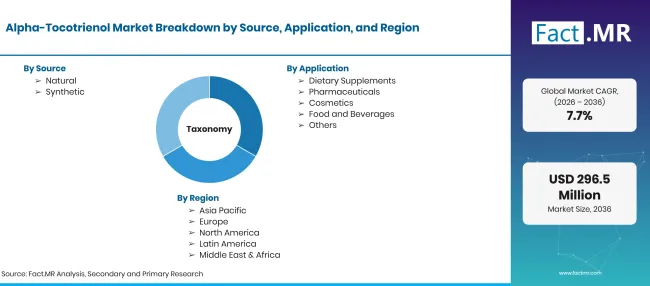
Alpha Tocotrienol Market Taxonomy | Source: Fact.MR
| Attribute | Details |
|---|---|
| Quantitative Units | USD million |
| Market Definition | Commercial alpha-tocotrienol ingredient value and applicable formulations, distinguished from other tocotrienols and alpha-tocopherol. |
| Source | Natural; Synthetic |
| Application | Dietary Supplements; Pharmaceuticals; Cosmetics; Food and Beverages; Others |
| Sales Channel | Online Retail; Supermarkets/Hypermarkets; Specialty Stores; Others |
| Regions Covered | North America; Latin America; Western Europe; Eastern Europe; East Asia; South Asia & Pacific; Middle East & Africa |
| Countries Covered | Germany; Brazil; USA; UK; Japan |
| Companies Profiled | ExcelVite Sdn. Bhd.; KLK OLEO (Davos Life Science); Vance Group Ltd.; SourceOne Global Partners LLC; SOP Nutraceuticals Sdn. Bhd.; Orochem Technologies Inc.; Cayman Chemical Company; PhytoGaia Sdn. Bhd.; SD Guthrie International Nutrition Sdn. Bhd.; Oryza Oil & Fat Chemical Co., Ltd. |
| Forecast Period | 2026 to 2036 |
| Approach | Ingredient-based segmentation with isomer-profile screening, application assessment and country-level qualitative comparison. |
Source: Fact.MR analysis. Updated Nov 2, 2026
How is the market segmented?
-
By Source
- Natural
- Synthetic
-
By Application
- Dietary Supplements
- Pharmaceuticals
- Cosmetics
- Food and Beverages
- Others
-
By Sales Channel
- Online Retail
- Supermarkets/Hypermarkets
- Specialty Stores
- Others
-
By Region
- North America
- Latin America
- Western Europe
- Eastern Europe
- East Asia
- South Asia & Pacific
- Middle East & Africa
Frequently Asked Questions
How big is the alpha-tocotrienol market in 2026?
What is the CAGR of the alpha-tocotrienol market?
Which source category holds the highest share?
Which application is the largest?
Who are the main companies in the alpha tocotrienol market?
Who worked on this report


Preview the report firsthand - request a free sample
Free SampleGet the brochure for pricing and purchase details
Download PDF