Aircraft Electric Motor Market (2026 - 2036)

Aircraft Electric Motor Market is segmented by Type (AC Motors including Induction Motors and Synchronous Motors/PMSM; and DC Motors including Brushless DC Motors/BLDC and Brushed DC Motors), Application (Propulsion Systems including Hybrid-Electric and Full-Electric Propulsion; Flight Control Systems including Primary and Secondary Flight Controls; Landing Gear including Extension/Retraction, Steering, and Braking Systems; and Actuation Systems including Thrust Reverser, Door, and Cargo Systems), End User (Fixed Wing Aircraft including Commercial, Business, and Military Aviation; Rotary Wing Aircraft including Civil and Military Helicopters; and Unmanned Aerial Vehicles including Commercial and Military UAVs), and Region. Forecast for 2026 to 2036.

Core Findings

    Aircraft Electric Motor Market Forecast and Outlook 2026 to 2036

    In 2025, the aircraft electric motor market was valued at USD 8.9 billion. Based on Future Market Insights' analysis, demand for aircraft electric motors is estimated to grow to USD 10.2 billion in 2026 and USD 30.9 billion by 2036. FACT.MR projects a CAGR of 11.5% during the forecast period.

    The absolute dollar growth from 2026 to 2036 represents a transformational gain of USD 20.7 billion reflecting the structural expansion from niche actuation and auxiliary power to primary flight control and hybrid-electric propulsion where electric motors transition from cost-optimized components to performance-critical systems enabling More Electric Aircraft (MEA) architectures that eliminate 400+ pounds per aircraft in hydraulic fluid, pumps, and pneumatic bleed air systems.

    As, electric aviation technology specialist Dr. Chris Harris, CEO of Evolito, said, “Electric flight requires ultra-high-power-density, super-low-weight electric powertrains. Our technology has already proven itself in the toughest automotive environments. Now we’re bringing that advantage to aerospace-helping our customers make sustainable flight a reality.”

    China leads at 13.2%, driven by COMAC C919 ramp-up, eVTOL programs such as EHang, and military UAV electrification. India follows at 12.8% supported by defense offsets and early UAM ecosystem growth. Brazil records 11.9% backed by Embraer production and regional eVTOL activity.The United States posts 10.8% anchored by major defense programs and FAA eVTOL certification progress. Germany and France grow at 10.5% and 10.3% due to Airbus production and hybrid-electric R&D. The United Kingdom trails at 10.1% with incremental gains from hybrid-electric engine development.
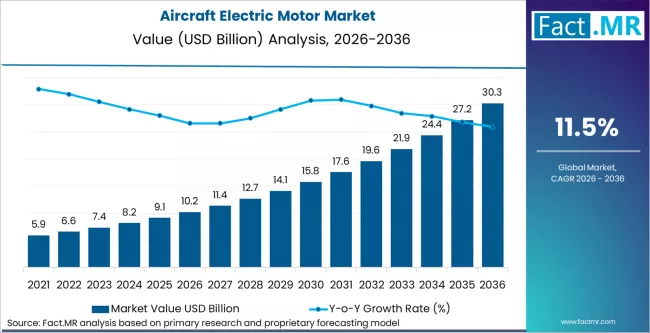
    Aircraft Electric Motor Market Market Value Analysis

    Market Definition

    Aircraft electric motors are AC and DC electromagnetic systems used for propulsion, actuation, and auxiliary power in commercial, military, and UAV platforms. Power ranges from small auxiliary loads to multi-megawatt propulsion units. They enable More Electric Aircraft architectures replacing hydraulic and pneumatic systems.

    Market Inclusions

    The report covers 2026-2036 forecasts by motor type, application, aircraft platform, and region. It evaluates power density trends, efficiency, rare earth magnet cost impact, and certification economics.

    Market Exclusions

    Starter-generators, ground equipment motors, and non-airborne systems are excluded. The focus is on airborne electric motors and associated controllers only.

    Research Methodology

    • Primary Research; Interviews were conducted with aerospace motor engineers, OEM sourcing heads, and propulsion architects across major suppliers and aircraft manufacturers.
    • Desk Research: Data was sourced from FAA and EASA certification databases, NASA research publications, aircraft delivery forecasts, and supplier financial disclosures.
    • Market Sizing and Forecasting: Sizing used aircraft production forecasts, motor content per aircraft, and validated average selling prices.
    • Data Validation: Findings were cross-checked against supplier earnings, OEM production updates, and certification milestone announcements.

    Summary

    • Market Definition
      • Aircraft electric motors support propulsion, actuation, and auxiliary systems across MEA platforms.
    • Demand Drivers
      • Narrow body production ramp-ups generate steady baseline motor demand.
      • eVTOL certification pathways create a new high-motor-count propulsion segment.
      • U.S. defense R&D funding expands electric motor applications in advanced aircraft.
    • Key Segments
      • By Type: DC motors hold 58% share led by brushless configurations offering high power density and efficiency.
      • By Application: Propulsion holds 42% share due to high power requirements in hybrid and eVTOL aircraft.
      • By End User: Fixed-wing aircraft dominate driven by large commercial and military production volumes.
    • Analyst Opinion
      • Shambhu Nath Jha, Principal Consultant at Fact.MR, opines, ' CXOs will find this report valuable for understanding how electrified propulsion certification and thermal management advances are reshaping competition. Value is shifting toward integrated propulsion suppliers that can meet FAA/EASA requirements and deliver 4-6 kW/kg power density for eVTOL and regional aircraft.
    • Strategic Implications
      • Suppliers should invest in aerospace certification capabilities to access propulsion applications.
      • OEMs must diversify rare earth magnet sourcing to reduce supply risk.
      • eVTOL developers should focus on thermal management and system integration for certification success.
    • Methodology
      • Sizing combined aircraft forecasts with motor content benchmarks from OEM and supplier data.
      • MEA adoption curves were benchmarked against Boeing 787, A350, and A320neo systems.
      • Rare earth price modeling incorporated neodymium cost trends and magnet content per motor.

    Segmental Analysis

    Aircraft Electric Motor Market Analysis by Type
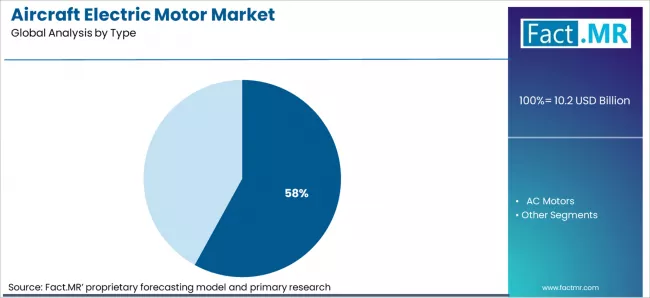
    Aircraft Electric Motor Market Analysis By Type

    Based on FACT.MR’s report, DC motors, mainly brushless designs, hold 58% share in 2025. BLDC motors deliver higher power density and efficiency than induction motors and integrate well with aircraft DC bus systems. Their compact design supports distributed architectures that improve redundancy and safety.

    • Honeywell Electric Motor Portfolio Expansion: Honeywell is expanding electric motor production capacity to serve narrowbody and eVTOL programs. Investment strengthens its position across multiple aircraft platforms. [4]
    • magniX Distributed Propulsion Technology: magniX has demonstrated high-power BLDC motors in electric aircraft test programs. Its distributed propulsion approach supports redundancy and enables commuter and eVTOL applications. [5]
    • Power Electronics Integration Trend: Collins Aerospace is developing integrated motor-drive units using silicon carbide inverters. Integration reduces weight, improves efficiency, and supports higher-voltage aircraft systems. [6]

    Aircraft Electric Motor Market Analysis by Application
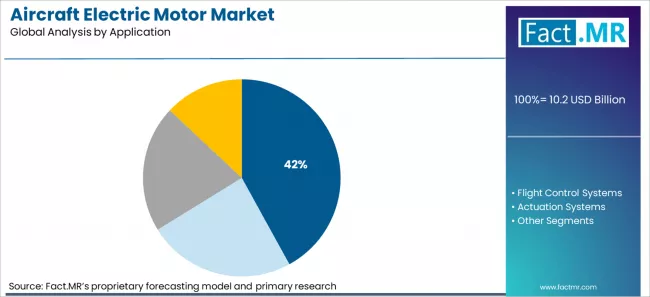
    Aircraft Electric Motor Market Analysis By Application

    Propulsion systems hold 42% share in 2025. Propulsion motors operate at far higher power levels than actuation systems and command significantly higher average selling prices. Hybrid-electric and eVTOL programs are expanding this segment rapidly.

    • Safran ENGINeUS Demonstrator Program: Safran’s hybrid-electric demonstrator validates distributed propulsion for regional aircraft. The program supports future electrification partnerships.
    • Joby Aviation eVTOL Propulsion Architecture: Joby’s multi-motor architecture demonstrates distributed propulsion with redundancy and regulatory acceptance. Certification progress is shaping the broader eVTOL market.
    • Flight Control Actuation MEA Adoption: Boeing 787 and Airbus A350 electric actuation systems replaced multiple hydraulic systems, reducing weight and maintenance. This segment is now mature and increasingly cost-competitive.

    Drivers, Restraints, and Opportunities

    Fact.MR analysis shows the aircraft electric motor market is driven by the shift toward More Electric Aircraft (MEA). Programs such as Boeing 787 and Airbus A350 proved that replacing hydraulic and pneumatic systems reduces weight, fuel burn, and maintenance costs, even if electric components cost more upfront. Electric systems eliminate hydraulic leaks and bleed air extraction, cutting lifecycle operating costs significantly.

    Adoption remains strongest in wide body aircraft, while narrow body platforms still use mixed architectures. The next growth phase depends on certifying higher-power electric systems that can fully replace hydraulics in high-volume aircraft families.

    • FAA eVTOL Certification Special Conditions: The FAA’s 2024 powered-lift rules create a clear certification path for distributed electric propulsion under Part 23. This enables companies such as Joby, Archer, and Beta to commercialize multi-motor aircraft faster than traditional transport category timelines. [1]
    • Rare Earth Magnet Supply Concentration: China controls most global neodymium magnet production, creating supply risk for high-power-density motors. U.S. and allied governments are investing in domestic processing, but volumes remain limited. OEMs are managing risk through inventory buffers and alternative motor designs. [2]
    • NASA Electrified Aircraft Propulsion Program: NASA funding supports hybrid-electric demonstrators and next-generation motor cooling technologies. Research targets higher power density and efficiency for regional aircraft and future commercial platforms. [3]

    Regional Analysis

    The aircraft electric motor market is analyzed across North America, Europe, Asia-Pacific, Latin America, and Middle East. Regional adoption intensity is shaped by aerospace manufacturing concentration, government funding for electrified aircraft R&D, eVTOL certification pathway maturity, and defense modernization budgets. The report offers detailed market attractiveness analysis comparing OEM electric motor content specifications, rare earth supply chain strategies, and certification timeline economics across regions.
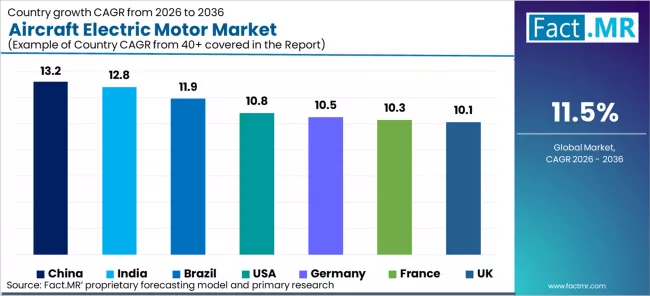
    Aircraft Electric Motor Market Cagr Analysis By Country

    Country CAGR%
    China 13.2%
    India 12.8%
    Brazil 11.9%
    United States 10.8%
    Germany 10.5%
    France 10.3%
    United Kingdom 10.1%

    Source: Fact.MR (FACT.MR) analysis, based on proprietary forecasting model and primary research

    North America Aircraft Electric Motor Market Analysis

    North America is the innovation and certification hub for aircraft electric motors, led by FAA eVTOL approval pathways and NASA-funded hybrid-electric propulsion programs. Major suppliers such as Honeywell, Collins Aerospace, GE Aerospace, and magniX anchor the regional ecosystem, supported by strong U.S. defense propulsion R&D programs creating dual-use technology pipelines.

    • United States: Demand for aircraft electric motors in the United States is projected to rise at 10.8% CAGR through 2036. Growth is driven by FAA Special Conditions for powered-lift aircraft enabling eVTOL certification under Part 23, NASA Electrified Aircraft Propulsion funding for hybrid-electric demonstrators, and Department of Defense investment in advanced propulsion for NGAD, MQ-25, and Future Vertical Lift programs. Narrowbody production and Honeywell’s electric motor capacity expansion further reinforce baseline demand.

    FACT.MR’s analysis of the aircraft electric motor market in North America includes country-level assessment covering the United States, Canada, and Mexico. Readers can find FAA certification timelines, NASA propulsion technology roadmaps, defense electrification funding allocations, and OEM electric motor content analysis by aircraft platform.

    Europe Aircraft Electric Motor Market Analysis

    Europe operates as the Clean Sky research center and Airbus MEA development base, supported by EASA SC-VTOL certification rules and EU-funded hybrid-electric aviation programs. Safran, Rolls-Royce Electrical, Siemens eAircraft, and Liebherr-Aerospace lead propulsion and actuation development across Airbus and regional aircraft platforms.

    • Germany: Demand for aircraft electric motors in Germany is projected to rise at 10.5% CAGR through 2036. Germany’s focus on distributed propulsion and MW-class motor development strengthens its long-term electrification position.
    • France: Demand for aircraft electric motors in France is projected to rise at 10.3% CAGR through 2036. Expansion is anchored by Safran’s hybrid-electric demonstrator programs, Airbus ZEROe hydrogen-electric research, and national sustainable aviation funding exceeding EUR 1 billion. Distributed propulsion and fault-tolerant motor control systems support future narrowbody and eVTOL applications.
    • United Kingdom: Demand for aircraft electric motors in the United Kingdom is projected to rise at 10.1% CAGR through 2036. Growth reflects Rolls-Royce UltraFan hybrid-electric integration, Aerospace Technology Institute funding for zero-emission aviation, and Vertical Aerospace eVTOL propulsion development targeting mid-decade certification.

    FACT.MR’s analysis of the aircraft electric motor market in Europe includes country-level assessment covering Germany, France, the United Kingdom, Italy, Spain, the Netherlands, Poland, and Switzerland. Readers can find Clean Sky program timelines, EASA certification frameworks, national aviation funding data, and Airbus MEA system evolution analysis.

    Asia Pacific Aircraft Electric Motor Market Analysis

    Asia Pacific combines fast-growing commercial aviation demand with state-backed indigenous aircraft and eVTOL programs. China leads with COMAC and EHang development, while India strengthens local manufacturing under defense offset policies. Regional suppliers compete with Western Tier 1 players across propulsion and actuation segments.

    • China: Demand for aircraft electric motors in China is projected to rise at 13.2% CAGR through 2036. Growth is driven by COMAC C919 MEA production ramp-up, CAAC-certified EHang eVTOL commercialization, and government funding under the 14th Five-Year Plan supporting hybrid-electric propulsion and distributed motor systems.
    • India: Demand for aircraft electric motors in India is projected to rise at 12.8% CAGR through 2036. Expansion reflects defense local-content mandates for HAL aircraft programs, growing eVTOL partnerships, and government funding for advanced electric motor research and superconducting technologies.
    • Brazil: Demand for aircraft electric motors in Brazil is projected to rise at 11.9% CAGR through 2036. Growth is anchored by Embraer’s E2 electrification features, Eve Air Mobility eVTOL development, and domestic aerospace motor manufacturing expansion supporting local content requirements.

    FACT.MR’s analysis of the aircraft electric motor market in Asia Pacific includes country-level assessment covering China, India, Brazil, Japan, South Korea, Australia, Singapore, and Indonesia. Readers can find COMAC MEA system data, CAAC eVTOL certification frameworks, defense offset policies, and regional motor manufacturing capability development trends.

    Competitive Aligners for Market Players
    Aircraft Electric Motor Market Analysis By Company

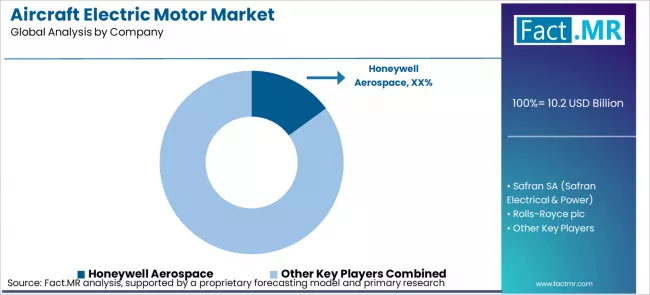
    The aircraft electric motor market is moderately concentrated. Tier 1 suppliers such as Honeywell Aerospace, Safran Electrical & Power, and Collins Aerospace control nearly half of OEM-qualified motor programs. Their advantage comes from AS9100 certification, DO-160 qualification, and multi-aircraft platform approvals. Switching suppliers can cost OEMs USD 15-35 million and take several years.

    Competition differs by application. Actuation motors compete on cost and weight. Propulsion motors compete on power density, thermal control, and certification track record. In new segments such as eVTOL and hybrid-electric aircraft, first certified suppliers often secure 60-80% share before rivals enter. Military programs are even more concentrated due to export controls.

    Vertically integrated players hold structural advantages. Suppliers with in-house silicon carbide inverters and thermal management systems deliver higher efficiency and lighter integrated packages. Even small efficiency gains translate into major fuel savings over an aircraft’s life. Aircraft OEMs run long qualification cycles and usually select one primary supplier and one backup. Contracts last five to seven years. eVTOL startups often accept sole-source deals to avoid certification delays and protect launch timelines.

    Recent Development

    • In September 2025, Honeywell Aerospace announced expanded production of its high-power electric motor portfolio for hybrid-electric and eVTOL platforms, securing new supply agreements with regional aircraft and advanced air mobility developers to support upcoming certification and entry-into-service programs.
    • In February 2025, EASA granted Safran’s ENGINeUS 100 electric motor the first type certificate issued under Special Condition SC E-19, setting a regulatory benchmark for certified electric propulsion systems and accelerating hybrid-electric and light aircraft development in Europe.

    Key Players

    • Honeywell Aerospace
    • Safran SA (Safran Electrical & Power)
    • Rolls-Royce plc
    • Collins Aerospace (RTX Corporation)
    • GE Aerospace
    • Parker Aerospace
    • Eaton Corporation
    • Woodward Inc.
    • AMETEK Inc.
    • Moog Inc.
    • Meggitt PLC (Parker-Hannifin)

    Scope of Report

    Items Values
    Quantitative Units USD 10.2 billion (2026) to USD 30.9 billion (2036), at a CAGR of 11.5%
    Market Definition Aircraft electric motors are AC and DC electromagnetic systems used for propulsion, actuation, and auxiliary power in commercial, military, and UAV platforms. Power ranges from small auxiliary loads to multi-megawatt propulsion units.
    Type Segmentation AC Motors (Induction Motors, Synchronous Motors PMSM), DC Motors (Brushless DC Motors, Brushed DC Motors)
    Application Segmentation Propulsion Systems, Flight Control Systems, Landing Gear Systems, Actuation Systems
    End User Segmentation Fixed Wing Aircraft, Rotary Wing Aircraft, Unmanned Aerial Vehicles (UAVs)
    Application Coverage Hybrid-Electric Propulsion, Full-Electric Propulsion, Primary and Secondary Flight Control Actuation, Landing Gear Extension and Braking Systems, Thrust Reverser and Door Actuation, UAV Motor Systems
    Regions Covered Asia Pacific, Europe, North America, Latin America, Middle East & Africa
    Countries Covered China, Japan, South Korea, Australia & New Zealand, India, ASEAN, Rest of Asia Pacific, Norway, Germany, United Kingdom, France, Spain, Netherlands, Nordics, Rest of Europe, United States, Canada, Mexico, Brazil, Chile, Ecuador, Rest of Latin America, Kingdom of Saudi Arabia, United Arab Emirates, South Africa, Turkey, Rest of Middle East & Africa
    Key Companies Profiled Honeywell Aerospace, Safran SA (Safran Electrical & Power), Rolls-Royce plc, Collins Aerospace (RTX Corporation), GE Aerospace, Parker Aerospace, Eaton Corporation, Woodward Inc., AMETEK Inc., Moog Inc., Meggitt PLC (Parker-Hannifin), Siemens AG, Thales Group, magniX,
    Forecast Period 2026 to 2036
    Approach A hybrid top-down and bottom-up modeling approach was used, cross-checked against OEM aircraft production plans, supplier manufacturing capacity, and certification milestone timelines. Estimates were validated through primary interviews with motor manufacturers and Tier 1 integrators, and benchmarked against FAA and EASA qualification standards

    Aircraft Electric Motor Market by Segment

    • By Type

      • AC Motors
        • Induction Motors (Three-Phase Squirrel Cage)
        • Synchronous Motors (PMSM - Permanent Magnet Synchronous)
      • DC Motors
        • Brushless DC Motors (BLDC with Electronic Commutation)
        • Brushed DC Motors (Legacy Applications)
    • By Application

      • Propulsion Systems
        • Hybrid-Electric Propulsion
        • Full-Electric Propulsion (Primary Thrust)
      • Flight Control Systems
        • Primary Flight Controls
        • Secondary Flight Controls
      • Landing Gear
        • Extension/Retraction Systems
        • Steering Systems
        • Braking Systems
      • Actuation Systems
        • Thrust Reverser Actuation
        • Door Actuation (Passenger, Cargo, Landing Gear)
    • By End User

      • Fixed Wing Aircraft
        • Commercial Aviation
        • Business Aviation
        • Military Aviation
      • Rotary Wing Aircraft
        • Civil Helicopters
        • Military Helicopters
      • Unmanned Aerial Vehicles (UAVs)
        • Commercial UAVs
        • Military UAVs
    • By Power Rating

      • Low Power
      • Medium Power
      • High Power Very High Power
    • Region

      • Asia Pacific
        • China
        • Japan
        • South Korea
        • Australia & New Zealand
        • India
        • ASEAN
        • Rest of Asia Pacific
      • Europe
        • Norway
        • Germany
        • United Kingdom
        • France
        • Spain
        • Netherlands
        • Nordics
        • Rest of Europe
      • North America
        • United States
        • Canada
        • Mexico
      • Latin America
        • Brazil
        • Chile
        • Ecuador
        • Rest of Latin America
      • Middle East & Africa
        • Kingdom of Saudi Arabia
        • United Arab Emirates
        • South Africa
        • Turkey
        • Rest of Middle East & Africa

    Bibliography

    • [1] Federal Aviation Administration. (2024, July). Special Conditions for Powered-Lift Category Aircraft Docket FAA-2023-1377. Federal Register.
    • [2] U.S. Geological Survey. (2024, February). Mineral Commodity Summaries 2024 Rare Earth Elements.
    • [3] NASA Aeronautics Research Mission Directorate. (2024, March). Electrified Aircraft Propulsion Program FY2024 Technology Development Portfolio.
    • [4] Honeywell Aerospace. (2023, October). Electric Motor Manufacturing Expansion Announcement Phoenix and Toulouse Facilities. Press Release.
    • [5] magniX. (2024, May). Magni650 and Magni500 Propulsion Motor Certification Test Campaign Completion. Technical Update.
    • [6] Collins Aerospace. (2024, March). Integrated Motor Drive Units Silicon Carbide Power Electronics Integration. Technical White Paper.

    This Report Addresses

    • Market intelligence for strategic planning: analysis of More Electric Aircraft adoption, hybrid versus full-electric certification pathways, eVTOL distributed propulsion architectures, and power electronics integration reshaping aerospace value chains.
    • Market size and forecast: aircraft electric motor market valued at USD 10.2 billion in 2026, projected to reach USD 30.9 billion by 2036 at 11.5% CAGR, with segmentation by motor type, application, platform, power rating, and region.
    • Growth opportunity mapping: high-value segments including eVTOL distributed propulsion, hybrid-electric regional aircraft systems, and narrow body MEA electrification programs.
    • Segment and regional forecasts: country-level CAGR analysis for China, India, Brazil, United States, Germany, France, and United Kingdom, with propulsion versus actuation and commercial versus military splits.
    • Competition strategy assessment: positioning of Honeywell, Safran, Collins, Rolls-Royce, GE, and magniX, covering certification barriers, vertical integration, and magnet supply risks.
    • Product and compliance tracking: FAA and EASA certification frameworks, DO-160 standards, NASA propulsion targets, and rare earth supply implications.
    • Technology roadmap analysis: shift to BLDC and PMSM motors, liquid and cryogenic cooling, silicon carbide inverters, and advanced magnetic materials.
    • Report delivery formats: Excel data tables, PowerPoint executive summary, and detailed PDF report with verified aerospace sources.

    Table of Content

    1. Executive Summary
      • Global Market Outlook
      • Demand to side Trends
      • Supply to side Trends
      • Technology Roadmap Analysis
      • Analysis and Recommendations
    2. Market Overview
      • Market Coverage / Taxonomy
      • Market Definition / Scope / Limitations
    3. Research Methodology
      • Chapter Orientation
      • Analytical Lens and Working Hypotheses
        • Market Structure, Signals, and Trend Drivers
        • Benchmarking and Cross-market Comparability
        • Market Sizing, Forecasting, and Opportunity Mapping
      • Research Design and Evidence Framework
        • Desk Research Programme (Secondary Evidence)
          • Company Annual and Sustainability Reports
          • Peer-reviewed Journals and Academic Literature
          • Corporate Websites, Product Literature, and Technical Notes
          • Earnings Decks and Investor Briefings
          • Statutory Filings and Regulatory Disclosures
          • Technical White Papers and Standards Notes
          • Trade Journals, Industry Magazines, and Analyst Briefs
          • Conference Proceedings, Webinars, and Seminar Materials
          • Government Statistics Portals and Public Data Releases
          • Press Releases and Reputable Media Coverage
          • Specialist Newsletters and Curated Briefings
          • Sector Databases and Reference Repositories
          • FMR Internal Proprietary Databases and Historical Market Datasets
          • Subscription Datasets and Paid Sources
          • Social Channels, Communities, and Digital Listening Inputs
          • Additional Desk Sources
        • Expert Input and Fieldwork (Primary Evidence)
          • Primary Modes
            • Qualitative Interviews and Expert Elicitation
            • Quantitative Surveys and Structured Data Capture
            • Blended Approach
          • Why Primary Evidence is Used
          • Field Techniques
            • Interviews
            • Surveys
            • Focus Groups
            • Observational and In-context Research
            • Social and Community Interactions
          • Stakeholder Universe Engaged
            • C-suite Leaders
            • Board Members
            • Presidents and Vice Presidents
            • R&D and Innovation Heads
            • Technical Specialists
            • Domain Subject-matter Experts
            • Scientists
            • Physicians and Other Healthcare Professionals
          • Governance, Ethics, and Data Stewardship
            • Research Ethics
            • Data Integrity and Handling
        • Tooling, Models, and Reference Databases
      • Data Engineering and Model Build
        • Data Acquisition and Ingestion
        • Cleaning, Normalisation, and Verification
        • Synthesis, Triangulation, and Analysis
      • Quality Assurance and Audit Trail
    4. Market Background
      • Market Dynamics
        • Drivers
        • Restraints
        • Opportunity
        • Trends
      • Scenario Forecast
        • Demand in Optimistic Scenario
        • Demand in Likely Scenario
        • Demand in Conservative Scenario
      • Opportunity Map Analysis
      • Product Life Cycle Analysis
      • Supply Chain Analysis
      • Investment Feasibility Matrix
      • Value Chain Analysis
      • PESTLE and Porter’s Analysis
      • Regulatory Landscape
      • Regional Parent Market Outlook
      • Production and Consumption Statistics
      • Import and Export Statistics
    5. Global Market Analysis 2021 to 2025 and Forecast, 2026 to 2036
      • Historical Market Size Value (USD Million) Analysis, 2021 to 2025
      • Current and Future Market Size Value (USD Million) Projections, 2026 to 2036
        • Y to o to Y Growth Trend Analysis
        • Absolute $ Opportunity Analysis
    6. Global Market Pricing Analysis 2021 to 2025 and Forecast 2026 to 2036
    7. Global Market Analysis 2021 to 2025 and Forecast 2026 to 2036, By Type
      • Introduction / Key Findings
      • Historical Market Size Value (USD Million) Analysis By Type , 2021 to 2025
      • Current and Future Market Size Value (USD Million) Analysis and Forecast By Type , 2026 to 2036
        • DC Motors
        • AC Motors
      • Y to o to Y Growth Trend Analysis By Type , 2021 to 2025
      • Absolute $ Opportunity Analysis By Type , 2026 to 2036
    8. Global Market Analysis 2021 to 2025 and Forecast 2026 to 2036, By Application
      • Introduction / Key Findings
      • Historical Market Size Value (USD Million) Analysis By Application, 2021 to 2025
      • Current and Future Market Size Value (USD Million) Analysis and Forecast By Application, 2026 to 2036
        • Propulsion Systems
        • Flight Control Systems
        • Actuation Systems
        • Landing Gear
      • Y to o to Y Growth Trend Analysis By Application, 2021 to 2025
      • Absolute $ Opportunity Analysis By Application, 2026 to 2036
    9. Global Market Analysis 2021 to 2025 and Forecast 2026 to 2036, By Region
      • Introduction
      • Historical Market Size Value (USD Million) Analysis By Region, 2021 to 2025
      • Current Market Size Value (USD Million) Analysis and Forecast By Region, 2026 to 2036
        • North America
        • Latin America
        • Western Europe
        • Eastern Europe
        • East Asia
        • South Asia and Pacific
        • Middle East & Africa
      • Market Attractiveness Analysis By Region
    10. North America Market Analysis 2021 to 2025 and Forecast 2026 to 2036, By Country
      • Historical Market Size Value (USD Million) Trend Analysis By Market Taxonomy, 2021 to 2025
      • Market Size Value (USD Million) Forecast By Market Taxonomy, 2026 to 2036
        • By Country
          • USA
          • Canada
          • Mexico
        • By Type
        • By Application
      • Market Attractiveness Analysis
        • By Country
        • By Type
        • By Application
      • Key Takeaways
    11. Latin America Market Analysis 2021 to 2025 and Forecast 2026 to 2036, By Country
      • Historical Market Size Value (USD Million) Trend Analysis By Market Taxonomy, 2021 to 2025
      • Market Size Value (USD Million) Forecast By Market Taxonomy, 2026 to 2036
        • By Country
          • Brazil
          • Chile
          • Rest of Latin America
        • By Type
        • By Application
      • Market Attractiveness Analysis
        • By Country
        • By Type
        • By Application
      • Key Takeaways
    12. Western Europe Market Analysis 2021 to 2025 and Forecast 2026 to 2036, By Country
      • Historical Market Size Value (USD Million) Trend Analysis By Market Taxonomy, 2021 to 2025
      • Market Size Value (USD Million) Forecast By Market Taxonomy, 2026 to 2036
        • By Country
          • Germany
          • UK
          • Italy
          • Spain
          • France
          • Nordic
          • BENELUX
          • Rest of Western Europe
        • By Type
        • By Application
      • Market Attractiveness Analysis
        • By Country
        • By Type
        • By Application
      • Key Takeaways
    13. Eastern Europe Market Analysis 2021 to 2025 and Forecast 2026 to 2036, By Country
      • Historical Market Size Value (USD Million) Trend Analysis By Market Taxonomy, 2021 to 2025
      • Market Size Value (USD Million) Forecast By Market Taxonomy, 2026 to 2036
        • By Country
          • Russia
          • Poland
          • Hungary
          • Balkan & Baltic
          • Rest of Eastern Europe
        • By Type
        • By Application
      • Market Attractiveness Analysis
        • By Country
        • By Type
        • By Application
      • Key Takeaways
    14. East Asia Market Analysis 2021 to 2025 and Forecast 2026 to 2036, By Country
      • Historical Market Size Value (USD Million) Trend Analysis By Market Taxonomy, 2021 to 2025
      • Market Size Value (USD Million) Forecast By Market Taxonomy, 2026 to 2036
        • By Country
          • China
          • Japan
          • South Korea
        • By Type
        • By Application
      • Market Attractiveness Analysis
        • By Country
        • By Type
        • By Application
      • Key Takeaways
    15. South Asia and Pacific Market Analysis 2021 to 2025 and Forecast 2026 to 2036, By Country
      • Historical Market Size Value (USD Million) Trend Analysis By Market Taxonomy, 2021 to 2025
      • Market Size Value (USD Million) Forecast By Market Taxonomy, 2026 to 2036
        • By Country
          • India
          • ASEAN
          • Australia & New Zealand
          • Rest of South Asia and Pacific
        • By Type
        • By Application
      • Market Attractiveness Analysis
        • By Country
        • By Type
        • By Application
      • Key Takeaways
    16. Middle East & Africa Market Analysis 2021 to 2025 and Forecast 2026 to 2036, By Country
      • Historical Market Size Value (USD Million) Trend Analysis By Market Taxonomy, 2021 to 2025
      • Market Size Value (USD Million) Forecast By Market Taxonomy, 2026 to 2036
        • By Country
          • Kingdom of Saudi Arabia
          • Other GCC Countries
          • Turkiye
          • South Africa
          • Other African Union
          • Rest of Middle East & Africa
        • By Type
        • By Application
      • Market Attractiveness Analysis
        • By Country
        • By Type
        • By Application
      • Key Takeaways
    17. Key Countries Market Analysis
      • USA
        • Pricing Analysis
        • Market Share Analysis, 2025
          • By Type
          • By Application
      • Canada
        • Pricing Analysis
        • Market Share Analysis, 2025
          • By Type
          • By Application
      • Mexico
        • Pricing Analysis
        • Market Share Analysis, 2025
          • By Type
          • By Application
      • Brazil
        • Pricing Analysis
        • Market Share Analysis, 2025
          • By Type
          • By Application
      • Chile
        • Pricing Analysis
        • Market Share Analysis, 2025
          • By Type
          • By Application
      • Germany
        • Pricing Analysis
        • Market Share Analysis, 2025
          • By Type
          • By Application
      • UK
        • Pricing Analysis
        • Market Share Analysis, 2025
          • By Type
          • By Application
      • Italy
        • Pricing Analysis
        • Market Share Analysis, 2025
          • By Type
          • By Application
      • Spain
        • Pricing Analysis
        • Market Share Analysis, 2025
          • By Type
          • By Application
      • France
        • Pricing Analysis
        • Market Share Analysis, 2025
          • By Type
          • By Application
      • India
        • Pricing Analysis
        • Market Share Analysis, 2025
          • By Type
          • By Application
      • ASEAN
        • Pricing Analysis
        • Market Share Analysis, 2025
          • By Type
          • By Application
      • Australia & New Zealand
        • Pricing Analysis
        • Market Share Analysis, 2025
          • By Type
          • By Application
      • China
        • Pricing Analysis
        • Market Share Analysis, 2025
          • By Type
          • By Application
      • Japan
        • Pricing Analysis
        • Market Share Analysis, 2025
          • By Type
          • By Application
      • South Korea
        • Pricing Analysis
        • Market Share Analysis, 2025
          • By Type
          • By Application
      • Russia
        • Pricing Analysis
        • Market Share Analysis, 2025
          • By Type
          • By Application
      • Poland
        • Pricing Analysis
        • Market Share Analysis, 2025
          • By Type
          • By Application
      • Hungary
        • Pricing Analysis
        • Market Share Analysis, 2025
          • By Type
          • By Application
      • Kingdom of Saudi Arabia
        • Pricing Analysis
        • Market Share Analysis, 2025
          • By Type
          • By Application
      • Turkiye
        • Pricing Analysis
        • Market Share Analysis, 2025
          • By Type
          • By Application
      • South Africa
        • Pricing Analysis
        • Market Share Analysis, 2025
          • By Type
          • By Application
    18. Market Structure Analysis
      • Competition Dashboard
      • Competition Benchmarking
      • Market Share Analysis of Top Players
        • By Regional
        • By Type
        • By Application
    19. Competition Analysis
      • Competition Deep Dive
        • Honeywell Aerospace
          • Overview
          • Product Portfolio
          • Profitability by Market Segments (Product/Age /Sales Channel/Region)
          • Sales Footprint
          • Strategy Overview
            • Marketing Strategy
            • Product Strategy
            • Channel Strategy
        • Safran SA (Safran Electrical & Power)
        • Rolls-Royce plc
        • Collins Aerospace (RTX Corporation)
        • GE Aerospace
        • Parker Aerospace
        • Eaton Corporation
        • Woodward Inc.
        • AMETEK Inc.
        • Moog Inc.
        • Meggitt PLC (Parker-Hannifin)
    20. Assumptions & Acronyms Used

    List Of Table

    • Table 1: Global Market Value (USD Million) Forecast by Region, 2021 to 2036
    • Table 2: Global Market Value (USD Million) Forecast by Type , 2021 to 2036
    • Table 3: Global Market Value (USD Million) Forecast by Application, 2021 to 2036
    • Table 4: North America Market Value (USD Million) Forecast by Country, 2021 to 2036
    • Table 5: North America Market Value (USD Million) Forecast by Type , 2021 to 2036
    • Table 6: North America Market Value (USD Million) Forecast by Application, 2021 to 2036
    • Table 7: Latin America Market Value (USD Million) Forecast by Country, 2021 to 2036
    • Table 8: Latin America Market Value (USD Million) Forecast by Type , 2021 to 2036
    • Table 9: Latin America Market Value (USD Million) Forecast by Application, 2021 to 2036
    • Table 10: Western Europe Market Value (USD Million) Forecast by Country, 2021 to 2036
    • Table 11: Western Europe Market Value (USD Million) Forecast by Type , 2021 to 2036
    • Table 12: Western Europe Market Value (USD Million) Forecast by Application, 2021 to 2036
    • Table 13: Eastern Europe Market Value (USD Million) Forecast by Country, 2021 to 2036
    • Table 14: Eastern Europe Market Value (USD Million) Forecast by Type , 2021 to 2036
    • Table 15: Eastern Europe Market Value (USD Million) Forecast by Application, 2021 to 2036
    • Table 16: East Asia Market Value (USD Million) Forecast by Country, 2021 to 2036
    • Table 17: East Asia Market Value (USD Million) Forecast by Type , 2021 to 2036
    • Table 18: East Asia Market Value (USD Million) Forecast by Application, 2021 to 2036
    • Table 19: South Asia and Pacific Market Value (USD Million) Forecast by Country, 2021 to 2036
    • Table 20: South Asia and Pacific Market Value (USD Million) Forecast by Type , 2021 to 2036
    • Table 21: South Asia and Pacific Market Value (USD Million) Forecast by Application, 2021 to 2036
    • Table 22: Middle East & Africa Market Value (USD Million) Forecast by Country, 2021 to 2036
    • Table 23: Middle East & Africa Market Value (USD Million) Forecast by Type , 2021 to 2036
    • Table 24: Middle East & Africa Market Value (USD Million) Forecast by Application, 2021 to 2036

    List Of Figures

    • Figure 1: Global Market Pricing Analysis
    • Figure 2: Global Market Value (USD Million) Forecast 2021-2036
    • Figure 3: Global Market Value Share and BPS Analysis by Type , 2026 and 2036
    • Figure 4: Global Market Y to o to Y Growth Comparison by Type , 2026-2036
    • Figure 5: Global Market Attractiveness Analysis by Type
    • Figure 6: Global Market Value Share and BPS Analysis by Application, 2026 and 2036
    • Figure 7: Global Market Y to o to Y Growth Comparison by Application, 2026-2036
    • Figure 8: Global Market Attractiveness Analysis by Application
    • Figure 9: Global Market Value (USD Million) Share and BPS Analysis by Region, 2026 and 2036
    • Figure 10: Global Market Y to o to Y Growth Comparison by Region, 2026-2036
    • Figure 11: Global Market Attractiveness Analysis by Region
    • Figure 12: North America Market Incremental Dollar Opportunity, 2026-2036
    • Figure 13: Latin America Market Incremental Dollar Opportunity, 2026-2036
    • Figure 14: Western Europe Market Incremental Dollar Opportunity, 2026-2036
    • Figure 15: Eastern Europe Market Incremental Dollar Opportunity, 2026-2036
    • Figure 16: East Asia Market Incremental Dollar Opportunity, 2026-2036
    • Figure 17: South Asia and Pacific Market Incremental Dollar Opportunity, 2026-2036
    • Figure 18: Middle East & Africa Market Incremental Dollar Opportunity, 2026-2036
    • Figure 19: North America Market Value Share and BPS Analysis by Country, 2026 and 2036
    • Figure 20: North America Market Value Share and BPS Analysis by Type , 2026 and 2036
    • Figure 21: North America Market Y to o to Y Growth Comparison by Type , 2026-2036
    • Figure 22: North America Market Attractiveness Analysis by Type
    • Figure 23: North America Market Value Share and BPS Analysis by Application, 2026 and 2036
    • Figure 24: North America Market Y to o to Y Growth Comparison by Application, 2026-2036
    • Figure 25: North America Market Attractiveness Analysis by Application
    • Figure 26: Latin America Market Value Share and BPS Analysis by Country, 2026 and 2036
    • Figure 27: Latin America Market Value Share and BPS Analysis by Type , 2026 and 2036
    • Figure 28: Latin America Market Y to o to Y Growth Comparison by Type , 2026-2036
    • Figure 29: Latin America Market Attractiveness Analysis by Type
    • Figure 30: Latin America Market Value Share and BPS Analysis by Application, 2026 and 2036
    • Figure 31: Latin America Market Y to o to Y Growth Comparison by Application, 2026-2036
    • Figure 32: Latin America Market Attractiveness Analysis by Application
    • Figure 33: Western Europe Market Value Share and BPS Analysis by Country, 2026 and 2036
    • Figure 34: Western Europe Market Value Share and BPS Analysis by Type , 2026 and 2036
    • Figure 35: Western Europe Market Y to o to Y Growth Comparison by Type , 2026-2036
    • Figure 36: Western Europe Market Attractiveness Analysis by Type
    • Figure 37: Western Europe Market Value Share and BPS Analysis by Application, 2026 and 2036
    • Figure 38: Western Europe Market Y to o to Y Growth Comparison by Application, 2026-2036
    • Figure 39: Western Europe Market Attractiveness Analysis by Application
    • Figure 40: Eastern Europe Market Value Share and BPS Analysis by Country, 2026 and 2036
    • Figure 41: Eastern Europe Market Value Share and BPS Analysis by Type , 2026 and 2036
    • Figure 42: Eastern Europe Market Y to o to Y Growth Comparison by Type , 2026-2036
    • Figure 43: Eastern Europe Market Attractiveness Analysis by Type
    • Figure 44: Eastern Europe Market Value Share and BPS Analysis by Application, 2026 and 2036
    • Figure 45: Eastern Europe Market Y to o to Y Growth Comparison by Application, 2026-2036
    • Figure 46: Eastern Europe Market Attractiveness Analysis by Application
    • Figure 47: East Asia Market Value Share and BPS Analysis by Country, 2026 and 2036
    • Figure 48: East Asia Market Value Share and BPS Analysis by Type , 2026 and 2036
    • Figure 49: East Asia Market Y to o to Y Growth Comparison by Type , 2026-2036
    • Figure 50: East Asia Market Attractiveness Analysis by Type
    • Figure 51: East Asia Market Value Share and BPS Analysis by Application, 2026 and 2036
    • Figure 52: East Asia Market Y to o to Y Growth Comparison by Application, 2026-2036
    • Figure 53: East Asia Market Attractiveness Analysis by Application
    • Figure 54: South Asia and Pacific Market Value Share and BPS Analysis by Country, 2026 and 2036
    • Figure 55: South Asia and Pacific Market Value Share and BPS Analysis by Type , 2026 and 2036
    • Figure 56: South Asia and Pacific Market Y to o to Y Growth Comparison by Type , 2026-2036
    • Figure 57: South Asia and Pacific Market Attractiveness Analysis by Type
    • Figure 58: South Asia and Pacific Market Value Share and BPS Analysis by Application, 2026 and 2036
    • Figure 59: South Asia and Pacific Market Y to o to Y Growth Comparison by Application, 2026-2036
    • Figure 60: South Asia and Pacific Market Attractiveness Analysis by Application
    • Figure 61: Middle East & Africa Market Value Share and BPS Analysis by Country, 2026 and 2036
    • Figure 62: Middle East & Africa Market Value Share and BPS Analysis by Type , 2026 and 2036
    • Figure 63: Middle East & Africa Market Y to o to Y Growth Comparison by Type , 2026-2036
    • Figure 64: Middle East & Africa Market Attractiveness Analysis by Type
    • Figure 65: Middle East & Africa Market Value Share and BPS Analysis by Application, 2026 and 2036
    • Figure 66: Middle East & Africa Market Y to o to Y Growth Comparison by Application, 2026-2036
    • Figure 67: Middle East & Africa Market Attractiveness Analysis by Application
    • Figure 68: Global Market - Tier Structure Analysis
    • Figure 69: Global Market - Company Share Analysis

    - FAQs -

    How large is the aircraft electric motor market in 2025?

    The aircraft electric motor market was valued at USD 8.9 billion in 2025.

    What will the market size be in 2026?

    The market is estimated to grow to USD 10.2 billion in 2026.

    What is the projected market size by 2036?

    The market is projected to reach USD 30.9 billion by 2036.

    What is the expected CAGR for the forecast period 2026 to 2036?

    FACT.MR projects a CAGR of 11.5% from 2026 to 2036.

    Which Type segment holds the largest market share?

    DC Motors including Brushless DC configurations command 58% type share in 2026.

    Which Application segment leads the market?

    Propulsion Systems hold 42% application share reflecting hybrid-electric regional aircraft and eVTOL distributed propulsion.

    What is the absolute dollar growth from 2026 to 2036?

    The absolute dollar growth from 2026 to 2036 represents a transformational gain of USD 20.7 billion.

    Which country shows the fastest growth rate?

    China projects the fastest country-level CAGR at 13.2% through 2036.

    How significant is India's market growth?

    India registers 12.8% CAGR driven by Ministry of Defence 30% offset requirements mandating HAL electric motor assembly for Tejas fighter and Light Combat Helicopter.

    Aircraft Electric Motor Market