Aircraft Weapons Market (2026 - 2036)

Aircraft Weapons Market is segmented by Weapon Type (Air-to-Ground Weapons, Air-to-Air Weapons, and Other), Range (Medium-range, Short-range, Long-range), End User (Defense & Military, Commercial, and Other), Guidance (GPS-guided, Laser-guided, and Other), and Region. Forecast for 2026 to 2036.

Core Findings

    Aircraft Weapons Market Forecast 2026 to 2036

    In 2025, the aircraft weapons market was valued at USD 12.3 billion. Based on Fact MR analysis, demand for aircraft weapons is estimated to grow to USD 13.4 billion in 2026 and USD 30.5 billion by 2036. FMR projects a CAGR of 8.6% during the forecast period.

    The absolute dollar growth from 2026 to 2036 is USD 17.1 billion. This growth is driven by rising defense budgets, modernization of air forces, and increasing geopolitical tensions that are prompting upgrades and expansions of military aircraft capabilities. Aircraft weapons, including precision-guided munitions, missiles, and gun systems, are critical for enhancing combat effectiveness and operational readiness. However, high development costs, strict export controls, and regulatory compliance requirements may limit growth in some regions.

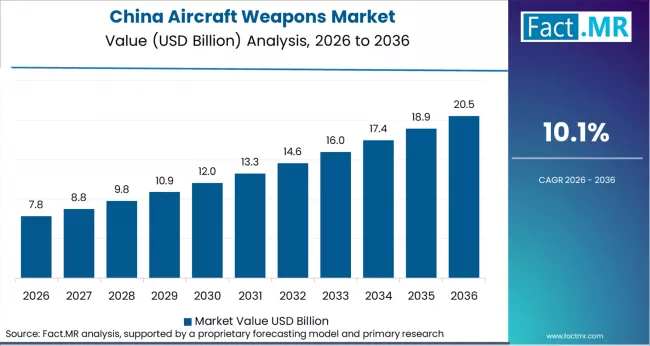
    China leads with a CAGR of 10.1%, driven by extensive military modernization programs and increasing investments in advanced weaponry. India follows with 9.4%, supported by upgrades to its air force capabilities and growing defense spending. The UK grows at 7.8%, reflecting steady investment in precision weapon systems for defense modernization. Germany shows growth at 7.6%, fueled by consistent defense requirements and technological advancements in aircraft armaments. France grows at 7.5%, driven by ongoing military modernization and procurement of advanced aircraft weapons.
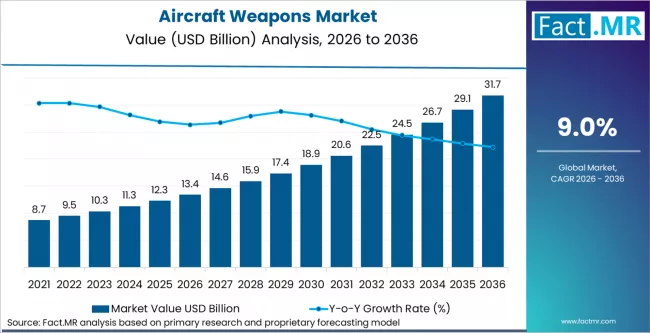
    Aircraft Weapons Market Market Value Analysis

    Aircraft Weapons Market

    Metric Value
    Estimated Value in (2026E) USD 13.4 billion
    Forecast Value in (2036F) USD 30.5 billion
    Forecast CAGR (2026 to 2036) 8.6%

    Aircraft Weapons Market Definition

    The Aircraft Weapons Market involves the development, manufacture, and sale of munitions and weapon systems designed to be deployed from military aircraft to engage air, ground, and maritime targets.

    Market Inclusions

    This report covers global and regional market sizes for aircraft weapons over a defined forecast period, including weapon types (air‑to‑air missiles, air‑to‑surface missiles, guided bombs, rockets), platform segments (fighters, bombers, attack helicopters, UAVs), and end‑use military users.

    Market Exclusions

    The scope excludes unrelated ground‑based weapon systems, defensive avionics not directly classified as weapons, and complete aircraft platforms where weapon systems are not separately quantified.

    Research Methodology

    • Primary Research: Interviews were conducted with defense analysts, weapon system engineers, and military procurement specialists.
    • Desk Research: Data was sourced from defense publications, military market reports, and trade association statistics.
    • Market‑Sizing and Forecasting: A hybrid model combining top‑down defence expenditure forecasts with bottom‑up weapons production and delivery data was used.
    • Data Validation and Update Cycle: Findings were validated through expert review and aligned with recent production and procurement figures.

    Summary of the Aircraft Weapons Market

    • Market Definition
      • The Aircraft Weapons Market includes the global production, trade, and deployment of airborne weapon systems, including air-to-ground, air-to-air, and other types, primarily for defense, military, and select commercial applications. The market covers missiles, bombs, cannons, and precision-guided munitions deployed across fighter jets, bombers, and attack aircraft.
    • Demand Drivers
      • Rising Defense Spending: Increased global defense budgets drive procurement of advanced aircraft weapons.
      • Air Force Modernization Programs: Upgrades to fighter jets, drones, and attack helicopters boost demand for precision and guided munitions.
      • Geopolitical and Strategic Preparedness: Nations prioritize advanced weaponry to maintain air superiority, combat readiness, and operational flexibility.
      • Precision and Mission Effectiveness: Adoption of guided, multi-mode, and smart munitions improves range, accuracy, and survivability.
      • Platform Versatility: Weapons compatible with multiple aircraft types enhance operational flexibility and reduce procurement complexity.
    • Key Segments Analyzed
      • Weapon Type: Air-to-Ground Weapons, Air-to-Air Weapons, Other.
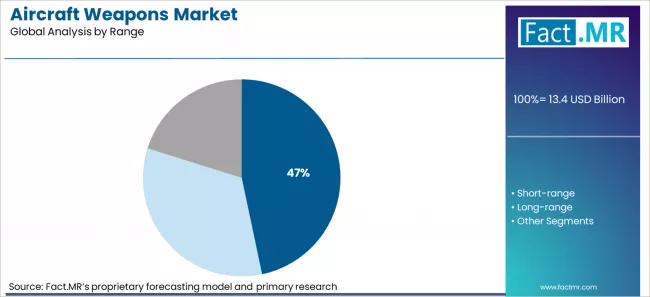
      • Range: Medium-range (46.7%), Short-range, Long-range.
      • Guidance: GPS-guided, Laser-guided, Other.
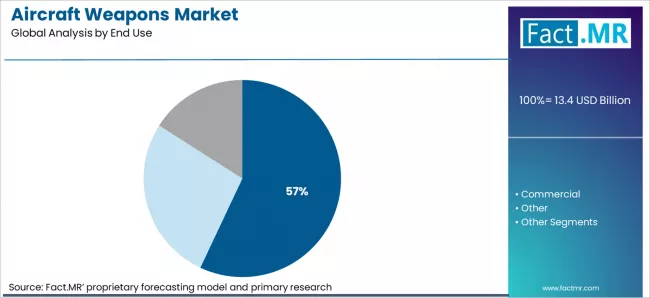
      • End Use: Defense & Military (57%), Commercial, Other.
      • Geography: China leads at 10.1% CAGR, followed by India (9.4%), United Kingdom (7.8%), Germany (7.6%), and France (7.5%).
    • Analyst Opinion at Fact MR
      • Shambhu Nath Jha, Principal Consultant at Fact MR, stated, "The aircraft weapons market is growth aligned with defense modernization priorities. Structural demand is driven by precision-guided munitions and high-value weapons supporting air combat readiness and strategic military capabilities rather than commercial cycles."
    • Strategic Implications / Executive Takeaways
      • Invest in Advanced Precision Systems: Focus on guided missiles, smart bombs, and multi-mode weapons to meet modern combat requirements.
      • Expand Regional Production and Partnerships: Target Asia Pacific and South Asia where defense spending and air force modernization are accelerating.
      • Comply with Export and Safety Regulations: Maintain ITAR compliance, interoperability standards, and certification for global procurement eligibility.
      • Strengthen Platform Integration Capabilities: Offer modular and aircraft-compatible systems to enhance adoption across fighter jets, bombers, and UCAVs.
      • Leverage Strategic Alliances: Collaborate with governments and defense integrators to secure long-term procurement contracts and offset obligations.
    • Methodology
      • Primary Research: Interviews with defense analysts, weapons engineers, and military procurement specialists.
      • Desk Research: Data sourced from defense publications, military market reports, and trade association statistics.
      • Market Sizing & Forecasting: Hybrid top-down defense expenditure forecasts combined with bottom-up weapons production and delivery data.

    Segmental Analysis

    Aircraft Weapons Market Analysis by End User
    Aircraft Weapons Market Analysis By End Use

    • Market Overview: Defense & military applications are expected to capture 57% of the market share by 2026. Aircraft weapons are predominantly used by defense forces to enhance combat capabilities, provide air superiority, and support strategic and tactical operations. Military aircraft are equipped with a variety of weapons, including missiles, guns, and bombs, to meet mission-specific requirements.
    • Demand Drivers:
      • Rising Defense Spending: Increased global defense budgets, particularly in regions with security concerns, are driving the demand for aircraft weapons in military applications.
      • Modernization of Air Forces: The upgrading of fighter jets, drones, and attack helicopters with advanced weaponry fuels market growth.
      • Strategic Military Preparedness: Nations prioritize equipping their air fleets with reliable and versatile weapons systems to maintain national security and operational superiority.

    Aircraft Weapons Market Analysis by Range
    Aircraft Weapons Market Analysis By Range

    • Market Overview: Medium-range aircraft weapons are projected to hold 46.7% of the market share by 2026. Medium-range weapons offer the ability to engage targets at intermediate distances, balancing precision, lethality, and operational flexibility for both offensive and defensive missions.
    • Demand Drivers:
      • Balanced Tactical Capability: Medium-range weapons provide an optimal combination of distance and accuracy, allowing aircraft to strike targets without entering high-risk zones.
      • Versatility Across Missions: These weapons are suitable for various platforms, including fighter jets, bombers, and unmanned combat aerial vehicles (UCAVs), enhancing their operational flexibility.
      • Increasing Modernization Programs: Military programs focusing on precision-guided munitions and adaptable weapon systems are boosting demand for medium-range aircraft weapons globally.

    Aircraft Weapons Market Drivers, Restraints, and Opportunities

    FMR analysts observe that the aircraft weapons market is a growth‑aligned, defense‑capability segment driven by sustained military modernization, evolving threat environments, and integration of precision strike systems across air platforms. Historically, unguided munitions dominated; as combat doctrines shifted toward networked, stand‑off, and precision engagement, structural demand grew for guided missiles, smart bombs, and integrated weapon suites that extend range, lethality, and survivability. The 2026 valuation reflects adoption tied to defense budgets, force readiness priorities, and geopolitical competition rather than cyclical commercial spending.

    While legacy unguided ordnance still accounts for volume in training and basic missions, advanced precision weapons with guidance, data‑link, and multi‑mode seekers are gaining share because they deliver higher mission success and lower collateral effects. These high‑value systems command premium pricing, contributing to net market growth even as unit counts scale with procurement cycles and strategic priorities. The market exists because sovereign forces require certified, interoperable weapons that meet performance and safety criteria in contested and asymmetric environments.

    • Modernization & Precision Demand: Air forces adopt guided missiles and smart munitions to replace basic bombs, improving range, accuracy, and mission effectiveness.
    • Standards & Regulatory Controls: Export controls (e.g., ITAR) and certification standards push procurement of compliant, interoperable weapon systems that meet defined performance benchmarks.
    • Regional Defense Dynamics: In North America and Europe, strong defense spending and allied integration drive advanced aircraft weapons uptake, while Asia‑Pacific expands investment with regional security concerns.

    Regional Analysis

    The market analysis covers key global regions, including East Asia, South Asia, and Western Europe. It is segmented geographically, with specific market dynamics for each region. The full report provides a detailed market attractiveness analysis.
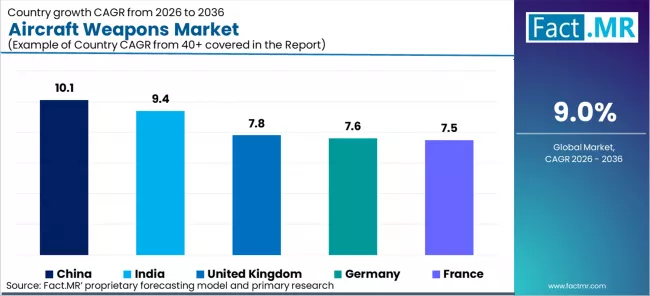
    Aircraft Weapons Market Cagr Analysis By Country

    Country CAGR (2026-2036)
    China 10.1%
    India 9.4%
    United Kingdom 7.8%
    Germany 7.6%
    France 7.5%

    Source: Fact MR (FMR) analysis, based on proprietary forecasting model and primary research

    East Asia:
    Aircraft Weapons Market Country Value Analysis

    China is the largest market, driven by increasing defense budgets, modernization of air force assets, and domestic production of advanced aircraft weapons. Key players include Norinco, AVIC, and Poly Technologies.

    • China: Demand for aircraft weapons in China is projected to rise at 10.1% CAGR through 2036. Growth is supported by government defense modernization programs (02-2025) and Norinco’s expansion of production facilities (08-2025).

    South Asia:

    India is a major market, supported by air force modernization programs, defense procurement, and domestic aerospace manufacturing initiatives.

    • India: Demand for aircraft weapons in India is projected to rise at 9.4% CAGR through 2036. Growth is driven by government defense tenders (03-2025) and HAL’s production capacity expansions (09-2025).
    • Western Europe: The United Kingdom, Germany, and France are key markets, driven by military modernization programs, defense procurement, and aerospace R&D.
    • United Kingdom: Demand for aircraft weapons in the UK is projected to rise at 7.8% CAGR through 2036. Growth is supported by Ministry of Defence procurement programs (04-2025) and BAE Systems’ facility expansions (08-2025).
    • Germany: Demand for aircraft weapons in Germany is projected to rise at 7.6% CAGR through 2036. Growth is influenced by federal defense procurement initiatives (05-2025) and Rheinmetall AG’s production expansion (09-2025).
    • France: Demand for aircraft weapons in France is projected to rise at 7.5% CAGR through 2036. Growth is supported by defense modernization programs (06-2025) and Dassault Aviation’s regional manufacturing expansions (10-2025).

    Fact MR's analysis of the aircraft weapons market in East Asia, South Asia, and Western Europe consists of country-wise assessments that include China, India, the United Kingdom, Germany, and France. Readers can find detailed trends, regulatory updates, and company-specific investments shaping market growth in these countries.

    What is the Competitive Structure and Buyer Behavior in the Aircraft Weapons Market?
    Aircraft Weapons Market Analysis By Company

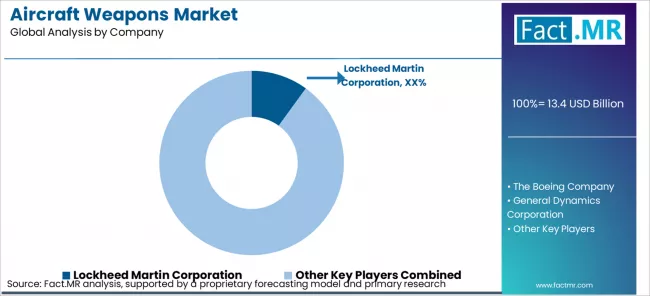
    The aircraft weapons market is highly concentrated, with major defence prime contractors such as Lockheed Martin Corporation, The Boeing Company, General Dynamics Corporation, MBDA, Northrop Grumman Corporation, Saab AB, and Thales Group holding dominant shares of global procurement. A small number of large, vertically integrated firms supply a broad range of munitions, missiles, and guided weapon systems that meet stringent military specifications, and proprietary technology and system integration capability are the primary competitive variables driving procurement decisions by air forces and defence ministries.

    Companies with deep engineering expertise, robust R&D investment, established production scale, and long‑standing government relationships hold structural advantages, as they can sustain certification, integrate weapons with diverse aircraft platforms, and manage complex supply chains. Large defence buyers wield strong leverage through long‑term contracts, competitive bidding processes, and strategic alignment with national security priorities. To manage supplier dependency, governments often require qualification of multiple vendors, enforce offset or industrial participation obligations, and standardize interoperability and certification requirements. These dynamics limit individual suppliers’ pricing power and shift competitive focus toward technical performance, lifecycle support, and strategic alignment rather than price alone.

    Recent Industry Developments

    • AI-Enabled Targeting (CommandIQ): Lockheed Martin showcased its CommandIQ suite in early 2026, which uses "agentic AI" to integrate F-35 sensor fusion with autonomous weapons. This system allows a single pilot to coordinate a "swarm" of collaborative combat aircraft (CCA) and their weapon releases via a unified, AI-optimized operational picture.
    • RTX (Raytheon) Production Landmark: In February 2026, Raytheon entered five landmark agreements with the U.S. Department of War to double or even quadruple production of critical aerial munitions. Annual production of the AMRAAM® missile is scaling to over 1,900 units, while the Tomahawk cruise missile (including air-launched maritime variants) is increasing to 1,000 units annually.
    • Boeing’s High-Altitude Expansion: In February 2026, Boeing established a new local production line in Australia for its HAAWC (High Altitude Anti-Submarine Warfare Weapon Capability). This wing kit allows P-8A aircraft to launch torpedoes from high altitudes, keeping crews safe from localized anti-aircraft fire while significantly expanding the "kill web" in maritime domains.

    Key Players of the Aircraft Weapons Market

    • Lockheed Martin Corporation
    • The Boeing Company
    • General Dynamics Corporation
    • MBDA
    • Northrop Grumman Corporation
    • Saab AB
    • Thales Group

    Report Scope

    Metric Value
    Quantitative Units USD 13.4 billion (2026) to USD 30.5 billion (2036), at a CAGR of 8.6%
    Market Definition The Aircraft Weapons Market includes production, trade, and deployment of airborne weapon systems, including air-to-ground, air-to-air, and other types for defense, military, and select commercial applications.
    Weapon Type Air-to-Ground Weapons, Air-to-Air Weapons, Other
    Range Medium-range, Short-range, Long-range
    Guidance GPS-guided, Laser-guided, Other
    End User Defense & Military, Commercial, Other
    Regions Covered North America, Latin America, Europe, East Asia, South Asia, Oceania, Middle East & Africa
    Countries Covered United States, Canada, Mexico, Brazil, Germany, France, United Kingdom, Italy, Spain, China, India, Japan, South Korea, Australia, and 20+ other countries
    Key Companies Profiled Lockheed Martin Corporation, The Boeing Company, General Dynamics Corporation, MBDA, Northrop Grumman Corporation, Saab AB, Thales Group
    Forecast Period 2026 to 2036
    Approach Hybrid top-down and bottom-up modeling validated through primary interviews with defense contractors and end users, supported by trade data benchmarking and program-level capacity verification.

    Aircraft Weapons Market Key Segments

    • Weapon Type

      • Air-to-Ground Weapons
      • Air-to-Air Weapons
      • Other
    • Range

      • Medium-range
      • Short-range
      • Long-range
    • End-Use Industry

      • Defense & Military
      • Commercial
      • Other
    • Guidance

      • GPS-guided
      • Laser-guided
      • Other
    • Region

      • North America
        • USA
        • Canada
        • Mexico
      • Europe
        • Germany
        • UK
        • France
        • Italy
        • Spain
        • Nordic Countries
        • BENELUX
        • Rest of Europe
      • Asia Pacific
        • China
        • Japan
        • South Korea
        • India
        • Australia
        • Rest of Asia Pacific
      • Latin America
        • Brazil
        • Argentina
        • Rest of Latin America
      • Middle East and Africa
        • Kingdom of Saudi Arabia
        • United Arab Emirates
        • South Africa
        • Rest of Middle East and Africa
      • Other Regions
        • Oceania
        • Central Asia
        • Other Markets

    Bibliographies

    • Stockholm International Peace Research Institute. (2024). Trends in international arms transfers. Stockholm International Peace Research Institute.
    • U.S. Department of Defense. (2023). Defense acquisition and procurement report for air-delivered weapons systems. U.S. Department of Defense.
    • North Atlantic Treaty Organization. (2023). Air power and precision-guided munition capabilities in modern defense operations. NATO.
    • International Institute for Strategic Studies. (2024). The military balance: Global defense capabilities and weapon system developments. International Institute for Strategic Studies.
    • India Strategic. (2026, February). Lockheed Martin to showcase advanced defense capabilities at the World Defense Show 2026. India Strategic.
    • RTX Corporation. (2026, February 4). Raytheon partners with the U.S. Department of Defense on multiple defense technology agreements. RTX Corporation.
    • The Boeing Company. (2026, February 2). Boeing expands precision aerial munition partnership with Ferra Engineering. The Boeing Company.

    This report addresses

    • Market intelligence enabling comprehensive assessment of leading countries and product segments across the Aircraft Weapons Market globally.
    • Market volume (sales units and revenue) estimates and 10-year revenue forecasts from 2026 to 2036, validated through defense procurement data, military program analysis, and country-level demand modeling.
    • Growth opportunity mapping across weapon types (Air-to-Ground Weapons, Air-to-Air Weapons, Other), range categories (Medium-range, Short-range, Long-range), guidance systems (GPS-guided, Laser-guided, Other), and end-user segments (Defense & Military, Commercial, Other).
    • Segment and regional revenue forecasts by weapon type, range, guidance, end-user, and geography across 40+ countries.
    • Competition strategy analysis covering weapon performance, precision and lethality, system integration, interoperability, and certification compliance, including major players like Lockheed Martin Corporation, The Boeing Company, General Dynamics Corporation, MBDA, Northrop Grumman Corporation, Saab AB, and Thales Group.
    • Product and regulatory compliance tracking aligned with military standards, export controls (e.g., ITAR), and weapon system certification requirements.
    • Regulatory impact analysis addressing defense modernization programs, procurement standards, interoperability requirements, and international arms regulations across key markets.
    • Report delivery in PDF, Excel, PowerPoint, and interactive dashboard formats for executive, procurement, and operational planning use.

    Table of Content

    1. Executive Summary
      • Global Market Outlook
      • Demand to side Trends
      • Supply to side Trends
      • Technology Roadmap Analysis
      • Analysis and Recommendations
    2. Market Overview
      • Market Coverage / Taxonomy
      • Market Definition / Scope / Limitations
    3. Research Methodology
      • Chapter Orientation
      • Analytical Lens and Working Hypotheses
        • Market Structure, Signals, and Trend Drivers
        • Benchmarking and Cross-market Comparability
        • Market Sizing, Forecasting, and Opportunity Mapping
      • Research Design and Evidence Framework
        • Desk Research Programme (Secondary Evidence)
          • Company Annual and Sustainability Reports
          • Peer-reviewed Journals and Academic Literature
          • Corporate Websites, Product Literature, and Technical Notes
          • Earnings Decks and Investor Briefings
          • Statutory Filings and Regulatory Disclosures
          • Technical White Papers and Standards Notes
          • Expert Input and Fieldwork (Primary Evidence)
            • Primary Modes
              • Qualitative Interviews and Expert Elicitation
              • Quantitative Surveys and Structured Data Capture
              • Blended Approach
            • Why Primary Evidence is Used
            • Field Techniques
              • Interviews
              • Surveys
              • Focus Groups
              • Observational and In-context Research
              • Social and Community Interactions
            • Stakeholder Universe Engaged
              • C-suite Leaders
              • Board Members
              • Presidents and Vice Presidents
              • R&D and Innovation Heads
              • Technical Specialists
              • Domain Subject-matter Experts
              • Scientists
              • Physicians and Other Healthcare Professionals
            • Governance, Ethics, and Data Stewardship
              • Research Ethics
              • Data Integrity and Handling
          • Tooling, Models, and Reference Databases
        • Data Engineering and Model Build
          • Data Acquisition and Ingestion
          • Cleaning, Normalisation, and Verification
          • Synthesis, Triangulation, and Analysis
        • Quality Assurance and Audit Trail
      • Market Background
        • Market Dynamics
          • Drivers
          • Restraints
          • Opportunity
          • Trends
        • Scenario Forecast
          • Demand in Optimistic Scenario
          • Demand in Likely Scenario
          • Demand in Conservative Scenario
        • Opportunity Map Analysis
        • Product Life Cycle Analysis
        • Supply Chain Analysis
        • Investment Feasibility Matrix
        • Value Chain Analysis
        • PESTLE and Porter’s Analysis
        • Regulatory Landscape
        • Regional Parent Market Outlook
        • Production and Consumption Statistics
        • Import and Export Statistics
      • Global Market Analysis 2021 to 2025 and Forecast, 2026 to 2036
        • Historical Market Size Value (USD Million) Analysis, 2021 to 2025
        • Current and Future Market Size Value (USD Million) Projections, 2026 to 2036
          • Y to o to Y Growth Trend Analysis
          • Absolute $ Opportunity Analysis
      • Global Market Pricing Analysis 2021 to 2025 and Forecast 2026 to 2036
      • Global Market Analysis 2021 to 2025 and Forecast 2026 to 2036, By End Use
        • Introduction / Key Findings
        • Historical Market Size Value (USD Million) Analysis By End Use , 2021 to 2025
        • Current and Future Market Size Value (USD Million) Analysis and Forecast By End Use , 2026 to 2036
          • Defense & Military
          • Commercial
          • Other
        • Y to o to Y Growth Trend Analysis By End Use , 2021 to 2025
        • Absolute $ Opportunity Analysis By End Use , 2026 to 2036
      • Global Market Analysis 2021 to 2025 and Forecast 2026 to 2036, By Range
        • Introduction / Key Findings
        • Historical Market Size Value (USD Million) Analysis By Range, 2021 to 2025
        • Current and Future Market Size Value (USD Million) Analysis and Forecast By Range, 2026 to 2036
          • Medium-range
          • Short-range
          • Long-range
        • Y to o to Y Growth Trend Analysis By Range, 2021 to 2025
        • Absolute $ Opportunity Analysis By Range, 2026 to 2036
      • Global Market Analysis 2021 to 2025 and Forecast 2026 to 2036, By Region
        • Introduction
        • Historical Market Size Value (USD Million) Analysis By Region, 2021 to 2025
        • Current Market Size Value (USD Million) Analysis and Forecast By Region, 2026 to 2036
          • North America
          • Latin America
          • Western Europe
          • Eastern Europe
          • East Asia
          • South Asia and Pacific
          • Middle East & Africa
        • Market Attractiveness Analysis By Region
      • North America Market Analysis 2021 to 2025 and Forecast 2026 to 2036, By Country
        • Historical Market Size Value (USD Million) Trend Analysis By Market Taxonomy, 2021 to 2025
        • Market Size Value (USD Million) Forecast By Market Taxonomy, 2026 to 2036
          • By Country
            • USA
            • Canada
            • Mexico
          • By End Use
          • By Range
        • Market Attractiveness Analysis
          • By Country
          • By End Use
          • By Range
        • Key Takeaways
      • Latin America Market Analysis 2021 to 2025 and Forecast 2026 to 2036, By Country
        • Historical Market Size Value (USD Million) Trend Analysis By Market Taxonomy, 2021 to 2025
        • Market Size Value (USD Million) Forecast By Market Taxonomy, 2026 to 2036
          • By Country
            • Brazil
            • Chile
            • Rest of Latin America
          • By End Use
          • By Range
        • Market Attractiveness Analysis
          • By Country
          • By End Use
          • By Range
        • Key Takeaways
      • Western Europe Market Analysis 2021 to 2025 and Forecast 2026 to 2036, By Country
        • Historical Market Size Value (USD Million) Trend Analysis By Market Taxonomy, 2021 to 2025
        • Market Size Value (USD Million) Forecast By Market Taxonomy, 2026 to 2036
          • By Country
            • Germany
            • UK
            • Italy
            • Spain
            • France
            • Nordic
            • BENELUX
            • Rest of Western Europe
          • By End Use
          • By Range
        • Market Attractiveness Analysis
          • By Country
          • By End Use
          • By Range
        • Key Takeaways
      • Eastern Europe Market Analysis 2021 to 2025 and Forecast 2026 to 2036, By Country
        • Historical Market Size Value (USD Million) Trend Analysis By Market Taxonomy, 2021 to 2025
        • Market Size Value (USD Million) Forecast By Market Taxonomy, 2026 to 2036
          • By Country
            • Russia
            • Poland
            • Hungary
            • Balkan & Baltic
            • Rest of Eastern Europe
          • By End Use
          • By Range
        • Market Attractiveness Analysis
          • By Country
          • By End Use
          • By Range
        • Key Takeaways
      • East Asia Market Analysis 2021 to 2025 and Forecast 2026 to 2036, By Country
        • Historical Market Size Value (USD Million) Trend Analysis By Market Taxonomy, 2021 to 2025
        • Market Size Value (USD Million) Forecast By Market Taxonomy, 2026 to 2036
          • By Country
            • China
            • Japan
            • South Korea
          • By End Use
          • By Range
        • Market Attractiveness Analysis
          • By Country
          • By End Use
          • By Range
        • Key Takeaways
      • South Asia and Pacific Market Analysis 2021 to 2025 and Forecast 2026 to 2036, By Country
        • Historical Market Size Value (USD Million) Trend Analysis By Market Taxonomy, 2021 to 2025
        • Market Size Value (USD Million) Forecast By Market Taxonomy, 2026 to 2036
          • By Country
            • India
            • ASEAN
            • Australia & New Zealand
            • Rest of South Asia and Pacific
          • By End Use
          • By Range
        • Market Attractiveness Analysis
          • By Country
          • By End Use
          • By Range
        • Key Takeaways
      • Middle East & Africa Market Analysis 2021 to 2025 and Forecast 2026 to 2036, By Country
        • Historical Market Size Value (USD Million) Trend Analysis By Market Taxonomy, 2021 to 2025
        • Market Size Value (USD Million) Forecast By Market Taxonomy, 2026 to 2036
          • By Country
            • Kingdom of Saudi Arabia
            • Other GCC Countries
            • Turkiye
            • South Africa
            • Other African Union
            • Rest of Middle East & Africa
          • By End Use
          • By Range
        • Market Attractiveness Analysis
          • By Country
          • By End Use
          • By Range
        • Key Takeaways
      • Key Countries Market Analysis
        • USA
          • Pricing Analysis
          • Market Share Analysis, 2025
            • By End Use
            • By Range
        • Canada
          • Pricing Analysis
          • Market Share Analysis, 2025
            • By End Use
            • By Range
        • Mexico
          • Pricing Analysis
          • Market Share Analysis, 2025
            • By End Use
            • By Range
        • Brazil
          • Pricing Analysis
          • Market Share Analysis, 2025
            • By End Use
            • By Range
        • Chile
          • Pricing Analysis
          • Market Share Analysis, 2025
            • By End Use
            • By Range
        • Germany
          • Pricing Analysis
          • Market Share Analysis, 2025
            • By End Use
            • By Range
        • UK
          • Pricing Analysis
          • Market Share Analysis, 2025
            • By End Use
            • By Range
        • Italy
          • Pricing Analysis
          • Market Share Analysis, 2025
            • By End Use
            • By Range
        • Spain
          • Pricing Analysis
          • Market Share Analysis, 2025
            • By End Use
            • By Range
        • France
          • Pricing Analysis
          • Market Share Analysis, 2025
            • By End Use
            • By Range
        • India
          • Pricing Analysis
          • Market Share Analysis, 2025
            • By End Use
            • By Range
        • ASEAN
          • Pricing Analysis
          • Market Share Analysis, 2025
            • By End Use
            • By Range
        • Australia & New Zealand
          • Pricing Analysis
          • Market Share Analysis, 2025
            • By End Use
            • By Range
        • China
          • Pricing Analysis
          • Market Share Analysis, 2025
            • By End Use
            • By Range
        • Japan
          • Pricing Analysis
          • Market Share Analysis, 2025
            • By End Use
            • By Range
        • South Korea
          • Pricing Analysis
          • Market Share Analysis, 2025
            • By End Use
            • By Range
        • Russia
          • Pricing Analysis
          • Market Share Analysis, 2025
            • By End Use
            • By Range
        • Poland
          • Pricing Analysis
          • Market Share Analysis, 2025
            • By End Use
            • By Range
        • Hungary
          • Pricing Analysis
          • Market Share Analysis, 2025
            • By End Use
            • By Range
        • Kingdom of Saudi Arabia
          • Pricing Analysis
          • Market Share Analysis, 2025
            • By End Use
            • By Range
        • Turkiye
          • Pricing Analysis
          • Market Share Analysis, 2025
            • By End Use
            • By Range
        • South Africa
          • Pricing Analysis
          • Market Share Analysis, 2025
            • By End Use
            • By Range
      • Market Structure Analysis
        • Competition Dashboard
        • Competition Benchmarking
        • Market Share Analysis of Top Players
          • By Regional
          • By End Use
          • By Range
      • Competition Analysis
        • Competition Deep Dive
          • Lockheed Martin Corporation
            • Overview
            • Product Portfolio
            • Profitability by Market Segments (Product/Age /Sales Channel/Region)
            • Sales Footprint
            • Strategy Overview
              • Marketing Strategy
              • Product Strategy
              • Channel Strategy
          • The Boeing Company
          • General Dynamics Corporation
          • MBDA
          • Northrop Grumman Corporation
          • Saab AB
          • Thales Group
    4. Assumptions & Acronyms Used

    List Of Table

    • Table 1: Global Market Value (USD Million) Forecast by Region, 2021 to 2036
    • Table 2: Global Market Value (USD Million) Forecast by End Use , 2021 to 2036
    • Table 3: Global Market Value (USD Million) Forecast by Range, 2021 to 2036
    • Table 4: North America Market Value (USD Million) Forecast by Country, 2021 to 2036
    • Table 5: North America Market Value (USD Million) Forecast by End Use , 2021 to 2036
    • Table 6: North America Market Value (USD Million) Forecast by Range, 2021 to 2036
    • Table 7: Latin America Market Value (USD Million) Forecast by Country, 2021 to 2036
    • Table 8: Latin America Market Value (USD Million) Forecast by End Use , 2021 to 2036
    • Table 9: Latin America Market Value (USD Million) Forecast by Range, 2021 to 2036
    • Table 10: Western Europe Market Value (USD Million) Forecast by Country, 2021 to 2036
    • Table 11: Western Europe Market Value (USD Million) Forecast by End Use , 2021 to 2036
    • Table 12: Western Europe Market Value (USD Million) Forecast by Range, 2021 to 2036
    • Table 13: Eastern Europe Market Value (USD Million) Forecast by Country, 2021 to 2036
    • Table 14: Eastern Europe Market Value (USD Million) Forecast by End Use , 2021 to 2036
    • Table 15: Eastern Europe Market Value (USD Million) Forecast by Range, 2021 to 2036
    • Table 16: East Asia Market Value (USD Million) Forecast by Country, 2021 to 2036
    • Table 17: East Asia Market Value (USD Million) Forecast by End Use , 2021 to 2036
    • Table 18: East Asia Market Value (USD Million) Forecast by Range, 2021 to 2036
    • Table 19: South Asia and Pacific Market Value (USD Million) Forecast by Country, 2021 to 2036
    • Table 20: South Asia and Pacific Market Value (USD Million) Forecast by End Use , 2021 to 2036
    • Table 21: South Asia and Pacific Market Value (USD Million) Forecast by Range, 2021 to 2036
    • Table 22: Middle East & Africa Market Value (USD Million) Forecast by Country, 2021 to 2036
    • Table 23: Middle East & Africa Market Value (USD Million) Forecast by End Use , 2021 to 2036
    • Table 24: Middle East & Africa Market Value (USD Million) Forecast by Range, 2021 to 2036

    List Of Figures

    • Figure 1: Global Market Pricing Analysis
    • Figure 2: Global Market Value (USD Million) Forecast 2021 to 2036
    • Figure 3: Global Market Value Share and BPS Analysis by End Use , 2026 and 2036
    • Figure 4: Global Market Y to o to Y Growth Comparison by End Use , 2026 to 2036
    • Figure 5: Global Market Attractiveness Analysis by End Use
    • Figure 6: Global Market Value Share and BPS Analysis by Range, 2026 and 2036
    • Figure 7: Global Market Y to o to Y Growth Comparison by Range, 2026 to 2036
    • Figure 8: Global Market Attractiveness Analysis by Range
    • Figure 9: Global Market Value (USD Million) Share and BPS Analysis by Region, 2026 and 2036
    • Figure 10: Global Market Y to o to Y Growth Comparison by Region, 2026 to 2036
    • Figure 11: Global Market Attractiveness Analysis by Region
    • Figure 12: North America Market Incremental Dollar Opportunity, 2026 to 2036
    • Figure 13: Latin America Market Incremental Dollar Opportunity, 2026 to 2036
    • Figure 14: Western Europe Market Incremental Dollar Opportunity, 2026 to 2036
    • Figure 15: Eastern Europe Market Incremental Dollar Opportunity, 2026 to 2036
    • Figure 16: East Asia Market Incremental Dollar Opportunity, 2026 to 2036
    • Figure 17: South Asia and Pacific Market Incremental Dollar Opportunity, 2026 to 2036
    • Figure 18: Middle East & Africa Market Incremental Dollar Opportunity, 2026 to 2036
    • Figure 19: North America Market Value Share and BPS Analysis by Country, 2026 and 2036
    • Figure 20: North America Market Value Share and BPS Analysis by End Use , 2026 and 2036
    • Figure 21: North America Market Y to o to Y Growth Comparison by End Use , 2026 to 2036
    • Figure 22: North America Market Attractiveness Analysis by End Use
    • Figure 23: North America Market Value Share and BPS Analysis by Range, 2026 and 2036
    • Figure 24: North America Market Y to o to Y Growth Comparison by Range, 2026 to 2036
    • Figure 25: North America Market Attractiveness Analysis by Range
    • Figure 26: Latin America Market Value Share and BPS Analysis by Country, 2026 and 2036
    • Figure 27: Latin America Market Value Share and BPS Analysis by End Use , 2026 and 2036
    • Figure 28: Latin America Market Y to o to Y Growth Comparison by End Use , 2026 to 2036
    • Figure 29: Latin America Market Attractiveness Analysis by End Use
    • Figure 30: Latin America Market Value Share and BPS Analysis by Range, 2026 and 2036
    • Figure 31: Latin America Market Y to o to Y Growth Comparison by Range, 2026 to 2036
    • Figure 32: Latin America Market Attractiveness Analysis by Range
    • Figure 33: Western Europe Market Value Share and BPS Analysis by Country, 2026 and 2036
    • Figure 34: Western Europe Market Value Share and BPS Analysis by End Use , 2026 and 2036
    • Figure 35: Western Europe Market Y to o to Y Growth Comparison by End Use , 2026 to 2036
    • Figure 36: Western Europe Market Attractiveness Analysis by End Use
    • Figure 37: Western Europe Market Value Share and BPS Analysis by Range, 2026 and 2036
    • Figure 38: Western Europe Market Y to o to Y Growth Comparison by Range, 2026 to 2036
    • Figure 39: Western Europe Market Attractiveness Analysis by Range
    • Figure 40: Eastern Europe Market Value Share and BPS Analysis by Country, 2026 and 2036
    • Figure 41: Eastern Europe Market Value Share and BPS Analysis by End Use , 2026 and 2036
    • Figure 42: Eastern Europe Market Y to o to Y Growth Comparison by End Use , 2026 to 2036
    • Figure 43: Eastern Europe Market Attractiveness Analysis by End Use
    • Figure 44: Eastern Europe Market Value Share and BPS Analysis by Range, 2026 and 2036
    • Figure 45: Eastern Europe Market Y to o to Y Growth Comparison by Range, 2026 to 2036
    • Figure 46: Eastern Europe Market Attractiveness Analysis by Range
    • Figure 47: East Asia Market Value Share and BPS Analysis by Country, 2026 and 2036
    • Figure 48: East Asia Market Value Share and BPS Analysis by End Use , 2026 and 2036
    • Figure 49: East Asia Market Y to o to Y Growth Comparison by End Use , 2026 to 2036
    • Figure 50: East Asia Market Attractiveness Analysis by End Use
    • Figure 51: East Asia Market Value Share and BPS Analysis by Range, 2026 and 2036
    • Figure 52: East Asia Market Y to o to Y Growth Comparison by Range, 2026 to 2036
    • Figure 53: East Asia Market Attractiveness Analysis by Range
    • Figure 54: South Asia and Pacific Market Value Share and BPS Analysis by Country, 2026 and 2036
    • Figure 55: South Asia and Pacific Market Value Share and BPS Analysis by End Use , 2026 and 2036
    • Figure 56: South Asia and Pacific Market Y to o to Y Growth Comparison by End Use , 2026 to 2036
    • Figure 57: South Asia and Pacific Market Attractiveness Analysis by End Use
    • Figure 58: South Asia and Pacific Market Value Share and BPS Analysis by Range, 2026 and 2036
    • Figure 59: South Asia and Pacific Market Y to o to Y Growth Comparison by Range, 2026 to 2036
    • Figure 60: South Asia and Pacific Market Attractiveness Analysis by Range
    • Figure 61: Middle East & Africa Market Value Share and BPS Analysis by Country, 2026 and 2036
    • Figure 62: Middle East & Africa Market Value Share and BPS Analysis by End Use , 2026 and 2036
    • Figure 63: Middle East & Africa Market Y to o to Y Growth Comparison by End Use , 2026 to 2036
    • Figure 64: Middle East & Africa Market Attractiveness Analysis by End Use
    • Figure 65: Middle East & Africa Market Value Share and BPS Analysis by Range, 2026 and 2036
    • Figure 66: Middle East & Africa Market Y to o to Y Growth Comparison by Range, 2026 to 2036
    • Figure 67: Middle East & Africa Market Attractiveness Analysis by Range
    • Figure 68: Global Market - Tier Structure Analysis
    • Figure 69: Global Market - Company Share Analysis

    - FAQs -

    How large is the demand for Aircraft Weapons in the global market in 2026?

    Demand for Aircraft Weapons in the global market is estimated to be valued at USD 13.4 billion in 2026.

    What will be the market size of Aircraft Weapons in the global market by 2036?

    The market size for Aircraft Weapons is projected to reach USD 30.5 billion by 2036.

    What is the expected demand growth for Aircraft Weapons in the global market between 2026 and 2036?

    Demand for Aircraft Weapons in the global market is expected to grow at a CAGR of 8.6% between 2026 and 2036.

    Which end-user segment is expected to dominate the market?

    Defense & Military applications are expected to dominate the market, accounting for 57% of the market share in 2026, due to sustained investments in modernizing aerial combat capabilities and advanced weapons systems.

    Which region is expected to show the highest growth rate for Aircraft Weapons?

    China is projected to show the highest regional CAGR at 10.1% during the forecast period, driven by ongoing expansion of the air force, indigenous weapons development programs, and modernization of defense capabilities.

    How significant is the growth outlook for India in this market?

    India is expected to grow at a CAGR of 9.4%, supported by procurement of advanced aircraft weapons, modernization of military aircraft fleets, and strategic investments in defense technologies.

    What is the growth outlook for the United Kingdom in the Aircraft Weapons market?

    The United Kingdom is expected to grow at a CAGR of 7.8%, reflecting investments in next-generation aircraft weapons systems and procurement for air defense and strategic operations.

    What is the growth forecast for Germany in the Aircraft Weapons market?

    Germany is expected to grow at a CAGR of 7.6%, driven by defense modernization programs, upgrading of military aircraft, and increasing focus on European air defense initiatives.

    What is the growth forecast for France in the Aircraft Weapons market?

    France is expected to grow at a CAGR of 7.5%, supported by investments in air combat capabilities, strategic defense planning, and upgrades to fighter aircraft and unmanned aerial systems.

    Which company is identified as a leading player in the Aircraft Weapons market?

    Lockheed Martin Corporation is recognized as a leading player in this market, providing advanced aircraft weapons and defense systems used in fighter jets, bombers, and other military aircraft worldwide.

    What are Aircraft Weapons used for?

    Aircraft Weapons are used in military and defense operations, providing air-to-air, air-to-ground, and strategic attack capabilities. They include missiles, bombs, cannons, and precision-guided munitions deployed on fighter jets, bombers, and attack aircraft.

    What does the Aircraft Weapons market include in this report?

    The market scope includes aircraft-mounted weapons systems for defense and military use, covering missiles, bombs, cannons, and precision-guided munitions deployed across fighter aircraft, bombers, and attack platforms.

    How is the market forecast developed in this report?

    The forecast is developed using historical data on aircraft weapons procurement, defense budgets, military modernization programs, and insights from leading global defense contractors like Lockheed Martin Corporation.

    What is meant by the Aircraft Weapons market in this report?

    The market refers to the global production, trade, and consumption of aircraft weapons, with a focus on systems deployed for defense and military applications, including fighter jets, bombers, and other combat aircraft.

    Aircraft Weapons Market