- Base Value(2025): 150 Mn
- Estimated Value(2026): 190 Mn
- Forecast Value (2036): 321 Mn
- CAGR (2026 - 2036): 5.4%
Quick-Release Aircraft Interior Fasteners Market Forecast 2026 to 2036
In 2025, the quick-release aircraft interior fasteners market was valued at USD 150 million. Based on Fact MR's analysis, demand for quick-release aircraft interior fasteners is estimated to grow to USD 190 million in 2026 and USD 321 million by 2036. FMR projects a CAGR of 5.4% during the forecast period.
The absolute dollar growth from 2026 to 2036 is USD 131 million. This growth is driven by the increasing demand for lightweight, durable, and easily detachable fasteners used in aircraft interiors, where quick-release mechanisms are crucial for efficient maintenance and modular design. However, challenges such as material cost volatility and the need for high precision in manufacturing may limit growth in certain regions.
India leads with a CAGR of 7.5%, driven by rapid growth in aerospace manufacturing and the need for efficient interior fastening solutions. China follows with a 7.0% CAGR, supported by expanding aerospace production and the demand for advanced aircraft interior technologies. Singapore grows at 5.2%, fueled by its aerospace industry and focus on improving aircraft maintenance. The USA shows a 4.6% growth rate, driven by the ongoing demand for modular aircraft interiors. France and Germany grow at 4.3% and 4.0%, respectively, due to steady growth in the European aerospace sector. The UK grows at 3.9%, while Japan shows the slowest growth at 3.4%, influenced by a mature aerospace market.
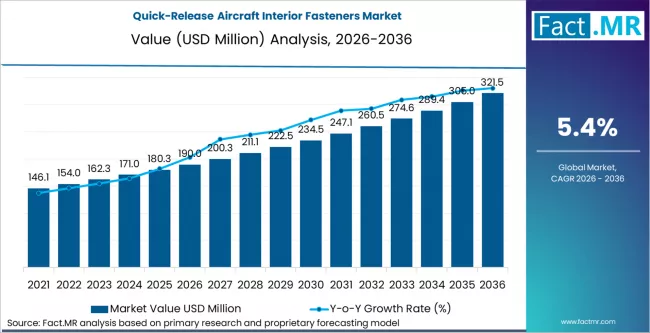
Quick Release Aircraft Interior Fasteners Market Market Value Analysis | Source: Fact.MR
Quick‑Release Aircraft Interior Fasteners Market Definition
The quick‑release aircraft interior fasteners market refers to the production and sale of fastener systems designed for rapid installation and removal of interior aircraft components. These fasteners include latches, clips, quick‑release pins, and quarter‑turn fasteners that enable efficient assembly and disassembly of seats, panels, galleys, and cabin trim without tools. Their primary function is to reduce maintenance time, support modular cabin layouts, and improve turnaround efficiency. Key end uses include commercial airlines, business jets, regional aircraft, and aerospace MRO (maintenance, repair, and overhaul) services.
Market Inclusions
This report covers global and regional market sizes for quick‑release aircraft interior fasteners with a defined forecast period. It includes segment breakdowns by product type (quick‑release pins, quarter‑turn fasteners, clips and latches), material (aluminum, stainless steel, composites), and aerospace application (seating systems, cabin panels, galleys). End users such as OEMs and MRO providers are analyzed. Pricing trends, raw material supply dynamics, and trade flow data are also included.
Market Exclusions
The scope excludes structural aircraft fasteners such as bolts, nuts, and rivets used in airframe assemblies. Finished aircraft, cabin equipment units, and unrelated hardware such as electrical connectors or fluid fittings are not included. Fasteners intended solely for non‑aviation industries are omitted to focus strictly on interior aviation applications.
Research Methodology
- Primary Research: Interviews were conducted with aerospace engineers, cabin systems designers, fastener suppliers, and MRO specialists.
- Desk Research: Data was sourced from industry reports, aircraft interior standards publications, and trade statistics.
- Market‑Sizing and Forecasting: A hybrid model was used, combining top‑down aerospace interior components demand estimates with bottom‑up shipment and revenue data.
- Data Validation and Update Cycle: Findings were validated through expert review and aligned with recent production and trade figures, with periodic updates.
Quick-Release Aircraft Interior Fasteners Market Summary
Quick-Release Aircraft Interior Fasteners Market Definition
The Quick-Release Aircraft Interior Fasteners Market involves fastener systems designed to allow rapid installation and removal of interior components in aircraft. These fasteners, including quarter-turn fasteners, panel latches, and DZUS-style fasteners, play a critical role in maintaining modular aircraft designs and ensuring efficient maintenance processes. Their primary function is to facilitate easy access to interior components, reduce aircraft downtime, and support the reconfiguration of aircraft cabins. These fasteners are widely used in commercial aircraft, military platforms, helicopters, business jets, and aerospace maintenance, repair, and overhaul (MRO) services.
Demand Drivers in the Market
- Increased Demand for Modular Aircraft Interiors: The growing trend toward modular and easily reconfigurable interiors is driving demand for quick-release fasteners that enable easy and quick disassembly and reassembly of aircraft interiors.
- Aerospace Production Growth: Rising production volumes of commercial, military, and business aircraft contribute to the demand for fasteners that streamline the assembly process and ensure ease of maintenance.
- Emphasis on Operational Efficiency and Reduced Turnaround Time: Airlines and MRO providers seek ways to improve operational efficiency, with quick-release fasteners playing a significant role in reducing aircraft downtime during maintenance and repairs.
- Regulatory Requirements for Safety and Maintenance Access: Aviation regulators require quick-access systems in aircraft interiors for emergencies and maintenance, further driving the demand for these fasteners.
Key Segments Analyzed in the FMR Report
- Fastener Family: Quarter-turn fasteners are expected to dominate the market, capturing the largest share in 2026 due to their ease of use, reliability, and efficiency in aircraft interior applications.
- Material: Aluminum, stainless steel, and composites are the primary materials used in quick-release fasteners. Aluminum, with its lightweight and corrosion-resistant properties, is projected to lead the material segment.
- End User: OEM line-fit applications are forecast to dominate the market due to the growing demand for quick-release fasteners in new aircraft production to meet both safety and operational standards.
- Application Area: Cabin panels, galleys, and seats are key application areas for quick-release fasteners, as these components require easy removal for maintenance and servicing.
Analyst Opinion at FMR
Fact MR Shambhu Nath Jha predicts that "The quick-release aircraft interior fasteners market will see strong growth, driven by the increasing demand for modular and easy-to-maintain aircraft interiors, along with advancements in aircraft design that emphasize flexibility, efficiency, and lightweight solutions."
Strategic Implications/Executive Takeaways
- Focus on Modular and Efficient Fastening Solutions: Manufacturers should focus on developing fasteners that offer quick access and reconfiguration capabilities to support the growing trend of modular interiors in aircraft.
- Expand MRO Capabilities: With the rising demand for MRO services, there is an opportunity for manufacturers to supply fasteners that meet the stringent requirements of aircraft maintenance and repairs.
- Explore Growth in Emerging Markets: Regions like India and China, with their rapidly expanding aerospace sectors, present significant growth opportunities for quick-release aircraft interior fasteners.
Methodology
- Primary Research: Interviews with aerospace engineers, fastener suppliers, aircraft designers, and MRO specialists provided valuable insights into the trends and technological advancements shaping the market.
- Desk Research: Data from industry reports, aerospace publications, and trade statistics were used to supplement findings from primary research.
- Market Sizing and Forecasting: A hybrid model combining top-down and bottom-up approaches was used to estimate market size and forecast future growth, validated through expert reviews and recent production data.
Segmental Analysis
Quick-Release Aircraft Interior Fasteners Market Analysis by Fastener Family
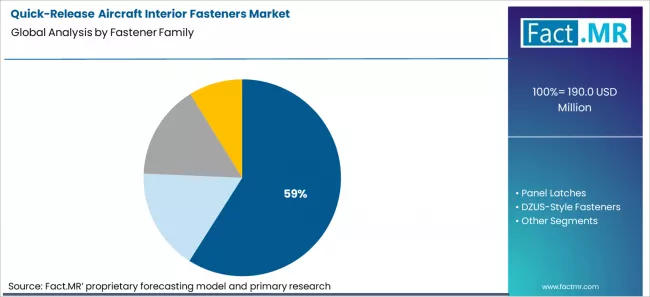
Quick Release Aircraft Interior Fasteners Market Analysis By Fastener Family | Source: Fact.MR
- Market Overview: Quarter-turn fasteners are expected to capture 59% of the quick-release aircraft interior fasteners market by 2026. Quarter-turn fasteners are widely used in aircraft interiors for securing panels, doors, and other components that require easy and quick removal. Their simple mechanism and reliable performance make them the preferred choice for interior applications.
- Demand Drivers:
- Ease of Maintenance and Serviceability: Quarter-turn fasteners are essential for the quick access and maintenance of aircraft interiors. The fastener's design allows for fast panel removal, making it easier for maintenance crews to service aircraft interiors, which is a key factor driving their demand.
- Regulatory and Safety Requirements: The use of quick-release fasteners is often a regulatory requirement in aerospace to ensure that interior panels can be quickly removed or replaced in emergencies, contributing to their widespread adoption.
- Aircraft Design Advancements: As aircraft designs evolve to improve interior efficiency and serviceability, the need for reliable, easy-to-use quick-release fasteners like quarter-turn fasteners increases, supporting their growth in the market.
Quick-Release Aircraft Interior Fasteners Market Analysis by End User
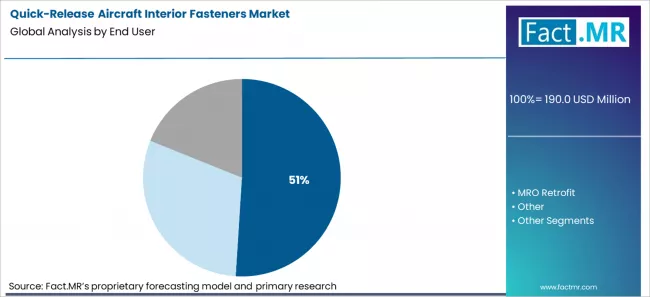
Quick Release Aircraft Interior Fasteners Market Analysis By End User | Source: Fact.MR
- Market Overview: OEM line-fit is projected to capture 51% of the market share by 2026. OEMs (Original Equipment Manufacturers) and tier suppliers are the primary consumers of quick-release fasteners, incorporating them into new aircraft during the production process to meet both regulatory and operational standards.
- Demand Drivers:
- Integration into New Aircraft Designs: OEM line-fit demand for quick-release fasteners is driven by the need to streamline the assembly process of new aircraft. These fasteners offer efficient assembly and meet regulatory requirements for easy access to aircraft interiors.
- Growing Aircraft Production: As global demand for both commercial and defense aircraft rises, the demand for fasteners in OEM line-fit applications increases. Quick-release fasteners are essential for ensuring that aircraft interiors meet both safety and operational efficiency standards.
- Customization for Aircraft Interiors: Manufacturers of aircraft interiors are increasingly integrating quick-release fasteners into their designs to meet specific needs for flexibility and accessibility, further boosting the demand in the OEM line-fit segment.
Quick Release Aircraft Interior Fasteners Market Drivers, Restraints, and Opportunities
FMR analysts observe that the quick‑release aircraft interior fasteners market is a mature, safety‑and‑efficiency‑focused segment anchored in the structural demands of modern aerospace interiors. Historically, conventional fasteners required time‑intensive installation and removal during cabin assembly and maintenance; as airline operational efficiency became paramount, quick‑release solutions emerged to reduce downtime while still meeting strict safety criteria. Estimated 2026 valuation reflects this balance between ongoing global fleet activity and the continuous need to improve serviceability and turnaround times in high‑utilization aircraft.
While basic threaded or permanent fasteners remain common in non‑service‑critical applications, quick‑release variants are gaining share where frequent access, reconfiguration, or maintenance occurs. These engineered fasteners command higher per‑unit prices, contributing to net market value growth even as overall unit volumes align with production and in‑service fleet work. The market exists at its current size because OEMs, MRO providers, and airlines prioritize both secure attachment and rapid removal in cabin systems, driven by operational efficiency and regulatory performance requirements.
- Maintenance Efficiency Demand: Airlines and MRO providers adopt quick‑release fasteners to speed cabin reconfiguration, inspection, and repair, replacing slower conventional hardware.
- Certification & Safety Standards: Aviation regulators like the FAA and EASA require interior fasteners to meet defined flammability, retention, and vibration criteria, pushing manufacturers toward certified quick‑release solutions.
- Regional Fleet Utilization Trends: In North America and Europe, high flight frequencies and rigorous service schedules drive stronger uptake of quick‑release interior fasteners compared with regions with lower fleet utilization intensity.
Regional Analysis
The market analysis covers key global regions, including South Asia and Pacific, East Asia, North America, Western Europe, and Germany. It is segmented geographically, with specific market dynamics for each region. The full report provides a detailed market attractiveness analysis.
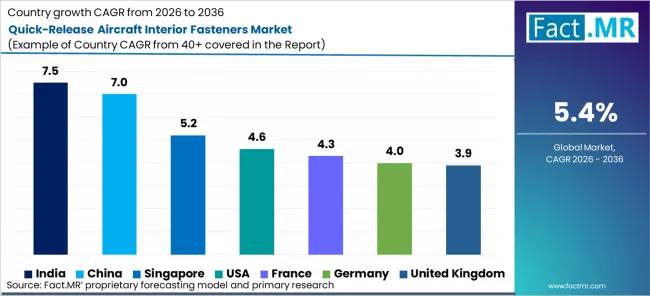
Quick Release Aircraft Interior Fasteners Market Cagr Analysis By Country | Source: Fact.MR
| Country | CAGR (2026-2036) |
|---|---|
| India | 7.5% |
| China | 7.0% |
| Singapore | 5.2% |
| USA | 4.6% |
| France | 4.3% |
| Germany | 4.0% |
| United Kingdom | 3.9% |
| Japan | 3.4% |
Source: Fact.MR analysis. Updated Feb 23, 2026
Source: Fact MR (FMR) analysis, based on proprietary forecasting model and primary research.
South Asia and Pacific:
South Asia and Pacific are "emerging markets" for quick-release aircraft interior fasteners, with significant growth driven by the growing aerospace industry in India and China.
- India: Demand for quick-release aircraft interior fasteners in India is projected to rise at 7.5% CAGR through 2036. India’s expanding aerospace and defense industry and growing domestic aircraft manufacturing contribute to significant market growth.
- China: Demand for quick-release aircraft interior fasteners in China is projected to rise at 7.0% CAGR through 2036. China’s large-scale aircraft production and focus on improving aircraft components continue to drive demand for quick-release fasteners.
East Asia:
East Asia remains a "key region" for quick-release fasteners due to rapid growth in the aerospace industry and demand for high-performance materials in commercial and military aircraft production.
- Singapore: Demand for quick-release aircraft interior fasteners in Singapore is projected to rise at 5.2% CAGR through 2036. Singapore’s growing aerospace manufacturing sector and focus on producing aircraft components fuel the demand for fasteners in the region.
- Japan: Demand for quick-release aircraft interior fasteners in Japan is projected to rise at 3.4% CAGR through 2036. Japan’s aerospace sector, with its emphasis on high-precision components, continues to support steady growth in fastener demand.
North America:
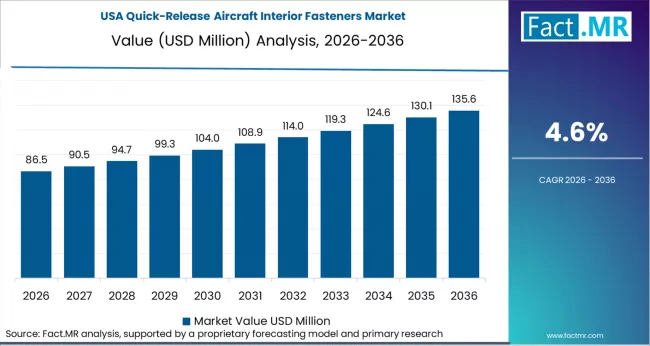
Quick Release Aircraft Interior Fasteners Market Country Value Analysis | Source: Fact.MR
North America, particularly the USA, continues to be a significant market for quick-release aircraft interior fasteners, driven by its large aerospace and defense sectors.
- USA: Demand for quick-release aircraft interior fasteners in the U.S. is projected to rise at 4.6% CAGR through 2036. The U.S. aerospace industry, with its major aircraft manufacturers and a growing demand for lightweight materials, continues to drive demand for quick-release fasteners.
Western Europe:
Western Europe, especially France, Germany, and the UK, represents a "mature market" for quick-release aircraft interior fasteners, driven by the region's advanced aerospace technologies and stringent standards.
- France: Demand for quick-release aircraft interior fasteners in France is projected to rise at 4.3% CAGR through 2036. France’s aerospace industry, especially in commercial aircraft manufacturing, contributes to the steady demand for high-performance fasteners.
- Germany: Demand for quick-release aircraft interior fasteners in Germany is projected to rise at 4.0% CAGR through 2036. Germany’s aerospace and defense sector and demand for efficient aircraft interior components continue to support market growth.
- United Kingdom: Demand for quick-release aircraft interior fasteners in the UK is projected to rise at 3.9% CAGR through 2036. The UK’s aerospace industry and growing demand for efficient interior components contribute to steady demand in the market.
Fact MR's analysis of the Quick-Release Aircraft Interior Fasteners Market in South Asia and Pacific, East Asia, North America, Western Europe, and Germany consists of country-wise assessments that include India, China, Singapore, the USA, France, Germany, the United Kingdom, and Japan. Readers can find detailed trends, regulatory updates, and company-specific investments shaping the market’s growth in these countries.
How Are Key Players Competing in the Quick-Release Aircraft Interior Fasteners Market?
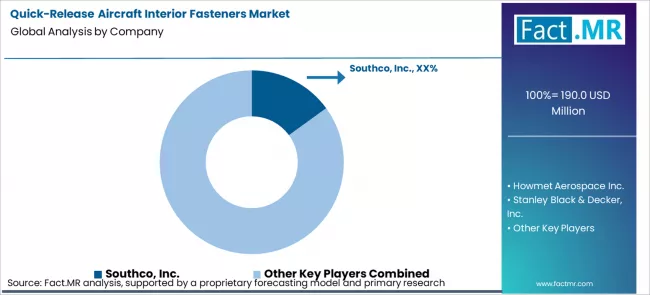
Quick Release Aircraft Interior Fasteners Market Analysis By Company | Source: Fact.MR
The quick-release aircraft interior fasteners market is marked by competition focused on providing lightweight, durable, and efficient fastening solutions. Southco, Inc. leads with advanced quick-release mechanisms for aircraft interiors, emphasizing ease of use and reliability. Howmet Aerospace Inc. and Stanley Black & Decker, Inc. offer high-strength, corrosion-resistant fasteners tailored to meet stringent aerospace standards. LISI S.A. and Wilhelm Böllhoff GmbH & Co. KG provide fasteners that are engineered for fast assembly and disassembly, crucial for aircraft maintenance. Monogram Aerospace Fasteners, Inc. and TriMas Corporation offer specialized quick-release fasteners to reduce time in aircraft assembly and repairs. Fairchild Fasteners and Incora (Incora Group) further strengthen their portfolios with products designed to improve operational efficiency and reduce downtime during maintenance, reinforcing their position in the fastener market.
Recent Industry Developments
- FAA (Federal Aviation Administration) | Airworthiness Directive (AD) 2026-01-21 | January 2026 The FAA issued a final rule requiring a visual inspection of the passenger service unit (PSU) trim panels on Pilatus PC-12 airplanes to ensure the presence of proper dual-lock fastener tapes, addressing an unsafe condition where emergency exit doors could not be opened from the inside.
- EASA (European Union Aviation Safety Agency) | Easy Access Rules Revision | August 2025 EASA updated its Easy Access Rules for Standardised European Rules of the Air (SERA), introducing new 2026 guidance for the certification of quick-release interior mechanisms in Manned VTOL (Vertical Take-off and Landing) aircraft to facilitate rapid emergency egress.
- NIST (National Institute of Standards and Technology) | Sustainable Metals Infrastructure | November 2025 NIST released technical benchmarks for 2026 that evaluate the performance of recycled aluminum and titanium alloys in high-cycle vibration environments, specifically targeting the durability of quarter-turn fasteners used in modular cabin panels.
Key Players of the Quick-Release Aircraft Interior Fasteners Market
- Southco, Inc.
- Howmet Aerospace Inc.
- Stanley Black & Decker, Inc.
- LISI S.A.
- Wilhelm Böllhoff GmbH & Co. KG
- Monogram Aerospace Fasteners, Inc.
- TriMas Corporation
- Fairchild Fasteners (Fairchild Fasteners Europe - TFI Aerospace Ltd.)
- Incora (Incora Group)
Report Scope
| Metric | Value |
|---|---|
| Quantitative Units | USD 190 million (2026) to USD 321 million (2036), at a CAGR of 5.4% |
| Market Definition | The Quick-Release Aircraft Interior Fasteners Market includes fasteners used in aircraft interiors that allow for quick and secure attachment, essential for various applications like cabin panels and seats. |
| By Fastener Family | Quarter-Turn Fasteners, Panel Latches, DZUS-Style Fasteners, Other |
| By Interior Application | Cabin Panels, Galleys & Lavatories, Seats & Monuments, Other |
| By End User | OEM Line-Fit, MRO Retrofit, Other |
| By Sales Channel | Direct to OEM/Tier, Distributors, MRO Supply, Other |
| Regions Covered | North America, Latin America, Europe, East Asia, South Asia, Oceania, Middle East and Africa |
| Countries Covered | United States, Canada, Mexico, Brazil, Argentina, Germany, France, United Kingdom, Italy, Spain, China, India, Japan, South Korea, Indonesia, Australia, and 40+ countries |
| Key Companies Profiled | Southco, Inc., Howmet Aerospace Inc., Stanley Black & Decker, Inc., LISI S.A., Wilhelm Böllhoff GmbH & Co. KG, Monogram Aerospace Fasteners, Inc., TriMas Corporation, Fairchild Fasteners (Fairchild Fasteners Europe - TFI Aerospace Ltd.), Incora (Incora Group) |
| Forecast Period | 2026 to 2036 |
| Approach | Hybrid top-down and bottom-up market modeling validated through primary interviews with manufacturers and supported by trade data benchmarking and market research. |
Source: Fact.MR analysis. Updated Feb 23, 2026
Bibliographies
- Federal Aviation Administration. (2026, January 21). Airworthiness directives; Pilatus Aircraft Ltd. Model PC-12 airplanes: Notice of proposed rulemaking. U.S. Department of Transportation.
- European Union Aviation Safety Agency. (2025, August). Easy Access Rules for Standardised European Rules of the Air (Revision introducing AMC/GM for manned VTOL-capable aircraft). European Union Aviation Safety Agency.
- European Union Aviation Safety Agency. (2025, December). Easy Access Rules for Air Operations (Revision 23). European Union Aviation Safety Agency.
- Southco, Inc.. (2025). Quick-release aerospace fasteners for aircraft interior and maintenance applications. Southco, Inc.
- Howmet Aerospace Inc.. (2025). Aerospace fastening systems and lightweight structural fasteners. Howmet Aerospace Inc.
- Stanley Black & Decker, Inc.. (2025). Aerospace fastening systems and engineered attachment solutions. Stanley Black & Decker, Inc.
- LISI Aerospace. (2025). Aircraft fastening systems for modular and maintenance-efficient designs. LISI Aerospace.
- TriMas Corporation. (2025). Precision-engineered aerospace fasteners for structural and interior applications. TriMas Corporation.
Segmentation
Quick-Release Aircraft Interior Fasteners Market Key Segments
-
By Fastener Family :
- Quarter-Turn Fasteners
- Panel Latches
- DZUS-Style Fasteners
- Other
-
By Interior Application :
- Cabin Panels
- Galleys & Lavatories
- Seats & Monuments
- Other
-
By End User :
- OEM Line-Fit
- MRO Retrofit
- Other
-
By Sales Channel :
- Direct to OEM/Tier
- Distributors
- MRO Supply
- Other
-
Region :
- North America
- USA
- Canada
- Mexico
- Europe
- Germany
- UK
- France
- Italy
- Spain
- Nordic Countries
- BENELUX
- Rest of Europe
- Asia Pacific
- China
- Japan
- South Korea
- India
- Australia
- Rest of Asia Pacific
- Latin America
- Brazil
- Argentina
- Rest of Latin America
- Middle East and Africa
- Kingdom of Saudi Arabia
- United Arab Emirates
- South Africa
- Rest of Middle East and Africa
- Other Regions
- Oceania
- Central Asia
- Other Markets
- North America
Frequently Asked Questions
How large is the demand for Quick-Release Aircraft Interior Fasteners in the global market in 2026?
What will be the market size of Quick-Release Aircraft Interior Fasteners in the global market by 2036?
What is the expected demand growth for Quick-Release Aircraft Interior Fasteners in the global market between 2026 and 2036?
Which fastener family is expected to dominate the market?
Which region is expected to show the highest growth rate for Quick-Release Aircraft Interior Fasteners?
How significant is the growth outlook for China in this market?
What is the growth outlook for the United States in this report?
What is the growth forecast for Singapore in the Quick-Release Aircraft Interior Fasteners market?
Which European market is highlighted in this analysis?
Which company is identified as a leading player in the Quick-Release Aircraft Interior Fasteners market?
What are Quick-Release Aircraft Interior Fasteners used for?
What does the Quick-Release Aircraft Interior Fasteners market include in this report?
How is the market forecast developed in this report?
What is meant by the Quick-Release Aircraft Interior Fasteners market in this report?
Who worked on this report


Preview the report firsthand - request a free sample
Free SampleGet the brochure for pricing and purchase details
Download PDF