- Market Value (2025): USD 2.5 Bn
- Estimated Value (2026): USD 2.8 Bn
- Forecast Value (2036): USD 8.2 Bn
- CAGR (2026-2036): 11.5%
What is the Airless Refill Dispensing Systems Market forecast to be worth by 2036?
USD 2.8 billion in 2026 to USD 8.2 billion by 2036 at an 11.5% CAGR.
- As per Fact.MR analysis, the airless refill dispensing systems market reached USD 2.5 billion in 2025.
- Demand is projected to increase from USD 2.8 billion in 2026 to USD 8.2 billion by 2036.
- The market is forecast to record an 11.5% CAGR from 2026 to 2036.
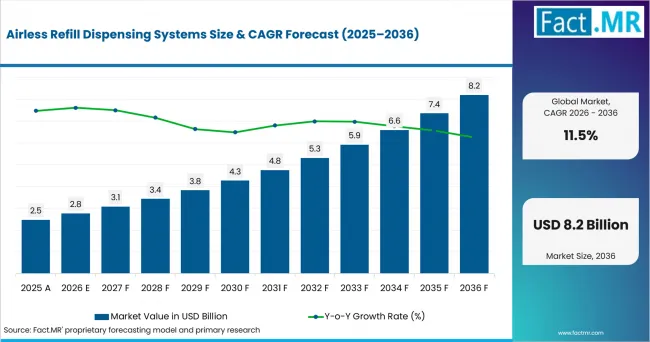
Airless Refill Dispensing Systems Value Analysis | Source: Fact.MR
What are the defining numbers behind Airless Refill Dispensing Systems Market growth?
An absolute opportunity of USD 5.4 billion is expected between 2026 and 2036.
- Demand Drivers in the Market
- Preference for refill packs among prestige skincare brand will increase owing to need to protect formulas from contamination.
- Serum brands need precise dosing because these products are usually used in small amounts. A controlled dispenser also makes them easier and cleaner to use.
- Packaging teams give more focus on to refill designs as European rules are more focused on reuse. In February 2025, the European Commission Regulation (EU) 2025/40 promotes refill and reuse.
- Key Segments Analyzed
- By System Type: Piston airless pump is expected to hold 31.0% share in 2026 because its familiar pump action gives controlled emptying of the product chamber.
- By Refill Model: Replaceable inner pouch is projected to account for 29.0% share in 2026 because brands keep the outer pack and replace a lighter inner reservoir.
- By Product: As per Fact.MR analysis, in 2026 the skin care segment holds 36.0% share as creams and treatments need protection and clean dispensing.
- By Dose: In 2026, the <0.2 mL captures 34.0% share because many eye products and serums need doses which are small and steady.
- Analyst Opinion at Fact.MR
- Principal Consultant, Shambhu Nath Jha at Fact.MR, states, “Refillable airless packs need to work on original pack. Brands also want each refill to give the right amount of product and keep it safe from contamination.”
- Strategic Implications
- Packaging teams need to test the product seals after many refill cycles and they have to set a clear limit on how many times each pack can be refilled.
- Packaging teams need to check the seals after final refills. They should also decide how many times each pack need to be safely refilled.
- Beauty brands should match the refill pack to the product’s thickness. This helps the pouch or cartridge are smoothly emptying via the airless system.
- Component suppliers should test refill with a complete pack. In October 2025, Aptar Beauty reported its Gaïa reloadable airless system for Clarins Total Eye Lift used a 15 mL format delivering a 150 µL dose.
- Contract fillers should confirm that refill components fit existing filling and assembly lines before a brand commits to a broad format conversion.
China is projected at 13.1% CAGR through 2036. The USA is forecast at 12.6% compare with Japan at 11.5%, France at 11.1%, and Germany at 10.5%.
How does the Airless Refill Dispensing Systems Market break down by segment?
Skin care leads at 36.0%; <0.2 mL leads at 34.0%.
Which System Type dominates?
Piston airless pump is expected to hold 31.0% share in 2026.
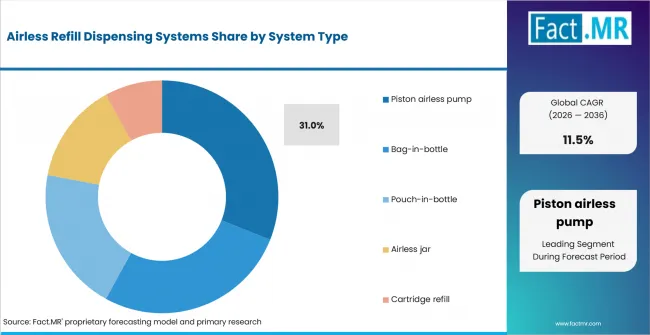
Airless Refill Dispensing Systems Analysis By System Type | Source: Fact.MR
Piston airless pumps pair a moving piston with a sealed product chamber, so the package can dispense while limiting air entry. The format suits creams and treatments that need steady emptying.
What leads the Refill Model segment?
In 2026, the replaceable inner pouch accounts for 29.0% share, as per Fact.MR analysis.
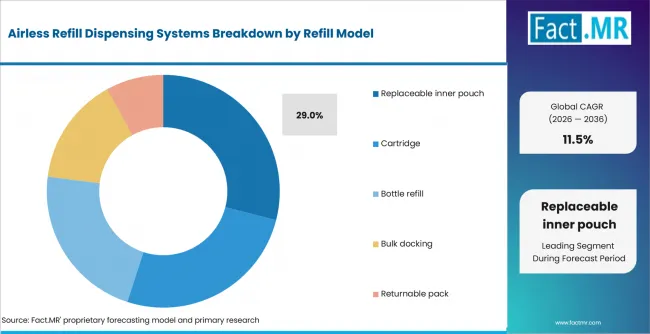
Airless Refill Dispensing Systems Analysis By Refill Model | Source: Fact.MR
A replaceable inner pouch keeps the outer pack and only change the pouch from inside. This reduces the amount of hard packaging thrown away with each new purchase. The same pump and outer pack can still be used.
How does Product shape demand?
Skin care is anticipated to capture 36.0% share in 2026.
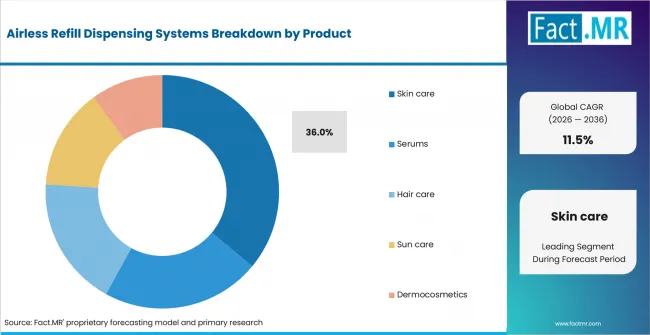
Airless Refill Dispensing Systems Analysis By Product | Source: Fact.MR
Skin care favors airless packaging because creams and treatment products often place a high value on controlled emptying and clean product contact. Serums increase the need for lower dosing and precise actuation.
What supports the <0.2 mL Dose segment?
By 2026, the <0.2 mL segment holds 34.0% share.
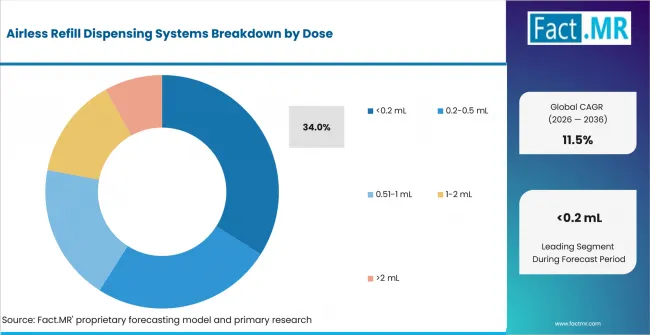
Airless Refill Dispensing Systems Analysis By Dose | Source: Fact.MR
Low-dose airless systems fit in all type skin-care products which applied to a small area or used in daily routines. Eye care application is the clear example because extra product can create waste.
What is accelerating Airless Refill Dispensing Systems Market adoption, and what is holding it back?
As per Fact.MR brands are moving to refill packs to keep products safe and reduce packaging. Problems with package leaks and refilling can slow down their use.
Drivers Impact Analysis
| DRIVER | (~) % IMPACT ON CAGR | GEOGRAPHIC RELEVANCE | IMPACT TIMELINE |
|---|---|---|---|
| Brand conversion to refillable skin-care systems | +1.7% | Global | Medium term (2-4 years) |
| EU reuse and refill policy direction | +1.3% | Europe | Medium term (2-4 years) |
| Precision dosing for concentrated formulas | +1.1% | Global | Short term (<= 2 years) |
| Airless protection for premium formulas | +0.9% | Global | Short term (<= 2 years) |
| Material reduction through replaceable reservoirs | +0.6% | Europe, East Asia, North America | Long term (>= 4 years) |
Source: Fact.MR analysis. Updated Oct 1, 2026
Opportunity Impact Analysis
| OPPORTUNITY | (~) % IMPACT ON CAGR | GEOGRAPHIC RELEVANCE | IMPACT TIMELINE |
|---|---|---|---|
| Standard refill cartridges across brand families | +1.2% | Global | Medium term (2-4 years) |
| Premium eye-care and serum dosing | +1.0% | North America, Europe, East Asia | Short term (<= 2 years) |
| Mono-material refill components | +0.8% | Europe | Medium term (2-4 years) |
| Smaller travel and treatment formats | +0.5% | Global | Long term (>= 4 years) |
Source: Fact.MR analysis. Updated Oct 1, 2026
Restraints Impact Analysis
| RESTRAINT | (~) % IMPACT ON CAGR | GEOGRAPHIC RELEVANCE | IMPACT TIMELINE |
|---|---|---|---|
| Seal failure after repeated reloads | -0.7% | Global | Short term (<= 2 years) |
| Higher component complexity than a single-use pump | -0.5% | Global | Medium term (2-4 years) |
| Consumer errors during refill insertion | -0.4% | Global | Short term (<= 2 years) |
| Material compatibility and recycling limits | -0.3% | Europe, North America, East Asia | Long term (>= 4 years) |
Source: Fact.MR analysis. Updated Oct 1, 2026
Which countries are scaling Airless Refill Dispensing Systems Market through 2036?
The country compares 2.6 percentage from 2026 to 2036.
- China remains 0.5 percentage point above the USA as cosmetics retail expands and local brands widen premium packaging options.
- The USA remains 1.1 percentage points above Japan as a large regulated product base supports demand for precision dispensing and refill conversions.
- Japan remains 0.4 percentage point above France through established skin-care routines and strong packaging quality expectations.
- France remains 0.6 percentage point above Germany as reuse policy and beauty-brand activity keep refill design visible in product development.
Comparable CAGRs can still produce different entry conditions. Refill use depends on regulation and infrastructure along with consumer routines.
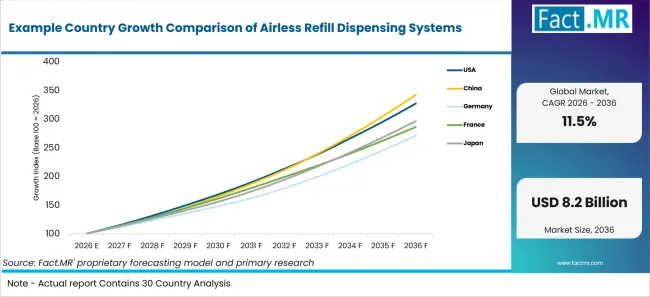
Example Country Growth Comparison Of Airless Refill Dispensing Systems | Source: Fact.MR
| Country | CAGR (2026-2036) |
|---|---|
| USA | 12.6% |
| China | 13.1% |
| Germany | 10.5% |
| France | 11.1% |
| Japan | 11.5% |
Source: Fact.MR analysis. Updated Oct 1, 2026
What supports USA adoption?
Demand will increase in the USA at 12.6% CAGR through 2036.
Sales of airless refill packs will grow in the USA as they are used for many skin care and treatment products. In September 2026, the U.S. FDA reported 16,398 active cosmetic facilities as of June 30, 2026. Premium beauty products need packs that limit the contamination.
How is China scaling demand?
13.1% CAGR, supported by cosmetics retail growth and premium skin-care formats.
Skin care brands in China regularly bring new products to the market. This activity is backed by strong cosmetics sales. In 2025, sales from larger cosmetics retailers reached 465.3 billion yuan, according to the National Bureau of Statistics.
What is supporting Germany’s adoption?
As per Fact.MR analysis the Germany CAGR is 10.5%, which support refill policy and packaging recovery.
German packaging designs focus on the packs easier to recycle and easily sort after use. In January 2026, the GEA reported around 5.5 million tonnes of packaging waste collected by dual systems which recycled in 2024. Beauty brands are use replaceable pouches and cartridges.
What supports France growth?
Demand will rise in the France at 11.1% CAGR from 2026 to 2036.
France gives refill design a clear role within its wider packaging reuse system. In September 2026, ADEME report 2.166 billion reused household packaging units’ record in 2024. French beauty brands use more refillable airless packs with a premium outer pack and a simple refill inside.
How does Japan perform?
11.5% CAGR, supported by precise package design and recycling systems.
Japan combines compact beauty formats with a detailed municipal packaging recovery system. In March 2026, the Ministry of the Environment reported in fiscal year 2024, 767,595 tonnes of plastic and packaging were collected. Small airless packs work well for serums and other treatments that are used in small amounts.
Who leads the Airless Refill Dispensing Systems Market?
For beauty products, AptarGroup produce airless and refillable packs. Its Gaïa refillable airless pack is used for Clarins Total Eye Lift. The pack keeps the product safe and gives the right amount during use. It is also easy to refill.
Quadpack reported in October 2025 that more than 50 Marini SkinSolutions products used its airless packs, tubes and jars. The Regula Airless Refill was also part of this packaging change. Quadpack tested more than 40 formulas at its Dallas lab to check if they worked well with the packs. Most of the packs were made and tested in North America.
Which companies are the key providers?
Key companies include AptarGroup; HCP Packaging; APG Packaging; Quadpack; Lumson; and Amcor.
- AptarGroup
- HCP Packaging
- APG Packaging
- Quadpack
- Lumson
- Amcor
Bibliography
- Directorate-General for Environment. (2025, February 11). New rules enter into force for a more sustainable and competitive packaging economy. European Commission.
- AptarGroup. (2025, October 6). Aptar Beauty and Clarins launch the new reloadable Total Eye Lift.
- U.S. Food and Drug Administration. (2026, September 9). FDA clarifies it does not provide certificates or other documents to verify compliance for cosmetic product facility registration.
- National Bureau of Statistics of China. (2026, January 20). Total retail sales of consumer goods in December 2025.
- German Environment Agency, & Central Agency Packaging Register. (2026, January 27). Facts against myths: Packaging waste recycling in Germany is working.
- Van de Voorde, J. (2026, September 17). Household packaging and graphic papers: Data 2024. ADEME.
- Quadpack. (2025, October 30). Marini SkinSolutions opts for North America-made packaging.
This Report Answers
- The report explains where airless refill dispensing systems are used across system type and refill model. It also covers product and dose requirements together with regional demand.
- Segment analysis identifies the leading subsegments and the packaging reasons brands select piston pumps, replaceable pouches, skin-care formats, and low-dose systems.
- Country analysis examines the USA, China, Germany, France, and Japan with country-specific drivers and restraints linked to cosmetics demand and packaging rules.
- Competitive analysis reviews current providers across airless dispensing, refill mechanisms, premium beauty packaging, and broader personal-care packaging capabilities.
- Application analysis assesses how formula protection, dose precision, refill handling, and material sorting influence package specification.
What does the Airless Refill Dispensing Systems Market cover?
Airless refill dispensing systems market covers refillable airless pumps, bottles, cartridges, and related dispensing formats. The report includes analysis based on packaging format, material, dispensing technology, end use, application, and region. Top demand drivers, emerging technologies, competitive developments, and market forecasts are also studied by our analysts. Fact.MR coverage includes refillable cleanser pumps, advanced preservative-free pumps, and refill-system-compatible packaging.
What is included in the scope?
The scope includes piston airless pumps, bag-in-bottle systems, pouch-in-bottle systems, airless jars and cartridge refills. Flexible-film PCR for personal-care packaging helps frame pouch materials used around refill systems. Transparent PCR resin in beauty packaging adds context for premium rigid components and recycled-content design.
Skin care, serums, hair care, sun care and dermocosmetics remain inside the product boundary. Clean beauty packaging prototypes provide context for refillable and reusable beauty concepts. Injection-moulding cosmetic packaging is relevant to molded pump bodies and outer shells. Zero-waste packaging adds context for refillable containers in cosmetics and personal care.
What is excluded from the scope?
The scope excludes conventional single-use pumps and jars, standalone refill pouches sold outside an airless dispensing platform, fragrance pumps outside airless formula protection, and industrial dispensers used beyond personal care.
Primary cosmetic containers enter the scope when they use a refillable airless design. Packaging materials, closures, actuators and decoration are covered when they form part of the airless refill system being evaluated.
How Was the Analysis Built?
The analysis draws on 120+ sources, 35+ company portfolios, 25+ countries, and more than 20 industry interviews.
- Primary Research: Primary research includes discussions with manufacturers, service providers, technology developers, distributors, end users, and subject-matter experts. These conversations examine purchasing priorities, product adoption, operational challenges, approval requirements, competitive positioning, and the factors that influence wider market acceptance.
- Desk Research: Desk research covers government statistics, regulatory publications, company filings, trade data, technical studies, industry associations, standards, public policy, and other authoritative sources. Every source used in the analysis is documented in the bibliography.
- Market Sizing and Forecasting: Market estimates combine historical performance, demand indicators, pricing and volume trends, segment shares, company participation, country-level growth, adoption patterns, investment activity, and barriers to market expansion.
- Data Validation and Update Cycle: Findings are validated by comparing primary interviews with public data, company activity, regulatory changes, trade patterns, and industry developments. Regular updates review new product launches, capacity changes, partnerships, approvals, and shifts in commercial adoption.
Segmentation
What is the report’s scope and coverage?
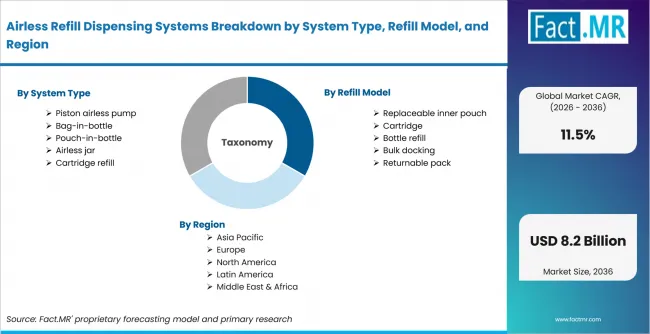
Airless Refill Dispensing Systems Breakdown By System Type, Refill Model, And Region | Source: Fact.MR
| Attribute | Details |
|---|---|
| Quantitative Units | USD billion |
| Market Definition | Refillable airless dispensing packages that protect and dispense personal-care formulas while allowing a replaceable pouch, cartridge, bottle refill, or other reservoir to be inserted into a reusable dispensing system. |
| System Type | Piston airless pump; Bag-in-bottle; Pouch-in-bottle; Airless jar; Cartridge refill |
| Refill Model | Replaceable inner pouch; Cartridge; Bottle refill; Bulk docking; Returnable pack |
| Product | Skin care; Serums; Hair care; Sun care; Dermocosmetics |
| Dose | <0.2 mL; 0.2–0.5 mL; 0.51–1 mL; 1–2 mL; >2 mL |
| Regions Covered | North America; Latin America; Western Europe; Eastern Europe; East Asia; South Asia & Pacific; Middle East & Africa |
| Countries Covered | USA; China; Germany; France; Japan |
| Key Companies Profiled | AptarGroup; HCP Packaging; APG Packaging; Quadpack; Lumson; Amcor |
| Forecast Period | 2026 to 2036 |
| Approach | Hybrid top-down and bottom-up approach using cosmetics demand, refill adoption, package architecture, dose requirements, company portfolios, country regulation, and primary-source validation. |
Source: Fact.MR analysis. Updated Oct 1, 2026
How is the market segmented?
-
By System Type:
- Piston airless pump
- Bag-in-bottle
- Pouch-in-bottle
- Airless jar
- Cartridge refill
-
By Refill Model:
- Replaceable inner pouch
- Cartridge
- Bottle refill
- Bulk docking
- Returnable pack
-
By Product:
- Skin care
- Serums
- Hair care
- Sun care
- Dermocosmetics
-
By Dose:
- <0.2 mL
- 0.2-0.5 mL
- 0.51-1 mL
- 1-2 mL
- >2 mL
-
By Region:
- North America
- Latin America
- Western Europe
- Eastern Europe
- East Asia
- South Asia & Pacific
- Middle East & Africa
Frequently Asked Questions
How big is the airless refill dispensing systems market in 2026?
What is the CAGR of the airless refill dispensing systems market from 2026 to 2036?
Which product leads the airless refill dispensing systems market?
Which dose range leads the airless refill dispensing systems market?
Who are the leading companies in the airless refill dispensing systems market?
Who worked on this report


Preview the report firsthand - request a free sample
Free SampleGet the brochure for pricing and purchase details
Download PDF