- Market Value (2025): USD 1.78 Bn
- Estimated Value (2026): USD 1.89 Bn
- Forecast Value (2036): USD 3.49 Bn
- CAGR (2026-2036): 6.3%
What is the Expanded Polystyrene (EPS) Recycling Market forecast to be worth by 2036?
USD 1.89 billion in 2026 to USD 3.49 billion by 2036, at a 6.3% CAGR.
- The expanded polystyrene recycling market was valued at USD 1.78 billion in 2025.
- Market value is projected to move from USD 1.89 billion in 2026 to USD 3.49 billion by 2036.
- A 6.3% CAGR is forecast from 2026 to 2036 as collection networks expand and recyclers recover more EPS for suitable applications.
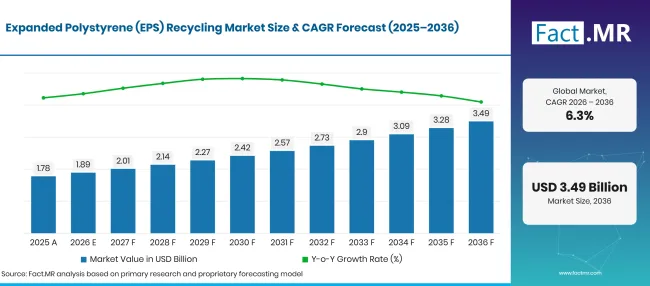
Expanded Polystyrene Eps Recycling Market Forecast Global | Source: Fact.MR
| Year | Basis | Market Value (USD billion) |
|---|---|---|
| 2025 | Actual | 1.78 |
| 2026 | Estimate | 1.89 |
| 2036 | Forecast | 3.49 |
| CAGR 2026 to 2036 | Forecast period | 6.3% |
Source: Fact.MR analysis. Updated Oct 31, 2026
What are the defining numbers behind Expanded Polystyrene (EPS) Recycling Market growth?
The market is projected to add USD 1.6 billion by 2036, with material recycling and packaging accounting for the leading segment shares.
- Demand Drivers in the Market
- Packaging converters seek clean recovered EPS that can return to polystyrene manufacturing. Eurostat reported on October 22, 2026, that 42.4% of EU plastic packaging waste generated in 2024 was recycled, compared with 41.6% in 2023 [10].
- Loose EPS occupies substantial space during transport, making collection costs a major issue for recycling businesses. Densifying the material closer to where it is discarded helps address that problem. BEWI reported collecting 38,444 tonnes of used EPS for recycling in 2025, up 16% from 2024 [1], illustrating how established collection routes can supply processing operations.
- Polystyrene producers also need a dependable source of recycled material with a known history. In June 2025, Agilyx announced an MOU with DerGrünePunkt to develop waste-polystyrene feedstock supplies for advanced recycling, initially targeting up to 20,000 tonnes per year as a planned volume [2].
- Insulation offcuts and protective packaging reach recyclers through different routes. Construction sites may generate concentrated volumes of clean offcuts, while demolition material can require additional sorting.
- Key Segments Analyzed
- By Recycling Process: Material Recycling accounts for 48.2% of the 2026 market and benefits from established densification and remelting steps for suitable EPS waste.
- By Application: Packaging represents 42.3% of the 2026 market because logistics and appliance distribution generate recoverable protective-foam streams.
- Analyst Opinion at Fact.MR
- Shambhu Nath Jha, Principal Consultant at Fact.MR, states, “EPS recyclers need clean material in enough volume to make collection economical. A useful question for future customer research is whether consistent supply agreements encourage packaging converters to trial recycled resin, while small and distant waste generators face higher transport costs.”
- Strategic Implications
- EPS recyclers should locate compaction equipment near distribution centers and production sites where waste can be segregated at source.
- Packaging converters should agree in advance on acceptable contamination levels and performance requirements for recycled grades.
- Before investing in chemical recycling capacity, operators should secure reliable feedstock agreements and assess how much of the incoming material can be processed into the intended output.
- Local authorities should assess EPS collection separately from mixed-plastic waste so that transport, sorting and processing costs can be compared accurately.
Germany is forecast to lead the five-country outlook at 7.1% CAGR through 2036, followed by Brazil at 6.5%, the UK at 6.1%, the USA at 5.8% and Japan at 5.0%. Differences in collection infrastructure, transport costs and processing routes shape these country forecasts.
How does the Expanded Polystyrene (EPS) Recycling Market break down by segment?
Material Recycling holds 48.2% of Recycling Process; Packaging contributes 42.3% of Application in 2026.
Which Recycling Process dominates?
Material Recycling accounts for 48.2% of 2026 value.
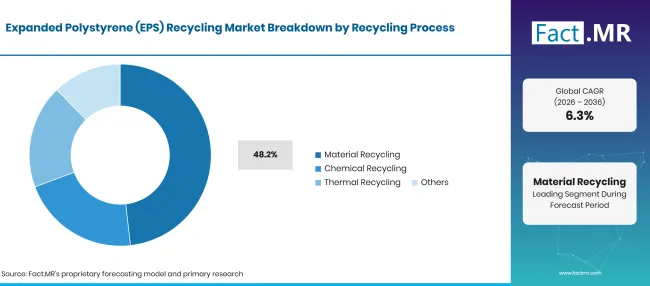
Expanded Polystyrene Eps Recycling Market Breakdown Recycling Process | Source: Fact.MR
| Recycling Process | Share (2026) |
|---|---|
| Material Recycling (Leading segment) | 48.2% |
| Other processes combined | 51.8% |
| Total | 100.0% |
Source: Fact.MR analysis. Updated Oct 31, 2026
Material recycling starts with separation and volume reduction. Clean EPS can be compacted and extruded into recycled polystyrene pellets for suitable subsequent products. Chemical recycling takes a different route by breaking down polystyrene into feedstock, while thermal recycling recovers energy from material that is unsuitable for material recovery. The commercial choice depends on waste quality and local plant access.
How does Application shape EPS recycling demand?
Packaging leads with 42.3% of the 2026 application value.
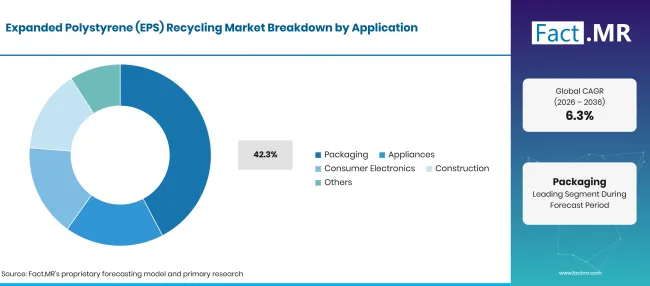
Expanded Polystyrene Eps Recycling Market Breakdown Application | Source: Fact.MR
| Application | Share (2026) |
|---|---|
| Packaging (Leading segment) | 42.3% |
| Other applications combined | 57.7% |
| Total | 100.0% |
Source: Fact.MR analysis. Updated Oct 31, 2026
Packaging waste arrives through logistics warehouses and appliance distributors, which makes repeat pickup agreements possible. Some loads consist of clean molded corner protectors or transport inserts that require limited preparation. Appliance housings and consumer electronics include other polymer types, so recyclers must identify the material before processing. Construction insulation offers larger pieces but often has longer service lives and more demanding collection conditions.
What is accelerating Expanded Polystyrene (EPS) Recycling Market adoption, and what is holding it back?
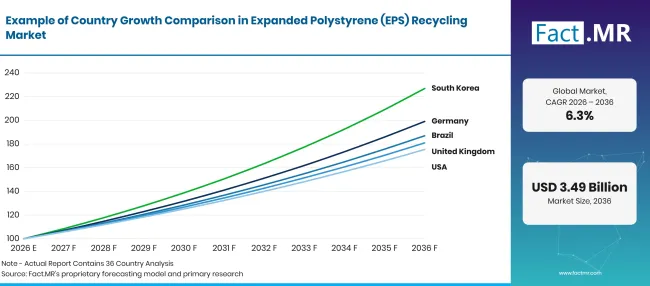
Expanded Polystyrene Eps Recycling Market Growth Index | Source: Fact.MR
| Country | CAGR (2026 to 2036) |
|---|---|
| Germany | 7.1% |
| Brazil | 6.5% |
| UK | 6.1% |
| USA | 5.8% |
| Japan | 5.0% |
Source: Fact.MR analysis. Updated Oct 31, 2026
What supports EPS recycling in Germany?
7.1% CAGR, supported by organized packaging recovery and polymer processing.
Germany has established collection and processing arrangements for packaging plastics. In its April 2025 review, the Federal Environment Agency reported material recycling of nearly 38% of collected plastics waste in 2023 [3]. Sorted EPS streams can use this broader infrastructure when collection rules recognize the material. The Federal Environment Agency reported in March 2026 that German packaging waste reached 17.9 million tonnes in 2023 [4]. Packaging suppliers can recover clean transport inserts from warehouses and business customers before they enter municipal mixed waste.
What supports EPS recycling in Brazil?
6.5% CAGR, linked to packaging collection and evolving recycled-content rules.
Brazil’s 2025 plastic-packaging reverse-logistics decree sets a national recovery target of 32% for 2026 [5]. EPS recyclers can use the policy direction to discuss collection systems with distributors, subject to the decree’s applicable packaging rules. The same official decree sets a national recycled-content target of 22% for plastic packaging in 2026. EPS packaging manufacturers need to check product-level eligibility and technical suitability before treating recovered material as an input. Decree No. 12,688/2025 sets Brazil’s plastic-packaging recovery target at 37% for 2030 and 40% for 2032. Its separate minimum recycled-content target is 30% for 2030.
How is EPS recycling developing in the UK?
6.1% CAGR, shaped by packaging recovery and recycled-content purchasing.
Defra reported that approximately 1.207 million tonnes of plastic packaging waste were recycled out of 2.108 million tonnes generated in 2025, giving a provisional recycling rate of 57.3% [6]. HM Revenue & Customs reported 1.506 million tonnes of plastic packaging declared as containing at least 30% recycled plastic in 2025/26 [7]. This covers all qualifying plastic packaging, not recycled EPS alone. Contamination from labels or mixed packaging makes incoming material less consistent. Defra reported 2,108 thousand tonnes of plastic packaging waste arising in the UK in 2025.
What supports EPS recycling in the USA?
5.8% CAGR, linked to commercial packaging collection networks.
Commercial EPS generators such as appliance distributors are useful starting points for recovering relatively clean foam. Collection schedules can be coordinated with routine deliveries. Companies that install compactors at regional warehouses can reduce bulk transport needs. Recyclers must still demonstrate stable pellet properties to converters. Polystyrene recovery from protective inserts is more straightforward where the waste generator keeps EPS separate from other foam materials.
How is Japan developing EPS recycling?
5.0% CAGR, supported by established EPS sorting practices.
The Japan Expanded Polystyrene Association describes EPS recovery through material and other utilization routes [8]. An exact 2025 effective-utilization percentage requires confirmation against the association’s original statistics. This includes recovery routes beyond material recycling, so it should not be read as an EPS material-recycling rate. Japan’s Ministry of the Environment reported 7.38 million tonnes of municipal waste recycled in fiscal 2024, representing a 19.3% recycling rate across municipal waste as a whole [9]. Japan’s Ministry of the Environment recorded a 19.3% municipal waste recycling rate for fiscal 2024.
Who leads the Expanded Polystyrene (EPS) Recycling Market?
BEWI directly collects and recycles EPS, while Agilyx develops feedstock arrangements for polystyrene recovery. Epsilyte reports activity involving post-consumer EPS, and Knauf Industries produces EPS packaging.
BASF and TotalEnergies participate in the broader circular-polymer supply chain, although their activities should be distinguished from direct collection and processing of EPS waste.
Ravago Group distributes and compounds polymers, including recycled products. Styropek is an EPS producer, and its role should be understood in the EPS supply chain rather than assumed to be an operator of every recycling stage. RAJ EPS Recycling Solutions is identified in the competitive universe, although its current operating scope requires separate confirmation before attributing a specific capacity or facility.
Which companies are the key providers?
Key companies include Agilyx ASA, BEWI, Ravago Group, Styropek, TotalEnergies, Epsilyte LLC, Knauf Industries, BASF SE, and RAJ EPS Recycling Solutions (Raj Polymers Group).
- Agilyx ASA
- BEWI
- Ravago Group
- Styropek
- TotalEnergies
- Epsilyte LLC
- Knauf Industries
- BASF SE
- RAJ EPS Recycling Solutions (Raj Polymers Group)
Bibliography
- [1] BEWI. (2026, March 26). Annual report 2025.
- [2] Agilyx. (2025, June 10). Agilyx ASA and DerGrunePunkt GmbH sign MOU for sourcing of waste polystyrene feedstock for advanced recycling.
- [3] Umweltbundesamt. (2025, April 30). Kunststoffabfälle.
- [4] Umweltbundesamt. (2026, March 5). Verpackungsabfälle.
- [5] Presidência da República. (2025, October 21). Decreto nº 12.688, de 21 de outubro de 2025
- [6] Department for Environment, Food & Rural Affairs. (2026, September 23). UK statistics on waste.
- [7] HM Revenue & Customs. (2026, August 27). Plastic Packaging Tax (PPT) statistics commentary.
- [8] Japan Expanded Polystyrene Association. (2026, August 26).[What is expanded polystyrene? Characteristics, uses, and recycling].
- [9] Ministry of the Environment, Japan. (2026, March 27). Municipal solid waste generation and disposal in FY2024.
- [10] Eurostat. (2026, October 22). Plastic packaging waste in the EU: 35.9 kg per person.
This Report Answers
- How EPS collection costs change between packaging and construction waste streams.
- Why material recovery and chemical recycling require different incoming feedstock conditions.
- How recycled polystyrene competes with virgin resin in converters’ purchasing decisions.
- What distinguishes EPS-specific evidence from recycling statistics for all plastics.
- How regional sorting networks influence commercial recovery of low-density EPS.
What does the Expanded Polystyrene (EPS) Recycling Market cover?
The market covers services and processing connected with recovering discarded EPS from packaging and other applications. Material recycling converts suitable foam into reusable polymer. Chemical recycling converts polystyrene to feedstock, while thermal routes are tracked separately in the process classification. Coverage follows the value of recovery activities rather than the full value of new virgin EPS products.
What is included in the scope?
Collection and densification linked to EPS recovery are included where they form part of the recycling service.
Suitable packaging inserts, appliance protection foam and construction offcuts are counted when processed through an eligible recovery route. Recycled resin obtained from EPS waste falls within the analysis where its value belongs to the recycling activity.
What is excluded from the scope?
Virgin EPS production and the sale of new EPS products fall outside this market.
Other polymers are excluded unless their separation is necessary to process the EPS waste stream. Standalone municipal waste handling unrelated to EPS recovery is also outside the market boundary.
How Was the Analysis Built?
The analysis draws on 120+ sources, 35+ company portfolios, 25+ countries, and more than 20 industry interviews.
- Primary Research: Primary research includes discussions with manufacturers, service providers, technology developers, distributors, end users, and subject-matter experts. These conversations examine purchasing priorities, product adoption, operational challenges, approval requirements, competitive positioning, and the factors that influence wider market acceptance.
- Desk Research: Desk research covers government statistics, regulatory publications, company filings, trade data, technical studies, industry associations, standards, public policy, and other authoritative sources. Every source used in the analysis is documented in the bibliography.
- Market Sizing and Forecasting: Market estimates combine historical performance, demand indicators, pricing and volume trends, segment shares, company participation, country-level growth, adoption patterns, investment activity, and barriers to market expansion.
- Data Validation and Update Cycle: Findings are validated by comparing primary interviews with public data, company activity, regulatory changes, trade patterns, and industry developments. Regular updates review new product launches, capacity changes, partnerships, approvals, and shifts in commercial adoption.
Segmentation
What is the report’s scope and coverage?
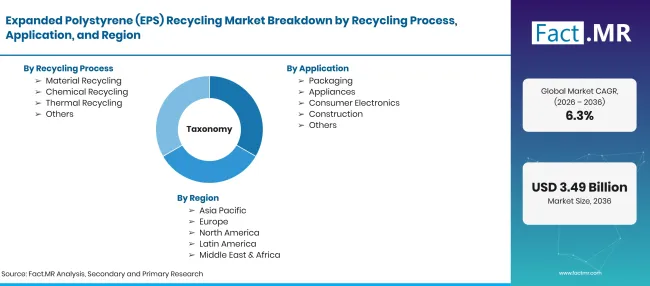
Expanded Polystyrene Eps Recycling Market Taxonomy | Source: Fact.MR
| Attribute | Details |
|---|---|
| Quantitative Units | USD billion |
| Market Definition | Services and processing activities involved in recovering discarded expanded polystyrene from packaging and other applications through material, chemical, thermal and related recycling routes. |
| Recycling Process | Material Recycling; Chemical Recycling; Thermal Recycling; Others |
| Application | Packaging; Appliances; Consumer Electronics; Construction; Others |
| Regions Covered | North America; Latin America; Western Europe; Eastern Europe; East Asia; South Asia & Pacific; Middle East & Africa |
| Countries Covered | Germany; Brazil; UK; USA; Japan |
| Companies Profiled | Agilyx ASA; BEWI; Ravago Group; Styropek; TotalEnergies; Epsilyte LLC; Knauf Industries; BASF SE; RAJ EPS Recycling Solutions (Raj Polymers Group) |
| Forecast Period | 2026 to 2036 |
| Approach | Assessment of EPS collection, densification, recycling routes, feedstock quality, transport economics, application-level recovery streams and supplier participation across major regional markets. |
Source: Fact.MR analysis. Updated Oct 31, 2026
How is the market segmented?
-
By Recycling Process
- Material Recycling
- Chemical Recycling
- Thermal Recycling
- Others
-
By Application
- Packaging
- Appliances
- Consumer Electronics
- Construction
- Others
-
By Region
- North America
- Latin America
- Western Europe
- Eastern Europe
- East Asia
- South Asia & Pacific
- Middle East & Africa
Frequently Asked Questions
How big is the Expanded Polystyrene (EPS) Recycling Market in 2026?
What is the CAGR of the Expanded Polystyrene (EPS) Recycling Market from 2026 to 2036?
Which recycling process leads the Expanded Polystyrene (EPS) Recycling Market?
Which application leads the Expanded Polystyrene (EPS) Recycling Market?
Who are the leading companies in the Expanded Polystyrene (EPS) Recycling Market?
Who worked on this report


Preview the report firsthand - request a free sample
Free SampleGet the brochure for pricing and purchase details
Download PDF