- Base Value(2025): 37.30 Bn
- Estimated Value(2026): 38.98 Bn
- Forecast Value (2036): 60.53 Bn
- CAGR (2026 - 2036): 4.50%
All Weather Tire Market Size, Market Forecast and Outlook By Fact.MR
The all weather tire market was valued at USD 37.30 billion in 2025, projected to reach USD 38.98 billion in 2026, and is forecast to expand to USD 60.53 billion by 2036 at a 4.50% CAGR. Provincial winter tire mandates in Canada and expanding seasonal tire requirements in European markets are driving adoption of 3PMSF-certified all weather tires that satisfy legal winter driving requirements without the cost and inconvenience of biannual seasonal tire changeovers. Consumers in temperate climates with occasional winter conditions increasingly view all weather tires as a practical single-purchase alternative to maintaining separate summer and winter tire sets.
The absolute dollar opportunity between 2026 and 2036 amounts to approximately USD 21.55 billion. Growth is steady, reflecting a consumer convenience trend rather than a regulatory mandate applicable to all markets. The aftermarket channel dominates because all weather tire adoption is primarily a consumer-driven replacement decision rather than an OEM standard fitment specification. As per Fact.MR analysis, the passenger car segment leads because individual consumers bear the seasonal changeover cost and storage burden that all weather tires eliminate, while commercial fleet operators often maintain dedicated seasonal tire inventories managed through bulk procurement contracts that reduce the convenience advantage.
India leads with a 6.8% CAGR as the domestic tire market expands with vehicle parc growth. China follows at 6.2%. Canada registers 5.5%, driven by provincial winter tire mandates that accept 3PMSF-certified all weather tires as compliant alternatives. USA advances at 4.2%. UK tracks at 4.0%. Germany maintains 3.8%, and Japan at 3.5%.

All Weather Tire Market Market Value Analysis | Source: Fact.MR
All Weather Tire Market Key Takeaways
| Metric | Details |
|---|---|
| Industry Size (2026) | USD 38.98 billion |
| Industry Value (2036) | USD 60.53 billion |
| CAGR (2026 to 2036) | 4.50% |
Source: Fact.MR analysis. Updated Mar 23, 2026
All Weather Tire Market Definition
All weather tires are year-round pneumatic tire products engineered with compound formulations and tread designs that maintain acceptable traction performance across dry, wet, light snow, and cold temperature conditions without requiring seasonal changeover between dedicated summer and winter tire sets. These products carry the three-peak mountain snowflake (3PMSF) certification alongside the M+S marking, confirming minimum winter traction capability.
All Weather Tire Market Inclusions
The report covers all weather tires for passenger cars, light commercial vehicles, heavy commercial vehicles, and other vehicle categories. Distribution channel segmentation spans aftermarket replacement and OEM fitment. Market sizing covers global and regional data across 40 plus countries for 2026 to 2036.
All Weather Tire Market Exclusions
Dedicated summer-only tires, dedicated winter/studded tires, off-road and mud-terrain tires, and racing slick tires are excluded. Tire retreading services, wheel rim manufacturing, and tire pressure monitoring system electronics fall outside the analytical scope.
All Weather Tire Market Research Methodology
- Primary Research: Analysts engaged with procurement directors, product engineers, and operations leads across the all weather tire value chain to map adoption triggers and specification thresholds.
- Desk Research: Data collection aggregated regulatory filings, standards ratification records, trade body publications, and corporate annual reports from allowed source categories.
- Market-Sizing and Forecasting: Baseline values derive from a hybrid top-down and bottom-up aggregation, applying region-specific adoption curves to project demand velocity through 2036.
- Data Validation and Update Cycle: Projections undergo cross-validation against publicly reported financial guidance, regulatory compliance databases, and independent industry association benchmarks.
Summary of All Weather Tire Market
- All Weather Tire Market Definition
- All weather tires are 3PMSF-certified, year-round pneumatic tires engineered to provide acceptable performance across dry, wet, and light snow conditions, eliminating the requirement for seasonal tire changeovers in temperate and moderate winter climates.
- Demand Drivers in the Market
- Provincial winter tire mandates in Canada that accept 3PMSF-certified all weather tires as compliant alternatives drive adoption among consumers seeking to avoid biannual seasonal changeover costs and separate tire storage requirements.
- Expanding consumer awareness in temperate European and North American markets that all weather tires deliver adequate winter traction without the expense and inconvenience of maintaining dedicated summer and winter tire sets.
- Vehicle parc growth in India and China, where seasonal tire segmentation is minimal and year-round versatile tire performance is the default consumer expectation, generates baseline demand growth aligned with new vehicle registrations.
- Key Segments Analyzed in the Fact.MR Report
- Passenger Cars: 63.4% share in 2026, reflecting the dominant configuration within the vehicle type category across global markets.
- Aftermarket: 74.9% share in 2026, as the leading sub-segment within distribution channel segmentation.
- India: 6.8% compound growth, representing the fastest-expanding national market within the forecast period.
- Analyst Opinion at Fact.MR
- The all weather tire market occupies a growing niche between dedicated summer and winter tire categories, driven primarily by consumer convenience economics rather than performance optimization. Buyers in temperate climates where winter conditions are moderate but legally regulated find all weather tires attractive because they satisfy 3PMSF compliance requirements while eliminating changeover labor, storage, and duplicate tire inventory costs. Tire manufacturers must manage the positioning carefully: premium all weather products compete with entry-level dedicated winter tires on compliance grounds and with premium summer tires on dry performance, creating a dual-front competitive dynamic. The aftermarket channel dominance reflects the consumer-initiated nature of this purchase decision, as OEMs rarely specify all weather tires as standard fitment due to the performance compromises relative to dedicated seasonal products. Nokian Tyres holds a structural early-mover advantage in the all weather category, but major manufacturers including Michelin, Continental, and Goodyear are expanding their all weather portfolios to capture this growing segment.
- Strategic Implications / Executive Takeaways
- Tire manufacturers must develop all weather product lines with verified 3PMSF certification to capture demand in Canadian provinces and European markets where winter tire mandates create a compliance-driven purchase trigger for year-round alternatives.
- Aftermarket distributors should position all weather tires as a convenience and cost-saving solution for consumers in temperate climates, emphasizing total ownership cost comparisons against maintaining separate seasonal tire sets.
- OEM product planners should evaluate all weather tire fitment as a standard or optional specification on vehicles sold in markets with winter tire mandates to simplify the customer purchase experience and reduce dealer seasonal tire inventory complexity.
Imperatives for Stakeholders in All Weather Tire Market
Design for year-round versatility, not just seasonal performance
- Offer complete mobility solutions: advanced compound technology + optimized tread patterns + severe weather certification + performance testing documentation + installation service networks.
- Preconfigured vehicle profiles: passenger car specifications, light commercial configurations, fleet management packages, and performance optimization for diverse driving requirements.
Certification readiness for regulatory compliance
- Real-time performance validation systems, severe weather certification documentation, and quality assurance protocols (three-peak mountain snowflake certification, wet grip ratings, rolling resistance standards).
Affordability-by-design approach
- Cost-optimized compound formulations, extended tread life engineering, flexible sizing options, and transparent total cost of ownership documentation.
Distribution network-focused market penetration
- Clear retailer partner networks + established training programs (installation support, consumer education, product positioning); direct customer engagement for brand development and technical knowledge transfer.
Segmental Analysis
The market segments by vehicle type into passenger cars, light commercial vehicles, heavy commercial vehicles, and others, representing the evolution from traditional passenger mobility toward comprehensive fleet solutions for commercial operations, logistics optimization, and diverse transportation requirements. The distribution channel segmentation divides the market into aftermarket (74.9%) and OEM channels, reflecting distinct purchase priorities for replacement tire autonomy and retailer selection flexibility versus factory-installed convenience and new vehicle integration applications.
The segmentation structure reveals all weather tire evolution from basic seasonal alternatives toward sophisticated year-round performance platforms with enhanced safety characteristics and certified weather capabilities, while distribution diversity spans from independent aftermarket retailers to automotive manufacturer partnerships requiring specialized supply protocols.
What Makes Passenger Cars Command the Largest Share in the All Weather Tire Market?
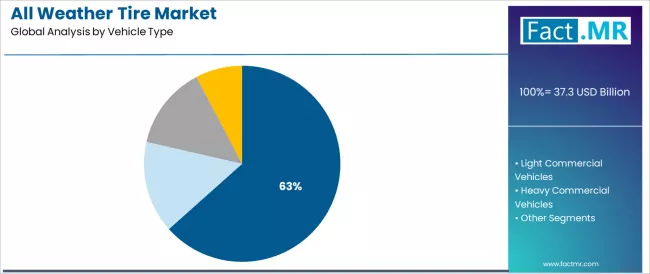
All Weather Tire Market Analysis By Vehicle Type | Source: Fact.MR
Passenger cars command the leading position in the all weather tire market with a 63.4% market share through essential urban commuter requirements, including optimized year-round performance, balanced traction characteristics, and versatile weather adaptation that enable drivers to achieve consistent safety across varied climate conditions and road surface applications.
The segment benefits from growing urban vehicle ownership for continuous mobility requirements, elimination of seasonal tire switching costs, and consumer convenience preferences without requiring dedicated winter tire storage investments. Advanced compound technology enables wet and dry performance optimization, snow traction capability, and integration with existing vehicle platforms, where convenience and cost-effectiveness represent critical consumer priorities. Sedan and SUV configurations hold significant share within the passenger car segment, appealing to family-oriented consumers seeking year-round tire solutions for diverse driving conditions.
Passenger car tire products differentiate through proven performance records, severe weather certifications, and integration with consumer mobility frameworks that enhance driving confidence while maintaining optimal convenience standards for diverse climate applications.
Key market characteristics:
- Advanced compound technology with optimized silica content and polymer formulations for temperature versatility
- Superior tread pattern design, enabling validated performance processes with predictable wet, dry, and snow traction
- Certification documentation support, including three-peak mountain snowflake symbols, EU tire labels, and performance testing data for consumer confidence
Why does the Aftermarket Represent the Dominant Distribution Channel?
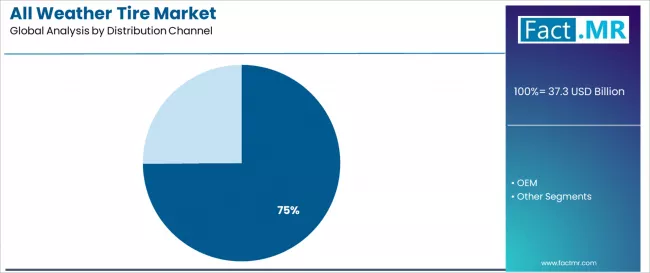
All Weather Tire Market Analysis By Distribution Channel | Source: Fact.MR
Aftermarket channels maintain leading market position with a 74.9% share due to their replacement tire accessibility and consumer purchase flexibility characteristics. These channels appeal to vehicle owners and fleet operators seeking tire selection autonomy with brand comparison opportunities, offering established retailer networks and competitive pricing advantages through independent tire dealers and automotive service centers. Market dominance is driven by replacement cycle economics, emphasizing consumer control over tire specifications and purchasing timeline flexibility through proven distribution infrastructure and competitive market dynamics.
How does OEM Distribution Shape Factory Integration in All Weather Tires?
OEM distribution channels demonstrate fastest growth momentum in the all weather tire market due to increasing factory installation and established focus on new vehicle convenience, year-round readiness positioning, and manufacturer partnerships that maximize consumer value perception while meeting automaker quality standards.
Automotive manufacturers prioritize all weather tire specifications for vehicle delivery preparation, warranty program integration, and alignment with established consumer convenience expectations that enables coordinated vehicle purchase experiences across diverse geographic markets.
The segment benefits from substantial new vehicle production volumes and automaker sustainability initiatives that emphasize all-season tire platforms for reduced consumer maintenance complexity and enhanced vehicle value propositions. Premium vehicle segments capture growing share within OEM channels, demonstrating automaker preference for factory-installed convenience systems.
New vehicle platform development incorporates all weather tire specifications as standard equipment considerations for year-round capability, while increasing consumer convenience demands enhanced factory-installed solutions that support immediate usability and eliminate seasonal tire management requirements.
What Drives Light Commercial Vehicle Adoption in Fleet Operations?
Light commercial vehicles capture substantial vehicle type share through comprehensive requirements in last-mile delivery operations, service fleet management, and urban logistics optimization. These vehicles demand reliable year-round tire performance capable of supporting commercial load requirements while providing effective weather versatility and minimal seasonal maintenance complexity, appealing to e-commerce logistics providers and service businesses seeking operational efficiency advantages.
What Establishes Mixed Climate Markets' Leadership in All Weather Tire Adoption?
Mixed climate markets establish geographic leadership in the all weather tire sector with substantial adoption rates due to comprehensive year-round weather variability and sustained focus on seasonal flexibility elimination, convenience optimization, and cost-effective tire management that maximize vehicle usability while maintaining safety attribute standards.
Vehicle owners and fleet operators prioritize versatile tire solutions, certified winter performance, and integration with established vehicle maintenance frameworks that enables coordinated mobility experiences across variable weather conditions. The sector benefits from substantial regulatory acceptance momentum and winter tire alternative recognition that emphasizes all weather tire platforms for commercial and personal vehicle applications.
Climate variability advancement incorporates all weather tires as standard mobility solutions for year-round safety, while increasing convenience preferences demand enhanced tire capabilities that meet winter traction requirements and eliminate seasonal tire storage challenges.
Market dynamics include:
- Strong growth in urban markets requiring convenient year-round solutions
- Increasing adoption in fleet operations for simplified tire management
- Rising integration with vehicle ownership programs for enhanced consumer value
How are Commercial Vehicle Applications Advancing Fleet Requirements?
Heavy commercial vehicle applications capture moderate vehicle type share through established logistics frameworks, long-haul transportation systems, and fleet optimization infrastructure. The segment demonstrates critical operational importance across commercial markets, with all weather tire platforms for trucks gaining traction in variable climate routes while operational efficiency pathways drive continued technology adoption requiring careful balance between load capacity and year-round versatility.
Why are Independent Retailers Positioned as Leading Aftermarket Distributors?
Independent tire retailers hold substantial aftermarket share with distinct distribution characteristics through replacement tire sales, consumer service operations, and brand selection diversity. Organizations including tire specialty chains demonstrate integrated all weather tire inventory requirements and competitive pricing expectations, while consumer service diversity creates opportunities for tire manufacturers seeking aftermarket channels with high turnover rates and established customer relationship volumes.
What are the Drivers, Restraints, and Key Trends of the All Weather Tire Market?
| Category | Factor | Impact | Why It Matters |
|---|---|---|---|
| Driver | Urban vehicle ownership growth & commuter mobility (passenger car expansion, infrastructure development) | ★★★★★ | Rising vehicle populations enable all weather tire demand for year-round solutions; urbanization drives technology adoption across passenger vehicle segments and fleet operations. |
| Driver | Consumer convenience preference & seasonal tire elimination (storage avoidance, cost reduction) | ★★★★★ | Drives demand for versatile tire solutions and year-round performance capabilities; manufacturers providing certified all-season performance gain competitive advantage in convenience-focused consumer segments. |
| Driver | E-commerce logistics growth & last-mile delivery expansion (LCV fleets, service vehicles) | ★★★★☆ | Fleet operators demand year-round operational reliability and reduced maintenance complexity; commercial growth expanding addressable segments beyond passenger vehicles and traditional seasonal approaches. |
| Restraint | Performance trade-off perceptions & dedicated tire preferences (winter specialists, summer optimization) | ★★★★☆ | Consumers face compromise concerns between all weather versatility and dedicated tire performance; affects premium segment penetration and specialized driving application adoption. |
| Restraint | Price premium challenges & cost-conscious markets (budget tire competition, economic sensitivity) | ★★★☆☆ | All weather tire suppliers face pricing pressure from conventional all-season alternatives and adoption hesitation, limiting market penetration in price-sensitive segments and budget-focused consumers. |
| Trend | Severe weather certification adoption & regulatory acceptance (three-peak mountain snowflake, winter alternatives) | ★★★★★ | Growing regulatory recognition for winter tire mandate alternatives and enhanced safety standards beyond conventional all-season tires; certification becomes core differentiation strategy for market credibility. |
| Trend | Advanced compound technology & performance optimization (silica integration, polymer innovation) | ★★★★☆ | Tire technology evolving beyond basic all-season specifications toward premium year-round performance; compound advancement drives enhanced capability and market positioning in performance-focused segments. |
Source: Fact.MR analysis. Updated Mar 23, 2026
Analysis of the All Weather Tire Market by Key Countries
The all weather tire market demonstrates robust regional growth dynamics with emerging leaders including India (5.6% CAGR) and China (5.5% CAGR) driving expansion through vehicle ownership programs and urban infrastructure development. Strong performers encompass Japan (4.5% CAGR), Brazil (5.2% CAGR), and France (5.1% CAGR), benefiting from established mixed climate conditions and year-round tire adoption ecosystems. Developed markets feature Germany (5.0% CAGR) and USA (4.8% CAGR), where regulatory frameworks and convenience preferences support consistent growth patterns.
Regional synthesis reveals Asian markets leading adoption through comprehensive vehicle ownership expansion positioning and road infrastructure initiatives, while Western countries demonstrate measured growth potential supported by winter tire alternative acceptance and consumer convenience investment. European markets show solid development driven by severe weather certification recognition and regulatory harmonization frameworks.
.webp "Top Country Growth Comparison All Weather Tire Market Cagr (2026 2036)")
Top Country Growth Comparison All Weather Tire Market Cagr (2026 2036) | Source: Fact.MR
| Region/Country | 2026-2036 Growth | How to win | What to watch out |
|---|---|---|---|
| India | 5.6% | Focus on affordable passenger car portfolios | Infrastructure variability; price sensitivity |
| China | 5.5% | Lead with OEM partnerships | Regulatory evolution; domestic competition |
| Japan | 4.5% | Offer premium urban solutions | Market maturity; population decline |
| Brazil | 5.2% | Provide cost-effective fleet options | Economic instability; import costs |
| France | 5.1% | Push certified all weather positioning | Winter tire regulations; consumer education |
| Germany | 5.0% | Deliver premium performance systems | Winter tire mandates; consumer preferences |
| USA | 4.8% | Maintain mixed climate leadership | Market saturation; seasonal tire loyalty |
Source: Fact.MR analysis. Updated Mar 23, 2026

All Weather Tire Market Cagr Analysis By Country | Source: Fact.MR
What is the Outlook for the All Weather Tire Market in India?
India establishes fastest market growth through progressive vehicle ownership expansion programs and comprehensive road infrastructure development, positioning all weather tire technologies as essential equipment in passenger car segments and urban commuter applications. The country's 5.6% growth rate reflects economic growth supporting automotive sector capabilities and middle-class expansion that encourages the deployment of year-round tire solutions in diverse climate settings.
Growth concentrates in major urban centers, including Delhi, Mumbai, and Bangalore, where passenger car buyers showcase increasing demand capacity for convenient tire solutions that appeal to value seekers demanding year-round performance and manageable maintenance costs.
Indian automotive consumers are adopting convenience-focused tire solutions that combine domestic pricing advantages with international quality standards, including growing awareness of all weather benefits and elimination of seasonal tire management complexities. Distribution channels through tire retailers and automotive service centers expand market access, while consumer education initiatives support adoption across diverse vehicle types and climate zone requirements.
What is the Forecast for the Market in China?
In Beijing, Shanghai, and Guangdong regions, automotive consumers and fleet operators are adopting all weather tire systems as essential equipment for year-round mobility operations, driven by increasing vehicle ownership growth and emphasis on convenience solutions that emphasize the importance of maintenance simplification.
The market holds a 5.5% growth rate, supported by urbanization momentum and automotive market maturation that promote all weather tire adoption for passenger applications. Chinese consumers are favoring versatile tire platforms that provide comprehensive year-round capabilities and performance documentation, particularly appealing in mixed climate markets where convenience and cost optimization represent critical purchase priorities.
Market expansion benefits from substantial automotive production infrastructure and OEM partnership development that enable domestic tire manufacturers to offer cost-competitive all weather systems for consumer applications. Industry adoption follows patterns established in automotive market growth, where consumer convenience preferences and urban lifestyle demands drive product positioning and market penetration.
How will Sales of All Weather Tires Expand in Japan?

All Weather Tire Market Japan Market Share Analysis By Vehicle Type | Source: Fact.MR
Japan establishes urban mixed climate leadership through comprehensive passenger car infrastructure and established year-round driving ecosystem, integrating all weather tire technologies across urban commuters, compact vehicle segments, and family car applications. The country's 4.5% growth rate reflects established consumer quality expectations and sophisticated automotive culture that support widespread deployment of certified all weather platforms in mixed climate applications. Growth concentrates in established metropolitan areas, including Tokyo, Osaka, and Nagoya, where urban drivers showcase convenience-focused adoption that appeals to quality-conscious consumers seeking validated systems and comprehensive manufacturer support.
Japanese automotive consumers leverage established tire retail relationships and comprehensive quality expectation systems, including severe weather certification preferences and performance validation requirements that create purchase confidence and safety assurance. The market benefits from substantial urban mobility culture and automotive maintenance sophistication that encourage premium tire purchases while supporting performance optimization investments and convenience prioritization.
How does Brazil Show Urban Adoption Momentum?
Brazil establishes urban adoption momentum through progressive automotive market development and limited seasonal tire infrastructure, positioning all weather tire technologies as practical solutions in passenger vehicle segments and fleet applications. The country's 5.2% growth rate reflects growing middle-class vehicle ownership and increasing automotive sector sophistication that supports expanding all weather tire deployment in Brazilian markets.
Growth concentrates in major urban regions, including São Paulo, Rio de Janeiro, and Brasília, where vehicle owners showcase demand for year-round tire solutions that appeal to convenience-focused consumers seeking simplified maintenance with reliable performance standards.
Brazilian automotive consumers focus on cost-effective convenience solutions and maintenance simplification priorities, creating demand for established all weather tire platforms that combine international safety certifications with local pricing advantages. The market benefits from expanding automotive infrastructure and growing tire retail networks that support all weather adoption while maintaining affordability important to Brazilian consumer economics.
What are the Prospects for the Market in France?
France's developed automotive market demonstrates progressive all weather tire integration with documented effectiveness in severe weather certification adoption and winter tire alternative positioning through specialized tire retailers and automotive service networks. The country maintains a 5.1% growth rate, leveraging established mixed climate conditions and government acceptance of certified all weather specifications as winter tire alternatives.
Automotive markets, including Île-de-France, Auvergne-Rhône-Alpes, and Provence regions, showcase convenience-oriented consumers where all weather tire technologies integrate with regulatory compliance frameworks and consumer preference for maintenance simplification to optimize year-round mobility and maintain safety standards under evolving tire regulation dynamics.
French consumers prioritize certified performance capabilities and regulatory compliance in tire selection, creating demand for three-peak mountain snowflake certified platforms with comprehensive performance documentation, including wet grip ratings and rolling resistance specifications. The market benefits from established automotive retail infrastructure and winter tire regulation evolution that provide alternative positioning opportunities and compliance with French road safety requirements.
How will Sales of All Weather Tires expand in Germany?
Germany's mature automotive market demonstrates measured all weather tire integration with documented quality focus in passenger car applications and premium vehicle segments through established tire retailers and automotive service networks. The country maintains a 5.0% growth rate, leveraging traditional winter tire culture and conservative consumer preferences in tire management.
Automotive centers, including Bavaria, North Rhine-Westphalia, and Baden-Württemberg, showcase quality-conscious consumers where all weather tire technologies face competition from dedicated winter tire traditions and established seasonal tire switching practices while gradually gaining acceptance in convenience-focused urban segments.
German consumers prioritize performance excellence and safety validation in tire adoption, creating selective demand for premium all weather platforms with exceptional winter performance characteristics, including comprehensive testing documentation and severe weather certification verification. The market benefits from established automotive quality culture and evolving convenience preferences that provide niche positioning opportunities while addressing strict winter situational tire requirements.
Why is the USA an Opportunistic Hub for All Weather Tire Manufacturing?

All Weather Tire Market Country Value Analysis | Source: Fact.MR
The USA establishes mixed climate leadership through comprehensive geographic diversity and established all-season tire culture, integrating all weather tire technologies across passenger vehicles, light truck segments, and fleet applications. The country's 4.8% growth rate reflects established consumer convenience preferences and diverse climate condition exposure that support steady deployment of certified all weather platforms in variable weather applications.
Growth concentrates in transitional climate regions, including Pacific Northwest, Northeast, and Midwest areas, where drivers showcase growing awareness of all weather advantages that appeals to convenience-focused consumers seeking winter capability without dedicated tire management.
Consumers leverage established tire retail infrastructure and comprehensive product selection systems, including online tire purchasing growth and mobile installation services that create purchase convenience and competitive pricing access. The market benefits from substantial automotive market maturity and growing severe weather certification awareness that encourage all weather consideration while supporting maintenance simplification investments and seasonal tire alternative exploration.
Europe Market Split by Country
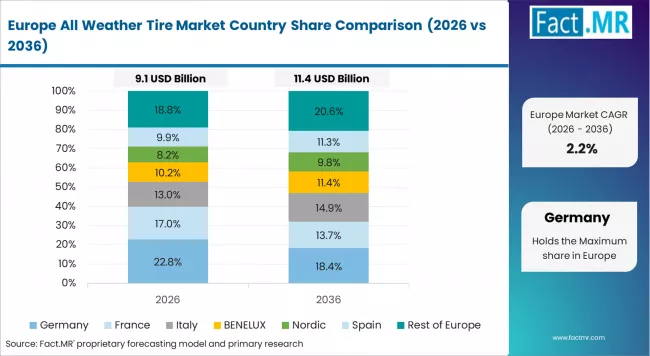
All Weather Tire Market Europe Country Market Share Analysis, 2026 & 2036 | Source: Fact.MR
The all weather tire market in Europe is projected to grow from USD 11.2 billion in 2026 to USD 17.8 billion by 2036, representing 30.1% of the global market in 2026 and expanding to approximately 30.6% by 2036. Germany is expected to maintain its leadership position with 26.8% of the European market in 2026, supported by its advanced automotive infrastructure and established tire manufacturing industry.
France follows with 18.9% of the European market in 2026, driven by comprehensive severe weather certification acceptance and winter tire alternative regulatory frameworks. UK holds 17.3% market share through established mixed climate conditions and year-round tire convenience networks.
Italy commands 14.2% share representing strong passenger car presence, while Spain accounts for 11.6% in 2026. The rest of Europe region maintains 11.2% of the European market, attributed to increasing all weather tire adoption in Nordic countries and emerging Eastern European markets implementing convenience-focused tire solutions.
Competitive Landscape of the All Weather Tire Market

All Weather Tire Market Analysis By Company | Source: Fact.MR
The all weather tire market exhibits a moderately consolidated competitive structure with approximately 30-50 active players operating across global tire manufacturing networks and regional distribution portfolios. Michelin maintains market leadership at a 12.0% share, reflecting strong product portfolio positioning across passenger and commercial tire segments with sophisticated global distribution strategies.
This competitive landscape demonstrates the maturation of all weather tire technology, where established players leverage economies of scale, extensive retail networks, and certification capabilities to maintain dominant positions, while emerging compound technology innovators and regional tire manufacturers create niche opportunities through specialized performance offerings and localized distribution strength.
Market leadership is maintained through several critical competitive advantages extending beyond manufacturing capabilities and product portfolios. Global distribution networks enable leading players to navigate diverse climate requirements and access varied customer segments including automotive OEMs, independent tire retailers, and fleet operators.
Technical innovation infrastructure and severe weather certification availability represent crucial differentiators in all weather tire categories, where decades of compound development expertise, tread pattern optimization, and performance testing create purchasing preference among safety-focused consumers.
Manufacturing efficiency in high-volume tire production, supply chain integration strategies, and raw material sourcing management separate major suppliers from smaller competitors, while comprehensive certification documentation addressing regulatory compliance, performance validation, and safety assurance strengthen market position and consumer confidence.
The market demonstrates emerging differentiation opportunities in advanced compound categories and sustainable tire technologies, where traditional all-season specifications face competition from performance-focused entrants emphasizing severe weather capabilities. However, significant competitive advantages persist in established manufacturer categories through integrated product portfolios and retail relationship depth. Three-peak mountain snowflake certified platforms with advanced silica compounds and optimized tread patterns command margin premiums through superior winter performance and year-round versatility.
Premium passenger car tire systems combining low rolling resistance with comprehensive performance documentation create specialized positioning that justifies higher price points beyond budget all-season tire applications. Comprehensive mobility solution portfolios emphasizing seamless vehicle integration, warranty programs, and unified retail support generate consumer loyalty and replacement tire preferences beyond transactional product competition.
| Stakeholder | What they actually control | Typical strengths | Typical blind spots |
|---|---|---|---|
| Global tire manufacturers | Comprehensive product portfolios; global distribution; certification capabilities | Market access; brand recognition; R&D investment; retail relationships | Pricing flexibility; regional customization; startup agility; niche segments |
| Premium tire brands | Compound expertise; performance innovation; certification leadership | Technology advancement; quality positioning; OEM partnerships; consumer trust | Price competitiveness; budget segments; emerging markets; distribution costs |
| Regional tire manufacturers | Local production; cost optimization; regional distribution; market knowledge | Affordability positioning; delivery efficiency; local support; cultural understanding | Certification resources; international expansion; brand strength; technology investment |
| OEM automotive partners | Vehicle integration; factory specifications; warranty programs; quality requirements | Volume purchasing; quality standards; consumer access; brand association | Tire manufacturing; aftermarket control; pricing power; distribution independence |
| Independent tire retailers | Consumer relationships; installation services; brand selection; local presence | Service flexibility; competitive pricing; consumer education; convenience positioning | Manufacturing capabilities; proprietary technology; global reach; brand development |
Source: Fact.MR analysis. Updated Mar 23, 2026
Key Players in the All Weather Tire Market
- Michelin
- Bridgestone Corporation
- Continental AG
- Goodyear Tire & Rubber Company
- Sumitomo Corporation
- Yokohama Tire Corporation
- CEAT Ltd.
- Pirelli & C. S.p.A.
- Nokian Tyres plc
- Dunlop
Bibliography
- European Tyre and Rubber Manufacturers Association. (2024). ETRMA position paper: All-season tire market trends and 3PMSF certification standards in Europe. ETRMA.
- UNECE. (2024). Regulation No. 117: Rolling resistance, wet grip, and rolling sound emission requirements for C1, C2, and C3 tyres, Revision 5. UNECE.
- Tire and Rubber Association of Canada. (2024). TRAC annual market report: All-weather tire adoption rates in Canadian provinces with winter tire mandates. TRAC.
- Transport Canada. (2024). Winter tire requirements by province: Regulatory summary and all-weather tire equivalence guidelines. Transport Canada.
- Tire Industry Association. (2024). TIA market intelligence: U.S. all-season and all-weather tire segment growth analysis 2023 to 2024. TIA.
- Japan Automobile Tyre Manufacturers Association. (2024). JATMA statistics: Four-season tire production and domestic shipment data 2024. JATMA.
This bibliography is provided for reader reference. The full Fact.MR report contains the complete reference list with primary research documentation.
This Report Addresses
- Market sizing and quantitative forecast metrics detailing global and regional expenditure on all weather tire through 2036.
- Segmentation analysis evaluating adoption patterns across vehicle type, distribution channel categories and their respective sub-segments.
- Regional deployment intelligence comparing growth trajectories, regulatory environments, and competitive dynamics across North America, Europe, Asia Pacific, Latin America, and the Middle East & Africa.
- Regulatory compliance assessment analyzing how safety, environmental, or performance standards shape procurement specifications and product development priorities.
- Competitive landscape evaluation tracking market structure, supplier positioning, and integration strategies among leading industry participants.
- Strategic investment guidance defining the procurement specifications, technology transitions, and capacity allocation decisions required for market positioning through the forecast period.
- Supply chain risk analysis identifying material sourcing constraints, manufacturing concentration vulnerabilities, and logistics dependencies affecting market participants.
- Custom data delivery formats encompassing interactive dashboards, raw Excel datasets, and comprehensive PDF narrative reports.
Segmentation
Scope of the Report
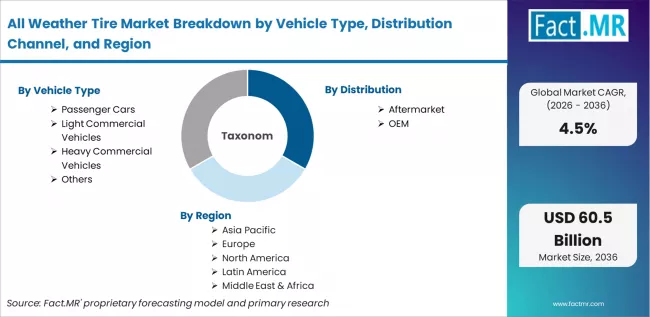
All Weather Tire Market Breakdown By Vehicle Type, Distribution Channel, And Region | Source: Fact.MR
| Metric | Value |
|---|---|
| Quantitative Units | USD 38.98 billion to USD 60.53 billion, at a CAGR of 4.50% |
| Market Definition | All weather tires are 3PMSF-certified, year-round pneumatic tires engineered to provide acceptable performance across dry, wet, and light snow conditions, eliminating the requirement for seasonal tire changeovers in temperate and moderate winter climates. |
| Vehicle Type Segmentation | Passenger Cars, Light Commercial Vehicles, Heavy Commercial Vehicles, Others |
| Distribution Channel Segmentation | Aftermarket, OEM |
| Regions Covered | North America, Latin America, Europe, East Asia, South Asia, Oceania, Middle East & Africa |
| Countries Covered | India, China, USA, Canada, UK, Germany, Japan, and 40 plus countries |
| Key Companies Profiled | Michelin, Bridgestone Corporation, Continental AG, Goodyear Tire & Rubber Company, Sumitomo Corporation, Yokohama Tire Corporation, CEAT Ltd., Pirelli & C. S.p.A., Nokian Tyres plc, Dunlop |
| Forecast Period | 2026 to 2036 |
| Approach | Forecasting models apply a hybrid top-down and bottom-up methodology, cross-validated against primary research and public industry filings. |
Source: Fact.MR analysis. Updated Mar 23, 2026
All Weather Tire Market by Segments
-
Vehicle Type :
- Passenger Cars
- Light Commercial Vehicles
- Heavy Commercial Vehicles
- Others
-
Distribution Channel :
- Aftermarket
- OEM
-
Region :
- North America
- USA
- Canada
- Mexico
- Europe
- Germany
- France
- UK
- Italy
- Spain
- Rest of Europe
- Asia Pacific
- India
- China
- Japan
- South Korea
- ASEAN
- Australia & New Zealand
- Rest of Asia Pacific
- Latin America
- Brazil
- Rest of Latin America
- Middle East & Africa
- GCC Countries
- South Africa
- Rest of Middle East & Africa
- North America
Frequently Asked Questions
How large is the all weather tire market in 2026?
What will the all weather tire market size be by 2036?
What is the expected CAGR for the all weather tire market between 2026 and 2036?
Which vehicle type segment is poised to lead in 2026?
Which country is the fastest-growing market?
What is the scope of this all weather tire market report?
What methodology does Fact.MR use for this forecast?
Which companies are profiled in this report?
Who worked on this report


Preview the report firsthand - request a free sample
Free SampleGet the brochure for pricing and purchase details
Download PDF