Small Drone Market (2026 - 2036)

Small Drone Market is segmented by Size (Micro, Nano), Wing Type (Rotary Wing, Fixed Wing, Hybrid Wing), Payload (Less than 2 kg, 2 to 5 kg, Above 5 kg), End Use (Recreational, Military and Government, Energy, Public Safety, Insurance, Healthcare, Oil and Gas, Logistics, Agriculture), and Region. Forecast for 2026 to 2036.

Core Findings

    Small Drone Market Size, Market Forecast and Outlook By Fact.MR

    The small drone market was valued at USD 6.00 billion in 2025, projected to reach USD 7.14 billion in 2026, and is forecast to expand to USD 40.66 billion by 2036 at a 19.00% CAGR. Regulatory frameworks enabling beyond-visual-line-of-sight (BVLOS) operations and remote identification compliance are unlocking commercial deployment at scale across infrastructure inspection, precision agriculture, and last-mile logistics sectors. Military procurement programmes focused on expendable reconnaissance platforms and swarm-capable micro drones are generating parallel demand streams with specifications distinct from commercial applications.
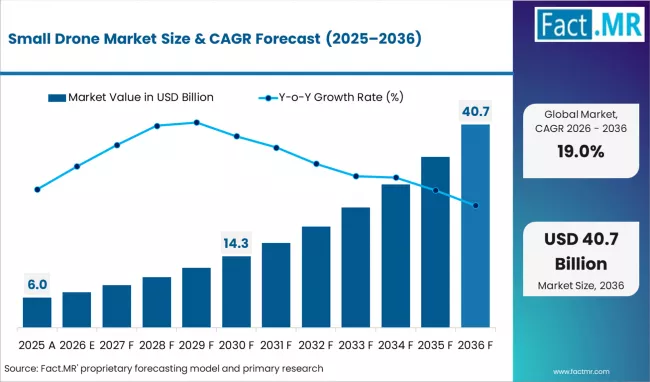
    Small Drone Market Market Value Analysis

    Summary of Small Drone Market

    • Small Drone Market Definition
      • Small drones are sub-25 kg unmanned aerial platforms designed for rapid field deployment across recreational, commercial, government, and military applications where lightweight airframes, low acquisition cost, and simplified regulatory compliance enable broad adoption.
    • Demand Drivers in the Market
      • Simplified regulatory registration requirements for sub-250 gram micro drones in the USA, EU, and India lower the barrier to entry for recreational and commercial operators, expanding the addressable buyer base across all end-use categories.
      • Military procurement programmes in the USA, China, and NATO member states are accelerating purchases of expendable reconnaissance micro drones and swarm-capable nano platforms for tactical battlefield awareness.
      • Commercial delivery and logistics operators conducting last-mile drone delivery trials in urban and suburban environments generate recurring fleet procurement demand for rotary wing platforms rated for payload capacities between 2 and 5 kg.
    • Key Segments Analyzed in the Fact.MR Report
      • Micro: 64.0% share in 2026, reflecting the dominant configuration within the size category across global markets.
      • Rotary Wing: 62.0% share in 2026, as the leading sub-segment within wing type segmentation.
      • China: 22.5% compound growth, representing the fastest-expanding national market within the forecast period.
    • Analyst Opinion at Fact.MR
      • The small drone market is bifurcating into two distinct procurement logics: high-volume, low-unit-cost consumer and micro-commercial platforms versus lower-volume, specification-intensive military and enterprise systems. Operators focused exclusively on recreational unit sales face margin compression as hardware commoditization accelerates, while those positioned in military, energy inspection, and agricultural monitoring capture higher per-unit values and multi-year service contracts. The regulatory environment is the single largest variable determining regional adoption velocity; jurisdictions that finalize BVLOS operational frameworks create immediate commercial deployment opportunities that lag by years in markets still operating under visual-line-of-sight restrictions. Fleet managers must also prepare for remote identification mandates that will require firmware or hardware upgrades across existing inventories, adding a compliance cost layer to the total fleet ownership calculation.
    • Strategic Implications / Executive Takeaways
      • Commercial drone service providers must secure BVLOS operational waivers in priority jurisdictions to access infrastructure inspection and delivery contracts that remain closed to visual-line-of-sight operators.
      • Defence procurement directors should evaluate expendable micro drone platforms for tactical reconnaissance roles where unit cost allows loss-tolerant deployment models that traditional manned ISR assets cannot support.
      • Agricultural technology integrators must develop bundled drone-plus-analytics service offerings to differentiate from hardware-only competitors in the precision farming segment where sensor data interpretation drives renewal revenue.

    Small Drone Market Key Takeaways

    Metric Details
    Industry Size (2026) USD 7.14 billion
    Industry Value (2036) USD 40.66 billion
    CAGR (2026 to 2036) 19.00%

    The absolute dollar opportunity between 2026 and 2036 amounts to approximately USD 33.52 billion. This rapid expansion reflects the convergence of falling hardware costs, maturing regulatory frameworks, and expanding commercial use cases beyond the initial recreational photography segment. Micro drones dominate unit volumes because their sub-250 gram category benefits from simplified registration and operational requirements in most jurisdictions. Based on Fact.MR's report, the recreational segment holds the largest individual end-use share, but commercial and government applications collectively account for the majority of revenue due to higher per-unit values and recurring service contract structures.

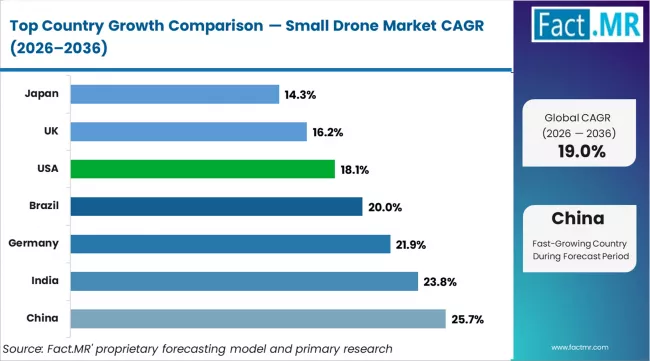
    China leads with a 22.5% CAGR, supported by domestic manufacturing scale and expanding commercial delivery trials. India follows at 21.0% as DGCA regulations enable agricultural and infrastructure inspection deployments. USA operations advance at 17.8%, with FAA Part 107 waivers expanding BVLOS commercial operations. South Korea registers 16.5%. Japan maintains 15.2%. Germany tracks at 14.0%, and UK networks at 13.5%.

    What are the regional trends of small drone market?

    Regionally, the small drone market is fueled by varying adoption factors and has strong growth trajectories. North America has consistently dominated the market, owing to large investments in military UAV budgets, drone-friendly FAA legislation for commercial applications, and strong technology ecosystems.

    The small drones are widely used in precision agriculture, border patrol and emergency response in the U.S. Then next is Europe, which largely focuses on infrastructure monitoring, environmental assessment and urban planning. Meanwhile, nations like Germany, France and the U.K. have all been speeding up new drone policies that aim to bring UAVs into civil airspace for commercial applications.

    The Asia-Pacific dominates as the fastest growing region, fueled by China's manufacturing onslaught, India's smart farming initiatives, and Japan's aging workforce threatening to agricultural viability. Growing demand in Southeast Asia for surveillance and disaster management applications promotes regional adoption.

    Moderate growth in Latin America and the Middle East along with continued oil & gas monitoring investments and border security are creating new opportunities. Regulatory harmonization and expansion of digital infrastructure will continue to drive adoption in developing regions.

    What are the challenges and restraining factors of small drone market?

    Uncertainties about regulation remain a key barrier, with many countries still to have well defined frameworks about drone operation, airspace integration and forms of cross border use. With issues of privacy and data security, as well as public concerns regarding unauthorized surveillance, potential obstacles arise, resulting in restrictions.

    Drone performance is limited by battery life and payload capacity, particularly in long endurance or heavy-lift applications. High entry barriers for advanced drones with AI and sensor technologies may discourage them from adopting a drone offer.

    Increasing cases of drone exploitation for smuggling, espionage, and airspace disruption have led to tougher regulations and affected their commercial deployment. Operational efficiency can also be limited by infrastructural constraints, such as insufficient coverage of GPS or connectivity in isolated sites.

    The drone platforms have limitations in terms of interoperability and lack a standardization that challenges scalability. Addressing these areas of concern is vital to unleash the potential of the small UAS market through innovation, regulatory convergence and public-private partnerships.

    Shifts in the Small Drone Market from (2021 to 2025) and Future Trends (2026 to 2036)

    Between 2021 and 2025, the overall global small drone market was benefitted by major adoption across the commercial segment, reducing the hardware price and surging demand from civilian and military sectors due to quick technological development. However, small-unmanned aerial systems weighing less than 25 kilograms were established for using application ranging from aerial photography and agriculture to tactical surveillance.

    Some of the factors in this time were demand from the defense sector for unmanned reconnaissance tasks, commercial needs in precise agriculture and logistics. Better battery technologies and miniaturized sensors also further improved the efficacy and utility of small drones.

    2026 to 2036, the market may experience accelerated growth. More AI, automation and real-time analytics tightly integrated will change what drones can do operationally. Regulatory regimes in major economies will mature over the decade, opening airspace corridors for fleets of commercial drones. Combined with sustainability goals and innovation in recyclable materials, the small drone market will likely progress to large-enough volumes for integrated roles in everyday operations of mainstream industry.

    Market Shift 2021 to 2025
    Regulatory Landscape Fragmented drone laws; initial frameworks by FAA, EASA; limited BVLOS ops.
    Technological Advancements Improved battery life, obstacle avoidance, GPS tracking, HD imaging.
    Industry-Specific Demand Strong in media, defense, and agriculture; pilot use in logistics.
    Sustainability & Circular Economy Initial steps in using lighter, efficient materials.
    Production & Supply Chain Reliant on China and select U.S. manufacturers; chip shortages affected output.
    Market Growth Drivers Tactical use in defense, need for remote sensing, commercial curiosity.
    Market Shift 2026 to 2036
    Regulatory Landscape Harmonized global standards; expanded BVLOS permissions; integrated air traffic systems.
    Technological Advancements AI-driven flight autonomy, swarm intelligence, 5G-enabled real-time data transfer, hydrogen fuel cells.
    Industry-Specific Demand Expanded in urban logistics, smart farming, infrastructure maintenance, environmental monitoring.
    Sustainability & Circular Economy Rise of biodegradable and recyclable drone components; focus on carbon-neutral drone fleets.
    Production & Supply Chain Diversified supply chains, additive manufacturing, and localized drone assembly units.
    Market Growth Drivers Autonomy, smart logistics, regulatory support, climate monitoring, and data monetization.

    The small drone market is expected to turf significant ascension due to their rapid technological integration and new commercial applications in a wide variety of fields. Using composite material, artificial intelligence, and autonomous navigation, small drones will increasingly play an integral role in logistics, precision agricultural, infrastructure construction, maintenance, and environmental assessment.

    This will require both regulatory harmonization, as well as the global rollout of beyond-visual-line-of-sight (BVLOS) operations, which will enable new business models and use cases including urban air mobility and delivery services. Sustainability is another trend that will take root, as manufacturers move toward recyclable parts and energy-efficient propulsion systems.

    As data become an increasingly valuable resource, there is already an accompanying transition of drones from vice to virtual market assets, where real-time analytics and decision-making will elevate the role of drones from an ancillary tool in digital environments and smart operations to a key player in the equation.

    Country-Wise Outlook

    Top Country Growth Comparison Small Drone Market Cagr (2026 2036)

    Country CAGR (2026 to 2036)
    United States 16.7%
    China 20.7%
    Germany 17.3%

    Small Drone Market Cagr Analysis By Country

    United States (U.S.)

    The small drone market in the U.S. is growing rapidly with new applications in defense, agriculture, inspection, and public safety. Through remote ID mandates and BVLOS (Beyond Visual Line of Sight) testing programs, the Federal Aviation Administration (FAA) has actively influenced regulatory pathways, enabling safer, more widespread drone integration. In agriculture, for crop monitoring, precision spraying and yield analysis, utility companies are also putting them to increase the use in asset inspection and disaster response.
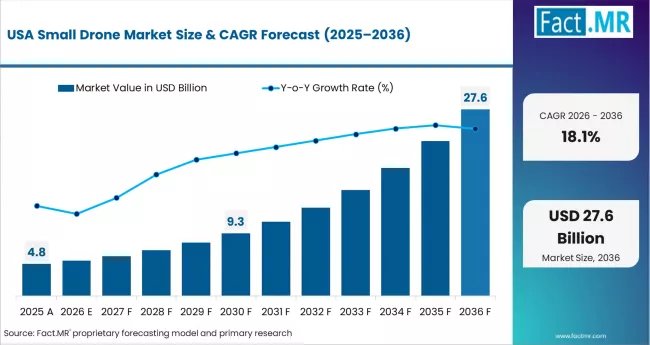
    Small Drone Market Country Value Analysis

    Domestic firm technological innovations like AI-based routing and swarming will make U.S.-made platforms more attractive in the 2020s. The Department of Defense’s pivot away from non-Chinese-origin drones and increased investments via the Blue UAS initiative and also support domestic manufacturing. Commercial growth in the market is also being driven by increasing demand from e-commerce and other logistics players for last-mile delivery drones.

    China

    China absolutely owns the world's small drone market and a significant share of the consumer to commercial drone manufacturers. The supportive policies of the government and integration of drones into national development strategies such as smart agriculture and urban air mobility have catalyzed innovation and mass adoption. Small drones are deployed in China for precision agriculture, surveillance, mapping, logistics and emergency response, a testament to the country’s move toward AI-augmented infrastructure.

    The development of the new system has been relatively advanced, as the Civil Aviation Administration of China (CAAC) has established various measures, such as name-based registration of drones and digital airspace. Growing investments in integration of 5G, autonomous flight, and industrial-grade drones augment growth. Scale, low-cost production, and advanced R&D make China a market lead for the global small drone ecosystem, with considerable growth forecast through 2035.

    Germany

    Germany's compact drone market seems to be making decent progress based on industrial automation, precision agriculture, and public infrastructure monitoring. A leader in engineering and innovation, Germany uses drones for automotive testing, rail network inspection and energy grid monitoring.

    The European Union (EU) Aviation Safety Agency (EASA) regulations, which were adopted nationally, have been instrumental in harmonizing drone operations across EU borders, leading to cross-border commercial drone services. Germany is also leading global efforts on drone corridors and urban air mobility pilots in Hamburg.

    With a strong emphasis on environmental issues in their country, the use of drones for sustainable agriculture, forest monitoring and environmental protection is taking root. Some startups and research institutions work together in the creation of AI-enabled navigation, sense-and-avoid systems, and clean propulsion technologies.

    Though military uses are limited by strict export controls, demand in the public sector is growing, particularly for firefighting, search-and-rescue and police surveillance. With conducive policy frameworks, a tech-savvy industrial base, and focus on sustainable innovation.

    Category-Wise Analysis

    Micro (6 inch) - By Size
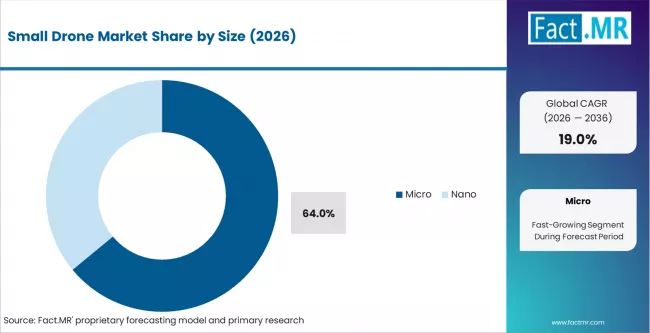
    Small Drone Market Analysis By Size

    Micro (6 inch) drone segment is the most robust segment among its small drone segment owing to its ultra-compact designs coupled with low weight with respect to their work applicability in precision based solutions. These drones are often beneficial in agriculture, surveillance, and indoor industry inspection.

    Their small footprint allows them to work in tight or complex environments, whether under canopies or inside warehouses. In agriculture, they help monitor crop health and identify pests without harming the environment.

    Micro drones are also popular in public safety operations, where they can be deployed quickly as eyes in the sky during search-and-rescue operations in urban areas. Their low price, relative ease of operation, and limited licensing requirements, especially for low-mass drones, help drive adoption among hobbyists and small-scale commercial operators.

    This, in addition to regulatory frameworks in a lot of countries being more lax toward micro drones, leads to even more usage. Micro drones are enhancing their appeal in both professional and recreational markets as drone technology advances, high-resolution cameras and autonomous navigation systems are being installed. They have a low risk profile, they are adaptable, and they provide an entry point for drone adoption around the world.

    Rotary Wing - By Wing Type
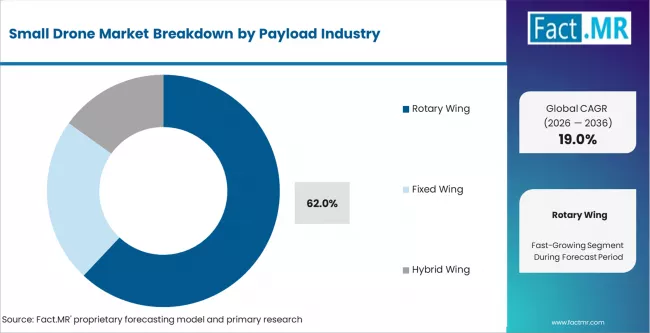
    Small Drone Market Analysis By Wing Type

    Rotary Wing drones are one of the most versatile in the small drone segment and provide the benefits of vertical take-off and landing, the ability to hover in one location and perform agile maneuvers. Making these characteristics particularly useful for tasks in constrained or urban environments where fixed-wing drones would find it hard.

    Rotary wing drones largely used in inspection, surveillance, aerial imaging, and emergency services. Law enforcement and fire departments rely on them for real-time situation awareness, and utility companies use them for infrastructure inspection without interrupting service.

    The accuracy and stability give rotary drones a perfect fit for agriculture, such as for targeted spraying and crop health monitoring. When compared to fixed-wing models, their typical flight time is shorter, but improved battery technologies and lightweight materials are aiding in improving their operational efficiency.

    Due to their established safety record, rotary drones tend to be lumped in with UAV policies, typically featuring altitude and visual line-of-sight restrictions, but with broad acceptance. The incredible versatility of the large aircraft and their operational flexibility will continue to maintain their demand across commercial and government marketplaces.

    Military and Government - By End Use
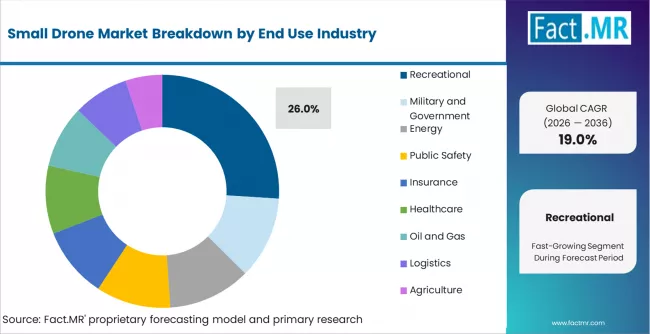
    Small Drone Market Analysis By End Use

    The Military and Government sector in small drone segment are owing to increase demand for real-time ISR (intelligence, surveillance and reconnaissance) and tactical communication ability. Small drones are being deployed more and more to patrol borders, conduct battlefield surveillance, perform search-and-rescue operations and acquire targets.

    With their capabilities to navigate difficult terrains and challenging environments, thermal imaging, encrypted data transmission and autonomous navigation, these can be invaluable assets for modern defense forces. Drones are also used by governments for disaster management, crowd control, and infrastructure assessment during emergencies.

    Military and governmental drones differ from commercial drones because those flown by military and governmental agencies are built to rigorous performance standards and are often fitted with proprietary software to deter cyber threats. Military drones are also subject to a more streamlined filing process due to their strategic interest in most regions.

    Competitive Analysis
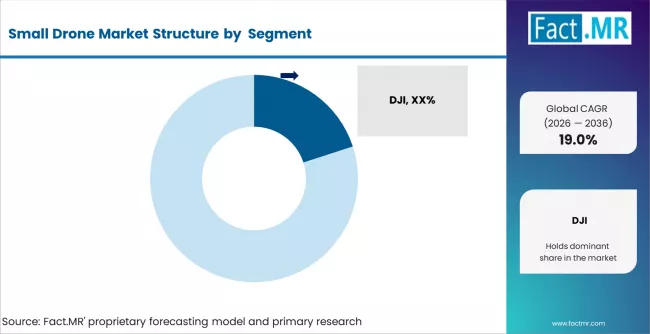
    Small Drone Market Analysis By Company

    The small drone market is fiercely competitive, with rapid technological advancements, regulatory changes, and a range of applications across industries shaping its competitive landscape. Businesses set themselves apart with innovations in battery life, payload capacity, autonomous navigation and real-time data processing.

    Price sensitivity continues to be high in consumer and commercial sectors, meaning that companies must strike a balance between cost and performance. Through agile development and AI integration, startups and niche players are encroaching on traditional manufactures.

    In addition, regional manufacturing prowess and supply chain approaches are becoming important competitive levers. Competition is therefore moving beyond hardware alone covering the full ecosystem from software to analytics to support solutions as demand increases from sectors such as agriculture, construction, surveillance and entertainment, with the stakes getting higher for maintaining relevance in the market.

    Key players are DJI, AeroVironment, AgEagle Aerial Systems, Autel Robotics, Draganfly Innovations, Hubsan, Parrot Drone SAS, Skydio Inc., MICRODRONES, Fly-robotics, and other players.

    Market Share Analysis by Company

    Company Name Estimated Market Share (%), 2024
    Top 5 Players ~75-85%
    Tier II Players ~5-15%
    Other Players ~5-10%

    Bibliography

    • Federal Aviation Administration. (2024). Part 107: Small unmanned aircraft systems, updated advisory circulars and remote identification compliance guidance. FAA.
    • European Union Aviation Safety Agency. (2024). Commission Delegated Regulation (EU) 2024/xxx: UAS operations in the open and specific categories. EASA.
    • International Organization for Standardization. (2024). ISO 21384-3: Unmanned aircraft systems, operational procedures for small UAS. ISO.
    • U.S. Department of Defense. (2024). Small UAS strategy: Replicator initiative and autonomous systems integration roadmap. DoD.
    • Civil Aviation Administration of China. (2024). Interim provisions on the administration of small unmanned aircraft flight activities, revised 2024. CAAC.
    • Directorate General of Civil Aviation, India. (2024). Drone rules 2024: Type certification and operational requirements for small UAS. DGCA.

    This bibliography is provided for reader reference. The full Fact.MR report contains the complete reference list with primary research documentation.

    This Report Addresses

    • Market sizing and quantitative forecast metrics detailing global and regional expenditure on small drone through 2036.
    • Segmentation analysis evaluating adoption patterns across size, wing type, payload, end use categories and their respective sub-segments.
    • Regional deployment intelligence comparing growth trajectories, regulatory environments, and competitive dynamics across North America, Europe, Asia Pacific, Latin America, and the Middle East & Africa.
    • Regulatory compliance assessment analyzing how safety, environmental, or performance standards shape procurement specifications and product development priorities.
    • Competitive landscape evaluation tracking market structure, supplier positioning, and integration strategies among leading industry participants.
    • Strategic investment guidance defining the procurement specifications, technology transitions, and capacity allocation decisions required for market positioning through the forecast period.
    • Supply chain risk analysis identifying material sourcing constraints, manufacturing concentration vulnerabilities, and logistics dependencies affecting market participants.
    • Custom data delivery formats encompassing interactive dashboards, raw Excel datasets, and comprehensive PDF narrative reports.

    Small Drone Market Definition

    Small drones are unmanned aerial vehicles weighing under 25 kilograms at takeoff, encompassing micro and nano size categories across rotary wing, fixed wing, and hybrid configurations. These platforms serve recreational, commercial inspection, agricultural monitoring, public safety, logistics delivery, and military surveillance applications where compact form factor, rapid deployment, and low operational cost are primary selection criteria.

    Small Drone Market Inclusions

    The report covers micro and nano drone size categories, rotary wing, fixed wing, and hybrid wing configurations, payload classes below 2 kg, 2 to 5 kg, and above 5 kg, and end-use applications spanning recreational, military, energy, public safety, insurance, healthcare, oil and gas, logistics, and agriculture sectors across global regions for 2026 to 2036.

    Small Drone Market Exclusions

    Medium and large unmanned aerial systems exceeding 25 kg maximum takeoff weight, manned aircraft with optional pilot configurations, tethered drone systems, and ground-based unmanned vehicles are excluded. Counter-drone systems, drone traffic management software, and pilot certification training services fall outside the analytical scope.

    Small Drone Market Research Methodology

    • Primary Research: Analysts engaged with procurement directors, product engineers, and operations leads across the small drone value chain to map adoption triggers and specification thresholds.
    • Desk Research: Data collection aggregated regulatory filings, standards ratification records, trade body publications, and corporate annual reports from allowed source categories.
    • Market-Sizing and Forecasting: Baseline values derive from a hybrid top-down and bottom-up aggregation, applying region-specific adoption curves to project demand velocity through 2036.
    • Data Validation and Update Cycle: Projections undergo cross-validation against publicly reported financial guidance, regulatory compliance databases, and independent industry association benchmarks.

    Scope of the Report

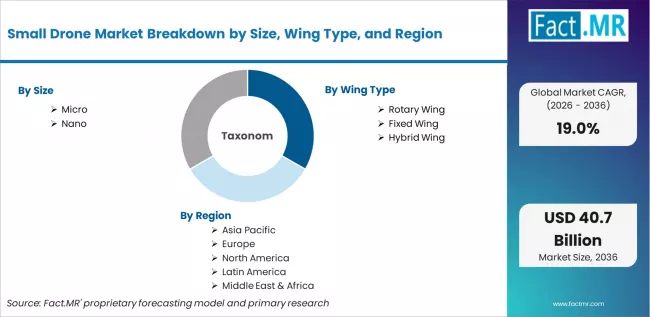
    Small Drone Market Breakdown By Size, Wing Type, And Region

    Metric Value
    Quantitative Units USD 7.14 billion to USD 40.66 billion, at a CAGR of 19.00%
    Market Definition Small drones are sub-25 kg unmanned aerial platforms designed for rapid field deployment across recreational, commercial, government, and military applications where lightweight airframes, low acquisition cost, and simplified regulatory compliance enable broad adoption.
    Size Segmentation Micro, Nano
    Wing Type Segmentation Rotary Wing, Fixed Wing, Hybrid Wing
    Payload Segmentation Less than 2 kg, 2 to 5 kg, Above 5 kg
    End Use Segmentation Recreational, Military and Government, Energy, Public Safety, Insurance, Healthcare, Oil and Gas, Logistics, Agriculture
    Regions Covered North America, Latin America, Europe, East Asia, South Asia, Oceania, Middle East & Africa
    Countries Covered India, China, USA, Canada, UK, Germany, Japan, and 40 plus countries
    Key Companies Profiled DJI, AeroVironment, Autel Robotics, Parrot Drone SAS, Skydio Inc., AgEagle Aerial Systems, Draganfly Innovations
    Forecast Period 2026 to 2036
    Approach Forecasting models apply a hybrid top-down and bottom-up methodology, cross-validated against primary research and public industry filings.

    Segmentation of Small Drone Market

    • By Size :

      • Micro (6 inch)
      • Nano (3 inch)
    • By Wing Type :

      • Fixed Wing
      • Rotary Wing
      • Hybrid Wing
    • By Payload :

      • Less than 2 kg
      • 2-5 kg
      • above 5 kg
    • By End Use :

      • Agriculture
      • Military and Government
      • Energy
      • Public Safety
      • Insurance
      • Healthcare
      • Oil and Gas
      • Logistics
      • Recreational
    • By Region :

      • North America
      • Latin America
      • Western Europe
      • Eastern Europe
      • East Asia
      • South Asia Pacific
      • Middle east & Africa

    Table of Content

    1. Executive Summary
      • Global Market Outlook
      • Demand to side Trends
      • Supply to side Trends
      • Technology Roadmap Analysis
      • Analysis and Recommendations
    2. Market Overview
      • Market Coverage / Taxonomy
      • Market Definition / Scope / Limitations
    3. Research Methodology
      • Chapter Orientation
      • Analytical Lens and Working Hypotheses
        • Market Structure, Signals, and Trend Drivers
        • Benchmarking and Cross-market Comparability
        • Market Sizing, Forecasting, and Opportunity Mapping
      • Research Design and Evidence Framework
        • Desk Research Programme (Secondary Evidence)
          • Company Annual and Sustainability Reports
          • Peer-reviewed Journals and Academic Literature
          • Corporate Websites, Product Literature, and Technical Notes
          • Earnings Decks and Investor Briefings
          • Statutory Filings and Regulatory Disclosures
          • Technical White Papers and Standards Notes
          • Trade Journals, Industry Magazines, and Analyst Briefs
          • Conference Proceedings, Webinars, and Seminar Materials
          • Government Statistics Portals and Public Data Releases
          • Press Releases and Reputable Media Coverage
          • Specialist Newsletters and Curated Briefings
          • Sector Databases and Reference Repositories
          • Fact.MR Internal Proprietary Databases and Historical Market Datasets
          • Subscription Datasets and Paid Sources
          • Social Channels, Communities, and Digital Listening Inputs
          • Additional Desk Sources
        • Expert Input and Fieldwork (Primary Evidence)
          • Primary Modes
            • Qualitative Interviews and Expert Elicitation
            • Quantitative Surveys and Structured Data Capture
            • Blended Approach
          • Why Primary Evidence is Used
          • Field Techniques
            • Interviews
            • Surveys
            • Focus Groups
            • Observational and In-context Research
            • Social and Community Interactions
          • Stakeholder Universe Engaged
            • C-suite Leaders
            • Board Members
            • Presidents and Vice Presidents
            • R&D and Innovation Heads
            • Technical Specialists
            • Domain Subject-matter Experts
            • Scientists
            • Physicians and Other Healthcare Professionals
          • Governance, Ethics, and Data Stewardship
            • Research Ethics
            • Data Integrity and Handling
        • Tooling, Models, and Reference Databases
      • Data Engineering and Model Build
        • Data Acquisition and Ingestion
        • Cleaning, Normalisation, and Verification
        • Synthesis, Triangulation, and Analysis
      • Quality Assurance and Audit Trail
    4. Market Background
      • Market Dynamics
        • Drivers
        • Restraints
        • Opportunity
        • Trends
      • Scenario Forecast
        • Demand in Optimistic Scenario
        • Demand in Likely Scenario
        • Demand in Conservative Scenario
      • Opportunity Map Analysis
      • Product Life Cycle Analysis
      • Supply Chain Analysis
      • Investment Feasibility Matrix
      • Value Chain Analysis
      • PESTLE and Porter’s Analysis
      • Regulatory Landscape
      • Regional Parent Market Outlook
      • Production and Consumption Statistics
      • Import and Export Statistics
    5. Global Market Analysis 2021 to 2025 and Forecast, 2026 to 2036
      • Historical Market Size Value (USD Million) Analysis, 2021 to 2025
      • Current and Future Market Size Value (USD Million) Projections, 2026 to 2036
        • Y to o to Y Growth Trend Analysis
        • Absolute $ Opportunity Analysis
    6. Global Market Pricing Analysis 2021 to 2025 and Forecast 2026 to 2036
    7. Global Market Analysis 2021 to 2025 and Forecast 2026 to 2036, By Size
      • Introduction / Key Findings
      • Historical Market Size Value (USD Million) Analysis By Size, 2021 to 2025
      • Current and Future Market Size Value (USD Million) Analysis and Forecast By Size, 2026 to 2036
        • Micro
        • Nano
      • Y to o to Y Growth Trend Analysis By Size, 2021 to 2025
      • Absolute $ Opportunity Analysis By Size, 2026 to 2036
    8. Global Market Analysis 2021 to 2025 and Forecast 2026 to 2036, By Wing Type
      • Introduction / Key Findings
      • Historical Market Size Value (USD Million) Analysis By Wing Type, 2021 to 2025
      • Current and Future Market Size Value (USD Million) Analysis and Forecast By Wing Type, 2026 to 2036
        • Rotary Wing
        • Fixed Wing
        • Hybrid Wing
      • Y to o to Y Growth Trend Analysis By Wing Type, 2021 to 2025
      • Absolute $ Opportunity Analysis By Wing Type, 2026 to 2036
    9. Global Market Analysis 2021 to 2025 and Forecast 2026 to 2036, By Payload
      • Introduction / Key Findings
      • Historical Market Size Value (USD Million) Analysis By Payload, 2021 to 2025
      • Current and Future Market Size Value (USD Million) Analysis and Forecast By Payload, 2026 to 2036
        • Less than 2 kg
        • 2-5 kg
        • Above 5 kg
      • Y to o to Y Growth Trend Analysis By Payload, 2021 to 2025
      • Absolute $ Opportunity Analysis By Payload, 2026 to 2036
    10. Global Market Analysis 2021 to 2025 and Forecast 2026 to 2036, By End Use
      • Introduction / Key Findings
      • Historical Market Size Value (USD Million) Analysis By End Use, 2021 to 2025
      • Current and Future Market Size Value (USD Million) Analysis and Forecast By End Use, 2026 to 2036
        • Recreational
        • Military and Government
        • Energy
        • Public Safety
        • Insurance
        • Healthcare
        • Oil and Gas
        • Logistics
        • Agriculture
      • Y to o to Y Growth Trend Analysis By End Use, 2021 to 2025
      • Absolute $ Opportunity Analysis By End Use, 2026 to 2036
    11. Global Market Analysis 2021 to 2025 and Forecast 2026 to 2036, By Region
      • Introduction
      • Historical Market Size Value (USD Million) Analysis By Region, 2021 to 2025
      • Current Market Size Value (USD Million) Analysis and Forecast By Region, 2026 to 2036
        • North America
        • Latin America
        • Western Europe
        • Eastern Europe
        • East Asia
        • South Asia and Pacific
        • Middle East & Africa
      • Market Attractiveness Analysis By Region
    12. North America Market Analysis 2021 to 2025 and Forecast 2026 to 2036, By Country
      • Historical Market Size Value (USD Million) Trend Analysis By Market Taxonomy, 2021 to 2025
      • Market Size Value (USD Million) Forecast By Market Taxonomy, 2026 to 2036
        • By Country
          • USA
          • Canada
          • Mexico
        • By Size
        • By Wing Type
        • By Payload
        • By End Use
      • Market Attractiveness Analysis
        • By Country
        • By Size
        • By Wing Type
        • By Payload
        • By End Use
      • Key Takeaways
    13. Latin America Market Analysis 2021 to 2025 and Forecast 2026 to 2036, By Country
      • Historical Market Size Value (USD Million) Trend Analysis By Market Taxonomy, 2021 to 2025
      • Market Size Value (USD Million) Forecast By Market Taxonomy, 2026 to 2036
        • By Country
          • Brazil
          • Chile
          • Rest of Latin America
        • By Size
        • By Wing Type
        • By Payload
        • By End Use
      • Market Attractiveness Analysis
        • By Country
        • By Size
        • By Wing Type
        • By Payload
        • By End Use
      • Key Takeaways
    14. Western Europe Market Analysis 2021 to 2025 and Forecast 2026 to 2036, By Country
      • Historical Market Size Value (USD Million) Trend Analysis By Market Taxonomy, 2021 to 2025
      • Market Size Value (USD Million) Forecast By Market Taxonomy, 2026 to 2036
        • By Country
          • Germany
          • UK
          • Italy
          • Spain
          • France
          • Nordic
          • BENELUX
          • Rest of Western Europe
        • By Size
        • By Wing Type
        • By Payload
        • By End Use
      • Market Attractiveness Analysis
        • By Country
        • By Size
        • By Wing Type
        • By Payload
        • By End Use
      • Key Takeaways
    15. Eastern Europe Market Analysis 2021 to 2025 and Forecast 2026 to 2036, By Country
      • Historical Market Size Value (USD Million) Trend Analysis By Market Taxonomy, 2021 to 2025
      • Market Size Value (USD Million) Forecast By Market Taxonomy, 2026 to 2036
        • By Country
          • Russia
          • Poland
          • Hungary
          • Balkan & Baltic
          • Rest of Eastern Europe
        • By Size
        • By Wing Type
        • By Payload
        • By End Use
      • Market Attractiveness Analysis
        • By Country
        • By Size
        • By Wing Type
        • By Payload
        • By End Use
      • Key Takeaways
    16. East Asia Market Analysis 2021 to 2025 and Forecast 2026 to 2036, By Country
      • Historical Market Size Value (USD Million) Trend Analysis By Market Taxonomy, 2021 to 2025
      • Market Size Value (USD Million) Forecast By Market Taxonomy, 2026 to 2036
        • By Country
          • China
          • Japan
          • South Korea
        • By Size
        • By Wing Type
        • By Payload
        • By End Use
      • Market Attractiveness Analysis
        • By Country
        • By Size
        • By Wing Type
        • By Payload
        • By End Use
      • Key Takeaways
    17. South Asia and Pacific Market Analysis 2021 to 2025 and Forecast 2026 to 2036, By Country
      • Historical Market Size Value (USD Million) Trend Analysis By Market Taxonomy, 2021 to 2025
      • Market Size Value (USD Million) Forecast By Market Taxonomy, 2026 to 2036
        • By Country
          • India
          • ASEAN
          • Australia & New Zealand
          • Rest of South Asia and Pacific
        • By Size
        • By Wing Type
        • By Payload
        • By End Use
      • Market Attractiveness Analysis
        • By Country
        • By Size
        • By Wing Type
        • By Payload
        • By End Use
      • Key Takeaways
    18. Middle East & Africa Market Analysis 2021 to 2025 and Forecast 2026 to 2036, By Country
      • Historical Market Size Value (USD Million) Trend Analysis By Market Taxonomy, 2021 to 2025
      • Market Size Value (USD Million) Forecast By Market Taxonomy, 2026 to 2036
        • By Country
          • Kingdom of Saudi Arabia
          • Other GCC Countries
          • Turkiye
          • South Africa
          • Other African Union
          • Rest of Middle East & Africa
        • By Size
        • By Wing Type
        • By Payload
        • By End Use
      • Market Attractiveness Analysis
        • By Country
        • By Size
        • By Wing Type
        • By Payload
        • By End Use
      • Key Takeaways
    19. Key Countries Market Analysis
      • USA
        • Pricing Analysis
        • Market Share Analysis, 2025
          • By Size
          • By Wing Type
          • By Payload
          • By End Use
      • Canada
        • Pricing Analysis
        • Market Share Analysis, 2025
          • By Size
          • By Wing Type
          • By Payload
          • By End Use
      • Mexico
        • Pricing Analysis
        • Market Share Analysis, 2025
          • By Size
          • By Wing Type
          • By Payload
          • By End Use
      • Brazil
        • Pricing Analysis
        • Market Share Analysis, 2025
          • By Size
          • By Wing Type
          • By Payload
          • By End Use
      • Chile
        • Pricing Analysis
        • Market Share Analysis, 2025
          • By Size
          • By Wing Type
          • By Payload
          • By End Use
      • Germany
        • Pricing Analysis
        • Market Share Analysis, 2025
          • By Size
          • By Wing Type
          • By Payload
          • By End Use
      • UK
        • Pricing Analysis
        • Market Share Analysis, 2025
          • By Size
          • By Wing Type
          • By Payload
          • By End Use
      • Italy
        • Pricing Analysis
        • Market Share Analysis, 2025
          • By Size
          • By Wing Type
          • By Payload
          • By End Use
      • Spain
        • Pricing Analysis
        • Market Share Analysis, 2025
          • By Size
          • By Wing Type
          • By Payload
          • By End Use
      • France
        • Pricing Analysis
        • Market Share Analysis, 2025
          • By Size
          • By Wing Type
          • By Payload
          • By End Use
      • India
        • Pricing Analysis
        • Market Share Analysis, 2025
          • By Size
          • By Wing Type
          • By Payload
          • By End Use
      • ASEAN
        • Pricing Analysis
        • Market Share Analysis, 2025
          • By Size
          • By Wing Type
          • By Payload
          • By End Use
      • Australia & New Zealand
        • Pricing Analysis
        • Market Share Analysis, 2025
          • By Size
          • By Wing Type
          • By Payload
          • By End Use
      • China
        • Pricing Analysis
        • Market Share Analysis, 2025
          • By Size
          • By Wing Type
          • By Payload
          • By End Use
      • Japan
        • Pricing Analysis
        • Market Share Analysis, 2025
          • By Size
          • By Wing Type
          • By Payload
          • By End Use
      • South Korea
        • Pricing Analysis
        • Market Share Analysis, 2025
          • By Size
          • By Wing Type
          • By Payload
          • By End Use
      • Russia
        • Pricing Analysis
        • Market Share Analysis, 2025
          • By Size
          • By Wing Type
          • By Payload
          • By End Use
      • Poland
        • Pricing Analysis
        • Market Share Analysis, 2025
          • By Size
          • By Wing Type
          • By Payload
          • By End Use
      • Hungary
        • Pricing Analysis
        • Market Share Analysis, 2025
          • By Size
          • By Wing Type
          • By Payload
          • By End Use
      • Kingdom of Saudi Arabia
        • Pricing Analysis
        • Market Share Analysis, 2025
          • By Size
          • By Wing Type
          • By Payload
          • By End Use
      • Turkiye
        • Pricing Analysis
        • Market Share Analysis, 2025
          • By Size
          • By Wing Type
          • By Payload
          • By End Use
      • South Africa
        • Pricing Analysis
        • Market Share Analysis, 2025
          • By Size
          • By Wing Type
          • By Payload
          • By End Use
    20. Market Structure Analysis
      • Competition Dashboard
      • Competition Benchmarking
      • Market Share Analysis of Top Players
        • By Regional
        • By Size
        • By Wing Type
        • By Payload
        • By End Use
    21. Competition Analysis
      • Competition Deep Dive
        • DJI
          • Overview
          • Product Portfolio
          • Profitability by Market Segments (Product/Age /Sales Channel/Region)
          • Sales Footprint
          • Strategy Overview
            • Marketing Strategy
            • Product Strategy
            • Channel Strategy
        • AeroVironment
        • Autel Robotics
        • Parrot Drone SAS
        • Skydio Inc.
        • AgEagle Aerial Systems
        • Draganfly Innovations
    22. Assumptions & Acronyms Used

    List Of Table

    • Table 1: Global Market Value (USD Million) Forecast by Region, 2021 to 2036
    • Table 2: Global Market Value (USD Million) Forecast by Size, 2021 to 2036
    • Table 3: Global Market Value (USD Million) Forecast by Wing Type, 2021 to 2036
    • Table 4: Global Market Value (USD Million) Forecast by Payload, 2021 to 2036
    • Table 5: Global Market Value (USD Million) Forecast by End Use, 2021 to 2036
    • Table 6: North America Market Value (USD Million) Forecast by Country, 2021 to 2036
    • Table 7: North America Market Value (USD Million) Forecast by Size, 2021 to 2036
    • Table 8: North America Market Value (USD Million) Forecast by Wing Type, 2021 to 2036
    • Table 9: North America Market Value (USD Million) Forecast by Payload, 2021 to 2036
    • Table 10: North America Market Value (USD Million) Forecast by End Use, 2021 to 2036
    • Table 11: Latin America Market Value (USD Million) Forecast by Country, 2021 to 2036
    • Table 12: Latin America Market Value (USD Million) Forecast by Size, 2021 to 2036
    • Table 13: Latin America Market Value (USD Million) Forecast by Wing Type, 2021 to 2036
    • Table 14: Latin America Market Value (USD Million) Forecast by Payload, 2021 to 2036
    • Table 15: Latin America Market Value (USD Million) Forecast by End Use, 2021 to 2036
    • Table 16: Western Europe Market Value (USD Million) Forecast by Country, 2021 to 2036
    • Table 17: Western Europe Market Value (USD Million) Forecast by Size, 2021 to 2036
    • Table 18: Western Europe Market Value (USD Million) Forecast by Wing Type, 2021 to 2036
    • Table 19: Western Europe Market Value (USD Million) Forecast by Payload, 2021 to 2036
    • Table 20: Western Europe Market Value (USD Million) Forecast by End Use, 2021 to 2036
    • Table 21: Eastern Europe Market Value (USD Million) Forecast by Country, 2021 to 2036
    • Table 22: Eastern Europe Market Value (USD Million) Forecast by Size, 2021 to 2036
    • Table 23: Eastern Europe Market Value (USD Million) Forecast by Wing Type, 2021 to 2036
    • Table 24: Eastern Europe Market Value (USD Million) Forecast by Payload, 2021 to 2036
    • Table 25: Eastern Europe Market Value (USD Million) Forecast by End Use, 2021 to 2036
    • Table 26: East Asia Market Value (USD Million) Forecast by Country, 2021 to 2036
    • Table 27: East Asia Market Value (USD Million) Forecast by Size, 2021 to 2036
    • Table 28: East Asia Market Value (USD Million) Forecast by Wing Type, 2021 to 2036
    • Table 29: East Asia Market Value (USD Million) Forecast by Payload, 2021 to 2036
    • Table 30: East Asia Market Value (USD Million) Forecast by End Use, 2021 to 2036
    • Table 31: South Asia and Pacific Market Value (USD Million) Forecast by Country, 2021 to 2036
    • Table 32: South Asia and Pacific Market Value (USD Million) Forecast by Size, 2021 to 2036
    • Table 33: South Asia and Pacific Market Value (USD Million) Forecast by Wing Type, 2021 to 2036
    • Table 34: South Asia and Pacific Market Value (USD Million) Forecast by Payload, 2021 to 2036
    • Table 35: South Asia and Pacific Market Value (USD Million) Forecast by End Use, 2021 to 2036
    • Table 36: Middle East & Africa Market Value (USD Million) Forecast by Country, 2021 to 2036
    • Table 37: Middle East & Africa Market Value (USD Million) Forecast by Size, 2021 to 2036
    • Table 38: Middle East & Africa Market Value (USD Million) Forecast by Wing Type, 2021 to 2036
    • Table 39: Middle East & Africa Market Value (USD Million) Forecast by Payload, 2021 to 2036
    • Table 40: Middle East & Africa Market Value (USD Million) Forecast by End Use, 2021 to 2036

    List Of Figures

    • Figure 1: Global Market Pricing Analysis
    • Figure 2: Global Market Value (USD Million) Forecast 2021 to 2036
    • Figure 3: Global Market Value Share and BPS Analysis by Size, 2026 and 2036
    • Figure 4: Global Market Y-o-Y Growth Comparison by Size, 2026 to 2036
    • Figure 5: Global Market Attractiveness Analysis by Size
    • Figure 6: Global Market Value Share and BPS Analysis by Wing Type, 2026 and 2036
    • Figure 7: Global Market Y-o-Y Growth Comparison by Wing Type, 2026 to 2036
    • Figure 8: Global Market Attractiveness Analysis by Wing Type
    • Figure 9: Global Market Value Share and BPS Analysis by Payload, 2026 and 2036
    • Figure 10: Global Market Y-o-Y Growth Comparison by Payload, 2026 to 2036
    • Figure 11: Global Market Attractiveness Analysis by Payload
    • Figure 12: Global Market Value Share and BPS Analysis by End Use, 2026 and 2036
    • Figure 13: Global Market Y-o-Y Growth Comparison by End Use, 2026 to 2036
    • Figure 14: Global Market Attractiveness Analysis by End Use
    • Figure 15: Global Market Value (USD Million) Share and BPS Analysis by Region, 2026 and 2036
    • Figure 16: Global Market Y-o-Y Growth Comparison by Region, 2026 to 2036
    • Figure 17: Global Market Attractiveness Analysis by Region
    • Figure 18: North America Market Incremental Dollar Opportunity, 2026 to 2036
    • Figure 19: Latin America Market Incremental Dollar Opportunity, 2026 to 2036
    • Figure 20: Western Europe Market Incremental Dollar Opportunity, 2026 to 2036
    • Figure 21: Eastern Europe Market Incremental Dollar Opportunity, 2026 to 2036
    • Figure 22: East Asia Market Incremental Dollar Opportunity, 2026 to 2036
    • Figure 23: South Asia and Pacific Market Incremental Dollar Opportunity, 2026 to 2036
    • Figure 24: Middle East & Africa Market Incremental Dollar Opportunity, 2026 to 2036
    • Figure 25: North America Market Value Share and BPS Analysis by Country, 2026 and 2036
    • Figure 26: North America Market Value Share and BPS Analysis by Size, 2026 and 2036
    • Figure 27: North America Market Y-o-Y Growth Comparison by Size, 2026 to 2036
    • Figure 28: North America Market Attractiveness Analysis by Size
    • Figure 29: North America Market Value Share and BPS Analysis by Wing Type, 2026 and 2036
    • Figure 30: North America Market Y-o-Y Growth Comparison by Wing Type, 2026 to 2036
    • Figure 31: North America Market Attractiveness Analysis by Wing Type
    • Figure 32: North America Market Value Share and BPS Analysis by Payload, 2026 and 2036
    • Figure 33: North America Market Y-o-Y Growth Comparison by Payload, 2026 to 2036
    • Figure 34: North America Market Attractiveness Analysis by Payload
    • Figure 35: North America Market Value Share and BPS Analysis by End Use, 2026 and 2036
    • Figure 36: North America Market Y-o-Y Growth Comparison by End Use, 2026 to 2036
    • Figure 37: North America Market Attractiveness Analysis by End Use
    • Figure 38: Latin America Market Value Share and BPS Analysis by Country, 2026 and 2036
    • Figure 39: Latin America Market Value Share and BPS Analysis by Size, 2026 and 2036
    • Figure 40: Latin America Market Y-o-Y Growth Comparison by Size, 2026 to 2036
    • Figure 41: Latin America Market Attractiveness Analysis by Size
    • Figure 42: Latin America Market Value Share and BPS Analysis by Wing Type, 2026 and 2036
    • Figure 43: Latin America Market Y-o-Y Growth Comparison by Wing Type, 2026 to 2036
    • Figure 44: Latin America Market Attractiveness Analysis by Wing Type
    • Figure 45: Latin America Market Value Share and BPS Analysis by Payload, 2026 and 2036
    • Figure 46: Latin America Market Y-o-Y Growth Comparison by Payload, 2026 to 2036
    • Figure 47: Latin America Market Attractiveness Analysis by Payload
    • Figure 48: Latin America Market Value Share and BPS Analysis by End Use, 2026 and 2036
    • Figure 49: Latin America Market Y-o-Y Growth Comparison by End Use, 2026 to 2036
    • Figure 50: Latin America Market Attractiveness Analysis by End Use
    • Figure 51: Western Europe Market Value Share and BPS Analysis by Country, 2026 and 2036
    • Figure 52: Western Europe Market Value Share and BPS Analysis by Size, 2026 and 2036
    • Figure 53: Western Europe Market Y-o-Y Growth Comparison by Size, 2026 to 2036
    • Figure 54: Western Europe Market Attractiveness Analysis by Size
    • Figure 55: Western Europe Market Value Share and BPS Analysis by Wing Type, 2026 and 2036
    • Figure 56: Western Europe Market Y-o-Y Growth Comparison by Wing Type, 2026 to 2036
    • Figure 57: Western Europe Market Attractiveness Analysis by Wing Type
    • Figure 58: Western Europe Market Value Share and BPS Analysis by Payload, 2026 and 2036
    • Figure 59: Western Europe Market Y-o-Y Growth Comparison by Payload, 2026 to 2036
    • Figure 60: Western Europe Market Attractiveness Analysis by Payload
    • Figure 61: Western Europe Market Value Share and BPS Analysis by End Use, 2026 and 2036
    • Figure 62: Western Europe Market Y-o-Y Growth Comparison by End Use, 2026 to 2036
    • Figure 63: Western Europe Market Attractiveness Analysis by End Use
    • Figure 64: Eastern Europe Market Value Share and BPS Analysis by Country, 2026 and 2036
    • Figure 65: Eastern Europe Market Value Share and BPS Analysis by Size, 2026 and 2036
    • Figure 66: Eastern Europe Market Y-o-Y Growth Comparison by Size, 2026 to 2036
    • Figure 67: Eastern Europe Market Attractiveness Analysis by Size
    • Figure 68: Eastern Europe Market Value Share and BPS Analysis by Wing Type, 2026 and 2036
    • Figure 69: Eastern Europe Market Y-o-Y Growth Comparison by Wing Type, 2026 to 2036
    • Figure 70: Eastern Europe Market Attractiveness Analysis by Wing Type
    • Figure 71: Eastern Europe Market Value Share and BPS Analysis by Payload, 2026 and 2036
    • Figure 72: Eastern Europe Market Y-o-Y Growth Comparison by Payload, 2026 to 2036
    • Figure 73: Eastern Europe Market Attractiveness Analysis by Payload
    • Figure 74: Eastern Europe Market Value Share and BPS Analysis by End Use, 2026 and 2036
    • Figure 75: Eastern Europe Market Y-o-Y Growth Comparison by End Use, 2026 to 2036
    • Figure 76: Eastern Europe Market Attractiveness Analysis by End Use
    • Figure 77: East Asia Market Value Share and BPS Analysis by Country, 2026 and 2036
    • Figure 78: East Asia Market Value Share and BPS Analysis by Size, 2026 and 2036
    • Figure 79: East Asia Market Y-o-Y Growth Comparison by Size, 2026 to 2036
    • Figure 80: East Asia Market Attractiveness Analysis by Size
    • Figure 81: East Asia Market Value Share and BPS Analysis by Wing Type, 2026 and 2036
    • Figure 82: East Asia Market Y-o-Y Growth Comparison by Wing Type, 2026 to 2036
    • Figure 83: East Asia Market Attractiveness Analysis by Wing Type
    • Figure 84: East Asia Market Value Share and BPS Analysis by Payload, 2026 and 2036
    • Figure 85: East Asia Market Y-o-Y Growth Comparison by Payload, 2026 to 2036
    • Figure 86: East Asia Market Attractiveness Analysis by Payload
    • Figure 87: East Asia Market Value Share and BPS Analysis by End Use, 2026 and 2036
    • Figure 88: East Asia Market Y-o-Y Growth Comparison by End Use, 2026 to 2036
    • Figure 89: East Asia Market Attractiveness Analysis by End Use
    • Figure 90: South Asia and Pacific Market Value Share and BPS Analysis by Country, 2026 and 2036
    • Figure 91: South Asia and Pacific Market Value Share and BPS Analysis by Size, 2026 and 2036
    • Figure 92: South Asia and Pacific Market Y-o-Y Growth Comparison by Size, 2026 to 2036
    • Figure 93: South Asia and Pacific Market Attractiveness Analysis by Size
    • Figure 94: South Asia and Pacific Market Value Share and BPS Analysis by Wing Type, 2026 and 2036
    • Figure 95: South Asia and Pacific Market Y-o-Y Growth Comparison by Wing Type, 2026 to 2036
    • Figure 96: South Asia and Pacific Market Attractiveness Analysis by Wing Type
    • Figure 97: South Asia and Pacific Market Value Share and BPS Analysis by Payload, 2026 and 2036
    • Figure 98: South Asia and Pacific Market Y-o-Y Growth Comparison by Payload, 2026 to 2036
    • Figure 99: South Asia and Pacific Market Attractiveness Analysis by Payload
    • Figure 100: South Asia and Pacific Market Value Share and BPS Analysis by End Use, 2026 and 2036
    • Figure 101: South Asia and Pacific Market Y-o-Y Growth Comparison by End Use, 2026 to 2036
    • Figure 102: South Asia and Pacific Market Attractiveness Analysis by End Use
    • Figure 103: Middle East & Africa Market Value Share and BPS Analysis by Country, 2026 and 2036
    • Figure 104: Middle East & Africa Market Value Share and BPS Analysis by Size, 2026 and 2036
    • Figure 105: Middle East & Africa Market Y-o-Y Growth Comparison by Size, 2026 to 2036
    • Figure 106: Middle East & Africa Market Attractiveness Analysis by Size
    • Figure 107: Middle East & Africa Market Value Share and BPS Analysis by Wing Type, 2026 and 2036
    • Figure 108: Middle East & Africa Market Y-o-Y Growth Comparison by Wing Type, 2026 to 2036
    • Figure 109: Middle East & Africa Market Attractiveness Analysis by Wing Type
    • Figure 110: Middle East & Africa Market Value Share and BPS Analysis by Payload, 2026 and 2036
    • Figure 111: Middle East & Africa Market Y-o-Y Growth Comparison by Payload, 2026 to 2036
    • Figure 112: Middle East & Africa Market Attractiveness Analysis by Payload
    • Figure 113: Middle East & Africa Market Value Share and BPS Analysis by End Use, 2026 and 2036
    • Figure 114: Middle East & Africa Market Y-o-Y Growth Comparison by End Use, 2026 to 2036
    • Figure 115: Middle East & Africa Market Attractiveness Analysis by End Use
    • Figure 116: Global Market - Tier Structure Analysis
    • Figure 117: Global Market - Company Share Analysis

    - Frequently Asked Questions -

    How large is the small drone market in 2026?

    The small drone market is estimated to be valued at USD 7.14 billion in 2026.

    What will the small drone market size be by 2036?

    The small drone market is projected to reach USD 40.66 billion by 2036.

    What is the expected CAGR for the small drone market between 2026 and 2036?

    The small drone market is expected to grow at a CAGR of 19.00% between 2026 and 2036.

    Which size segment is poised to lead in 2026?

    Micro accounts for 64.0% of size share in 2026, making it the leading sub-segment within this category.

    Which country is the fastest-growing market?

    China is projected to grow at a CAGR of 22.5% during 2026 to 2036, representing the fastest compound expansion among countries analyzed.

    What is the scope of this small drone market report?

    The report covers market sizing, segmentation by size, wing type, payload, end use, regional analysis across 40 plus countries, competitive landscape evaluation, and regulatory impact assessment for 2026 to 2036.

    What methodology does Fact.MR use for this forecast?

    Fact.MR applies a hybrid top-down and bottom-up methodology, cross-validated against primary research interviews, public financial disclosures, and independent industry association data.

    Which companies are profiled in this report?

    Companies profiled include DJI, AeroVironment, Autel Robotics, Parrot Drone SAS, Skydio Inc., and others. The full list is available in the scope of the report section.

    Small Drone Market