- Base Value(2025): 196.4 Bn
- Estimated Value(2026): 205.9 Bn
- Forecast Value (2036): 356.8 Bn
- CAGR (2026 - 2036): 5.6%
Ambient Ready Meals Market Size, Market Forecast and Outlook By Fact.MR
The ambient ready meals market reached USD 196.4 billion in 2025. Fact MR estimates the market will expand to USD 205.9 billion in 2026 and attain USD 356.8 billion by 2036. The market is forecast to register a CAGR of 5.6% across the assessment period.
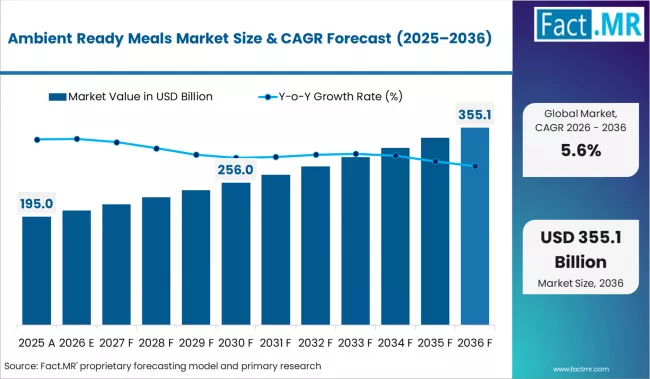
Ambient Ready Meals Market Market Value Analysis | Source: Fact.MR
Summary of Ambient Ready Meals Market
- Market Definition
- The market includes shelf stable prepared meal products designed for storage at room temperature without refrigeration, requiring minimal preparation such as reheating or hydration prior to consumption. Ambient ready meals include retort processed foods, canned complete meals, shelf stable rice and pasta dishes, soups, and packaged meal kits formulated to maintain microbiological safety and product stability over extended shelf life periods. These products are distributed through retail and foodservice channels where long storage capability supports logistics efficiency and inventory stability.
- Demand Drivers
- Increasing consumer preference for convenient meal formats requiring minimal preparation time
- Expansion of retail shelf space dedicated to packaged shelf stable meal solutions across organized retail environments
- Growth in retort packaging technologies supporting extended storage duration without cold chain dependency
- Rising demand for long shelf life food products supporting emergency stockpiling and flexible consumption planning
- Key Segments Analyzed
- Product Type: Ambient ready to eat meals account for approximately 36% share supported by convenience consumption patterns
- Distribution Channel: Supermarkets and hypermarkets represent nearly 48% share driven by structured retail shelf placement of packaged meal products
- Packaging Type: Retort pouches and sealed trays demonstrate stable adoption across shelf stable food processing applications
- Geography: Europe demonstrates consistent consumption supported by established packaged food retail infrastructure
- Analyst Opinion at Fact MR
- Shambhu Nath Jha, Principal Consultant, Fact MR, opines, "In this updated edition of the Ambient Ready Meals Market report, industry participants will observe continued demand stability supported by shelf life advantages and distribution efficiency characteristics associated with ambient packaged foods. Processing technologies including retort sterilization and aseptic packaging enable long duration storage without refrigeration dependency. Companies that optimize packaging durability, formulation stability, and retail distribution efficiency are expected to maintain competitive positioning through 2036."
- Strategic Implications Executive Takeaways
- Invest in packaging technologies supporting extended shelf stability and protection of product quality during ambient storage conditions
- Strengthen product portfolio diversification across shelf stable rice meals, pasta dishes, soups, and complete meal formats
- Improve supply chain efficiency through reduction of cold storage dependency and optimization of retail distribution logistics
- Monitor regulatory compliance requirements related to food safety validation and thermal processing standards
- Methodology
- Primary interviews conducted with packaged food manufacturers, ingredient suppliers, packaging providers, and retail procurement stakeholders
- Desk research based on packaged food consumption statistics, shelf stable food regulatory frameworks, and company product portfolio analysis
- Market sizing developed using hybrid top-down packaged meal demand assessment combined with bottom-up analysis of shelf stable product penetration across retail channels
- Data validation performed through cross comparison of product availability trends, expert consultation, and internal analytical review aligned with Fact MR research standards
Ambient Ready Meals Market
| Metric | Details |
|---|---|
| Industry Size (2026E) | USD 205.9 billion |
| Industry Value (2036F) | USD 356.8 billion |
| CAGR (2026 to 2036) | 5.6% |
Source: Fact.MR analysis. Updated Mar 27, 2026
An increase of USD 150.9 billion indicates incremental but structurally durable expansion driven by shelf-stable convenience demand and distribution efficiency advantages. Growth remains supported by long storage economics and retail penetration, while moderated by sodium reduction reformulation costs, private label price competition, and substitution pressure from chilled ready meals and food delivery platforms.
The United Kingdom leads with a projected CAGR of 6.3%, supported by steady demand for shelf-stable convenience meals. Germany follows with a CAGR of 6.1%, driven by expansion of packaged meal assortments. The United States records a CAGR of 5.8%, reflecting stable consumption across retail food channels. France shows a CAGR of 5.6%, supported by consistent demand for preserved meal formats. Japan records the slowest growth at 5.2%, reflecting a mature market tied to replacement consumption cycles. Mature markets generate a significant share of replacement demand as product reformulation focuses on shelf stability and packaging efficiency.
Segmental Analysis
Ambient Ready Meals Market Analysis by Distribution Channel
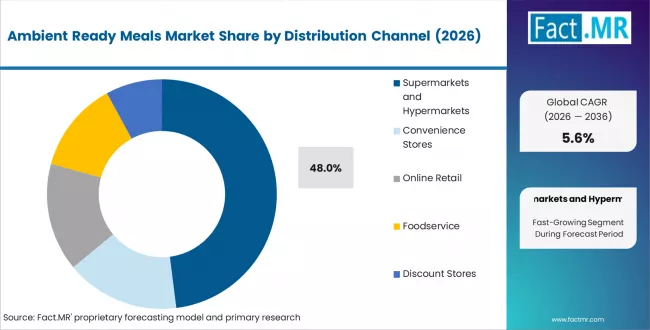
Ambient Ready Meals Market Analysis By Distribution Channel | Source: Fact.MR
- Market Overview: Based on Fact MR assessment, supermarkets and hypermarkets are projected to account for 48% share of the ambient ready meals market in 2026. Organized retail environments support structured shelf allocation for shelf-stable packaged meals requiring controlled ambient storage conditions. Ambient ready meal products are positioned across center store aisles enabling high visibility and simplified consumer access without dependence on refrigeration infrastructure. Retail procurement systems maintain inventory continuity across packaged meal categories including retort processed foods, canned meals, and shelf-stable trays designed for extended storage duration under standard temperature conditions.
- Demand Drivers:
- Shelf Stability Requirements: Ambient ready meals are distributed through retail channels without dependence on cold chain logistics, supporting inventory management efficiency across large retail networks.
- Category Placement Structure: Supermarkets allocate shelf space for ready to eat packaged meals positioned within packaged food aisles supporting consistent product accessibility.
- Retail Inventory Efficiency: Ambient packaged meals support longer shelf rotation cycles enabling stable stock availability across multi location retail distribution environments.
Ambient Ready Meals Market Analysis by Product Type
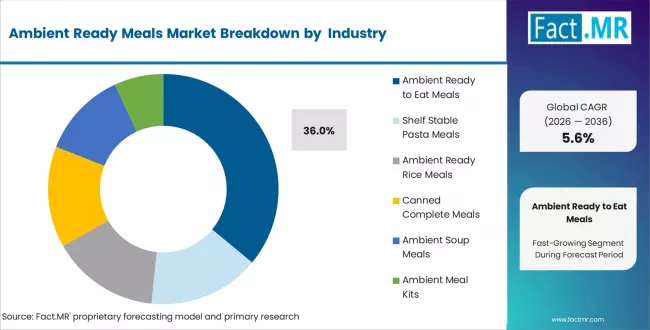
Ambient Ready Meals Market Analysis By Product Type | Source: Fact.MR
- Market Overview: Ambient ready to eat meals are estimated to hold 36% share of the ambient ready meals market in 2026, supported by processing methods enabling microbiological stability without refrigeration. Retort sterilization, aseptic packaging, and thermal processing methods are applied to achieve extended shelf life across packaged meal products requiring minimal preparation prior to consumption. Product formats include shelf-stable rice meals, pasta dishes, legume preparations, and protein-based entrees packaged within sealed trays, pouches, and cans structured for long duration storage compatibility.
- Demand Drivers:
- Processing Stability Requirements: Thermal processing methods enable inactivation of microbial activity supporting extended shelf life performance across packaged ready meals.
- Convenience Consumption Patterns: Ready to eat ambient meals support simplified meal preparation requirements aligned with time constrained consumption environments.
- Packaging Compatibility: Sealed containers including retort pouches and rigid trays maintain product integrity across storage, transport, and retail display conditions.
Key Dynamics of Ambient Ready Meals Market
Ambient Ready Meals Market Drivers, Restraints, and Opportunities
Fact MR analysis indicates that the ambient ready meals market developed from shelf-stable food preservation technologies designed to extend product storage life without refrigeration. Early commercial products relied on canning and retort processing methods that allowed meals to remain stable at room temperature for extended periods. The current market valuation reflects the expansion of packaged meals using retort pouches, aseptic packaging, and controlled thermal processing technologies. Demand persists because ambient ready meals enable long storage periods, simplified logistics, and accessibility in retail environments without cold chain requirements.
A structural shift is occurring as conventional frozen ready meals compete with shelf-stable alternatives that reduce distribution complexity and storage costs. Frozen meals remain widely used where refrigeration infrastructure supports product preservation and texture retention. Ambient ready meals involve advanced packaging materials and thermal sterilization processes designed to maintain food safety and product stability during extended shelf life. These processing technologies increase packaging and production costs compared with basic canned foods. Even with moderate consumption growth, higher-value packaging formats and convenience-driven purchasing patterns support gradual market value expansion.
- Shelf Stable Convenience: Food manufacturers produce ambient ready meals packaged in retort pouches and aseptic containers that allow storage without refrigeration.
- Food Safety Processing Standards: Frameworks such as Hazard Analysis and Critical Control Points (HACCP) and U.S. Food and Drug Administration low-acid canned food regulations influence thermal processing validation.
- Europe Retail Distribution: The United Kingdom, Germany, and France maintain established retail distribution of shelf-stable ready meals supported by organized grocery supply chains.
Regional Analysis of Ambient Ready Meals Market
The ambient ready meals market is assessed across North America, Europe, Asia Pacific, Latin America, and Middle East & Africa, segmented by country-level shelf-stable meal demand, convenience food consumption, and packaged food distribution networks. Regional demand reflects extended shelf-life requirements, retail penetration, and meal portability preferences. The full report offers market attractiveness analysis.
.webp "Top Country Growth Comparison Ambient Ready Meals Market Cagr (2026 2036)")
Top Country Growth Comparison Ambient Ready Meals Market Cagr (2026 2036) | Source: Fact.MR
| Country | CAGR (2026-2036) |
|---|---|
| United Kingdom | 6.3% |
| Germany | 6.1% |
| United States | 5.8% |
| France | 5.6% |
| Japan | 5.2% |
Source: Fact.MR analysis. Updated Mar 27, 2026
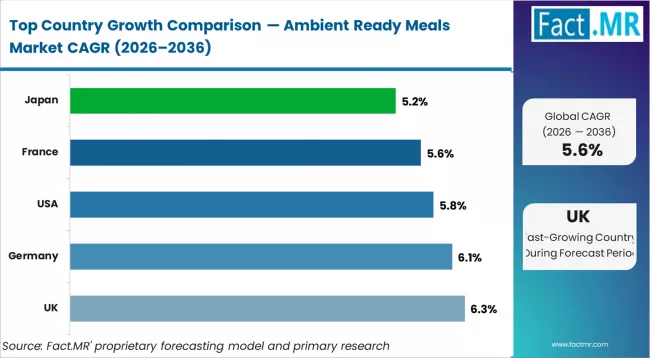
Ambient Ready Meals Market Cagr Analysis By Country | Source: Fact.MR
Source: Fact MR analysis, based on proprietary forecasting model and primary research
Europe
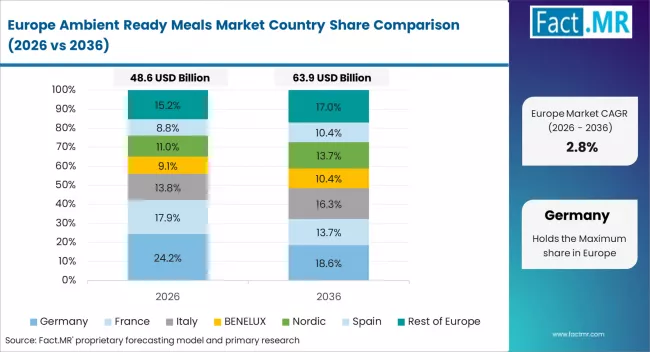
Ambient Ready Meals Market Europe Country Market Share Analysis, 2026 & 2036 | Source: Fact.MR
Europe functions as the shelf-stable meal innovation and convenience food formulation laboratory, supported by strong packaged food consumption and structured food safety standards. Nestlé S.A. strengthens ambient meal product development. Unilever plc expands ready meal product portfolio. Bonduelle Group supports shelf-stable meal offerings.
- United Kingdom: Demand for ambient ready meals in United Kingdom is projected to rise at 6.3% CAGR through 2036. The UK Food Standards Agency packaged food safety framework (updated 2021) supports shelf-stable product compliance. Unilever plc expanded ambient ready meal product lines (March 2023), supporting retail demand.
- Germany: Demand for ambient ready meals in Germany is projected to rise at 6.1% CAGR through 2036. EU packaged food safety regulations (European Commission, updated 2022) support long shelf-life food production standards. Nestlé S.A. expanded shelf-stable meal product offerings (February 2023), supporting adoption.
- France: Demand for ambient ready meals in France is projected to rise at 5.6% CAGR through 2036. The National Food Programme update (French Ministry of Agriculture, 2022) supports packaged food availability. Bonduelle Group expanded shelf-stable meal product distribution (January 2023), supporting market growth.
North America
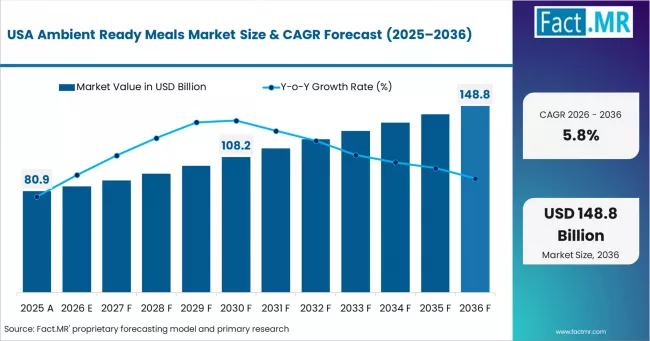
Ambient Ready Meals Market Country Value Analysis | Source: Fact.MR
North America functions as the convenience meal distribution and packaged food innovation hub, supported by strong retail channel presence and ready meal consumption trends. Campbell Soup Company strengthens shelf-stable meal portfolio. Conagra Brands, Inc. expands ready meal product innovation. Kraft Heinz Company supports packaged meal product distribution.
- United States: Demand for ambient ready meals in United States is projected to rise at 5.8% CAGR through 2036. FDA packaged food labeling and safety regulations (updated 2022) support shelf-stable meal production standards. Conagra Brands, Inc. expanded shelf-stable ready meal product offerings (April 2023), supporting market expansion.
Asia Pacific
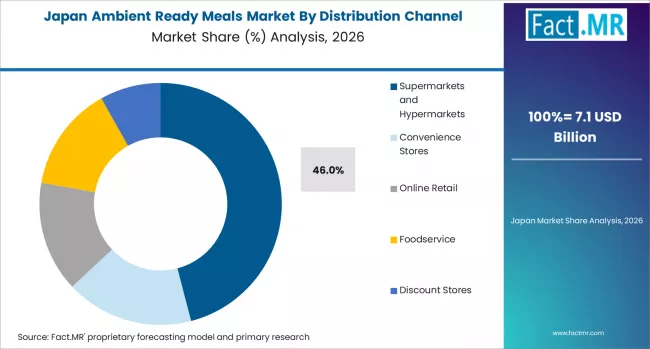
Ambient Ready Meals Market Japan Market Share Analysis By Distribution Channel | Source: Fact.MR
Asia Pacific serves as the convenience meal consumption and long shelf-life packaged food market, supported by urban consumption patterns and expanding retail availability. Ajinomoto Co., Inc. strengthens ready meal product development. Nissin Foods Holdings Co., Ltd. expands shelf-stable meal product portfolio. Morinaga & Co., Ltd. supports packaged meal innovation.
- Japan: Demand for ambient ready meals in Japan is projected to rise at 5.2% CAGR through 2036. The Food Sanitation Act update (Ministry of Health, Labour and Welfare, 2021) supports packaged meal compliance requirements. Nissin Foods Holdings Co., Ltd. expanded shelf-stable meal product lines (May 2023), supporting domestic demand.
Fact MR's analysis of ambient ready meals market in global regions consists of country-wise assessment that includes United Kingdom, Germany, United States, France, and Japan. Readers can find convenience food consumption trends, shelf-stable packaging developments, regulatory frameworks, and competitive positioning across key markets.
Competitive Landscape of Ambient Ready Meals Market
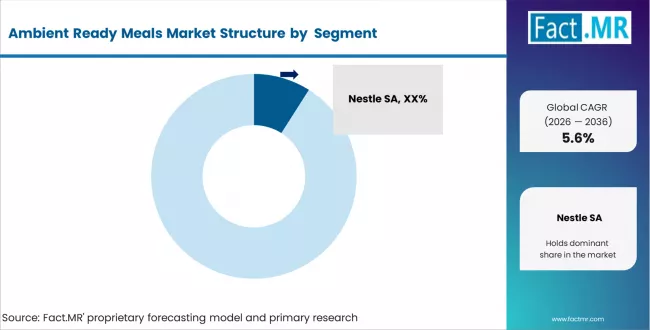
Ambient Ready Meals Market Analysis By Company | Source: Fact.MR
Competitive Structure and Buyer Dynamics in the Ambient Ready Meals Market
The competitive structure of the Ambient Ready Meals Market is moderately concentrated, with multinational packaged food companies controlling a notable share of shelf stable meal supply. Companies such as Nestle SA, Unilever PLC, Kraft Heinz Company, Campbell Soup Company, Conagra Brands Inc., and Hormel Foods Corporation maintain strong positions through established ready meal portfolios and global retail distribution networks. Additional participants including General Mills Inc., Premier Foods PLC, Ajinomoto Co. Inc., and Mars Incorporated contribute through diversified processed meal offerings. Competition is primarily influenced by taste consistency, shelf stability performance, packaging reliability, and price positioning across retail channels and private label competition.
Several companies maintain structural advantages through integrated food processing infrastructure and strong brand recognition across packaged food categories. Firms such as Nestle SA, Kraft Heinz Company, and Unilever PLC benefit from large scale manufacturing capabilities and established supply chain networks that support consistent product availability. Ajinomoto Co. Inc. maintains advantages through expertise in flavor formulation and shelf stable meal development. Retailers often offer multiple ready meal brands to reduce dependence on a single supplier. Procurement decisions evaluate suppliers based on product consistency, packaging durability, and demand patterns, moderating supplier pricing leverage.
Key Players of the Ambient Ready Meals Market
- Nestle SA
- Unilever PLC
- Kraft Heinz Company
- Campbell Soup Company
- Hormel Foods Corporation
- Conagra Brands Inc.
- General Mills Inc.
- Premier Foods PLC
- Ajinomoto Co. Inc.
- Mars Incorporated
Bibliographies
- [1] U.S. Food and Drug Administration (FDA). (2022). Guidance for industry: Low-acid canned foods and thermally processed foods packaged in hermetically sealed containers. U.S. FDA.
- [2] European Commission. (2022). Regulation (EC) No 852/2004 on the hygiene of foodstuffs: Application to shelf-stable ready meals and retort-processed foods. European Commission.
- [3] Food Standards Agency (United Kingdom). (2021). Packaged food safety framework: Guidance for shelf-stable ready meals and retort-processed foods. Food Standards Agency, UK.
- [4] Nestle Research. (2023). Shelf-stable ready meals and consumer convenience: Nutrition, sensory quality, and safety profiles of ambient-packaged meals. Nestle Research.
- [5] Bonduelle Group. (2023). Shelf-stable meal offerings: Case studies on ambient ready-meals for retail and foodservice distribution in Europe. Bonduelle Sustainability and Innovation Report.
This Report Addresses
- Market size estimation and revenue forecasts for the Ambient Ready Meals Market from 2026 to 2036, supported by shelf-stable food consumption benchmarks and packaged meal distribution trends across retail supply chains.
- Growth opportunity mapping across ambient ready to eat meals, shelf stable pasta meals, ambient ready rice meals, canned complete meals, ambient soup meals, and ambient meal kits aligned with long shelf-life convenience food consumption patterns.
- Segment and regional revenue forecasts covering packaging formats, distribution channels, and major consumption markets including United Kingdom, Germany, United States, France, and Japan.
- Competition strategy assessment of major companies such as Nestlé SA, Unilever PLC, Kraft Heinz Company, Campbell Soup Company, and Conagra Brands Inc, including processing capability benchmarking and retail distribution positioning across packaged meal categories.
- Regulatory impact analysis covering Hazard Analysis and Critical Control Points (HACCP) requirements, U.S. Food and Drug Administration low-acid canned food regulations, and packaged food safety compliance frameworks influencing shelf-stable meal formulation and processing standards.
- Market report delivery in PDF, Excel, PPT, and interactive dashboard formats designed for packaged food portfolio evaluation, shelf-stable product benchmarking, and retail distribution performance assessment.
- Supply chain vulnerability assessments examining retort packaging material costs, sodium reduction reformulation constraints, thermal processing validation requirements, private label price competition pressure, and substitution impact from chilled ready meals and food delivery services influencing market expansion.
Ambient Ready Meals Market Definition
The Ambient Ready Meals Market includes shelf stable, fully cooked meal products that can be stored at room temperature without refrigeration and are designed for convenient consumption after minimal preparation such as heating or rehydration.
Ambient Ready Meals Market Inclusions
The report includes global and regional market size estimates, forecast analysis, and segmentation by meal type, packaging format, distribution channel, end user group, pricing structure, and retail availability patterns.
Ambient Ready Meals Market Exclusions
The scope excludes frozen ready meals, chilled ready meals requiring cold storage, meal kits needing significant preparation, and packaged food products not intended as complete meal solutions.
Ambient Ready Meals Market Research Methodology
- Primary Research: Interviews were conducted with ready meal manufacturers, packaging providers, retailers, foodservice operators, and supply chain distributors.
- Desk Research: Public sources included packaged food consumption data, company product catalogs, regulatory guidelines on shelf stable foods, and industry publications.
- Market-Sizing and Forecasting: A hybrid model combining top-down packaged meal demand evaluation and bottom-up analysis of shelf stable ready meal adoption was applied.
- Data Validation and Update Cycle: Outputs were validated through cross comparison of product availability data, expert review, and periodic monitoring of retail assortment expansion.
Segmentation
Report Scope of Ambient Ready Meals Market
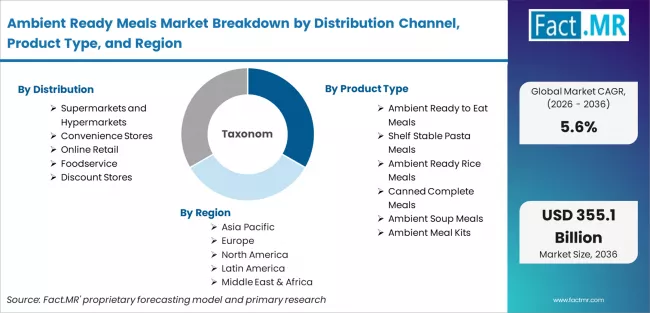
Ambient Ready Meals Market Breakdown By Distribution Channel, Product Type, And Region | Source: Fact.MR
| Metric | Value |
|---|---|
| Quantitative Units | USD 205.9 billion (2026) to USD 356.8 billion (2036), at a CAGR of 5.6% |
| Market Definition | The ambient ready meals market includes shelf-stable packaged meals designed for consumption without refrigeration, processed using thermal preservation technologies to maintain safety, quality, and extended shelf life under room temperature storage conditions. |
| Product Type Segmentation | Ambient ready to eat meals, Shelf stable pasta meals, Ambient ready rice meals, Canned complete meals, Ambient soup meals, Ambient meal kits |
| Packaging Type Segmentation | Retort pouches, Cans, Trays and bowls, Cartons, Glass jars |
| Distribution Channel Segmentation | Supermarkets and hypermarkets, Convenience stores, Online retail, Foodservice, Discount stores |
| Regions Covered | North America, Latin America, Europe, East Asia, South Asia, Oceania, Middle East and Africa |
| Countries Covered | United States, Canada, Mexico, Brazil, Argentina, Germany, France, United Kingdom, Italy, Spain, China, India, Japan, South Korea, Thailand, Indonesia, Australia, Saudi Arabia, and 40+ countries |
| Key Companies Profiled | Nestle SA, Unilever PLC, Kraft Heinz Company, Campbell Soup Company, Hormel Foods Corporation, Conagra Brands Inc., General Mills Inc., Premier Foods PLC, Ajinomoto Co. Inc., Mars Incorporated |
| Forecast Period | 2026 to 2036 |
| Approach | Hybrid top-down and bottom-up market estimation based on shelf-stable meal consumption patterns, packaging technology adoption, retail sales benchmarking, supply chain distribution analysis, and validation through primary interviews with packaged food manufacturers, ingredient suppliers, and retail distribution stakeholders. |
Source: Fact.MR analysis. Updated Mar 27, 2026
Ambient Ready Meals Market Key Segments
-
Product Type :
- Ambient Ready to Eat Meals
- Shelf Stable Pasta Meals
- Ambient Ready Rice Meals
- Canned Complete Meals
- Ambient Soup Meals
- Ambient Meal Kits
-
Packaging Type :
- Retort Pouches
- Cans
- Trays and Bowls
- Cartons
- Glass Jars
-
Distribution Channel :
- Supermarkets and Hypermarkets
- Convenience Stores
- Online Retail
- Foodservice
- Discount Stores
-
Region :
- North America
- USA
- Canada
- Mexico
- Europe
- Germany
- UK
- France
- Italy
- Spain
- Nordic Countries
- BENELUX
- Rest of Europe
- Asia Pacific
- China
- Japan
- South Korea
- India
- Australia
- Rest of Asia Pacific
- Latin America
- Brazil
- Argentina
- Rest of Latin America
- Middle East and Africa
- Kingdom of Saudi Arabia
- United Arab Emirates
- South Africa
- Rest of Middle East and Africa
- Other Regions
- Oceania
- Central Asia
- Other Markets
- North America
Frequently Asked Questions
How large is the demand for Ambient Ready Meals in the global market in 2026?
What will be the market size of Ambient Ready Meals in the global market by 2036?
What is the expected demand growth for Ambient Ready Meals in the global market between 2026 and 2036?
Which company is identified as a leading manufacturer in the Ambient Ready Meals market?
Which distribution channel is projected to dominate Ambient Ready Meals sales by 2026?
Why are supermarkets and hypermarkets important for ambient ready meal distribution?
What is driving demand for Ambient Ready Meals in the United Kingdom?
What is the growth outlook for the Ambient Ready Meals market in the United Kingdom?
Why is Germany an important market for ambient ready meals?
What is the growth outlook for the Ambient Ready Meals market in Germany?
How is demand for Ambient Ready Meals evolving in the United States?
What is the growth outlook for the Ambient Ready Meals market in the United States?
What is the growth outlook for the Ambient Ready Meals market in France?
How is Japan positioned in the Ambient Ready Meals market?
What is the growth outlook for the Ambient Ready Meals market in Japan?
What are ambient ready meals and what are they mainly used for?
What does the Ambient Ready Meals market include in this report?
What applications are included in the scope of the Ambient Ready Meals market?
What is excluded from the scope of the Ambient Ready Meals market report?
What does market forecast mean in the Ambient Ready Meals market report?
How is the Ambient Ready Meals market forecast developed in this report?
What does primary validation indicate in the Ambient Ready Meals market analysis?
Who worked on this report


Preview the report firsthand - request a free sample
Free SampleGet the brochure for pricing and purchase details
Download PDF