- Market Value (2025): USD 52.85 Bn
- Estimated Value (2026): USD 55.6 Bn
- Forecast Value (2036): USD 92.2 Bn
- CAGR (2026-2036): 5.2%
What is the Industrial Starch Market forecast to be worth by 2036?
USD 55.6 billion in 2026 to USD 92.2 billion by 2036 at a 5.2% CAGR.
- As per Fact.MR analysis, the industrial starch market reached USD 52.85 billion in 2025.
- Sales are projected to rise from USD 55.6 billion in 2026 to USD 92.2 billion by 2036.
- Industrial starch demand is forecast to advance at a 5.2% CAGR from 2026 to 2036 as food manufacturing and industrial processing continue to purchase application-specific grades.
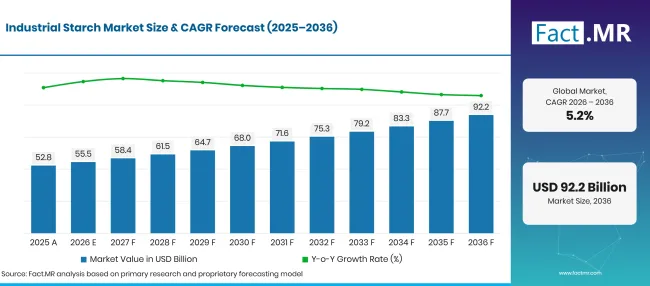
Industrial Starch Market Forecast Global | Source: Fact.MR
| Year | Basis | Market Value (USD billion) |
|---|---|---|
| 2025 | Actual | 52.8 |
| 2026 | Estimate | 55.6 |
| 2036 | Forecast | 92.2 |
| CAGR 2026 to 2036 | Forecast period | 5.2% |
Source: Fact.MR analysis. Updated Nov 3, 2026
What are the defining numbers behind Industrial Starch Market growth?
The forecast indicates an increase of USD 36.6 billion between 2026 and 2036.
- Demand Drivers in the Market
- Manufacturers purchase starch to set viscosity and preserve texture after heating or cooling. Cooking stability is one of the requirements that determine grade selection.
- The USDA National Agricultural Statistics Service estimated US corn production at 17.0 billion bushels in 2025 [1]. That agricultural base supports domestic wet-milling operations, although starch prices still depend on processing economics and competing uses for corn.
- Packaging and paper producers use starch in sizing and coating to strengthen sheet surfaces. Mill trials remain central to a change in paper-sizing ingredients.
- In October 2025 Roquette introduced AMYSTA L 123 soluble pea starch for powdered foods [2]. Its launch illustrates how manufacturers can sell particular starch functions through application testing instead of competing only on raw material price.
- Key Segments Analyzed
- By Source: Corn is projected to account for 48.3% in 2026, reflecting its wet-milling base and range of end-use grades.
- By Type: Modified Starch is forecast to hold 42.1% in 2026, given its tailored stability and processing behavior.
- By Application: Feed is expected to represent 18.3% in 2026, including starch-derived inputs used in animal nutrition and feed manufacture.
- By Form: Dry is projected to contribute 67.3% in 2026, assisted by storage and transport flexibility.
- Analyst Opinion at Fact.MR
- Shambhu Nath Jha, Principal Consultant at Fact.MR, states, “For starch suppliers, a repeat order depends on whether the ingredient performs consistently in the customer’s production process. Food and paper manufacturers often need plant trials before changing grades, because a small difference in viscosity or binding can affect the finished product.”
- Strategic Implications
- Starch processors can align feedstock sourcing plans with the grades required by nearby food and paper manufacturers.
- Food formulators benefit from checking viscosity performance under actual heating and shelf-life conditions before changing commercial suppliers.
- Paper mills need to assess surface strength and coating runnability during plant trials when adopting a different starch formulation.
- Distributors can keep dry food-grade inventory separate from industrial-use specifications to maintain traceability and customer confidence.
Germany is projected to grow at 6.0% CAGR as food and industrial users seek tailored grades. Brazil follows at 5.5%, supported by its maize and cassava feedstock base.
How does the Industrial Starch Market break down by segment?
Corn accounts for 48.3% of Source; Modified Starch holds 42.1% of Type; Feed represents 18.3% of Application; Dry comprises 67.3% of Form in 2026.
Which Source dominates?
Corn accounts for 48.3% of the 2026 segment.
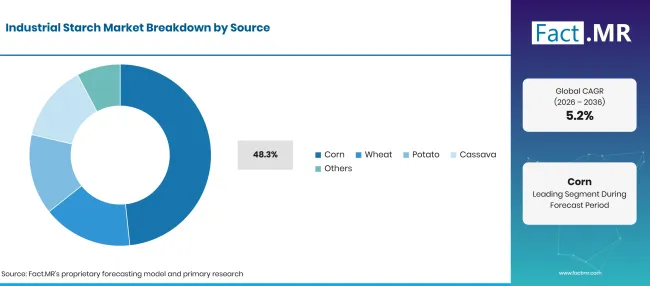
Industrial Starch Market Breakdown Source | Source: Fact.MR
| Source | Share (2026) |
|---|---|
| Corn (Leading segment) | 48.3% |
| Other segments combined | 51.7% |
| Total | 100.0% |
Source: Fact.MR analysis. Updated Nov 3, 2026
Corn starch is made by separating starch from other parts of the kernel during wet milling. The same agricultural feedstock supports grades used in food thickening, paper sizing and other applications. Wheat offers different processing and texture properties, while waxy maize can be selected for particular swelling or consistency needs. Local wet-milling capacity influences which products suppliers can provide reliably.
What leads the Type segment?
Modified Starch leads with 42.1% of the 2026 segment.
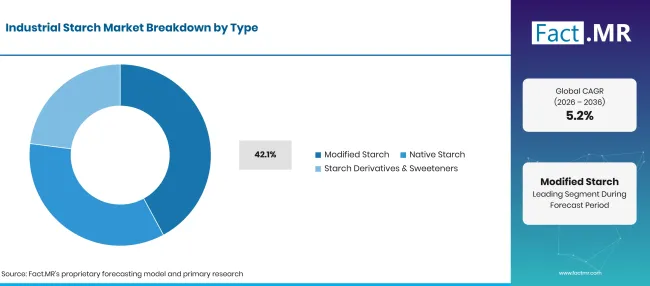
Industrial Starch Market Breakdown Type | Source: Fact.MR
| Type | Share (2026) |
|---|---|
| Modified Starch (Leading segment) | 42.1% |
| Other segments combined | 57.9% |
| Total | 100.0% |
Source: Fact.MR analysis. Updated Nov 3, 2026
Modified starch is treated to change how it behaves during production or use. Food plants may specify stability under heating or shear, whereas paper customers evaluate adhesion and drainage. Native starch remains useful when the processing conditions permit a simpler ingredient. Starch derivatives and sweeteners include products further processed for distinct commercial functions. Tate & Lyle described its combined specialty starch and hydrocolloid capabilities in its June 2025 annual-report update [3].
How does Application shape demand?
Feed captures 18.3% of the 2026 segment.
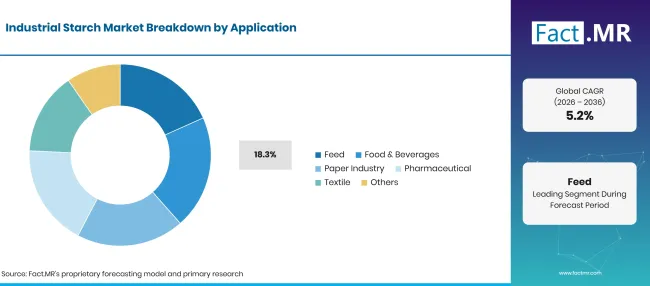
Industrial Starch Market Breakdown Application | Source: Fact.MR
| Application | Share (2026) |
|---|---|
| Feed (Leading segment) | 18.3% |
| Other segments combined | 81.7% |
| Total | 100.0% |
Source: Fact.MR analysis. Updated Nov 3, 2026
Feed takes an estimated 18.3% share of industrial starch applications in 2026. Formulators use starch-bearing materials and processed carbohydrates as part of the energy and physical structure of animal feed. Food and beverages form another major outlet where thickening and stability matter. Paper mills use starch to improve sheet strength, while pharmaceutical manufacturers select excipient grades for tablet binding or disintegration.
Which Form accounts for more demand?
Dry represents 67.3% of the 2026 segment.
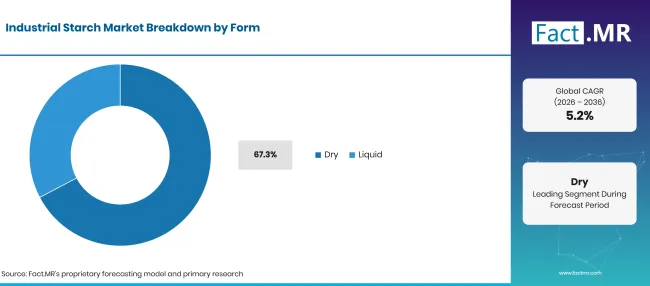
Industrial Starch Market Breakdown Form | Source: Fact.MR
| Form | Share (2026) |
|---|---|
| Dry (Leading segment) | 67.3% |
| Other segments combined | 32.7% |
| Total | 100.0% |
Source: Fact.MR analysis. Updated Nov 3, 2026
Dry starch is projected to account for 67.3% of 2026 value. Powder can move through established bulk handling and packaging systems without transporting as much water. This provides flexibility for factories that prepare their own starch solutions during production. In dry product design, instant prepared foods require starch grades suited to the intended mixing process.
What is accelerating Industrial Starch Market adoption, and what is holding it back?
Food-processing requirements support purchasing, while feedstock price changes and qualification costs affect supplier decisions.
Drivers Impact Analysis
| DRIVER | (~) % IMPACT ON CAGR | GEOGRAPHIC RELEVANCE | IMPACT TIMELINE |
|---|---|---|---|
| Specialty food texture specifications | +1.2% | Europe, North America | Medium term |
| Paper sizing and coating | +0.9% | Europe, East Asia | Medium term |
| Broad crop-based processing base | +0.8% | Americas | Short term |
| Convenient dry handling | +0.6% | Global | Short term |
| Feed formulation applications | +0.4% | Latin America, North America | Long term |
Source: Fact.MR analysis. Updated Nov 3, 2026
Opportunity Impact Analysis
| OPPORTUNITY | (~) % IMPACT ON CAGR | GEOGRAPHIC RELEVANCE | IMPACT TIMELINE |
|---|---|---|---|
| Heat-stable sauce and filling grades | +0.7% | North America, Europe | Medium term |
| Starch-based paper coatings | +0.6% | Europe, East Asia | Long term |
| Cassava and potato specialization | +0.5% | Latin America, Asia | Medium term |
| Application testing and technical service | +0.3% | Global | Short term |
Source: Fact.MR analysis. Updated Nov 3, 2026
Restraints Impact Analysis
| RESTRAINT | (~) % IMPACT ON CAGR | GEOGRAPHIC RELEVANCE | IMPACT TIMELINE |
|---|---|---|---|
| Crop and grain cost volatility | -0.6% | Global | Short term |
| Heat and energy processing expense | -0.5% | Europe, Japan | Short term |
| Customer requalification cycles | -0.4% | Global | Medium term |
| Competition among functional ingredients | -0.3% | Global | Long term |
Source: Fact.MR analysis. Updated Nov 3, 2026
Which countries are scaling the Industrial Starch Market through 2036?
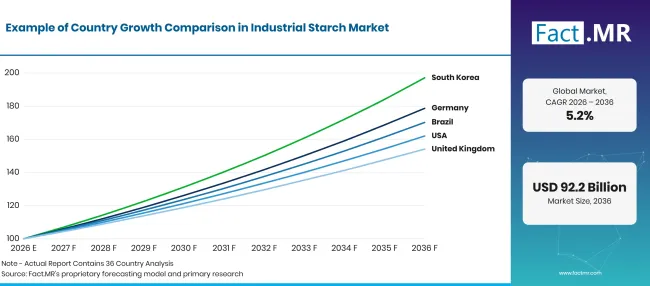
Factmr Industrial Starch Market Growth Index | Source: Fact.MR
| Country | CAGR (2026 to 2036) |
|---|---|
| Germany | 6.0% |
| Brazil | 5.5% |
| United States | 4.9% |
| United Kingdom | 4.4% |
| Japan | 3.9% |
Source: Fact.MR analysis. Updated Nov 3, 2026
What supports Germany’s industrial starch demand?
6.0% CAGR, tied to food formulation and paper manufacturing.
Germany’s food manufacturers use starch in sauces and bakery products that require controlled texture. Product-specific acceptance tests shape a supplier’s chance of securing regular production orders. Eurostat reported that the EU’s value of sold production of food products, measured at constant prices, increased by 3.8% in 2025 [4]. Destatis reported German industry production was 1.1% lower in 2025 [5]. Weaker industrial operating conditions can delay paper-plant trials and reduce orders linked to production volume.
How is Brazil developing its starch market?
5.5% CAGR, with cassava and corn offering different processing routes.
Brazil’s cassava processing base provides a feedstock route for tapioca starch. Manufacturers select these grades when their texture or viscosity profile fits the finished product. IBGE estimated Brazil’s 2025 corn harvest at 141.7 million tonnes [6]. Large maize availability supports a broad agricultural processing base while other grain uses compete for the same crop. Food processors can source corn and cassava ingredients based on formulation and local plant access.
What is shaping United States demand?
4.9% CAGR, linked to wet-milling operations and specialist food grades.
U.S. wet mills separate corn into ingredients for food and industrial customers. Existing transport and processing systems let producers serve multiple end uses from the same crop. The USDA estimated 95.3 million acres of corn planted in 2026 [7]. A broad agricultural base gives wet mills crop sourcing options while actual costs vary by region and season. USDA reported 2.10 billion bushels of old-crop corn stocks on September 1, 2026 [8]. Inventory changes can affect raw material price discussions for mills and their customers.
How does the United Kingdom use industrial starch?
4.4% CAGR, with food manufacturing a main demand outlet.
British prepared-food manufacturers purchase starch for sauce consistency and texture after reheating. Product developers screen grades against finished food performance requirements. The Office for National Statistics reported manufacturing product sales of GBP 452.0 billion in 2025 [9]. UK paper converters require predictable sizing or coating behavior when a starch product is used. Incoming material has to match plant handling requirements.
What distinguishes Japan’s industrial starch outlook?
3.9% CAGR, shaped by starch sweeteners and specialist modified grades.
Japanese beverage and food production uses starch conversion products for sweetening and formulation functions. Buyers select grades by process reliability and customer specification. Japan’s agriculture ministry forecast 1.642 million tonnes of demand for starch-derived saccharification products in starch year 2026 [10]. The forecast points to a distinct outlet for starch conversion operations. The ministry separately forecast 229,000 tonnes of demand for modified starch in starch year 2026.
Who leads the Industrial Starch Market?
Industrial starch suppliers include grain processors and ingredient specialists. Cargill offers modified starch products.
ADM processes agricultural crops. Ingredion supplies starch and texturizing ingredients. Tate & Lyle serves specialty food applications, and Roquette offers plant-derived starch grades. Customer qualification and consistent product performance affect supplier selection. Supplier competition depends on repeatable quality and help during plant trials. Hydroxypropyl starch phosphates illustrate a more specialized modified-starch chemistry used for formulation control.
Which companies are the key providers?
The companies profiled are Cargill, Incorporated; Archer Daniels Midland Company; Tate & Lyle PLC; Ingredion Incorporated; and Roquette Frères.
- Cargill, Incorporated
- Archer Daniels Midland Company
- Tate & Lyle PLC
- Ingredion Incorporated
- Roquette Frères
How is the market segmented?
-
By Source
- Corn
- Wheat
- Potato
- Cassava
- Others
-
By Type
- Modified Starch
- Native Starch
- Starch Derivatives & Sweeteners
-
By Application
- Feed
- Food & Beverages
- Paper Industry
- Pharmaceutical
- Textile
- Others
-
By Form
- Dry
- Liquid
-
By Region
- North America
- Latin America
- Western Europe
- Eastern Europe
- East Asia
- South Asia & Pacific
- Middle East & Africa
Bibliography
- [1] U.S. Department of Agriculture, National Agricultural Statistics Service. (2026, January 12). Crop production 2025 summary
- [2] Roquette. (2025, October 31). AMYSTA™ L 123, the new label-friendly soluble pea starch
- [3] Tate & Lyle. (2025, June 5). Our 2025 annual report: A year focussed on accelerating growth
- [4] Eurostat. (2026, August 24). EU industrial production rebounds in 2025
- [5] Statistisches Bundesamt (Destatis). (2026, February 6). Production in December 2025: -1.9% on the previous month.
- [6] Instituto Brasileiro de Geografia e Estatística. (2026, January 15). Em dezembro, IBGE prevê safra de 346,1 milhões de toneladas para 2025 e de 339,8 milhões de toneladas para 2026.
- [7] U.S. Department of Agriculture, National Agricultural Statistics Service. (2026, June 30). Corn planted acreage down 3% from 2025, soybean acreage up 5% from last year.
- [8] U.S. Department of Agriculture, National Agricultural Statistics Service. (2026, September 30). US corn ending stocks up 35% from last year, soybean ending stocks down 3%.
- [9] Office for National Statistics. (2026, July 24). UK manufacturers’ sales by product: 2025.
- [10] Ministry of Agriculture, Forestry and Fisheries. (2026, September 25).[Starch supply and demand outlook for starch year 2026]
This Report Answers
- The report compares industrial starch made from corn, wheat, potato and cassava according to customer applications.
- Type analysis covers modified starch, native starch and further-processed starch derivatives.
- Application analysis reviews the different commercial needs of feed, food, paper, pharmaceutical and textile users.
- Country analysis connects agricultural supply and manufacturing activity to five national growth outlooks.
- Competitive analysis explains how processing scale and technical support affect supplier selection.
What does the Industrial Starch Market cover?
The market covers starch ingredients purchased for commercial production. It includes food texture, paper strength, feed formulation and industrial processing applications. Finished foods and paper products fall outside the market value. Industrial starch suppliers also process wheat and potato starch for applications that need different functional properties.
What is included in the scope?
Native starch and modified starch grades are covered alongside starch derivatives and sweeteners within the stated classification. Corn, wheat, potato and cassava are source groups.
Food producers compare modified starch grades when recipes require stability during heating or storage. Unmodified ingredients follow different application tests from functional grades, while cassava-derived materials offer another raw-material route. Paper mills also compare surface-sizing starch formulations based on their machine speed and the surface finish required.
What is excluded from the scope?
Whole grain traded without separation into starch is excluded. Finished food and paper products are outside the market value even when starch is a processing ingredient.
How Was the Analysis Built?
The analysis draws on 120+ sources, 35+ company portfolios, 25+ countries, and more than 20 industry interviews.
- Primary Research: Primary research includes discussions with manufacturers, service providers, technology developers, distributors, end users, and subject-matter experts. These conversations examine purchasing priorities, product adoption, operational challenges, approval requirements, competitive positioning, and the factors that influence wider market acceptance.
- Desk Research: Desk research covers government statistics, regulatory publications, company filings, trade data, technical studies, industry associations, standards, public policy, and other authoritative sources. Every source used in the analysis is documented in the bibliography.
- Market Sizing and Forecasting: Market estimates combine historical performance, demand indicators, pricing and volume trends, segment shares, company participation, country-level growth, adoption patterns, investment activity, and barriers to market expansion.
- Data Validation and Update Cycle: Findings are validated by comparing primary interviews with public data, company activity, regulatory changes, trade patterns, and industry developments. Regular updates review new product launches, capacity changes, partnerships, approvals, and shifts in commercial adoption.
Segmentation
What is the report’s scope and coverage?
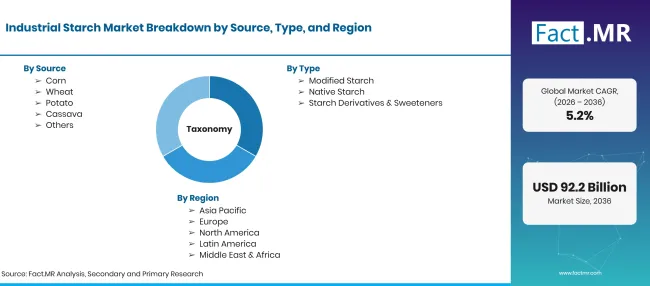
Factmr Industrial Starch Market Taxonomy | Source: Fact.MR
| Attribute | Details |
|---|---|
| Quantitative units | USD billion |
| Market definition | Starch and starch-derived products used as functional ingredients in manufacturing, including food, paper, feed, pharmaceutical and textile applications. |
| Source | Corn; Wheat; Potato; Cassava; Others |
| Type | Modified Starch; Native Starch; Starch Derivatives & Sweeteners |
| Application | Feed; Food & Beverages; Paper Industry; Pharmaceutical; Textile; Others |
| Form | Dry; Liquid |
| Regions covered | North America; Latin America; Western Europe; Eastern Europe; East Asia; South Asia & Pacific; Middle East & Africa |
| Countries covered | Germany; Brazil; United States; United Kingdom; Japan |
| Companies profiled | Cargill, Incorporated; Archer Daniels Midland Company; Tate & Lyle PLC; Ingredion Incorporated; Roquette Frères. |
| Forecast period | 2026 to 2036 |
| Approach | End-use demand indicators, crop processing economics, application qualification and company portfolio review |
Source: Fact.MR analysis. Updated Nov 3, 2026
Frequently Asked Questions
How big is the Industrial Starch Market in 2026?
What is the CAGR of the Industrial Starch Market from 2026 to 2036?
Which source leads the Industrial Starch Market?
Which type leads the Industrial Starch Market?
Who are the leading companies in the Industrial Starch Market?
Who worked on this report


Preview the report firsthand - request a free sample
Free SampleGet the brochure for pricing and purchase details
Download PDF