- Market Value (2025): USD 1.31 Bn
- Estimated Value (2026): USD 1.4 Bn
- Forecast Value (2036): USD 2.64 Bn
- CAGR (2026-2036): 6.5%
What is the Anti-Scattering Film Market forecast to be worth by 2036?
USD 1.4 billion in 2026 to USD 2.6 billion by 2036 at a 6.5% CAGR.
- At USD 1.31 billion in 2025, the anti-scattering film market stands at USD 1.4 billion in 2026, according to Fact.MR.
- Starting at USD 1.4 billion in 2026, the market will reach USD 2.64 billion by 2036 as more glass goes into screens, cabins and facades.
- Larger in-vehicle displays and safety retrofits in public buildings will support a 6.5% CAGR between 2026 and 2036.
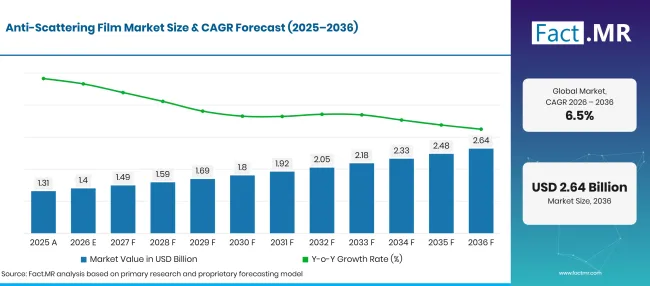
Anti Scattering Film Market Forecast Global 2 | Source: Fact.MR
| Year | Basis | Market Value (USD billion) |
|---|---|---|
| 2025 | Actual | 1.31 |
| 2026 | Estimate | 1.4 |
| 2036 | Forecast | 2.64 |
| CAGR 2026 to 2036 | Forecast period | 6.5% |
Source: Fact.MR analysis. Updated Oct 22, 2026
What are the defining numbers behind Anti-Scattering Film Market growth?
The decade from 2026 to 2036 adds USD 1.2 billion in revenue, with electronics and vehicle glass taking the greater part.
- Demand Drivers in the Market
- Anti-scattering film for car displays gains volume as electric models add wide touchscreens and glass roofs. The International Energy Agency reported that electric car sales exceeded 17 million in 2024, a sales share above 20% [1]. Each of these cabins carries more glass that needs a fragment-retention layer.
- Glass shatter protection in buildings rises with new construction and refurbishment. Eurostat reported that production in construction increased by 0.5% in the EU in 2025 on an annual average basis [2]. Schools, offices and transit stations often specify safety film when glazing is replaced or upgraded.
- Earthquake and storm risk keeps safety window film on public and household checklists. Retrofit film is cheaper than replacing glass with laminated panes, and installers can treat a building without removing frames.
- Security concerns lift spending on thicker films for retail fronts, banks and government buildings. These grades slow forced entry and keep glass in the frame after an impact, which buys time for occupants.
- Recycled PET facestock opens a new selling point. Building owners with carbon targets now ask window film suppliers for lower-emission products that still pass impact tests.
- Key Segments Analyzed
- By Material Type: Polyethylene Terephthalate will hold 42.3% share in 2026, given its clarity, tensile strength and low cost per square meter.
- By Application: Electronics will account for 38.7% share in 2026 on the strength of cover glass lamination in phones, tablets and laptops.
- By End-User: Consumer Electronics will capture 40.2% share in 2026, as device brands specify the film on every new glass-fronted model.
- By Distribution Channel: Offline will command 72.4% share in 2026 through converters, glazing dealers and certified installers who fit the film on site.
- Analyst Opinion at Fact.MR
- Shambhu Nath Jha, Principal Consultant at Fact.MR, states, “Buyers in this field pay for what happens after glass breaks, so tested performance carries more weight than price per roll. Device makers will keep the bulk of volume, yet vehicle cabins and public buildings will add the faster layer of new orders. Suppliers that pair optical-grade film with trained installer networks will gain a clear edge.”
- Strategic Implications
- Film producers should qualify thin, high-clarity grades for foldable and curved displays, where adhesion must survive repeated bending.
- Automotive suppliers should test films against cabin heat and vibration cycles early in a vehicle program, since late changes to display stacks are costly.
- Installers and dealers should train crews on attachment systems for security grades, because building owners now ask for certified installation records.
- Building managers in seismic zones should budget for film on stairwell, corridor and school glazing during planned maintenance.
Japan will set the pace at 7.8% CAGR, where earthquake preparedness drives glass shatter protection in homes and offices. The United Kingdom follows at 6.8%, helped by rising electric car registrations and steady building work. Germany will grow at 6.1% as battery-electric models gain a larger slice of new car sales. A 5.5% rate in the United States rests on high spending on nonresidential construction. Brazil will advance at 4.8% on broad phone ownership and a large domestic electronics assembly base.
How does the Anti-Scattering Film Market break down by segment?
Polyethylene Terephthalate will lead Material Type at 42.3%; Electronics will lead Application at 38.7%; Consumer Electronics will lead End-User at 40.2%; Offline will lead Distribution Channel at 72.4%.
Which Material Type dominates?
Polyethylene Terephthalate takes 42.3% of 2026 sales.
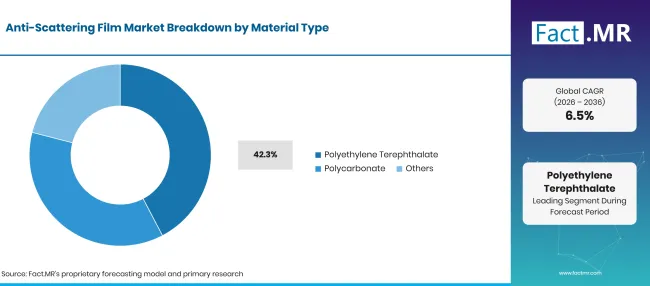
Anti Scattering Film Market Breakdown Material Type 1 | Source: Fact.MR
| Material Type | Share (2026) |
|---|---|
| Polyethylene Terephthalate (Leading segment) | 42.3% |
| Other segments combined | 57.7%* |
| Total | 100.0% |
Source: Fact.MR analysis. Updated Oct 22, 2026
PET anti-scattering film stays clear after coating, takes adhesives well and resists tearing at low gauges. Converters can buy it in wide rolls from many polyester film lines, which keeps supply steady. Producers are now adding recycled PET facestock, building on the post-consumer recycled films base that packaging already uses. Polycarbonate film serves parts that must bend or resist heat, such as curved bezels and some vehicle trim. It costs more and scratches more easily without a hard coat. Other polymers fill niche roles in specialty optics.
What leads the Application segment?
Electronics represents 38.7% of 2026 demand.
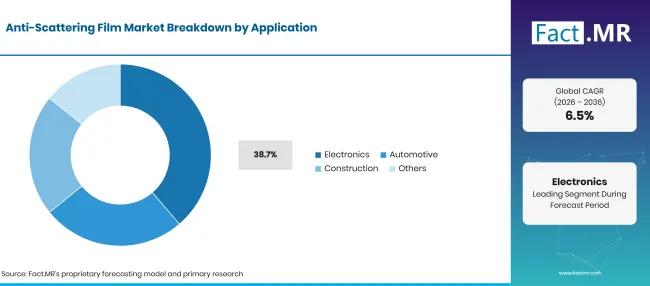
Anti Scattering Film Market Breakdown Application | Source: Fact.MR
| Application | Share (2026) |
|---|---|
| Electronics (Leading segment) | 38.7% |
| Other segments combined | 61.3%* |
| Total | 100.0% |
Source: Fact.MR analysis. Updated Oct 22, 2026
Phone and tablet makers laminate a film under or over cover glass so a cracked screen does not release splinters into the user’s hand. The smartphone supply chain buys these films in high, steady volumes. ITU reported that 82% of individuals aged 10 years or older worldwide owned a mobile phone in 2025 [3]. Automotive uses cover display glass, sunroofs and side windows. Safety film is also applied as a retrofit over automotive glass in fleet and armored vehicles. Construction uses film on glazing in schools, hospitals and transit buildings.
How does End-User shape demand?
Consumer Electronics buyers make up 40.2% of 2026 volume.
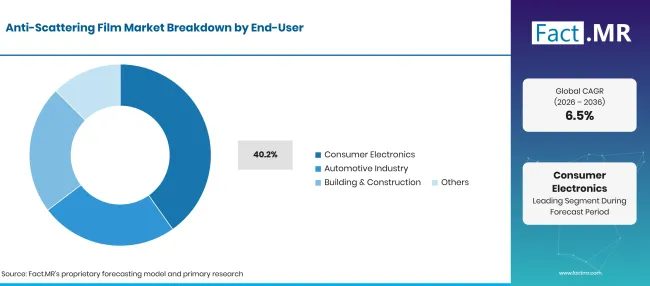
Anti Scattering Film Market Breakdown End User | Source: Fact.MR
| End-User | Share (2026) |
|---|---|
| Consumer Electronics (Leading segment) | 40.2% |
| Other segments combined | 59.8%* |
| Total | 100.0% |
Source: Fact.MR analysis. Updated Oct 22, 2026
Drop damage is a frequent reason a phone or tablet reaches a repair counter. Device brands therefore treat fragment retention as a basic safety feature, set in their own drop and ball-impact tests. The automotive industry buys film through Tier 1 display and glazing suppliers, with long qualification cycles. Building and construction buyers order through glaziers and facility managers. German authorities approved 19,500 dwellings in January 2026, up 8.4% on a year earlier [4]. That points to more glazing work ahead.
What supports Offline within Distribution Channel?
Offline routes handle 72.4% of 2026 orders.
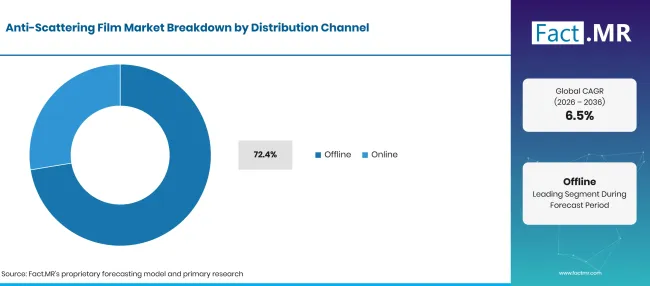
Anti Scattering Film Market Breakdown Distribution Channel | Source: Fact.MR
| Distribution Channel | Share (2026) |
|---|---|
| Offline (Leading segment) | 72.4% |
| Other segments combined | 27.6%* |
| Total | 100.0% |
Source: Fact.MR analysis. Updated Oct 22, 2026
Most safety window film is cut and fitted on site by trained crews. Electronics makers buy through direct contracts and converter partners. These channels give buyers test data, installation warranties and local stock. Online channels serve do-it-yourself buyers and small installers who order precut rolls and screen protectors. Retail window films for homes are a growing share of that traffic.
What is accelerating Anti-Scattering Film Market adoption, and what is holding it back?
Adoption is rising with screen-heavy devices, glass-rich vehicle cabins and safety retrofits in public buildings. Price pressure in consumer electronics and the cost of skilled installation slow the pace in some regions.
Drivers Impact Analysis
| DRIVER | (~) % IMPACT ON CAGR | GEOGRAPHIC RELEVANCE | IMPACT TIMELINE |
|---|---|---|---|
| Cover glass lamination in smartphones, tablets and laptops | +1.5% | East Asia, North America, South Asia & Pacific | Short term (<= 2 years) |
| Larger displays and glass roofs in electric vehicles | +1.2% | East Asia, Western Europe, North America | Medium term (2-4 years) |
| Seismic and storm preparedness in buildings | +0.9% | East Asia, North America | Medium term (2-4 years) |
| Security retrofits for schools, retail and public buildings | +0.7% | North America, Western Europe | Short term (<= 2 years) |
| Glazing work in new and refurbished buildings | +0.5% | Western Europe, Middle East & Africa | Long term (>= 4 years) |
Source: Fact.MR analysis. Updated Oct 22, 2026
Opportunity Impact Analysis
| OPPORTUNITY | (~) % IMPACT ON CAGR | GEOGRAPHIC RELEVANCE | IMPACT TIMELINE |
|---|---|---|---|
| Films for foldable and curved displays | +0.8% | East Asia | Medium term (2-4 years) |
| Recycled PET safety and solar control films | +0.6% | East Asia, Western Europe | Medium term (2-4 years) |
| Certified installer programs for security grades | +0.4% | North America, Latin America | Long term (>= 4 years) |
Source: Fact.MR analysis. Updated Oct 22, 2026
Restraints Impact Analysis
| RESTRAINT | (~) % IMPACT ON CAGR | GEOGRAPHIC RELEVANCE | IMPACT TIMELINE |
|---|---|---|---|
| Price pressure from device makers on film suppliers | -0.6% | East Asia, South Asia & Pacific | Short term (<= 2 years) |
| Competition from laminated and tempered glass | -0.5% | Global | Long term (>= 4 years) |
| Shortage of trained film installers | -0.3% | Latin America, Middle East & Africa | Medium term (2-4 years) |
Source: Fact.MR analysis. Updated Oct 22, 2026
Which countries are scaling the Anti-Scattering Film Market through 2036?
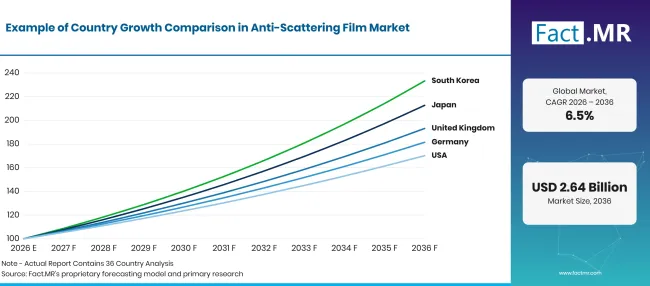
Factmr Anti Scattering Film Market Growth Index | Source: Fact.MR
| Country | CAGR (2026 to 2036) |
|---|---|
| Japan | 7.8% |
| United Kingdom | 6.8% |
| Germany | 6.1% |
| United States | 5.5% |
| Brazil | 4.8% |
Source: Fact.MR analysis. Updated Oct 22, 2026
What supports Japan’s adoption?
7.8% CAGR, driven by earthquake preparedness in homes, schools and offices.
Glass shatter prevention film in Japan is a standard item in disaster kits and building upkeep. The Earthquake Research Committee raised its 30-year probability for a Nankai Trough earthquake to about 80% in its January 2025 update [5]. Local window film suppliers sell scattering-prevention grades for homes and vehicles. Japanese display makers also laminate the film on panels for phones and car cockpits.
How is the United Kingdom scaling demand?
6.8% CAGR, backed by electric car registrations and steady construction output.
Safety film sales in the United Kingdom track both vehicles and buildings. The Department for Transport reported 528,000 zero emission vehicles registered for the first time in 2025, up 24% [6]. The Office for National Statistics reported that construction output increased by 1.8% in 2025 [7]. Schools and public offices also fit security film under protective security guidance.
What supports Germany’s growth?
6.1% CAGR, on the back of battery-electric car sales and a deep vehicle supply chain.
Car glass and display film demand in Germany follows vehicle output. The Kraftfahrt-Bundesamt reported 545,142 new battery-electric passenger cars in 2025, a 19.1% share and a 43.2% rise [8]. These models carry wide center screens and panoramic roofs. German glaziers also fit safety film on commercial glazing.
How is the United States developing demand?
5.5% CAGR, reflecting high nonresidential construction spending.
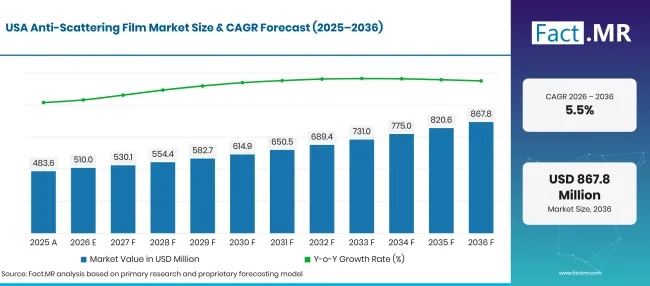
Anti Scattering Film Market Forecast Usa | Source: Fact.MR
Security window film in the United States is often fitted in schools, retail stores and federal buildings. The Census Bureau estimated nonresidential construction at a seasonally adjusted annual rate of $773.0 billion in August 2026 [9]. Hurricane zones along the Gulf and Atlantic coasts add steady orders for impact-rated film.
How does Brazil perform?
4.8% CAGR, as phone ownership and local electronics assembly widen the base.
Screen protection film in Brazil reaches buyers through phone retailers and repair shops. IBGE reported that 88.9% of people aged 10 or older had a mobile phone for personal use in 2024 [10]. National industrial production rose 0.6% in 2025, according to IBGE [11]. Electronics plants in the Manaus Free Trade Zone assemble phones and tablets for the home market.
Who leads the Anti-Scattering Film Market?
Suppliers fall into two groups. Diversified materials firms such as 3M and Eastman sell safety and security film lines through dealer networks, with 3M Scotchshield and LLumar safety film covering offices, schools and public buildings.
Saint-Gobain competes through Solar Gard Armorcoat, which is designed to hold shattered glass together after impact. Specialist film makers compete on certified systems and regional depth. Madico launched SafetyShield G2 in September 2025, a safety film and attachment system tested against blast and forced-entry standards [12]. LINTEC sells window films for buildings and vehicles that limit glass fragment scattering, and in July 2025 it launched a solar control film made from 100% recycled PET that also reduces shard scatter [13]. Garware Hi-Tech Films offers Secure Guard and Secure Plus safety films. Test certification, installer training and recycled content will shape who gains share.
Which companies are the key providers?
Key companies include 3M Company; Eastman Chemical Company (LLumar); Saint-Gobain (Solar Gard); Madico, Inc.; LINTEC Corporation; and Garware Hi-Tech Films Limited.
- 3M Company
- Eastman Chemical Company (LLumar)
- Saint-Gobain (Solar Gard)
- Madico, Inc.
- LINTEC Corporation
- Garware Hi-Tech Films Limited
Bibliography
- [1] International Energy Agency. (2025). Global EV Outlook 2025: Executive summary.
- [2] Eurostat. (2026, February 19). Production in construction up by 0.9% in the euro area and by 1.2% in the EU.
- [3] International Telecommunication Union. (2025, October 15). Facts and Figures 2025: Mobile phone ownership.
- [4] Statistisches Bundesamt (Destatis). (2026, March 18). Baugenehmigungen für Wohnungen im Januar 2026: +8,4 % zum Vorjahresmonat [Building permits for dwellings in January 2026: +8.4% on the same month a year earlier].
- [5] Earthquake Research Committee, Japan. (2025, January 15). 長期評価による地震発生確率値の更新について [Update of earthquake occurrence probabilities from long-term evaluation].
- [6] Department for Transport. (2026, April 29). Vehicle licensing statistics: 2025.
- [7] Office for National Statistics. (2026, February 12). Construction output in Great Britain: December 2025, new orders and construction output price indices, October to December 2025.
- [8] Kraftfahrt-Bundesamt. (2026, January 6). Fahrzeugzulassungen im Dezember 2025: Jahresbilanz [Vehicle registrations in December 2025: Annual results].
- [9] U.S. Census Bureau. (2026, October 1). Monthly Construction Spending, August 2026.
- [10] Instituto Brasileiro de Geografia e Estatística (IBGE). (2025, July 24). No Brasil, 88,9% da população de 10 anos ou mais tinha celular em 2024 [In Brazil, 88.9% of the population aged 10 or older had a mobile phone in 2024].
- [11] Instituto Brasileiro de Geografia e Estatística (IBGE). (2026, February 10). Produção industrial fecha 2025 com avanço em 10 dos 18 locais pesquisados [Industrial production closes 2025 with gains in 10 of 18 surveyed locations].
- [12] Madico, Inc. (2025, September 3). Madico Launches SafetyShield G2 Safety Film System.
- [13] LINTEC Corporation. (2025, July 8). Lintec Launches Solar Control Window Film Made with 100% Recycled PET Resin.
This Report Answers
- How large is anti-scattering film revenue in 2026, and what will it reach by 2036?
- Which material, application, end-user and channel hold first place in each segment?
- How do earthquake risk, vehicle electrification and building work shape demand in the five profiled countries?
- Which film makers offer certified safety and security systems, and what sets them apart?
- What limits growth, from device price pressure to installer shortages?
What does the Anti-Scattering Film Market cover?
Shatterproof film for glass in this study means clear PET, polycarbonate and other polymer films with an adhesive layer. These films are applied to display glass, vehicle windows and building glazing to keep fragments in place after breakage.
Sales are tracked at the film level across electronics, automotive and construction uses. Revenue is counted when the film is sold to device makers, converters, dealers or installers.
What is included in the scope?
Factory-laminated films on phone, tablet and laptop cover glass are included, as are retrofit safety and security window films. Films applied to automotive windshields and side glass for fragment retention also count.
Dual-purpose films that combine solar control with shatter resistance are included at their full film value. Installation labor is counted only when sold as part of a film system.
What is excluded from the scope?
Laminated and tempered glass made without an applied film fall outside the revenue boundary. So do PVB and other interlayers sealed inside flat glass during lamination.
Decorative, privacy and tint films that carry no fragment-retention rating are excluded. Paint protection films for car bodies are also left out.
How Was the Analysis Built?
The analysis draws on 120+ sources, 35+ company portfolios, 25+ countries, and more than 20 industry interviews.
- Primary Research: Primary research includes discussions with manufacturers, service providers, technology developers, distributors, end users, and subject-matter experts. These conversations examine purchasing priorities, product adoption, operational challenges, approval requirements, competitive positioning, and the factors that influence wider market acceptance.
- Desk Research: Desk research covers government statistics, regulatory publications, company filings, trade data, technical studies, industry associations, standards, public policy, and other authoritative sources. Every source used in the analysis is documented in the bibliography.
- Market Sizing and Forecasting: Market estimates combine historical performance, demand indicators, pricing and volume trends, segment shares, company participation, country-level growth, adoption patterns, investment activity, and barriers to market expansion.
- Data Validation and Update Cycle: Findings are validated by comparing primary interviews with public data, company activity, regulatory changes, trade patterns, and industry developments. Regular updates review new product launches, capacity changes, partnerships, approvals, and shifts in commercial adoption.
Segmentation
What is the report’s scope and coverage?
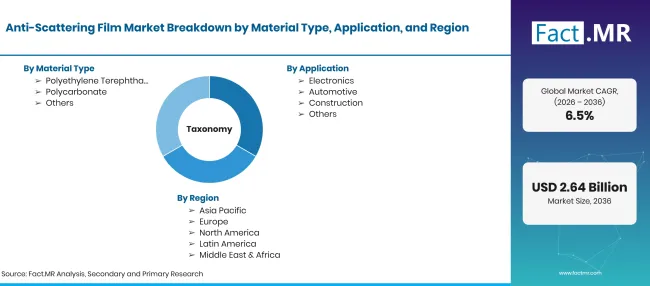
Anti Scattering Film Market Taxonomy | Source: Fact.MR
| Attribute | Details |
|---|---|
| Quantitative Units | USD billion in 2026 to USD billion by 2036 at CAGR |
| Market Definition | Transparent polymer films with adhesive that are laminated to glass to hold fragments together when it breaks. The market covers films for display cover glass, vehicle glazing and building windows. |
| Material Type | Polyethylene Terephthalate; Polycarbonate; Others |
| Application | Electronics; Automotive; Construction; Others |
| End-User | Consumer Electronics; Automotive Industry; Building & Construction; Others |
| Distribution Channel | Offline; Online |
| Regions Covered | North America; Latin America; Western Europe; Eastern Europe; East Asia; South Asia & Pacific; Middle East & Africa |
| Countries Covered | Japan; United Kingdom; Germany; United States; Brazil |
| Companies Profiled | 3M Company; Eastman Chemical Company (LLumar); Saint-Gobain (Solar Gard); Madico, Inc.; LINTEC Corporation; Garware Hi-Tech Films Limited |
| Forecast Period | 2026 to 2036 |
| Approach | Hybrid top-down and bottom-up approach using device shipments; vehicle glazing area; building glazing retrofits; film price per square meter; and supplier portfolio review. |
Source: Fact.MR analysis. Updated Oct 22, 2026
How is the market segmented?
-
By Material Type
- Polyethylene Terephthalate
- Polycarbonate
- Others
-
By Application
- Electronics
- Automotive
- Construction
- Others
-
By End-User
- Consumer Electronics
- Automotive Industry
- Building & Construction
- Others
-
By Distribution Channel
- Offline
- Online
-
By Region
- North America
- Latin America
- Western Europe
- Eastern Europe
- East Asia
- South Asia & Pacific
- Middle East & Africa
Frequently Asked Questions
How big is the anti-scattering film market in 2026?
What is the CAGR of the anti-scattering film market from 2026 to 2036?
Which material type leads the anti-scattering film market?
Which application leads the anti-scattering film market?
Which end-user leads the anti-scattering film market?
Which distribution channel leads the anti-scattering film market?
Which country will grow the most in the anti-scattering film market?
Who are the main companies in the anti-scattering film market?
Who worked on this report


Preview the report firsthand - request a free sample
Free SampleGet the brochure for pricing and purchase details
Download PDF