- Market Value (2025): USD 2.83 Bn
- Estimated Value (2026): USD 2.98 Bn
- Forecast Value (2036): USD 4.95 Bn
- CAGR (2026-2036): 5.2%
What is the Mineral Flotation Collectors Market forecast to be worth by 2036?
USD 3.0 billion in 2026 to USD 5.0 billion by 2036, at a CAGR of 5.2%.
- As per Fact.MR analysis, the mineral flotation collectors market was valued at USD 2.83 billion in 2025.
- Revenue is projected to increase from USD 2.98 billion in 2026 to USD 4.95 billion by 2036 as mining operators seek improved mineral recovery, concentrate quality, and flotation circuit efficiency.
- The market is forecast to record a 5.2% CAGR from 2026 to 2036.
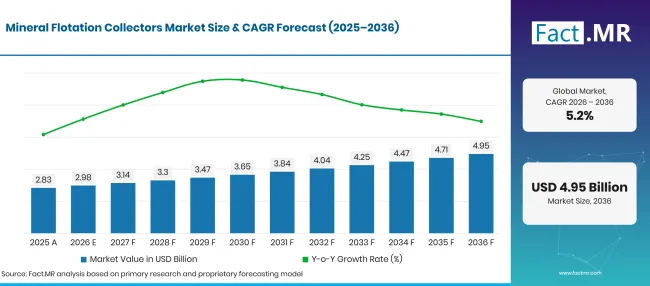
Mineral Flotation Collectors Market Forecast Global | Source: Fact.MR
| Year | Basis | Market Value (USD billion) |
|---|---|---|
| 2025 | Actual | 2.83 |
| 2026 | Estimate | 2.98 |
| 2036 | Forecast | 4.95 |
| CAGR, 2026–2036 | Forecast period | 5.2% |
Source: Fact.MR analysis. Updated Oct 24, 2026
What are the defining numbers behind Mineral Flotation Collectors Market growth?
USD 2.0 billion in additional revenue is projected between 2026 and 2036.
- Demand Drivers in the Market
- Growth in mineral production supports demand for flotation collectors used to separate valuable minerals from ore and improve concentrate recovery. The U.S. Geological Survey reported in February 2026 that the value of U.S. mineral production increased by 5.6% to USD 112 billion in 2025, reflecting continued activity across the domestic mining sector [1].
- Rising demand for critical minerals increases the importance of efficient mineral processing technologies. The U.S. Geological Survey reported that global lithium production increased by 31% in 2025, while consumption rose by 20% [2].
- Investment in mineral beneficiation and processing supports the need for suitable collector formulations across different ore types. Brazilian mineral statistics provide broader context for beneficiation activity, while collector use depends on the mineral processed and the separation method selected. 3
- Key Segments Analyzed
- By Collector Type: Anionic collectors leads the collector type segmentation with 42.5% share in 2026, reflecting their role in mineral surface modification and selective separation during flotation.
- By Mineral Type: Sulfide minerals holds 48.3% share, driven by the importance of flotation in processing sulfide ores and recovering valuable metals.
- By Application: Mining will account for 62.7% of the market segmentation, reflecting the use of flotation collectors to improve mineral recovery and concentrate quality during ore beneficiation.
- By End-User Industry: Mining represents 62.7% of the segmentation in 2026, supported by reagent requirements linked to ore throughput, recovery targets, concentrate specifications, and processing costs.
- Analyst Opinion at Fact.MR
- Shambhu Nath Jha, Principal Consultant at Fact.MR, states, “Mineral flotation collectors market is influenced by the need to optimize mineral recovery while managing processing costs and increasingly complex ore characteristics. Suppliers developing selective collector chemistries, customized formulations, and lower-dosage solutions may be better positioned to address changing beneficiation requirements.”
- Strategic Implications
- Manufacturers need to develop mineral-specific collector formulations to address differences in sulfide, oxide, and non-sulfide mineral processing requirements.
- Mining operators can apply laboratory testing and plant-level monitoring to optimize reagent dosage, mineral recovery, concentrate grades, and processing costs.
- Suppliers benefit from strengthening technical support through customized formulations and application testing that account for variations in mineralogy, water chemistry, and operating conditions.
- Companies are encouraged to evaluate lower-impact collector technologies that reduce chemical consumption or improve process efficiency while maintaining metallurgical performance and meeting environmental requirements.
Germany leads the country growth outlook with a projected CAGR of 6.7% from 2026 to 2036, followed by Brazil at 6.1%. The United States is projected to grow at 5.5%, while the United Kingdom and Japan are expected to record CAGRs of 4.9% and 4.4%, respectively.
How does the Mineral Flotation Collectors Market break down by segment?
Fact.MR's analysis Anionic Collectors as the leading Collector Type at 42.5%, Sulfide Minerals as the leading Mineral Type at 48.3%, and Mining as the leading category in both Application and End-User Industry at 62.7%.
Which Collector Type dominates?
Anionic Collectors account for 42.5% share in the segmentation.
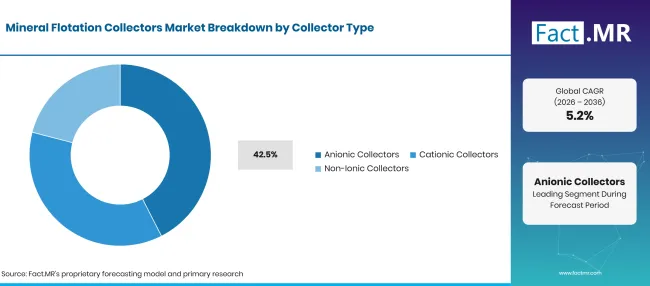
Mineral Flotation Collectors Market Breakdown Collector Type | Source: Fact.MR
| Collector Type | Share |
|---|---|
| Anionic Collectors (Leading segment) | 42.5% |
| Other segments combined | 57.5%* |
| Total | 100.0% |
Source: Fact.MR analysis. Updated Oct 24, 2026
Anionic collectors promote mineral separation by modifying surface properties and supporting the attachment of selected particles to air bubbles during froth flotation. Their performance depends on mineral composition, reagent structure, process pH, and water chemistry. Cationic collectors, non-ionic collectors, and other collector chemistries serve different mineral-processing requirements. Collector selection depends on the desired balance between mineral recovery, concentrate grade, and separation selectivity.
Which Mineral Type leads the Market?
Sulfide Minerals holds 48.3% share in 2026.
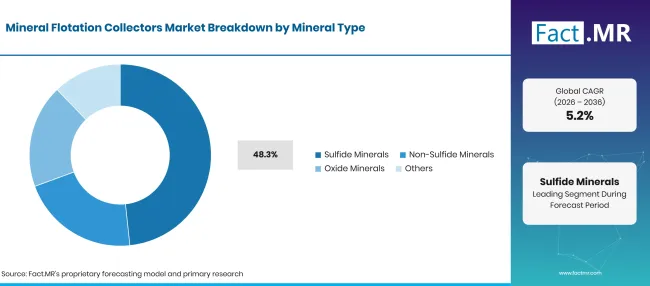
Mineral Flotation Collectors Market Breakdown Mineral Type | Source: Fact.MR
| Mineral Type | Share |
|---|---|
| Sulfide Minerals (Leading segment) | 48.3% |
| Other segments combined | 51.7%* |
| Total | 100.0% |
Source: Fact.MR analysis. Updated Oct 24, 2026
Sulfide minerals represent an important category in flotation-based metal recovery. Collectors interact with mineral surfaces to improve hydrophobicity and facilitate separation from unwanted material. Non-sulfide and oxide minerals may require different reagent formulations and operating conditions because their surface properties and flotation responses vary. Mineral composition, surface oxidation, particle size, and water chemistry influence collector performance and the quality of the resulting concentrate.
How does Application shape demand?
Mining leads with 62.7% share application segmentation in 2026.
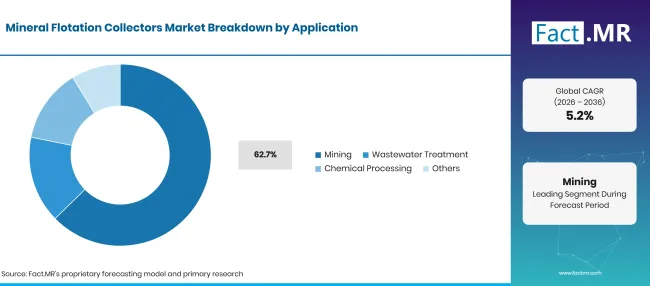
Mineral Flotation Collectors Market Breakdown Application | Source: Fact.MR
| Application | Share |
|---|---|
| Mining (Leading segment) | 62.7% |
| Other segments combined | 37.3%* |
| Total | 100.0% |
Source: Fact.MR analysis. Updated Oct 24, 2026
Mining operations use flotation collectors to separate valuable minerals from gangue and produce concentrates for downstream processing. Reagent demand depends on ore throughput, mineral composition, recovery targets, and the required concentrate grade. Laboratory testing and plant trials help operators determine suitable collector formulations and dosage levels. Mineral beneficiation is the core application for flotation collectors in this report. Other separation processes belong in the market only when the approved product definition and revenue scope expressly include them.
Which End-User Industry leads?
Mining accounts for 62.7% share end-user industry segmentation.
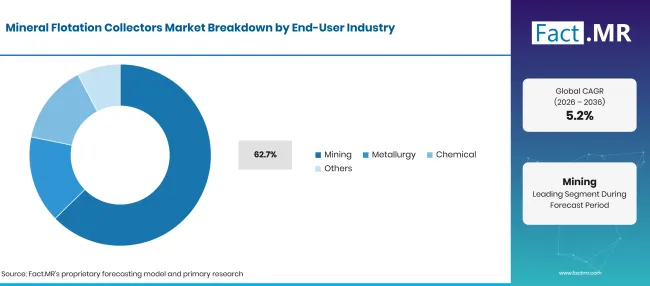
Mineral Flotation Collectors Market Breakdown End User Industry | Source: Fact.MR
| End-User Industry | Share |
|---|---|
| Mining (Leading segment) | 62.7% |
| Other segments combined | 37.3%* |
| Total | 100.0% |
Source: Fact.MR analysis. Updated Oct 24, 2026
Mining companies and mineral-processing operators purchase flotation collectors according to ore characteristics, processing capacity, recovery targets, concentrate specifications, and reagent costs. Procurement decisions often involve laboratory evaluations, pilot-scale trials, and plant-level performance monitoring to establish whether a formulation delivers consistent metallurgical results.
What is accelerating Mineral Flotation Collectors Market adoption, and what is holding it back?
Demand for efficient mineral recovery, selective separation, and improved concentrate quality supports market growth, while reagent costs, ore variability, and flotation circuit compatibility can constrain adoption.
rivers Impact Analysis
| Driver | (~) % IMPACT ON CAGR | Geographic Relevance | Impact Timeline |
|---|---|---|---|
| Rising demand for mineral recovery and ore beneficiation | +1.0% | Global | Medium term (2–4 years) |
| Increasing processing requirements for complex sulfide ores | +0.9% | Americas, Asia-Pacific | Medium term (2–4 years) |
| Optimization of collector dosage and flotation selectivity | +0.7% | Global | Short term (≤ 2 years) |
| Expansion of mineral processing capacity | +0.5% | Asia-Pacific, Americas | Long term (≥ 4 years) |
Source: Fact.MR analysis. Updated Oct 24, 2026
Opportunity Impact Analysis
| Opportunity | (~) % IMPACT ON CAGR | Geographic Relevance | Impact Timeline |
|---|---|---|---|
| Mineral-specific collector formulations | +0.8% | Global | Medium term (2–4 years) |
| Lower reagent consumption through flotation optimization | +0.6% | Americas, Asia-Pacific | Medium term (2–4 years) |
| Development of lower-impact flotation reagents | +0.5% | Europe, Asia-Pacific | Long term (≥ 4 years) |
| Digital monitoring of reagent dosage and recovery performance | +0.4% | Global | Short term (≤ 2 years) |
Source: Fact.MR analysis. Updated Oct 24, 2026
Restraints Impact Analysis
| Restraint | (~) % IMPACT ON CAGR | Geographic Relevance | Impact Timeline |
|---|---|---|---|
| Reagent costs and cost per tonne of processed ore | −0.8% | Global | Short term (≤ 2 years) |
| Variable ore mineralogy and inconsistent flotation response | −0.6% | Global | Medium term (2–4 years) |
| Collector compatibility with process water and flotation conditions | −0.5% | Global | Short term (≤ 2 years) |
| Limited technical expertise and plant-level optimization capabilities | −0.4% | Emerging mining markets | Medium term (2–4 years) |
Source: Fact.MR analysis. Updated Oct 24, 2026
Which countries are scaling the Mineral Flotation Collectors Market through 2036?
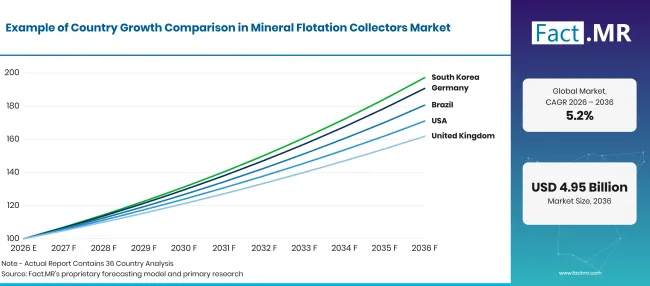
Mineral Flotation Collectors Market Growth Index | Source: Fact.MR
| Country | CAGR (2026–2036) |
|---|---|
| Germany | 6.7% |
| Brazil | 6.1% |
| USA | 5.5% |
| UK | 4.9% |
| Japan | 4.4% |
Source: Fact.MR analysis. Updated Oct 24, 2026
What supports Germany's adoption?
6.7% CAGR, reflecting potential demand for specialized mineral-processing chemicals and industrial mineral beneficiation.
Germany's industrial and chemical manufacturing base provides a relevant context for specialty chemicals used in mineral processing. Flotation collectors can support beneficiation activities where mineral separation is required to meet downstream quality specifications. Demand may be influenced by industrial mineral applications, reagent technology development, and the availability of specialized chemical suppliers.
Fact.MR analysis indicates that customized collector formulations, process optimization, and demand for efficient mineral separation could support market development. Suppliers serving German customers may find opportunities in reagent systems designed to improve recovery, selectivity, and chemical efficiency.
What supports Brazil's adoption?
6.1% CAGR, led potential opportunities in mineral processing, iron ore beneficiation, and specialized flotation chemistry.
Brazil has a substantial mining industry and is an important producer of iron ore and other mineral commodities. Flotation chemicals can support the separation of valuable mineral fractions and the improvement of concentrate quality in relevant processing operations. However, not all iron ore beneficiation relies on flotation, and demand for collectors depends on the mineral characteristics and processing route used at each facility.
Fact.MR analysis indicates that demand for tailored reagents, technical support, and improved mineral recovery could support market development. Growth will depend on mining investment, ore characteristics, processing requirements, and the commercial performance of collector formulations.
What supports adoption in the United States?
5.5% CAGR, supported potential demand for mineral recovery technologies and specialized reagents for metal and industrial mineral processing.
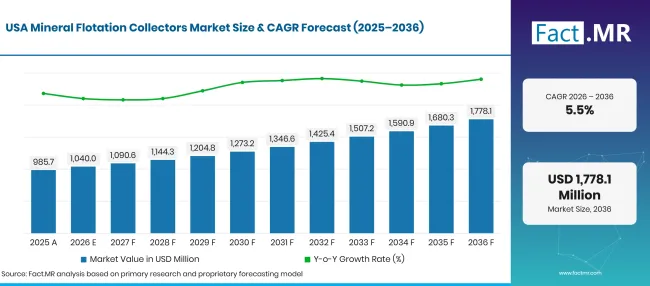
Mineral Flotation Collectors Market Forecast Usa | Source: Fact.MR
The United States has an established mining and mineral-processing sector. The U.S. Geological Survey's Mineral Commodity Summaries 2026 provides information on domestic mineral production, industry structure, trade, and supply conditions across more than 90 nonfuel mineral commodities. These indicators provide context for the demand for mineral-processing technologies but do not directly measure flotation collector consumption [4].
Fact.MR analysis indicates that collectors capable of supporting recovery and concentrate-grade targets could find applications across selected mining operations. Suppliers may also find opportunities in solutions designed for complex ores and selected critical mineral processing applications.
How does the United Kingdom perform?
4.9% CAGR, backed potential demand for specialized reagents in mineral processing and industrial mineral applications.
The UK Mineral Flotation Collectors Market may benefit from demand for efficient mineral recovery, specialised reagents and critical mineral processing. UK specialist chemical suppliers can serve domestic mineral processing and overseas beneficiation operations, with opportunities depending on customer specifications and flotation circuit performance. UK priorities around critical mineral supply security and reliable industrial mineral supplies may further support selected beneficiation applications . [6][6]
How is Japan developing demand?
4.4% CAGR, shaped potential demand for efficient mineral processing, advanced reagent technologies, and reliable mineral supply chains.
Japan's industrial manufacturing base creates demand for mineral raw materials used in metals, electronics, chemicals, and other downstream industries. Flotation collectors can support mineral beneficiation in relevant domestic or overseas processing operations supplying these industries. However, demand for mineral raw materials does not directly translate into domestic collector consumption.
Who leads the Mineral Flotation Collectors Market?
The competitive landscape of the Mineral Flotation Collectors Market includes BASF SE, Clariant AG, Syensqo SA/NV, Nouryon, and Orica Limited. These companies have relevant mineral-processing chemical portfolios, flotation reagent products, or documented activity in the sector.
Competitive positioning depends on collector performance, dosage requirements, mineral selectivity, raw material costs, technical support, and supply reliability. Manufacturers seek to address variations in ore mineralogy, surface chemistry, and processing conditions through specialized formulations and application expertise.
Market participants can differentiate themselves through mineral-specific collector technologies, laboratory testing, technical assistance, and consistent performance across different flotation circuits. Competitive assessments should distinguish direct mineral flotation collector suppliers from companies that primarily provide frothers, modifiers, or other adjacent processing chemicals.
Which companies are the key providers?
The key companies identified for the Mineral Flotation Collectors Market are:
- BASF SE
- Clariant AG
- Syensqo SA/NV
- Nouryon
- Orica Limited
Bibliography
- [1] U.S. Geological Survey. (2026, February 6). Value of U.S. mineral production rose last year, driven by precious metals prices.
- [2] U.S. Geological Survey. (2026, February 6). Lithium. In Mineral commodity summaries 2026.
- [3] Agência Nacional de Mineração. (n.d.). Produção mineral.
- [4] U.S. Geological Survey. (2026, February 6). Mineral commodity summaries 2026.
- [5] Ministry of Mines, Government of India. (2026). Annual report 2025–26.
- [6] Gem Resources plc. (2026, September 8). Acquisition. London Stock Exchange.
- [7] Ministry of Economy, Trade and Industry. (2026, June 30). Current survey of production.
This Report Answers
- Mineral Flotation Collectors Market revenue is analyzed by collector type, mineral type, application, and end-user industry.
- The report examines how collector chemistry, ore characteristics, and flotation conditions influence mineral recovery and concentrate quality.
- Mining activity, mineral-processing requirements, and industrial demand frame the comparison of Germany, Brazil, the United States, the United Kingdom, and Japan.
- Company profiles identify five companies from the competitive landscape, subject to verification of their participation in the defined market.
- Drivers, opportunities, and restraints are assessed for their potential influence on market development through 2036.
- The report identifies potential opportunities associated with specialized collector formulations, reagent optimization, and mineral beneficiation.
What does the Mineral Flotation Collectors Market cover?
The Mineral Flotation Collectors Market covers chemical reagents used in froth flotation to improve the selective separation of valuable minerals from unwanted gangue. Collectors modify the surface properties of target minerals, making them more hydrophobic and promoting their attachment to air bubbles during mineral beneficiation.
The assessment considers collector chemistries used in sulfide, non-sulfide, and oxide mineral processing. Demand is influenced by ore mineralogy, reagent dosage, flotation efficiency, recovery targets, concentrate specifications, and the operating economics of mining and processing facilities.
What is included in the scope?
The proposed market scope includes flotation collectors used in relevant mineral-processing applications. Collector categories include anionic collectors, cationic collectors, non-ionic collectors, and other specialized chemistries.
Products are included when their primary function is to act as collectors in mineral flotation. Customized formulations may be included when they are developed specifically to support mineral recovery and beneficiation requirements. Market sizing should account for the revenue attributable to these products rather than the full value of a supplier's mining chemicals portfolio.
What is excluded from the scope?
Unless explicitly included in the finalized market definition, the assessment excludes frothers, depressants, activators, flocculants, and other flotation reagents that do not function primarily as collectors.
Mining equipment, flotation cells, grinding systems, mineral concentrates, mining services, and standalone laboratory testing services are excluded from collector-market revenue. These products and services may influence collector adoption but are not themselves flotation collectors.
How Was the Analysis Built?
The analysis draws on 120+ sources, 35+ company portfolios, 25+ countries, and more than 20 industry interviews.
- Primary Research: Primary research includes discussions with manufacturers, service providers, technology developers, distributors, end users, and subject-matter experts. These conversations examine purchasing priorities, product adoption, operational challenges, approval requirements, competitive positioning, and the factors that influence wider market acceptance.
- Desk Research: Desk research covers government statistics, regulatory publications, company filings, trade data, technical studies, industry associations, standards, public policy, and other authoritative sources. Every source used in the analysis is documented in the bibliography.
- Market Sizing and Forecasting: Market estimates combine historical performance, demand indicators, pricing and volume trends, segment shares, company participation, country-level growth, adoption patterns, investment activity, and barriers to market expansion.
- Data Validation and Update Cycle: Findings are validated by comparing primary interviews with public data, company activity, regulatory changes, trade patterns, and industry developments. Regular updates review new product launches, capacity changes, partnerships, approvals, and shifts in commercial adoption.
Segmentation
What is the report's scope and coverage?
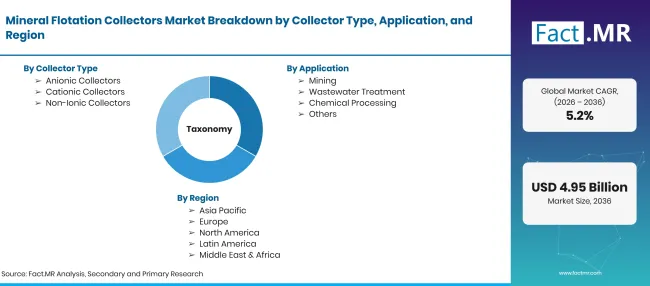
Mineral Flotation Collectors Market Taxonomy | Source: Fact.MR
| Attribute | Details |
|---|---|
| Quantitative Units | USD billion in 2026 to USD billion by 2036, at CAGR |
| Market Definition | Chemical reagents used to modify mineral surface properties and promote the selective attachment of target mineral particles to air bubbles during froth flotation |
| Collector Type | Anionic Collectors; Cationic Collectors; Non-Ionic Collectors; Others |
| Mineral Type | Sulfide Minerals; Non-Sulfide Minerals; Oxide Minerals; Others |
| Application | Mining; Wastewater Treatment; Chemical Processing; Others |
| End-User Industry | Mining; Metallurgy; Chemical Processing; Others |
| Regions Covered | North America; Latin America; Western Europe; Eastern Europe; East Asia; South Asia & Pacific; Middle East & Africa |
| Countries Covered | Germany; Brazil; United States; United Kingdom; Japan |
| Companies Profiled | BASF SE; Clariant AG; Syensqo SA/NV; Nouryon; Orica Limited |
| Forecast Period | 2026 to 2036 |
| Proposed Approach | Hybrid top-down and bottom-up approach using mineral production, ore-processing volumes, collector consumption, reagent pricing, flotation technology adoption, company portfolios, and country-level mining indicators |
Source: Fact.MR analysis. Updated Oct 24, 2026
How is the market segmented?
-
By Collector Type
- Anionic Collectors
- Cationic Collectors
- Non-Ionic Collectors
- Others
-
By Mineral Type
- Sulfide Minerals
- Non-Sulfide Minerals
- Oxide Minerals
- Others
-
By Application
- Mining
- Wastewater Treatment
- Chemical Processing
- Others
-
By End-User Industry
- Mining
- Metallurgy
- Chemical Processing
- Others
-
By Region
- North America
- Latin America
- Western Europe
- Eastern Europe
- East Asia
- South Asia & Pacific
- Middle East & Africa
Frequently Asked Questions
How big is the Mineral Flotation Collectors Market in 2026?
What is the CAGR of the Mineral Flotation Collectors Market from 2026 to 2036?
Which Collector Type leads the Mineral Flotation Collectors Market?
Which Mineral Type leads the Mineral Flotation Collectors Market?
Which country will grow the most in the Mineral Flotation Collectors Market?
Who are the main companies in the Mineral Flotation Collectors Market?
Who worked on this report


Preview the report firsthand - request a free sample
Free SampleGet the brochure for pricing and purchase details
Download PDF