- Market Value (2025): USD 179.9 Mn
- Estimated Value (2026): USD 190.9 Mn
- Forecast Value (2036): USD 372.6 Mn
- CAGR (2026-2036): 6.1%
What is the Arrowroot Powder Market forecast to be worth by 2036?
USD 190.9 million in 2026 to USD 372.6 million by 2036 at 6.1% CAGR.
- The arrowroot powder market reached USD 179.9 million in 2025 as food and cosmetics users assessed cleaner starch options.
- Demand is projected to increase from USD 190.9 million in 2026 to USD 372.6 million by 2036.
- The market is forecast to record 6.1% CAGR from 2026 to 2036.
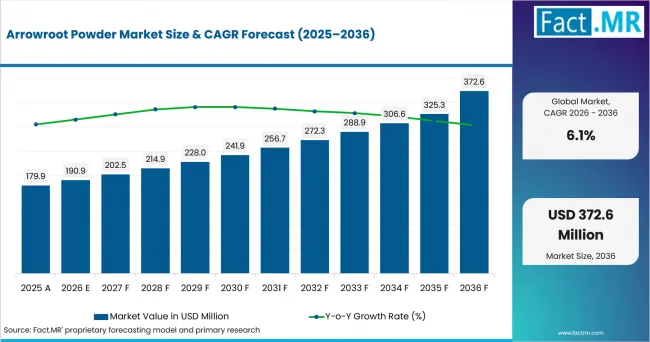
Arrowroot Powder Market Value Analysis | Source: Fact.MR
What are the defining numbers behind Arrowroot Powder Market growth?
USD 181.7 million absolute opportunity by 2036, led by Pure arrowroot powder and Food applications alongside clean-label formulation and texture-control demand.
- Demand Drivers in the Market
- Ingredient buyers evaluate arrowroot powder through texture and label fit before approving repeat use.
- Food users look for neutral thickening behavior in sauces and fillings. That use keeps the ingredient close to routine recipe work.
- Cosmetic formulators compare arrowroot powder with absorbent powders when dry-touch feel is part of the product brief.
- Retail and online channels give small brands a way to test pack sizes before deeper distribution.
- Key Segments Analyzed
- By Type: Pure is expected to hold 61.8% share in 2026 because buyers value a direct ingredient identity and simpler formulation control.
- By Application: Food is projected to lead with 61.6% share in 2026 as cooking and prepared-food uses create repeat purchase behavior.
- Analyst Opinion at Fact.MR
- Shambhu Nath Jha, PrincipalConsultant at Fact.MR, states, “Arrowroot powder suppliers need to prove application fit instead of presenting the ingredient as a general pantry substitute. Repeat orders are expected to depend on clean labeling and stable texture performance. Reliable supply across food and cosmetics channels is expected to decide repeat purchasing.”
- Strategic Implications
- Food brands gain a clearer buying case when arrowroot powder is positioned around thickening performance and label simplicity.
- Cosmetic suppliers can improve conversion by explaining absorbency and powder feel. Ingredient compatibility for body-care products then becomes easier to judge.
- Distributors need pack-size planning that separates household pantry use from manufacturer purchasing. That split reduces the risk of treating every order through one route.
The UK leads at 7.5% CAGR through clean-label ingredient demand and strong retail access. Australia follows at 7.7% as household cooking and specialty stores support trial. The USA reaches 7.1% through wider food and cosmetics use. Canada records 7.3% with stable specialty distribution, while Germany posts 6.0% as strict quality checks keep adoption measured.
How does the Arrowroot Powder Market break down by segment?
Pure leads Type with 61.8% share in 2026. Food leads Application with 61.6% share in 2026.
Why does Pure lead Type?
Pure is projected to account for 61.8% share in 2026.
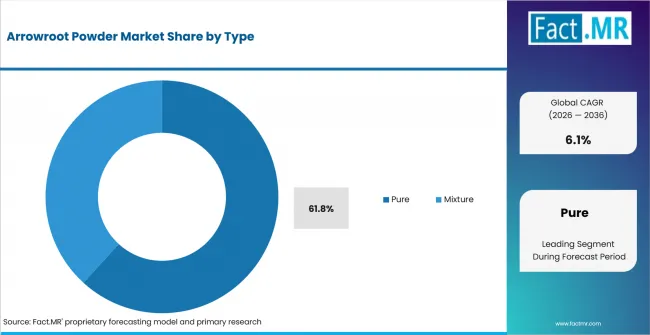
Arrowroot Powder Market Analysis By Type | Source: Fact.MR
A single-ingredient format gives Pure arrowroot powder an advantage in clean-label products. Manufacturers can control texture without adding extra components to the ingredient list. Mixture formats remain relevant for buyers seeking modified performance or lower formulation costs.
Why does Food lead Application?
Food accounts for 61.6% share in 2026.
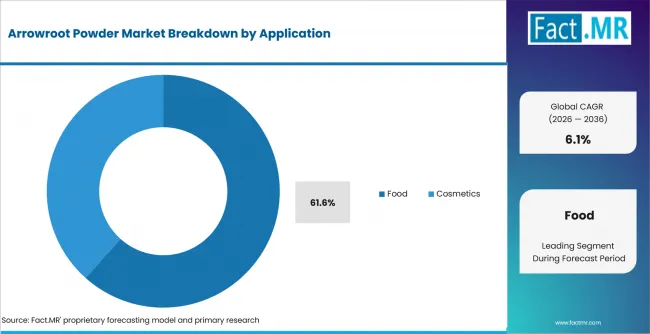
Arrowroot Powder Market Analysis By Application | Source: Fact.MR
Arrowroot powder fits naturally into sauces, fillings and other recipes that require gentle thickening. Its neutral taste and familiar handling support repeated use by households and food processors. Cosmetics form a separate demand base, mainly where absorbency and dry-touch performance matter.
What is accelerating Arrowroot Powder Market adoption, and what is holding it back?
Demand is expected to grow through clean-label food use and ready-to-sell product formats. Uneven raw material quality and competition from other starches may slow growth. Clear product-use guidance can support repeat orders.
Drivers Impact Analysis
| DRIVER | (~) % IMPACT ON CAGR | GEOGRAPHIC RELEVANCE | IMPACT TIMELINE |
|---|---|---|---|
| Clean-label food formulation | +1.7% | UK, USA, Australia | Short term (<= 2 years) |
| Pure ingredient positioning | +1.3% | North America and Europe | Short term (<= 2 years) |
| Online pantry and specialty retail access | +1.0% | USA, Canada, Australia | Medium term (2-4 years) |
| Cosmetics absorbency use | +0.8% | UK and Germany | Medium term (2-4 years) |
| Pack-size differentiation | +0.6% | Retail-based markets | Long term (>= 4 years) |
Source: Fact.MR analysis. Updated Aug 4, 2026
- Clean-label food formulation: Arrowroot powder is projected to gain attention when brands need thickening performance with a simple ingredient statement.
- Pure ingredient positioning: Buyers that prefer direct ingredient names are likely to favor Pure formats before testing blended options.
- Online pantry access: Digital shelves are expected to support trial because home cooks can compare pack sizes and use notes before buying.
Opportunity Impact Analysis
| OPPORTUNITY | (~) % IMPACT ON CAGR | GEOGRAPHIC RELEVANCE | IMPACT TIMELINE |
|---|---|---|---|
| Gluten-free cooking applications | +1.2% | USA, UK, Australia | Medium term (2-4 years) |
| Natural cosmetic powder formats | +0.9% | Germany and UK | Medium term (2-4 years) |
| Supplier-led application guidance | +0.7% | Food processing clusters | Long term (>= 4 years) |
| Retail pack-size segmentation | +0.5% | Canada and Australia | Long term (>= 4 years) |
Source: Fact.MR analysis. Updated Aug 4, 2026
- Gluten-free cooking applications: Arrowroot powder can serve recipes that need texture control without changing taste. This makes it useful for buyers comparing gluten-free products.
- Natural cosmetic powder formats: Personal care brands are expected to use arrowroot powder when absorbency supports a dry-touch product feel.
- Supplier guidance: Clear usage notes can reduce trial risk when buyers compare arrowroot with corn starch or tapioca starch.
Restraints Impact Analysis
| RESTRAINT | (~) % IMPACT ON CAGR | GEOGRAPHIC RELEVANCE | IMPACT TIMELINE |
|---|---|---|---|
| Input availability and crop dependence | -0.9% | Global supplier base | Short term (<= 2 years) |
| Substitution from other starches | -0.7% | Food manufacturing markets | Short term (<= 2 years) |
| Labeling and quality checks | -0.5% | USA, UK, Germany | Medium term (2-4 years) |
| Low awareness outside pantry use | -0.4% | Emerging retail channels | Long term (>= 4 years) |
Source: Fact.MR analysis. Updated Aug 4, 2026
- Input availability and crop dependence: Sourcing variability can affect cost and lot consistency before buyers approve larger supply agreements.
- Substitution from other starches: Corn starch and tapioca starch can limit switching when buyers prioritize price or existing supply routines.
- Labeling and quality checks: Suppliers need documentation that supports food and cosmetics use without adding approval work for customers.
Which countries are scaling Arrowroot Powder Market fastest?
- The country comparison spans 2.1 percentage points across the forecast period and keeps every listed country near the global 6.1% CAGR.
- The UK records 7.5% CAGR with retail access and clean-label ingredient selection.
- Australia reaches 7.7% CAGR through household cooking use and specialty retail visibility.
- The USA posts 7.1% CAGR as application breadth gives suppliers several routes to buyers.
- Canada reaches 7.3% CAGR with retail availability and small-brand distribution.
- Germany records 6.0% CAGR where mature food ingredient buying keeps approval more measured.
Comparable CAGRs can create different entry conditions due to buyer routines and application priorities. Full report coverage includes North America and Latin America. Europe and East Asia are included. South Asia and Pacific plus Middle East and Africa complete the regional view.
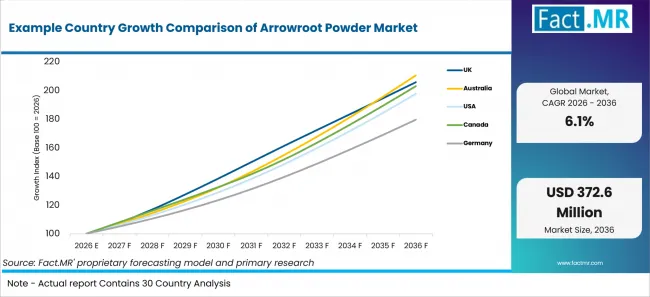
Example Country Growth Comparison Of Arrowroot Powder Market | Source: Fact.MR
| Country | CAGR (2026-2036) |
|---|---|
| UK | 7.5% |
| Australia | 7.7% |
| USA | 7.1% |
| Canada | 7.3% |
| Germany | 6.0% |
Source: Fact.MR analysis. Updated Aug 4, 2026
What is driving the UK’s growth through 2036?
7.5% CAGR, supported by retail access and clean-label ingredient selection.
The UK outlook starts with retail visibility. Buyers are expected to assess arrowroot powder as a pantry starch before moving it into repeat recipe use. Suppliers that explain texture performance in simple terms are better placed with food users and small cosmetics brands.
How is Australia building demand?
7.7% CAGR, backed by specialty retail channels and household cooking use.
Australia’s growth comes from buyers that compare alternative starches for cooking performance. Specialty grocery channels keep arrowroot powder visible for recipe-led use. Pack sizes that fit household trial and small manufacturer purchasing can improve conversion.
What supports USA adoption?
7.1% CAGR, carried by application breadth and online ingredient discovery.
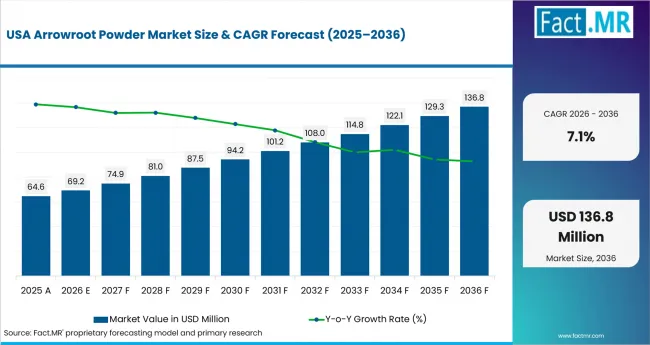
Arrowroot Powder Market Country Value Analysis | Source: Fact.MR
The USA market has several routes to the buyer. Food and wellness retail channels make arrowroot powder easier to discover. Manufacturers are expected to compare the ingredient with other food thickeners before approving broader use.
What is driving Canada’s growth through 2036?
7.3% CAGR, shaped by retail distribution and stable specialty ingredient demand.
Canada shows measured expansion in retail and specialty ingredient channels. Buyers are expected to value steady availability before testing broader use. Distributors that separate pantry demand from small food brand purchasing can serve the market more clearly.
How does Germany perform?
6.0% CAGR, tempered by mature food ingredient purchasing and quality checks.
Germany grows at a slower listed rate because ingredient approval is expected to be more selective. Food buyers review quality documentation and compare arrowroot with established starches. Cosmetics use can add demand when natural cosmetics and organic personal care claims require powder feel support.
Who leads the Arrowroot Powder Market?
Bob's Red Mill Natural Foods and Mountain Rose Herbs show the direct relevance. Westpoint Naturals and Terrasoul Superfoods widen the supplier set through ingredient and botanical product reach.
Bob's Red Mill Natural Foods supports arrowroot powder demand through pantry ingredient positioning. Mountain Rose Herbs contributes botanical and natural ingredient reach. Westpoint Naturals adds distribution depth for natural and specialty foods. Terrasoul Superfoods and Anthony’s Goods strengthen access to plant-based ingredient buyers. Hoosier Hill Farm and Namaste Foods add retail visibility. Authentic Foods and Naturevibe Botanicals extend the food-focused provider group. Barry Farm Foods plus Judee’s Gluten Free complete the named company set.
Which companies are the key providers?
Key companies include Bob's Red Mill Natural Foods; Mountain Rose Herbs; Westpoint Naturals; Terrasoul Superfoods; Anthony’s Goods; Hoosier Hill Farm; Namaste Foods; Authentic Foods; Naturevibe Botanicals; Barry Farm Foods; and Judee’s Gluten Free.
- Bob's Red Mill Natural Foods
- Mountain Rose Herbs
- Westpoint Naturals
- Terrasoul Superfoods
- Anthony’s Goods
- Hoosier Hill Farm
- Namaste Foods
- Authentic Foods
- Naturevibe Botanicals
- Barry Farm Foods
- Judee’s Gluten Free
Bibliography
- U.S. Census Bureau. (2025, May 19). Quarterly retail e-commerce sales: First quarter 2025. U.S. Department of Commerce.
- U.S. Food and Drug Administration. (2025, January). Guidance for industry: Questions and answers regarding food allergens, including the food allergen labeling requirements of the Federal Food, Drug, and Cosmetic Act (Edition 5).
- Office for Product Safety and Standards. (2025, July 10). Consumer products: Cosmetics. GOV.UK.
This Report Answers
- The report provides strategic intelligence on the Arrowroot Powder Market across Type and Application choices. It shows how food processing ingredients and cosmetics use shape demand.
- Segment analysis covers Pure and Food as the share leaders within the 2026 market.
- Country outlook evaluates the UK and Australia alongside the USA and Canada. Germany completes the growth comparison across the profiled markets.
- Competitive analysis profiles Bob's Red Mill Natural Foods and Mountain Rose Herbs alongside Westpoint Naturals and Terrasoul Superfoods. Anthony’s Goods and other suppliers complete the provider set.
- Application assessment covers Food and Cosmetics. The food view shows how arrowroot powder supports recipe texture. Cosmetics coverage focuses on absorbency and powder feel.
What does the Arrowroot Powder Market cover?
Arrowroot powder products are used across food and cosmetics when texture and absorbency influence purchase approval.
The Arrowroot Powder Market covers Pure and Mixture products sold through retail and business channels. Coverage includes food uses where the powder works as a starch-based thickener. Cosmetics are included when absorbency and dry-touch performance support formulation. The market also covers regional demand differences across the UK and Australia. USA and Canada follow in the country set. Germany completes the coverage.
What is included in the scope?
Commercial arrowroot powder products used in the defined Type and Application categories are included.
The scope includes Pure and Mixture formats. Food applications cover recipe and formulation use. Cosmetics applications cover powder-based and absorbency use. Regional coverage spans the listed countries and wider regions. Company coverage includes the named suppliers when their portfolios include arrowroot powder or related ingredient offerings.
What is excluded from the scope?
Products outside the defined type and application categories remain outside the assessment. Regional categories follow the same boundary.
The scope excludes unrelated starch products when they are not sold as arrowroot powder. It also excludes finished food or cosmetic products unless arrowroot powder demand is assessed through the ingredient. Company revenue without a clear arrowroot powder or related ingredient supply connection is not included.
How Was the Analysis Built?
The analysis draws on more than 120 sources. It reviews 35+ company portfolios and 25+ countries. More than 20 industry interviews support the final validation.
- Primary Research: Primary research includes discussions with manufacturers and service providers. Technology developers and distributors are reviewed with end users. Procurement teams and subject-matter experts are included where relevant. These conversations examine purchasing priorities and product adoption. They also review approval needs and factors that influence wider market acceptance.
- Desk Research: Desk research covers government statistics and regulatory publications. Company filings and trade data are reviewed separately. Technical studies and industry associations support market boundaries. Standards and public policy are checked where they affect market acceptance. Every source used in the analysis is documented in the bibliography.
- Market Sizing and Forecasting: Market estimates combine historical performance and demand indicators. Pricing and volume trends are reviewed with segment shares. Company participation and country-level growth support the forecast. Adoption patterns and barriers to market expansion are checked before final sizing.
- Data Validation and Update Cycle: Findings are validated by comparing primary interviews with public data. Company activity and regulatory changes are reviewed during updates. Trade patterns and industry developments are checked separately. Regular updates review product launches and capacity changes. Partnerships and procurement trends are reviewed when they affect commercial adoption.
Segmentation
What is the report’s scope and coverage?
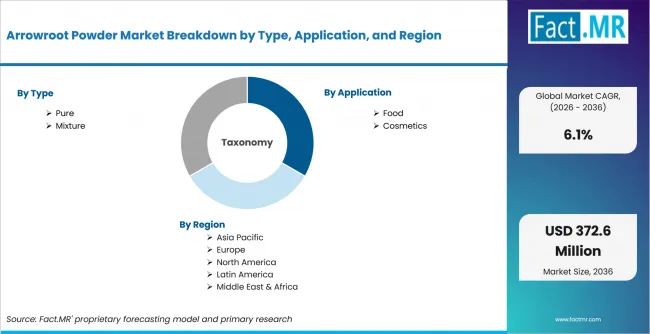
Arrowroot Powder Market Breakdown By Type, Application, And Region | Source: Fact.MR
| Attribute | Details |
|---|---|
| Quantitative Units | USD million in 2026 to USD million by 2036 at CAGR |
| Market Definition | Commercial arrowroot powder products used across food and cosmetics where texture control, absorbency, label fit and supply consistency influence purchasing |
| Type | Pure; Mixture |
| Application | Food; Cosmetics |
| Regions Covered | North America; Latin America; Europe; East Asia; South Asia and Pacific; Middle East and Africa |
| Countries Covered | UK; Australia; USA; Canada; Germany |
| Key Companies Profiled | Bob's Red Mill Natural Foods; Mountain Rose Herbs; Westpoint Naturals; Terrasoul Superfoods; Anthony’s Goods; Hoosier Hill Farm; and others |
| Forecast Period | 2026 to 2036 |
| Approach | Hybrid top-down and bottom-up market assessment using demand indicators, segment shares, supplier mapping and regional growth comparison |
Source: Fact.MR analysis. Updated Aug 4, 2026
How is the market segmented?
-
By Type:
- Pure
- Mixture
-
By Application:
- Food
- Cosmetics
-
By Region:
- North America
- Latin America
- Europe
- East Asia
- South Asia and Oceania
- Middle East and Africa
Frequently Asked Questions
Which type leads the Arrowroot Powder Market?
Which application leads the market?
Which country records the fastest growth?
What is the primary driver in this market?
What is the main restraint?
Which companies are included in the market assessment?
Who worked on this report


Preview the report firsthand - request a free sample
Free SampleGet the brochure for pricing and purchase details
Download PDF