- Market Value (2025): USD 9.93 Bn
- Estimated Value (2026): USD 10.5 Bn
- Forecast Value (2036): USD 18.4 Bn
- CAGR (2026-2036): 5.7%
What is the Artillery Ammunition Market forecast to be worth by 2036?
USD 10.5 billion in 2026 to USD 18.4 billion by 2036 at a CAGR of 5.7%.
- As per Fact.MR analysis, the Artillery Ammunition Market was valued at USD 9.93 billion in 2025
- Demand will grow from USD 10.5 billion in 2026 to USD 18.4 billion by 2036
- The market is forecast to expand at a 5.7% CAGR through 2036 as armed forces continue ammunition procurement and manufacturers respond to replenishment requirements.
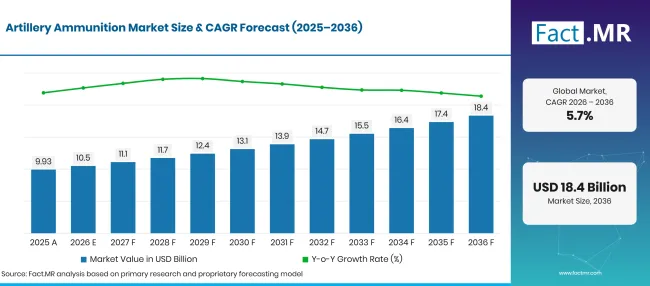
Artillery Ammunition Market Forecast Global | Source: Fact.MR
| Year | Basis | Market Value (USD billion) |
|---|---|---|
| 2025 | Actual | 9.93 |
| 2026 | Estimate | 10.5 |
| 2036 | Forecast | 18.4 |
| CAGR 2026 to 2036 | Forecast period | 5.7% |
Source: Fact.MR analysis. Updated Oct 30, 2026
What are the defining numbers behind Artillery Ammunition Market growth?
USD 7.9 billion absolute opportunity between 2026 and 2036
- Demand Drivers in the Market
- Military inventory replenishment is supporting demand as defense organizations seek to maintain ammunition availability for training and operational readiness. A July 2026 Department of War Office of Inspector General evaluation examined the capability and capacity to produce 155 mm artillery ammunition, providing oversight context for domestic production and supply planning [1]. [1]
- Expansion of ammunition manufacturing capacity is supporting the industry's ability to respond to procurement demand. The European Union's ASAP programme supports industrial projects intended to increase the production capacity of artillery ammunition and address supply-chain constraints [2].
- Modern artillery ammunition is supporting demand for products compatible with current artillery platforms. Artillery ammunition includes established 105 mm and 155 mm products used with compatible weapon systems, with selection governed by the applicable platform and operational requirements [3]. [3]
- Long-term defense procurement commitments can improve production planning by providing manufacturers with greater visibility into future orders. NATO identifies industrial capacity and timely supply as priorities for strengthening defense readiness, supporting continued attention to ammunition production and delivery capabilities [4].
- Key Segments Analyzed
- By Type: Medium Caliber is projected to capture 42.3% share in 2026.
- By Component: Projectiles will account for 38.2% of the market in 2026.
- By Application: Defense leads with 78.4% share in 2026.
- By End-User: Military is projected to represent for 81.2% of the market in 2026.
- Analyst Opinion at Fact.MR
- Shambhu Nath Jha, Principal Consultant at Fact.MR, states, “The artillery ammunition market is influenced by defense procurement priorities and the need for reliable access to ammunition supplies. Manufacturers with established production capabilities and the ability to meet qualification requirements are positioned to compete for procurement opportunities. Capacity expansion and supply-chain resilience will remain important considerations as defense organizations plan future purchases.”
- Strategic Implications
- Ammunition manufacturers should assess production capacity and supply-chain resilience to support procurement commitments and delivery schedules.
- Defense suppliers can strengthen their market position by demonstrating product compliance and compatibility with the artillery systems specified by customers.
- Procurement organizations need to consider supplier capacity and continuity of supply when planning ammunition replenishment.
- Manufacturers must monitor long-term defense procurement programmes and capacity investment initiatives to identify changes in demand and potential supply constraints.
Germany is projected to grow at a 5.1% CAGR from 2026 to 2036, while Brazil is forecast to expand at 5.6%. The United States is projected to record a 6.3% CAGR, followed by the United Kingdom at 4.3%. Japan has the highest country growth estimate at 7.2%.
How does the Artillery Ammunition Market break down by segment?
Medium Caliber is projected to lead the Type segment at 42.3%, Projectiles will represent 38.2% of Component, Defense will account for 78.4% of Application and Military will lead End-User at 81.2% in 2026.
Which Type leads?
Medium Caliber will represent 42.3% of 2026 share.
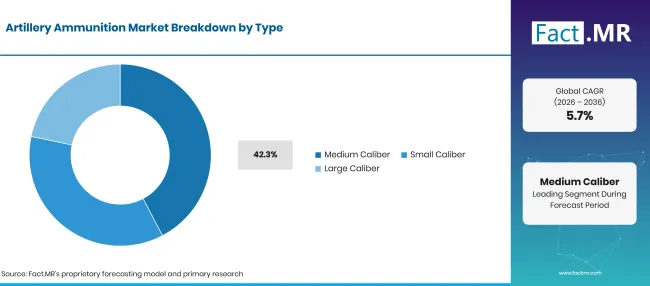
Artillery Ammunition Market Breakdown Type | Source: Fact.MR
| Type | Share (2026) |
|---|---|
| Medium Caliber (Leading segment) | 42.3% |
| Other segments combined | 57.7%* |
| Total | 100.0% |
Source: Fact.MR analysis. Updated Oct 30, 2026
The Medium Caliber category requires a defined caliber range within the market classification; its relevance to artillery ammunition must be established by the underlying research. Demand depends on the platforms in service and the procurement specifications of defense organizations. However, the category should be reviewed against the market boundary: small-caliber ammunition is not typically classified as artillery ammunition in a narrowly defined market. The report should specify the calibers included before treating the type shares as directly comparable.
What supports Projectiles within Component?
Projectiles will make up 38.2% of 2026 share.
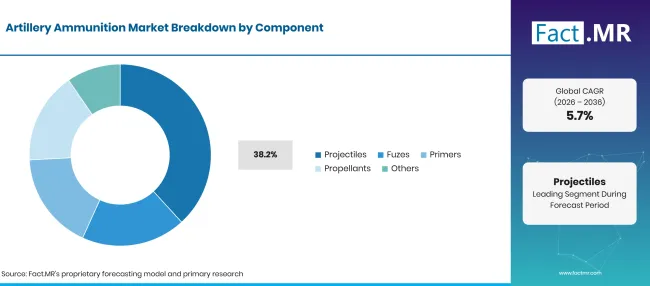
Artillery Ammunition Market Breakdown Component | Source: Fact.MR
| Component | Share (2026) |
|---|---|
| Projectiles (Leading segment) | 38.2% |
| Other segments combined | 61.8%* |
| Total | 100.0% |
Source: Fact.MR analysis. Updated Oct 30, 2026
Projectiles form the principal physical component of artillery rounds and must meet requirements for dimensional consistency and compatibility with the relevant weapon system. Their manufacture involves material processing and quality inspection to ensure that finished products meet specified standards. Fuzes and primers are separate components that support the intended functioning of a round, while propellants provide the energy needed for firing. The relative value of these components depends on the product mix and the scope used for market valuation.
How does Application shape demand?
Defense is projected to account for 78.4% of 2026 share.
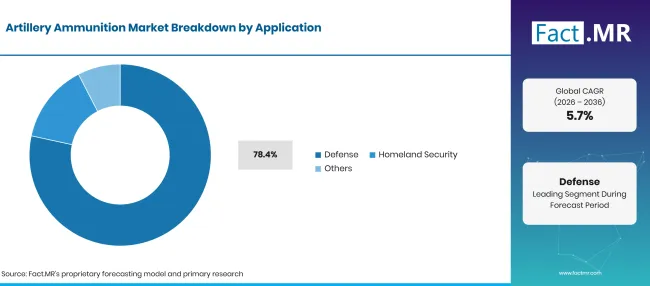
Artillery Ammunition Market Breakdown Application | Source: Fact.MR
| Application | Share (2026) |
|---|---|
| Defense (Leading segment) | 78.4% |
| Other segments combined | 21.6%* |
| Total | 100.0% |
Source: Fact.MR analysis. Updated Oct 30, 2026
Defense demand is shaped by military procurement plans and the need to maintain ammunition inventories for training and operational readiness. Purchasing decisions depend on compatibility with existing artillery platforms and the ability of suppliers to meet contractual quality requirements. Longer-term procurement arrangements can help manufacturers plan production and manage supply commitments. Homeland security and other applications should be retained as separate categories only where the report's market definition identifies relevant ammunition purchases in those areas.
Which End-User leads?
Military is projected to hold 81.2% share in 2026.
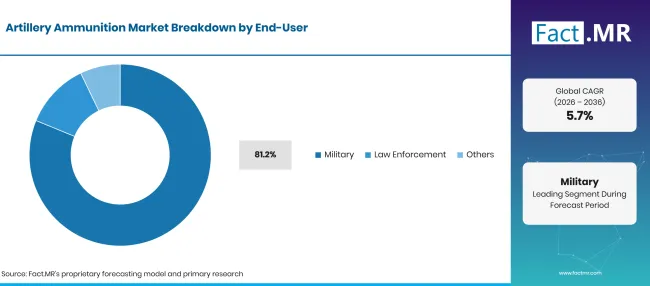
Artillery Ammunition Market Breakdown End User | Source: Fact.MR
| End-User | Share (2026) |
|---|---|
| Military (Leading segment) | 81.2% |
| Other segments combined | 18.8%* |
| Total | 100.0% |
Source: Fact.MR analysis. Updated Oct 30, 2026
Military organizations represent the primary end-user category in the segmentation because artillery ammunition is procured mainly for armed forces and their operational requirements. Demand is influenced by inventory replenishment and the need to maintain compatible supplies for equipment already in service. Procurement cycles can also reflect training needs and long-term defense planning. The law enforcement category requires particular scrutiny because conventional artillery ammunition is not generally a standard law enforcement purchase; retain it only if the underlying research supports its inclusion in the defined market.
What is accelerating the Artillery Ammunition Market, and what is holding it back?
Rising defense spending and demand for modern artillery systems accelerate adoption, while high ammunition costs and stringent procurement requirements slow market growth.
Drivers Impact Analysis
| DRIVER | (~) % IMPACT ON CAGR | GEOGRAPHIC RELEVANCE | IMPACT TIMELINE |
|---|---|---|---|
| Rising defense expenditure and ammunition replenishment | +1.2% | Europe, Americas | Short term (≤ 2 years) |
| Modernization of artillery systems | +1.0% | Global | Medium term (2–4 years) |
| Increased procurement amid regional security concerns | +0.9% | Europe, Asia | Short term (≤ 2 years) |
| Expansion of domestic ammunition production capacity | +0.6% | Europe, Americas, Asia | Medium term (2–4 years) |
| Demand for precision-compatible artillery ammunition | +0.5% | Global | Long term (≥ 4 years) |
Source: Fact.MR analysis. Updated Oct 30, 2026
Opportunity Impact Analysis
| OPPORTUNITY | (~) % IMPACT ON CAGR | GEOGRAPHIC RELEVANCE | IMPACT TIMELINE |
|---|---|---|---|
| Multi-year defense procurement contracts | +0.9% | Europe, Americas | Medium term (2–4 years) |
| Investments in new ammunition manufacturing facilities | +0.8% | Europe, Asia | Medium term (2–4 years) |
| Replacement of aging ammunition stockpiles | +0.7% | Global | Short term (≤ 2 years) |
| Standardization and interoperability across allied forces | +0.5% | Europe, Americas | Long term (≥ 4 years) |
Source: Fact.MR analysis. Updated Oct 30, 2026
Restraints Impact Analysis
| RESTRAINT | (~) % IMPACT ON CAGR | GEOGRAPHIC RELEVANCE | IMPACT TIMELINE |
|---|---|---|---|
| High production costs and raw material expenses | -0.8% | Global | Short term (≤ 2 years) |
| Stringent safety, testing, and procurement requirements | -0.6% | Global | Medium term (2–4 years) |
| Limited manufacturing capacity and supply chain constraints | -0.5% | Europe, Asia | Short term (≤ 2 years) |
| Lengthy government contracting and qualification processes | -0.4% | Global | Medium term (2–4 years) |
Source: Fact.MR analysis. Updated Oct 30, 2026
Which countries are scaling the Artillery Ammunition Market through 2036?
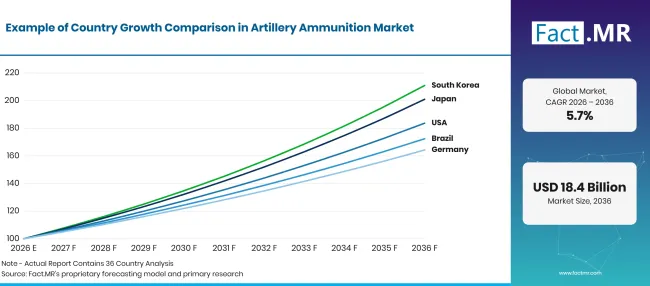
Artillery Ammunition Market Growth Index | Source: Fact.MR
| Country | CAGR (2026–2036) |
|---|---|
| Germany | 5.1% |
| Brazil | 5.6% |
| USA | 6.3% |
| UK | 4.3% |
| Japan | 7.2% |
Source: Fact.MR analysis. Updated Oct 30, 2026
What supports Japan's adoption?
7.2% CAGR, shaped by ammunition procurement priorities and efforts to strengthen stockpile availability.
Japan's artillery ammunition market is supported by defense procurement priorities and efforts to improve the availability of ammunition for its Self-Defense Forces. The Ministry of Defense's FY2026 budget documents include procurement of 155 mm high-explosive shells and measures to strengthen ammunition availability [5].
What supports the United States market?
6.3% CAGR, supported by domestic manufacturing expansion and efforts to strengthen ammunition supply chains.
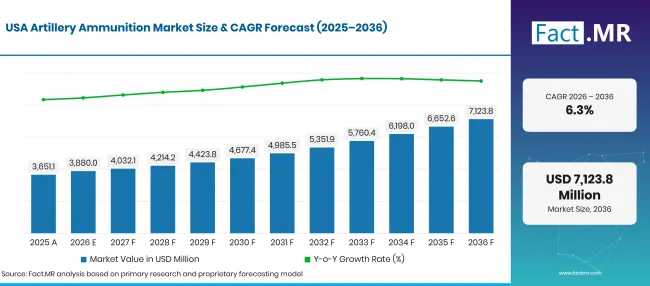
Artillery Ammunition Market Forecast Usa | Source: Fact.MR
The United States is expanding artillery ammunition production capacity to support military requirements and replenish supplies. On April 13, 2026, the US Army announced a new load, assemble, and pack facility in Parsons, Kansas, operated with Day & Zimmermann to produce 155 mm M795 artillery ammunition. At full operating capacity, the facility is expected to produce 12,000 projectiles per month. Increased production capacity can improve supply resilience, support inventory replenishment and reduce pressure on existing manufacturing facilities[6].
How is Brazil developing demand?
5.6% CAGR, driven by military readiness priorities and the need to sustain compatible ammunition supplies.
Brazil's artillery ammunition market may benefit from efforts to maintain operational readiness and support existing artillery systems. Demand is influenced by ammunition stockpile requirements, barrel and weapon-system compatibility, caliber standardization and the availability of domestic production capabilities. Procurement decisions also depend on defense budget allocations and delivery schedules.
What supports Germany's market?
5.1% CAGR, backed by higher defense spending and ammunition procurement for national and allied defense readiness.
Germany's artillery ammunition market is supported by defense investment priorities focused on strengthening military capabilities and replenishing ammunition supplies. Government funding for ammunition procurement can support orders for 155 mm artillery shells, production-line expansion and longer-term supply agreements. Compatibility with NATO-standard artillery systems also supports interoperability and coordinated procurement [7].
How does the United Kingdom perform?
4.3% CAGR, led by defense readiness requirements and the need to maintain reliable ammunition supplies.
The United Kingdom's artillery ammunition market is influenced by military readiness priorities and the need to maintain sufficient stocks for training and operational deployment. Demand depends on procurement of compatible artillery rounds, ammunition storage capacity, manufacturing throughput and the ability of suppliers to meet stringent safety and quality requirements. Multi-year procurement agreements and production-capacity investments can help improve delivery reliability and reduce supply bottlenecks.
Who leads the Artillery Ammunition Market?
Fact.MR finds that BAE Systems, General Dynamics, Rheinmetall, Elbit Systems and KNDS are profiled across the artillery ammunition manufacturing landscape.
BAE Systems offers artillery-related munitions, including the Bofors 155 mm BONUS munition. General Dynamics Ordnance and Tactical Systems manufactures artillery ammunition in 105 mm to 155 mm calibers. Rheinmetall supplies 155 mm artillery ammunition and invests in production capacity. Elbit Systems offers high-explosive and extended-range 155 mm projectiles. KNDS manufactures 105 mm and 155 mm artillery ammunition for compatible weapon systems. Product portfolios differ by caliber, projectile design, range and intended operational use, so comparisons should account for ammunition qualification, platform compatibility, production capacity and delivery performance.
Which companies are the key providers?
The key companies for the Artillery Ammunition Market are:
- BAE Systems plc
- General Dynamics Corporation
- Rheinmetall AG
- Elbit Systems Ltd.
- KNDS France
Bibliography
- [1] Department of War Office of Inspector General. (2026, July 9). Evaluation of the DoW’s capability and capacity to produce 155-millimeter artillery ammunition (Report No. DOWIG-2026-095).
- [2] European Commission. (n.d.). Regulation on Supporting Ammunition Production (ASAP).
- [3] General Dynamics Ordnance and Tactical Systems. (n.d.). Artillery.
- [4] North Atlantic Treaty Organization. (2026, July 8). Increasing defence industrial production.
- [5] Ministry of Defense, Japan. (2025, December 26). FY2026 budget: Major projects.
- [6] Chambers, M. (2026, April 13). US Army, industry partner open new artillery assembly facility. U.S. Army.
- [7] Federal Government of Germany. (2025, December 19). Bundeshaushalt 2026: Investitionen für die Zukunft.
This report answers
- Artillery Ammunition Market revenue is segmented by type and component alongside application and end-user.
- The leading segment in each category is identified with relevant demand factors.
- Country-level growth are compared across Germany and Brazil alongside the United States, United Kingdom and Japan.
- Company profiles cover selected manufacturers with verified artillery ammunition portfolios.
- Market drivers and opportunities are assessed alongside restraints affecting procurement and production capacity.
What does the Artillery Ammunition Market cover?
The Artillery Ammunition Market covers ammunition intended for use in artillery systems. Depending on the defined market boundary, this includes complete rounds and relevant components such as projectiles and fuzes alongside primers and propellants. Demand is influenced by defense procurement plans and the requirements of compatible artillery platforms. The report also considers manufacturing capacity and the ability of suppliers to meet customer specifications.
What is included in the scope?
The market includes artillery ammunition for military procurement and other explicitly defined applications. It covers the component categories listed in the segmentation and the suppliers that manufacture qualifying products. Market valuation should count products according to the boundary to avoid double counting complete rounds and the individual components incorporated into them.
What is excluded from the scope?
Small-arms ammunition and ammunition for unrelated weapon systems are excluded unless explicitly included in the report's defined market boundary. Artillery platforms and weapon systems themselves are excluded from ammunition revenue. General defense services and unrelated military equipment are also excluded. Separately sold components should not be counted twice when they are already included in the valuation of complete ammunition rounds.
How was the analysis built?
The analysis draws on 120+ sources, 35+ company portfolios, 25+ countries, and more than 20 industry interviews.
- Primary Research: Primary research includes discussions with manufacturers, service providers, technology developers, distributors, end users, and subject-matter experts. These conversations examine purchasing priorities, product adoption, operational challenges, approval requirements, competitive positioning, and the factors that influence wider market acceptance.
- Desk Research: Desk research covers government statistics, regulatory publications, company filings, trade data, technical studies, industry associations, standards, public policy, and other authoritative sources. Every source used in the analysis is documented in the bibliography.
- Market Sizing and Forecasting: Market estimates combine historical performance, demand indicators, pricing and volume trends, segment shares, company participation, country-level growth, adoption patterns, investment activity, and barriers to market expansion.
- Data Validation and Update Cycle: Findings are validated by comparing primary interviews with public data, company activity, regulatory changes, trade patterns, and industry developments. Regular updates review new product launches, capacity changes, partnerships, approvals, and shifts in commercial adoption.
Segmentation
What is the report's scope and coverage?
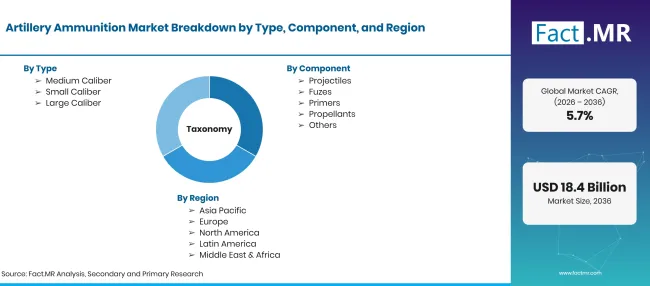
Artillery Ammunition Market Taxonomy | Source: Fact.MR
| Attribute | Details |
|---|---|
| Quantitative Units | USD billion in 2026 to USD billion by 2036, at CAGR |
| Market Definition | The Artillery Ammunition Market covers ammunition designed for use in artillery systems, including projectiles and associated ammunition components within the defined market boundary. |
| Type | Medium Caliber; Small Caliber; Large Caliber |
| Component | Projectiles; Fuzes; Primers; Propellants; Others |
| Application | Defense; Homeland Security; Others |
| End-User | Military; Law Enforcement; Others |
| Regions Covered | North America; Latin America; Western Europe; Eastern Europe; East Asia; South Asia and Pacific; Middle East and Africa |
| Countries Covered | Germany; Brazil; United States; United Kingdom; Japan |
| Companies Profiled | BAE Systems plc; General Dynamics Corporation; Rheinmetall AG; Elbit Systems Ltd.; KNDS France |
| Forecast Period | 2026 to 2036 |
| Approach | Market sizing and forecasting based on defense procurement indicators and ammunition demand alongside supplier portfolio analysis and country-level growth CAGR. |
Source: Fact.MR analysis. Updated Oct 30, 2026
How is the market segmented?
-
By Type
- Medium Caliber
- Small Caliber
- Large Caliber
-
By Component
- Projectiles
- Fuzes
- Primers
- Propellants
- Others
-
By Application
- Defense
- Homeland Security
- Others
-
By End-User
- Military
- Law Enforcement
- Others
-
By Region
- North America
- Latin America
- Western Europe
- Eastern Europe
- East Asia
- South Asia and Pacific
- Middle East and Africa
Frequently Asked Questions
How big is the Artillery Ammunition Market in 2026?
What is the CAGR of the Artillery Ammunition Market from 2026 to 2036?
Which type leads the Artillery Ammunition Market?
Which component leads the Artillery Ammunition Market?
Which country will grow the most in the Artillery Ammunition Market?
Who are the main companies in the Artillery Ammunition Market?
Who worked on this report


Preview the report firsthand - request a free sample
Free SampleGet the brochure for pricing and purchase details
Download PDF