- Market Value (2025): USD 6.48 Bn
- Estimated Value (2026): USD 8.57 Bn
- Forecast Value (2036): USD 140.1 Bn
- CAGR (2026-2036): 32.2%
What is the Artificial Intelligence in Manufacturing Market forecast to be worth by 2036?
USD 8.6 billion in 2026 to USD 140.1 billion by 2036 at a 32.2% CAGR.
- As per Fact.MR analysis, the artificial intelligence in manufacturing market was valued at USD 6.48 billion in 2025.
- Demand is forecast to grow from USD 8.57 billion in 2026 to USD 140.1 billion by 2036.
- The forecast records a 32.2% CAGR from 2026 to 2036 as manufacturers expand the use of AI-enabled industrial systems.
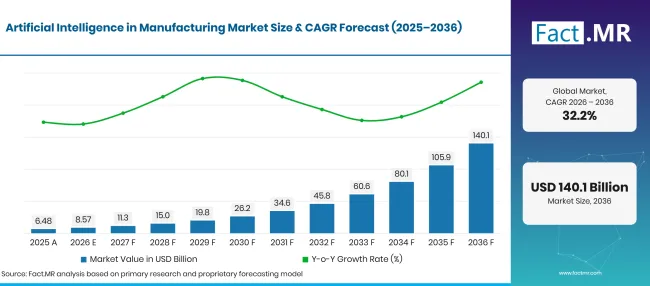
Artificial Intelligence In Manufacturing Market Forecast Global | Source: Fact.MR
| Year | Basis | Market Value (USD billion) |
|---|---|---|
| 2025 | Actual | 6.48 |
| 2026 | Estimate | 8.57 |
| 2036 | Forecast | 140.1 |
| CAGR 2026 to 2036 | Forecast period | 32.2% |
Source: Fact.MR analysis. Updated Oct 30, 2026
What are the defining numbers behind Artificial Intelligence in Manufacturing Market growth?
USD 131.5 billion absolute opportunity between 2026 and 2036.
- Demand Drivers in the Market
- Growing adoption of AI across manufacturing operations has driven the market growth. The U.S. Census Bureau tracks business adoption of artificial intelligence through its business surveys [1].
- AI-assisted quality inspection presents opportunities for manufacturers seeking to identify production defects and improve consistency across manufacturing processes. The National Institute of Standards and Technology (NIST) supports research into advanced manufacturing technologies and measurement systems. AI-powered inspection can help manufacturers identify defects and improve product consistency. Growing interest in smart manufacturing creates opportunities for computer vision and automated inspection solutions. NIST supports research into reliable AI applications for manufacturing, including evaluation of AI-assisted industrial systems [3]. [2] [2]
- Rising demand for predictive maintenance supports the growth of the market. NIST’s work on smart manufacturing supports the development of data-driven industrial systems. Wider integration of sensors and analytics can strengthen demand for AI-based monitoring solutions. [3]
- Key Segments Analyzed
- By Component: Software is expected to hold 48.2% of the artificial intelligence in manufacturing market in 2026, supported by demand for AI platforms and industrial analytics tools.
- By Technology: Machine learning is projected to capture 44.8% of the market in 2026 as manufacturers use data-driven systems to improve production processes.
- By Application: Predictive maintenance is estimated to account for 32.7% of the market in 2026, driven by the need to identify equipment failures early and reduce downtime.
- By Deployment Mode: On-premises deployment is expected to represent 68.3% of the market in 2026, reflecting manufacturers’ preference for greater control over industrial data and system security.
- By Enterprise Size: Large enterprises are projected to account for 72.8% of the market in 2026, supported by their capacity to invest in advanced AI infrastructure and integration.
- By End-User: The automotive industry is expected to hold 28.3% of the market in 2026, driven by the use of AI in quality inspection and production automation.
- Analyst Opinion at Fact.MR
- Shambhu Nath Jha, Principal Consultant at Fact.MR, states, “AI adoption in manufacturing is moving beyond isolated pilot projects toward applications that support maintenance, quality, and production decisions. Manufacturers will need reliable industrial data, integration with existing equipment, and clear performance measures to translate these deployments into sustained operational gains.”
- Strategic Implications
- Manufacturers should prioritize AI projects with measurable operational goals, such as reducing downtime, lowering defect rates, or improving production throughput.
- Technology providers need to demonstrate interoperability with existing industrial control systems, enterprise software, and plant-floor equipment.
- Large enterprises must establish data governance and cybersecurity standards before expanding AI deployments across multiple facilities.
- Small and medium enterprises can assess implementation costs, staff training needs, and the availability of scalable software before committing to larger deployments.
Germany is set to record a 29.3% CAGR through 2036. Brazil is projected to grow at 32.8%, the USA at 31.2%, the UK at 38.8%, and Japan at 36.8%.
How does the Artificial Intelligence in Manufacturing Market break down by segment?
Fact.MR identifies Software as the leading Component at 48.2%, Machine Learning as the leading Technology at 44.8%, Predictive Maintenance as the leading Application at 32.7%, On-Premises as the leading Deployment Mode at 68.3%, Large Enterprises as the leading Enterprise Size at 72.8%, and Automotive as the leading End-User Industry at 28.3%.
Which Component dominates?
Software is set to hold 48.2% share in 2026.
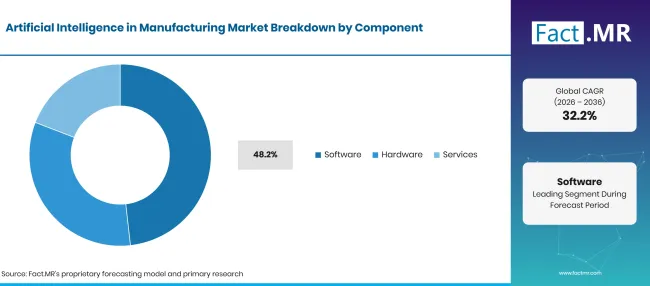
Artificial Intelligence In Manufacturing Market Breakdown Component | Source: Fact.MR
| Component | Share (2026) |
|---|---|
| Software (Leading segment) | 48.2% |
| Other segments combined | 51.8%* |
| Total | 100.0% |
Source: Fact.MR analysis. Updated Oct 30, 2026
Software adoption is supported by the need to process industrial data and translate it into actionable production insights. AI platforms can integrate with manufacturing execution systems and supervisory control systems to analyze equipment performance. They can also detect anomalies in sensor readings and identify deviations from production tolerances. Integration with existing industrial systems enables manufacturers to deploy AI models without replacing their entire operational infrastructure. Hardware and services remain essential for data acquisition and system implementation.
What leads the Technology segment?
Machine Learning is set to represent 44.8% share in 2026.
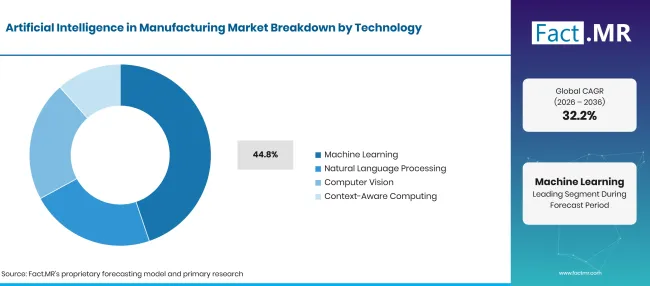
Artificial Intelligence In Manufacturing Market Breakdown Technology | Source: Fact.MR
| Technology | Share (2026) |
|---|---|
| Machine Learning (Leading segment) | 44.8% |
| Other segments combined | 55.2%* |
| Total | 100.0% |
Source: Fact.MR analysis. Updated Oct 30, 2026
Machine learning holds a prominent position because it can identify patterns in complex industrial datasets and improve predictions as new operating data becomes available. Supervised models can classify defects using historical inspection results, while anomaly detection algorithms can identify unusual equipment behavior. Time-series models can help forecast component degradation and production bottlenecks.
How does Application shape demand?
Predictive Maintenance is likely to account for 32.7% share in 2026.
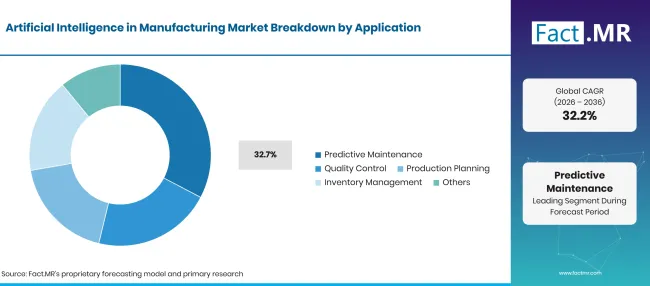
Artificial Intelligence In Manufacturing Market Breakdown Application | Source: Fact.MR
| Application | Share (2026) |
|---|---|
| Predictive Maintenance (Leading segment) | 32.7% |
| Other segments combined | 67.3%* |
| Total | 100.0% |
Source: Fact.MR analysis. Updated Oct 30, 2026
Predictive maintenance uses equipment and process data to estimate potential failures and prioritize service interventions. Quality control helps detect defects and variations, while production planning supports scheduling and resource allocation. Inventory management can use demand and consumption patterns to improve stock decisions. Other applications cover additional industrial workflows. Predictive maintenance benefits from the availability of sensor data on vibration and temperature alongside pressure readings and equipment operating cycles. AI models analyze these signals to identify patterns associated with component wear or potential failure.
Which Deployment Mode leads?
On-Premises is likely to capture for 68.3% share in 2026.
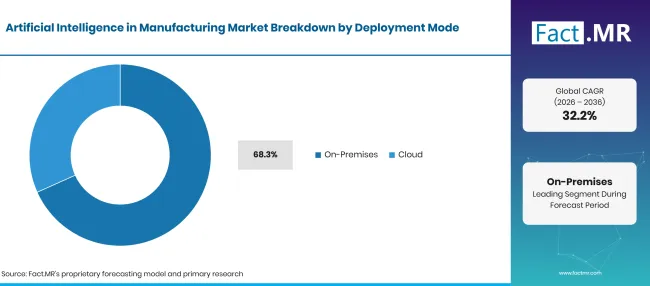
Artificial Intelligence In Manufacturing Market Breakdown Deployment Mode | Source: Fact.MR
| Deployment Mode | Share (2026) |
|---|---|
| On-Premises (Leading segment) | 68.3% |
| Other segments combined | 31.7%* |
| Total | 100.0% |
Source: Fact.MR analysis. Updated Oct 30, 2026
On-premises deployment can give manufacturers more direct control over operational data, integration with plant systems, and network access. Cloud deployment can offer flexible computing capacity and centralized management across multiple facilities. The choice depends on latency, cybersecurity, data governance, cost, and the technical needs of individual applications. On-premises deployment appeals to manufacturers that require low-latency processing and direct control over sensitive production data. Running AI workloads within plant networks can support real-time responses to equipment conditions without depending entirely on external connectivity. This model can also simplify integration with legacy control systems and help organizations meet internal security requirements.
Which Enterprise Size Holds Prominent Position in the Market?
Large Enterprises are set to represent 72.8% share in 2026.
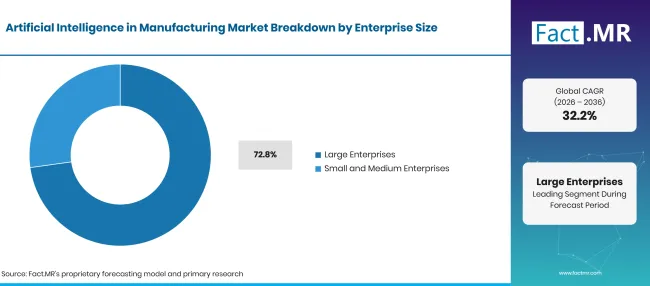
Artificial Intelligence In Manufacturing Market Breakdown Enterprise Size | Source: Fact.MR
| Enterprise Size | Share (2026) |
|---|---|
| Large Enterprises (Leading segment) | 72.8% |
| Other segments combined | 27.2%* |
| Total | 100.0% |
Source: Fact.MR analysis. Updated Oct 30, 2026
Large enterprises often operate multiple production sites and have more resources to invest in data infrastructure, AI specialists, and system integration. Small and medium enterprises can adopt targeted AI tools for inspection, maintenance, and production monitoring, although implementation costs and access to technical skills can influence adoption. Large enterprises are positioned to adopt manufacturing AI because they often have established data infrastructure and dedicated technical teams. Their operations may generate substantial volumes of information across production lines and facilities, creating opportunities for predictive analytics and process optimization. Larger investment capacity can support model development and integration with enterprise resource planning systems.
Which End-User Industry dominates?
Automotive is set to account for 28.3% share in 2026.
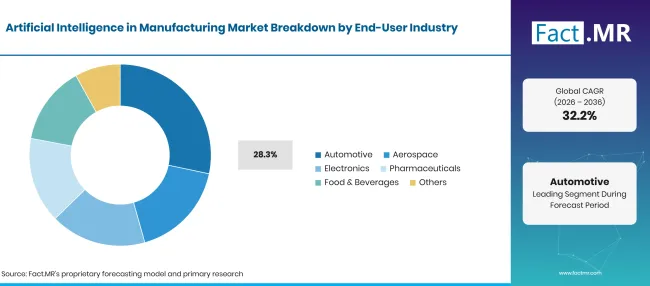
Artificial Intelligence In Manufacturing Market Breakdown End User Industry | Source: Fact.MR
| End-User Industry | Share (2026) |
|---|---|
| Automotive (Leading segment) | 28.3% |
| Other segments combined | 71.7%* |
| Total | 100.0% |
Source: Fact.MR analysis. Updated Oct 30, 2026
Automotive production involves repeated processes, high-volume assembly, and stringent quality requirements. AI can support defect inspection, equipment monitoring, production scheduling, and robotics. Aerospace, electronics, pharmaceuticals, food and beverages, and other manufacturing industries have their own requirements for traceability, process consistency, and quality assurance. Automotive manufacturing is well suited to AI applications because assembly operations involve repetitive tasks and tightly controlled production tolerances. Computer vision can inspect components for surface defects and dimensional deviations, while machine learning can identify process variations that affect product quality. AI systems can also coordinate production schedules and monitor robotic equipment to support line efficiency.
What is accelerating Artificial Intelligence in Manufacturing Market adoption, and what is holding it back?
Manufacturers are adopting AI to improve equipment reliability and maintain consistent product quality while increasing production efficiency. However, high integration costs and inconsistent data can hinder implementation.
Drivers Impact Analysis
| DRIVER | (~) % IMPACT ON CAGR | GEOGRAPHIC RELEVANCE | IMPACT TIMELINE |
|---|---|---|---|
| Predictive maintenance deployment | +1.0% | Global | Medium term (2–4 years) |
| AI-assisted quality inspection | +0.8% | Global | Short term (≤ 2 years) |
| Production planning and scheduling optimization | +0.7% | Europe, Asia, Americas | Medium term (2–4 years) |
| Industrial data infrastructure expansion | +0.6% | Global | Long term (≥ 4 years) |
| AI integration with factory automation | +0.5% | Global | Medium term (2–4 years) |
Source: Fact.MR analysis. Updated Oct 30, 2026
Opportunity Impact Analysis
| OPPORTUNITY | (~) % IMPACT ON CAGR | GEOGRAPHIC RELEVANCE | IMPACT TIMELINE |
|---|---|---|---|
| Scalable AI tools for mid-sized manufacturers | +0.7% | Global | Medium term (2–4 years) |
| Industrial copilots and natural language interfaces | +0.6% | Global | Short term (≤ 2 years) |
| AI-enabled machine vision systems | +0.6% | Europe, Asia, Americas | Medium term (2–4 years) |
| Cross-site analytics and digital twins | +0.5% | Global | Long term (≥ 4 years) |
Source: Fact.MR analysis. Updated Oct 30, 2026
Restraints Impact Analysis
| RESTRAINT | (~) % IMPACT ON CAGR | GEOGRAPHIC RELEVANCE | IMPACT TIMELINE |
|---|---|---|---|
| High integration and deployment costs | -0.9% | Global | Short term (≤ 2 years) |
| Inconsistent or incomplete production data | -0.7% | Global | Medium term (2–4 years) |
| Cybersecurity and operational technology risks | -0.6% | Global | Short term (≤ 2 years) |
| Shortage of skilled AI and industrial specialists | -0.5% | Global | Medium term (2–4 years) |
Source: Fact.MR analysis. Updated Oct 30, 2026
Which countries are scaling the Artificial Intelligence in Manufacturing Market through 2036?
| Country | CAGR (2026–2036) |
|---|---|
| Germany | 29.3% |
| Brazil | 32.8% |
| USA | 31.2% |
| UK | 38.8% |
| Japan | 36.8% |
Source: Fact.MR analysis. Updated Oct 30, 2026
What supports Germany adoption?
29.3% CAGR, supported by the country’s advanced industrial automation infrastructure.
Germany's advanced manufacturing base supports AI integration into automated production lines and industrial control systems. According to the ifo Institute's June 5, 2026 announcement, 58.7% of surveyed German manufacturing companies were using AI applications, compared with 54.5% across all surveyed industries. Adoption in production-related activities such as quality inspection and maintenance can support machine-vision deployment and predictive analytics [4][4]
How is Brazil developing AI adoption in manufacturing?
32.8% CAGR, driven by industrial digitalization.
Brazil's projected growth depends on manufacturers' investment in automation, process monitoring, and production efficiency. AI applications can support equipment maintenance, visual inspection, and planning in factories with different levels of digital maturity. Brazil's manufacturing sector offers opportunities for AI adoption through industrial digitalization and process optimization. AI-enabled monitoring can combine machine sensor readings with production data to identify abnormal operating conditions and improve equipment utilization.
What supports United States adoption?
31.2% CAGR, shaped by established industrial automation ecosystem.
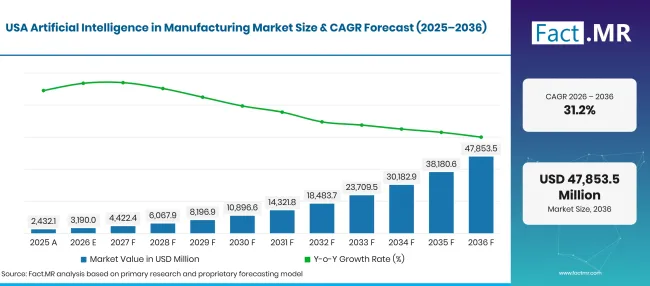
Artificial Intelligence In Manufacturing Market Forecast Usa | Source: Fact.MR
The United States benefits from an established industrial automation ecosystem that supports the integration of AI with manufacturing execution systems and programmable logic controllers. Rockwell Automation's industrial AI portfolio includes machine-learning tools for process prediction and computer-vision systems for defect detection.
How is the United Kingdom building adoption?
38.8% CAGR, supported by integration of intelligent analytics into existing production infrastructure.
The United Kingdom's manufacturing AI opportunity is supported by industrial digitalization and the integration of intelligent analytics into existing production infrastructure. Siemens offers AI-enabled visual inspection and predictive maintenance solutions that analyze equipment behavior and production images. Such systems can identify emerging machinery faults and classify product defects, helping manufacturers improve asset availability and inspection consistency. Digital-twin technology can also simulate production changes before implementation on physical equipment. [5]
What supports Japan adoption?
36.8% CAGR, driven by technology advancement and factory automation.
Japan's established robotics and factory automation capabilities provide a technical foundation for AI integration. Mitsubishi Electric's e-F@ctory approach connects shop-floor equipment with edge computing and higher-level information systems. This architecture enables real-time analysis of machine data and supports predictive maintenance. FANUC's work on AI-enabled CNC systems and digital twins further demonstrates the integration of intelligent algorithms with machining operations, allowing manufacturers to improve process monitoring and optimize equipment performance. [6] [7]
Who leads the Artificial Intelligence in Manufacturing Market?
Fact.MR profiles following companies includes Siemens AG, ABB Ltd., Rockwell Automation Inc., Schneider Electric SE, Honeywell Technologies, Mitsubishi Electric Corporation, and FANUC Corporation.
Siemens, Rockwell Automation, ABB, and Schneider Electric participate in industrial automation and digital manufacturing technologies. Their AI-related offerings address different applications, including equipment monitoring, industrial analytics, engineering, and production operations. Individual product capabilities should be assessed using each manufacturer’s current technical documentation. Honeywell, Mitsubishi Electric, and FANUC participate in industrial technology, automation, or related manufacturing systems. Their inclusion in the competitive landscape reflects their relevance to industrial technology. [8][9]
Competition depends on software capabilities, hardware compatibility, industrial data integration, cybersecurity, deployment flexibility, and the ability to demonstrate measurable performance improvements. Manufacturers often evaluate providers according to their existing plant systems, operational priorities, and requirements for support across multiple sites.
Which companies are the key providers?
Key companies includes:
- Siemens AG
- ABB Ltd.
- Rockwell Automation Inc.
- Schneider Electric SE
- Honeywell Technologies
- Mitsubishi Electric Corporation
- FANUC Corporation
How is the market segmented?
-
By Component
- Software
- Hardware
- Services
-
By Technology
- Machine Learning
- Natural Language Processing
- Computer Vision
- Context-Aware Computing
-
By Application
- Predictive Maintenance
- Quality Control
- Production Planning
- Inventory Management
- Others
-
By Deployment Mode
- On-Premises
- Cloud
-
By Enterprise Size
- Large Enterprises
- Small and Medium Enterprises
-
By End-User Industry
- Automotive
- Aerospace
- Electronics
- Pharmaceuticals
- Food & Beverages
- Others
-
By Region
- North America
- Latin America
- Western Europe
- Eastern Europe
- East Asia
- South Asia & Pacific
- Middle East & Africa
Bibliography
- [1] U.S. Census Bureau. (2026, June 4). Business Trends and Outlook Survey data release—June 4, 2026.
- [2] Lee, J., Su, H., Macchi, M., Polenghi, A., Wu, W., Zhao, Z., Huang, G. Q., Allgood, K., Jain, D., Gieger, B., et al. (2026). 2026 roadmap on artificial intelligence and machine learning for smart manufacturing. Machine Learning: Engineering, 2, 022001.
- [3] National Institute of Standards and Technology. (2026, July 17). Artificial intelligence (AI) for manufacturing. U.S. Department of Commerce.
- [4] ifo Institute. (2026, June 5). More than half of companies in Germany use artificial intelligence.
- [5] Siemens. (n.d.). Artificial intelligence solutions.
- [6] Mitsubishi Electric India. (n.d.). Factory Automation Systems.
- [7] FANUC Corporation. (2026, October 23). Financial results for the six months ended September 30, 2026.
- [8] ABB. (2026, April 17). ABB enhances AI capabilities of flagship industrial device digital solutions.
- [9] ABB. (2025, October 12). Machine vision and control in automation systems.
This Report Answers
- The report describes how AI software, hardware, and services are applied across manufacturing operations.
- Segment analysis compares the specified technologies, applications, deployment modes, enterprise sizes, and end-user industries.
- Country analysis discusses Germany, Brazil, the USA, the UK, and Japan alongside the country growth estimates.
- The competitive overview profiles eight industrial technology and automation companies.
- Application analysis distinguishes predictive maintenance from quality control, production planning, inventory management, and other manufacturing workflows.
What does the Artificial Intelligence in Manufacturing Market cover?
The market covers AI technologies and services used to improve manufacturing operations. It includes software, hardware, and service components used in predictive maintenance, quality inspection, production planning, inventory management, and related workflows. The defined market spans on-premises and cloud deployments, with demand assessed across enterprise sizes and manufacturing industries.
What is included in the scope?
Included products and services are AI-enabled solutions intended for manufacturing use. The scope covers machine learning, natural language processing, computer vision, and context-aware computing across the specified applications. It also considers industrial automation providers that offer relevant AI-enabled systems or services.
What is excluded from the scope?
The analysis excludes general-purpose AI applications with no direct manufacturing use. It excludes conventional automation equipment without relevant AI functionality, standalone consulting unrelated to manufacturing AI, and general IT hardware not attributable to the defined market. The revenue boundary should avoid counting the same software or service twice when bundled with larger industrial systems.
How Was the Analysis Built?
The analysis draws on 120+ sources, 35+ company portfolios, 25+ countries, and more than 20 industry interviews.
- Primary Research: Primary research includes discussions with manufacturers, service providers, technology developers, distributors, end users, and subject-matter experts. These conversations examine purchasing priorities, product adoption, operational challenges, approval requirements, competitive positioning, and the factors that influence wider market acceptance.
- Desk Research: Desk research covers government statistics, regulatory publications, company filings, trade data, technical studies, industry associations, standards, public policy, and other authoritative sources. Every source used in the analysis is documented in the bibliography.
- Market Sizing and Forecasting: Market estimates combine historical performance, demand indicators, pricing and volume trends, segment shares, company participation, country-level growth, adoption patterns, investment activity, and barriers to market expansion.
- Data Validation and Update Cycle: Findings are validated by comparing primary interviews with public data, company activity, regulatory changes, trade patterns, and industry developments. Regular updates review new product launches, capacity changes, partnerships, approvals, and shifts in commercial adoption.
Segmentation
What is the report's scope and coverage?
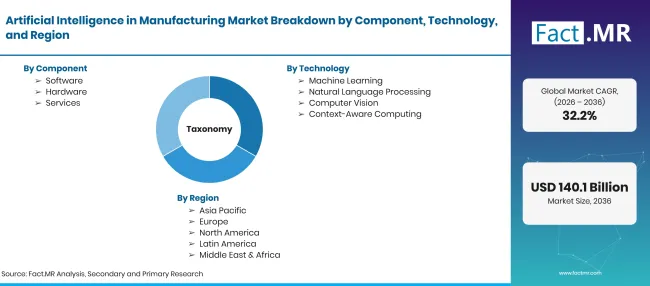
Artificial Intelligence In Manufacturing Market Taxonomy | Source: Fact.MR
| Attribute | Details |
|---|---|
| Quantitative Units | USD billion in 2026 to USD billion by 2036, at CAGR |
| Market Definition | The artificial intelligence in manufacturing market as the market for AI software and related hardware and services used to improve manufacturing operations. These solutions enable manufacturers to analyze production data and automate quality inspection. |
| Component | Software; Hardware; Services |
| Technology | Machine Learning; Natural Language Processing; Computer Vision; Context-Aware Computing |
| Application | Predictive Maintenance; Quality Control; Production Planning; Inventory Management; Others |
| Deployment Mode | On-Premises; Cloud |
| Enterprise Size | Large Enterprises; Small and Medium Enterprises |
| End-User Industry | Automotive; Aerospace; Electronics; Pharmaceuticals; Food & Beverages; Others |
| Regions Covered | North America; Latin America; Western Europe; Eastern Europe; East Asia; South Asia & Pacific; Middle East & Africa |
| Countries Covered | Germany; Brazil; USA; UK; Japan |
| Companies Profiled | Siemens AG; ABB Ltd.; Rockwell Automation Inc.; Schneider Electric SE; Honeywell Technologies; Mitsubishi Electric Corporation; FANUC Corporation |
| Forecast Period | 2026 to 2036 |
| Approach | Market segmentation and scenario-based analysis using supplied estimates and public company information |
Source: Fact.MR analysis. Updated Oct 30, 2026
Frequently Asked Questions
How big is the Artificial Intelligence in Manufacturing Market in 2026?
What is the CAGR from 2026 to 2036?
Which Component has the largest share?
Which Technology leads?
Which companies are covered?
Who worked on this report


Preview the report firsthand - request a free sample
Free SampleGet the brochure for pricing and purchase details
Download PDF