- Market Value (2025): USD 2.04 Bn
- Estimated Value (2026): USD 2.18 Bn
- Forecast Value (2036): USD 4.3 Bn
- CAGR (2026-2036):7.0%
What is the Omni Antenna Market forecast to be worth by 2036?
USD 2.18 billion in 2026 to USD 4.3 billion by 2036 at a 7.0% CAGR.
- At USD 2.04 billion in 2025, the omni antenna market drew most of its revenue from cell sites, business premises and industrial radio links.
- Revenue will move from USD 2.18 billion in 2026 to USD 4.3 billion by 2036 as operators densify networks and integrators extend coverage indoors.
- A 7.0% CAGR will hold from 2026 to 2036, since each new frequency band and each connected machine adds antenna positions to the installed base.
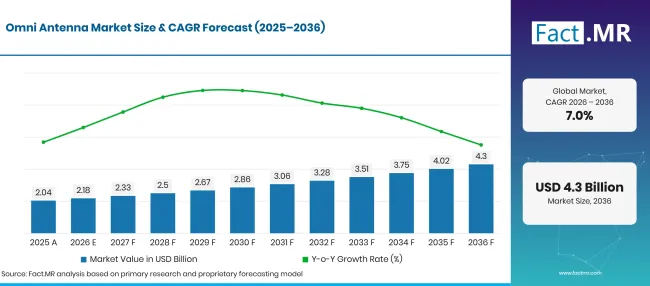
Omni Antenna Market Forecast Global | Source: Fact.MR
| Year | Basis | Market Value (USD billion) |
|---|---|---|
| 2025 | Actual | 2.04 |
| 2026 | Estimate | 2.18 |
| 2036 | Forecast | 4.3 |
| CAGR 2026 to 2036 | Forecast period | 7.0% |
Source: Fact.MR analysis. Updated Oct 30, 2026
What are the defining numbers behind Omni Antenna Market growth?
USD 2.1 billion in new value will open between 2026 and 2036, led by telecom sites and commercial buildings.
- Demand Drivers in the Market
- 5G base station rollouts multiply the number of sites that need coverage antennas. India’s Ministry of Communications reported 518,854 installed 5G base transceiver stations as of December 31, 2025, with service in 99.9% of districts [1]. Each small site and rural cell creates fresh demand for antennas that cover a full circle around the mast.
- New spectrum arrangements reshape antenna specifications. In February 2026, the International Telecommunication Union approved Recommendation ITU-R M.1036-8 on frequency arrangements for the terrestrial component of International Mobile Telecommunications [2]. Suppliers redesign radiating elements so one housing can serve the bands that regulators open next.
- Transport corridors and public facilities are adding private and shared 5G networks. In January 2026, the European Commission awarded EUR 106 million to 12 projects, split between cross-border 5G corridors on road and rail routes and 5G networks for airports, hospitals and universities [3]. Track-side masts and vehicle roofs depend on antennas that hold a signal while the receiver moves.
- Factory and warehouse automation brings radio links onto the shop floor. Sensors, guided vehicles and handheld scanners connect through ceiling-mounted access points, where an omnidirectional pattern reaches equipment that changes position during a shift.
- Public safety and broadcast services keep VHF and UHF equipment in service. Emergency agencies and radio stations replace antennas on a regular cycle as masts age and coverage plans change.
- Key Segments Analyzed
- By Type: Monopole will hold 62.2% share in 2026, as a single vertical radiator over a ground plane is cheap to make and quick to mount on masts, vehicles and routers.
- By Application: Telecommunications will account for 45.7% share in 2026, given that cell sites, small cells and fixed wireless terminals need coverage without beam alignment.
- By Frequency Range: VHF will capture 31.2% share in 2026 through broadcast radio, land mobile and public safety networks that rely on long-range propagation.
- Analyst Opinion at Fact.MR
- Shambhu Nath Jha, Principal Consultant at Fact.MR, states, “Every new cell site, private network and connected vehicle adds antenna positions, and most of those positions need coverage in all directions. The monopole design wins on cost and mounting simplicity, so suppliers will compete on multiband performance and housing durability. Firms that qualify one product across several bands and certify it quickly with operators will win the larger contracts.”
- Strategic Implications
- Antenna makers should publish measured radiation patterns and gain data for every band, since network planners select products from verified test files.
- Mobile operators should standardize a short list of multiband omni models for small cells, which cuts spare stock and speeds site upgrades.
- Industrial integrators should specify ruggedized housings rated for vibration, dust and temperature swings before choosing antennas for plant networks.
- Public safety agencies should plan VHF and UHF antenna replacement alongside mast inspections to avoid coverage gaps during network migration.
The United Kingdom heads the group at 9.0% CAGR, as 5G coverage outside premises widens beyond city centres. Brazil follows at 8.0%, where 5G connections are spreading to new municipalities each quarter. Japan advances at 6.6% with near-national 5G population coverage now shifting spend to indoor and local networks. In the United States, a 6.1% rate reflects tower upgrades and a large broadcast base. Germany completes the list at 5.2%, since high land-area coverage leaves densification as the main source of new orders.
How does the Omni Antenna Market break down by segment?
Monopole will lead Type at 62.2%; Telecommunications will head Application at 45.7%; and VHF will top Frequency Range at 31.2%.
Which Type leads?
Monopole takes 45.7% of 2026 revenue.
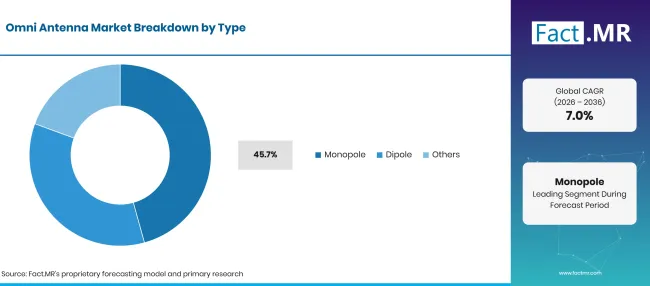
Omni Antenna Market Breakdown Type | Source: Fact.MR
| Type | Share (2026) |
|---|---|
| Monopole (Leading segment) | 62.2% |
| Other segments combined | 37.8%* |
| Total | 100.0% |
Source: Fact.MR analysis. Updated Oct 30, 2026
A quarter-wave whip or blade needs only one radiating element and a ground plane, which keeps material cost and assembly time low. Router makers, vehicle builders and site installers fit the same basic design in many sizes. Short monopoles also fold into compact radomes for small cells. Dipole antennas suit masts where no ground plane is available and where a balanced feed improves pattern symmetry. Collinear dipole arrays stack elements to add gain for long-range links. Other designs, including discone and helical types, serve wideband monitoring and specialist radio work.
What supports Telecommunications within Application?
Telecommunications buyers account for 45.7% of 2026 revenue.
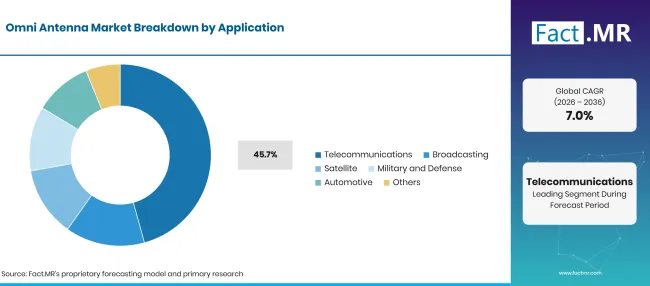
Omni Antenna Market Breakdown Application | Source: Fact.MR
| Application | Share (2026) |
|---|---|
| Telecommunications (Leading segment) | 45.7% |
| Other segments combined | 54.3%* |
| Total | 100.0% |
Source: Fact.MR analysis. Updated Oct 30, 2026
Mobile operators place omni antennas on small cells, rooftop sites and in-building systems, where users connect from every side. Suppliers of 5G antennas now ship multiband models that cover low, mid and upper bands from one radome. Densification work around small cell 5G networks adds new mounting points each year. Coverage targets keep operators building. The European Commission reported in June 2026 that 96.8% of EU households had basic 5G coverage [4]. Broadcasting, satellite, defense and automotive users buy smaller volumes but often specify tighter performance. Builders of connected cars fit roof and shark-fin antennas for cellular, GNSS and V2X links.
How does Frequency Range shape demand?
VHF represents 31.2% of 2026 revenue.
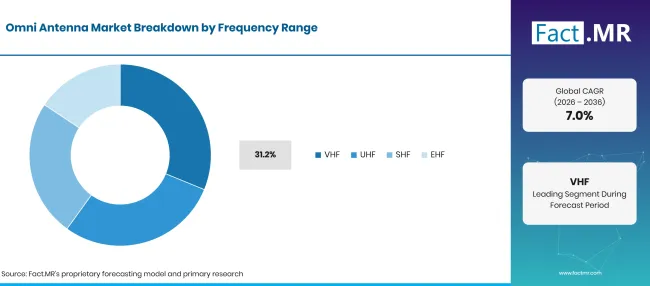
Omni Antenna Market Breakdown Frequency Range | Source: Fact.MR
| Frequency Range | Share (2026) |
|---|---|
| VHF (Leading segment) | 31.2% |
| Other segments combined | 68.8%* |
| Total | 100.0% |
Source: Fact.MR analysis. Updated Oct 30, 2026
Signals between 30 MHz and 300 MHz travel far over hills and around buildings, which suits broadcast radio and public safety voice networks. FM radio, marine VHF and land mobile radio all operate in this range. Their antennas are large and long-lived, so replacement cycles drive steady orders. The FCC counted 6,589 commercial FM stations and 4,755 educational FM stations in the United States at the end of 2025 [5]. UHF covers cellular, Wi-Fi and private LTE bands, while SHF serves 5G mid-band and satellite links. EHF remains a small segment linked to millimetre-wave trials.
What is accelerating Omni Antenna Market adoption, and what is holding it back?
Site densification, new spectrum bands and private networks in transport and industry keep antenna orders growing. Interference in crowded bands, permit delays for new masts and the shift to beam-forming panels on macro sites limit the share of positions that use omni designs.
Drivers Impact Analysis
| DRIVER | (~) % IMPACT ON CAGR | GEOGRAPHIC RELEVANCE | IMPACT TIMELINE |
|---|---|---|---|
| 5G base station and small cell densification | +1.9% | East Asia, South Asia & Pacific, North America | Medium term (2-4 years) |
| Indoor coverage demand in commercial buildings | +1.4% | North America, Western Europe, East Asia | Short term (<= 2 years) |
| Replacement of VHF and UHF broadcast and public safety antennas | +0.8% | Global | Medium term (2-4 years) |
| Private wireless networks in factories, ports and transport corridors | +0.7% | Western Europe, East Asia, North America | Long term (>= 4 years) |
Source: Fact.MR analysis. Updated Oct 30, 2026
Opportunity Impact Analysis
| OPPORTUNITY | (~) % IMPACT ON CAGR | GEOGRAPHIC RELEVANCE | IMPACT TIMELINE |
|---|---|---|---|
| Compact multiband antennas covering low, mid and upper 5G bands | +1.0% | Global | Medium term (2-4 years) |
| Ruggedized antennas for industrial and rail installations | +0.8% | Western Europe, East Asia, North America | Medium term (2-4 years) |
| Antennas for public safety, defense and satellite terminals | +0.6% | Global | Long term (>= 4 years) |
| Vehicle roof antennas for cellular, GNSS and V2X links | +0.5% | East Asia, Western Europe, North America | Long term (>= 4 years) |
Source: Fact.MR analysis. Updated Oct 30, 2026
Restraints Impact Analysis
| RESTRAINT | (~) % IMPACT ON CAGR | GEOGRAPHIC RELEVANCE | IMPACT TIMELINE |
|---|---|---|---|
| Interference and multipath limits in dense installations | -0.7% | Global | Short term (<= 2 years) |
| Spectrum rules and type approval that vary by country | -0.5% | Global | Medium term (2-4 years) |
| Beam-forming and directional panels on macro sites | -0.3% | Global | Medium term (2-4 years) |
Source: Fact.MR analysis. Updated Oct 30, 2026
Which countries are scaling the Omni Antenna Market through 2036?
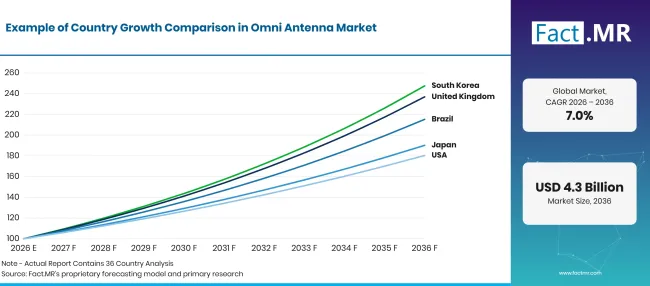
Omni Antenna Market Growth Index | Source: Fact.MR
| Country | CAGR (2026 to 2036) |
|---|---|
| United Kingdom | 9.0% |
| Brazil | 8.0% |
| Japan | 6.6% |
| United States | 6.1% |
| Germany | 5.2% |
Source: Fact.MR analysis. Updated Oct 30, 2026
How is the United Kingdom scaling demand?
9.0% CAGR, driven by a rapid widening of 5G coverage outside premises.
Ofcom reported in May 2026 that outdoor 5G coverage from all mobile operators reached 64% in January 2026, measured outside premises, up from 47% six months earlier [6]. Operators are switching on 5G at existing sites and adding small cells in towns. Each upgrade calls for multiband antennas that can share a mast with older 4G equipment.
How is Brazil developing demand?
8.0% CAGR, helped by fast growth in 5G connections across new municipalities.
Brazil’s Ministry of Communications reported in October 2026 that 5G accesses reached 69.8 million, up 30.7% in one year [7]. The service was available in 1,610 municipalities and covered about 77% of the population [7]. Operators building out in mid-sized cities buy rooftop and street-level antennas for new sites.
What supports Japan’s growth?
6.6% CAGR, reflecting a shift from national rollout to indoor and local networks.
Japan’s Ministry of Internal Affairs and Communications reported in July 2026 that 5G population coverage reached 98.6% at the end of fiscal 2025, with prefectures ranging from 89.2% to 99.9% [8]. With outdoor reach near complete, operators and enterprises now spend on in-building systems and Local 5G networks in plants. Ceiling-mount omni units fit these indoor projects.
What is supporting United States adoption?
6.1% CAGR, backed by tower upgrades and a large base of broadcast stations.
In September 2025, the Federal Communications Commission opened a proceeding to speed the building, densifying and upgrading of wireless networks, including towers and small cells [9]. The FCC also counted 33,573 licensed broadcast stations at the end of 2025, including 468 VHF television stations [5]. Both groups replace antennas as sites are rebuilt.
How does Germany perform?
5.2% CAGR, as densification follows near-complete land-area coverage.
The Bundesnetzagentur reported in December 2025 that 5G covered about 95% of Germany’s land area in October 2025, up from about 93% a year earlier [10]. Mobile broadband through 4G or 5G reached about 98% of the country [10]. With coverage this wide, new orders come from capacity sites, campus networks and rail lines.
Who leads the Omni Antenna Market?
Competition splits into three groups. Network infrastructure suppliers such as Ericsson and Amphenol sell site antennas to mobile operators under multi-year frame deals, so operator qualification and delivery scale count most. Ericsson set up local passive antenna production in India in April 2025, with part of the output planned for export [11]. In June 2025, it introduced Antenna 1005 and Antenna 1006 for public protection and disaster relief networks [12].
Interconnect and RF specialists, including HUBER+SUHNER, TE Connectivity and Molex, compete on rugged housings and multiband designs for rail, industrial and vehicle use. Embedded antenna firms such as Taoglas and Ezurio win device makers through custom tuning and fast certification support. Over the forecast period, the ability to cover more bands in one radome and to pass operator and rail approvals will decide which suppliers gain share.
Which companies are the key providers?
Key companies include Amphenol Corporation; Ericsson; HUBER+SUHNER AG; TE Connectivity; Molex; Taoglas; and Ezurio.
- Amphenol Corporation
- Ericsson
- HUBER+SUHNER AG
- TE Connectivity
- Molex
- Taoglas
- Ezurio
Bibliography
- [1] Press Information Bureau, Ministry of Communications, Government of India. (2026, February 5). Expansion and Status of 5G Services.
- [2] International Telecommunication Union. (2026, February). Recommendation ITU-R M.1036-8: Frequency arrangements for implementation of the terrestrial component of International Mobile Telecommunications in the bands identified for IMT in the Radio Regulations.
- [3] European Commission. (2026, January 22). 5G large-scale pilots: 12 projects funded under the fourth CEF Digital Call.
- [4] European Commission. (2026, June 17). State of the Digital Decade report: progress made, but gaps remain.
- [5] Federal Communications Commission. (2026, January 13). Broadcast Station Totals as of December 31, 2025 (DA 26-49).
- [6] Ofcom. (2026, May 13). Connected Nations update: Spring 2026.
- [7] Ministério das Comunicações, Brazil. (2026, October 26). Acessos ao 5G crescem 30,7% em um ano e já somam 69,8 milhões no Brasil [5G accesses grow 30.7% in one year and already total 69.8 million in Brazil].
- [8] Ministry of Internal Affairs and Communications, Japan. (2026, July 27). 5G[Publication of 5G deployment status at the end of fiscal 2025].
- [9] Federal Communications Commission. (2025, September 30). FCC Aims to Accelerate Wireless Infrastructure Buildout.
- [10] Bundesnetzagentur. (2025, December 15). Bundesnetzagentur publishes latest figures from mobile communications monitoring.
- [11] Ericsson. (2025, April 22). Ericsson sets up antenna manufacturing in India: strengthening innovation, growth, and global delivery.
- [12] Ericsson. (2025, June 18). Ericsson introduces next-generation antennas for mission-critical networks.
This Report Answers
- Revenue for omni antennas is tracked from 2025 through 2036 by type, application, frequency range and end-user.
- Readers learn why monopoles, telecom sites and VHF bands hold first place in 2026.
- 5G coverage data and broadcast station counts frame the comparison of the five profiled countries.
- Supplier profiles group antenna makers by customer type, from mobile operators to device designers.
- Spectrum rules, interference and beam-forming panels are weighed as limits on omni antenna use.
What does the Omni Antenna Market cover?
Omni antennas covered here include monopole, dipole and other designs such as discone, collinear and helical types. Products range from embedded device antennas to rooftop, mast and vehicle units.
Demand is tracked across telecommunications, broadcasting, satellite, defense and automotive uses. Revenue is counted at the antenna level, before the antenna is built into a router, base station or vehicle.
What is included in the scope?
External and embedded omni antennas, their radomes and integrated mounting brackets are counted. Multiband units that combine cellular, Wi-Fi and GNSS elements in one housing are included at full value.
Omni terminals for satellite communication links on ships, vehicles and remote sites are also in scope. Antennas bought for spares and site replacement count alongside new installations.
What is excluded from the scope?
Radios, base station electronics, routers and connectivity services are not counted. Cables and connectors sold separately are excluded.
Sector panels, dishes and other directional designs are excluded, including point-to-multipoint microwave antennas used for backhaul. Active beam-forming arrays on macro sites are also left out.
Flat-panel multi-band reflectarray antennas used in satellite and radar terminals are not counted. Test and measurement antennas sold with spectrum analyzers are also excluded.
How Was the Analysis Built?
The analysis draws on 120+ sources, 35+ company portfolios, 25+ countries, and more than 20 industry interviews.
- Primary Research: Primary research includes discussions with manufacturers, service providers, technology developers, distributors, end users, and subject-matter experts. These conversations examine purchasing priorities, product adoption, operational challenges, approval requirements, competitive positioning, and the factors that influence wider market acceptance.
- Desk Research: Desk research covers government statistics, regulatory publications, company filings, trade data, technical studies, industry associations, standards, public policy, and other authoritative sources. Every source used in the analysis is documented in the bibliography.
- Market Sizing and Forecasting: Market estimates combine historical performance, demand indicators, pricing and volume trends, segment shares, company participation, country-level growth, adoption patterns, investment activity, and barriers to market expansion.
- Data Validation and Update Cycle: Findings are validated by comparing primary interviews with public data, company activity, regulatory changes, trade patterns, and industry developments. Regular updates review new product launches, capacity changes, partnerships, approvals, and shifts in commercial adoption.
Segmentation
What is the report’s scope and coverage?
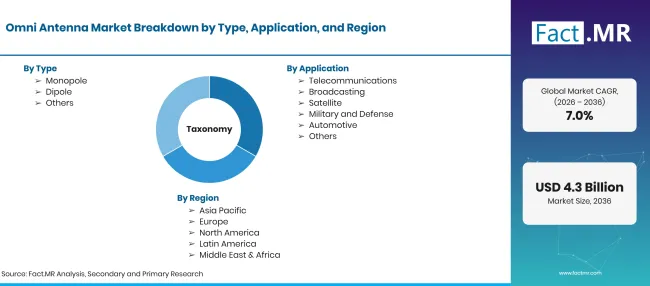
Omni Antenna Market Taxonomy | Source: Fact.MR
| Attribute | Details |
|---|---|
| Quantitative Units | USD billion |
| Market Definition | Antennas that radiate and receive radio signals evenly through 360 degrees in the horizontal plane. The scope covers hardware sold to network operators, broadcasters, vehicle makers, device makers and building owners. |
| Type | Monopole; Dipole; Others |
| Application | Telecommunications; Broadcasting; Satellite; Military and Defense; Automotive; Others |
| Frequency Range | VHF; UHF; SHF; EHF |
| End-User | Commercial; Residential; Industrial |
| Regions Covered | North America; Latin America; Western Europe; Eastern Europe; East Asia; South Asia & Pacific; Middle East & Africa |
| Countries Covered | United Kingdom; Brazil; Japan; United States; Germany |
| Companies Profiled | Amphenol Corporation; Ericsson; HUBER+SUHNER AG; TE Connectivity; Molex; Taoglas; Ezurio |
| Forecast Period | 2026 to 2036 |
| Approach | Hybrid top-down and bottom-up approach using cell site and small cell counts; broadcast station totals; antenna positions per site and per building; average selling prices by type and band; and supplier portfolio review. |
Source: Fact.MR analysis. Updated Oct 30, 2026
How is the market segmented?
-
By Type
- Monopole
- Dipole
- Others
-
By Application
- Telecommunications
- Broadcasting
- Satellite
- Military and Defense
- Automotive
- Others
-
By Frequency Range
- VHF
- UHF
- SHF
- EHF
-
By End-User
- Commercial
- Residential
- Industrial
-
By Region
- North America
- Latin America
- Western Europe
- Eastern Europe
- East Asia
- South Asia & Pacific
- Middle East & Africa
Frequently Asked Questions
How big is the omni antenna market in 2026?
What is the CAGR of the omni antenna market from 2026 to 2036?
Which type leads the omni antenna market?
Which application leads the omni antenna market?
Which frequency range leads the omni antenna market?
Which country will grow the most in the omni antenna market?
Who are the main companies in the omni antenna market?
Who worked on this report


Preview the report firsthand - request a free sample
Free SampleGet the brochure for pricing and purchase details
Download PDF