- Base Value(2025): 70 Mn
- Forecast Value (2036): 260 Mn
- CAGR (2036): 12.2%
What is the at-home ferritin tests market forecast to be worth by 2036?
USD 82 million in 2026 to USD 260 million by 2036 at 12.2% CAGR.
- The At-Home Ferritin Tests Market was valued at USD 70 million in 2025.
- The market is estimated at USD 82 million in 2026. It is projected to reach USD 260 million by 2036.
- The market is forecast to expand at 12.2% CAGR during the forecast period as consumer interest in preventive healthcare, digital diagnostics and home testing continues rising.
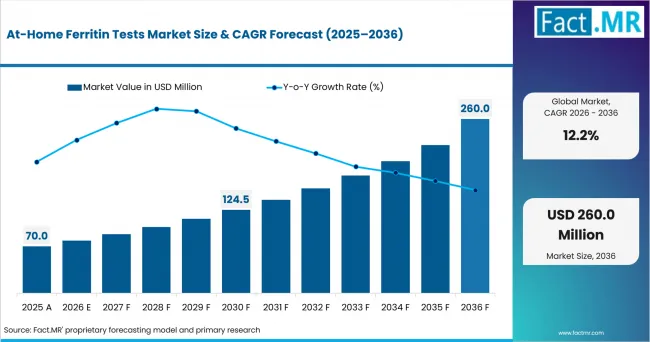
At Home Ferritin Tests Market Market Value Analysis | Source: Fact.MR
What are the defining numbers behind at-home ferritin tests growth?
USD 178 million absolute opportunity by 2036 led by the United States and Germany.
- Demand Drivers in the Market
- Home healthcare adoption continues increasing.
- Iron deficiency awareness is improving worldwide.
- Telehealth platforms support diagnostic access.
- Preventive wellness programs encourage regular testing.
- Key Segments Analyzed
- By Format: Finger-Prick Kits are expected to hold 38.0% share in 2026 because they provide convenient sample collection.
- By Customer Segment: Women's Health is projected to account for 35.0% share in 2026 because iron deficiency screening remains common.
- By Channel: DTC Online is expected to hold 40.0% share in 2026 because consumers increasingly purchase health tests online.
- By Test Model: Lab-Analyzed is projected to account for 44.0% share in 2026 because it offers higher analytical confidence.
- By Geography: The United States is projected to record 12.8% CAGR through 2036.
- Analyst Opinion at Fact.MR
- Shambhu Nath Jha, Senior Analyst at Fact.MR, states, "At-home ferritin testing is becoming an important part of preventive healthcare. Consumers increasingly prefer convenient testing options that support early detection of iron deficiency. Digital health platforms and telehealth services will continue strengthening long-term market demand."
- Strategic Implications
- Expand consumer-friendly testing solutions.
- Develop app-connected diagnostic platforms.
- Strengthen partnerships with telehealth providers.
- Invest in improved sample collection technologies.
At-home ferritin tests help consumers measure iron storage levels without visiting a laboratory. These products support early screening for iron deficiency and ongoing health monitoring through convenient sample collection.
The United States is projected to record 12.8% CAGR through 2036 because home diagnostic adoption continues expanding. Germany is expected to grow at 12.5% CAGR due to strong preventive healthcare awareness. The United Kingdom is forecast to expand at 12.3% CAGR as digital health services continue growing. Japan is projected to register 11.9% CAGR through 2036 because self-testing adoption continues increasing. Australia is expected to grow at 11.7% CAGR due to expanding telehealth services and consumer wellness programs.
How does the at-home ferritin tests market break down by segment?
Finger-Prick Kits lead at 38.0%. Women's Health leads at 35.0%.
Which test format generates the highest demand?
Finger-Prick Kits hold 38.0% share in 2026.
Finger-prick kits lead because they provide a simple sample collection process at home. They require only a small blood sample and deliver a convenient testing experience. Consumers prefer these kits because they reduce the need for clinic visits. They also support regular monitoring of iron levels. Demand remains strong across preventive healthcare applications. Abbott introduced GLP Systems Track to improve laboratory automation and diagnostic workflow. The platform supports laboratories processing clinical chemistry and immunoassay tests including ferritin testing.
Which customer segment accounts for the largest share?
Women's Health accounts for 35.0% share in 2026.
Women's health remains the leading customer segment because iron deficiency is common among women during different life stages. Regular ferritin testing supports early detection and treatment. Healthcare providers continue encouraging routine iron screening. Growing health awareness also supports wider adoption. Demand continues increasing across preventive care programs.
Which sales channel leads the market?
DTC Online holds 40.0% share in 2026.
Direct-to-consumer online channels account for the largest share because they provide convenient product access. Consumers can compare products and order testing kits from home. Digital platforms also improve customer education. Fast home delivery further supports online purchases. Demand continues rising through expanding e-commerce adoption. Labcorp OnDemand continued expanding direct-to-consumer testing through its consumer diagnostics platform. The company's home testing portfolio strengthens the broader at-home diagnostics ecosystem that includes ferritin assessment services.
Which test model remains the most preferred?
Lab-Analyzed leads with 44.0% share in 2026.
Lab-analyzed tests lead because they provide higher analytical accuracy and professional result interpretation. Consumers continue trusting laboratory verification for health decisions. These tests also support detailed reporting. Healthcare professionals often recommend laboratory analysis for ferritin assessment. Demand remains high across home diagnostic services.
What is accelerating at-home ferritin tests demand, and what is holding it back?
Preventive healthcare supports growth while reimbursement limitations remain a challenge.
The primary growth driver is increasing awareness of iron deficiency. Consumers are taking a greater interest in routine health monitoring. Telehealth services also continue expanding. Digital healthcare platforms make home testing more accessible. Growing demand for convenient diagnostics supports market growth. Self-testing also reduces unnecessary clinic visits.
The primary restraint is limited reimbursement for home testing products. Many consumers continue paying out of pocket. Regulatory approval requirements also increase product development time. Smaller companies may face barriers to market entry.
Which sectors offer the strongest growth potential?
- Digital Health Platforms: Connected healthcare services continue expanding, and app-linked ferritin tests improve user engagement and long-term monitoring.
- Employer Wellness Programs: Employers continue investing in preventive health initiatives. Home testing supports workforce wellness programs.
- Telehealth Services: Virtual healthcare providers continue recommending home diagnostics. Ferritin testing complements remote consultations.
- Subscription Testing: Recurring testing programs support continuous health monitoring. Subscription models improve customer retention.
Which countries are scaling at-home ferritin tests fastest?
United States 12.8%, Germany 12.5%, United Kingdom 12.3%, Japan 11.9%, Australia 11.7%.
Based on regional analysis, the at-home ferritin tests market is segmented into North America, Western Europe, Asia Pacific, Latin America, and Middle East and Africa.
| Country | CAGR (2026-2036) |
|---|---|
| United States | 12.8% |
| Germany | 12.5% |
| United Kingdom | 12.3% |
| Japan | 11.9% |
| Australia | 11.7% |
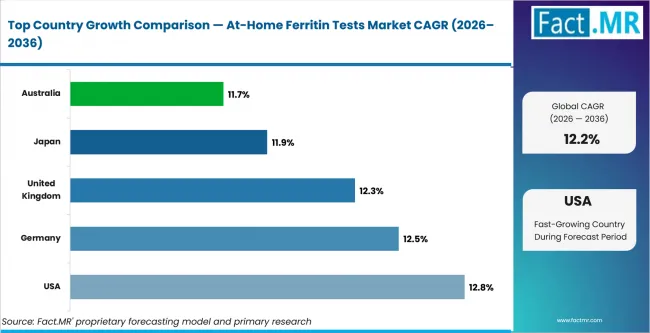
At Home Ferritin Tests Market Cagr Analysis By Country | Source: Fact.MR
What supports growth in the United States?
12.8% CAGR, driven by home healthcare adoption
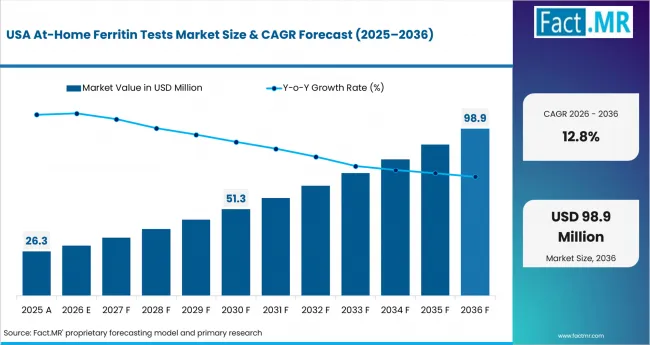
At Home Ferritin Tests Market Country Value Analysis | Source: Fact.MR
The United States is projected to record 12.8% CAGR through 2036 because consumers continue adopting home diagnostic products. Digital healthcare platforms and telehealth services are making self-testing more accessible. Demand is also increasing as preventive healthcare becomes more common. Consumers are monitoring iron levels before symptoms become severe. The country leads demand for home diagnostic testing.
How is Germany strengthening market demand?
12.5% CAGR, supported by preventive healthcare
Germany is expected to post 12.5% CAGR through 2036 because preventive health screening continues expanding. Consumers are placing greater importance on nutritional health and early diagnosis. Retail pharmacies continue increasing the availability of home testing products. Digital healthcare services also support wider adoption. Germany remains one of Europe's leading home diagnostics markets.
Why is the United Kingdom becoming a key market?
12.3% CAGR, backed by digital health services
The United Kingdom is forecast to expand at 12.3% CAGR through 2036 because telehealth services continue growing. Consumers increasingly purchase home testing products through online healthcare platforms. Demand also benefits from strong awareness of iron deficiency. Wellness programs continue encouraging routine screening. The country continues supporting growth in consumer diagnostics.
What is driving adoption in Japan?
11.9% CAGR, supported by consumer wellness
Japan is projected to register 11.9% CAGR through 2036 because preventive health monitoring continues expanding. Consumers increasingly use home testing products to manage nutritional health. Digital healthcare platforms continue improving access to diagnostic services. Home testing is becoming part of routine wellness monitoring. The country remains an important market for self-testing solutions.
How is Australia expanding home diagnostics?
11.7% CAGR, supported by telehealth growth
Australia is expected to grow at 11.7% CAGR through 2036 because telehealth services continue expanding across the country. Consumers increasingly prefer convenient testing solutions that reduce clinic visits. Online pharmacies continue improving product availability. Preventive healthcare programs also support market growth. Australia continues strengthening its home diagnostics market.
Which companies are shaping market competition?
Medichecks, LetsGetChecked, Thriva, Labcorp OnDemand and Quest Health / Quest Diagnostics lead through consumer diagnostics expertise and digital health capabilities.
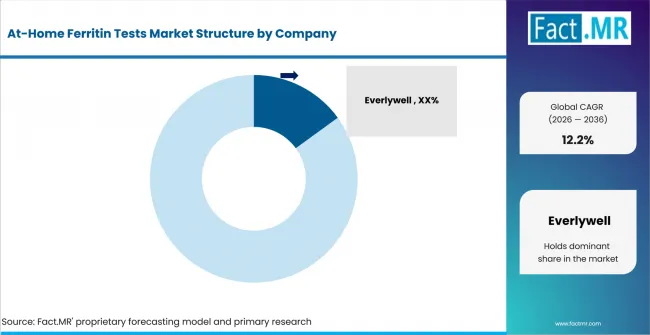
At Home Ferritin Tests Market Analysis By Company | Source: Fact.MR
The market remains moderately consolidated. Competition focuses on testing accuracy and user convenience. Companies continue improving sample collection methods. They are also investing in digital platforms that simplify result reporting and follow-up care. Women's health accounts for the largest share of demand. Wellness consumers and athletes also continue increasing product adoption. Subscription health programs are creating additional opportunities for recurring test sales.
Finger-prick kits remain the leading format. Lab-analyzed testing also generates steady demand because consumers value reliable clinical results and professional interpretation. Medichecks and LetsGetChecked maintain strong positions through direct-to-consumer testing services. Thriva continues expanding digital wellness programs. Labcorp OnDemand and Quest Health / Quest Diagnostics support home testing through laboratory analysis networks. Abbott, Roche and MyHealthChecked continue strengthening their diagnostic portfolios through technology innovation.
Competition will increasingly depend on diagnostic accuracy and digital integration. Companies offering reliable testing, easy-to-use platforms and dependable customer support are expected to strengthen their market position.
Who are the major suppliers in the At-Home Ferritin Tests Market?
Medichecks, Thriva, Labcorp OnDemand, Quest Health / Quest Diagnostics
- Medichecks
- Thriva
- Labcorp OnDemand
- Quest Health / Quest Diagnostics
- MyHealthChecked
Bibliography
- Thriva. (2026). Advanced iron profile blood test. Thriva.
- MyHealthChecked. (2026). Iron deficiency (ferritin) rapid test. MyHealthChecked.
- Quest Health. (2026). Iron, TIBC & ferritin panel test. Quest Diagnostics.
- Labcorp. (2026). Ferritin. Labcorp.
- MedlinePlus. (2025, March 18). Ferritin blood test. U.S. National Library of Medicine.
This Report Addresses
- Strategic intelligence on at-home ferritin testing technologies.
- Segment analysis covering testing formats and customer groups.
- Assessment of distribution channels and testing models.
- Regional outlook covering the United States, Germany, the United Kingdom, Japan, and Australia.
- Competitive assessment of leading home diagnostic providers.
- Analysis of preventive healthcare and consumer wellness trends.
- Evaluation of digital health platforms and telehealth adoption.
- Primary interviews and company benchmarking supporting market estimates.
- Assessment of consumer purchasing behavior across home diagnostics.
- Analysis of future opportunities in self-testing and remote healthcare.
What is covered in the market?
Home testing solutions designed to measure ferritin levels.
The market covers commercial at-home ferritin testing products that enable consumers to monitor iron stores through self-collected samples. Products support wellness screening and anemia risk assessment.
Which products are included?
Consumer ferritin testing products and related diagnostic services.
The scope includes finger-prick kits, dried blood spot cards, lateral-flow tests, lab-mailer kits and app-linked kits.
What is excluded from the scope?
Hospital laboratory ferritin analyzers and professional diagnostic equipment.
The scope excludes automated laboratory analyzers, hospital diagnostic instruments, and conventional clinical pathology services not sold through consumer-initiated or home-sample models.
How was the market evaluated?
100+ sources, 30+ company assessments, 25+ countries, and industry interviews.
- Primary Research: Interviews with diagnostic manufacturers, laboratory specialists, healthcare professionals and telehealth providers.
- Desk Research: Analysis of home diagnostic adoption, iron deficiency screening trends and consumer healthcare spending.
- Market Sizing and Forecasting: Estimates based on test kit sales, consumer adoption and diagnostic service demand.
- Data Validation and Update Cycle: Forecasts validated through company benchmarking and expert interviews.
What is the report's scope and coverage?
| Attribute | Details |
|---|---|
| Quantitative Units | USD Million in 2026 to USD Million by 2036 at CAGR |
| Market Definition | Home testing products designed to measure ferritin levels for iron deficiency screening |
| Formats Covered | Finger-Prick Kits, Dried Blood Spot Cards, Lateral-Flow Tests, Lab-Mailer Kits, App-Linked Kits |
| Customer Segments Covered | Women's Health, Athletes, Vegetarians/Vegans, Anemia Monitoring, Wellness Consumers |
| Channels Covered | DTC Online, Retail Pharmacy, Telehealth, Employer Wellness, Diagnostic Lab Networks |
| Test Models Covered | Self-Read, Lab-Analyzed, Subscription Testing, Clinician-Reviewed, Bundled Micronutrient Panels |
| Regions Covered | North America, Western Europe, Asia Pacific, Latin America, Middle East & Africa |
| Key Countries Covered | United States, Germany, United Kingdom, Japan, Australia |
| Companies Covered | Medichecks, Thriva, Labcorp OnDemand, Quest Health / Quest Diagnostics, MyHealthChecked |
| Forecast Period | 2026 to 2036 |
| Research Approach | Hybrid top-down and bottom-up methodology using home diagnostic adoption, consumer healthcare demand and preventive screening trends. |
How is the market segmented?
-
By Format
- Finger-Prick Kits
- Dried Blood Spot Cards
- Lateral-Flow Tests
- Lab-Mailer Kits
- App-Linked Kits
-
By Customer Segment
- Women's Health
- Athletes
- Vegetarians/Vegans
- Anemia Monitoring
- Wellness Consumers
-
By Channel
- DTC Online
- Retail Pharmacy
- Telehealth
- Employer Wellness
- Diagnostic Lab Networks
-
By Test Model
- Self-Read
- Lab-Analyzed
- Subscription Testing
- Clinician-Reviewed
- Bundled Micronutrient Panels
-
Region:
- North America
- United States
- Canada
- Europe
- Germany
- United Kingdom
- France
- Italy
- Spain
- Asia Pacific
- China
- Japan
- South Korea
- India
- Singapore
- Latin America
- Brazil
- Mexico
- Argentina
- Middle East & Africa
- GCC Countries
- South Africa
- Israel
- North America