- Market Value (2025): USD 816.4 Mn
- Estimated Value (2026): USD 862.2 Mn
- Forecast Value (2036): USD 1489.7 Mn
- CAGR (2026-2036): 5.6%
Laboratory Cold Room Market Forecast and Outlook 2026 to 2036
According to the Fact.MR analysis, the laboratory cold rooms market surpassed a value of USD 816.4 million in 2025 and is projected to grow from USD 862.2 million in 2026 to USD 1489.7 million by 2036. Demand for laboratory cold rooms is likely to grow at a CAGR of 5.6% over the forecast period.
Demand for laboratory cold rooms is rising as biologics, vaccines, cell therapies and biobanks require controlled storage at scale. Suppliers of laboratory cold rooms are offering modular, monitored rooms with redundant refrigeration. For example, Brazil's Butantan Institute and Fiocruz have expanded vaccine production since 2021, raising cold storage needs. Similar biopharma growth is projected to drive sales of laboratory cold rooms through 2036.
Key Takeaways from the Laboratory Cold Room Market
- Laboratory Cold Room Market Value (2025): USD 816.4 million
- Laboratory Cold Room Market Value (2026): USD 862.2 million
- Laboratory Cold Room Market Forecast Value (2036): USD 1489.7 million
- Laboratory Cold Room Market Forecast CAGR (2026-2036): 5.6%
- Leading Product Type: Walk-In Cold Rooms (42.3%)
- Key Market Participants: Thermo Fisher Scientific Inc., Panasonic Healthcare Co. Ltd., Eppendorf AG, Helmer Scientific, B Medical Systems, Haier Biomedical
- Key Growth Regions: Brazil, Japan, United Kingdom, United States, Germany
Large biobanks such as UK Biobank and Japan's Tohoku Medical Megabank store hundreds of thousands of samples under controlled conditions. Demand for laboratory cold rooms is growing as research institutes expand sample collections. Suppliers of laboratory cold rooms are adding remote monitoring and alarm systems. Similar programs are projected to drive sales of laboratory cold rooms across research centers.
Laboratory Cold Room Market
| Metric | Value |
|---|---|
| Estimated Value in (2026) | USD 862.2 million |
| Forecast Value in (2036) | USD 1,489.7 million |
| Forecast CAGR (2026 to 2036) | 5.6% |
Source: Fact.MR analysis. Updated Nov 18, 2026
Source: Fact.MR analysis.
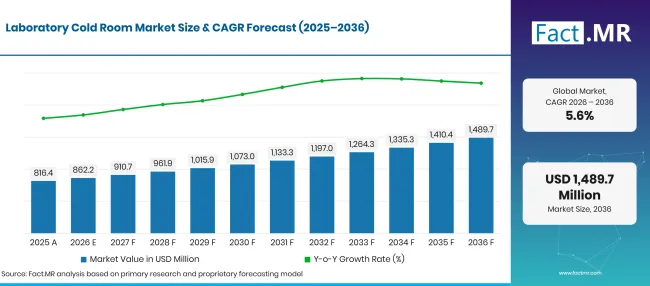
Laboratory Cold Room Market Forecast Global | Source: Fact.MR
Category
| Category | Segments |
|---|---|
| Product Type | Walk-In Cold Rooms, Modular Cold Rooms, Reach-In Cold Rooms |
| Application | Biotechnology, Pharmaceuticals, Research Laboratories, Hospitals, Others |
| Temperature Range | Chilled, Frozen |
| End-User | Pharmaceutical & Biotechnology Companies, Academic & Research Institutes, Hospitals & Diagnostic Centers, Others |
| Region | Brazil; Japan; United Kingdom; United States; Germany |
Source: Fact.MR analysis. Updated Nov 18, 2026
Source: Fact.MR analysis.
Segmental Analysis
How do walk-in cold rooms maintain the lead in product demand?
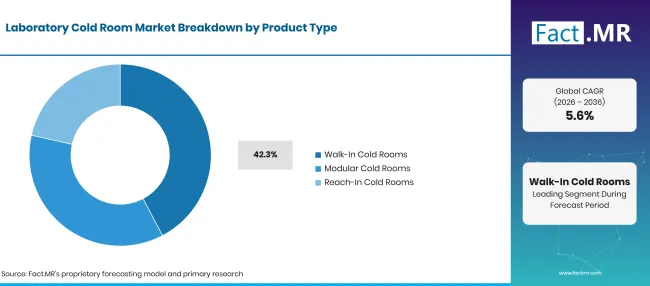
Laboratory Cold Room Market Breakdown Product Type | Source: Fact.MR
Adoption of walk-in cold rooms account for 42.3% of 2026 revenue, about USD 365 million, because laboratories and life-science manufacturers need substantial, organized storage for reagents, biological samples, culture media and temperature-sensitive products. Their capacity to accommodate shelving, monitoring systems and separate storage zones makes them suitable for facilities handling high sample volumes. Modular cold rooms are also attracting demand where laboratories need to expand storage without undertaking major building modifications. Prefabricated insulated panels can shorten installation and support customized layouts, helping walk-in systems retain the largest product share.
What is driving biotechnology to lead application demand?
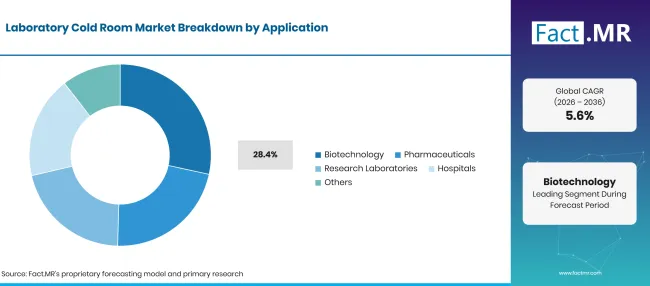
Laboratory Cold Room Market Breakdown Application | Source: Fact.MR
Biotechnology represents 28.4% of 2026 revenue, about USD 245 million, supported by demand for controlled storage of cell lines, enzymes, culture media, research materials and biologic products. Biotech laboratories and biomanufacturing facilities need dependable temperature management to protect sample integrity during research, development and production. India's Department of Biotechnology dashboard reports 3,248 ongoing projects and 2,213 projects sanctioned through FY 2025–26, indicating a substantial publicly supported biotechnology research base. This expansion in research activity supports the need for laboratory infrastructure, including dedicated cold storage.
Which temperature category generates the strongest demand for laboratory cold rooms?
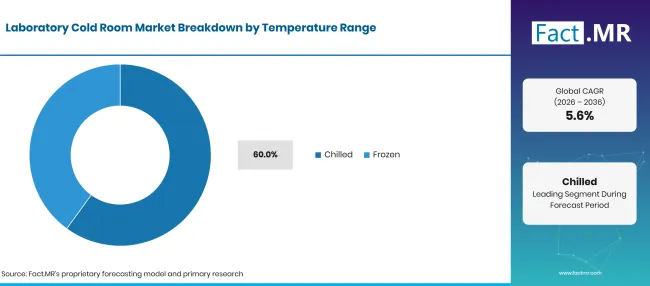
Laboratory Cold Room Market Breakdown Temperature Range | Source: Fact.MR
Demand for chilled rooms segment holds 60.0% of 2026 sales, about USD 515 million, because many laboratory reagents, diagnostic materials and biological products require controlled refrigeration rather than deep-freeze storage. Laboratories need stable temperatures, continuous monitoring and alarm systems to protect materials from temperature fluctuations. India's Ministry of Health and Family Welfare laboratory guidance identifies 2°C to 8°C as the recommended storage and transportation range for many clinical specimens, with exceptions for temperature-sensitive organisms. This reinforces the role of refrigerated storage in routine laboratory workflows. Although frozen rooms remain essential for materials requiring sub-zero conditions, the broader range of routinely refrigerated laboratory supplies sustains chilled rooms' leading sales share.
How are pharmaceutical and biotechnology companies sustaining end-user demand?
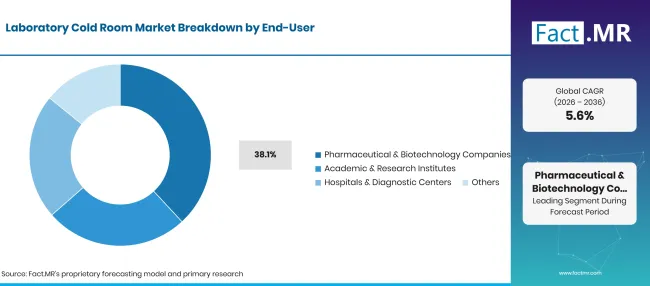
Laboratory Cold Room Market Breakdown End User | Source: Fact.MR
Adoption of laboratory cold room by pharmaceutical and biotechnology companies generate 38.1% of 2026 revenue, about USD 330 million, as they require controlled storage for raw materials, intermediates, finished products and biological substances. Their purchasing decisions are influenced by GMP requirements for suitable storage areas, temperature monitoring, documented records and controlled environmental conditions. In March 2026, the Government of India reported that the pharmaceutical PLI scheme had attracted ₹45,774 crore in cumulative investment by March 2026, with 60 manufacturing units associated with approved applicants located in Maharashtra. The revised Schedule M GMP requirements also became effective for manufacturers with turnover below ₹250 crore from 1 January 2026. These developments support investment in compliant pharmaceutical facilities, including qualified cold-storage infrastructure.
Laboratory Cold Room Market-Drivers, Restraints & Trends
Drivers: Expansion of Biologics and Cell Therapy Pipelines -:
Demand for laboratory cold rooms is increasing as biologics manufacturing, cell and gene therapy development and vaccine research expand. The U.S. FDA reported in January 2026 that it had approved close to 50 cell and gene therapies over the preceding decade. On March 26, 2026, the agency approved Kresladi, its first gene therapy for severe leukocyte adhesion deficiency type I, adding to the range of advanced therapies requiring specialized manufacturing and storage infrastructure. These developments increase the need for temperature-controlled laboratory environments that support biological materials, clinical samples and pharmaceutical intermediates. Suppliers such as Haier Biomedical and B Medical Systems are addressing these requirements through specialized cold-chain equipment and laboratory storage solutions. Demand for GMP-compatible cold rooms with validated temperature uniformity, continuous data logging and alarm systems is expected to support sales throughout the forecast period.
Restraints:High Installation and Energy Costs-:
High installation, validation and electricity costs are restricting laboratory cold room adoption, particularly among smaller research laboratories, universities and emerging biotechnology companies. Installation requires insulated room panels, refrigeration units, backup power, temperature-control systems and commissioning procedures, increasing initial capital expenditure. Eurostat reported that average electricity prices for EU non-household consumers reached €0.18/kWh in the first half of 2026, despite declining 5.4% year over year. In the United States, the Energy Information Administration reported an average commercial electricity price of 14.47 cents/kWh in August 2026, representing a 4.3% increase from August 2025. These electricity expenses add to the lifetime operating costs of continuously functioning refrigeration infrastructure. In addition, EU Regulation 2024/573, which entered into force on March 11, 2024, introduces restrictions on fluorinated greenhouse gases and refrigerant-related compliance requirements. Suppliers must improve energy efficiency and offer compliant refrigeration systems to reduce installation and operating-cost barriers.
Opportunity:
Natural Refrigerant Systems Demand for laboratory cold rooms using low-global-warming-potential refrigerants is creating opportunities for refrigeration equipment manufacturers. The European Commission's implementation of Regulation (EU) 2024/573 is accelerating the transition away from high-GWP fluorinated gases, encouraging manufacturers to develop refrigeration systems using carbon dioxide (CO₂), propane and other alternatives. The Commission identifies CO₂ (R-744) with a global warming potential (GWP) of 1 and propane (R-290) with a GWP of 0.02, compared with substantially higher values for several conventional HFC refrigerants. Its 2026 regulatory documentation also includes additional implementation measures and refrigerant-related compliance requirements. Laboratory cold room suppliers can capitalize on this transition by developing energy-efficient systems with natural refrigerants, appropriate safety engineering and reliable low-temperature performance. Replacement demand is expected to increase as laboratories modernize existing refrigeration infrastructure and prioritize long-term regulatory compliance.
Trend:
Remote Monitoring Remote temperature monitoring is becoming an important feature of laboratory cold rooms as pharmaceutical companies and research facilities seek continuous visibility into storage conditions. The U.S. Centers for Disease Control and Prevention updated its Vaccine Storage and Handling Toolkit on July 14, 2026, recommending digital data loggers for routine vaccine storage, transportation and temporary clinics, alongside backup monitoring devices. The updated guidance also emphasizes calibration records and appropriate responses to temperature excursions. These requirements reinforce the importance of continuous monitoring and reliable temperature documentation across temperature-sensitive storage environments. Laboratory cold room manufacturers are increasingly incorporating connected sensors, cloud-based dashboards, automated alerts and historical temperature records to help operators identify equipment failures and temperature deviations. Demand for integrated monitoring solutions is expected to support premium cold room installations and replacement sales across pharmaceutical laboratories, biotechnology facilities and research institutions.
Laboratory Cold Room Market by Analysis by Key Country
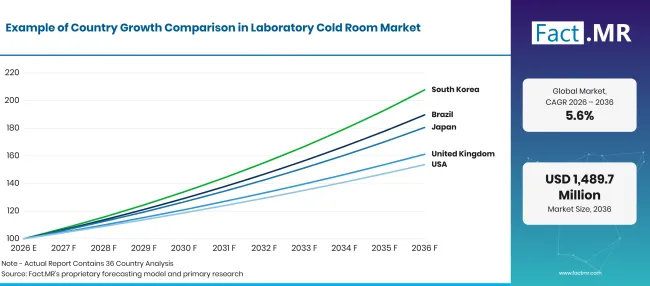
Laboratory Cold Room Market Growth Index | Source: Fact.MR
| Country | CAGR (2026-2036) |
|---|---|
| Brazil | 6.6% |
| Japan | 6.1% |
| United Kingdom | 4.9% |
| United States | 4.4% |
| Germany | 4.1% |
Source: Fact.MR analysis. Updated Nov 18, 2026
Source: Fact.MR analysis.
Why is Brazil the fastest-growing market for laboratory cold rooms?
Sales of laboratory cold rooms in Brazil are projected to grow at a 6.6% CAGR, the fastest among the five key countries, as Butantan and Fiocruz expand vaccine production.
Suppliers are serving public institutes. Similar investment is projected to drive sales in Brazil. On February 9, 2026, the federal government allocated R$1.4 billion to build two new Instituto Butantan factories and modernize two existing facilities. The planned plants include annual production capacities of 6 million DTPa vaccine doses and 20 million HPV vaccine doses. In September 2026, Brazil's Ministry of Health also reported R$210 million in investment in domestic mRNA vaccine platforms, involving Fiocruz, Butantan and UFMG. These projects are expected to support sales of walk-in cold rooms and other controlled-storage systems across vaccine production, quality-control and research facilities.
What is driving laboratory cold room demand in Japan?
Demand for laboratory cold rooms in Japan is estimated to record a 6.1% CAGR, supported by research and development in regenerative medicine, cell therapies and biobanking.
The Japan Agency for Medical Research and Development (AMED) lists a FY2026 budget of ¥116.9 billion in government subsidies, alongside ¥6.7 billion in operating grants and ¥17.5 billion in adjustment funding. Its regenerative medicine and cell and gene therapy programs support research, clinical translation and manufacturing infrastructure for cells and vectors. These activities require controlled storage for cell materials, reagents and research samples, creating demand for laboratory refrigeration and freezer systems.
What is shaping laboratory cold room demand in the United Kingdom?
Demand for laboratory cold rooms in the United Kingdom is projected to rise at a 4.9% CAGR, as investment in life sciences and biobank infrastructure sustains demand for secure sample storage.
In July 2026, the UK government reported that the life sciences sector had attracted more than £3 billion in public-private investment over 12 months. UK Biobank's 2026 infrastructure expansion is also significant: its biological-sample facility holds around 17 million containers, and the organization plans to move more than 11 million samples to its new Manchester headquarters, which will have automated freezer capacity for up to 20 million samples. This scale of sample management supports demand for specialized cold rooms, freezer installations and backup storage infrastructure.
What is shaping laboratory cold room sales in the United States?
Sales of laboratory cold rooms in the United States are estimated to record a 4.4% CAGR, supported by continued biomedical research funding and investment in laboratory infrastructure.
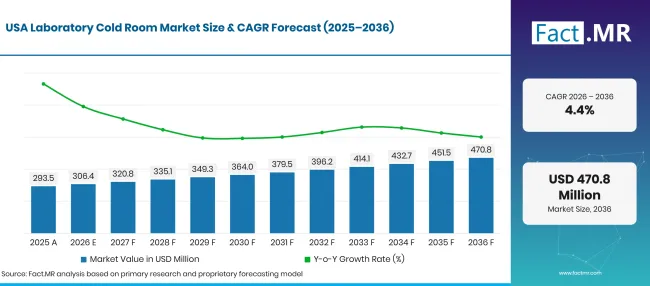
Laboratory Cold Room Market Forecast Usa | Source: Fact.MR
In March 2026, the National Institutes of Health reported that it had awarded USD 35.3 billion through 55,394 research grants in FY2025, supporting research at universities, hospitals, small businesses and other organizations. The NIH FY2026 operating plan also allocated USD 80 million for extramural construction of biomedical research facilities. These funding streams support laboratory activity and infrastructure development, creating opportunities for cold-room suppliers serving pharmaceutical companies, research institutions and biotechnology facilities.
How does Germany’s mature pharmaceutical and research base influence laboratory cold room demand?
Demand for laboratory cold rooms in Germany is projected to increase at a 4.1% CAGR, the slowest among the five key countries, as established pharmaceutical and research facilities are more likely to purchase replacement systems or upgrade existing installations than build entirely new storage infrastructure.
Germany nevertheless maintains a substantial research base: Destatis reported that national research and development expenditure reached 3.1% of GDP in 2024 in its 2026 country indicators. Pharmaceutical production also increased by 8.0% in September 2026 compared with August, according to Destatis. EU F-gas requirements add another consideration, encouraging equipment operators to assess refrigerant compliance when replacing or modernizing refrigeration systems.
Competitive Landscape for Laboratory Cold Room Market
Competition in the laboratory cold room market includes biomedical refrigeration manufacturers, specialist environmental-chamber suppliers and commercial cold-room engineering companies. Haier Biomedical and Angelantoni Life Science compete through laboratory and life-science temperature-control solutions, while FARRAR (Trane Technologies), Environmental Specialties (ES Chambers) and Darwin Chambers Company serve customers requiring specialized controlled-environment and cold-storage systems. Cantrol International, Cold Room Solutions and Porkka Finland add expertise in refrigeration engineering, modular cold rooms and temperature-controlled facilities. Buyers compare suppliers on temperature uniformity, control accuracy, insulation performance, energy consumption, customization, installation and after-sales service.
From 2024 onward, competition has increasingly focused on energy efficiency, refrigerant selection, temperature uniformity and remote monitoring. FARRAR has strengthened its position with a CO₂ refrigeration system using a natural refrigerant with a GWP of 1, alongside modular cold rooms, redundant refrigeration and remote monitoring. Darwin Chambers emphasizes precision temperature control, alarms, data logging and calibration services, while Environmental Specialties offers cold rooms with volumetric temperature uniformity and humidity control. Haier Biomedical provides dedicated vaccine and biological-product cold rooms with equipment fault diagnosis and warning functions. The EU F-gas Regulation (EU) 2024/573, applicable since March 11, 2024, is adding pressure to reduce reliance on high-GWP refrigerants in relevant equipment markets. Consequently, suppliers that can demonstrate reliable temperature performance, lower environmental impact, validation support and responsive maintenance are better positioned to compete.
Recent Developments
- On February 13, 2026, Darwin Chambers introduced SenSolve, an AI-powered predictive monitoring platform designed to continuously monitor environmental chamber performance. The system uses smart sensors, cellular connectivity and AI-driven diagnostics to identify unusual operating patterns and potential equipment failures before they affect research materials.
- On May 12, 2025, FARRAR introduced CYCLONE, a forced-air convection ultra-low-temperature storage chamber designed for flexible temperature settings between -20°C and -80°C. The system offers temperature uniformity of ±2°C, up to 50% faster recovery following door openings and integration with Modbus TCP and BACnet IP monitoring systems. The launch strengthens FARRAR's cold-storage portfolio for pharmaceutical manufacturing, clinical trials and bioscience applications.
- On October 26, 2026, Haier Biomedical announced that an IEC standard project covering automated and semi-automated medical cold rooms had been approved for development, with the company leading the initiative. This is an important industry-standardization development related directly to medical cold storage infrastructure.
Key Players in Laboratory Cold Room Market
Key companies operating in the market include Haier Biomedical, FARRAR (Trane Technologies), Angelantoni Life Science, Environmental Specialties LLC (ES Chambers), Darwin Chambers Company, Cantrol International Inc., Cold Room Solutions LLC, and Porkka Finland Oy.
- Haier Biomedical
- FARRAR (Trane Technologies)
- Angelantoni Life Science
- Environmental Specialties LLC (ES Chambers)
- Darwin Chambers Company
- Cantrol International Inc.
- Cold Room Solutions LLC
- Porkka Finland Oy
Bibliography
- Checkpoint Surgical. (2026, August 20). Checkpoint Surgical expands peripheral nerve portfolio with new flexible nerve conduit.
- Darwin Chambers Company. (2026, February 13). Darwin Chambers launches SenSolve™ predictive monitoring platform.
- Department of Biotechnology, Government of India. (n.d.). Dashboard DBT: Key statistics.
- European Commission. (n.d.). Climate-friendly alternatives to F-gases: Refrigeration.
- European Commission. (n.d.). F-gas legislation.
- European Parliament & Council of the European Union. (2024). Regulation (EU) 2024/573 of 7 February 2024 on fluorinated greenhouse gases. Official Journal of the European Union.
- Eurostat. (2026, November 4). Electricity prices for non-household consumers in the first half of 2026.
- Instituto Butantan. (2024). Annual report.
- Ministry of Chemicals and Fertilizers, Government of India. (2026, July 28). Strengthening pharmaceutical and bulk drug manufacturing in Maharashtra. Press Information Bureau.
- Ministry of Health and Family Welfare, Government of India. (n.d.). Laboratory manual: Storage and transportation of specimens.
- Ministry of Health and Family Welfare, Government of India. (2026, March 24). Steps taken to ensure drug quality and curb counterfeit medicines. Press Information Bureau.
- Ministry of Science and Technology, Government of India. (2026, July 23). Parliament question: Implementation of BioE3 Policy. Press Information Bureau.
- U.S. Centers for Disease Control and Prevention. (n.d.). Vaccine storage and handling.
- U.S. Energy Information Administration. (n.d.). Electricity monthly update.
- U.S. Food and Drug Administration. (2026). FDA increases flexibility in requirements for cell and gene therapies to advance innovation.
- U.S. Food and Drug Administration. (2026, March 26). FDA approves first gene therapy for severe leukocyte adhesion deficiency type I.
- UK Biobank. (n.d.). About us.
Segmentation
Scope of Report
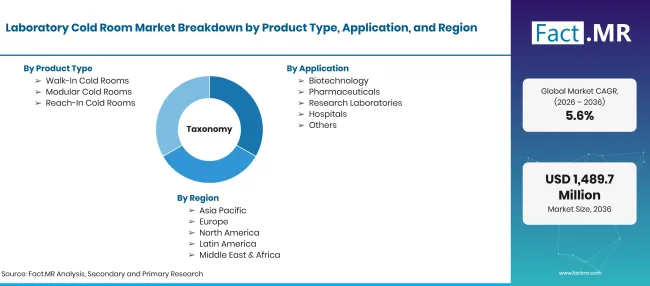
Laboratory Cold Room Market Taxonomy | Source: Fact.MR
| Items | Values |
|---|---|
| Quantitative Units (2026) | USD 862.2 Million |
| Product Type | Walk-In Cold Rooms, Modular Cold Rooms, Reach-In Cold Rooms |
| Application | Biotechnology, Pharmaceuticals, Research Laboratories, Hospitals, Others |
| Temperature Range | Chilled, Frozen |
| End-User | Pharmaceutical & Biotechnology Companies, Academic & Research Institutes, Hospitals & Diagnostic Centers, Others |
| Regions Covered | North America, Latin America, Europe, East Asia, South Asia and Pacific, Middle East & Africa |
| Countries Covered | United States, Germany, Japan, United Kingdom, Brazil, and other countries |
| Key Companies Profiled |
Haier Biomedical; FARRAR (Trane Technologies); Angelantoni Life Science; Environmental Specialties LLC (ES Chambers); Darwin Chambers Company; Cantrol International Inc.; Cold Room Solutions LLC; Porkka Finland Oy |
| Additional Attributes | Dollar revenue in the Laboratory Cold Room Market is segmented by product type (walk-in cold rooms, modular cold rooms, reach-in cold rooms); application (biotechnology, pharmaceuticals, research laboratories, hospitals); temperature range (chilled, frozen); end-user (pharmaceutical & biotechnology companies, academic & research institutes, hospitals & diagnostic centers) and region. |
Source: Fact.MR analysis. Updated Nov 18, 2026
Laboratory Cold Room Market by Segments
-
Product Type
- Walk-In Cold Rooms
- Modular Cold Rooms
- Reach-In Cold Rooms
-
Application
- Biotechnology
- Pharmaceuticals
- Research Laboratories
- Hospitals
- Others
-
Temperature Range
- Chilled
- Frozen
-
End-User
- Pharmaceutical & Biotechnology Companies
- Academic & Research Institutes
- Hospitals & Diagnostic Centers
- Others
-
Region:
- North America
- United States
- Canada
- Mexico
- Europe
- Germany
- United Kingdom
- France
- Italy
- Spain
- Rest of Europe
- Asia Pacific
- China
- India
- Japan
- South Korea
- Australia
- Rest of Asia Pacific
- Latin America
- Brazil
- Mexico
- Argentina
- Rest of Latin America
- Middle East & Africa
- GCC Countries
- South Africa
- Rest of Middle East & Africa
- North America
Frequently Asked Questions
How big is the global Laboratory Cold Room Market in 2026?
What will be the size of the Laboratory Cold Room Market by 2036?
How fast will the Laboratory Cold Room Market grow during the forecast period?
Which product type segment holds the largest share of the Laboratory Cold Room Market?
Who worked on this report


Preview the report firsthand - request a free sample
Free SampleGet the brochure for pricing and purchase details
Download PDF