- Base Value(2025): 3.6 Bn
- Estimated Value(2026): 4.3 Bn
- Forecast Value (2036): 23.8 Bn
- CAGR (2026 - 2036): 18.7%
Augmented Reality Head-Up Display Systems Market Forecast and Outlook By FACT MR
In 2025, the augmented reality head-up display systems market was valued at USD 3.6 billion. Based on Fact.MR analysis, demand for augmented reality head-up display systems is estimated to grow to USD 4.3 billion in 2026 and USD 23.8 billion by 2036. FACT.MR projects a CAGR of 18.7% during the forecast period.
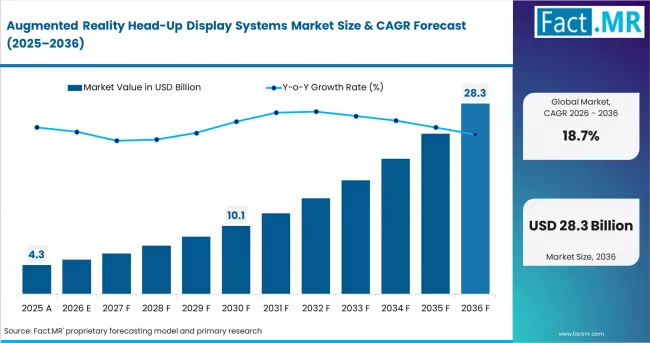
Augmented Reality Head Up Display Systems Market Market Value Analysis | Source: Fact.MR
Summary of Augmented Reality Head-Up Display Systems Market
- Market Definition
- The market covers conventional and AR-HUD optical projection systems with windshield and combiner formats, supplying navigational and ADAS overlay data to vehicle drivers via OEM-integrated display and processing unit assemblies globally.
- Demand Drivers
- China's NEV platform mandates require integrated smart cockpit systems, with AR-HUD fitment becoming standard across subsidy-eligible electric vehicle platforms launching from domestic OEMs.
- EU NCAP 2026 safety assessment criteria now include AR-HUD assisted lane-departure and collision-alert overlay scoring, directly incentivising OEM fitment across European passenger vehicle programmes.
- India's near-premium vehicle OEMs are accelerating AR-HUD adoption as a feature differentiator, with Tata Motors and Mahindra disclosing cockpit digitalisation roadmaps targeting 2026 model year fitment.
- Key Segments Analyzed
- By Technology: Conventional HUD holds approximately 55% share in 2026 due to cost advantage, while AR-HUD is the fastest-growing sub-segment driven by luxury and EV platform adoption.
- By HUD Type: Windshield HUD leads with approximately 65% share in 2026 as the primary OEM integration format, with combiner HUD declining as windshield formats achieve cost parity.
- By Geography: China leads at 18.3% CAGR through 2036, driven by NEV cockpit digitalisation mandates and domestic AR-HUD supply chain development.
- Analyst Opinion at FACT.MR
- Shambhu Nath Jha, Principal Consultant at Fact.MR, opines, CXOs will find that AR-HUD contract wins are increasingly linked to AR rendering software capability rather than optical hardware alone. Tier-1 suppliers integrating waveguide optics with proprietary AR middleware are positioned to capture a disproportionate share of OEM programmes through 2036.
- Strategic Implications
- Invest in AR rendering software integration alongside optical hardware to secure bundled OEM platform contracts in Germany, Japan, and China premium and EV segments.
- Develop cost-optimised conventional HUD solutions for India and Southeast Asia near-premium vehicle OEMs to capture high-growth volume segments during the AR transition.
- Accelerate NCAP-aligned ADAS overlay capability to qualify AR-HUD systems for EU safety scoring, enabling preferred supplier status across European OEM procurement cycles.
- Methodology
- Market sizing based on vehicle production volumes, HUD attach rates by technology type, and average selling prices by HUD format. Validated with 2024–2025 OEM sourcing data.
- Analysis incorporates OEM earnings disclosures, DSCC panel data, China NEV mandates, and EU automotive regulation filings for demand assessment.
- Forecasts account for vehicle electrification trends, AR software cost curve trajectories, OEM platform refresh cycles, and regional safety regulation timelines.
| Metric | Value |
|---|---|
| Estimated Value in 2026 | USD 4.3 billion |
| Forecast Value in 2036 | USD 23.8 billion |
| Forecast CAGR (2026 to 2036) | 18.7% |
Source: Fact.MR analysis. Updated May 4, 2026
The market is projected to generate USD 19.5 billion in absolute opportunity between 2026 and 2036. Growth is transformational rather than incremental, anchored by ADAS regulatory mandates, OEM cockpit digitalisation commitments, and electric vehicle platform architecture transitions favouring full-digital instrument zones. Restraints include high waveguide and projection unit costs, AR software calibration complexity, and OEM homologation cycles that slow generational refresh.
AR-HUD adoption across major vehicle platforms is accelerating. Continental AG and Visteon Corporation have both disclosed AR-HUD supply programme wins in their 2024 earnings communications, citing increased OEM content per vehicle. Continental confirmed in its Q3 2024 results that AR-HUD represented the fastest-growing cockpit content category in their forward order intake, with double-digit growth in programme nominations across European and Chinese OEM customers.
India leads with a projected CAGR of 17.6% through 2036, driven by accelerating EV adoption and feature penetration in near-premium vehicles. China follows at 18.3%, anchored by NEV platform mandates and smart cockpit integration requirements across domestic OEMs. Germany records 16.0%, fueled by luxury OEM innovation cycles at BMW Group and Mercedes-Benz integrating AR overlays across new platform launches. The United States grows at 16.2%, supported by ADAS programme mandates and strong premium vehicle demand. Japan records 15.4%, sustained by a deep Tier-1 supplier ecosystem and early HUD standardization across OEM platforms. Mature markets including Japan and Germany face longer homologation cycles as a structural moderator on growth speed.
Segmental Analysis
Augmented Reality Head-Up Display Systems Market Analysis by Technology
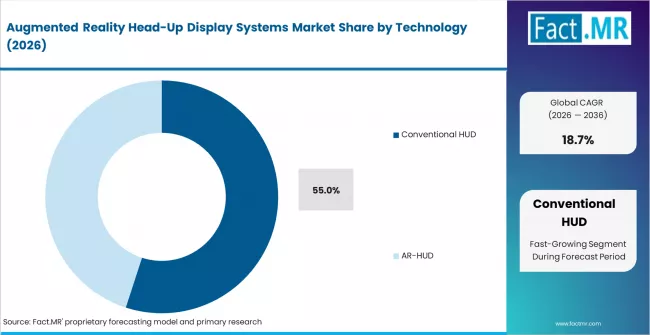
Augmented Reality Head Up Display Systems Market Analysis By Technology | Source: Fact.MR
Based on FACT.MR’s analysis, conventional HUD holds ~55% share in 2026. It leads due to cost advantage and established OEM integration. It supports basic speed, navigation, and warning displays. AR-HUD is the fastest-growing segment, gaining traction in luxury and EV platforms.
- Continental AG Investment: Continental AG identified AR-HUD as the fastest-growing cockpit segment in Q3 2024. It reported strong programme nominations and increased waveguide R&D investment for 2025 [1].
- Visteon AR Platform Development: Visteon launched its SmartCore AR-HUD platform in 2024. It integrates AR compute and HUD control in a single cockpit domain controller, targeting 2026–2027 programmes [2].
- AR-HUD Attach Rate Trend: OICA 2024 data shows AR-HUD nominations rose 34% YoY. Luxury and near-premium EVs accounted for 78% of new fitment programmes [3].
Augmented Reality Head-Up Display Systems Market Analysis by HUD Type
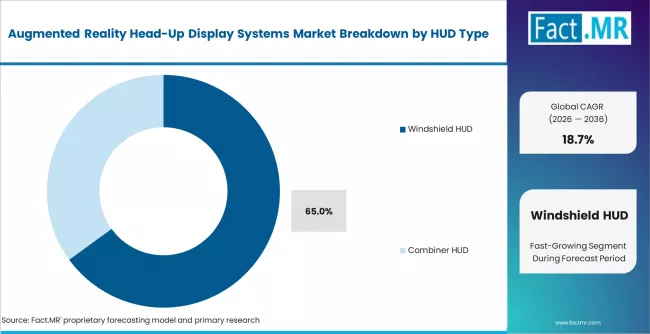
Augmented Reality Head Up Display Systems Market Analysis By Hud Type | Source: Fact.MR
Based on FACT.MR’s analysis, windshield HUD holds 65% share in 2026. It enables larger projection areas and advanced AR overlays. Combiner HUD continues to decline as cost gaps narrow.
- Nippon Seiki Platform Win: Nippon Seiki secured windshield AR-HUD supply for two Japanese OEM platforms in Q4 2024. Combined volumes reach ~350,000 units annually from 2026 [4].
- Harman Windshield Development: Harman launched its WindshieldAR module at CES 2025. It features 12-degree field-of-view AR overlay with ADAS sensor integration [5].
- Combiner HUD Decline Trend: DSCC Q3 2024 data shows combiner HUD share fell to 31%, down from 44% in 2022. Cost reductions in windshield systems reduced combiner advantage [6].
Drivers, Restraints, and Opportunities
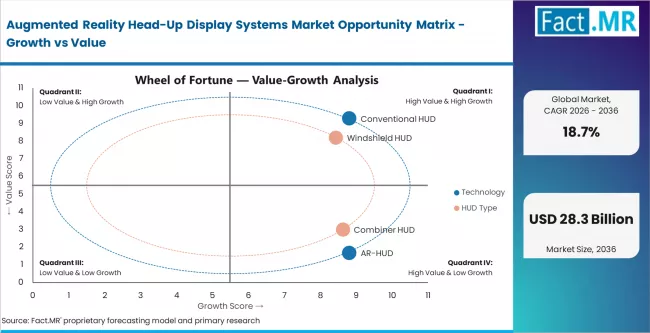
Augmented Reality Head Up Display Systems Market Opportunity Matrix Growth Vs Value | Source: Fact.MR
FACT.MR analysts observe that the AR head-up display systems market is structurally growth-driven and undergoing rapid technology transition. Demand is driven by OEM cockpit digitalisation, ADAS regulatory requirements, and EV platform shifts toward integrated digital interfaces. Current valuation reflects early-stage AR-HUD scaling, with volume concentrated in luxury and near-premium segments but gradually expanding into mainstream platforms.
Conventional HUD is losing share in premium segments to AR-HUD, while still growing in volume markets. AR-HUD commands 40–60% higher pricing per unit. This supports strong value growth despite stable conventional volumes. Processing units are the fastest-growing component due to AR rendering needs. Suppliers lacking AR compute capability risk exclusion from luxury OEM programmes from 2026 onward.
- EU NCAP AR-HUD Scoring: Euro NCAP updated its 2024 protocol to include AR-HUD-based collision warning and lane overlay scoring from 2026. This encourages OEM standard fitment to maintain safety ratings. Continental AG and Visteon highlighted AR-HUD programme expansion in Q3 2024, citing NCAP alignment [2].
- China NEV Smart Cockpit Mandate: China’s 2024 MIIT policy includes AR-HUD as an advanced interface for NEV subsidy tiers. BYD and NIO deployed AR-HUD across flagship EVs in 2024. BOE Technology Group and Huawei expanded AR-HUD partnerships with domestic OEMs [3].
- India Near-Premium EV Adoption: India’s 2024 PLI extension supports local AR-HUD assembly. Tata Motors outlined AR-HUD integration for Harrier and Safari from 2026. Mahindra increased ADAS-linked display investments for EV platforms, supporting SUV adoption growth [4].
Regional Analysis
The augmented reality head-up display systems market is assessed across Asia Pacific, North America, Europe, Latin America, and Middle East and Africa, covering major vehicle production and consumption markets with distinct OEM innovation ecosystems, regulatory environments, and ADAS adoption profiles. The full report provides market attractiveness analysis by region and country.
.webp "Top Country Growth Comparison Augmented Reality Head Up Display Systems Market Cagr (2026 2036)")
Top Country Growth Comparison Augmented Reality Head Up Display Systems Market Cagr (2026 2036) | Source: Fact.MR
| Country | CAGR (2026 to 2036) |
|---|---|
| China | 18.3% |
| India | 17.6% |
| Germany | 16.0% |
| United States | 16.2% |
| Japan | 15.4% |
Source: Fact.MR analysis. Updated May 4, 2026
Source: Fact.MR (FACT.MR) analysis, based on proprietary forecasting model and primary research
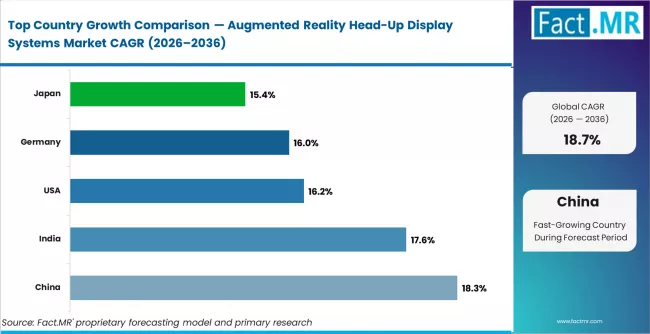
Augmented Reality Head Up Display Systems Market Cagr Analysis By Country | Source: Fact.MR
Asia Pacific Augmented Reality Head-Up Display Systems Market Analysis
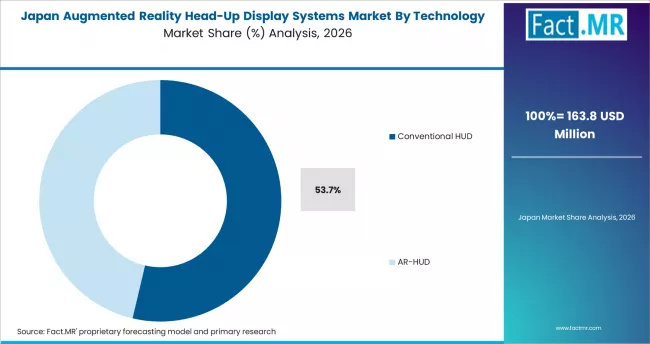
Augmented Reality Head Up Display Systems Market Japan Market Share Analysis By Technology | Source: Fact.MR
Asia Pacific remains the primary growth hub and production base for AR-HUD systems. China leads in scale through NEV mandates. India shows the fastest expansion pace. Japan brings depth through strong OEM-supplier integration. BOE Technology Group, Panasonic Automotive, and Denso Corporation define the regional landscape.
- China: China’s market is expanding rapidly at 18.3% CAGR through 2036, driven by policy-backed NEV adoption. The 2024 MIIT update positioned AR-HUD as a premium cockpit feature. BYD rolled out AR-HUD across Seal and Han EVs. NIO moved toward standard fitment in ET7 and EC7. BOE strengthened supply with capacity expansion in Chengdu.
- India: India is emerging as a high-growth market with 17.6% CAGR through 2036. Demand is fuelled by rising SUV penetration and feature-rich EV launches. Tata Motors outlined AR-HUD deployment from 2026. Government incentives under the PLI scheme improved localisation. Mahindra is advancing AR-enabled ADAS displays in its EV lineup.
- Japan: Japan shows steady growth at 15.4% CAGR through 2036, supported by a mature supplier ecosystem. Toyota integrated AR-HUD within its Arene OS architecture. Nippon Seiki secured new OEM programmes. Denso is strengthening AR processing capabilities for future platforms. Adoption is gradual but technology-focused.
FACT.MR’s analysis of the AR head-up display systems market in Asia Pacific covers China, India, Japan, South Korea, ASEAN, and Australia and New Zealand. Readers can find NEV policy impacts, OEM shifts, ADAS trends, and supply chain insights.
Europe Augmented Reality Head-Up Display Systems Market Analysis
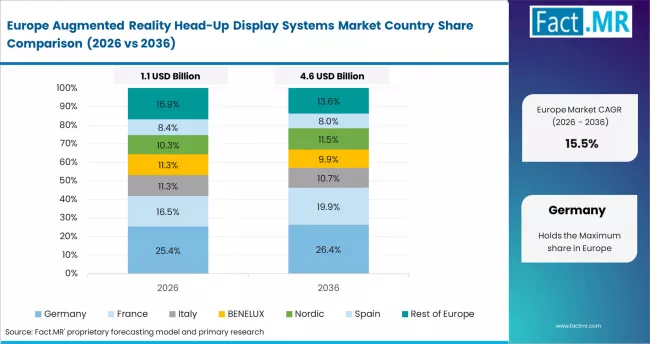
Augmented Reality Head Up Display Systems Market Europe Country Market Share Analysis, 2026 & 2036 | Source: Fact.MR
Europe serves as a global benchmark for AR-HUD innovation and premium specifications. German OEMs lead in defining AR interface standards. Continental AG and Harman International anchor supplier competition. Regulatory frameworks continue to shape adoption.
- Germany: Germany is advancing at 16.0% CAGR through 2036, led by high-end vehicle innovation. BMW introduced AR-guided displays across key models in 2024. Mercedes-Benz is scaling AR-HUD across multiple platforms from 2025. Updated NCAP protocols are reinforcing AR adoption across OEM portfolios.
FACT.MR’s analysis of the AR head-up displays systems market in Europe covers Germany, United Kingdom, France, Italy, Spain, Nordic Countries, and BENELUX. Readers can find regulatory insights, OEM trends, and specification benchmarks.
North America Augmented Reality Head-Up Display Systems Market Analysis
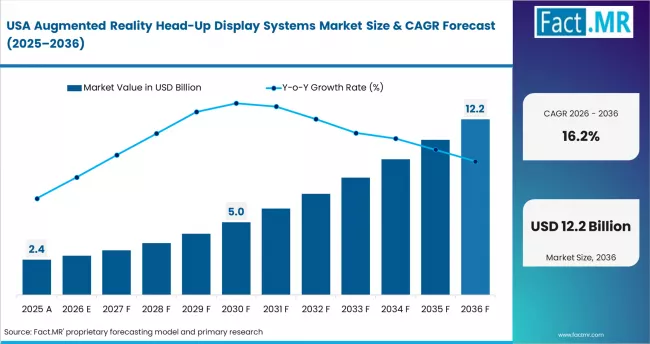
Augmented Reality Head Up Display Systems Market Country Value Analysis | Source: Fact.MR
North America is characterized by strong value generation and regulatory-led adoption. Premium vehicle demand and ADAS integration are key drivers. Visteon Corporation and Harman International dominate supply.
- United States: The U.S. market is growing at 16.2% CAGR through 2036, supported by safety regulations and high-end vehicle demand. NHTSA guidelines updated in 2024 expanded AR display requirements. Ford introduced AR-HUD in key SUV and pickup models. General Motors is integrating AR-HUD across its EV portfolio from 2026.
FACT.MR’s analysis of the AR head-up display systems market in North America covers the United States, Canada, and Mexico. Readers can find regulatory data, OEM investments, and adoption trends.
Competitive Aligners for Market Players
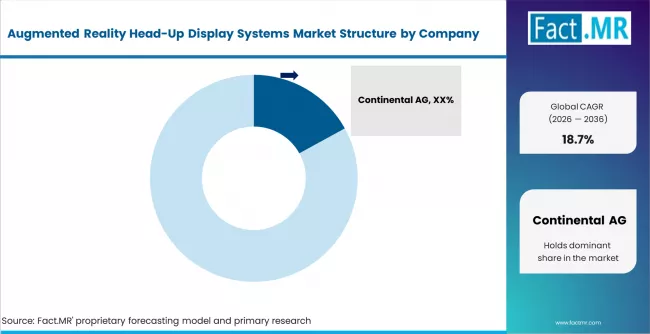
Augmented Reality Head Up Display Systems Market Analysis By Company | Source: Fact.MR
The augmented reality head-up displays (AR-HUD) systems market is moderately consolidated, with competition centered on Tier-1 automotive suppliers, optical technology specialists, and display ecosystem players. The competitive landscape is shifting from hardware-led differentiation to software-defined cockpit platforms. Suppliers capable of integrating AR rendering engines, waveguide optics, and ADAS-linked data processing are gaining a decisive advantage in OEM programme awards.
Continental AG and Denso Corporation lead the market through strong OEM relationships and end-to-end cockpit integration capabilities. These players combine AR-HUD hardware with domain controllers and ADAS interfaces, positioning themselves as full-stack solution providers. Their early investments in waveguide optics and AR software stacks are supporting long-term programme visibility.
Visteon Corporation and Harman International are strengthening their positions through software-centric cockpit platforms. Visteon’s SmartCore architecture and Harman’s AR visualisation systems integrate AR rendering with infotainment and sensor fusion. This enables scalable deployment across EV and premium vehicle platforms.
Nippon Seiki remains a key specialist in HUD optics and windshield projection systems, leveraging long-standing OEM partnerships in Japan and North America. Meanwhile, Panasonic Automotive Systems is expanding its AR-HUD portfolio through cockpit domain integration and partnerships with EV-focused OEMs. On the component side, BOE Technology Group is emerging as a critical supplier of AR display panels, supported by domestic OEM alignment and scale advantages. Chinese ecosystem players are rapidly closing the technology gap, particularly in cost-optimised AR-HUD modules. Thus, the market is evolving toward a winner-takes-contract dynamic, where suppliers offering integrated AR software, optics, and compute platforms will secure disproportionate share through 2036.
Key Players
- Continental AG
- Denso Corporation
- Visteon Corporation
- Panasonic Automotive Systems Co., Ltd.
- Nippon Seiki Co., Ltd.
- Harman International Industries, Inc.
- BOE Technology Group Co., Ltd.
- Robert Bosch GmbH
- Aptiv PLC
- Huawei Technologies Co., Ltd. (Intelligent Automotive Solution BU)
Bibliography
- [1] Continental AG. (2024). Investor communication highlighting AR-HUD as the fastest-growing cockpit segment and outlining waveguide R&D investment plans for 2025.
- [2] Visteon Corporation. (2024). Product announcement of SmartCore AR-HUD platform integrating AR rendering and HUD control within a cockpit domain controller.
- [3] Organisation Internationale des Constructeurs d'Automobiles (OICA). (2024). Vehicle platform data analysis reporting AR-HUD programme nomination growth and EV segment contribution trends.
- [4] Nippon Seiki. (2024). OEM programme award disclosure for windshield AR-HUD systems across Japanese vehicle platforms.
- [5] Harman International. (2025). WindshieldAR module launch at CES showcasing AR overlay and ADAS integration capabilities.
- [6] Display Supply Chain Consultants (DSCC). (2024). Automotive display report presenting HUD format share trends and combiner HUD decline data.
This Report Addresses
- Strategic intelligence on AR head-up display demand across conventional HUD and AR-HUD technology types, windshield and combiner formats, and display unit and processing unit components for passenger and luxury vehicle OEM programmes globally.
- Market forecast from USD 4.3 billion in 2026 to USD 23.8 billion by 2036 at a CAGR of 18.7%.
- Growth opportunity mapping across China NEV cockpit digitalisation mandates, India near-premium EV adoption, Germany luxury AR overlay integration, and U.S. ADAS programme-driven demand.
- Segment analysis by technology (conventional HUD, AR-HUD), HUD type (windshield, combiner), and component (display unit, processing unit, others).
- Regional outlook covering Asia Pacific NEV-driven AR-HUD volume growth, North America NHTSA ADAS interface compliance, and Europe EU NCAP safety scoring requirements driving OEM AR-HUD standard fitment.
- Competitive analysis of Continental AG, Visteon Corporation, Nippon Seiki, Denso Corporation, Panasonic Automotive, Harman International, and BOE Technology Group. Focus on AR rendering integration depth, OEM programme qualification breadth, and ADAS overlay accuracy.
- Regulatory impact analysis covering EU NCAP 2026 AR-HUD safety scoring, China MIIT NEV smart cockpit mandates, NHTSA forward collision warning interface guidelines, and India PLI advanced automotive electronics incentives.
- Report delivered in PDF, Excel datasets, and presentation formats. Supported by primary OEM and Tier-1 interviews, HUD supply programme disclosures, NEV policy documents, and NCAP regulatory filings.
Augmented Reality Head-Up Display Systems Market Definition
The market covers optical projection systems integrated into vehicle dashboards that overlay navigational, ADAS alert, and vehicle status data onto the driver's forward field of vision. AR-HUD systems add real-world-anchored augmented overlays.
Augmented Reality Head-Up Display Systems Market Inclusions
Covers global and regional forecasts from 2026 to 2036. Includes conventional and AR-HUD technology types. Covers windshield and combiner HUD formats. Includes display unit, processing unit, and ancillary component segments across passenger vehicle, luxury vehicle, and commercial vehicle OEM fitment channels.
Augmented Reality Head-Up Display Systems Market Exclusions
Excludes head-mounted AR displays and motorcycle helmet-integrated HUD systems unless supplied as OEM-integrated cabin components. Omits standalone navigation devices and rear-view mirror display overlays. Excludes raw optical component supply not assembled into complete HUD system modules for OEM programme delivery.
Augmented Reality Head-Up Display Systems Market Research Methodology
- Primary Research
- Interviews with vehicle OEM cockpit engineering leads, Tier-1 HUD system suppliers, AR software developers, and automotive procurement managers across Germany, China, Japan, India, and the United States.
- Desk Research
- Uses OEM annual reports, DSCC automotive display data, EU Regulation 2019/2144 type approval filings, China NEV policy documents, and company disclosures from Continental AG, Visteon Corporation, and Nippon Seiki from 2024 to 2025.
- Market-Sizing and Forecasting
- Hybrid model using vehicle production volumes, HUD attach rates by technology type and vehicle segment, average selling prices by HUD format, and OEM platform refresh cycles across all covered geographies.
- Data Validation and Update Cycle
- Validated using OEM sourcing disclosures, Tier-1 earnings call references, and automotive electronics trade data. Cross-checked with HMI engineering expert interviews. Updated annually.
Segmentation
Scope of Report
| Attribute | Details |
|---|---|
| Quantitative Units | USD 4.3 billion (2026) to USD 23.8 billion (2036), at a CAGR of 18.7% |
| Market Definition | Conventional and AR-HUD optical projection systems with windshield and combiner formats, supplied as OEM factory-fit assemblies including display unit, processing unit, and ancillary components for passenger, luxury, and commercial vehicle programmes globally. |
| Technology Segmentation | Conventional HUD, AR-HUD |
| HUD Type Segmentation | Windshield HUD, Combiner HUD |
| Component Segmentation | Display Unit, Processing Unit, Others |
| Application Coverage | OEM factory-fit AR and conventional HUD systems, ADAS overlay interfaces, navigational and vehicle status projection, lane-guidance and collision-alert AR overlays across electric, hybrid, and ICE vehicle platforms globally. |
| Regions Covered | North America, Europe, Asia Pacific, Latin America, Middle East and Africa |
| Countries Covered | USA, Canada, Mexico, Germany, UK, France, Italy, Spain, Nordic, BENELUX, China, Japan, South Korea, India, ASEAN, Australia and New Zealand, Brazil, Argentina, Chile, Saudi Arabia, GCC, Turkey, South Africa, Rest of MEA |
| Key Companies Profiled | Continental AG, Denso Corporation, Visteon Corporation, Panasonic Automotive, Nippon Seiki, Harman International, BOE Technology Group, Robert Bosch GmbH, Aptiv PLC, Huawei (Intelligent Automotive Solution BU) |
| Forecast Period | 2026 to 2036 |
| Approach | Hybrid top-down and bottom-up model using vehicle production volumes by type, HUD attach rates by technology and vehicle segment, average selling prices by HUD format, OEM platform refresh cycles, NEV policy mandates, and primary interviews with OEM cockpit engineering leads and Tier-1 HUD suppliers. |
Source: Fact.MR analysis. Updated May 4, 2026
Augmented Reality Head-Up Display Systems Market by Segments
-
By Technology:
- Conventional HUD
- AR-HUD
-
By HUD Type:
- Windshield HUD
- Combiner HUD
-
By Component:
- Display Unit
- Processing Unit
- Others
-
By Region:
- North America
- United States
- Canada
- Mexico
- Latin America
- Brazil
- Argentina
- Chile
- Rest of Latin America
- Western Europe
- Germany
- United Kingdom
- France
- Italy
- Spain
- Nordic Countries
- BENELUX
- Rest of Western Europe
- Eastern Europe
- Russia
- Poland
- Hungary
- Balkan and Baltic
- Rest of Eastern Europe
- East Asia
- China
- Japan
- South Korea
- South Asia and Pacific
- India
- ASEAN
- Australia and New Zealand
- Rest of South Asia and Pacific
- Middle East and Africa
- Kingdom of Saudi Arabia
- Other GCC Countries
- Turkey
- South Africa
- Rest of Middle East and Africa
- North America
Frequently Asked Questions
How large is the global augmented reality head-up display systems market in 2025?
What will the market size be in 2026?
What is the projected market size by 2036?
What is the expected CAGR from 2026 to 2036?
FACT.MR projects a CAGR of 18.7% for the global augmented reality head-up display systems market during the 2026 to 2036 forecast period.
Which HUD type holds the largest share?
Which country shows the fastest growth?
What is driving demand for AR head-up display systems?
What is the key challenge in this market?
Who worked on this report


Preview the report firsthand - request a free sample
Free SampleGet the brochure for pricing and purchase details
Download PDF