- Base Value(2025): 4.1 Bn
- Forecast Value (2035): 13.3 Bn
- CAGR (2035): 12.5%
Automated Guided Vehicle Market Outlook (2025 to 2035)
The global automated guided vehicle market is projected to increase from USD 4.1 billion in 2025 to USD 13.3 billion by 2035, with a CAGR of 12.5% during the forecast period. Growth is driven by the increasing need for automation in logistics and manufacturing, as businesses seek to enhance efficiency, reduce labor costs, and streamline operations. Their precision, reliability, and ability to operate 24/7 make AGVs ideal for warehouses, distribution centers, and manufacturing floors.
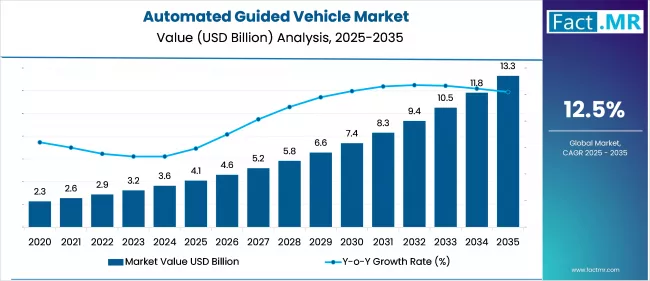
Automated Guided Vehicle Market Value Analysis 2025 To 2035 | Source: Fact.MR
| Metric | Value |
|---|---|
| Industry Size (2025E) | USD 4.1 billion |
| Industry Size (2035F) | USD 13.3 billion |
| CAGR (2025 to 2035) | 12.5% |
Source: Fact.MR analysis. Updated Jul 11, 2025
What are the Drivers of Automated Guided Vehicle Market?
The growth of the automated guided vehicle market is driven by the rapid expansion of e-commerce and the increasing demand for efficient and scalable logistics. In e-commerce warehouses and retail distribution hubs, AGVs streamline material handling, order fulfillment, and packaging operations. E-commerce involves buying and selling goods and services online. E-commerce is growing due to shifting consumer preferences, increased convenience, and personalized offerings. In e-commerce warehouses and retail hubs, automated guided vehicles simplify material handling, packaging, and supply chain management.
Automation solutions utilize technology and software to automate activities, eliminating the need for human intervention, thereby improving efficiency, productivity, and operations across various industries. Automation solutions in AGVs follow Industry 4.0, where smart technology and connectivity automate production and logistics. In October 2023, Cavintek Inc., a U.S.-based productivity applications and workflow automation company, found that over 80% of corporate executives were increasing productivity automation and using remote workers.
Government initiatives promoting Industry 4.0 and smart factories are driving the adoption of AGVs, especially in countries that are heavily investing in manufacturing modernization.
What are the Regional Trends of Automated Guided Vehicle Market?
The North American market is experiencing growth driven by advanced technology and widespread automation. Automation technology is heavily invested in the region, with applications in the automotive, e-commerce, and manufacturing sectors. Logistics maturity and innovations in automated guided vehicle technology support regional market growth.
Sales of automated guided vehicles are increasing in Europe due to the growing adoption of automation in the manufacturing and logistics sectors. Stringent regulations promoting efficiency and environmental sustainability support the region's growth. Due to technological advances and the advent of Industry 4.0, Germany and the U.K. are leading the adoption of AGVs in the automotive and industrial sectors.
The Asia Pacific region is experiencing significant growth in the e-commerce sector, particularly in China and India, where online shopping has emerged as the dominant retail channel. AGVs are increasingly being utilized in warehouses and fulfillment centers to efficiently handle large volumes of orders while optimizing inventory management and order processing.
Middle East & Africa (MEA) countries, such as the UAE and Saudi Arabia, are developing infrastructure and logistics hubs, driving the automated guided vehicle market growth.
What are the Challenges and Restraining Factors of Automated Guided Vehicle Market?
The high upfront cost of automated guided vehicle (AGV) systems is a significant barrier to market expansion, particularly for small and medium-sized businesses. The initial costs include not only the vehicles, but also the supporting infrastructure, software integration, and employee training. For instance, depending on load capacity and sophistication, a single AGV unit can cost between USD 20,000 and $100,000, indicating a significant capital investment.
Most AGVs are programmed to follow predetermined paths and routines, which limits their adaptability in rapidly changing environments, such as modern warehouses or manufacturing plants. This rigidity necessitates costly reprogramming or upgrades whenever the layout or workflow changes.
Integration with legacy systems is frequently complicated and expensive. Facilities with out-of-date warehouse management or enterprise resource planning systems may experience compatibility issues, requiring more time and money to overhaul the system or deploy middleware.
Safety concerns, while less frequent with newer models, remain a barrier. Malfunctions and sensor failures can result in accidents or operational disruptions. To meet stringent safety standards such as ISO 3691-4, businesses must conduct extensive testing and routine maintenance, which increases operating costs.
Country-Wise Outlook
The U.S. Drives AGV Market Growth with Industry 4.0 Adoption
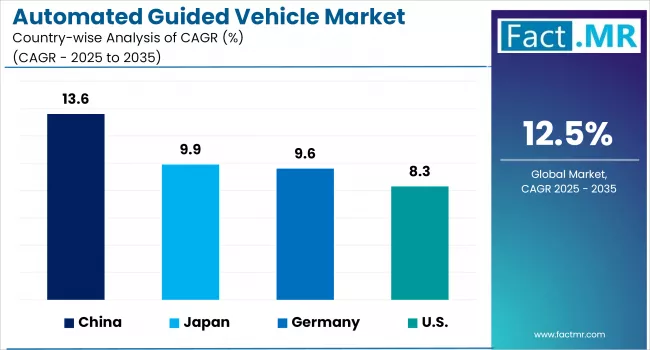
Automated Guided Vehicle Market Country Wise Analysis Of CAGR | Source: Fact.MR
The U.S. is a prominent player in the automated guided vehicle (AGV) market, owing to its advanced manufacturing infrastructure, robust e-commerce ecosystem, and strong emphasis on automation and Industry 4.0 integration. AGV adoption is rapidly increasing in industries such as automotive, retail, healthcare, and food and beverage, as businesses seek to increase productivity and reduce labor dependency.
The U.S. Bureau of Labor Statistics estimates that job openings in the transportation and warehousing sector will exceed 500,000 by 2023. AGVs provide a solution by automating repetitive material handling tasks and maintaining a consistent workflow in high-demand fulfillment centers.
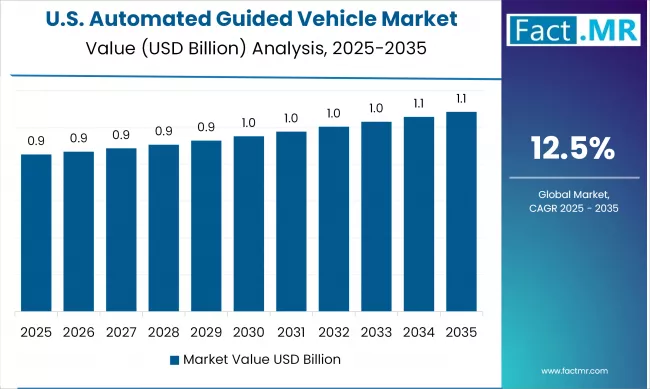
US Automated Guided Vehicle Market | Source: Fact.MR
The Occupational Safety and Health Administration (OSHA) requires strict adherence to workplace safety, and AGVs help reduce worker exposure to high-risk areas, aligning with compliance objectives. The American National Standards Institute (ANSI) and the Industrial Truck Standards Development Foundation (ITSDF) provide safety guidelines for AGV design and deployment, thereby enhancing market confidence.
Germany witnesses Rapid Market Growth Backed by Strong Automotive and Manufacturing Sector
The country has a strong automotive and manufacturing sector. As companies such as BMW, Volkswagen, and Siemens automate their intralogistics, the demand for precision-guided, autonomous transportation systems grows. According to the German Engineering Federation (VDMA), by 2023, more than 65% of Germany's large industrial facilities are expected to have implemented automated material handling systems.
Germany is also experiencing a skilled labor shortage, particularly in logistics and warehousing. AGVs are viewed as a strategic solution for sustaining productivity levels. According to a 2022 survey by the German Chamber of Commerce and Industry (DIHK), 57% of logistics companies reported difficulty finding qualified employees, accelerating the push toward automation.
Strict workplace safety regulations, enforced by the German Statutory Accident Insurance (DGUV), promote the use of AGVs to reduce human exposure to hazardous environments. Furthermore, TÜV certification standards for industrial vehicles encourage the safe deployment of AGVs in factories and warehouses.
Germany's emphasis on sustainable production is also consistent with the growth of the AGV market. Electric AGVs help to reduce emissions and noise levels, aligning with national environmental goals. Many German logistics companies are incorporating AGVs powered by lithium-ion batteries and solar-assisted charging systems.
Japan Fuels AGV Market Growth Through Robotics and Ageing Workforce Solutions
Japan is a key player in the automated guided vehicle (AGV) market, owing to its advanced robotics industry, ageing workforce, and emphasis on precision manufacturing. As a global leader in industrial automation, Japan has long adopted AGV technologies in various sectors, including automotive, electronics, and pharmaceuticals.
Toyota, Honda, and Nissan have aggressively implemented AGVs in their production lines to improve just-in-time manufacturing. Toyota Industries Corporation, for example, will expand its AGV offerings in 2023 by integrating AI-powered fleet management and real-time path adjustment systems.
The Japanese government's Society 5.0 initiative promotes the integration of robotics and artificial intelligence (AI) into industrial infrastructure, thereby increasing AGV deployment. Government funding for smart factory technologies through programs run by the Ministry of Economy, Trade, and Industry (METI) has enabled SMEs to modernize their logistics with AGV solutions.
In terms of regulations, Japan's Industrial Safety and Health Act promotes the use of automation in hazardous work environments, which helps drive the adoption of AGVs. The Japanese Industrial Standards Committee (JISC) oversees industrial safety standards, ensuring that AGVs meet stringent performance and safety benchmarks.
Category-wise Analysis
Forklift Trucks to Exhibit Leading by Vehicle Type
A forklift is one of the most common automated guided vehicles because it performs the necessary stacking and unstacking operations. It is occasionally used for short-distance transportation in a manufacturing environment. It was one of the first modified AGVs, and it is in high demand in today's market. Forklifts are the most popular type of AGV because they can perform a variety of material handling tasks such as loading, unloading, transporting, and stacking. These are useful in almost all manufacturing plants, hence they are in high demand across all industries.
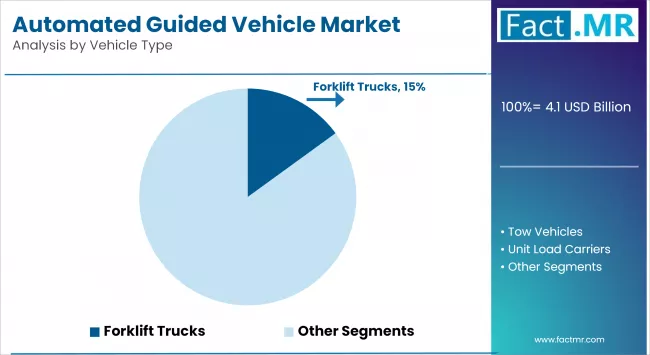
Automated Guided Vehicle Market Analysis By Vehicle Type | Source: Fact.MR
Tow trucks are the most productive autonomous guided vehicles for towing and pulling because they can transport more loads with multiple trailers than forklifts. Loading can be performed either automatically or manually within the vehicle. The navigation system utilizes sensors and algorithms to detect and avoid obstacles autonomously. This vehicle's economical design enables it to operate at a set speed while meeting safety standards and production goals, thereby indirectly contributing to the growth of the global automated guided vehicle market and increased demand.
Laser Guided to Exhibit led by Navigation Technology
Industrial demand for accurate and reliable navigation solutions is driving growth in the laser guidance segment, as it enhances both operational efficiency and workplace safety. The performance of AGVs in complex industrial environments relies on the accurate, reliable, and adaptable navigation solutions provided by laser guidance technology. Laser scans enable laser-guided AGVs to follow predefined paths and navigate around obstacles with precision. For complex manoeuvring and consistent performance, large warehouses, manufacturing facilities, and distribution centers need this accuracy.
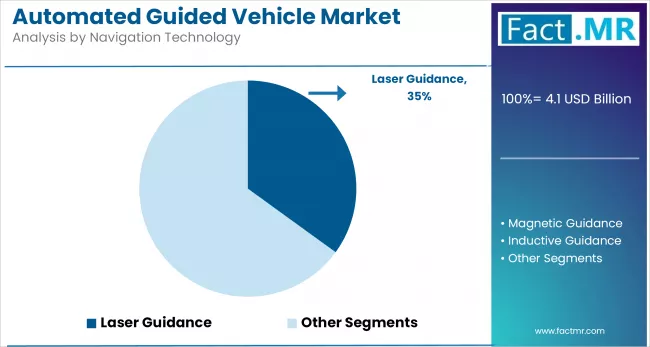
Automated Guided Vehicle Market Analysis By Navigation Technology | Source: Fact.MR
Vision-guided AGVs leverage cameras and sensors to navigate and make real-time decisions in complex or unstructured environments. With the rising adoption of advanced automation, this segment is experiencing steady growth. Other cars, including wire-guided AGVs, use physical wires or other navigation methods to meet niche market needs. As industries utilize advanced navigation technologies to enhance efficiency and flexibility, the market is expanding.
Lead to Exhibit Leading by Battery
Lead batteries are used in AGVs due to their affordability, reliability, and compatibility with existing infrastructure. These batteries are suitable for AGVs in initial cost-sensitive applications. Lead-acid batteries are favored in low-duty-cycle or predictable usage settings due to their affordability and recyclability, despite their heavier weight and slower charging times. Small to mid-sized businesses often choose them for their low upfront costs and ease of maintenance.
Lithium-ion batteries' higher energy density, faster charging, and longer lifecycle are making them popular in AGVs. High-efficiency environments, such as e-commerce, automotive, and manufacturing warehouses, require AGVs to operate for extended periods with minimal downtime. Although lithium-ion batteries are more expensive than lead-acid batteries, they offer savings in maintenance and energy costs. Opportunity charging adaptability ensures continuous workflow in demanding industrial settings.
Transportation to Exhibit Leading by Application
The transportation segment holds a significant market share, as AGVs optimize the movement of goods within warehouses and distribution centers. Their efficiency in managing large volumes of materials and seamless integration with modern supply chains make them a preferred choice for widespread adoption. Storage and assembly AGVs optimize warehouse storage and assembly line operations and boost productivity and organization. This segment is growing steadily as industries seek improvements in warehouse management and assembly efficiency.
Packaging AGVs help to automate the packaging process, which is becoming increasingly important for ensuring consistency and speed in production lines. The demand for efficient and dependable packaging solutions is driving the segment's growth. Overall, the automated guided vehicle market is growing as companies seek to use automation to improve efficiency in transportation, storage, and packaging applications.
Manufacturing to Exhibit Leading by End-User
Manufacturing led the automated guided vehicle market due to rising demand for automated solutions that streamline production workflows and reduce manual labor. The timely and accurate delivery of materials, components, and finished products between manufacturing stages is automated by AGVs. This reduces bottlenecks, downtime, and boosts production efficiency, enabling companies to meet market demands and stay competitive. Integrating AGVs with Industry 4.0 technologies, such as IoT and real-time data analytics, enables manufacturers to monitor and improve their operational performance.
Aerospace is expected to be the most opportunistic segment during the forecast period. The complexity of components such as wings, engine pods, and nacelles necessitates large aerospace manufacturing facilities. Automated guided vehicles make it easier to transport aerospace components without accidents or mishaps.
Competitive Analysis
The global automated guided vehicle (AGV) market is becoming increasingly competitive, with a mix of established automation providers, robotics startups, and system integrators serving diverse industries, including automotive, food and beverage, pharmaceuticals, and e-commerce. This competitive landscape is largely driven by innovation in navigation technologies, battery efficiency, fleet management software, and AI integration. Companies are focusing on enhancing AGV performance in complex environments, offering modular solutions, and developing scalable systems to meet the growing demand for smart, flexible, and labor-efficient material handling solutions.
Technological advancements are transforming the AGV landscape. Integration with Industry 4.0 technologies, including AI, machine learning, and IoT, has enabled AGVs to become more autonomous, intelligent, and adaptable. Modern AGVs can navigate in real-time with sensors, cameras, and LiDAR systems, allowing them to operate safely in dynamic environments. This has shifted their use cases from traditional repetitive material handling to more complex, collaborative operations.
These businesses are investing in product development, partnerships, and acquisitions to gain a competitive advantage. Smaller companies are also entering the market with niche products, particularly custom-built AGVs and AI-powered control systems.
Key players in the automated guided vehicle industry include Addverb Technologies, Aichi Machine Industry Co., Ltd., China SME Group Co., Ltd., DAIFUKU GROUP, Egemin Automation Inc., GreyOrange, GRIDBOTS, JBT Corporation, KOLEC, Konecranes, KUKA AG, Murata Machinery, Ltd., Oceaneering International, Inc., SHENZHEN MIRCOLOMAY TECHNOLOGY CO., LTD., System Logistics S.p.A., TOYOTA INDUSTRIES CORPORATION, and others.
Recent Development
- In April 2024, HMS Networks significantly improved the efficiency of Mercedes-Benz's Automated Guided Vehicle (AGV) system at its Ludwigsfelde auto plant. The upgrade entailed installing an advanced wireless system to support expanded AGV operations, increase efficiency, and ensure compliance with the EU Machinery Regulation 2023/1230.
- In April 2024, Siemens Nederland and VDL Automated Vehicles strengthened their partnership to launch the second generation of their automated logistics platform, which is based on automated guided vehicles (AGVs). This collaboration builds upon their previous work on AGVs, with the new generation offering enhanced capabilities and features.
Segmentation
Segmentation of the Automated Guided Vehicle Market
-
By Vehicle Type :
- Tow Vehicles
- Unit Load Carriers
- Pallet Trucks
- Assembly Line Vehicles
- Forklift Trucks
- Other Types
-
By Navigation Technology :
- Laser Guidance
- Magnetic Guidance
- Inductive Guidance
- Optical Tape Guidance
- Vision Guidance
-
Others
-
By Battery :
- Lead Battery
- Lithium-Ion Battery
- Nickel-based Battery
- Others
-
By Application :
- Transportation
- Storage
- Distribution
- Assembly
- Packaging
- Waste Handling
-
By End-User :
- Automotive
- Manufacturing
- Food & Beverages
- Aerospace
- Healthcare
- Logistics
- Retail
-
By Region :
- North America
- Latin America
- Western Europe
- Eastern Europe
- East Asia
- South Asia & Pacific
- Middle East & Africa
Frequently Asked Questions
What is the global automated guided vehicle market size in 2025?
Who are the major players operating in the automated guided vehicle market?
What is the estimated valuation of the automated guided vehicle market by 2035?
What Value CAGR did the automated guided vehicle market exhibit over the last five years?
Who worked on this report


Preview the report firsthand - request a free sample
Free SampleGet the brochure for pricing and purchase details
Download PDF