- Base Value(2026): 17.2 Bn
- Estimated Value(2026): 17.2 Bn
- Forecast Value (2036): 31.4 Bn
- CAGR (2026 - 2036): 6.2%
Server Operating System Market Forecast and Outlook 2026 to 2036
The global server operating system market is valued at USD 17.2 billion in 2026 and is projected to reach USD 31.4 billion by 2036, progressing at a compound annual growth rate (CAGR) of 6.2% from 2026 to 2036. In 2026, the Linux-based systems segment is projected to hold a dominant 51.3% share, while enterprise applications account for 58.7% of total demand.
Quick Stats for Server Operating System Market
- Server Operating System Market Value (2026): USD 17.2 billion
- Server Operating System Market Forecast Value (2036): USD 31.4 billion
- Server Operating System Market Forecast CAGR: 6.2%
- Leading Operating System Type in Server Operating System Market: Linux-based Systems (51.3%)
- Key Growth Regions in Server Operating System Market: North America, Europe, Asia Pacific
- Key Players in Server Operating System Market: Microsoft Corporation, Red Hat Inc., SUSE Linux Enterprise, Canonical Ltd., Oracle Corporation
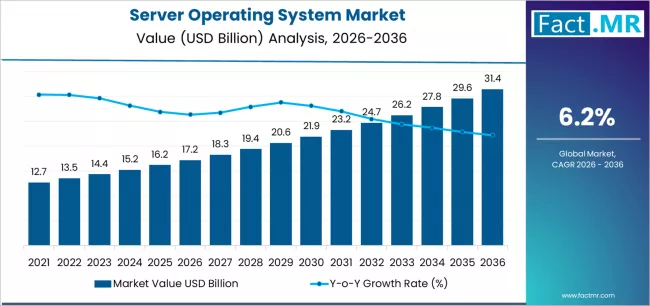
Server Operating System Market Market Value Analysis | Source: Fact.MR
Market growth is primarily driven by the accelerating global adoption of cloud infrastructure, enterprise digitization, and the rising criticality of advanced security and virtualization in data centers. The proliferation of hybrid work models, data-intensive applications, and edge computing is compelling organizations to invest in robust, scalable, and intelligent server platforms. Operating systems are the foundational layer that enables efficient resource management, security enforcement, and seamless deployment across diverse computing environments.
Innovation in artificial intelligence integration, container orchestration, and automated system management will define the market's evolution. The shift towards AI-augmented operations for predictive maintenance and resource optimization, alongside the maturation of Kubernetes and microservices architectures, is leading to smarter, more autonomous, and highly efficient server ecosystems. These trends are critical for supporting next-generation applications in both traditional data centers and distributed cloud environments.
Server Operating System Market Key Takeaways
| Metric | Value |
|---|---|
| Estimated Value in (2026E) | USD 17.2 billion |
| Forecast Value in (2036F) | USD 31.4 billion |
| Forecast CAGR (2026 to 2036) | 6.2% |
Source: Fact.MR analysis. Updated Dec 18, 2025
Category
| Category | Key Segments |
|---|---|
| Operating System Type | Linux-based, Windows Server, UNIX, Mainframe, Others |
| Application Sector | Enterprises, Data Centers, Cloud Service Providers, Web Hosting, Others |
| Deployment Model | On-Premises, Cloud, Hybrid, Edge Computing |
| Region | North America, Europe, Asia Pacific, Latin America, MEA |
Source: Fact.MR analysis. Updated Dec 18, 2025
Segmental Analysis
By Operating System Type, Which Segment Commands the Leading Share?
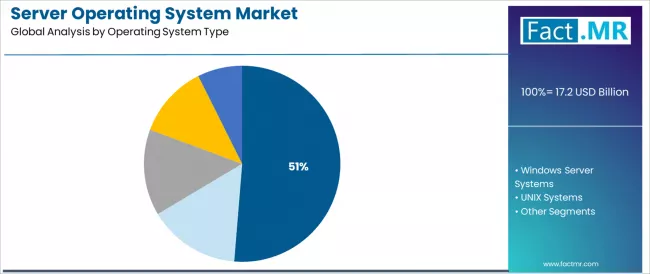
Server Operating System Market Analysis By Operating System Type | Source: Fact.MR
Linux-based systems are projected to hold a 51.3% market share in 2026. Its dominance is rooted in its open-source nature, superior stability, cost-effectiveness, and unparalleled flexibility for customization and containerization. It is the platform of choice for cloud infrastructure, high-performance computing, and modern microservices architectures.
- The segment benefits from massive community support, strong security credentials, and native compatibility with leading development and orchestration tools like Kubernetes.
- Enterprise investments in cloud-native transformation and operational automation continue to solidify Linux's position as the backbone of modern data center and cloud strategy.
By Application Sector, Which Segment Generates Maximum Demand?
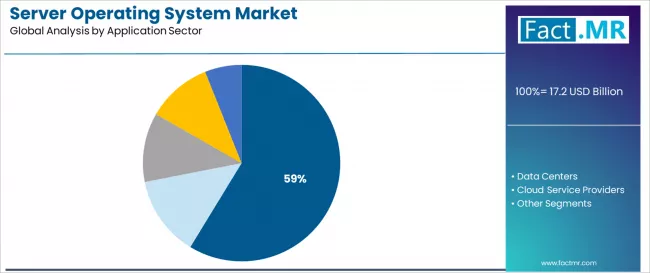
Server Operating System Market Analysis By Application Sector | Source: Fact.MR
Enterprise applications are projected to hold a dominant 58.7% share in 2026. This segment encompasses the core IT infrastructure of corporations across all verticals, requiring robust, secure, and scalable operating systems to run mission-critical applications, databases, and enterprise resource planning (ERP) systems.
- The digital transformation of business processes, adoption of SaaS models, and need for integrated IT environments fuel continuous demand for advanced server OS solutions.
- The trend toward private and hybrid cloud deployments within enterprises further entrenches the need for powerful, feature-rich operating systems capable of managing complex workloads.
What are the Drivers, Restraints, and Key Trends of the Server Operating System Market?
The market is propelled by the exponential growth of data generation, the migration to hybrid and multi-cloud environments, and stringent regulatory requirements for data security and sovereignty. The rise of AI/ML workloads and IoT ecosystems also creates non-negotiable demand for powerful, reliable server platforms. Market growth faces challenges from the increasing maturity of cloud-native alternatives that abstract the underlying OS, the complexity and cost of managing legacy system migrations, and concerns around vendor lock-in with proprietary platforms.
Key trends include:
- Embedding AIops directly into the OS for predictive analytics, automated healing, and intelligent resource allocation to minimize downtime and administrative overhead;
- Development of lightweight, secure, and manageable server OS variants designed for deployment in distributed edge locations, bringing compute power closer to the data source,
- The OS's role evolving towards being an optimized host for containerized workloads, emphasizing minimal footprints, enhanced security isolation (e.g., gVisor, Kata Containers), and streamlined orchestration integration.
Analysis of the Server Operating System Market by Key Countries
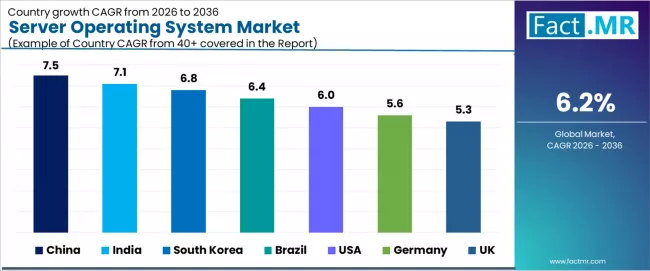
Server Operating System Market Cagr Analysis By Country | Source: Fact.MR
| Country | CAGR (2026-2036) |
|---|---|
| China | 7.5% |
| India | 7.1% |
| Germany | 5.6% |
| Brazil | 6.4% |
| USA | 6.0% |
| UK | 5.3% |
| South Korea | 6.8% |
Source: Fact.MR analysis. Updated Dec 18, 2025
What is Propelling China's Leadership in Server OS Demand?
China's position as the fastest-growing market, with a projected CAGR of 7.5%, is driven by its sovereign digital infrastructure ambitions and explosive growth in domestic cloud services. Government initiatives like "Digital China" and "Made in China 2025" mandate the modernization of IT infrastructure across state-owned enterprises and industries, creating massive, centralized demand for server platforms. Furthermore, the rapid expansion of Chinese tech giants (e.g., Alibaba Cloud, Tencent Cloud) into global markets necessitates world-class, scalable data center operations built on robust operating systems.
A strong push toward indigenous innovation also fuels development and adoption of local Linux distributions, aiming to reduce reliance on Western technology. The market is characterized by large-scale procurement, a focus on cost-effective yet high-performance solutions, and increasing integration of AI capabilities directly into the server stack for next-generation applications.
How is India's Digital Transformation Fueling Server OS Adoption?
India's robust growth, forecast at a 7.1% CAGR, is underpinned by a nationwide digital public infrastructure push and the proliferation of tech startups and IT services. Initiatives like Digital India and massive investments in data localization and smart cities are driving unprecedented demand for server infrastructure. The growth of Indian SaaS companies and the global capability centers of multinational corporations establish a continuous need for modern, secure, and compliant server environments.
India's vibrant developer community strongly favors open-source solutions, accelerating the adoption of Linux distributions for both traditional and cloud-native workloads. The market is price-sensitive yet rapidly maturing, with demand spanning from lightweight OSes for edge deployments in rural connectivity projects to enterprise-grade solutions for large financial institutions and hyperscale data centers.
Why does South Korea's Tech-Intensive Industry Demand Cutting-Edge Server OS?
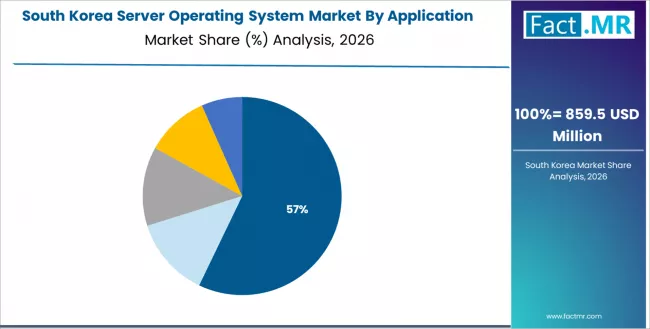
Server Operating System Market South Korea Market Share Analysis By Application Sector | Source: Fact.MR
South Korea's market growth is projected at a 6.8% CAGR. This trajectory is a direct reflection of its leadership in semiconductors, consumer electronics, and advanced manufacturing. These industries require extremely high-performance computing (HPC) environments, low-latency networks, and relentless uptime, placing a premium on stable and optimized server operating systems.
The country's early and dense rollout of 5G and focus on the metaverse, IoT, and AI research creates backend demands for highly efficient, container-friendly OS platforms. South Korean corporations and research institutes often participate in upstream open-source development, contributing to features that meet their specific needs for performance tuning and security. The market demands leading-edge features, exceptional reliability, and deep integration with advanced hardware, driving adoption of both commercial and open-source enterprise Linux variants.
What is Fueling Steady Demand in Brazil's Growing Digital Economy?
Brazil's steady growth, with a projected 6.4% CAGR, is anchored in the largest digital economy in Latin America. Fintech innovation, e-commerce expansion, and government digitalization efforts are key drivers. Data sovereignty laws and latency requirements for consumer applications are fueling investment in local data center infrastructure, which in turn requires robust server operating systems.
While cost-consciousness is significant, there is growing demand for supported enterprise distributions that ensure compliance and security for the financial and healthcare sectors. The market also shows increasing interest in hybrid cloud models, creating demand for OS platforms that can seamlessly span on-premises data centers and public clouds, with a notable rise in the use of open-source solutions to maintain flexibility and control costs.
How is the Mature USA Market Evolving through Innovation and Regulation?
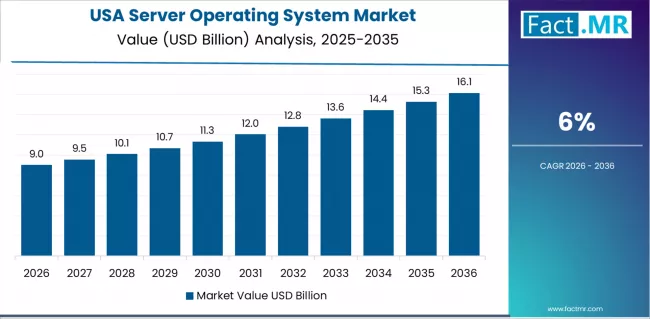
Server Operating System Market Country Value Analysis | Source: Fact.MR
The USA market demonstrates steady evolution with a forecast CAGR of 6.0%, driven by continuous cloud migration, cybersecurity mandates, and AI/ML adoption. Growth is fueled by the relentless innovation cycle of Silicon Valley, where new application architectures (e.g., real-time analytics, massive-scale AI training) constantly push the boundaries of what is required from a server OS. Strict regulations in sectors like finance, healthcare, and defense drive demand for operating systems with certified security configurations and audit capabilities.
The market is highly sophisticated, with strong demand for automated management suites, container-native OS builds, and support for specialized hardware accelerators (GPUs, FPGAs). Competition is intense between open-source ecosystems and commercial vendors, with enterprises often adopting multi-OS strategies tailored to specific workload requirements.
What Supports Germany's Demand for High-Quality, Secure Server OS?
Germany’s market is characterized by a demand for engineering precision, data privacy, and compliance, supporting a stable 5.6% CAGR. Industry 4.0 creates demand for reliable, real-time capable operating systems at the edge and in factory data centers. Germany's stringent data protection laws (influenced by GDPR) make security-hardened and transparently managed OS platforms a top priority for enterprises.
There is a strong preference for commercial distributions with comprehensive support contracts and clear long-term roadmaps, particularly in the automotive, industrial, and financial services sectors. The market values predictability, certification, and integration with existing high-availability and disaster recovery setups, favoring solutions known for their stability and professional support networks.
How is the UK Market Shaped by Hybrid Cloud and Financial Services?
Growth in the UK, projected at a 5.3% CAGR, is shaped by its dominant financial services sector and widespread adoption of hybrid cloud strategies. London's status as a global financial hub demands server operating systems that deliver extreme performance, resilience, and compliance for trading platforms and banking systems. This drives investment in premium, supported distributions with advanced security features.
The broad-based shift among UK enterprises to hybrid cloud models necessitates OS platforms that provide consistent operations and security policies across on-premises infrastructure and multiple public clouds. Government digital services and a strong startup scene, which often leans towards agile, open-source solutions, creating a diverse demand landscape that values both cutting-edge innovation and proven enterprise-grade stability, also influence the market.
Competitive Landscape of the Server Operating System Market
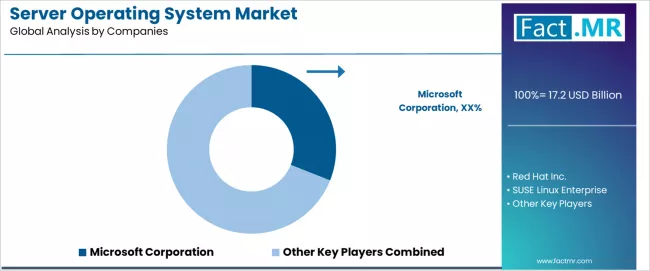
Server Operating System Market Analysis By Company | Source: Fact.MR
The server operating system market is characterized by competition among established technology companies, specialized system developers, and integrated enterprise solution providers. Companies are investing in advanced computing technologies, specialized operational platforms, product innovation capabilities, and comprehensive distribution networks to deliver consistent, high-quality, and reliable server systems. Innovation in virtualization processing, security enhancement, and enterprise-focused product development is central to strengthening market position and customer satisfaction.
Microsoft Corporation offers a strong focus on enterprise innovation and comprehensive server solutions, offering institutional and commercial systems with emphasis on performance excellence and technology heritage. Red Hat Inc. provides integrated enterprise automation with a focus on open-source market applications and precision server networks. SUSE Linux Enterprise delivers comprehensive technology solutions with a focus on enterprise positioning and operational efficiency. Canonical Ltd. specializes in comprehensive server technologies with an emphasis on cloud computing applications. Oracle Corporation focuses on comprehensive enterprise systems with advanced design and premium positioning capabilities.
Key Players in the Server Operating System Market
- Microsoft Corporation
- Red Hat Inc.
- SUSE Linux Enterprise
- Canonical Ltd.
- Oracle Corporation
- International Business Machines Corporation
- Amazon Web Services Inc.
- VMware Inc.
- Citrix Systems Inc.
- Hewlett Packard Enterprise Company
- Dell Technologies Inc.
- Rocky Enterprise Software Foundation
- AlmaLinux OS Foundation
- CloudLinux Inc.
- CentOS Project
Segmentation
Scope of the Report
| Items | Values |
|---|---|
| Quantitative Units (2026) | USD 17.2 Billion |
| Operating System Type | Linux-based Systems, Windows Server Systems, UNIX Systems, Mainframe Operating Systems, Other System Configurations |
| Application Sector | Enterprises, Data Centers, Cloud Service Providers, Web Hosting Services, Others |
| Deployment Model | On-premises Installations, Cloud Deployments, Hybrid Configurations, Edge Computing, Other Deployment Platforms |
| End-User Category | Large Enterprises, Small and Medium Businesses, Government Organizations, Other End-User Services |
| Regions Covered | North America, Europe, Asia Pacific, Latin America, MEA, Other Regions |
| Countries Covered | China, India, Germany, Brazil, USA, UK, South Korea, and 40+ countries |
| Key Companies Profiled | Microsoft Corporation, Red Hat Inc., SUSE Linux Enterprise, Canonical Ltd., Oracle Corporation, and other leading server operating system companies |
| Additional Attributes | Dollar sales by operating system type, application sector, deployment model, end-user category, and region; regional demand trends, competitive landscape, technological advancements in computing engineering, operational performance optimization initiatives, security enhancement programs, and premium product development strategies |
Source: Fact.MR analysis. Updated Dec 18, 2025
Server Operating System Market by Segments
-
Operating System Type :
- Linux-based Systems
- Windows Server Systems
- UNIX Systems
- Mainframe Operating Systems
- Other System Configurations
-
Application Sector :
- Enterprises
- Data Centers
- Cloud Service Providers
- Web Hosting Services
- Others
-
Deployment Model :
- On-premises Installations
- Cloud Deployments
- Hybrid Configurations
- Edge Computing
- Other Deployment Platforms
-
End-User Category :
- Large Enterprises
- Small and Medium Businesses
- Government Organizations
- Other End-User Services
-
Region :
-
North America
- USA
- Canada
- Mexico
-
Europe
- Germany
- UK
- France
- Italy
- Spain
- Nordic Countries
- BENELUX
- Rest of Europe
-
Asia Pacific
- China
- India
- Japan
- South Korea
- Australia
- Rest of Asia Pacific
-
Latin America
- Brazil
- Argentina
- Rest of Latin America
-
MEA
- Saudi Arabia
- UAE
- South Africa
- Rest of MEA
-
Frequently Asked Questions
How big is the server operating system market in 2026?
What will be the size of server operating system market in 2036?
How much will be the server operating system market growth between 2026 and 2036?
What are the key product types in the server operating system market?
Which application sector segment to contribute significant share in the server operating system market in 2026?
Who worked on this report


Preview the report firsthand - request a free sample
Free SampleGet the brochure for pricing and purchase details
Download PDF