- Market Value (2025): USD 159.5 Mn
- Estimated Value (2026): USD 165.8 Mn
- Forecast Value (2036): USD 243.7 Mn
- CAGR (2026-2036): 3.9%
What is the Automatic Sectional Warpers Market forecast to be worth by 2036?
USD 165.8 million in 2026 to USD 243.7 million by 2036 at a 3.9% CAGR.
- In 2025, the automatic sectional warpers market was worth USD 159.5 million, with weaving mills in Asia and Europe accounting for most machine orders.
- Revenue will grow from USD 165.8 million in 2026 to USD 243.7 million by 2036 as mills replace older warping lines with high-speed, servo-controlled models.
- A 3.9% CAGR reflects a capital equipment niche where machines run for many years, so growth follows mill expansion and replacement cycles more than new users.
| Year | Basis | Market Value (USD million) |
|---|---|---|
| 2025 | Actual | 159.5 |
| 2026 | Estimate | 165.8 |
| 2036 | Forecast | 243.7 |
| CAGR 2026 to 2036 | Forecast period | 3.9% |
Source: Fact.MR analysis. Updated Nov 12, 2026
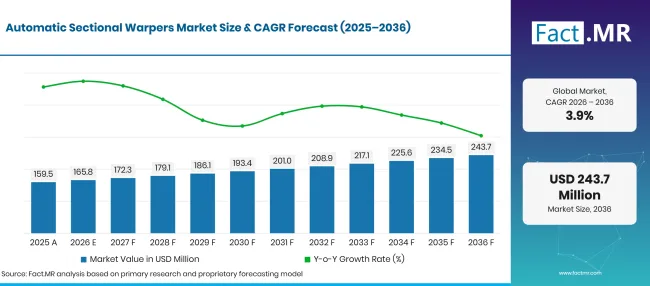
Automatic Sectional Warpers Market Forecast Global | Source: Fact.MR
What are the defining numbers behind Automatic Sectional Warpers Market growth?
The 2026 to 2036 period will add USD 78.0 million in new value, led by high-speed and fully automatic machines sold directly to weaving mills.
- Demand Drivers in the Market
- Rising textile output and exports are pushing weavers to add warping capacity. India’s textile exports grew 10.3% to ₹1.43 lakh crore in April to August 2026, with man-made textiles up 13.6% over the same period.
- Man-made fibre fabrics need precise tension control, since polyester and viscose filaments react quickly to uneven winding. India approved 52 new applications under its PLI Scheme for Textiles in April 2026. The approvals carry a committed investment of ₹6,708 crore, and 19 of them are for MMF fabrics.
- Technical textiles for vehicles, medical use, construction and farming demand exact yarn placement and uniform fabric build. India’s National Technical Textiles Mission has approved 168 projects in total. Of these, 79 are research projects in specialty fibres, geotextiles, agro-textiles and smart textiles.
- New integrated textile parks are creating fresh demand for complete weaving preparation lines. India has approved seven PM MITRA parks with an outlay of Rs 4,445 crore. Investment MoUs worth over Rs 27,434 crore have been signed for them.
- Mills upgrading from manual warping want servo drives, touch-screen controls and live process data, which cut setup time and limit operator error on every beam.
- Key Segments Analyzed
- By Product Type: High-Speed Warpers will hold 61.2% share in 2026, since large weaving mills need faster section winding to feed modern looms.
- By Application: Textile Industry will account for 35.6% of 2026 value as general fabric weaving remains the broadest use of sectional warping.
- By Automation Level: Fully Automatic will capture 67.3% in 2026, given that automated section change and tension regulation reduce labour on each warp.
- By Distribution Channel: Direct Sales will take 54.8% in 2026 because buyers settle width, creel size and commissioning terms directly with the machine builder.
- Analyst Opinion at Fact.MR
- Shambhu Nath Jha, Principal Consultant at Fact.MR, states, “Automatic sectional warpers will gain ground as weavers add capacity, widen their fabric range and move warp preparation away from manual setting. Machines that hold steady tension at high speed and record process data for every section will win the larger orders. Builders who pair reliable hardware with fast local service will gain most from mill modernization through 2036.”
- Strategic Implications
- Machine builders should focus development on servo tension control, automatic section shifting and data interfaces that link warping reports to mill systems.
- Large mills should weigh fully automatic lines against labour savings and beam quality, since one faulty warp can stop a loom for hours.
- Service partners should keep spare parts and trained technicians close to weaving clusters, because installation support often decides which supplier wins the order.
- Investors should watch builders with models tuned for filament yarns and technical fabrics, where accuracy requirements keep rising.
Country growth spans 5.1% to 2.8%. Germany (5.1%) leads on a precision machinery base and mills that buy for technical and high-value fabrics. Japan (4.7%) follows, as its weavers focus on fine filament fabrics that need exact tension. Brazil (3.6%) grows from a deep cotton supply chain, though mill budgets limit the pace of upgrades. The United States (3.2%) relies on a smaller but productive mill base that renews equipment steadily. The United Kingdom (2.8%) trails because its textile output is concentrated in niche fabrics that buy machines in small numbers.
How does the Automatic Sectional Warpers Market break down by segment?
High-Speed Warpers will lead Product Type at 61.2%; Textile Industry will head Application at 35.6%; Fully Automatic will top Automation Level at 67.3%; Direct Sales will hold Distribution Channel at 54.8% in 2026.
Which Product Type leads?
High-Speed Warpers represent 61.2% of 2026 sales.
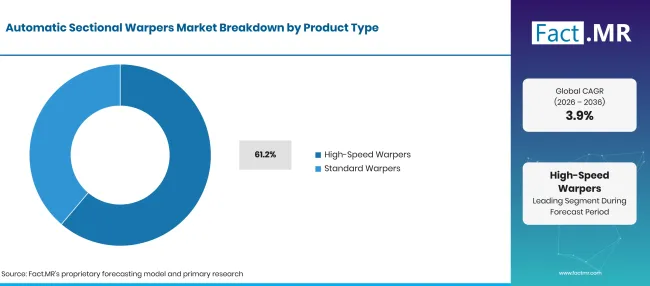
Automatic Sectional Warpers Market Breakdown Product Type | Source: Fact.MR
| Product Type | Share (2026) |
|---|---|
| High-Speed Warpers (Leading segment) | 61.2% |
| Other segments combined | 38.8%* |
| Total | 100.0% |
Source: Fact.MR analysis. Updated Nov 12, 2026
Modern air-jet and rapier looms consume warp quickly, so the warping room must keep pace or the weave shed waits. High-speed sectional warpers wind each section faster while holding tension steady across the drum width. Rabatex lists its RI 109 model at a warping speed of 1,000 metres per minute and beaming at 200 metres per minute with 3-axis servo control. Standard warpers remain in use at smaller mills and sample rooms with moderate output. These units cost less and suit short runs, but their lower speed and simpler controls make them a weaker fit for high-volume production. Mills that buy textile machinery from several suppliers often keep a standard warper for trial warps.
What supports Textile Industry within Application?
Textile Industry takes 35.6% of 2026 revenue.
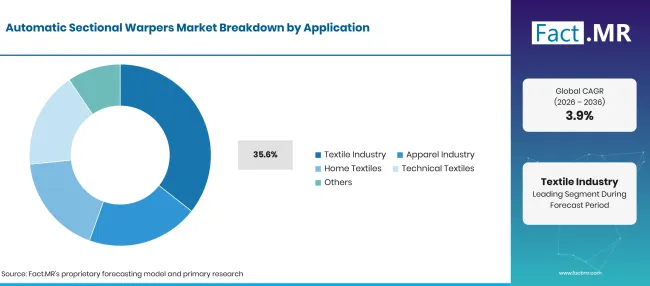
Automatic Sectional Warpers Market Breakdown Application | Source: Fact.MR
| Application | Share (2026) |
|---|---|
| Textile Industry (Leading segment) | 35.6% |
| Other segments combined | 64.4%* |
| Total | 100.0% |
Source: Fact.MR analysis. Updated Nov 12, 2026
General fabric weavers run the widest mix of yarns, counts and patterns, and each new style calls for a fresh warp. Sectional warping lets them build striped and multi-colour warps without stocking many beams. This flexibility keeps general textile mills as the main buyers of the machines. Apparel, home textiles and technical textiles complete the application range. Home textile producers weave bed linen and towels in long runs, while makers of technical textiles need precise yarn placement for filters, belts and medical fabrics.
How does Automation Level shape demand?
Fully Automatic accounts for 67.3% of 2026 value.
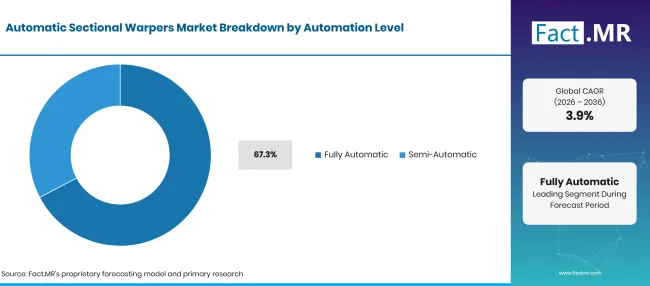
Automatic Sectional Warpers Market Breakdown Automation Level | Source: Fact.MR
| Automation Level | Share (2026) |
|---|---|
| Fully Automatic (Leading segment) | 67.3% |
| Other segments combined | 32.7%* |
| Total | 100.0% |
Source: Fact.MR analysis. Updated Nov 12, 2026
Large mills want each section wound to the same length and density, with no operator adjustment between sections. KARL MAYER describes its NOV-O-MATIC with integrated automatic leasing separation and laser-controlled feed regulation, warping at up to 1,000 metres per minute. Its PROWARP model adds a high-resolution camera that records band geometry on the sectional drum, with an optional OPC-UA link to mill systems. Semi-automatic machines serve smaller weavers where volumes do not repay the cost of full automation. These units still use electronic length counters, while manual steps remain at section change. Mills that later add machinery retrofit modules can raise the automation level of older warpers without full replacement.
How does Distribution Channel shape demand?
Direct Sales represent 54.8% of 2026 demand.
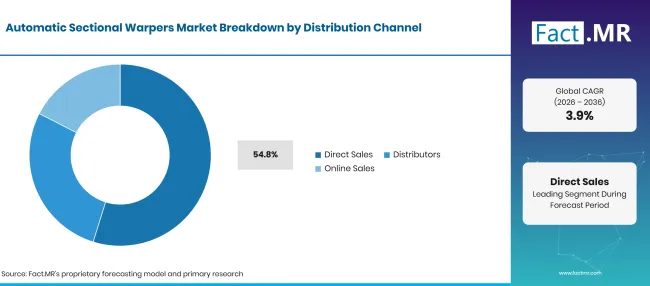
Automatic Sectional Warpers Market Breakdown Distribution Channel | Source: Fact.MR
| Distribution Channel | Share (2026) |
|---|---|
| Direct Sales (Leading segment) | 54.8% |
| Other segments combined | 45.2%* |
| Total | 100.0% |
Source: Fact.MR analysis. Updated Nov 12, 2026
Buying a sectional warper involves choices on working width, creel capacity and drum design, so mills talk to the builder before they order. Direct contracts also cover installation, operator training and trial runs on the buyer’s own yarn, which a reseller rarely handles alone. Distributors cover regions where builders have no local office, and they often stock parts and arrange service visits. Online sales mostly support product discovery and enquiries for smaller machines. Mills that plan textile mill electric drives upgrades at the same time usually negotiate with each supplier directly.
What is accelerating Automatic Sectional Warpers Market adoption, and what is holding it back?
Higher fabric output, a shift toward synthetic and technical yarns and the push to cut labour in warp preparation are bringing new orders to warping machine builders. High purchase prices, the need for skilled maintenance and tight capital budgets at small and medium mills still slow the move away from manual and older machines.
Drivers Impact Analysis
| DRIVER | (~) % IMPACT ON CAGR | GEOGRAPHIC RELEVANCE | IMPACT TIMELINE |
|---|---|---|---|
| Demand for high-speed yarn preparation to keep modern looms running | +1.3% | Global | Short term (<=2 years) |
| Adoption of automated warp preparation and electronic process control | +0.9% | Global | Medium term (2-4 years) |
| Modernization of weaving mills and replacement of conventional warpers | +0.6% | East Asia, South Asia & Pacific, Western Europe, North America | Medium term (2-4 years) |
| Need for consistent warp quality in apparel, home and technical textiles | +0.4% | Global | Long term (>=4 years) |
Source: Fact.MR analysis. Updated Nov 12, 2026
Opportunity Impact Analysis
| OPPORTUNITY | (~) % IMPACT ON CAGR | GEOGRAPHIC RELEVANCE | IMPACT TIMELINE |
|---|---|---|---|
| Fully automatic warpers with servo tension control | +0.6% | Global | Medium term (2-4 years) |
| Camera monitoring, data interfaces and automatic section change | +0.4% | Western Europe, East Asia, South Asia & Pacific | Medium term (2-4 years) |
| Warping solutions for technical textiles and mixed yarn warps | +0.3% | North America, Western Europe, East Asia | Long term (>=4 years) |
| Cost-efficient high-speed warpers for emerging textile hubs | +0.2% | South Asia & Pacific, Latin America, Middle East & Africa | Short term (<=2 years) |
Source: Fact.MR analysis. Updated Nov 12, 2026
Restraints Impact Analysis
| RESTRAINT | (~) % IMPACT ON CAGR | GEOGRAPHIC RELEVANCE | IMPACT TIMELINE |
|---|---|---|---|
| High initial cost of fully automatic sectional warping lines | -0.4% | Global | Short term (<=2 years) |
| Maintenance needs and reliance on skilled technicians | -0.3% | Global | Medium term (2-4 years) |
| Uneven automation readiness and capital access among small mills | -0.1% | South Asia & Pacific, Latin America, Middle East & Africa | Long term (>=4 years) |
Source: Fact.MR analysis. Updated Nov 12, 2026
Which countries are scaling the Automatic Sectional Warpers Market through 2036?
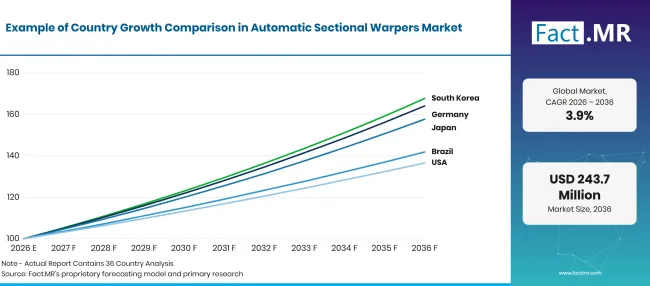
Automatic Sectional Warpers Market Growth Index | Source: Fact.MR
| Country | CAGR (2026 to 2036) |
|---|---|
| Germany | 5.1% |
| Japan | 4.7% |
| Brazil | 3.6% |
| United States | 3.2% |
| United Kingdom | 2.8% |
Source: Fact.MR analysis. Updated Nov 12, 2026
What supports Germany’s adoption?
5.1% CAGR, backed by a precision textile machinery base and demand for technical fabrics.
German weavers serve automotive, industrial and premium apparel customers that set tight limits on fabric faults. Machinery output is volatile month to month, with production in machinery and equipment down 6.5% in September 2026 after a 5.8% rise in August. New orders for machinery and equipment rose 8.3% in September 2026, which points to fresh investment demand.
What does Japan’s growth rely on?
4.7% CAGR, helped by fine filament weaving and close attention to fabric consistency.
Japanese mills weave thin polyester and nylon fabrics where small tension errors show up as visible streaks. Industrial production rose 2.2% from the previous month in September 2026, and production machinery ranked second among the industries behind the increase. METI announced its Current Survey of Production yearbook for 2025 on June 30, 2026, which tracks output of manufactured textile products.
How is Brazil developing demand?
3.6% CAGR, reflecting a cotton supply chain that supports domestic spinning and weaving.
Brazil’s cotton lint production reached 4,085 thousand tonnes in the 2025/26 season. Cotton exports in calendar 2025 totalled 3,025.7 thousand tonnes worth US$ 4,923.8 million, according to the same ministry summary. That raw material base gives local mills room to weave more cloth at home. High-speed sectional warpers draw interest from larger denim and home textile producers, though equipment costs and credit access still shape the timing of orders.
What is supporting United States adoption?
3.2% CAGR, as productive mills renew warping lines for industrial and home fabrics.
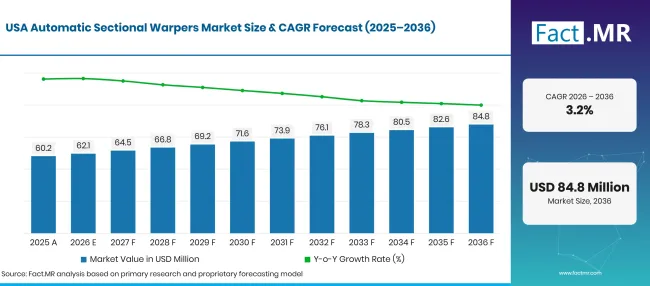
Automatic Sectional Warpers Market Forecast Usa | Source: Fact.MR
American textile mills employed 77.7 thousand people in October 2026, and labour productivity in the sector rose 4.8% in 2025. A lean workforce producing more per hour favours machines that need less manual setting. Producers of industrial fabrics, home furnishings and military textiles look for warpers that change styles quickly and keep tension even on synthetic yarns.
How is the United Kingdom scaling demand?
2.8% CAGR, driven by niche fabric producers that upgrade machines selectively.
Turnover in UK textile manufacturing came to £5,079.1 million in 2025, according to the Office for National Statistics. Much of that output comes from wool cloth, furnishing fabrics and technical materials made in short runs. Sectional warpers suit this work because they build patterned warps without large beam stocks, but mills buy few machines and weigh each purchase against payback.
Who leads the Automatic Sectional Warpers Market?
Competition splits into three groups. KARL MAYER leads the premium tier, selling warping lines on speed, laser control and process data to mills that weave fine filament and technical fabrics. At ITMA ASIA 2026 in October, the company showed its latest warp preparation range with the WARPDIRECT 2.0 at up to 1,200 metres per minute.
Rius-Comatex offers direct and sectional warpers for both weaving and knitting preparation. Indian builders Prashant Gamatex, Rabatex Industries and Jupiter Comtex form a second group that competes on price, quick delivery and service near India’s weaving clusters. Jupiter Comtex introduced its I-SEC intelligence sectional warping machine in March 2026. T-Tech Japan supplies TW-series warpers and beamers for filament and spun yarns. Through 2036, the winners will be the builders that join steady tension at high speed with fast local service and data links that mills can use.
Which companies are the key providers?
Key companies in the Automatic Sectional Warpers Market include KARL MAYER, Prashant Gamatex, Rabatex Industries, Rius-Comatex, Jupiter Comtex and T-Tech Japan.
- KARL MAYER
- Prashant Gamatex
- Rabatex Industries
- Rius-Comatex
- Jupiter Comtex
- T-Tech Japan
Bibliography
- Federal Statistical Office of Germany (Destatis). (2026, November 5). New orders in manufacturing in September 2026: +4.4% on the previous month.
- Federal Statistical Office of Germany (Destatis). (2026, November 6). Production in September 2026: +0.7% on the previous month.
- Jupiter Comtex. (2026, March 16). I-SEC Intelligence Sectional Warping Machine.
- KARL MAYER. (2026, September 21). NOV-O-MATIC sectional warper.
- KARL MAYER. (2026, September 21). PROWARP sectional warper.
- KARL MAYER. (2026, October 29). KARL MAYER at the Weaving Hall of ITMA ASIA 2026: High-Performance Warp Preparation for High-Quality Fabrics Made from Staple Fibers and New Horizons in Textiles.
- Ministério da Agricultura e Pecuária, Brazil. (2026, August). Sumário Executivo: Algodão.
- Ministry of Economy, Trade and Industry, Japan. (2026, October 30). Current Survey of Production.
- Ministry of Economy, Trade and Industry, Japan. (2026, October 30). Indices of Industrial Production.
- Ministry of Textiles, Government of India. (2025, December 5). National Technical Textiles Mission.
- Ministry of Textiles, Government of India. (2025, December 24). Year End Review 2025 of Ministry of Textiles.
- Ministry of Textiles, Government of India. (2026, April 10). 52 New Applications approved under Production Linked Incentive (PLI) Scheme for Textiles.
- Ministry of Textiles, Government of India. (2026, September 17). India’s Textile exports rise 16.1% to ₹29,776 crore in August 2026.
- Office for National Statistics. (2026, October 15). UKProdTO: 13 Manufacture of textiles HOME (£m).
- Rabatex Industries. (2025, April 16). Sectional Warping Machine.
- U.S. Bureau of Labor Statistics. (2026, November 6). Textile Mills: NAICS 313.
This Report Answers
- How much revenue will automatic sectional warpers generate from 2026 to 2036, and what growth rate applies?
- Which product type, application, automation level and sales channel hold the lead positions in 2026?
- What role do high-speed winding, servo tension control and mill modernization play in new orders?
- Where do camera monitoring, data links and technical textile warps open room for builders?
- Which costs and skill gaps slow adoption at small and medium mills?
- How do growth rates differ across Germany, Japan, Brazil, the United States and the United Kingdom?
What does the Automatic Sectional Warpers Market cover?
Automatic sectional warpers arrange many yarn ends into sections, wind them side by side on a drum and then beam the whole sheet onto a warp beam for weaving. The machines control yarn order, length and tension so that each warp runs evenly on the loom.
Market value counts new high-speed and standard machines with fully or semi-automatic control, at the price paid by the mill. Modern units carry servo tension systems, touch-screen controls and automatic section shifting. Some add camera monitoring of the yarn band.
What is included in the scope?
New automatic and semi-automatic sectional warping machines used to prepare warps for weaving.
High-speed and standard models for apparel, home textile, general fabric and technical textile weaving. Sectional warpers that prepare warp beams for warp knitting, a field linked to industrial knitting equipment. Built-in functions such as section winding, tension control, length measurement and beaming. Machines sold through direct sales, distributor networks and online channels.
What is excluded from the scope?
Direct warping machines and sizing machines sold as separate equipment.
Spinning frames, weaving looms, knitting machines and finishing systems used in the wider textile industry. Standalone creels, yarn tensioners, spare parts and accessories sold on their own. Used and refurbished sectional warpers traded on the second-hand market.
How Was the Analysis Built?
The analysis draws on 120+ sources, 35+ company portfolios, 25+ countries, and more than 20 industry interviews.
- Primary Research: Primary research includes discussions with manufacturers, service providers, technology developers, distributors, end users, and subject-matter experts. These conversations examine purchasing priorities, product adoption, operational challenges, approval requirements, competitive positioning, and the factors that influence wider market acceptance.
- Desk Research: Desk research covers government statistics, regulatory publications, company filings, trade data, technical studies, industry associations, standards, public policy, and other authoritative sources. Every source used in the analysis is documented in the bibliography.
- Market Sizing and Forecasting: Market estimates combine historical performance, demand indicators, pricing and volume trends, segment shares, company participation, country-level growth, adoption patterns, investment activity, and barriers to market expansion.
- Data Validation and Update Cycle: Findings are validated by comparing primary interviews with public data, company activity, regulatory changes, trade patterns, and industry developments. Regular updates review new product launches, capacity changes, partnerships, approvals, and shifts in commercial adoption.
Segmentation
What is the report’s scope and coverage?
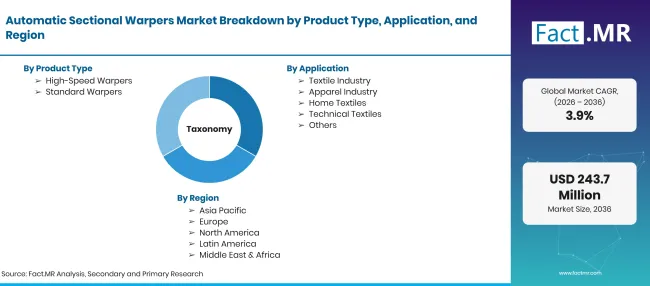
Automatic Sectional Warpers Market Taxonomy | Source: Fact.MR
| Attribute | Details |
|---|---|
| Quantitative Units | USD million |
| Market Definition | Automatic sectional warpers are weaving preparation machines that wind yarn in uniform sections on a warping drum and then transfer the full sheet onto a warp beam, sold in high-speed and standard versions with fully or semi-automatic control. |
| Product Type | High-Speed Warpers; Standard Warpers |
| Application | Textile Industry; Apparel Industry; Home Textiles; Technical Textiles; Others |
| Automation Level | Fully Automatic; Semi-Automatic |
| Distribution Channel | Direct Sales; Distributors; Online Sales |
| Regions Covered | North America; Latin America; Western Europe; Eastern Europe; East Asia; South Asia & Pacific; Middle East & Africa |
| Countries Covered | Germany; Japan; Brazil; United States; United Kingdom |
| Companies Profiled | KARL MAYER; Prashant Gamatex; Rabatex Industries; Rius-Comatex; Jupiter Comtex; T-Tech Japan |
| Forecast Period | 2026 to 2036 |
| Approach | Hybrid top-down and bottom-up model built from weaving capacity, warp preparation needs, automation levels and builder portfolio reviews. |
Source: Fact.MR analysis. Updated Nov 12, 2026
How is the market segmented?
-
By Product Type
- High-Speed Warpers
- Standard Warpers
-
By Application
- Textile Industry
- Apparel Industry
- Home Textiles
- Technical Textiles
- Others
-
By Automation Level
- Fully Automatic
- Semi-Automatic
-
By Distribution Channel
- Direct Sales
- Distributors
- Online Sales
-
By Region
- North America
- Latin America
- Western Europe
- Eastern Europe
- East Asia
- South Asia & Pacific
- Middle East & Africa
Frequently Asked Questions
How large is the automatic sectional warpers market in 2026?
What growth rate will the automatic sectional warpers market record?
Which product type leads?
Which application leads?
Which automation level leads?
Which distribution channel leads?
Which country will grow quickest?
Who are the main companies?
What holds the market back?
Who worked on this report


Preview the report firsthand - request a free sample
Free SampleGet the brochure for pricing and purchase details
Download PDF