- Market Value (2025): USD 711.1 Mn
- Estimated Value (2026): USD 748.7 Mn
- Forecast Value (2036): USD 1253.6 Mn
- CAGR (2026-2036): 5.3%
What is the Automatic Balanced Control Valves Market forecast to be worth by 2036?
USD 748.7 million in 2026 to USD 1253.6 million by 2036 at a 5.3% CAGR.
- At USD 711.1 million in 2025, the automatic balanced control valves market drew most of its revenue from variable-flow HVAC circuits in offices, hospitals and hotels.
- Revenue will grow from USD 748.7 million in 2026 to USD 1253.6 million by 2036, as owners refit older constant-flow systems and new buildings specify connected valves from the design stage.
- A 5.3% CAGR reflects a replacement-led market in which each retrofit project upgrades a few hundred terminal valves at a time.
| Year | Basis | Market Value (USD million) |
|---|---|---|
| 2025 | Actual | 711.1 |
| 2026 | Estimate | 748.7 |
| 2036 | Forecast | 1253.6 |
| CAGR 2026 to 2036 | Forecast period | 5.3% |
Source: Fact.MR analysis. Updated Nov 12, 2026
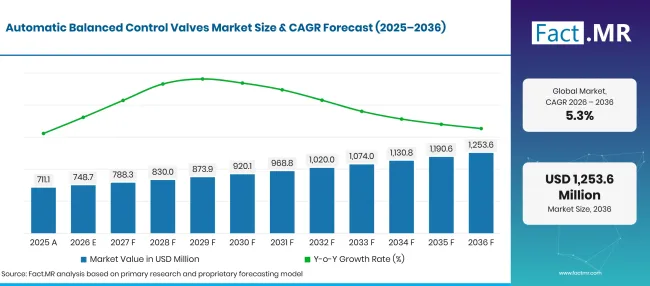
Automatic Balanced Control Valves Market Forecast Global | Source: Fact.MR
What are the defining numbers behind Automatic Balanced Control Valves Market growth?
The 2026 to 2036 period adds USD 504.9 million in new value, much of it from pressure-independent valves fitted during HVAC renovations in commercial buildings.
- Demand Drivers in the Market
- Building energy use is under close watch. The UN Environment Programme reported in March 2025 that buildings and construction account for 32% of global energy demand and 34% of global CO2 emissions. Pumping and terminal-unit control are among the cheaper places to cut that load, which brings balancing valves into efficiency programmes.
- Commercial stock is large and old. Non-domestic buildings in England and Wales used 120 TWh of electricity and 152 TWh of gas in 2023, according to the 2025 ND-NEED release. Much of that heat and cooling flows through hydronic circuits that were balanced once at handover and never again.
- Retrofit work is turning into a steady source of valve orders. Belimo reported in January 2026 that its RetroFIT+ initiative gained traction in 2025, with building owners upgrading older HVAC systems for lower energy use and better reliability. Swapping manual balancing sets for pressure-independent valves is a common first step in these projects.
- Liquid cooling is widening the customer base. IMI said in November 2025 that its Climate Control sector was benefiting from demand for advanced cooling technologies in the data centre market. Chilled-water and direct-to-chip loops need exact flow at every rack, a task that suits automatic flow control.
- Key Segments Analyzed
- By Product Type: Pressure Independent Control Valves will hold 38.5% share in 2026, since one body combines the control valve, flow limiter and differential pressure regulator that older designs split into three.
- By Application: HVAC Systems will account for 42.3% of 2026 revenue as fan coils, air-handling units and chilled beams all need stable water flow to hold room conditions.
- By End-User: Commercial Buildings will capture 39.7% of 2026 value, given that offices, hotels and hospitals run long hours with zone loads that change through the day.
- By Distribution Channel: Direct Sales will command 48.3% of 2026 sales, because most orders follow a consultant specification and need factory support on sizing and commissioning.
- Analyst Opinion at Fact.MR
- Shambhu Nath Jha, Principal Consultant at Fact.MR, states, “Specifying engineers now judge a balancing valve by the energy it saves at the pump and chiller. Price comes second. Suppliers that can show measured flow and delta T data from installed projects will win the retrofit work that drives this market. Over the next ten years, the valve will become a sensor point in the building management system as much as a piece of hydronic hardware.”
- Strategic Implications
- Valve manufacturers should publish verified flow accuracy, minimum differential pressure and actuator data in BIM-ready formats, since consultants shortlist products at the drawing stage.
- Building owners should audit pumps, coils and controls together before replacing valves, so that the new pressure-independent valves deliver their full pumping savings.
- Distributors should build commissioning and selection teams around their stock, as contractors on smaller jobs lack in-house hydronic expertise.
- Investors should follow renovation incentives and data center cooling budgets, which will shape order flow more than new-build construction starts.
The United Kingdom heads the five-country set at 6.7%, driven by a large stock of older offices and public buildings now entering heat decarbonisation programmes. Germany comes next at 5.7%, where heat pumps in new homes and refurbished heating networks need tighter flow control. Japan grows at 5.3% even as new non-residential construction slows, because renovation of existing buildings carries most of the demand. Brazil, at 4.2%, starts from a small hydronic base that new federal efficiency rules will enlarge over time. The United States closes the range at 3.9%, a mature market where state energy codes support steady replacement and fewer greenfield gains.
How does the Automatic Balanced Control Valves Market break down by segment?
Pressure Independent Control Valves will lead Product Type at 38.5%; HVAC Systems will head Application at 42.3%; Commercial Buildings will hold End-User at 39.7%; Direct Sales will lead Distribution Channel at 48.3% in 2026.
Which Product Type leads?
Pressure Independent Control Valves take 38.5% of 2026 sales.
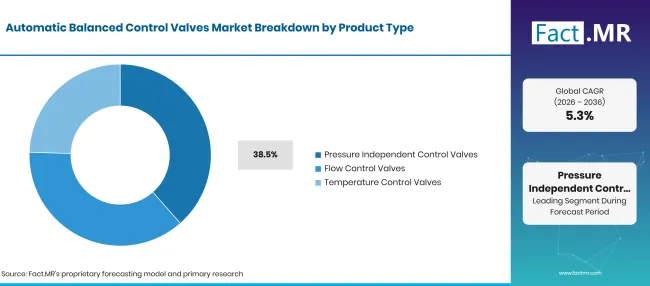
Automatic Balanced Control Valves Market Breakdown Product Type | Source: Fact.MR
| Product Type | Share (2026) |
|---|---|
| Pressure Independent Control Valves (Leading segment) | 38.5% |
| Other segments combined | 61.5%* |
| Total | 100.0% |
Source: Fact.MR analysis. Updated Nov 12, 2026
Engineers like a valve that keeps its set flow whatever happens elsewhere in the loop. A built-in differential pressure regulator gives the control part full authority, so a fan coil gets the same water at part load as at design load. Belimo reported that its 2025 control valve growth came partly from customers shifting from pressure-dependent to higher-value pressure-independent valves. The same principle holds upstream, where heat pump plants run best with a stable return temperature. Flow Control Valves cover automatic flow limiters and dynamic balancing cartridges that fix a maximum flow without modulating it. Temperature Control Valves serve radiators, underfloor circuits and domestic hot water, often with thermostatic heads or small electric actuators. Both suit simpler systems and low-cost home heating renovation.
What supports HVAC Systems within Application?
HVAC Systems represent 42.3% of 2026 revenue.
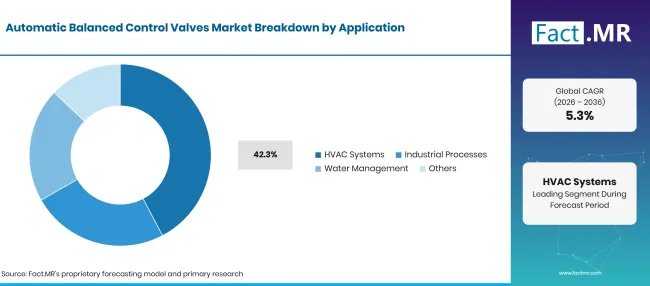
Automatic Balanced Control Valves Market Breakdown Application | Source: Fact.MR
| Application | Share (2026) |
|---|---|
| HVAC Systems (Leading segment) | 42.3% |
| Other segments combined | 57.7%* |
| Total | 100.0% |
Source: Fact.MR analysis. Updated Nov 12, 2026
Chilled-water and heating coils lose capacity quickly when flow drifts from design, and rooms at the end of a long pipe run feel it first. Balanced valves keep each branch on target, which raises the delta T at the chiller and cuts pump speed. Plant rooms that pair these valves with plate heat exchangers and variable-speed circulating pumps see the clearest gains. Industrial Processes use automatic balancing on cooling loops for moulding machines, compressors and server halls, where IMI has pointed to data centre cooling demand. Water Management covers district energy substations and municipal heating networks. Others include geothermal fields linked to ground source heat pumps and specialised test rigs.
How does End-User shape demand?
Commercial Buildings account for 39.7% of 2026 value.
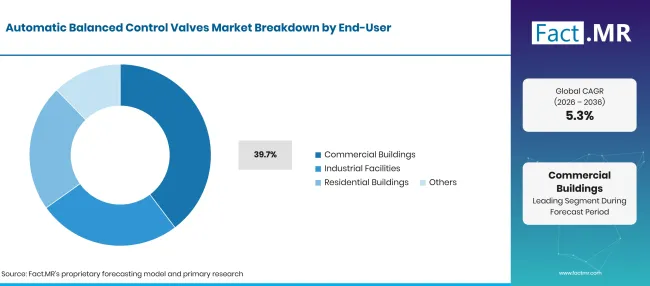
Automatic Balanced Control Valves Market Breakdown End User | Source: Fact.MR
| End-User | Share (2026) |
|---|---|
| Commercial Buildings (Leading segment) | 39.7% |
| Other segments combined | 60.3%* |
| Total | 100.0% |
Source: Fact.MR analysis. Updated Nov 12, 2026
Office towers, hospitals, hotels and shopping centres run hundreds of terminal units across zones with uneven loads. Offices alone used 18 TWh of electricity in England and Wales in 2023, about 15% of non-domestic use. Owners of such buildings are under steady pressure to cut running costs and meet efficiency ratings, so valve upgrades often go into the first phase of a retrofit. Industrial Facilities buy valves for process cooling and utility loops. Residential Buildings use them in apartment blocks with central heating and in larger homes with heat pumps. Others cover airports, universities and public infrastructure.
How does Distribution Channel shape demand?
Direct Sales capture 48.3% of 2026 orders.
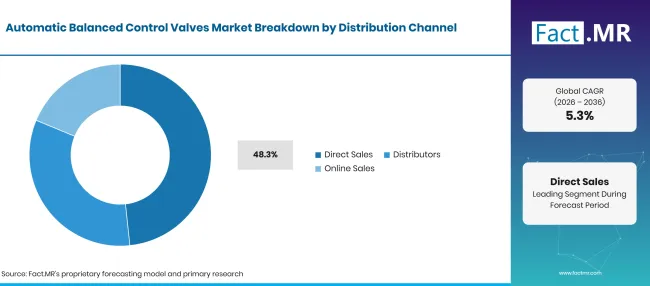
Automatic Balanced Control Valves Market Breakdown Distribution Channel | Source: Fact.MR
| Distribution Channel | Share (2026) |
|---|---|
| Direct Sales (Leading segment) | 48.3% |
| Other segments combined | 51.7%* |
| Total | 100.0% |
Source: Fact.MR analysis. Updated Nov 12, 2026
Large projects start with a consultant who sizes each valve against coil data and pump curves. Manufacturers sell directly into these jobs so their engineers can check selections, supply submittal data and attend commissioning. Contract terms often bundle valves with refrigeration valves and controls under a single mechanical package. Distributors serve contractors that need stock quickly for smaller jobs and for replacement after failures. Online Sales handle standard sizes, actuators and spare parts, with buyers using sizing tools before they order.
What is accelerating Automatic Balanced Control Valves Market adoption, and what is holding it back?
Pressure on building energy bills, ageing commercial HVAC systems and new cooling loads in data centers are pushing owners toward self-balancing, connected valves. Uptake slows where the upfront price looks high next to a manual balancing valve. It also slows when old pipework and pumps make a retrofit hard to design. Small projects often lack the hydronic skills needed to commission the valves correctly.
Drivers Impact Analysis
| DRIVER | (~) % IMPACT ON CAGR | GEOGRAPHIC RELEVANCE | IMPACT TIMELINE |
|---|---|---|---|
| Focus on HVAC energy use and dynamic hydronic balancing | +1.7% | Global | Short term (<=2 years) |
| Replacement of ageing heating and cooling systems | +1.2% | Global | Medium term (2-4 years) |
| Growth in commercial floor space needing zoned climate control | +0.8% | Asia Pacific, North America | Medium term (2-4 years) |
| Wider use of building management and connected controls | +0.5% | Europe, North America, East Asia | Long term (>=4 years) |
Source: Fact.MR analysis. Updated Nov 12, 2026
Opportunity Impact Analysis
| OPPORTUNITY | (~) % IMPACT ON CAGR | GEOGRAPHIC RELEVANCE | IMPACT TIMELINE |
|---|---|---|---|
| Connected PICVs with digital actuators and flow measurement | +0.7% | Global | Medium term (2-4 years) |
| Hydronic balancing retrofits in existing commercial buildings | +0.5% | Western Europe, North America | Long term (>=4 years) |
| Valves matched to heat pumps and low-temperature systems | +0.4% | Europe, Japan | Medium term (2-4 years) |
| Liquid cooling loops in data centers | +0.3% | North America, East Asia | Medium term (2-4 years) |
Source: Fact.MR analysis. Updated Nov 12, 2026
Restraints Impact Analysis
| RESTRAINT | (~) % IMPACT ON CAGR | GEOGRAPHIC RELEVANCE | IMPACT TIMELINE |
|---|---|---|---|
| Higher upfront cost of automatic valves and actuators | -0.4% | Global | Short term (<=2 years) |
| Retrofit complexity with existing piping, pumps and controls | -0.3% | Global | Medium term (2-4 years) |
| Shortage of skilled commissioning support on small projects | -0.1% | Emerging markets | Long term (>=4 years) |
| Slower new non-residential construction in mature markets | -0.1% | Western Europe, Japan | Short term (<=2 years) |
Source: Fact.MR analysis. Updated Nov 12, 2026
Which countries are scaling the Automatic Balanced Control Valves Market through 2036?
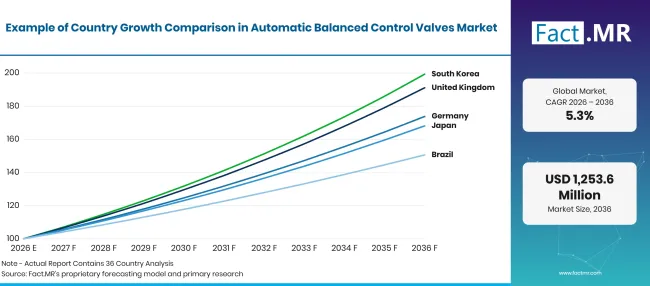
Automatic Balanced Control Valves Market Growth Index | Source: Fact.MR
| Country | CAGR (2026 to 2036) |
|---|---|
| United Kingdom | 6.7% |
| Germany | 5.7% |
| Japan | 5.3% |
| Brazil | 4.2% |
| United States | 3.9% |
Source: Fact.MR analysis. Updated Nov 12, 2026
What supports adoption in the United Kingdom?
6.7% CAGR, helped by heat decarbonisation work across a large non-domestic building stock.
England and Wales had 1,767,000 non-domestic buildings in March 2026 that used 151 TWh of gas in 2024. Moving that heat to low-carbon sources means lower flow temperatures and tighter balancing in existing radiator and coil circuits. Homes are also using less gas, with median consumption 13% lower in 2024 than in 2021. Contractors working on schools, hospitals and offices increasingly fit pressure-independent valves when they replace boilers.
How is Germany developing demand?
5.7% CAGR, reflecting fast heat pump uptake and tighter heating system rules.
Heat pumps were the main heating system in 73.6% of residential buildings completed in Germany in 2025, up from 69.4% in 2024. Heat pumps run efficiently only at low supply temperatures, so every radiator and floor loop must get its share of water. Automatic valves cut the time each balancing job takes. Apartment blocks and refurbished offices feed most of the commercial demand.
What is supporting Japan’s adoption?
5.3% CAGR, as renovation of existing buildings offsets slower new construction.
Construction statistics for FY2025 from the Ministry of Land, Infrastructure, Transport and Tourism showed non-residential starts falling for a fourth year in a row. Offices, shops, factories and warehouses all declined. Valve demand therefore leans on upgrades to chilled-water systems in existing towers, hospitals and plants. Owners favour compact, quiet valves that fit tight ceiling voids.
How is Brazil developing demand?
4.2% CAGR, backed by Brazil’s first mandatory efficiency levels for new buildings.
Brazil’s Ministry of Mines and Energy set minimum energy efficiency levels for new residential, commercial and public buildings through Resolution CGIEE No. 4 of September 26, 2025. Federal public buildings must reach level A from 2027. Commercial and service buildings in cities above 100,000 people need at least level C from 2028. Chilled-water plants in São Paulo offices, hospitals and malls will be the first to feel the change.
How does the United States perform?
3.9% CAGR, driven by state energy codes and steady HVAC replacement.
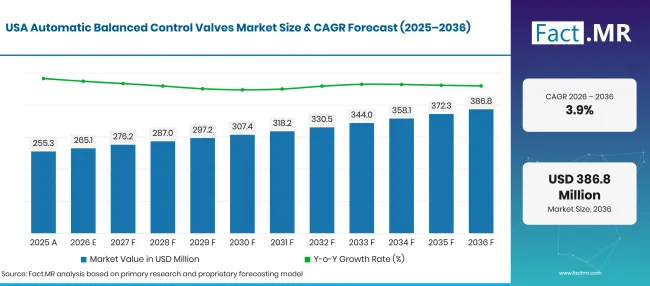
Automatic Balanced Control Valves Market Forecast Usa | Source: Fact.MR
The California Energy Commission’s 2025 Building Energy Efficiency Standards cover new buildings, additions and alterations, and they put heat pumps first for space and water heating. Rules of this kind push designers toward variable-flow hydronic systems in schools, offices and laboratories. Much of the US market is replacement work in buildings already fitted with pressure-independent valves. That mature base keeps growth steady but modest.
Who leads the Automatic Balanced Control Valves Market?
Competition splits into two groups that sell to the same consultants in different ways. Building technology firms such as Siemens, Schneider Electric and Johnson Controls offer pressure-independent valves as part of full automation packages, so they win where the client wants one controls contract.
Valve specialists such as Belimo, Danfoss and IMI compete on hydronic know-how, sizing software and digital actuators that measure flow. Belimo reported in July 2025 that it had secured a substantial share of data center projects, with control valves and damper actuators both gaining from faster data center deployment. IMI linked its first-half 2025 Climate Control performance to energy-saving products and a growing portfolio of smart-connected products. Frese and Caleffi hold strong positions in European and North American mid-size projects with compact PICV and combined balancing ranges. Verified field data on flow accuracy and savings will separate winners from suppliers selling on price.
Which companies are the key providers?
Key companies in the Automatic Balanced Control Valves Market include Belimo, Danfoss, IMI, Siemens, Schneider Electric, Johnson Controls, Frese and Caleffi.
- Belimo
- Danfoss
- IMI
- Siemens
- Schneider Electric
- Johnson Controls
- Frese
- Caleffi
Bibliography
- Belimo. (2025, July 21). Capitalizing on Strong Growth Momentum.
- Belimo. (2026, January 19). Belimo Accelerated Sales Growth in 2025.
- California Energy Commission. (2025, July 7). 2025 Building Energy Efficiency Standards for Residential and Nonresidential Buildings: Title 24, Part 6, and Associated Administrative Regulations in Part 1.
- Department for Energy Security and Net Zero. (2025, August 21). The Non-Domestic National Energy Efficiency Data-Framework 2025 (England and Wales).
- Department for Energy Security and Net Zero. (2026, June 11). National Energy Efficiency Data Framework (NEED) report: Summary of analysis 2026.
- Department for Energy Security and Net Zero. (2026, September 30). The Non-Domestic National Energy Efficiency Data-Framework 2026 (England and Wales).
- IMI. (2025, August 1). IMI plc: Interim results 2025.
- IMI. (2025, November 6). Excellent third quarter performance: Interim management statement November 2025.
- Ministério de Minas e Energia. (2025, September 26). Resolução CGIEE nº 4, de 26 de setembro de 2025.
- Ministry of Land, Infrastructure, Transport and Tourism. (2026, April 30).(Building Construction Starts Statistics Report, FY2025).
- Statistisches Bundesamt (Destatis). (2026, June 10). Rund drei Viertel der im Jahr 2025 errichteten Wohngebäude heizen mit Wärmepumpen.
- United Nations Environment Programme. (2025, March 17). Global Status Report for Buildings and Construction 2024/2025.
This Report Answers
- How large will automatic balanced control valve revenue be in 2026 and 2036, and what growth rate links the two?
- Which product type, application, end-user and sales channel leads in 2026, and why?
- How do building efficiency rules and HVAC retrofits change valve demand in each of the five countries?
- Where do data center cooling loops and heat pump systems open new demand for automatic flow control?
- What separates building technology groups from hydronic valve specialists in winning projects?
- Which drivers, opportunities and restraints carry the most weight on the 2026 to 2036 growth rate?
What does the Automatic Balanced Control Valves Market cover?
This market counts valves that regulate water flow automatically and keep a hydronic system in balance without repeated manual adjustment. Pressure-independent control valves, automatic flow limiters and dynamic temperature control valves all fall inside it.
Revenue is measured at manufacturer selling price for new valves, including any actuator or flow sensor sold as part of the same valve assembly. Values are shown in USD million for 2026 to 2036.
What is included in the scope?
Pressure-independent control valves for fan coils, air-handling units, chilled beams and heating circuits.
Automatic flow limiters and dynamic balancing cartridges used in heating and cooling networks.
Electronic and thermal actuators, flow meters and connectivity modules sold as part of a complete valve assembly, including units that work alongside temperature and pressure switches.
Valves used in industrial process cooling, district energy substations and data center liquid cooling loops.
What is excluded from the scope?
Manual balancing valves, shut-off valves and check valves with no automatic flow or pressure regulation.
Actuators, sensors and controllers sold separately from a valve body.
Pumps, chillers, boilers, heat exchangers and building management software.
Pipes, fittings, installation labour, commissioning services and aftermarket maintenance contracts.
How Was the Analysis Built?
The analysis draws on 120+ sources, 35+ company portfolios, 25+ countries, and more than 20 industry interviews.
- Primary Research: Primary research includes discussions with manufacturers, service providers, technology developers, distributors, end users, and subject-matter experts. These conversations examine purchasing priorities, product adoption, operational challenges, approval requirements, competitive positioning, and the factors that influence wider market acceptance.
- Desk Research: Desk research covers government statistics, regulatory publications, company filings, trade data, technical studies, industry associations, standards, public policy, and other authoritative sources. Every source used in the analysis is documented in the bibliography.
- Market Sizing and Forecasting: Market estimates combine historical performance, demand indicators, pricing and volume trends, segment shares, company participation, country-level growth, adoption patterns, investment activity, and barriers to market expansion.
- Data Validation and Update Cycle: Findings are validated by comparing primary interviews with public data, company activity, regulatory changes, trade patterns, and industry developments. Regular updates review new product launches, capacity changes, partnerships, approvals, and shifts in commercial adoption.
Segmentation
What is the report’s scope and coverage?
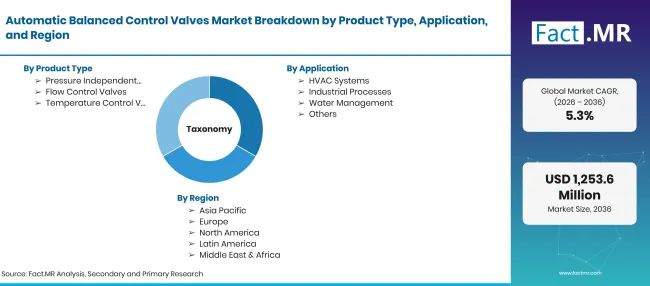
Automatic Balanced Control Valves Market Taxonomy | Source: Fact.MR
| Attribute | Details |
|---|---|
| Quantitative Units | USD million |
| Market Definition | Automatic balancing and pressure-independent control valves that regulate flow and keep hydraulic balance in hydronic HVAC, industrial and water-based control systems. |
| Product Type | Pressure Independent Control Valves; Flow Control Valves; Temperature Control Valves |
| Application | HVAC Systems; Industrial Processes; Water Management; Others |
| End-User | Commercial Buildings; Industrial Facilities; Residential Buildings; Others |
| Distribution Channel | Direct Sales; Distributors; Online Sales |
| Regions Covered | North America; Latin America; Western Europe; Eastern Europe; East Asia; South Asia & Pacific; Middle East & Africa |
| Countries Covered | United Kingdom; Germany; Japan; Brazil; United States |
| Companies Profiled | Belimo; Danfoss; IMI; Siemens; Schneider Electric; Johnson Controls; Frese; Caleffi |
| Forecast Period | 2026 to 2036 |
| Approach | Hybrid top-down and bottom-up model built on hydronic HVAC installations, retrofit rates, building efficiency rules and supplier portfolios. |
Source: Fact.MR analysis. Updated Nov 12, 2026
How is the market segmented?
-
By Product Type
- Pressure Independent Control Valves
- Flow Control Valves
- Temperature Control Valves
-
By Application
- HVAC Systems
- Industrial Processes
- Water Management
- Others
-
By End-User
- Commercial Buildings
- Industrial Facilities
- Residential Buildings
- Others
-
By Distribution Channel
- Direct Sales
- Distributors
- Online Sales
-
By Region
- North America
- Latin America
- Western Europe
- Eastern Europe
- East Asia
- South Asia & Pacific
- Middle East & Africa
Frequently Asked Questions
How large is the automatic balanced control valves market in 2026?
What growth rate will the automatic balanced control valves market record?
Which product type leads?
Which application leads?
Which end-user leads?
Which distribution channel leads?
Which country will grow quickest?
Who are the main companies?
What holds the market back?
Who worked on this report


Preview the report firsthand - request a free sample
Free SampleGet the brochure for pricing and purchase details
Download PDF