- Market Value (2025): USD 3.24 Bn
- Estimated Value (2026): USD 3.38 Bn
- Forecast Value (2036): USD 5.16 Bn
- CAGR (2026-2036): 4.3%
What is the Automotive Die-stamping Equipment Market forecast to be worth by 2036?
USD 3.4 billion in 2026 to USD 5.2 billion by 2036 at a 4.3% CAGR.
- As per Fact.MR analysis, the automotive die-stamping equipment market reached USD 3.24 billion in 2025.
- Sales are projected to rise from USD 3.38 billion in 2026 to USD 5.16 billion by 2036.
- The market is forecast to record a 4.3% CAGR from 2026 to 2036 as equipment replacement and new automotive body programs influence spending.
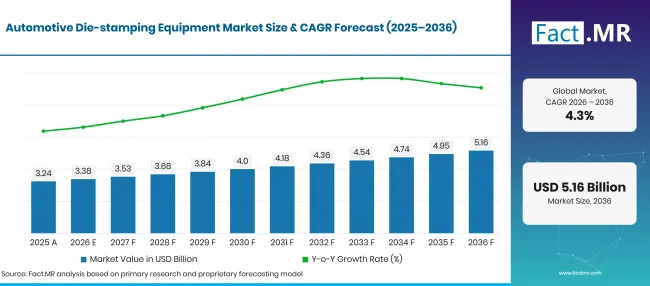
Factmr Automotive Die Stamping Equipment Market Forecast Global | Source: Fact.MR
| Year | Basis | Market value (USD billion) |
|---|---|---|
| 2025 | Actual | 3.24 |
| 2026 | Estimate | 3.38 |
| 2036 | Forecast | 5.16 |
| CAGR 2026 to 2036 | Forecast period | 4.3% |
Source: Fact.MR analysis. Updated Oct 14, 2026
What are the defining numbers behind Automotive Die-stamping Equipment Market growth?
USD 1.8 billion in additional market value between 2026 and 2036.
- Demand Drivers in the Market
- Car manufacturers may replace older presses when frequent body-panel changes make production costlier. Part quality and steady production often influence the choice between traditional presses and more flexible machines.
- Press lines that can handle different metal grades and tooling setups often attract interest from manufacturers updating vehicle designs. Adjustable machine settings help operators adapt production without replacing the entire line.
- Vehicle production in the UK creates ongoing demand for tooling and press maintenance. The Society of Motor Manufacturers and Traders recorded 555,826 passenger-car exports during 2025 [5]. Export-focused plants value equipment that can support model changes while keeping production running smoothly.
- Key Segments Analyzed
- By Product Type: Mechanical Press accounts for 44.2% share in 2026, supported by repeatable press cycles used for common stamped vehicle components.
- By Application: Passenger Vehicles represent 73.5% in 2026 as car body programs require many stamped parts per vehicle.
- By Material Type: Steel holds 58.7% in 2026, reflecting its continued use in structural and exterior automotive parts.
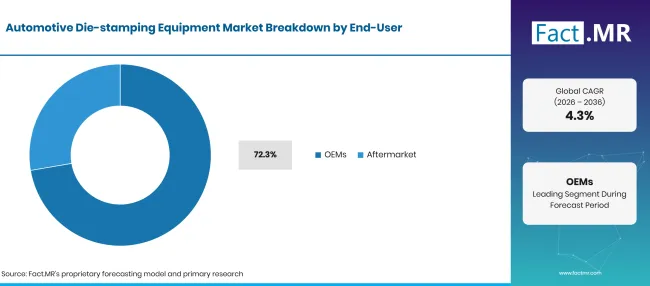
- By End-User: OEMs account for 72.3% in 2026 because assembly plants and their dedicated stamping operations require matched production equipment.
- Analyst Opinion at Fact.MR
- Shambhu Nath Jha, Principal Consultant at Fact.MR, states, “Automotive press purchases depend on reliable operation and quick tool changes. Vehicle makers often choose suppliers with a strong record of part quality and service support. For specialist component plants, matching existing tools can matter more than machine specifications.”
- Strategic Implications
- Press manufacturers can demonstrate equipment performance using the steel and aluminum materials already common in customer plants. Clear tool-change instructions make machine comparisons easier.
- Vehicle manufacturers often review the performance of the entire stamping line before deciding on a new press or a larger factory upgrade. Production downtime and existing tools influence the overall cost.
- Component manufacturers often coordinate tool maintenance with equipment purchase plans. Service availability and access to spare parts also influence supplier decisions.
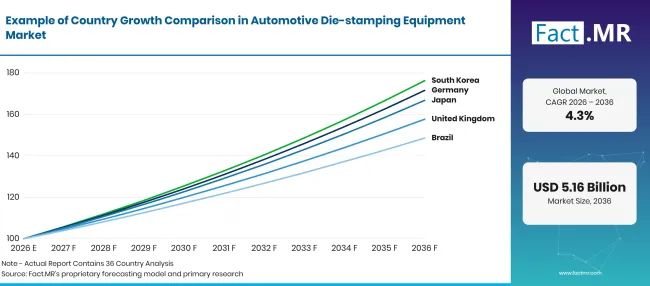
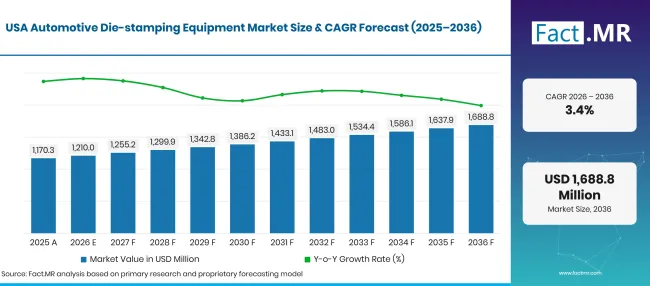
Germany is projected to grow at 5.6% CAGR as vehicle manufacturers update their stamping operations. Japan follows at 5.3%, supported by press makers serving export markets. The United Kingdom records 4.7%, while Brazil reaches 4.0%. U.S. equipment sales are estimated to grow at 3.4% through 2036.
How does the Automotive Die-stamping Equipment Market break down by segment?
Mechanical Press 44.2%; Passenger Vehicles 73.5%; Steel 58.7%; OEMs 72.3%.
Which Product Type dominates?
Mechanical Press is expected to hold 44.2% share in 2026.
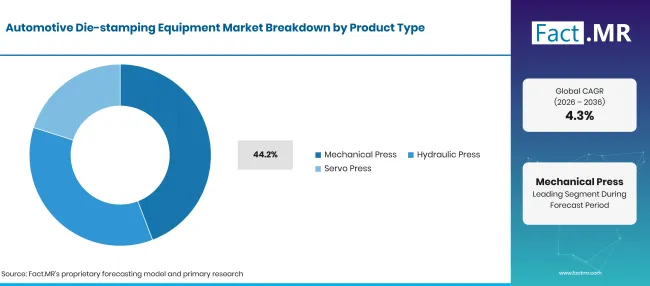
Factmr Automotive Die Stamping Equipment Market Breakdown Product Type | Source: Fact.MR
| Product Type | Share (2026) |
|---|---|
| Mechanical Press (Leading segment) | 44.2% |
| Other segments combined | 55.8%* |
| Total | 100.0% |
Source: Fact.MR analysis. Updated Oct 14, 2026
Mechanical presses are often used for producing the same sheet-metal parts over long production runs. They fit applications where tooling changes are infrequent. Hydraulic presses are chosen for jobs that need greater force control, while servo presses offer more flexibility during production. Manufacturers compare these options based on tooling costs, product changes, and machine price. The overall production line also affects how much output the press can deliver each day.
What leads the Application segment?
Passenger Vehicles are projected to account for 73.5% share in 2026.
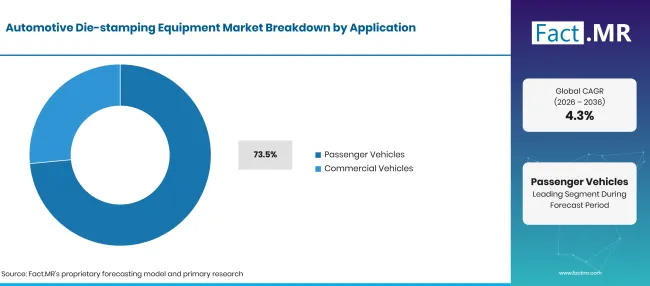
Factmr Automotive Die Stamping Equipment Market Breakdown Application | Source: Fact.MR
| Application | Share (2026) |
|---|---|
| Passenger Vehicles (Leading segment) | 73.5% |
| Other segments combined | 26.5%* |
| Total | 100.0% |
Source: Fact.MR analysis. Updated Oct 14, 2026
Passenger vehicles use large volumes of stamped metal parts for body panels and structural components. As a result, vehicle production levels often influence equipment purchases. Commercial vehicles also require stamping equipment, though production runs are usually smaller and part sizes can vary. Model updates make quick setup and tool handling important for both segments. Investment decisions often depend on whether parts are produced in-house or sourced from specialist stamping companies.
How does Material Type shape equipment demand?
Steel is forecast to account for 58.7% share in 2026.
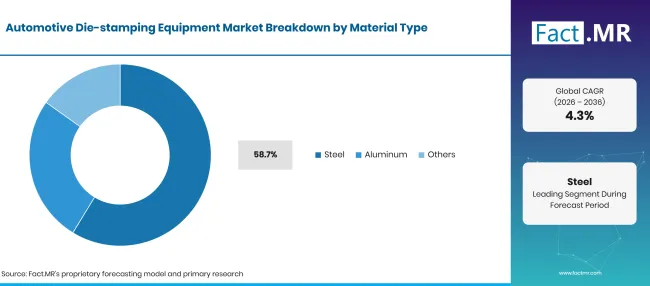
Factmr Automotive Die Stamping Equipment Market Breakdown Material Type | Source: Fact.MR
| Material Type | Share (2026) |
|---|---|
| Steel (Leading segment) | 58.7% |
| Other segments combined | 41.3%* |
| Total | 100.0% |
Source: Fact.MR analysis. Updated Oct 14, 2026
Steel is widely used for automotive stamped parts because it suits a range of strength and surface requirements. Different steel grades need different forming methods during production. Aluminum brings its own challenges, as maintaining part shape and surface finish requires extra attention. Other materials are mainly used for specialized applications.
Which End-User accounts for the larger share?
OEMs are expected to hold 72.3% share in 2026.
Factmr Automotive Die Stamping Equipment Market Breakdown End User | Source: Fact.MR
| End-User | Share (2026) |
|---|---|
| OEMs (Leading segment) | 72.3% |
| Other segments combined | 27.7%* |
| Total | 100.0% |
Source: Fact.MR analysis. Updated Oct 14, 2026
OEM stamping plants produce parts for specific vehicle models and supply them directly to assembly lines. Equipment purchases often depend on available factory space, maintenance needs, and how long a vehicle model will stay in production. The aftermarket also uses stamped parts for repairs and replacements, but demand patterns are different from vehicle manufacturing.
What is accelerating Automotive Die-stamping Equipment Market adoption, and what is holding it back?
New vehicle models and changing production needs encourage equipment purchases. High machine costs and factory workload often influence buying decisions. Companies usually invest when production plans support the expense and expected output.
Drivers Impact Analysis
| DRIVER | (~) % IMPACT ON CAGR | GEOGRAPHIC RELEVANCE | IMPACT TIMELINE |
|---|---|---|---|
| Automotive body-program changes | +1.1% | Germany, Japan | Medium term (2–4 years) |
| Replacement of aging press lines | +0.9% | Global | Medium term (2–4 years) |
| Greater control over complex forming | +0.8% | Japan, Germany | Long term (>= 4 years) |
| Vehicle component localization | +0.6% | Brazil, USA | Long term (>= 4 years) |
| Need to improve press-line uptime | +0.5% | Global | Short term (<= 2 years) |
Source: Fact.MR analysis. Updated Oct 14, 2026
Opportunity Impact Analysis
| OPPORTUNITY | (~) % IMPACT ON CAGR | GEOGRAPHIC RELEVANCE | IMPACT TIMELINE |
|---|---|---|---|
| Servo press retrofits and upgrades | +0.8% | Japan, Germany | Medium term (2–4 years) |
| Integrated die and material handling | +0.6% | Global | Medium term (2–4 years) |
| Higher-strength steel forming | +0.5% | Europe, North America | Long term (>= 4 years) |
| After-sales press servicing | +0.4% | Global | Short term (<= 2 years) |
Source: Fact.MR analysis. Updated Oct 14, 2026
Restraints Impact Analysis
| RESTRAINT | (~) % IMPACT ON CAGR | GEOGRAPHIC RELEVANCE | IMPACT TIMELINE |
|---|---|---|---|
| High initial equipment cost | -0.8% | Global | Short term (<= 2 years) |
| Changing vehicle production volumes | -0.6% | Germany, UK | Medium term (2–4 years) |
| Long equipment replacement cycles | -0.5% | Global | Long term (>= 4 years) |
| Tooling and installation complexity | -0.4% | Global | Medium term (2–4 years) |
Source: Fact.MR analysis. Updated Oct 14, 2026
Which countries are scaling the Automotive Die-stamping Equipment Market through 2036?
Factmr Automotive Die Stamping Equipment Market Growth Index | Source: Fact.MR
| Country | CAGR (2026–2036) |
|---|---|
| Germany | 5.6% |
| Japan | 5.3% |
| United Kingdom | 4.7% |
| Brazil | 4.0% |
| United States | 3.4% |
Source: Fact.MR analysis. Updated Oct 14, 2026
Why is Germany leading automotive die-stamping equipment growth?
5.6% CAGR, driven by large vehicle plants, export-oriented production, and press modernization.
Germany has a strong position in the market because its vehicle factories operate large stamping facilities for body-panel production. The German Association of the Automotive Industry reported 4.15 million passenger cars produced in 2025 [4]. Many German plants also supply export markets, making production continuity and tool compatibility important when equipment is replaced.
How is Japan building demand for specialized stamping equipment?
5.3% CAGR, supported by global production networks and strong press-engineering capabilities.
Japan stands out through the global presence of its automakers and its experience in press manufacturing. JAMA reported 16,357,035 vehicles produced overseas by Japanese manufacturers in 2025 [3]. This gives Japanese press suppliers opportunities to supply, and replace equipment at factories around the world. Servo presses are also gaining attention as manufacturers work with different steel grades and need greater control during part production.
What is supporting the United Kingdom’s stamping equipment market?
4.7% CAGR, shaped by export-focused vehicle production and factory upgrade programs.
The United Kingdom has a smaller automotive industry than Germany and Japan, but many of its factories support export-focused vehicle production. SMMT reported 717,371 passenger cars produced in 2025 [2]. The market also benefits from DRIVE35 funding for automotive investment and research. UK manufacturers often look for equipment that fits existing factory layouts, tooling, and material-handling systems.
How is Brazil developing automotive stamping equipment purchases?
4.0% CAGR, linked to local manufacturing cycles and the need for flexible production equipment.
Brazil's market is influenced mainly by activity at local vehicle factories rather than large export-focused replacement programs. Many component manufacturers supply parts to several vehicle plants, so flexible machine settings and efficient tool changes remain important. Equipment purchases are often influenced by service support, maintenance availability, and stable production schedules.
Why is the United States growing more slowly despite its large automotive base?
3.4% CAGR, reflecting extensive installed press capacity and selective equipment replacement.
Factmr Automotive Die Stamping Equipment Market Forecast Usa | Source: Fact.MR
The United States has a large automotive manufacturing base, but many plants already operate established high-volume press lines. The U.S. Bureau of Labor Statistics counted 401,600 production and nonsupervisory employees in motor vehicle parts manufacturing in May 2026 [1]. This creates a substantial service market, but it also means manufacturers can often maintain existing equipment instead of replacing complete lines. New purchases are therefore more closely tied to confirmed vehicle programs, tooling changes, and specific forming requirements.
Who leads the Automotive Die-stamping Equipment Market?
Press manufacturers compete on machine capacity and how well their equipment fits into existing factory operations. AIDA Engineering, Schuler Group, Komatsu, JIER, and Fagor Arrasate supply presses for a range of automotive stamping applications.
Amada and Haco serve wider metalworking needs, while Nidec Minster and Simpac focus on industrial press equipment. Macrodyne specializes in hydraulic presses. Automotive manufacturers compare these options based on the parts they produce and the tooling they already use.
Which companies are the key providers?
Key companies include AIDA Engineering, Ltd.; ANDRITZ Schuler GmbH (Schuler); Komatsu Ltd.; JIER Machine-Tool Group Co., Ltd.; Fagor Arrasate S.Coop.; AMADA PRESS SYSTEM CO., LTD.; HACO BLISSBRET (HACO Group); Nidec Minster Corporation; SIMPAC Inc.; and Macrodyne Technologies Inc.
- AIDA Engineering Ltd.
- ANDRITZ Schuler GmbH (Schuler)
- Komatsu Ltd.
- JIER Machine-Tool Group Co. Ltd.
- Fagor Arrasate S.Coop
- AMADA PRESS SYSTEM CO., LTD.
- HACO BLISSBRET (HACO Group)
- Nidec Minster Corporation
- Simpac Inc.
- Macrodyne Technologies Inc.
Bibliography
- [1] U.S. Bureau of Labor Statistics. (2026, May). Employment and Earnings: Table B-6a.
- [2] Society of Motor Manufacturers and Traders. (2026, February 20). SMMT Motor Industry Facts 2026.
- [3] Japan Automobile Manufacturers Association. (2026, February 27). 2025年第4四半期・同年累計海外生産統計 [2025 fourth-quarter and annual overseas production statistics].
- [4] German Association of the Automotive Industry. (2026, January 5). Passenger car production in 2025 slightly above previous year's level.
- [5] Society of Motor Manufacturers and Traders. (2026, February 20). SMMT Motor Industry Facts 2026.
- [6] Ministry of Economy, Trade and Industry. (2026, June 30). Indices of Industrial Production: Preliminary Report for May 2026.
This Report Answers
- How equipment sales differ among mechanical, hydraulic and servo presses used for automotive components.
- Which applications and material categories account for the stated 2026 segment positions.
- How country-level manufacturing conditions affect potential press replacement and new installations.
- What installation and maintenance issues shape supplier selection for stamping operations.
- How automotive producers compare press systems across tooling needs and factory throughput.
What does the Automotive Die-stamping Equipment Market cover?
The market covers mechanical, hydraulic and servo presses used to form automotive metal components. It includes equipment supplied to vehicle makers and specialist stamping facilities where pressing is part of vehicle component production.
What is included in the scope?
The scope includes new die-stamping presses sold for automotive operations, along with line equipment when it forms part of the press installation. Coverage extends to vehicle-body components and other stamped metal parts handled within the specified material and use categories.
What is excluded from the scope?
Primary Research: Interviews and hypothetical survey scenarios can examine press-line uptime, die changes and supplier service needs. Reported findings are limited to completed and documented research activities.
How Was the Analysis Built?
The analysis draws on 120+ sources, 35+ company portfolios, 25+ countries, and more than 20 industry interviews.
- Primary Research: Primary research includes discussions with manufacturers, service providers, technology developers, distributors, end users, and subject-matter experts. These conversations examine purchasing priorities, product adoption, operational challenges, approval requirements, competitive positioning, and the factors that influence wider market acceptance.
- Desk Research: Desk research covers government statistics, regulatory publications, company filings, trade data, technical studies, industry associations, standards, public policy, and other authoritative sources. Every source used in the analysis is documented in the bibliography.
- Market Sizing and Forecasting: Market estimates combine historical performance, demand indicators, pricing and volume trends, segment shares, company participation, country-level growth, adoption patterns, investment activity, and barriers to market expansion.
- Data Validation and Update Cycle: Findings are validated by comparing primary interviews with public data, company activity, regulatory changes, trade patterns, and industry developments. Regular updates review new product launches, capacity changes, partnerships, approvals, and shifts in commercial adoption.
Segmentation
What is the report’s scope and coverage?
Factmr Automotive Die Stamping Equipment Market Taxonomy | Source: Fact.MR
| Attribute | Details |
|---|---|
| Quantitative Units | USD billion in 2026; USD billion by 2036; CAGR |
| Market Definition | Presses and associated equipment used to form automotive sheet-metal parts with stamping dies. |
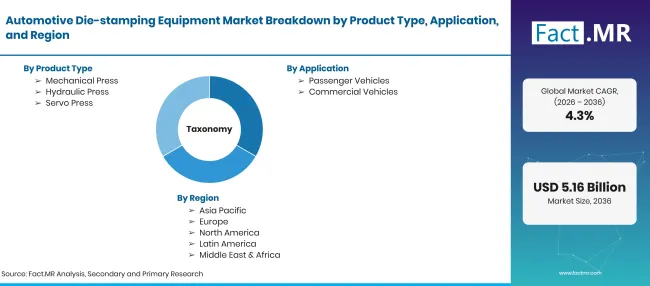
| Product Type | Mechanical Press; Hydraulic Press; Servo Press |
| Application | Passenger Vehicles; Commercial Vehicles |
| Material Type | Steel; Aluminum; Others |
| End-User | OEMs; Aftermarket |
| Regions Covered | North America; Latin America; Western Europe; Eastern Europe; East Asia; South Asia & Pacific; Middle East & Africa |
| Countries Covered | Germany; Brazil; USA; UK; Japan |
| Companies Profiled | AIDA Engineering Ltd.; ANDRITZ Schuler GmbH (Schuler); Komatsu Ltd.; JIER Machine-Tool Group Co. Ltd.; Fagor Arrasate S.Coop; AMADA PRESS SYSTEM CO., LTD.; HACO BLISSBRET (HACO Group); Nidec Minster Corporation; Simpac Inc.; Macrodyne Technologies Inc. |
| Forecast Period | 2026 to 2036 |
| Approach | Market-level equipment review, automotive stamping applications, material categories, country outlook and first-party vehicle-manufacturing evidence. |
Source: Fact.MR analysis. Updated Oct 14, 2026
How is the market segmented?
-
By Product Type
- Mechanical Press
- Hydraulic Press
- Servo Press
-
By Application
- Passenger Vehicles
- Commercial Vehicles
-
By Material Type
- Steel
- Aluminum
- Others
-
By End-User
- OEMs
- Aftermarket
-
By Region
- North America
- Latin America
- Western Europe
- Eastern Europe
- East Asia
- South Asia & Pacific
- Middle East & Africa
Frequently Asked Questions
How big is the automotive die-stamping equipment market in 2026?
What is the market CAGR from 2026 to 2036?
Which product type has the largest stated share?
Which application accounts for the greater share?
Which companies supply equipment in this field?
Who worked on this report


Preview the report firsthand - request a free sample
Free SampleGet the brochure for pricing and purchase details
Download PDF