- Market Value (2025): USD 4.69 Bn
- Estimated Value (2026): USD 5.1 Bn
- Forecast Value (2036): USD 11.8 Bn
- CAGR (2026-2036): 8.8%
What is the Automotive Drive Control Unit Market forecast to be worth by 2036?
USD 5.1 billion in 2026 to USD 11.8 billion by 2036, at an 8.8% CAGR.
- As per Fact.MR analysis, the automotive drive control unit market reached USD 4.69 billion in 2025.
- Sales are forecast to reach USD 5.1 billion in 2026 to USD 11.8 billion in 2036, with control electronics becoming more closely tied to vehicle software.
- The market is projected to record an 8.8% CAGR during 2026 to 2036 as automakers expand electronic control across passenger cars and commercial platforms.
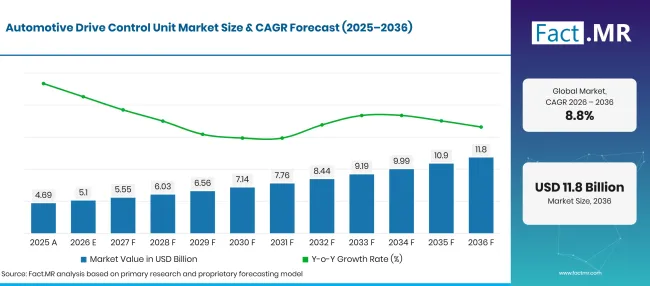
Automotive Drive Control Unit Market Forecast Global | Source: Fact.MR
| Year | Basis | Market Value (USD billion) |
|---|---|---|
| 2025 | Actual | 4.69 |
| 2026 | Estimate | 5.1 |
| 2036 | Forecast | 11.8 |
| CAGR 2026 to 2036 | Forecast period | 8.8% |
Source: Fact.MR analysis. Updated Oct 22, 2026
What are the defining numbers behind Automotive Drive Control Unit Market growth?
USD 6.7 billion in additional market value from 2026 to 2036, with passenger cars and OEM supply shaping purchasing volumes.
- Demand Drivers in the Market
- Vehicle engineering teams require controllers that exchange sensor readings quickly enough to keep engine or chassis functions coordinated during everyday driving.
- Automakers increasingly assess whether a control platform serves several model variants. Shared hardware can simplify validation work when the software functions remain clearly separated.
- Electric vehicle engineers have a particular interest in control strategies that coordinate propulsion response with braking and steering commands. The exact architecture depends on vehicle design.
- System integrators look for reliable diagnostics and fault handling before accepting changes to safety-related drive controls. Approval depends on testing across normal and unusual operating conditions.
- Key Segments Analyzed
- By Vehicle Type: Passenger Cars account for 60.1% share in 2026, given the size of passenger-vehicle production programmes.
- By Component: Sensors lead with 32.4% share in 2026 as controllers rely on reliable vehicle-condition inputs.
- By Application: Engine Control holds 28.9% share in 2026, covering electronic management of engine functions.
- By Sales Channel: OEM captures 74.2% share in 2026 since new controllers usually enter vehicles during factory assembly.
- Analyst Opinion at Fact.MR
- Shambhu Nath Jha, Principal Consultant at Fact.MR, states, “Automakers need drive controllers that respond reliably in everyday traffic and unusual driving conditions. Engineers therefore test how the software reads sensor inputs, commands actuators, and handles faults. Suppliers with clear system interfaces and dependable calibration support have a more practical route from prototypes to series production.”
- Strategic Implications
- Automakers should decide early which vehicle functions remain in separate modules and which functions use shared control resources. That choice affects later integration tests.
- Tier-one suppliers need to support repeatable software updates and clear records of controller behaviour across different vehicle platforms. These records help resolve approval questions.
- Sensor manufacturers benefit from giving control-system engineers consistent signal specifications. Stable inputs reduce the effort involved in checking actuator commands under changing road conditions.
- Aftermarket distributors need to distinguish compatible replacement modules from components requiring factory programming. Incorrect matching can interrupt repairs even when the physical connector fits.
Germany is forecast to record 11.0% CAGR, followed by Brazil at 10.0% and the United Kingdom at 9.5%. Japan is projected to post 7.2%, while the United States carries 6.5%. The differences reflect separate manufacturing programmes and vehicle-mix conditions across these markets.
How does the Automotive Drive Control Unit Market break down by segment?
Passenger Cars 60.1%; Sensors 32.4%; Engine Control 28.9%; OEM 74.2% in 2026.
Which Vehicle Type dominates?
Passenger Cars holds 60.1% share in 2026.
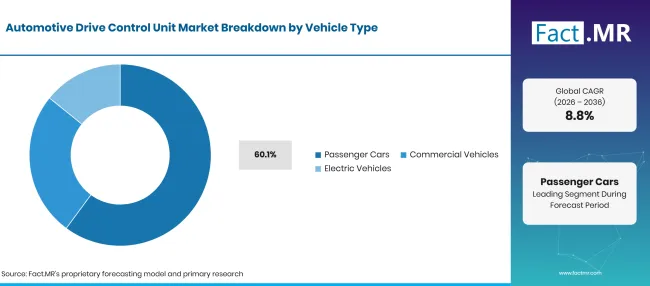
Automotive Drive Control Unit Market Breakdown Vehicle Type | Source: Fact.MR
| Vehicle Type dominates | Share (2026) |
|---|---|
| Passenger Cars (Leading segment) | 60.1% |
| Other segments combined | 39.9% |
| Total | 100.0% |
Source: Fact.MR analysis. Updated Oct 22, 2026
Passenger-car programmes require controllers to operate reliably in frequent stop-start travel and changing road conditions. Shared electronic platforms are attractive when automakers offer several trims on a common vehicle base. Commercial vehicles place more weight on operating life and service schedules because downtime affects fleet operations. Electric vehicles also bring distinct requirements for traction response and coordination with regenerative braking. Vehicle engineers compare both software behaviour and access to replacement parts before confirming the final hardware layout.
What leads the Component segment?
Sensors account for 32.4% share in 2026.
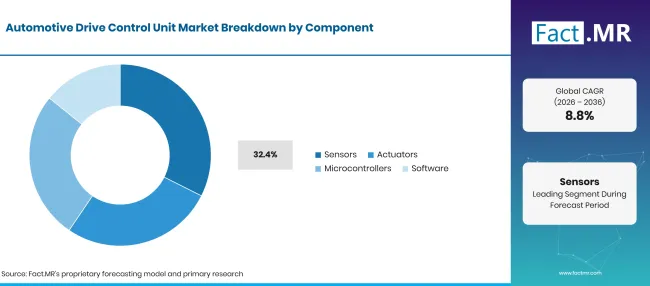
Automotive Drive Control Unit Market Breakdown Component | Source: Fact.MR
| Component segment | Share (2026) |
|---|---|
| Sensors (Leading segment) | 32.4% |
| Other segments combined | 67.6% |
| Total | 100.0% |
Source: Fact.MR analysis. Updated Oct 22, 2026
Sensors send vehicle speed and operating-condition signals to control electronics. Engineers check signal accuracy and response time because incorrect readings can alter actuator commands. Actuators then carry out the controller’s instructions, while microcontrollers process inputs and run embedded software. Software design remains closely tied to the selected hardware architecture. A control unit is therefore assessed as a connected system rather than an isolated chip, especially where a fault must trigger a predictable response. Control-unit developers assess signal accuracy alongside the switching response of automotive actuators during vehicle testing.
Which Application represents the largest share?
Engine Control leads with 28.9% share in 2026.
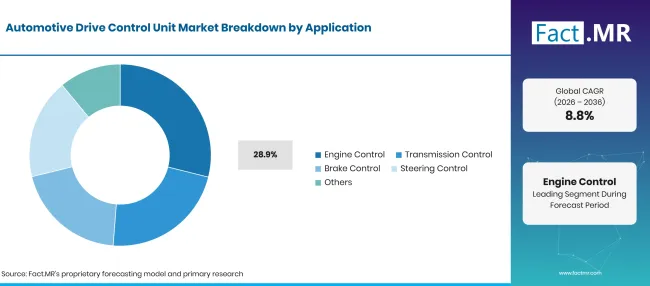
Automotive Drive Control Unit Market Breakdown Application | Source: Fact.MR
| Application | Share (2026) |
|---|---|
| Engine Control (Leading segment) | 28.9% |
| Other segments combined | 71.1% |
| Total | 100.0% |
Source: Fact.MR analysis. Updated Oct 22, 2026
Engine-control units adjust operating functions using readings from vehicle sensors and calibration maps. Transmission-control applications have different timing and shift-quality needs, while brake-control functions place greater attention on safe response to faults. Steering control also requires clear command limits and dependable feedback.
How does Sales Channel shape purchases?
OEM captures 74.2% share in 2026.
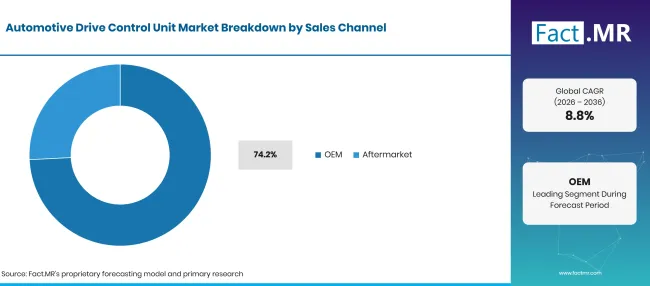
Automotive Drive Control Unit Market Breakdown Sales Channel | Source: Fact.MR
| Sales Channel | Share (2026) |
|---|---|
| OEM (Leading segment) | 74.2% |
| Other segments combined | 25.8% |
| Total | 100.0% |
Source: Fact.MR analysis. Updated Oct 22, 2026
Original equipment manufacturers usually determine drive-control requirements before production starts. Controller design follows the vehicle platform because electrical interfaces and embedded software require joint approval. The aftermarket remains relevant when a failed module needs replacement during the service life of a vehicle. Workshops often need a part with the correct configuration and approved programming procedure. This makes catalogue accuracy more useful than a broad stock list when distributors serve several vehicle generations. OEM approval of automotive electronics involves validating module interfaces before controllers enter series production.
What is accelerating Automotive Drive Control Unit Market adoption, and what is holding it back?
Controller integration and vehicle electrification support purchases; validation effort and production costs constrain adoption.
Drivers Impact Analysis
| DRIVER | (~) % IMPACT ON CAGR | GEOGRAPHIC RELEVANCE | IMPACT TIMELINE |
|---|---|---|---|
| Vehicle control integration | +1.0% | Global | Medium term (2–4 years) |
| Passenger-car production | +0.8% | Global | Short term (<= 2 years) |
| Electric-drive coordination | +0.7% | Europe, Asia | Medium term (2–4 years) |
| Sensor-based functions | +0.5% | Global | Medium term (2–4 years) |
| OEM platform renewal | +0.4% | Global | Long term (>= 4 years) |
Source: Fact.MR analysis. Updated Oct 22, 2026
Opportunity Impact Analysis
| OPPORTUNITY | (~) % IMPACT ON CAGR | GEOGRAPHIC RELEVANCE | IMPACT TIMELINE |
|---|---|---|---|
| Software reuse | +0.8% | Global | Medium term (2–4 years) |
| Diagnostics support | +0.6% | Global | Short term (<= 2 years) |
| Modular controller design | +0.5% | Europe, Japan | Medium term (2–4 years) |
| Service-compatible replacement | +0.4% | Global | Long term (>= 4 years) |
Source: Fact.MR analysis. Updated Oct 22, 2026
Restraints Impact Analysis
| RESTRAINT | (~) % IMPACT ON CAGR | GEOGRAPHIC RELEVANCE | IMPACT TIMELINE |
|---|---|---|---|
| Safety validation | -0.8% | Global | Short term (<= 2 years) |
| Electronic component costs | -0.6% | Global | Medium term (2–4 years) |
| Vehicle integration effort | -0.5% | Global | Medium term (2–4 years) |
| Repair programming limits | -0.4% | Global | Long term (>= 4 years) |
Source: Fact.MR analysis. Updated Oct 22, 2026
Which countries are scaling the Automotive Drive Control Unit Market through 2036?
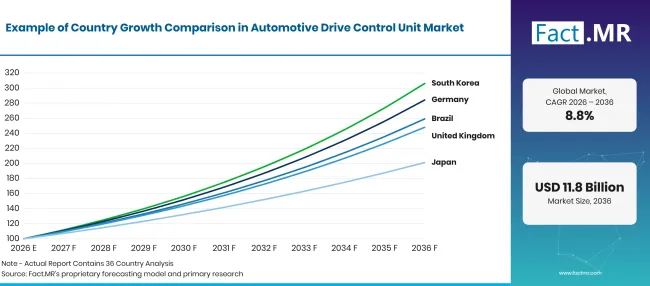
Automotive Drive Control Unit Market Growth Index | Source: Fact.MR
| Country | CAGR (2026–2036) |
|---|---|
| Germany | 11.0% |
| Brazil | 10.0% |
| United Kingdom | 9.5% |
| Japan | 7.2% |
| United States | 6.5% |
Source: Fact.MR analysis. Updated Oct 22, 2026
Why is Germany developing integrated drive controls?
11.0% CAGR, influenced by domestic engineering activity and a large passenger-car base.
German automakers review controller software alongside braking and driveline integration. The country has established vehicle electronics supply networks, making qualification of control hardware a central part of production planning. Destatis recorded 2,857,591 new passenger-car registrations in Germany in 2025 [2]. The activity provides an important vehicle-platform base for original equipment control systems. The German Federal Statistical Office counted 49.3392 million passenger cars in the country at the start of 2025 [3]. A broad active fleet also creates ongoing module-service requirements. Destatis reported that German automotive industry production declined 1.7% in 2025 [4].
How is Brazil shaping drive-control purchases?
10.0% CAGR, linked to local assembly volumes and model-specific controller sourcing.
Brazilian plants serve both domestic buyers and overseas destinations. Controller sourcing depends on the configuration of each locally assembled vehicle, while service access shapes later replacement sales. Anfavea reported production of 2.644 million vehicles in Brazil in 2025 [5]. The production base gives local assembly programmes a clear base for factory-installed control electronics. The same association reported 528,800 vehicle exports in 2025.
What supports the United Kingdom outlook?
9.5% CAGR, shaped by the change in new-car powertrains and domestic vehicle engineering.
Manufacturers and engineering suppliers in the United Kingdom work with mixed powertrain programmes. New electric models require careful control of torque response and coordination with existing brake functions. The Department for Transport recorded 2.617 million first-time vehicle registrations in the United Kingdom in 2025 [6]. New registrations create a broad base for factory-fitted electronic controls. The Department for Transport reported 147,000 new zero-emission car registrations during the second quarter of 2026 [7]. Such models require purpose-built electronic drive-control calibration. The Society of Motor Manufacturers and Traders recorded 764,715 vehicles built in the United Kingdom in 2025 [8].
Why does Japan favour precise controller integration?
7.2% CAGR, associated with established supplier relationships and control-system quality requirements.
Japanese manufacturers closely coordinate vehicle electronics with established hardware platforms. Supplier selection often depends on traceable software changes and predictable performance across a full vehicle model cycle. The Japan Automobile Manufacturers Association published its Motor Industry of Japan 2026 report covering domestic vehicle production and registration data [9]. The annual series supports model-specific supply planning. Japan Automobile Dealers Association issued its 2026 new-registration yearbook covering 2025 registrations [10]. The model-level coverage helps distinguish passenger and commercial vehicle requirements.
How does the United States influence control-unit design?
6.5% CAGR, related to large vehicle programmes and changing powertrain configurations.
American vehicle platforms cover diverse size classes and driving conditions. Controller teams need dependable fault monitoring while balancing hardware cost against software functions. The U.S. Environmental Protection Agency reported an average real-world fuel economy of 27.2 mpg for model-year 2024 vehicles in its February 2026 report [11]. Powertrain control is one contributor to managing operating efficiency. The EPA reported that average fuel economy was 1.7 mpg lower when battery-electric and plug-in hybrid vehicles were excluded from its comparison.
Who leads the Automotive Drive Control Unit Market?
Bosch and ZF offer vehicle-control technology, while Denso support related electronic control functions.
ZF Friedrichshafen AG offers cubiX control software and related chassis technologies [1]. Denso Corporation supplies electronic components and control technology used by vehicle manufacturers. Their products serve different functions and vehicle architectures, so purchasing comparisons depend on the system boundary selected by each automaker.
Magna International Inc., Aptiv PLC, Valeo SA, Hyundai Mobis, and Astemo Ltd. participate in automotive electronics or vehicle-control systems within their respective product areas. The relevant purchase decision concerns the fit between each module and the vehicle programme, including validation records and supplier support. Product coverage varies across suppliers and does not establish a single market-share ranking. New orders remain tied to specific automaker platforms and the timing of engineering approval.
Which companies are the key providers?
Key companies include Robert Bosch GmbH; Denso Corporation; ZF Friedrichshafen AG; Magna International Inc.; Aptiv PLC; Valeo SA; Hyundai Mobis; Astemo Ltd.
- Robert Bosch GmbH
- Denso Corporation
- ZF Friedrichshafen AG
- Magna International Inc.
- Aptiv PLC
- Valeo SA
- Hyundai Mobis
- Astemo Ltd.
Bibliography
- [1] ZF Friedrichshafen AG. (n.d.). Top technology for sustainable mobility: IAA Mobility 2025.
- [2] Statistisches Bundesamt (Destatis). (2026, March 23). Neuzulassungen von Kraftfahrzeugen in Deutschland.
- [3] Statistisches Bundesamt (Destatis). (2026, March 23). Bestand an Kraftfahrzeugen und Schienenfahrzeugen für die Jahre 2021 bis 2025.
- [4] Statistisches Bundesamt (Destatis). (2026, February 6). Production in December 2025: -1.9% on the previous month.
- [5] Associação Nacional dos Fabricantes de Veículos Automotores. (2026, January 15). Produção e venda de autoveículos crescem em 2025 e Anfavea projeta nova alta em 2026.
- [6] Department for Transport. (2026, April 29). Vehicle licensing statistics, United Kingdom: 2025.
- [7] Department for Transport. (2026, September 23). Vehicle licensing statistics: April to June 2026.
- [8] Society of Motor Manufacturers and Traders. (2026, January 29). Tough year for auto but new models and Industrial Strategy can deliver growth.
- [9] Japan Automobile Manufacturers Association. (2026). The Motor Industry of Japan 2026.
- [10] Japan Automobile Dealers Association. (2026). [Annual report on new vehicle registrations, 2026 edition].
- [11] U.S. Environmental Protection Agency. (2026, February). 2025 EPA Automotive Trends Report: Fuel economy and technology since 1975 (EPA-420-R-26-001).
This Report Answers
- The report examines the vehicle applications that influence purchasing of electronic drive-control systems.
- Component analysis explains how sensors and embedded processors interact with actuator commands.
- Country comparisons cover Germany, Brazil, the United Kingdom, Japan and the United States.
- Competitive analysis considers controller software, vehicle electronics and supplier qualification.
- Sales-channel coverage distinguishes factory-installed controls from service replacement demand.
What does the Automotive Drive Control Unit Market cover?
The market covers automotive drive control units and directly associated functions involved in managing the vehicle response to driver commands. It considers control-related sensors and embedded software used for engine, transmission, brake and steering applications. Related Fact.MR coverage of automotive engine electronic control systems provides a separate view of engine-specific electronic architecture. The wider use of engine electronic control systems forms a related application area where software calibration and sensor feedback shape drive-control performance.
What is included in the scope?
Included sales cover controllers associated with passenger cars, commercial vehicles and electric vehicles.
The component analysis considers sensors, actuators, microcontrollers and software when they form part of the stated drive-control system boundary. Factory installations enter the OEM channel, while replacement units and related service parts enter the aftermarket category. Application coverage spans engine control and transmission control, with brake and steering functions included when connected to the relevant drive-control architecture. Regional analysis compares different vehicle-platform and production conditions, without treating registration totals as direct controller revenue.
What is excluded from the scope?
The scope excludes unrelated infotainment electronics and stand-alone vehicle accessories that have no drive-control function.
General-purpose software and factory automation equipment remain outside the market unless supplied as an identifiable part of an automotive drive-control unit.
How Was the Analysis Built?
The analysis draws on 120+ sources, 35+ company portfolios, 25+ countries, and more than 20 industry interviews.
- Primary Research: Primary research includes discussions with manufacturers, service providers, technology developers, distributors, end users, and subject-matter experts. These conversations examine purchasing priorities, product adoption, operational challenges, approval requirements, competitive positioning, and the factors that influence wider market acceptance.
- Desk Research: Desk research covers government statistics, regulatory publications, company filings, trade data, technical studies, industry associations, standards, public policy, and other authoritative sources. Every source used in the analysis is documented in the bibliography.
- Market Sizing and Forecasting: Market estimates combine historical performance, demand indicators, pricing and volume trends, segment shares, company participation, country-level growth, adoption patterns, investment activity, and barriers to market expansion.
- Data Validation and Update Cycle: Findings are validated by comparing primary interviews with public data, company activity, regulatory changes, trade patterns, and industry developments. Regular updates review new product launches, capacity changes, partnerships, approvals, and shifts in commercial adoption.
Segmentation
What is the report’s scope and coverage?
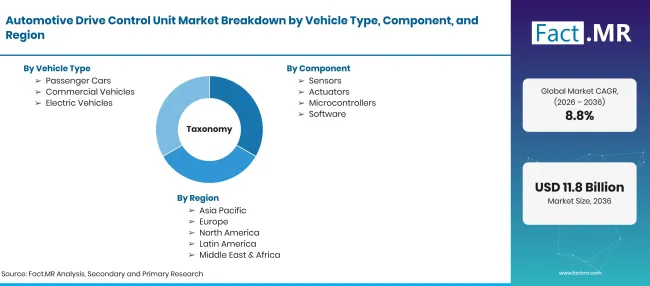
Automotive Drive Control Unit Market Taxonomy | Source: Fact.MR
| Attribute | Details |
|---|---|
| Quantitative Units | USD billion in 2026 to USD billion by 2036 at an CAGR |
| Market Definition | Electronic control units and associated controller components used to manage vehicle drive functions |
| Vehicle Type | Passenger Cars; Commercial Vehicles; Electric Vehicles |
| Component | Sensors; Actuators; Microcontrollers; Software |
| Application | Engine Control; Transmission Control; Brake Control; Steering Control; Others |
| Sales Channel | OEM; Aftermarket |
| Regions Covered | North America; Latin America; Western Europe; Eastern Europe; East Asia; South Asia & Pacific; Middle East & Africa |
| Countries Covered | Germany; Brazil; United States; United Kingdom; Japan |
| Companies Profiled | Robert Bosch GmbH; Denso Corporation; ZF Friedrichshafen AG; Magna International Inc.; Aptiv PLC; Valeo SA; Hyundai Mobis; Astemo Ltd. |
| Forecast Period | 2026 to 2036 |
| Approach | Assessment of vehicle types, controller components, drive-control applications, sales channels, country outlook, and supplier activity |
Source: Fact.MR analysis. Updated Oct 22, 2026
How is the market segmented?
-
By Vehicle Type
- Passenger Cars
- Commercial Vehicles
- Electric Vehicles
-
By Component
- Sensors
- Actuators
- Microcontrollers
- Software
-
By Application
- Engine Control
- Transmission Control
- Brake Control
- Steering Control
- Others
-
By Sales Channel
- OEM
- Aftermarket
-
By Region
- North America
- Latin America
- Western Europe
- Eastern Europe
- East Asia
- South Asia & Pacific
- Middle East & Africa
Frequently Asked Questions
How big is the automotive drive control unit market in 2026?
What is the CAGR from 2026 to 2036?
Which vehicle type leads?
Which component leads?
Who are the main companies in the automotive drive control unit market?
Who worked on this report


Preview the report firsthand - request a free sample
Free SampleGet the brochure for pricing and purchase details
Download PDF