- Market Value (2025): USD 43.7 Bn
- Estimated Value (2026): USD 46.2 Bn
- Forecast Value (2036): USD 80.5 Bn
- CAGR (2026-2036): 5.7%
What is the Automotive Engine Electronic Control System Market forecast to be worth by 2036?
USD 46.2 billion in 2026 to USD 80.5 billion by 2036, at a 5.71% CAGR.
- As per Fact.MR analysis, the automotive engine electronic control system market reached USD 43.7 billion in 2025.
- Demand will increase from USD 46.2 billion in 2026 to USD 80.5 billion in 2036.
- The market is forecast to record a 5.7% CAGR during 2026 to 2036 as hybrid powertrain architectures, stringent tailpipe emissions standards, and over-the-air calibration updates expand electronic control unit complexity.
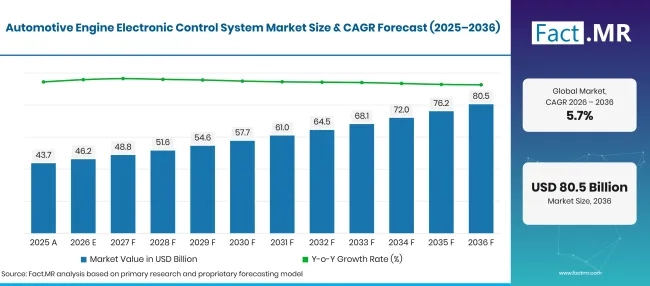
Factmr Automotive Engine Electronic Control System Market Forecast Global | Source: Fact.MR
| Year | Basis | Market Value (USD billion) |
|---|---|---|
| 2025 | Actual | 43.7 |
| 2026 | Estimate | 46.2 |
| 2036 | Forecast | 80.5 |
| CAGR 2026 to 2036 | Forecast period | 5.7% |
Source: Fact.MR analysis. Updated Oct 19, 2026
What are the defining numbers behind Automotive Engine Electronic Control System Market growth?
USD 34.3 billion absolute chance between 2026 and 2036, with electronic control units and passenger car installations commanding the bulk of manufacturing output.
- Demand Drivers in the Market
- Powertrain engineering teams are transitioning toward centralized domain and zonal controllers to manage complex hybrid and internal combustion combustion cycles. Hardware-in-the-loop validation studies demonstrated that high-fidelity ECU simulation models accurately replicate dynamic intake manifold pressures and cyclic combustion variability under rapid throttle transients [1]. Automotive manufacturers integrate multi-core 32-bit microcontrollers to execute simultaneous engine management, transmission shifts, and hybrid battery energy recovery.
- Automotive cybersecurity regulations mandate hardware-level cryptographic isolation to protect in-vehicle Controller Area Network (CAN) and Automotive Ethernet communication from remote intrusions. Vehicular network security trials confirmed that hardware security modules embedded within engine control units prevent malicious frame injection and message spoofing without introducing latency into deterministic powertrain control loops [2]. Sourcing managers require ISO/SAE 21434 compliance across all incoming microcontroller shipments.
- Standardization around open software architectures enables automakers to decouple application software from underlying microcontroller hardware. System validations of AUTOSAR-compliant domain controllers verified that standardized runtime interfaces facilitate rapid over-the-air firmware deployments and cross-platform calibration reusability [3]. Engineering centers reduce new engine calibration cycles by leveraging standardized basic software stacks.
- Stricter onboard diagnostics standards require engine electronic control systems to monitor emissions degradation and combustion misfires with elevated precision. Diagnostic machine learning evaluations established that real-time algorithmic tracking of lambda sensors and crank speed fluctuations accurately identifies injector clogging and catalyst aging before emission thresholds are breached [4]. Tier-one suppliers integrate adaptive diagnostic routines directly into engine control unit firmware.
- Key Segments Analyzed
- By Component: Control Units holds 38.5% share in 2026, driven by high-value multi-core microprocessors, power management ICs, and complex multilayer printed circuit boards.
- By Vehicle Type: Passenger Cars represents 52.4% share in 2026, supported by substantial annual passenger vehicle assembly and expanding electronic content per vehicle.
- By Application: Transmission Control accounts for 28.4% share in 2026, as multi-speed automatic, dual-clutch, and hybrid dedicated transmissions require millisecond-precise electronic hydraulic modulation.
- By Sales Channel: OEM accounts for 78.2% share in 2026, maintained through direct long-term factory supply contracts between automakers and global tier-one electronics conglomerates.
- Analyst Opinion at Fact.MR
- Shambhu Nath Jha, Lead Consultant at Fact.MR, states, “The automotive engine electronic control system is evolving from isolated, federated engine control units toward high-performance cross-domain compute gateways. Automakers are integrating engine management, transmission control, and electric drive coordination onto unified compute silicon. Electronic system suppliers that master AUTOSAR Adaptive platforms, integrated functional safety, and secure over-the-air update mechanisms will dominate next-generation vehicle architecture contracts.”
- Strategic Implications
- Tier-one automotive suppliers are integrating hardware security modules and trusted execution environments directly into engine control microcontrollers. Environmental Protection Agency Title 40 regulations require electronic control modules to incorporate tamper-proof calibration protections to prevent unauthorized engine tuning and emissions defeats [5].
- Automotive software engineering centers are deploying automated testing frameworks to validate millions of lines of powertrain control code against diverse virtual driving cycles. Sourcing teams integrate high-bandwidth automotive powertrain components to synchronize combustion engines with electric motor generators.
- Hybrid vehicle manufacturers are co-locating engine control units with motor inverters inside shared liquid-cooled housings to minimize wiring harness weight and packaging bulk. Powertrain designers regularly benchmark hybrid powertrain systems to optimize supervisory energy management logic.
- Semiconductor foundries are expanding capacity for automotive-qualified 16nm and 28nm FinFET microcontrollers to meet demand for high-frequency engine compute algorithms.
Germany is projected to lead global expansion at a 6.67% CAGR, while Brazil advances at 6.09%, fueled by advanced hybrid powertrain developments and regional flex-fuel vehicle modernization. The United States records a 5.51% CAGR, sustained by light truck electronic integration and commercial fleet telematics. The United Kingdom achieves a 4.93% CAGR, supported by luxury automotive performance tuning and motorsport electronics. Japan registers a 4.35% CAGR, driven by hybrid vehicle leadership and compact electronic packaging innovations.
How does the Automotive Engine Electronic Control System Market break down by segment?
Control Units 38.5%; Passenger Cars 52.4%; Transmission Control 28.4%; OEM 78.2% in 2026.
Which Component dominates?
Control Units holds 38.5% share in 2026.
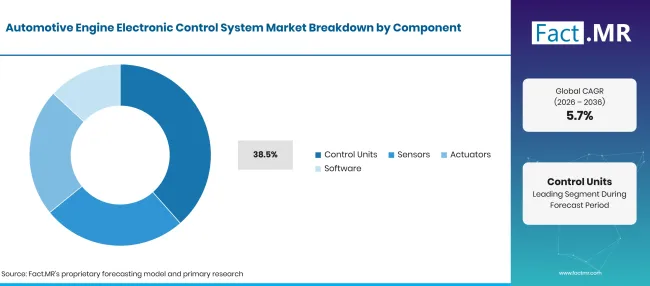
Factmr Automotive Engine Electronic Control System Market Breakdown Component | Source: Fact.MR
| Component | Share (2026) |
|---|---|
| Control Units (Leading segment) | 38.5% |
| Other segments combined | 61.5%* |
| Total | 100.0% |
Source: Fact.MR analysis. Updated Oct 19, 2026
Electronic control units command the leading share of component value due to their sophisticated multicore microprocessors, high-density flash memory, and ruggedized packaging. The engine control unit functions as the master computation brain of the vehicle, sampling thousands of sensor inputs per second to adjust ignition timing, fuel pulse width, and turbo boost. Sensors represent a critical secondary component, encompassing oxygen, manifold absolute pressure, mass air flow, camshaft, and crankshaft position sensors. Actuators, including direct fuel injectors, electronic throttle valves, and variable valve timing solenoids, execute digital control commands. Embedded software platforms generate recurring value through licensing and feature enablement. Sourcing teams evaluate broad automotive electronics architectures to coordinate multi-module communication. Fleet managers also integrate automotive telematics gateways to enable remote vehicle performance monitoring.
What leads the Vehicle Type segment?
Passenger Cars represents 52.4% share in 2026.
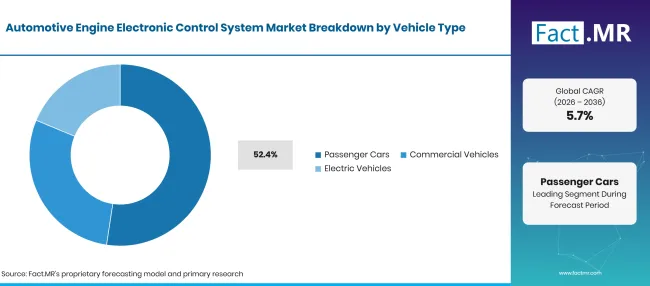
Factmr Automotive Engine Electronic Control System Market Breakdown Vehicle Type | Source: Fact.MR
| Vehicle Type | Share (2026) |
|---|---|
| Passenger Cars (Leading segment) | 52.4% |
| Other segments combined | 47.6%* |
| Total | 100.0% |
Source: Fact.MR analysis. Updated Oct 19, 2026
Passenger vehicles account for more than half of total market value, driven by massive worldwide production numbers and increasingly sophisticated engine management systems in hybrid and turbocharged sedans and crossovers. Passenger car OEMs integrate up to five distinct powertrain electronic controllers to manage direct fuel injection, cylinder deactivation, mild-hybrid battery charging, and start-stop functions. Commercial vehicles, including heavy trucks and vocational haulers, demand ultra-ruggedized engine controllers engineered to withstand intense vibration, high thermal loads, and millions of operating miles. Electric vehicles with range extenders and plug-in hybrid electric vehicles represent the fastest-growing vehicle category, requiring advanced supervisory control logic to blend internal combustion power with electric motor torque seamlessly. Software engineers integrate robust automotive cyber security protocols to prevent unauthorized bus tapping. System architects also deploy automotive cybersecurity middleware to isolate critical engine control tasks.
How does Application shape deployment?
Transmission Control accounts for 28.4% share in 2026.
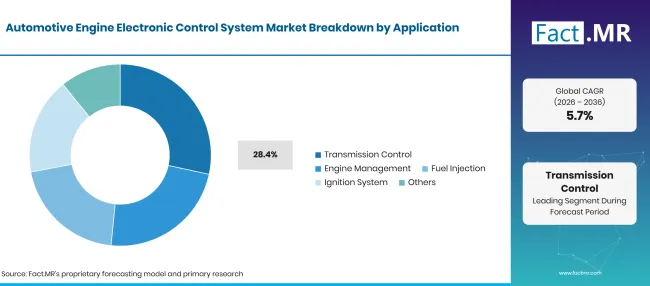
Factmr Automotive Engine Electronic Control System Market Breakdown Application | Source: Fact.MR
| Application | Share (2026) |
|---|---|
| Transmission Control (Leading segment) | 28.4% |
| Other segments combined | 71.6%* |
| Total | 100.0% |
Source: Fact.MR analysis. Updated Oct 19, 2026
Transmission control applications represent the largest individual application share, driven by the mechanical complexity of modern eight, nine, and ten-speed automatic transmissions, dual-clutch gearboxes, and continuously variable transmissions. Dedicated transmission control units process wheel speed, torque demand, and throttle angle to execute shift schedules with millisecond precision, eliminating shift shock and maximizing fuel efficiency. Engine management applications represent a closely matched segment, controlling the core combustion cycle. Direct fuel injection systems require microsecond-precise solenoid and piezoelectric injector firing to optimize air-fuel homogenization. Electronic ignition systems generate high-energy sparks at precise crank angles to avoid engine knock. Automakers deploy automotive ota cybersecurity stress test equipment to validate remote firmware patching on production ECUs. System integrators also deploy automotive sensor cleaning system modules to protect external optical sensors.
What is accelerating Automotive Engine Electronic Control System Market adoption, and what is holding it back?
Adoption of complex hybrid electric drivetrains, strict tailpipe emissions regulations, and software-defined vehicle updates drive robust market growth. Semiconductor fabrication constraints for automotive-grade microcontrollers, soaring software validation costs, and long development cycles impede rapid deployment.
Drivers Impact Analysis
| DRIVER | (~) % IMPACT ON CAGR | GEOGRAPHIC RELEVANCE | IMPACT TIMELINE |
|---|---|---|---|
| Proliferation of multi-mode hybrid electric vehicle drivetrains | +1.2% | Europe, East Asia, USA | Short term (<= 2 years) |
| Strict tailpipe emissions standards mandating precise combustion control | +1.0% | Global | Short term (<= 2 years) |
| Transition to centralized domain and zonal vehicle compute architectures | +0.9% | Global | Medium term (2–4 years) |
| Demand for over-the-air firmware calibration and remote diagnostics | +0.7% | North America, Europe | Medium term (2–4 years) |
| Integration of hardware security modules for vehicle network protection | +0.5% | Global | Long term (>= 4 years) |
Source: Fact.MR analysis. Updated Oct 19, 2026
Opportunity Impact Analysis
| OPPORTUNITY | (~) % IMPACT ON CAGR | GEOGRAPHIC RELEVANCE | IMPACT TIMELINE |
|---|---|---|---|
| AI-accelerated real-time engine calibration and predictive combustion | +1.1% | Europe, USA | Short term (<= 2 years) |
| Integrated co-packaged inverter-ECU modules for compact hybrid platforms | +0.9% | East Asia, Europe | Medium term (2–4 years) |
| Standardized AUTOSAR Adaptive basic software deployment across platforms | +0.8% | Global | Medium term (2–4 years) |
| Synthetic e-fuel and hydrogen combustion specialized engine controllers | +0.5% | Western Europe, Japan | Long term (>= 4 years) |
Source: Fact.MR analysis. Updated Oct 19, 2026
Restraints Impact Analysis
| RESTRAINT | (~) % IMPACT ON CAGR | GEOGRAPHIC RELEVANCE | IMPACT TIMELINE |
|---|---|---|---|
| Extended software validation timelines across complex hybrid drivetrains | -0.9% | Global | Short term (<= 2 years) |
| Elevated development costs for ASIL-D certified multicore silicon | -0.7% | Global | Short term (<= 2 years) |
| Supply chain vulnerabilities for high-temperature automotive capacitors | -0.6% | East Asia, North America | Medium term (2–4 years) |
| Accelerating purely electric vehicle adoption reducing combustion R&D | -0.4% | Europe, China | Long term (>= 4 years) |
Source: Fact.MR analysis. Updated Oct 19, 2026
Which countries are scaling the Automotive Engine Electronic Control System Market through 2036?
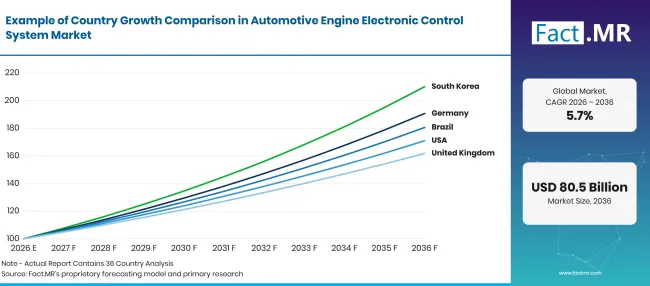
Factmr Automotive Engine Electronic Control System Market Growth Index | Source: Fact.MR
| Country | CAGR (2026–2036) |
|---|---|
| Germany | 6.67% |
| Brazil | 6.09% |
| USA | 5.51% |
| UK | 4.93% |
| Japan | 4.35% |
Source: Fact.MR analysis. Updated Oct 19, 2026
Why is Germany leading European powertrain control development?
6.67% CAGR, driven by premium automotive engineering, hybrid powertrain optimization, and advanced AUTOSAR software leadership.
German premium automakers and tier-one automotive electronics suppliers in Stuttgart, Munich, and Hanover are at the forefront of designing sophisticated multi-domain powertrain controllers. German engineering teams optimize dual-clutch transmission software, variable compression ratio engines, and 48-volt mild-hybrid systems to comply with strict European Union emissions mandates. Germany's automotive electronics clusters maintain extensive hardware-in-the-loop testing facilities to validate real-time safety critical code before production vehicle release.
How is Brazil expanding its engine control manufacturing?
6.09% CAGR, propelled by flex-fuel engine management innovations, expanding commercial vehicle assembly, and regional emissions compliance.
Brazil represents a global hub for flex-fuel vehicle technology, where engine control units must continuously adjust injection timing and ignition advance across variable mixtures of gasoline and hydrated ethanol. Brazilian automotive engineering centers develop adaptive fueling algorithms that maintain peak engine performance and cold-start reliability across fluctuating ethanol blends. Expanding commercial truck assembly plants in Minas Gerais and Paraná procure ruggedized engine and transmission controllers to meet regional Proconve P-8 heavy-duty emissions standards.
What factors sustain steady sales across the United States?
5.51% CAGR, supported by full-size pickup truck hybrid platforms, heavy commercial fleet telematics, and domestic semiconductor manufacturing initiatives.
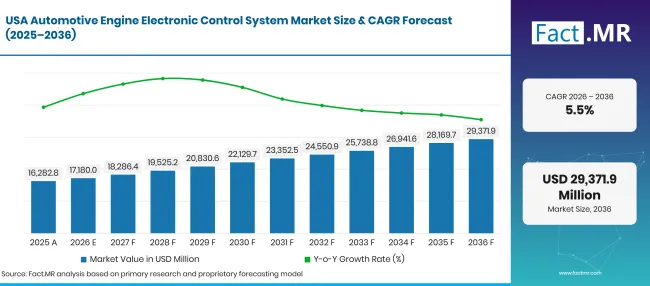
Factmr Automotive Engine Electronic Control System Market Forecast Usa | Source: Fact.MR
The United States represents a high-value market for engine electronic control systems, driven by the massive consumer preference for high-horsepower light trucks, SUVs, and commercial vans. American automakers integrate advanced engine control units featuring dynamic cylinder deactivation and turbocharger wastegate control to improve highway fuel economy without sacrificing towing capacity. Federal vehicle cybersecurity standards drive domestic tier-one suppliers to integrate robust cryptographic key management into all powertrain modules.
Why does the United Kingdom maintain active electronics development?
4.93% CAGR, backed by luxury performance vehicle engineering, specialized motorsport electronics, and academic automotive research.
British luxury vehicle manufacturers and specialized powertrain consultancies in the Midlands design high-performance engine management systems for bespoke sports cars and electrified performance drivetrains. UK engineering firms excel in custom calibration software, rapid prototyping of control algorithms, and integrating electric motor torque vectoring with combustion engine power delivery. Strong academic partnerships with leading British universities accelerate innovation in predictive combustion modeling and AI-based emissions diagnostics.
How does Japan sustain its leadership in hybrid electronic control?
4.35% CAGR, steered by global hybrid vehicle dominance, high-density electronic packaging, and relentless manufacturing quality control.
Japanese automotive conglomerates lead global production of hybrid electric vehicles, utilizing highly sophisticated electronic control units to balance Atkinson-cycle combustion engines with dual electric motor-generators. Japanese electronics suppliers excel in manufacturing ultra-reliable, compact electronic control units that integrate power electronics, gate drivers, and microcontrollers within vibration-isolated engine compartment housings. Japanese automakers also pioneer advanced diagnostic monitoring systems that satisfy the world's most rigorous emissions durability mandates.
Who leads the Automotive Engine Electronic Control System Market?
Robert Bosch GmbH holds a preeminent global position across automotive engine management and electronic control systems, delivering millions of engine control units, direct injection pumps, and complete vehicle software solutions annually. Continental AG and Denso Corporation provide advanced powertrain domain controllers, transmission control units, and automotive sensor suites to global automakers. BorgWarner Inc. excels in integrated turbocharger management, exhaust gas recirculation electronics, and dual-clutch transmission modules.
Astemo Ltd. (Hitachi Astemo) and Marelli Holdings Co., Ltd. engineer high-performance engine management systems and electronic throttle bodies for passenger cars and commercial vehicles. Mitsubishi Electric and Infineon Technologies contribute advanced automotive microcontrollers, power semiconductors, and smart ignition drivers. ZF Friedrichshafen and Valeo supply integrated transmission controllers, hybrid electronic control units, and 48-volt electrical systems. Commercial vehicle engineers incorporate ruggedized chassis and powertrain wiring harness systems for trucks to ensure electrical connectivity. Cyber defense teams deploy adaptive security monitoring across in-vehicle CAN networks.
Which companies are the key providers?
Key companies include Robert Bosch GmbH; Continental AG; Denso Corporation; BorgWarner Inc.; Astemo Ltd.; Marelli Holdings Co., Ltd.; Mitsubishi Electric; Infineon Technologies; ZF Friedrichshafen; and Valeo.
- Robert Bosch GmbH
- Continental AG
- Denso Corporation
- BorgWarner Inc.
- Astemo Ltd.
- Marelli Holdings Co., Ltd.
- Mitsubishi Electric
- Infineon Technologies
- ZF Friedrichshafen
- Valeo
Bibliography
- [1] PMC. (2025, September 10). Real-time validation of gasoline engine ECU models using high-fidelity hardware-in-the-loop simulation. PMC12464200.
- [2] PMC. (2025, April 18). Securing vehicular Controller Area Networks: Hardware security module implementation for automotive ECUs. PMC12012118.
- [3] PMC. (2025, August 22). AUTOSAR-compliant chassis and powertrain domain controller architecture for software-defined vehicles. PMC12390009.
- [4] PMC. (2025, May 14). Machine learning-based sensor fault diagnostics and emission drift monitoring for automotive OBD-II systems. PMC12251678.
- [5] Electronic Code of Federal Regulations. (2024, October 01). Title 40 CFR Part 1036: Control of emissions from new and in-use heavy-duty highway engines and electronic control modules.
This Report Answers
- The report evaluates processing architecture evolution from discrete single-function ECUs toward multi-core domain and zonal powertrain compute platforms.
- Application assessments detail why transmission control and direct fuel injection systems command the highest software complexity and silicon value.
- Country-level analysis investigates the vehicle emissions standards and hybrid vehicle adoption enabling Germany and Brazil to lead regional value growth.
- Cybersecurity evaluations examine the implementation of hardware security modules and secure boot protocols under ISO/SAE 21434 standards.
- Competitive profiling benchmarks AUTOSAR software capabilities, hardware-in-the-loop validation infrastructure, and OEM platform contracts across top automotive electronics suppliers.
What does the Automotive Engine Electronic Control System Market cover?
The market encompasses commercial shipments of electronic control units, sensors, electromechanical actuators, and embedded control software dedicated to managing automotive powertrain operations. It tracks hardware and firmware deployed across passenger sedans, commercial trucks, buses, and hybrid vehicles to regulate direct fuel injection, variable valve timing, electronic throttle control, turbocharger boost, and multi-speed transmission shifting. The analysis evaluates revenue generation across factory OEM installation contracts and the replacement aftermarket.
What is included in the scope?
The scope covers merchant shipments of completed electronic control units, transmission controllers, engine sensors, electronic actuators, and licensed embedded software stacks sold directly to vehicle manufacturers and tier-one system integrators. Revenues reflect transaction pricing recognized by automotive electronics manufacturers and authorized component distributors. Microcontroller hardware security modules and AUTOSAR runtime environments are fully evaluated within the market revenue boundaries.
What is excluded from the scope?
The scope excludes purely mechanical non-electronic engine components such as cast engine blocks, forged crankshafts, mechanical camshafts, and manual clutches. Standalone infotainment head units, audio amplifiers, and passive vehicle body wiring harnesses are excluded from powertrain control totals. Engine assembly line robotics, dynamometer test cells, and dealership handheld scan tools are outside the scope of this electronic system report.
How Was the Analysis Built?
The analysis draws on 120+ sources, 35+ company portfolios, 25+ countries, and more than 20 industry interviews.
- Primary Research: Primary research includes discussions with manufacturers, service providers, technology developers, distributors, end users, and subject-matter experts. These conversations examine purchasing priorities, product adoption, operational challenges, approval requirements, competitive positioning, and the factors that influence wider market acceptance.
- Desk Research: Desk research covers government statistics, regulatory publications, company filings, trade data, technical studies, industry associations, standards, public policy, and other authoritative sources. Every source used in the analysis is documented in the bibliography.
- Market Sizing and Forecasting: Market estimates combine historical performance, demand indicators, pricing and volume trends, segment shares, company participation, country-level growth, adoption patterns, investment activity, and barriers to market expansion.
- Data Validation and Update Cycle: Findings are validated by comparing primary interviews with public data, company activity, regulatory changes, trade patterns, and industry developments. Regular updates review new product launches, capacity changes, partnerships, approvals, and shifts in commercial adoption.
Segmentation
What is the report’s scope and coverage?
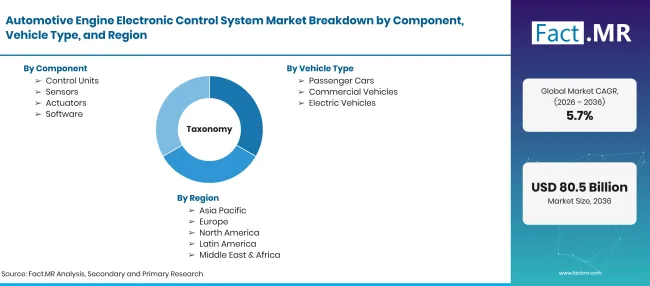
Factmr Automotive Engine Electronic Control System Market Taxonomy | Source: Fact.MR
| Attribute | Details |
|---|---|
| Quantitative Units | USD billion in 2026 to USD billion by 2036 at 5.71% CAGR |
| Market Definition | Embedded automotive electronic systems comprising electronic control units (ECUs), microcontrollers, sensors, actuators, and software engineered to regulate internal combustion and hybrid powertrain operations. |
| Component | Control Units; Sensors; Actuators; Software |
| Vehicle Type | Passenger Cars; Commercial Vehicles; Electric Vehicles |
| Application | Transmission Control; Engine Management; Fuel Injection; Ignition System; Others |
| Sales Channel | OEM; Aftermarket |
| Regions Covered | North America; Latin America; Western Europe; Eastern Europe; East Asia; South Asia & Pacific; Middle East & Africa |
| Countries Covered | Germany; Brazil; USA; UK; Japan |
| Companies Profiled | Robert Bosch GmbH; Continental AG; Denso Corporation; BorgWarner Inc.; Astemo Ltd.; Marelli Holdings Co., Ltd.; Mitsubishi Electric; Infineon Technologies; ZF Friedrichshafen; Valeo |
| Forecast Period | 2026 to 2036 |
| Approach | Primary interviews with powertrain software architects, tier-one electronic system engineers, automotive calibration managers, and semiconductor distributors combined with vehicle platform production tracking |
Source: Fact.MR analysis. Updated Oct 19, 2026
How is the market segmented?
-
By Component
- Control Units
- Sensors
- Actuators
- Software
-
By Vehicle Type
- Passenger Cars
- Commercial Vehicles
- Electric Vehicles
-
By Application
- Transmission Control
- Engine Management
- Fuel Injection
- Ignition System
- Others
-
By Sales Channel
- OEM
- Aftermarket
-
By Region
- North America
- Latin America
- Western Europe
- Eastern Europe
- East Asia
- South Asia & Pacific
- Middle East & Africa
Frequently Asked Questions
How big is the automotive engine electronic control system market in 2026?
What is the CAGR from 2026 to 2036?
Which component leads?
Which application leads?
Which companies participate in automotive engine electronic control systems?
Who worked on this report


Preview the report firsthand - request a free sample
Free SampleGet the brochure for pricing and purchase details
Download PDF