- Market Value (2025): USD 30.1 Bn
- Estimated Value (2026): USD 31.8 Bn
- Forecast Value (2036): USD 55.4 Bn
- CAGR (2026-2036): 5.7%
What is the Automotive Electronic Stability Control Systems Market forecast to be worth by 2036?
USD 31.8 billion in 2026 to USD 55.4 billion by 2036 at 5.7% CAGR.
- The automotive electronic stability control systems market was valued at USD 30.1 billion in 2025.
- Demand is projected to increase from USD 31.8 billion in 2026 to USD 55.4 billion by 2036.
- The market is forecast to record 5.7% CAGR from 2026 to 2036 as regulated fitment and electronic chassis integration sustain platform demand.
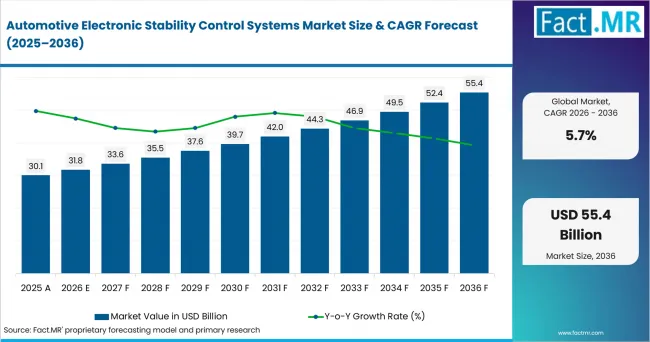
Automotive Electronic Stability Control Systems Market Value Analysis | Source: Fact.MR
What are the defining numbers behind Automotive Electronic Stability Control Systems Market growth?
USD 23.6 billion absolute opportunity by 2036, led by electronic stability control and vehicle stability management.
- Demand Drivers in the Market
- Vehicle manufacturers need stability systems that pass regulated performance checks across passenger cars and commercial platforms.
- Electric-vehicle programs need coordinated braking control as regenerative braking changes with speed and battery condition.
- Sport utility and commercial vehicles need yaw and roll control calibrated for higher body weight and changing payloads.
- Key Segments Analyzed
- By Stability Control System: Electronic Stability Control is expected to hold 58% share in 2026 because it provides the direct correction layer for yaw deviation.
- By Vehicle Function: Vehicle Stability Management is projected to account for 41% share in 2026 owing to its use in yaw control and rollover prevention.
- By Vehicle Category: Passenger Cars are anticipated to capture 65% share in 2026 as high production volumes support calibration and validation.
- By End User: Automotive Original Equipment Manufacturers are estimated to represent 72% share in 2026 since they control architecture approval and homologation.
- By Control Technology: Electronic Hydraulic Control Unit is forecast to account for 45% share in 2026 due to rapid wheel-level pressure response.
- Analyst Opinion at Fact.MR
- Shambhu Nath Jha, Principal Consultant at Fact.MR, states, “Electronic stability control is now judged by vehicle-level behavior and not skid correction alone. Original equipment manufacturers want repeatable sensing, brake pressure control and launch support across vehicle variants.”
- Strategic Implications
- Stability-control companies strengthen buyer confidence by presenting sensing, actuation and software evidence as one qualified safety chain.
- Vehicle manufacturers gain clearer approval paths by finalizing yaw and traction targets before chassis and braking decisions.
- Electric-vehicle manufacturers reduce calibration risk by validating regenerative braking against friction braking across battery conditions and road-grip levels.
China leads at 6.5% CAGR through new-energy vehicle scale and local electronic brake production. The USA follows at 6.2% through stability standards. Germany reaches 5.9% through premium chassis engineering. Japan posts 5.6% as hybrid platforms need clean brake blending. India records 5.3% with utility-vehicle growth. South Korea reaches 5.0% as chassis software deepens. Brazil closes the range at 4.7% through mandatory fitment.
How does the Automotive Electronic Stability Control Systems Market break down by segment?
Electronic Stability Control leads Stability Control System at 58% share in 2026. Vehicle Stability Management leads Vehicle Function at 41%.
Which Stability Control System dominates?
Electronic Stability Control holds 58% share in 2026.
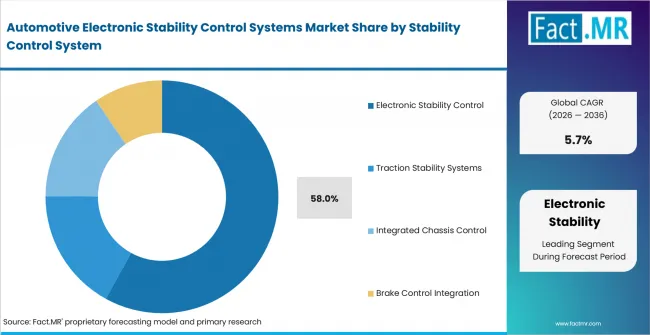
Automotive Electronic Stability Control Systems Market Analysis By Stability Control System | Source: Fact.MR
Electronic Stability Control leads because yaw correction is the basic control layer used to keep a vehicle close to the driver’s intended path. Roll Stability Control extends the response toward body movement and rollover risk. Brake Control Integration brings the function closer to brake-by-wire design and electronic brake distribution.
What leads the Vehicle Function segment?
Vehicle Stability Management leads with 41% share in 2026.
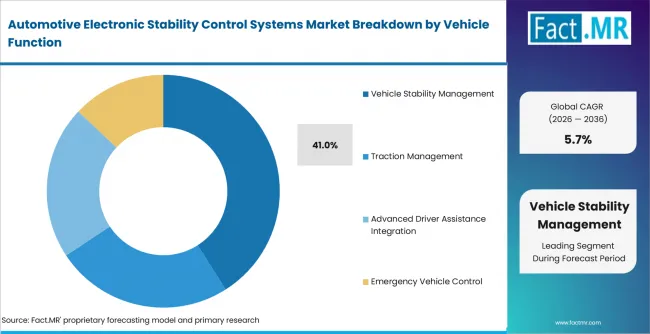
Automotive Electronic Stability Control Systems Market Analysis By Vehicle Function | Source: Fact.MR
Vehicle Stability Management has the leading position since it deals with loss-of-control events during ordinary and difficult driving. Traction Management supports low-grip starts and corner exits. Emergency Vehicle Control adds automated steering support when sudden maneuvers demand fast brake response.
Why do Passenger Cars lead Vehicle Category demand?
Passenger Cars hold 65% share in 2026.
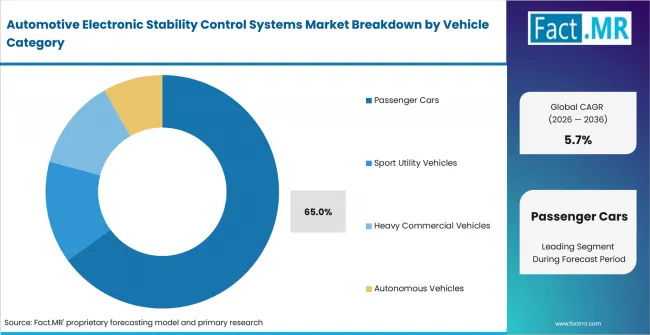
Automotive Electronic Stability Control Systems Market Analysis By Vehicle Category | Source: Fact.MR
Passenger Cars lead because hatchbacks and sedans provide the production scale needed for hardware recovery and control calibration. Battery Electric Vehicles need closer brake blending with propulsion torque. That need places stability control beside electric vehicle architecture choices.
Which End User accounts for the largest share?
Automotive Original Equipment Manufacturers account for 72% share in 2026.
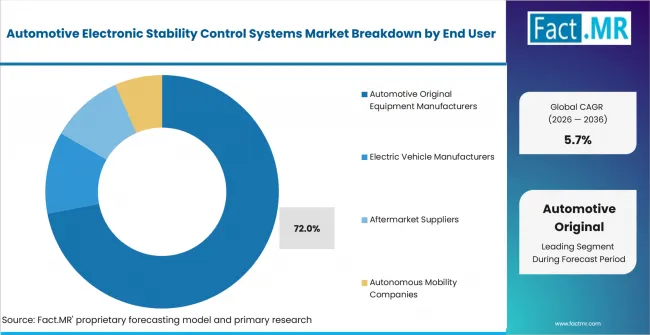
Automotive Electronic Stability Control Systems Market Analysis By End User | Source: Fact.MR
Automotive Original Equipment Manufacturers lead because vehicle makers approve the chassis architecture and carry warranty responsibility. Tier 1 Automotive Suppliers integrate control units and embedded code. Final release still depends on whole-vehicle testing and type approval evidence.
Which Control Technology leads?
Electronic Hydraulic Control Unit holds 45% share in 2026.
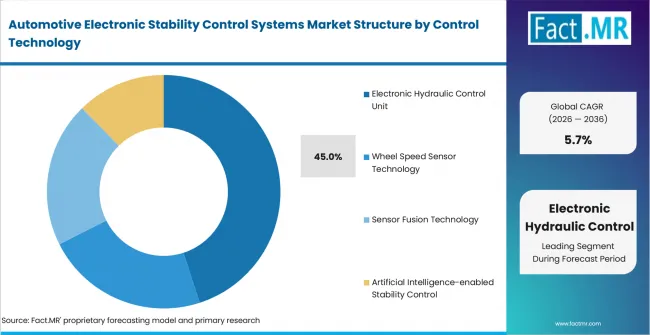
Automotive Electronic Stability Control Systems Market Analysis By Control Technology | Source: Fact.MR
Electronic Hydraulic Control Unit leads because it turns a stability decision into wheel-level pressure changes. Yaw Rate Sensor Technology and the Electronic Brake Control Module build the motion estimate. Automotive brake actuator design affects how fast the system can respond.
What is accelerating Automotive Electronic Stability Control Systems Market adoption, and what is holding it back?
Demand is expected to rise through regulated fitment and integrated vehicle-motion control. Growth is expected to be limited by validation burden and service coding needs.
Drivers Impact Analysis
| DRIVER | COMMERCIAL EFFECT | GEOGRAPHIC RELEVANCE | IMPACT TIMELINE |
|---|---|---|---|
| Mandatory electronic stability control fitment | Creates a durable baseline for qualified hardware and software | Global with USA and Europe emphasis | Current forecast period |
| Electric-vehicle brake blending | Raises calibration value across regenerative and friction braking | China, Germany, Japan and South Korea | Current forecast period |
| Sport utility and commercial-vehicle roll control | Supports demand for load-sensitive yaw and roll response | USA, China, India and Brazil | Medium term |
| ADAS and emergency-maneuver integration | Requires rapid pressure response and stable motion feedback | USA, Europe, China and Japan | Short to medium term |
| Software-defined chassis architectures | Moves value toward diagnostics and update governance | China, USA, Germany and South Korea | Medium term |
Source: Fact.MR analysis. Updated Aug 6, 2026
- Electrified and assisted control: Electric platforms change brake response when energy recovery is active.
- Software-defined chassis programs: Central control is expected to raise the value of diagnostics and update checks.
Opportunity Impact Analysis
| OPPORTUNITY | COMMERCIAL EFFECT | GEOGRAPHIC RELEVANCE | IMPACT TIMELINE |
|---|---|---|---|
| Scalable ESC module families | Allows reuse across sedan and electric derivatives | China, India and Brazil | Medium term |
| Integrated chassis control | Combines braking and steering around common motion targets | Germany, China, USA and Japan | Medium term |
| Brake-by-wire integration | Improves pressure response and packaging freedom | China, USA, Germany, Japan and South Korea | Short to medium term |
| Localized calibration and validation | Shortens problem resolution near vehicle plants | India, China, Brazil and South Korea | Current to medium term |
Source: Fact.MR analysis. Updated Aug 6, 2026
- Scalable control families: Passenger-car scale creates room for common electronic hydraulic hardware.
- Localized brake-control production: ADVICS signed a joint venture agreement with Brakes India in June 2024 for the brake business in India. The company said the venture plans to manufacture ESC and other brake control products. Local output is expected to shorten launch support for Indian vehicle programs.
Restraints Impact Analysis
| RESTRAINT | COMMERCIAL EFFECT | GEOGRAPHIC RELEVANCE | IMPACT TIMELINE |
|---|---|---|---|
| Vehicle-level validation and liability | Extends test work before supplier changes | All vehicle manufacturing markets | Current forecast period |
| Sensor calibration and supply continuity | Creates dependence on validated wheel-speed and yaw inputs | Global automotive supply chains | Medium term |
| Cybersecurity and software change control | Adds documentation and update-governance cost | Connected and software-defined vehicles | Short to medium term |
| Aftermarket coding and compatibility limits | Restricts interchangeable replacement modules | Mature vehicle parc markets | Medium term |
| Cost pressure on entry vehicles | Limits advanced integration beyond the required baseline | India, Brazil and price-sensitive markets | Medium term |
Source: Fact.MR analysis. Updated Aug 6, 2026
- Validation and fault management: A stability-control change affects yaw response and braking distance.
- Cost and packaging pressure: Entry vehicles are expected to retain the required stability-control baseline first.
Which countries are scaling Automotive Electronic Stability Control Systems Market fastest?
- The country comparison spans 1.8 percentage points and forms three practical growth bands across the forecast period.
- China records the strongest listed pace at 6.5% CAGR through local electronic brake production.
- The USA follows China by 0.3 percentage point as safety rules keep platform qualification active.
- Germany tracks 0.3 percentage point below the USA through premium chassis engineering and type approval discipline.
- Japan remains above India by 0.3 percentage point as hybrid programs need steady brake blending.
- India grows faster than South Korea by 0.3 percentage point with utility-vehicle fitment and localization.
- Brazil closes the displayed range at 4.7% CAGR through mandatory fitment and compact-vehicle demand.
Comparable CAGRs create different entry conditions due to platform scale and local service depth. Full report coverage includes North America; Europe; Asia Pacific; Central & South America; and the Middle East & Africa.
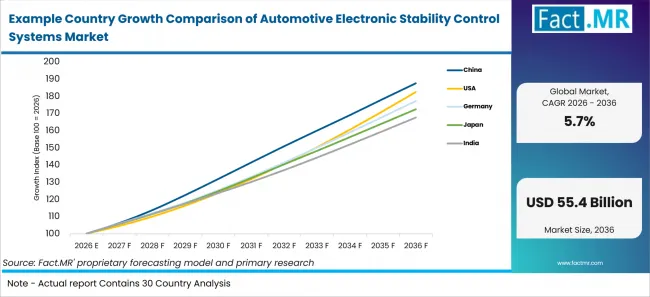
Example Country Growth Comparison Of Automotive Electronic Stability Control Systems Market | Source: Fact.MR
| Country | CAGR (2026-2036) |
|---|---|
| USA | 6.2% |
| Germany | 5.9% |
| Japan | 5.6% |
| India | 5.3% |
| South Korea | 5.0% |
| Brazil | 4.7% |
Source: Fact.MR analysis. Updated Aug 6, 2026
What is driving China’s growth through 2036?
6.5% CAGR, driven by new-energy vehicle scale and local electronic brake production.
China’s vehicle programs move quickly from model refresh to platform release. Local manufacturers are expected to favor compact stability systems that fit sedans and electric derivatives. Calibration support close to vehicle plants is expected to decide which companies gain repeat orders.
How is the USA advancing demand?
6.2% CAGR, supported by stability standards and broad platform diversity.
The USA market starts from a rule-based buying environment. Light vehicles and heavier platforms need documented stability behavior before approval. Companies serving this market are expected to win by proving service readiness and long-cycle support.
What supports Germany’s position?
5.9% CAGR, backed by premium chassis engineering and brake-by-wire activity.
German programs place stability control inside a wider chassis plan. Automakers are expected to evaluate braking response, software checks and functional-safety evidence together. This gives established brake and motion-control companies a clear route into premium platforms.
How does Japan perform?
5.6% CAGR, led by brake-control expertise and hybrid platform calibration.
Japan’s demand is shaped by careful release work and compact system design. Hybrid and electric programs need clean movement between energy recovery and friction braking. Local brake-control companies are expected to compete through quiet operation and service reliability.
What supports India’s growth?
5.3% CAGR, supported by utility-vehicle demand and local brake-system investment.
India’s market is expected to scale as more utility vehicles and electric models add stability functions. Cost remains a practical filter for each platform. Local testing and service support are expected to matter during launch and warranty review.
How is South Korea developing demand?
5.0% CAGR, shaped by electronics depth and chassis-by-wire development.
South Korean vehicle makers are expected to combine stability control with centralized chassis software. Domestic electronics strength helps braking and sensing work in the same control path. Export programs keep validation requirements high for local companies.
What keeps Brazil in the forecast range?
4.7% CAGR, supported by mandatory fitment and compact-vehicle demand.
Brazil remains a fitment-driven market with firm cost pressure. Companies are expected to focus on durable modules and local calibration support. Commercial-vehicle duty cycles add a separate need for stable roll and yaw behavior.
Who leads the Automotive Electronic Stability Control Systems Market?
Robert Bosch and Continental hold leading positions through integrated braking hardware, sensors and stability software. ZF Friedrichshafen adds brake-by-wire and chassis-control capability.
ADVICS strengthens electronic brake systems and localized production support. Astemo contributes motion-control and vehicle-integration expertise. Hyundai Mobis broadens competition through chassis electronics and by-wire development, while Knorr-Bremse extends the supplier base with braking and stability solutions for commercial vehicle platforms and demanding duty cycles worldwide across major markets.
Which companies are the key providers?
Key companies include Robert Bosch GmbH; Continental AG; ZF Friedrichshafen AG; ADVICS Co., Ltd.; Astemo, Ltd.; Hyundai Mobis Co., Ltd.; Knorr-Bremse AG.
- Robert Bosch GmbH
- Continental AG
- ZF Friedrichshafen AG
- ADVICS Co., Ltd.
- Astemo, Ltd.
- Hyundai Mobis Co., Ltd.
- Knorr-Bremse AG
How is the market segmented?
-
By Stability Control System
- Electronic Stability Control
- Yaw Stability Control
- Roll Stability Control
- Traction Stability Systems
- Integrated Chassis Control
- Brake Control Integration
-
By Vehicle Function
- Vehicle Stability Management
- Traction Management
- Advanced Driver Assistance Integration
- Emergency Vehicle Control
- Rollover Prevention
- Autonomous Vehicle Stability
-
By Vehicle Category
- Passenger Cars
- Sport Utility Vehicles
- Battery Electric Vehicles
- Light Commercial Vehicles
- Trucks and Buses
- Autonomous Vehicles
-
By End User
- Automotive Original Equipment Manufacturers
- Tier 1 Automotive Suppliers
- Electric Vehicle Manufacturers
- Commercial Vehicle Manufacturers
- Brake System Integrators
- Aftermarket Suppliers
- Autonomous Mobility Companies
-
By Control Technology
- Electronic Hydraulic Control Unit
- Yaw Rate Sensor Technology
- Wheel Speed Sensor Technology
- Electronic Brake Control Module
- Brake Pressure Modulation
- Integrated Vehicle Dynamics Control
- Artificial Intelligence-enabled Stability Control
- Predictive Motion Control
-
By Region
- North America
- Latin America
- Europe
- East Asia
- South Asia and Oceania
- Middle East and Africa
Bibliography
- ADVICS CO., LTD. (2024, June 5). Establishment of a Joint Venture in India.
- Brembo N.V. (2026, May 4). The New Standard Begins: SENSIFY™ by Brembo Enters Production.
- Hyundai Mobis Co., Ltd. (2025, December 9). Hyundai Mobis to Unveil 30+ New Technologies at CES 2026, Aiming to Strengthen Global OEM Partnerships.
- National Highway Traffic Safety Administration. (2025, December 11). NHTSA Releases Multi-Year Research Project on Modernizing Safety Standards for Automated Vehicles.
This Report Answers
- The report provides strategic intelligence on the Automotive Electronic Stability Control Systems Market across Stability Control System and Control Technology choices.
- Segment analysis covers Electronic Stability Control and Vehicle Stability Management as the share leaders within the 2026 market.
- Country outlook evaluates China and the USA alongside Germany and Japan. India, South Korea and Brazil complete the growth comparison.
- Competitive analysis profiles Robert Bosch GmbH and Continental AG alongside ZF Friedrichshafen AG.
- Scope assessment explains what belongs inside electronic stability control demand and what remains outside the market boundary.
What does the Automotive Electronic Stability Control Systems Market cover?
Electronic stability control systems maintain intended vehicle motion when yaw, traction or roll behavior moves outside safe limits.
The Automotive Electronic Stability Control Systems Market covers control units and sensors. Electronic hydraulic modules and embedded software are included when they support stability intervention. Coverage extends to passenger cars and sport utility vehicles. Commercial platforms are included when stability functions guide vehicle motion.
What is included in the scope?
The scope includes electronic stability control and yaw control. Roll, traction and integrated chassis-control functions are included when they use the same safety chain.
Coverage spans Vehicle Stability Management, Traction Management and Advanced Driver Assistance Integration. Emergency Vehicle Control and Rollover Prevention are included when they use stability-control hardware or software. Original equipment programs and relevant Tier 1 integration work are part of the scope.
What is excluded from the scope?
Standalone brake pads and tires remain outside the market scope. Mechanical suspension parts and unrelated driver-assistance software are excluded.
General braking hardware is excluded unless it is used for electronic stability intervention. Generic fleet telematics and infotainment electronics are excluded. Company revenue without a clear stability-control connection remains outside the calculation.
How Was the Analysis Built?
The analysis draws on 120+ sources and 35+ company portfolios. It covers 25+ countries and more than 20 industry interviews.
- Primary Research: Primary research includes discussions with manufacturers and service providers. Technology developers, distributors and end users are included. The interviews examine purchasing priorities, product adoption and approval requirements.
- Desk Research: Desk research covers government statistics and regulatory publications. Company filings, technical studies and industry associations are reviewed. Every retained source is documented in the bibliography.
- Market Sizing and Forecasting: Market estimates combine historical performance and demand indicators. Segment shares, company participation and country-level growth are reviewed. Barriers to market expansion are then applied.
- Data Validation and Update Cycle: Findings are validated by comparing primary interviews with public data. Company activity and regulatory changes are reviewed. Updates cover product launches, partnerships and commercial adoption shifts.
Segmentation
What is the report’s scope and coverage?
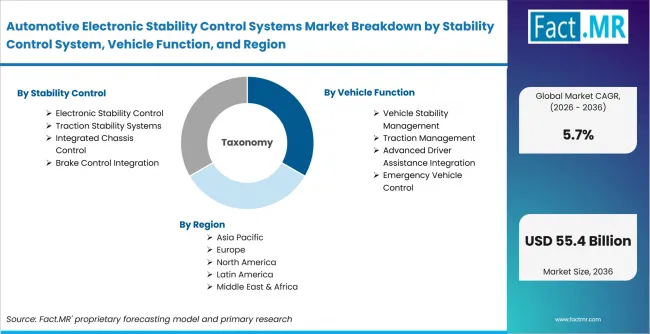
Automotive Electronic Stability Control Systems Market Breakdown By Stability Control System, Vehicle Function, And Region | Source: Fact.MR
| Attribute | Details |
|---|---|
| Quantitative Units | USD billion |
| Market Definition | Electronic control systems that correct vehicle yaw, roll and traction instability through brake-pressure control, powertrain response and embedded software. |
| Stability Control System | Electronic Stability Control; Yaw Stability Control; Roll Stability Control; Traction Stability Systems; Integrated Chassis Control; Brake Control Integration |
| Vehicle Function | Vehicle Stability Management; Traction Management; Advanced Driver Assistance Integration; Emergency Vehicle Control; Rollover Prevention; Autonomous Vehicle Stability |
| Vehicle Category | Passenger Cars; Sport Utility Vehicles; Battery Electric Vehicles; Light Commercial Vehicles; Trucks and Buses; Autonomous Vehicles |
| End User | Automotive Original Equipment Manufacturers; Tier 1 Automotive Suppliers; Electric Vehicle Manufacturers; Commercial Vehicle Manufacturers; Brake System Integrators; Aftermarket Suppliers; Autonomous Mobility Companies |
| Control Technology | Electronic Hydraulic Control Unit; Yaw Rate Sensor Technology; Wheel Speed Sensor Technology; Electronic Brake Control Module; Brake Pressure Modulation; Integrated Vehicle Dynamics Control; Artificial Intelligence-enabled Stability Control; Predictive Motion Control |
| Regions Covered | North America; Europe; Asia Pacific; Central & South America; Middle East & Africa |
| Countries Covered | China; USA; Germany; Japan; India; South Korea; Brazil |
| Key Companies Profiled | Robert Bosch GmbH; Continental AG; ZF Friedrichshafen AG; ADVICS Co., Ltd.; Astemo, Ltd.; Hyundai Mobis Co., Ltd.; Knorr-Bremse AG |
| Forecast Period | 2026 to 2036 |
| Approach | Hybrid top-down and bottom-up approach using regulated fitment, vehicle production, brake-control content, electronic hydraulic modules, sensor use, electric-vehicle programs, assisted-driving integration, country growth rates and company portfolio review. |
Source: Fact.MR analysis. Updated Aug 6, 2026
Frequently Asked Questions
How big is the automotive electronic stability control systems market in 2026?
What is the CAGR of the automotive electronic stability control systems market from 2026 to 2036?
Which stability control system leads the automotive electronic stability control systems market?
Which end-user segment leads the automotive electronic stability control systems market?
Who are the leading companies in the automotive electronic stability control systems market?
Who worked on this report


Preview the report firsthand - request a free sample
Free SampleGet the brochure for pricing and purchase details
Download PDF