- Market Value (2025): USD 34.3 Bn
- Estimated Value (2026): USD 38.1 Bn
- Forecast Value (2036): USD 107.0 Bn
- CAGR (2026-2036): 10.9%
What is the automotive PreCash System Market forecast to be worth by 2036?
USD 38.1 billion in 2026 to USD 107.0 billion by 2036 at a 10.9% CAGR.
- As per Fact.MR analysis, the Automotive PreCrash System Market was valued at USD 34.3 billion in 2025.
- Demand will grow from USD 38.1 billion in 2026 to USD 107.0 billion by 2036.
- The forecast to record a 10.9% CAGR from 2026 to 2036, driven by growing demand for advanced vehicle safety technologies and improved occupant protection.
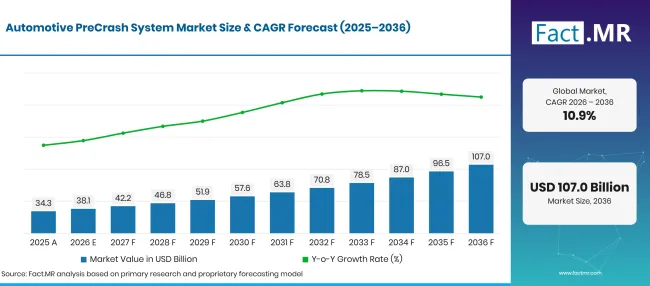
Factmr Automotive Precrash System Market Forecast Global | Source: Fact.MR
| Year | Basis | Market Value (USD billion) |
|---|---|---|
| 2025 | Actual | 34.3 |
| 2026 | Estimate | 38.1 |
| 2036 | Forecast | 107.0 |
| CAGR 2026 to 2036 | Forecast period | 10.9% |
Source: Fact.MR analysis. Updated Oct 19, 2026
What are the defining numbers behind Automotive PreCrash System Market growth?
USD 68.9 billion absolute opportunity between 2026 and 2036
- Demand Drivers in the Market
- Automotive manufacturers are placing greater emphasis on collision prevention and occupant safety as advanced driver-assistance systems become more important in vehicle design. Pre-crash systems use sensors and other technologies to detect potential collisions and support timely warnings or vehicle interventions. NHTSA’s April 29, 2024, safety rule on automatic emergency braking highlights the role of collision-prevention technologies in improving road safety [1].
- Vehicle safety requirements and consumer expectations are encouraging the integration of advanced collision-detection technologies.
- Automakers and technology suppliers are developing autonomous emergency braking, pedestrian detection, and collision-avoidance technologies to help reduce collision risks. These systems rely on accurate environmental sensing, reliable software, and integration with vehicle control and restraint systems.
- Original equipment manufacturers (OEMs) remain central to market adoption because pre-crash technologies are increasingly integrated during vehicle design and production.
- Key Segments Analyzed
- By Component: Sensors will account for 32.4% share in 2026, reflecting their role in detecting nearby vehicles, obstacles, and potential collision hazards.
- By Vehicle Type: Passenger Cars will represent 72.3% share in 2026, supported by the integration of advanced safety features into personal vehicles.
- By Technology: Autonomous Emergency Braking will account for 41.2% share in 2026, reflecting demand for technologies designed to intervene when a collision risk is detected.
- By Sales Channel: OEMs will account for 88.4% share in 2026, as pre-crash technologies are commonly integrated into vehicles during manufacturing.
- Analyst Opinion at Fact.MR
- Shambhu Nath Jha, Principal Consultant at Fact.MR, states, “Automotive pre-crash systems are likely to attract greater interest as manufacturers prioritize collision prevention and occupant protection. Automakers still need reliable sensing performance, effective system integration, and rigorous validation under different driving conditions before adopting these technologies at scale.”
- Strategic Implications
- Manufacturers should prioritize sensor accuracy, system reliability, and compatibility with vehicle safety architectures to support wider adoption.
- Automotive suppliers need to strengthen collaboration with OEMs to integrate collision-detection and braking technologies during vehicle development.
- Technology developers must focus on improving the performance of autonomous emergency braking and pedestrian detection systems under diverse road, weather, and traffic conditions.
- Vehicle manufacturers should evaluate system costs alongside safety performance, regulatory requirements, and consumer demand when selecting pre-crash technologies.
Germany is set to record a 12.1% CAGR through 2036. Brazil is forecast to post 11.0%, followed by the USA at 10.0%. The UK is estimated to advance at 8.9%, while Japan is forecast at 7.9%. Differences in vehicle production, automotive safety requirements, and the adoption of advanced driver-assistance technologies create distinct pathways for market growth across these countries.
How does the Automotive PreCrash System Market break down by segment?
Fact.MR finds that Sensors leads Component at 32.4%; Passenger Cars leads Vehicle Type at 72.3%; Autonomous Emergency Braking leads Technology at 41.2%; OEM leads Sales Channel at 88.4%.
Which Vehicle Type dominates?
Passenger Cars hold 72.3% share in 2026.
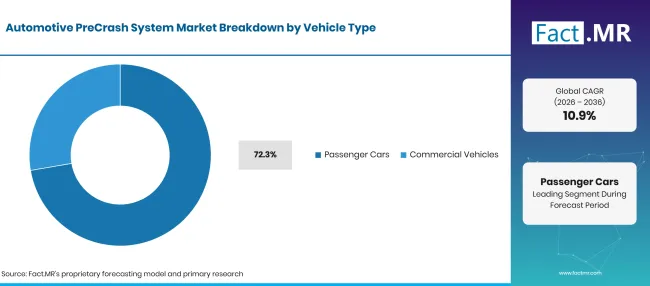
Factmr Automotive Precrash System Market Breakdown Vehicle Type | Source: Fact.MR
| Vehicle Type | Share (2026) |
|---|---|
| Passenger Cars (Leading segment) | 72.3% |
| Other segments combined | 27.7%* |
| Total | 100.0% |
Source: Fact.MR analysis. Updated Oct 19, 2026
Passenger cars account for the stated vehicle-type share as automakers increasingly integrate pre-crash safety technologies into passenger vehicles to support collision prevention and occupant protection.
What leads the Component segment?
Sensors represents 32.4% share in 2026.
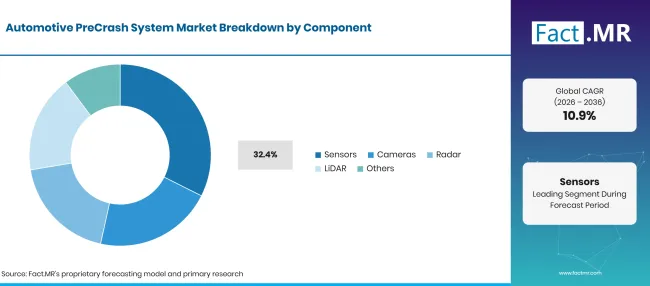
Factmr Automotive Precrash System Market Breakdown Component | Source: Fact.MR
| Component | Share (2026) |
|---|---|
| Sensors (Leading segment) | 32.4% |
| Other segments combined | 67.6%* |
| Total | 100.0% |
Source: Fact.MR analysis. Updated Oct 19, 2026
Sensors account for the stated component share because pre-crash systems depend on reliable detection of surrounding vehicles, pedestrians, obstacles, and changing road conditions. These components provide data that supports timely warnings and automated safety responses.
How does Technology shape demand?
Autonomous Emergency Braking accounts for 41.2% share in 2026.
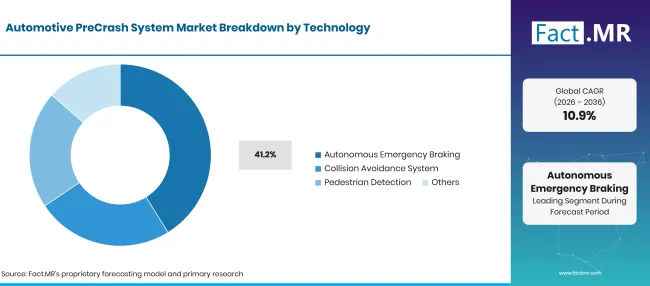
Factmr Automotive Precrash System Market Breakdown Technology | Source: Fact.MR
| Technology | Share (2026) |
|---|---|
| Autonomous Emergency Braking (Leading segment) | 41.2% |
| Other segments combined | 58.8%* |
| Total | 100.0% |
Source: Fact.MR analysis. Updated Oct 19, 2026
Autonomous Emergency Braking holds dominant share in the market as demand increases for technologies that automatically apply brakes when collision risks are detected. Autonomous Emergency Braking adoption is increasing as automakers prioritize collision prevention and pedestrian safety. Advances in radar, cameras, and object recognition enable faster hazard detection and braking responses. Regulatory requirements and growing integration of advanced driver-assistance systems further support market expansion.
How does the Sales Channel segment shape market demand?
OEM captures 88.4% share in 2026.
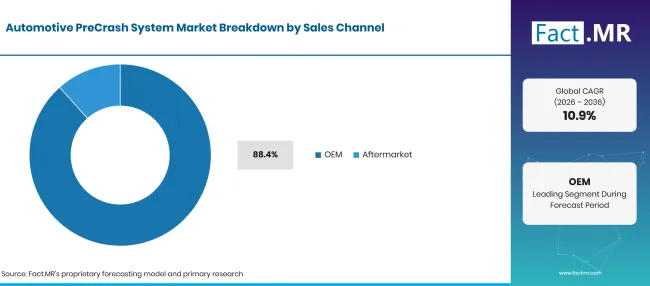
Factmr Automotive Precrash System Market Breakdown Sales Channel | Source: Fact.MR
| Sales Channel | Share (2026) |
|---|---|
| OEM (Leading segment) | 88.4% |
| Other segments combined | 11.6%* |
| Total | 100.0% |
Source: Fact.MR analysis. Updated Oct 19, 2026
OEMs account for the stated sales-channel share because pre-crash systems are commonly integrated into vehicles during manufacturing. Factory installation allows automakers to coordinate sensors, cameras, radar, braking controls, and vehicle software within a unified safety architecture. The aftermarket serves vehicle owners seeking to add or upgrade safety technologies after purchase, although installation can depend on vehicle compatibility, system complexity, and integration requirements.
What is accelerating Automotive PreCrash System Market adoption, and what is holding it back?
Rising demand for vehicle safety and advanced driver assistance systems boosts adoption, but high system integration costs and technical complexity slow market expansion.
Drivers Impact Analysis
| DRIVER | (~) % IMPACT ON CAGR | GEOGRAPHIC RELEVANCE | IMPACT TIMELINE |
|---|---|---|---|
| Rising integration of advanced driver assistance systems (ADAS) | +1.0% | Europe, Americas | Medium term (2–4 years) |
| Increasing vehicle safety regulations | +0.9% | Global | Short term (≤ 2 years) |
| Growing demand for autonomous emergency braking | +0.7% | Global | Medium term (2–4 years) |
| Advancements in sensor and camera technologies | +0.5% | Global | Short term (≤ 2 years) |
| OEM investment in integrated vehicle safety systems | +0.4% | Asia, Europe | Long term (≥ 4 years) |
Source: Fact.MR analysis. Updated Oct 19, 2026
Opportunity Impact Analysis
| OPPORTUNITY | (~) % IMPACT ON CAGR | GEOGRAPHIC RELEVANCE | IMPACT TIMELINE |
|---|---|---|---|
| Integration of AI-based collision prediction systems | +0.8% | Global | Medium term (2–4 years) |
| Expansion of pre-crash technologies in emerging markets | +0.6% | Asia, Americas | Medium term (2–4 years) |
| Development of advanced radar and LiDAR systems | +0.5% | Europe, Asia | Long term (≥ 4 years) |
| Retrofitting and aftermarket safety solutions | +0.4% | Global | Short term (≤ 2 years) |
Source: Fact.MR analysis. Updated Oct 19, 2026
Restraints Impact Analysis
| RESTRAINT | (~) % IMPACT ON CAGR | GEOGRAPHIC RELEVANCE | IMPACT TIMELINE |
|---|---|---|---|
| High system development and integration costs | -0.8% | Global | Short term (≤ 2 years) |
| Complex integration with existing vehicle architectures | -0.6% | Global | Medium term (2–4 years) |
| Sensor performance limitations in adverse weather conditions | -0.5% | Global | Short term (≤ 2 years) |
| Limited aftermarket compatibility and installation complexity | -0.4% | Global | Medium term (2–4 years) |
Source: Fact.MR analysis. Updated Oct 19, 2026
Which countries are scaling the Metal Chelates Market through 2036?
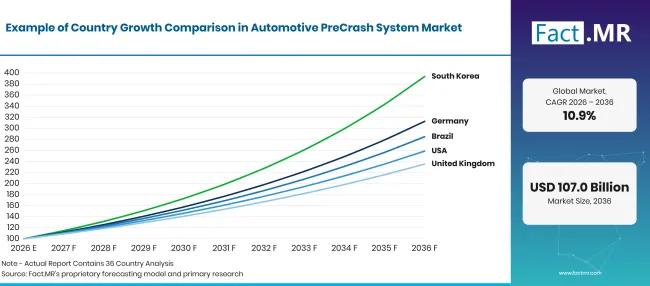
Factmr Automotive Precrash System Market Growth Index | Source: Fact.MR
| Country | CAGR (2026-2036) |
|---|---|
| Germany | 12.1% |
| Brazil | 11.0% |
| USA | 10.0% |
| UK | 8.9% |
| Japan | 7.9% |
Source: Fact.MR analysis. Updated Oct 19, 2026
What supports Germany adoption?
12.1% CAGR, led by stringent vehicle safety standards and advanced automotive manufacturing.
Demand for automotive pre-crash system in Germany benefits from its established vehicle manufacturing industry and focus on advanced driver-assistance technologies. The European Union’s General Safety Regulation introduced additional mandatory safety features for new vehicles, including advanced emergency braking and systems for detecting vulnerable road users in relevant vehicle categories. These requirements support OEM integration of sensors, cameras, radar, and autonomous emergency braking systems. [2]
How is Brazil developing adoption?
11.0% CAGR, backed by evolving vehicle safety requirements and wider integration of collision warning technologies.
Brazil’s market can benefit from regulatory efforts to improve vehicle safety and from growing interest in advanced driver-assistance features. The country’s CONTRAN Resolution No. 759 established requirements for rear alert or monitoring systems in specified vehicle categories, with implementation beginning for new vehicle projects in 2025 and extending to all vehicles in production from 2027. These measures can support demand for cameras, sensors, and other systems that help drivers detect nearby obstacles. [3]
What supports United States adoption?
10.0% CAGR, shaped by mandatory automatic emergency braking requirements and growing ADAS integration.
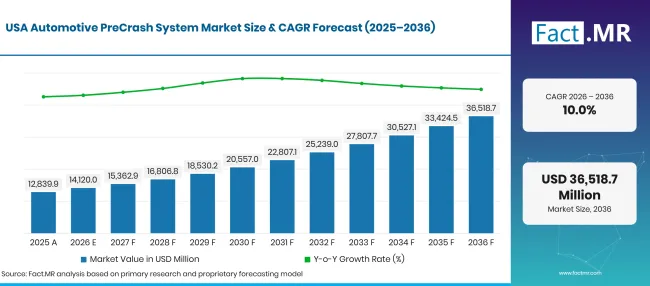
Factmr Automotive Precrash System Market Forecast Usa | Source: Fact.MR
The United States automotive pre-crash system market is projected to grow at a 10.0% CAGR through 2036. Growth is supported by mandatory automatic emergency braking requirements, stronger federal safety rules, and wider use of ADAS features in new vehicles. Automakers are adding more sensor-based safety functions to meet regulatory requirements and improve crash prevention across passenger and commercial vehicle models.
How is the United Kingdom building adoption?
8.9% CAGR, shaped by road safety initiatives and increasing integration of collision prevention technologies.
The UK market strengthen the vehicle safety standards and reduce road casualties. The government has consulted on introducing additional safety technologies into Great Britain’s vehicle type-approval framework, including emergency braking and other driver-assistance systems. These initiatives may support wider adoption of sensors, cameras, and autonomous emergency braking, particularly through OEM installations in passenger cars. [4]
What supports Japan adoption?
7.9% CAGR, supported by established automotive technology capabilities and emphasis on collision prevention.
Sales of automotive pre-crash system in Japan benefits from its advanced vehicle manufacturing industry and focus on preventing collisions involving vehicles and pedestrians. The Ministry of Land, Infrastructure, Transport and Tourism has introduced requirements for collision damage mitigation braking systems in new vehicles, with implementation phased across vehicle categories and production timelines. These measures support demand for radar, cameras, sensors, and autonomous emergency braking systems, particularly through factory-installed safety technologies. [5]
Who leads the Automotive PreCrash System Market?
Fact.MR profiles Robert Bosch GmbH, ZF Friedrichshafen AG, DENSO Corporation and Aptiv PLC in the Automotive PreCrash System Market.
The companies which are included in the market are participate in automotive safety and advanced driver-assistance systems (ADAS), including radar-based sensing, camera systems, object detection and collision-risk assessment. Their technologies support applications such as Autonomous Emergency Braking (AEB), forward collision warning, collision avoidance and pedestrian detection. ZF Friedrichshafen AG’s planned transfer of its passenger-car ADAS business to HARMAN is a relevant development, covering radar, smart cameras, computing solutions and ADAS software. Other developments in the wider sensing ecosystem include Zadar Labs’ acquisition of Fusionride in February 2026 and indie Semiconductor’s agreement to acquire an image-sensor product line from ams OSRAM in May 2026 [6] [7] [8].
Commercial competition depends on detection accuracy, sensor reliability, software integration and response time. Automakers prioritize validated, cost-effective systems, while ADAS developers require compatible hardware and software for real-time decision-making. Supplier comparisons should consider specific pre-crash capabilities, production scalability and technical support.
Which companies are the key providers?
Key companies in the Automotive PreCrash System Market include Robert Bosch GmbH, ZF Friedrichshafen AG, DENSO Corporation and Aptiv PLC.
- Robert Bosch GmbH
- ZF Friedrichshafen AG
- DENSO Corporation
- Aptiv PLC
Bibliography
- [1] National Highway Traffic Safety Administration. (2024, April 29). NHTSA finalizes key safety rule to reduce crashes and save lives.
- [2] European Commission. (2026, July 8). Safer cars, safer roads: New rules take effect.
- [3] Ministério dos Transportes. (2022, December 22). Resolução CONTRAN nº 759, de 20 de dezembro de 2018.
- [4] Department for Transport. (2026, July 16). Mandating vehicle safety technologies in GB type approval: Government response.
- [5] Ministry of Land, Infrastructure, Transport and Tourism. (2020, January 31). Introduction of international standards for collision damage mitigation braking systems and mandatory requirements for new vehicles.
- [6] ZF Friedrichshafen AG. (2025, December 23). ZF sells ADAS business to in-cabin electronics leader Harman.
- [7] Zadar Labs. (2026, February 25). Zadar Labs completes acquisition of Fusionride, introducing zSIGNAL 2.0.
- [8] Samsung Electronics. (2025, December 23). HARMAN to acquire ZF’s ADAS business.
This Report Answers
- The report describes how automotive pre-crash systems support collision detection, accident prevention and vehicle safety across the specified vehicle types.
- Segment analysis compares the specified component categories, vehicle types, technologies and sales channels, including their 2026 market shares where provided.
- Country analysis discusses Germany, Brazil, USA, UK and Japan alongside their respective market growth rates.
- The competitive overview profiles Robert Bosch GmbH, ZF Friedrichshafen AG, DENSO Corporation and Aptiv PLC.
- Technology analysis distinguishes Autonomous Emergency Braking, collision avoidance systems and pedestrian detection, while sales channel analysis separates OEM sales from the aftermarket.
What does the Automotive PreCrash System Market cover?
The market covers automotive pre-crash systems designed to detect potential collisions and support preventive vehicle safety. It tracks applications in passenger cars and commercial vehicles. Product coverage includes sensors, cameras, radar, LiDAR and other components, while technology coverage distinguishes Autonomous Emergency Braking, collision avoidance systems and pedestrian detection. Vehicle safety requirements and the adoption of advanced driver-assistance systems influence purchasing decisions.
What is included in the scope?
Included products and technologies are associated with automotive pre-crash detection and collision prevention. The market coverage includes systems incorporating the specified components and technologies, with sales channels divided between OEM and aftermarket. The segmentation also covers passenger cars and commercial vehicles, alongside the identified countries: Germany, Brazil, USA, UK and Japan.
What is excluded from the scope?
The analysis excludes automotive technologies unrelated to pre-crash detection or collision prevention. General vehicle components without a direct role in the defined pre-crash system category are outside the scope. Standalone automotive manufacturing equipment and unrelated vehicle accessories are also excluded. Revenue from unrelated automotive systems should not be included unless it falls within the defined pre-crash system market boundary.
How Was the Analysis Built?
The analysis draws on 120+ sources, 35+ company portfolios, 25+ countries, and more than 20 industry interviews.
- Primary Research: Primary research includes discussions with manufacturers, service providers, technology developers, distributors, end users, and subject-matter experts. These conversations examine purchasing priorities, product adoption, operational challenges, approval requirements, competitive positioning, and the factors that influence wider market acceptance.
- Desk Research: Desk research covers government statistics, regulatory publications, company filings, trade data, technical studies, industry associations, standards, public policy, and other authoritative sources. Every source used in the analysis is documented in the bibliography.
- Market Sizing and Forecasting: Market estimates combine historical performance, demand indicators, pricing and volume trends, segment shares, company participation, country-level growth, adoption patterns, investment activity, and barriers to market expansion.
- Data Validation and Update Cycle: Findings are validated by comparing primary interviews with public data, company activity, regulatory changes, trade patterns, and industry developments. Regular updates review new product launches, capacity changes, partnerships, approvals, and shifts in commercial adoption.
Segmentation
What is the report’s scope and coverage?
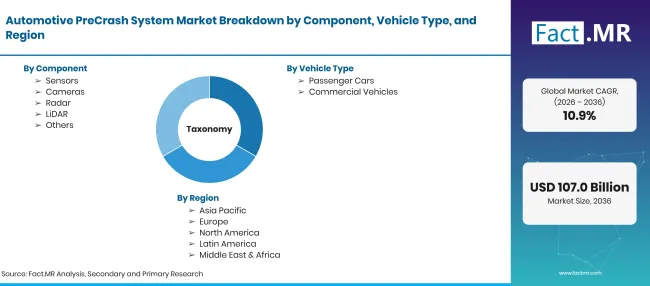
Factmr Automotive Precrash System Market Taxonomy | Source: Fact.MR
| Attribute | Details |
|---|---|
| Quantitative Units | USD billion: 2026 valuation, 2036 forecast and CAGR |
| Market Definition | Automotive pre-crash systems that use sensing, detection and safety technologies to identify potential collisions and support preventive vehicle safety measures. |
| Component | Sensors; Cameras; Radar; LiDAR; Others |
| Vehicle Type | Passenger Cars; Commercial Vehicles |
| Technology | Autonomous Emergency Braking; Collision Avoidance System; Pedestrian Detection; Others |
| Sales Channel | OEM; Aftermarket |
| Regions Covered | North America; Latin America; Western Europe; Eastern Europe; East Asia; South Asia & Pacific; Middle East & Africa |
| Countries Covered | Germany; Brazil; USA; UK; Japan |
| Companies Profiled | Robert Bosch GmbH; ZF Friedrichshafen AG; DENSO Corporation; Aptiv PLC |
| Forecast Period | 2026 to 2036 |
| Approach | Market segmentation and forecast analysis based on component, vehicle type, technology, sales channel and country-level growth rates. |
Source: Fact.MR analysis. Updated Oct 19, 2026
How is the market segmented?
-
By Component
- Sensors
- Cameras
- Radar
- LiDAR
- Others
-
By Vehicle Type
- Passenger Cars
- Commercial Vehicles
-
By Technology
- Autonomous Emergency Braking
- Collision Avoidance System
- Pedestrian Detection
- Others
-
By Sales Channel
- OEM
- Aftermarket
-
By Region
- North America
- Latin America
- Western Europe
- Eastern Europe
- East Asia
- South Asia & Pacific
- Middle East & Africa
Frequently Asked Questions
How big is the automotive PreCrash system market in 2026?
What is the CAGR from 2026 to 2036?
Which component has the largest stated share?
Which vehicle type leads?
Which companies are covered?
Who worked on this report


Preview the report firsthand - request a free sample
Free SampleGet the brochure for pricing and purchase details
Download PDF