- Market Value (2025): USD 11.3 Bn
- Estimated Value (2026): USD 12.1 Bn
- Forecast Value (2036): USD 23.6 Bn
- CAGR (2026-2036): 6.9%
What is the Automotive Exhaust Muffler Market forecast to be worth by 2036?
USD 12.1 billion in 2026 to USD 23.6 billion by 2036 at 6.9% CAGR.
- The automotive exhaust muffler market reached USD 11.3 billion in 2025 as OEM programs and replacement channels retained combustion-exhaust content.
- Demand is projected to increase from USD 12.1 billion in 2026 to USD 23.6 billion by 2036.
- The market is forecast to record 6.9% CAGR from 2026 to 2036 as passenger-car fitments and repair-channel replacements support muffler purchasing.
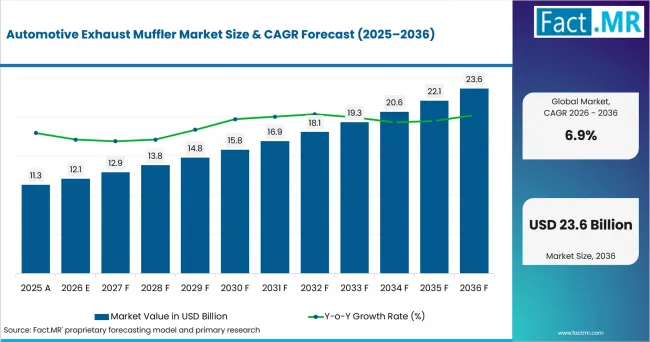
Automotive Exhaust Muffler Market Value Analysis | Source: Fact.MR
What are the defining numbers behind Automotive Exhaust Muffler Market growth?
USD 11.5 billion absolute opportunity by 2036, led by Automotive Exhaust Mufflers, OEM and 1.5 - 2.0 Inch Inlet applications.
- Demand Drivers in the Market
- OEM sourcing teams need fit-ready muffler assemblies because acoustic performance, backpressure control and underbody packaging are approved together.
- Repair workshops require reliable replacement coverage when corrosion, noise and bracket wear move a vehicle into service.
- Fleet operators are expected to value durable housings where commercial vehicles face longer duty cycles and repeated heat exposure.
- Engineering teams are anticipated to keep muffler selection tied to vehicle size, inlet routing and NVH targets.
- Key Segments Analyzed
- By Product: Automotive Exhaust Mufflers are expected to hold 56.90% share in 2026 owing to direct fitment across passenger and commercial exhaust layouts.
- By Sales Channel: OEM is projected to account for 78.20% share in 2026 as platform approval remains concentrated at assembly programs.
- By Size: 1.5 - 2.0 Inch Inlet is anticipated to capture 42.30% share in 2026 due to broad passenger-vehicle compatibility.
- By Vehicle Type: Passenger Cars are estimated to represent 32.60% share in 2026 since compact and mid-sized models create steady fitment volume.
- Analyst Opinion at Fact.MR
- Shambhu Nath Jha, Principal Consultant at Fact.MR, states, “Muffler suppliers face a narrow commercial balance between acoustic comfort, packaging limits and cost discipline. Production acceptance is expected to depend on fit accuracy and material durability across several vehicle platforms. Suppliers with catalog depth and verified OEM programs are better placed than firms selling only generic replacement boxes.”
- Strategic Implications
- OEM procurement teams should treat muffler sourcing as an NVH and durability decision, not only a metal-fabrication purchase.
- Aftermarket distributors should prioritize SKU coverage for aging passenger cars where exhaust noise and corrosion create replacement demand.
- Engineering suppliers should document inlet size, weld quality and mounting reliability before price negotiations narrow the supplier list.
- Investors should separate muffler exposure from broader exhaust aftertreatment content because electrification affects each component differently.
Germany is projected to record 7.6% CAGR through 2036 supported by domestic assembly scale and exhaust-system engineering depth. Brazil is expected to post 6.9% CAGR as local vehicle output and repair channels sustain replacement demand. The USA is forecast to advance at 6.2% CAGR due to high road use and large aftermarket coverage. The U.K. is anticipated to hold 5.6% CAGR as older cars keep workshops focused on exhaust service. Japan is estimated to reach 4.9% CAGR with hybrid continuity supporting selective muffler programs.
How does the Automotive Exhaust Muffler Market break down by segment?
Automotive Exhaust Mufflers lead Product at 56.90%; OEM leads Sales Channel at 78.20%.
Which product dominates?
Automotive Exhaust Mufflers are projected to account for 56.9% share in 2026.
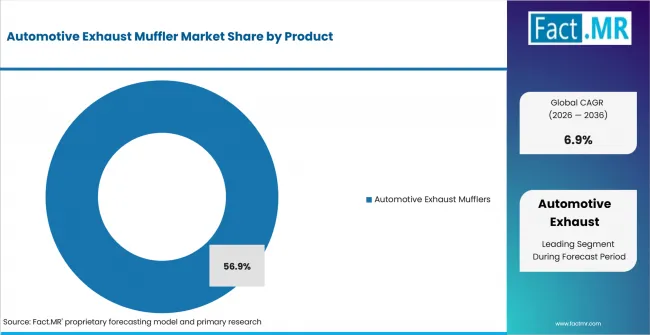
Automotive Exhaust Muffler Market Analysis By Product | Source: Fact.MR
Automotive Exhaust Mufflers are expected to lead Product due to direct installation in combustion and hybrid exhaust layouts. Center inlet mufflers and dual inlet mufflers serve conventional routing needs where platform space is predictable. Offset inlet and outlet designs are anticipated to retain value where underbody packaging requires angled flow paths. The segment connects most directly with vehicle exhaust systems because mufflers remain part of complete gas-flow and acoustic-control assemblies.
What leads the Sales Channel segment?
OEM is expected to hold 78.2% share in 2026.
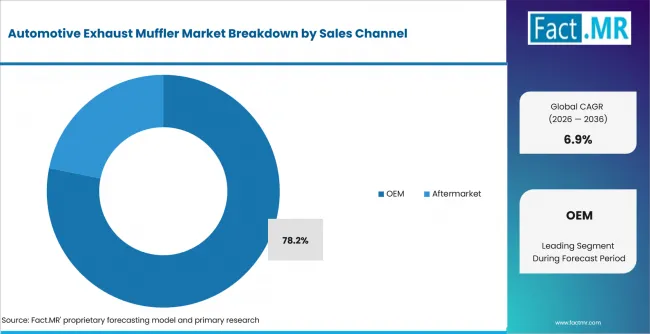
Automotive Exhaust Muffler Market Analysis By Sales Channel | Source: Fact.MR
OEM is projected to lead Sales Channel as mufflers are approved alongside vehicle platforms before production release. Passenger Vehicle OEMs retain stronger fitment volume because compact and mid-sized models account for broad production runs. Commercial Vehicle OEMs require thicker housings and more durable mountings for heavier duty cycles. The aftermarket is expected to remain relevant where aftermarket automotive parts demand depends on vehicle age and repair access.
How does Size shape demand?
1.5 - 2.0 Inch Inlet is anticipated to lead with 42.3% share in 2026.
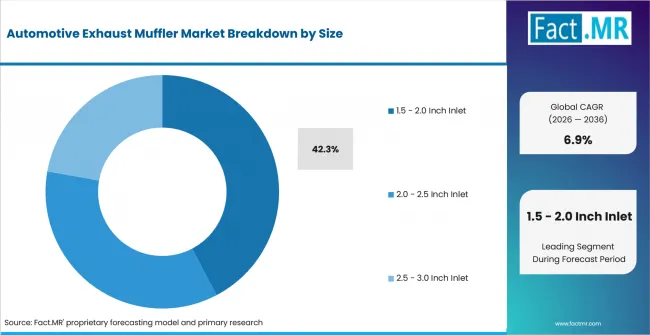
Automotive Exhaust Muffler Market Analysis By Size | Source: Fact.MR
1.5 - 2.0 Inch Inlet is anticipated to lead Size as passenger cars use smaller routing envelopes and lower exhaust-flow requirements. Standard passenger vehicle applications support the share because these mufflers fit common engine classes. Larger 2.0 - 2.5 Inch and 2.5 - 3.0 Inch inlets are expected to serve heavier vehicles and performance uses. Adjacent parts such as exhaust flexible couplings remain relevant where vibration and underbody movement affect exhaust durability.
What supports Passenger Cars within Vehicle Type?
Passenger Cars are estimated to represent 32.6% share in 2026.
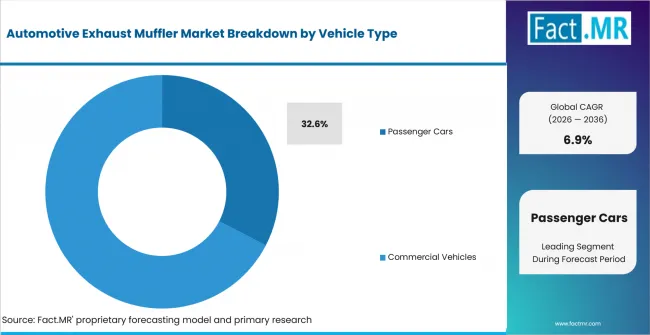
Automotive Exhaust Muffler Market Analysis By Vehicle Type | Source: Fact.MR
Passenger Cars are estimated to lead Vehicle Type due to high installed volume across compact and mid-sized models. Compact Passenger Cars provide frequent muffler replacement needs where price and fitment accuracy matter. Premium and luxury passenger cars require quieter acoustic tuning and better corrosion resistance. Commercial vehicles still support heavier formats, with heavy-duty automotive aftermarket coverage shaping replacement demand for larger fleets.
What is accelerating Automotive Exhaust Muffler Market adoption, and what is holding it back?
OEM fitment and replacement coverage drive it; electrification and cost pressure restrain it.
Drivers Impact Analysis
| DRIVER | (~) % IMPACT ON CAGR | GEOGRAPHIC RELEVANCE | IMPACT TIMELINE |
|---|---|---|---|
| OEM exhaust fitment volume | +2.1% | Germany, Brazil, Japan | Short term (<= 2 years) |
| Aftermarket replacement need | +1.8% | USA and U.K. | Short term (<= 2 years) |
| Passenger-car acoustic control | +1.4% | Global passenger-car hubs | Medium term (2-4 years) |
| Commercial durability demand | +1.0% | Brazil, USA, Germany | Medium term (2-4 years) |
| Size-specific platform coverage | +0.6% | OEM and aftermarket channels | Long term (>= 4 years) |
Source: Fact.MR analysis. Updated Aug 19, 2026
- OEM exhaust fitment volume: Germany remains a useful production signal for muffler suppliers. Large assembly programs are expected to keep OEM muffler approvals tied to vehicle launch timing and sourcing discipline. Suppliers with vehicle-level documentation are anticipated to retain an advantage in platform sourcing.
- Aftermarket replacement need: Road use keeps exhaust wear visible in service channels. The U.K. Department for Transport reported in May 2026 that 342.6 billion vehicle miles were driven on Great Britain’s roads in 2025. Higher mileage is expected to support inspections, replacements and noise-related repairs.
- Passenger-car acoustic control: Cabin comfort targets are expected to keep mufflers linked to NVH approval. Passenger-car suppliers therefore need designs that reduce noise without creating avoidable backpressure penalties.
- Commercial durability demand: Commercial-vehicle mufflers face repeated heat cycles and vibration. Fleet operators are anticipated to favor robust mountings and corrosion-resistant materials when uptime is more valuable than the lowest part price.
- Size-specific platform coverage: Inlet diameter and package fit are expected to decide whether a muffler can serve several trims. Wider fitment evidence gives suppliers a clearer path into OEM and repair-channel catalogs.
Opportunity Impact Analysis
| OPPORTUNITY | (~) % IMPACT ON CAGR | GEOGRAPHIC RELEVANCE | IMPACT TIMELINE |
|---|---|---|---|
| Catalog depth for aging cars | +1.3% | USA, U.K., Germany | Short term (<= 2 years) |
| Sustainable exhaust materials | +0.9% | Europe and Japan | Medium term (2-4 years) |
| Hybrid platform continuity | +0.8% | Japan and Germany | Medium term (2-4 years) |
| Commercial vehicle replacement | +0.6% | Brazil and USA | Long term (>= 4 years) |
Source: Fact.MR analysis. Updated Aug 19, 2026
- Catalog depth for aging cars: Repair channels need part availability for older cars where corrosion and noise failures appear late in ownership. Fitment evidence is expected to sustain distributor preference for muffler catalogs that match common passenger-car platforms.
- Sustainable exhaust materials: Purem by Eberspächer reported in November 2025 that its Wilsdruff plant had converted a production line for exhaust gas aftertreatment systems to sustainable stainless steel. The company said that, since the beginning of 2025, around 90% of the most common steel grade used on the production line had been converted to sustainable stainless steel. The move is expected to influence material conversations around mufflers and adjacent exhaust modules.
- Hybrid platform continuity: Hybrid vehicles continue to need exhaust silencers and mufflers because their combustion engines remain active. That powertrain mix is projected to support selective OEM demand even as full battery-electric models remove tailpipes.
- Commercial vehicle replacement: Heavy-duty mufflers are exposed to long running hours and harsh road conditions. Suppliers with durable assemblies are expected to benefit where fleets prioritize service life and downtime reduction.
Restraints Impact Analysis
| RESTRAINT | (~) % IMPACT ON CAGR | GEOGRAPHIC RELEVANCE | IMPACT TIMELINE |
|---|---|---|---|
| Battery-electric vehicle shift | -1.6% | Europe, USA, Japan | Long term (>= 4 years) |
| Material and fabrication cost | -1.1% | Global | Short term (<= 2 years) |
| Price pressure in replacement channel | -0.8% | Aftermarket-led countries | Medium term (2-4 years) |
| Platform-specific qualification | -0.6% | OEM channels | Medium term (2-4 years) |
Source: Fact.MR analysis. Updated Aug 19, 2026
- Battery-electric vehicle shift: The IEA reported in 2026 that electric car sales exceeded 20 million in 2025 and reached about one-quarter of global car sales. Full battery-electric platforms do not use exhaust mufflers, so electrification is expected to narrow long-term addressable fitment.
- Material and fabrication cost: Mufflers rely on steel, welding and formed housings. Cost changes are expected to squeeze margins when OEMs demand durable assemblies but resist price increases.
- Price pressure in replacement channel: Aftermarket customers often compare low-cost alternatives against branded products. That behavior is anticipated to limit premium pricing unless the part solves fitment, warranty or noise concerns clearly.
- Platform-specific qualification: OEM mufflers must match routing, mounting and acoustic targets. Qualification work can slow supplier switches because a cheaper part still needs vehicle-level approval before production use.
Which countries are scaling Automotive Exhaust Muffler Market fastest?
- The country comparison spans 2.7 percentage points and forms three practical growth bands across the forecast period.
- Germany remains 0.7 percentage point above Brazil through domestic production scale and exhaust-system engineering depth.
- Brazil remains 0.7 percentage point above the USA as local vehicle output and repair demand support muffler purchasing.
- The USA remains 0.6 percentage point above the U.K. through high vehicle use and deep aftermarket distribution.
- The U.K. remains 0.7 percentage point above Japan as older cars sustain repair-channel exhaust service.
- Japan closes the displayed range as hybrid continuity offsets a mature vehicle market and slower replacement growth.
Comparable CAGRs can create different supplier conditions due to vehicle production, installed vehicle age, workshop density and electrification pace. Full report coverage includes North America, Latin America, Europe, East Asia, South Asia and Pacific, Middle East and Africa.
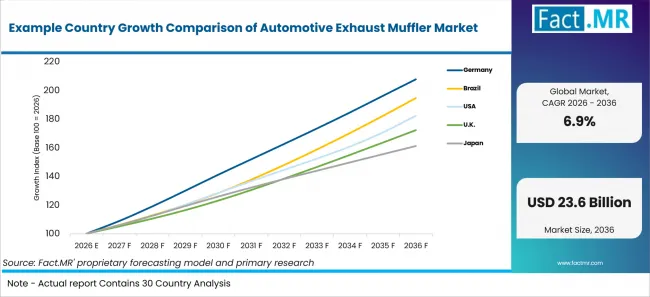
Example Country Growth Comparison Of Automotive Exhaust Muffler Market | Source: Fact.MR
| Country | CAGR (2026-2036) |
|---|---|
| Germany | 7.6% |
| Brazil | 6.9% |
| USA | 6.2% |
| U.K. | 5.6% |
| Japan | 4.9% |
Source: Fact.MR analysis. Updated Aug 19, 2026
What supports Germany adoption?
7.6% CAGR, supported by domestic production scale and exhaust-system engineering depth.
Germany is expected to remain the fastest listed country because domestic car production gives muffler suppliers a clear OEM base. VDA reported in February 2026 that electric vehicles reached 40% of German passenger-car production in 2025. That transition is anticipated to make muffler programs more selective and more dependent on combustion and hybrid platform timing.
How is Brazil scaling demand?
6.9% CAGR, backed by vehicle output and repair-channel replacement needs.
Brazil’s growth is tied to local assembly and a repair base that serves older vehicles in mixed road conditions. IBGE reported in July 2026 that production of motor vehicles, trailers and bodies rose 4.1% from April to May 2026 and was among the main positive influences on overall industrial production. Local output is expected to support OEM fitment and replacement-part sourcing.
How is the USA developing demand?
6.2% CAGR, shaped by road use and aftermarket coverage.
The USA has a wide workshop and parts-distribution base that supports muffler replacement after noise or corrosion failures. FHWA’s Traffic Volume Trends program, updated in 2026, uses about 5,000 continuous traffic-counting locations nationwide. That road-use visibility is expected to keep aftermarket suppliers focused on catalog accuracy and fast delivery.
What supports U.K. adoption?
5.6% CAGR, supported by vehicle age and repair-channel demand.
The U.K. outlook depends on service demand from older cars and a changing production mix. ONS reported in July 2026 that UK manufacturers' product sales value for motor vehicles with only a petrol engine above 1,500 cubic centimetres fell 23.1% in 2025. Workshop demand is expected to offset part of that OEM pressure through muffler replacement work.
How does Japan perform?
4.9% CAGR, led by mature vehicle production and hybrid powertrain continuity.
Japan’s muffler demand is supported by mature engineering capability and continued use of combustion engines in hybrid platforms. The IEA reported in May 2026 that electric cars accounted for less than 3% of Japan’s car sales in 2025. That slow transition is expected to preserve selective muffler demand in hybrid and combustion platforms.
Who leads the Automotive Exhaust Muffler Market?
Tenneco, Eberspächer and Futaba show the direct relevance, while Boysen and Yutaka Giken add OEM exhaust depth.
Tenneco is relevant through Walker replacement exhaust coverage and its Clean Air business. Eberspächer contributes exhaust acoustic and aftertreatment manufacturing through Purem. Futaba Industrial and Yutaka Giken bring Japanese OEM exhaust-system capability. Friedrich Boysen supports European exhaust systems, while Benteler, Sejong Industrial, Bosal Nederland and Eminox extend the competitive set across metal forming, commercial vehicles and exhaust components.
Which companies are the key providers?
Key companies include Tenneco Inc., Eberspächer Gruppe GmbH & Co. KG, Futaba Industrial Co. Ltd., Sango Co., Ltd., Friedrich Boysen GmbH & Co. KG, Motherson Yutaka Giken Co., Ltd., SJG Sejong Co., Ltd., Bosal Nederland B.V., and Katcon Global.
- Tenneco Inc.
- Eberspächer Gruppe GmbH & Co. KG
- Futaba Industrial Co. Ltd.
- Sango Co., Ltd.
- Friedrich Boysen GmbH & Co. KG
- Motherson Yutaka Giken Co., Ltd.
- SJG Sejong Co., Ltd.
- Bosal Nederland B.V.
- Katcon Global
Bibliography
- Brazilian Institute of Geography and Statistics. (2026, July 3). Industrial production changes -0.2% in May.
- Department for Transport. (2026, May 20). Road traffic estimates in Great Britain, 2025: Headline figures.
- Eberspächer Gruppe GmbH & Co. KG. (2025, November 4). Purem by Eberspaecher relies on sustainable stainless steel with lower carbon footprint.
- Federal Highway Administration. (2026, May). Traffic Volume Trends: May 2026.
- International Energy Agency. (2026, May 20). Trends in electric cars. In Global EV Outlook 2026.
- Office for National Statistics. (2026, July 24). UK manufacturers’ sales by product: 2025.
- Tenneco Inc. (2025, December 11). DRiV expands Walker CARB-compliant CalCat coverage across high-demand vehicles.
- German Association of the Automotive Industry. (2026, February 3). New record: 40% electric share of passenger car production in 2025.
This Report Addresses
- The report provides strategic intelligence on the Automotive Exhaust Muffler Market across Product and Sales Channel choices that shape OEM sourcing and replacement demand.
- Segment analysis covers automotive exhaust mufflers and OEM sales as the share leaders within the 2026 market.
- Country outlook evaluates Germany and Brazil alongside the USA, U.K. and Japan across the profiled markets.
- Competitive analysis profiles Tenneco, Eberspächer and Futaba alongside Boysen, Yutaka Giken, Sejong, Bosal and Eminox.
- Size assessment covers 1.5 - 2.0 Inch Inlet applications. Larger inlet classes complete the view across commercial and performance uses.
What does the Automotive Exhaust Muffler Market cover?
Automotive exhaust mufflers reduce combustion-engine noise while helping maintain acceptable exhaust flow. Coverage includes standard muffler assemblies and routing variants that operate within automotive exhaust silencers and broader exhaust architecture.
The Automotive Exhaust Muffler Market covers mufflers sold through OEM and aftermarket channels. Passenger cars, commercial vehicles and heavy-duty formats are included where the vehicle requires an exhaust acoustic component. The scope includes inlet-size classes from 1.5 - 2.0 Inch Inlet to 2.5 - 3.0 Inch Inlet where those sizes map to vehicle fitment needs.
What is included in the scope?
The scope includes mufflers, inlet and outlet routing variants, OEM sales and replacement-channel products. It covers passenger-car and commercial-vehicle applications. Adjacent systems such as exhaust manifolds and downpipes are referenced only when they clarify where mufflers fit inside the underbody exhaust path.
Coverage extends to exhaust service conditions where mufflers interact with mounting, vibration and aftertreatment packaging. Automotive catalytic converter devices are not counted as mufflers, although their replacement activity helps explain how exhaust catalogs are managed by distributors.
What is excluded from the scope?
The scope excludes exhaust sensors, catalytic converters, particulate filters, SCR dosing systems and full exhaust systems unless the claim directly relates to muffler fitment or replacement behavior.
Battery-electric vehicle thermal systems are excluded because they do not use combustion exhaust mufflers. Standalone noise-control materials, body acoustic insulation and non-automotive silencers also remain outside the scope. Company revenue without a direct link to mufflers or exhaust acoustic components is excluded from provider assessment.
How Was the Analysis Built?
The analysis draws on 120+ sources, 35+ company portfolios, 25+ countries, and more than 20 industry interviews.
- Primary Research: Primary research includes discussions with manufacturers, distributors, repair-channel operators, OEM sourcing teams and vehicle engineering specialists. These conversations examine fitment decisions, pricing pressure, catalog coverage and the factors that influence wider market acceptance.
- Desk Research: Desk research covers government statistics, company releases, vehicle production data, road-use indicators, national fleet statistics and official energy-transition sources. Every source used in the analysis is documented in the bibliography.
- Market Sizing and Forecasting: Market estimates combine historical performance, product shares, country-level growth, OEM fitment patterns, replacement demand, material selection and barriers to market expansion.
- Data Validation and Update Cycle: Findings are validated by comparing interview inputs with public data, company activity, replacement trends, production patterns and shifts in commercial adoption.
Segmentation
What is the report’s scope and coverage?
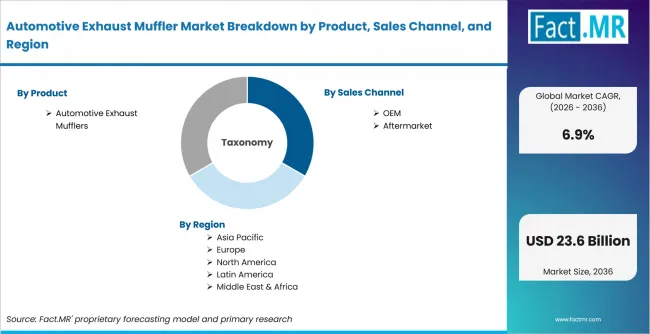
Automotive Exhaust Muffler Market Breakdown By Product, Sales Channel, And Region | Source: Fact.MR
| Attribute | Details |
|---|---|
| Quantitative Units | USD billion in 2026 to USD billion by 2036 at CAGR |
| Market Definition | Automotive exhaust mufflers are acoustic and flow-management components fitted within exhaust systems to reduce engine noise, manage backpressure and support vehicle-specific packaging requirements. |
| Product | Automotive Exhaust Mufflers; Center Inlet Mufflers; Dual Inlet Mufflers; Offset Inlet Mufflers; Center Outlet Mufflers; Dual Outlet Mufflers; Offset Outlet Mufflers |
| Sales Channel | OEM; Passenger Vehicle OEMs; Commercial Vehicle OEMs; Aftermarket; Replacement Market; Performance Upgrade Market |
| Size | 1.5 - 2.0 Inch Inlet; Standard Passenger Vehicle Applications; Light Duty Commercial Applications; 2.0 - 2.5 Inch Inlet; Mid-Segment Vehicle Applications; Light Commercial Vehicle Applications; 2.5 - 3.0 Inch Inlet; High Performance Vehicle Applications; Heavy Duty Vehicle Applications |
| Vehicle Type | Passenger Cars; Compact Passenger Cars; Mid-Sized Passenger Cars; Premium Passenger Cars; Luxury Passenger Cars; Commercial Vehicles; Light Commercial Vehicles; Heavy Commercial Vehicles |
| Regions Covered | North America; Latin America; Europe; East Asia; South Asia and Pacific; Middle East and Africa |
| Countries Covered | Germany; Brazil; USA; U.K.; Japan |
| Key Companies Profiled | Tenneco Inc.; Eberspächer Gruppe GmbH & Co. KG; Futaba Industrial Co. Ltd.; Sango Co., Ltd.; Friedrich Boysen GmbH & Co. KG; Motherson Yutaka Giken Co., Ltd.; SJG Sejong Co., Ltd.; Bosal Nederland B.V.; Katcon Global |
| Forecast Period | 2026 to 2036 |
| Approach | Hybrid top-down and bottom-up approach using vehicle production, parc age, road-use indicators, exhaust replacement channels, OEM sourcing, size mix, vehicle-type fitment, country growth patterns and verified company activity |
Source: Fact.MR analysis. Updated Aug 19, 2026
How is the market segmented?
-
By Product
- Automotive Exhaust Mufflers
- Center Inlet Mufflers
- Dual Inlet Mufflers
- Offset Inlet Mufflers
- Center Outlet Mufflers
- Dual Outlet Mufflers
- Offset Outlet Mufflers
- Automotive Exhaust Mufflers
-
By Sales Channel
- OEM
- Passenger Vehicle OEMs
- Commercial Vehicle OEMs
- Aftermarket
- Replacement Market
- Performance Upgrade Market
- OEM
-
By Size
- 1.5 - 2.0 Inch Inlet
- Standard Passenger Vehicle Applications
- Light Duty Commercial Applications
- 2.0 - 2.5 Inch Inlet
- Mid-Segment Vehicle Applications
- Light Commercial Vehicle Applications
- 2.5 - 3.0 Inch Inlet
- High Performance Vehicle Applications
- Heavy Duty Vehicle Applications
- 1.5 - 2.0 Inch Inlet
-
By Vehicle Type
- Passenger Cars
- Compact Passenger Cars
- Mid-Sized Passenger Cars
- Premium Passenger Cars
- Luxury Passenger Cars
- Commercial Vehicles
- Light Commercial Vehicles
- Heavy Commercial Vehicles
- Passenger Cars
-
By Region
- North America
- Latin America
- Europe
- East Asia
- South Asia and Oceania
- Middle East and Africa
Frequently Asked Questions
How big is the automotive exhaust muffler market in 2026?
What is the CAGR of the automotive exhaust muffler market from 2026 to 2036?
Which product leads the automotive exhaust muffler market?
Which sales channel leads the automotive exhaust muffler market?
Who are the leading companies in the automotive exhaust muffler market?
Who worked on this report


Preview the report firsthand - request a free sample
Free SampleGet the brochure for pricing and purchase details
Download PDF