- Market Value (2025): USD 753.2 Mn
- Estimated Value (2026): USD 836.0 Mn
- Forecast Value (2036): USD 2373.8 Mn
- CAGR (2026-2036): 11.0%
What is the Aviation Component Digital Twins Market forecast to be worth by 2036?
USD 836.0 million in 2026 to USD 2,373.8 million by 2036 at an 11.0% CAGR.
- The Aviation Component Digital Twins Market reached USD 753.2 million in 2025.
- Demand is set to increase from USD 836.0 million in 2026 to USD 2,373.8 million by 2036.
- The market is forecast to record 11.0% CAGR from 2026 to 2036.
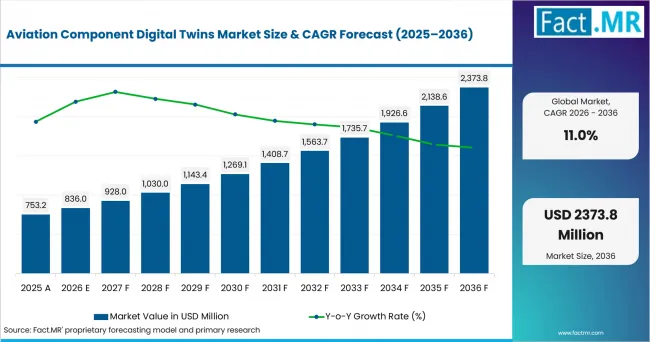
Aviation Component Digital Twins Market Value Analysis | Source: Fact.MR
What are the defining numbers behind Aviation Component Digital Twins Market growth?
An absolute opportunity of USD 1,537.8 million is expected between 2026 and 2036.
- Demand Drivers in the Market
- MRO teams need repeat estimates of how much useful life remains in a part. Twin models can link modeled wear with inspection results. This gives teams clearer support for repair and removal plans.
- Airframe teams need model updates that stay tied to the correct real part. Clear links between design and service records reduce the risk of using an outdated model.
- Fleet teams need early signs of wear because unplanned removals disrupt repair schedules. Part-level twins can compare measured results with expected performance. This helps teams focus on parts that show unusual change.
- Key Segments Analyzed
- By Component: Engine components are expected to hold 37.0% share in 2026. These parts face high heat and load during each flight cycle.
- By Twin Fidelity: Physics model is projected to account for 35.0% share in 2026. The model gives teams clear links between load, material response, and part behavior.
- By Lifecycle Stage: Design is anticipated to capture 31.0% share in 2026. Teams can test geometry, loads, and interfaces before tooling and formal approval work is complete.
- By Output: Remaining life is estimated to represent 38.0% share in 2026. MRO teams use this output to judge how long engines, landing gear, and other parts can stay in service.
- Analyst Opinion at Fact.MR
- Shambhu Nath Jha, Principal Consultant at Fact.MR, states, “A part twin has value when the model stays tied to the right physical part and its service record. Demand is expected to favor models that combine tested physics with live data. Suppliers should keep model checks, part tracking, and MRO use simple enough for both design and service teams.”
- Strategic Implications
- Software suppliers should keep a clear part ID through every model update. Teams can then trace each digital state back to the right physical part and configuration.
- MRO technology teams should focus on remaining-life and fault outputs that fit current repair steps. Each output should also show a clear reason for the suggested action.
- Model firms should make reduced-order models easy to run across active aircraft and engine fleets. These faster models help when full model work takes too long for repeat checks.
The USA leads at 12.0% CAGR through high aircraft activity and a mature aerospace engineering base. Germany follows at 11.7% as strong aircraft traffic and design capabilities support component-level twin adoption. France reaches 11.4% through its established aerospace design and aircraft-program base. Japan records 9.9% as high flight activity creates recurring component-maintenance needs, while the UK posts 9.3% through heavy passenger traffic and an established aircraft service ecosystem.
How does the Aviation Component Digital Twins Market break down by segment?
Engine components lead Component at 37.0%; Remaining life leads Output at 38.0%.
Which Component dominates?
Engine components are set to hold 37.0% share in 2026.
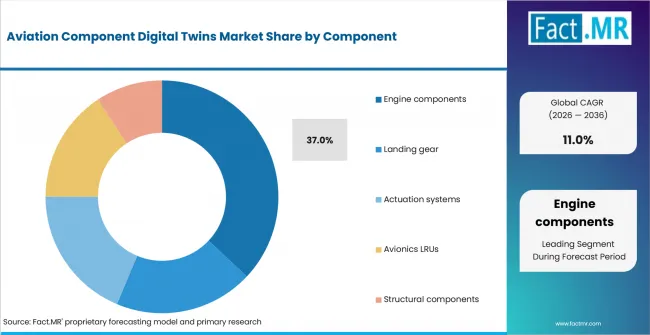
Aviation Component Digital Twins Market Analysis By Component | Source: Fact.MR
Engine components are set to lead because each flight cycle adds heat and load history. A tested part model can compare that history with measured data. Landing gear, actuation systems, avionics LRUs, and structures also gain value when service data stays tied to part ID.
GE Aerospace uses AI-based digital-twin models to forecast MRO work scopes and required parts months before engine induction. Siemens Simcenter supports aircraft subsystem simulation and the integration of subsystem models into aircraft-level architectures for mission-level analysis.
What leads the Twin Fidelity segment?
Physics model is projected to account for 35.0% share in 2026.
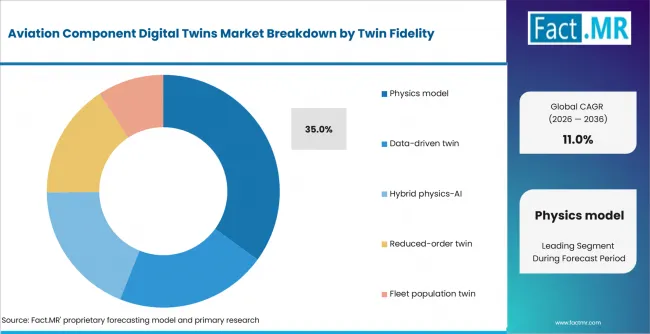
Aviation Component Digital Twins Market Analysis By Twin Fidelity | Source: Fact.MR
Physics models are set to lead because teams need clear links between applied loads and part response. Data-driven twins work best when service histories are rich. Hybrid models combine measured data with design rules, while reduced-order twins trade some detail for speed.
How does Lifecycle Stage shape demand?
Design is anticipated to capture 31.0% share in 2026.
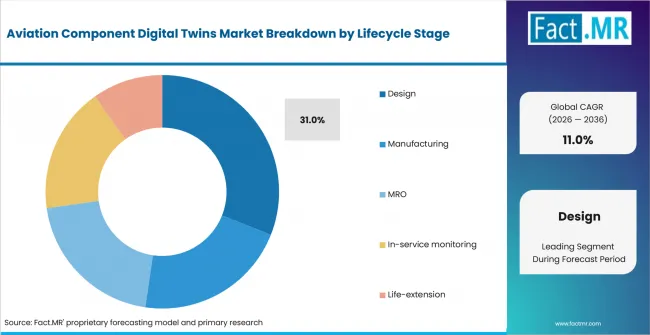
Aviation Component Digital Twins Market Analysis By Lifecycle Stage | Source: Fact.MR
Design is expected to lead because teams set geometry, loads, and interfaces before production starts. Manufacturing twins then help with process and inspection records. MRO and in-service twins use the same model context for later part checks.
In July 2026, the UK Office for National Statistics reported that sales from the repair and maintenance of civil aircraft and civil aircraft engines reached GBP 3.7 billion in 2025. The scale of this MRO activity provides a substantial operating environment in which digital-twin technologies can support maintenance planning and repair analysis.
What supports Remaining life within Output?
Remaining life is estimated to represent 38.0% share in 2026.
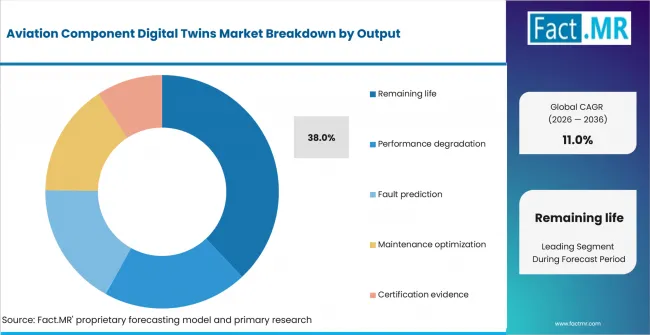
Aviation Component Digital Twins Market Analysis By Output | Source: Fact.MR
Remaining-life output is expected to lead because it turns model results into a direct MRO choice. Wear and fault outputs show changing part condition, while repair planning uses those findings to set the next action.
In October 2025, GE Aerospace reported that it uses predictive-maintenance approaches and digital-twin technology to provide deeper parts data and help identify issues earlier. The resulting data can support maintenance and MRO planning.
What is accelerating Aviation Component Digital Twins Market adoption, and what is holding it back?
Lifecycle tracking and condition-based MRO support adoption; model checks and data gaps can slow deployment.
Drivers Impact review
| DRIVER | (~) % IMPACT ON CAGR | GEOGRAPHIC RELEVANCE | IMPACT TIMELINE |
|---|---|---|---|
| Condition-based component maintenance | +1.8% | North America, Europe, East Asia | Short term (<= 2 years) |
| Digital thread continuity from design to service | +1.5% | Global | Medium term (2-4 years) |
| Higher aircraft utilization and MRO workload | +1.2% | North America, Europe | Medium term (2-4 years) |
| Reduced-order and hybrid twin deployment | +0.9% | Global | Long term (>= 4 years) |
Opportunity Impact review
| OPPORTUNITY | (~) % IMPACT ON CAGR | GEOGRAPHIC RELEVANCE | IMPACT TIMELINE |
|---|---|---|---|
| Engine remaining-life services | +1.3% | North America, Europe | Short term (<= 2 years) |
| MRO integration with component twins | +1.0% | Global | Medium term (2-4 years) |
| Fleet population twins for recurring analytics | +0.8% | Global | Long term (>= 4 years) |
Restraints Impact review
| RESTRAINT | (~) % IMPACT ON CAGR | GEOGRAPHIC RELEVANCE | IMPACT TIMELINE |
|---|---|---|---|
| Validation burden for safety-critical models | -0.8% | Global | Short term (<= 2 years) |
| Incomplete lifecycle data continuity | -0.6% | Global | Medium term (2-4 years) |
| Integration across legacy engineering systems | -0.4% | North America, Europe, East Asia | Long term (>= 4 years) |
Which countries are scaling the Aviation Component Digital Twins Market through 2036?
- The country comparison spans 2.7 percentage points and forms three practical growth bands across the forecast period.
- The USA remains 0.3 percentage point above Germany through high aircraft activity, a large active fleet, and a mature aerospace engineering base.
- Germany remains 0.3 percentage point above France as strong passenger traffic and aircraft-design depth support component-level twin adoption.
- France remains 1.5 percentage points above Japan through its established aerospace design base and major aircraft programs.
- Japan remains 0.6 percentage point above the United Kingdom as high flight activity creates recurring component-maintenance and service-data needs.
- The United Kingdom closes the displayed range at 9.3% CAGR, supported by heavy passenger traffic and an established aircraft repair and maintenance base.
Comparable CAGRs can create different entry conditions because aircraft activity, MRO intensity, design capability, lifecycle-data continuity, and service infrastructure vary by country. Full report coverage includes North America, Latin America, Western Europe, Eastern Europe, East Asia, South Asia & Pacific, and Middle East & Africa.
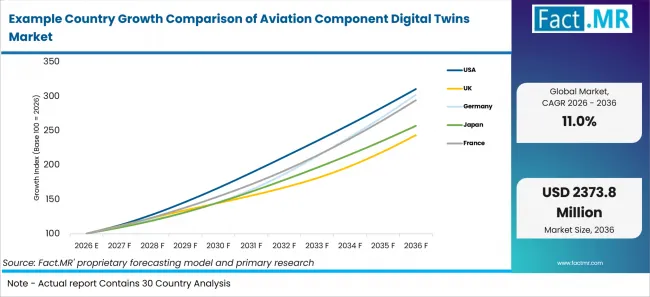
Example Country Growth Comparison Of Aviation Component Digital Twins Market | Source: Fact.MR
| Country | CAGR (2026-2036) |
|---|---|
| United States | 12.0% |
| Germany | 11.7% |
| France | 11.4% |
| Japan | 9.9% |
| United Kingdom | 9.3% |
What helps USA use?
12.0% CAGR, backed by a large active fleet and mature aircraft design base.
U.S. airlines carried 81.2 million scheduled passengers in December 2025, according to the Bureau of Transportation Statistics. A large active fleet creates many engine and part service events. Twin models can help link those events with part history and repair planning.
What is helping Germany’s use?
11.7% CAGR, led by a large aircraft market and strong design depth.
In January 2026, Destatis reported that Germany’s major commercial airports handled around 207.2 million passengers in 2025. That traffic creates repeat checks and service work across airline fleets. Germany also has a strong aircraft and design base that helps model-led part tracking.
How is France developing demand?
11.4% CAGR, supported by aircraft design and major aircraft programs.
In September 2026, INSEE reported that turnover among companies in Occitanie’s aeronautics and space sector increased by 8% in 2025. The region has a dense aircraft and systems design base. This helps model-led design, output, and service work.
How does Japan perform?
9.9% CAGR, led by high flight use and part maintenance needs.
Japan recorded 111.47 million domestic scheduled-airline passengers in calendar year 2025, according to the Ministry of Land, Infrastructure, Transport and Tourism. Repeat flight cycles create useful service histories. Twin models can compare measured part condition with expected response across engines and other high-value parts.
What helps the United Kingdom’s growth?
9.3% CAGR, driven by record passenger use and an established aircraft service base.
The UK Civil Aviation Authority reported 302 million airport passengers in 2025. Heavy aircraft use creates repeat inspection and maintenance work across active fleets. Twin models can help when serial-level history stays linked to the correct design model.
Who leads the Aviation Component Digital Twins Market?
Siemens and Dassault Systèmes provide broad digital-twin and lifecycle-service platforms for aerospace applications. PTC connects engineering, product and service information through digital-thread and digital-twin technologies. Hexagon supplies aerospace inspection technology, and GE Aerospace combines engine-focused digital modeling, predictive analytics and engine-health monitoring.
Siemens supports aircraft simulation through its Simcenter portfolio, while Dassault Systèmes uses virtual-twin technology to connect aircraft engineering, operational and maintenance information for MRO applications.
In June 2025, PTC discussed digital approaches for improving mission readiness in aerospace and defense, while its aerospace portfolio connects digital threads and digital twins with engineering, maintenance and lifecycle information. In May 2025, Hexagon introduced the Leica Absolute Tracker ATS800, which combines laser tracking and direct scanning for large-scale inspection applications including aerospace. GE Aerospace uses AI-based digital-twin models for engine MRO forecasting and provides engine-health monitoring and component-inspection technologies.
Which companies are the key providers?
Key companies include Siemens; Dassault Systèmes; Synopsys (Ansys); PTC; Hexagon; and GE Aerospace.
- Siemens
- Dassault Systèmes
- Synopsys (Ansys)
- PTC
- Hexagon
- GE Aerospace
Bibliography
- Dassault Systèmes. (2025, April 24). Dassault Systèmes and Airbus extend strategic partnership to use virtual twins for next-generation programs.
- Federal Aviation Administration. (2026). FAA Aerospace Forecast Fiscal Years 2026–2046: Review of 2025.
- Bureau of Transportation Statistics. (2026, March 13). December 2025 U.S. airline traffic data down 2.6% from the same month last year.
- UK Civil Aviation Authority. (2026, February 24). UK aviation officially breaks records with over 300m passenger journeys in 2025.
- Office for National Statistics. (2026, July 24). UK manufacturers’ sales by product: 2025.
- Statistisches Bundesamt (Destatis). (2026, January 29). 3,9 % mehr Fluggäste im Jahr 2025 als im Vorjahr [3.9% more air passengers in 2025 than in the previous year].
- Manchon, A. (2026, September 3). Filière aéronautique et spatiale en Occitanie : En 2025, le chiffre d’affaires de la filière dépasse son niveau d’avant crise sanitaire. Institut national de la statistique et des études économiques.
- Rivière, M. (2025, June 21). Ensuring mission readiness in aerospace and defense. PTC.
- Hexagon. (2025, May 7). Hexagon accelerates large-scale aerospace inspection with laser tracking and direct scanning in one automation-optimised device.
- GE Aerospace Staff. (2025, October 8). How innovation, collaboration, and FLIGHT DECK power resilient skies. GE Aerospace.
This Report Answers
- The report explains where aviation component digital twins are used across component type and twin fidelity. It also covers lifecycle stage and output, together with regional deployment.
- Segment analysis identifies the leading subsegments and explains why aerospace teams prioritize engine components, physics-based models, design-stage twins, and remaining-life outputs.
- Country analysis examines the United States, United Kingdom, Germany, Japan, and France. It also considers aircraft activity, aerospace engineering depth, MRO intensity, and service infrastructure supporting component-level twin adoption.
- Competitive analysis reviews Siemens, Dassault Systèmes, Synopsys (Ansys), PTC, Hexagon, and GE Aerospace. It covers simulation, virtual twins, digital threads, inspection technologies, predictive analytics, and engine-health applications.
- Application analysis assesses how part identity, lifecycle-data continuity, model fidelity, remaining-life estimation, and fault prediction influence adoption. It also considers MRO integration, validation requirements, service tracking, and compatibility with existing engineering systems.
What does the Aviation Component Digital Twins Market cover?
The market covers physics, data-driven, hybrid, and reduced-order twins used to show the state and response of individual aircraft parts.
The market covers models of aircraft parts used across design and service. It includes engines, landing gear, actuation systems, avionics LRUs, and structural parts when the model stays linked to a real part or defined fleet group. The scope is narrower than broad aircraft digital-thread software. General design platforms are included only when they support part twins, while fleet tools are included only when they provide part-level condition or remaining-life analysis.
What is included in the scope?
The scope includes aircraft part twins used in design, factory work, maintenance, and in-service state tracking.
Coverage includes physics, data-driven, hybrid, and reduced-order twins across design, factory work, MRO, and service. Outputs include life left, wear, fault prediction, and maintenance planning. Related markets are covered only when they help part-level tracking.
What is excluded from the scope?
Whole-aircraft fleet software and standalone MRO services are outside the scope unless component digital twins are a core function.
The scope excludes generic CAD, standalone maintenance services, asset leasing, and ground-support equipment. Aerospace MRO and parts manufacturing remain related areas when they do not include a component digital-twin layer.
How Was the Analysis Built?
The analysis draws on 120+ sources, 35+ company portfolios, 25+ countries, and more than 20 industry interviews.
- Primary Research: Primary research includes discussions with manufacturers, service providers, technology developers, distributors, end users, and subject-matter experts. These conversations examine purchasing priorities, product adoption, operational challenges, approval requirements, competitive positioning, and the factors that influence wider market acceptance.
- Desk Research: Desk research covers government statistics, regulatory publications, company filings, trade data, technical studies, industry associations, standards, public policy, and other authoritative sources. Every source used in the analysis is documented in the bibliography.
- Market Sizing and Forecasting: Market estimates combine historical performance, demand indicators, pricing and volume trends, segment shares, company participation, country-level growth, adoption patterns, investment activity, and barriers to market expansion.
- Data Validation and Update Cycle: Findings are validated by comparing primary interviews with public data, company activity, regulatory changes, trade patterns, and industry developments. Regular updates review new product launches, capacity changes, partnerships, approvals, and shifts in commercial adoption.
What is the report’s scope and coverage?
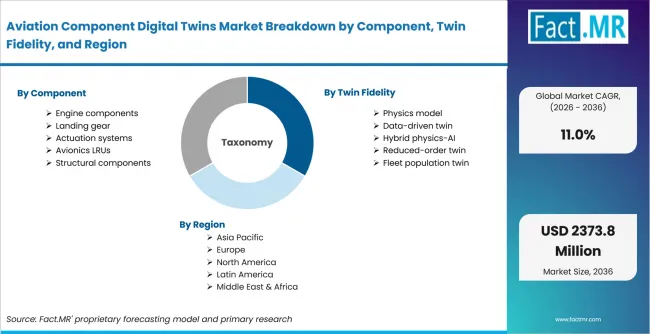
Aviation Component Digital Twins Market Breakdown By Component, Twin Fidelity, And Region | Source: Fact.MR
| Attribute | Details |
|---|---|
| Quantitative Units | USD million in 2026 to USD million by 2036 at an CAGR |
| Market Definition | Digital twins representing individual aviation components and their lifecycle condition, including physics, data-driven and hybrid models used across design, manufacturing, MRO, in-service monitoring and life-extension work. |
| Component | Engine components; Landing gear; Actuation systems; Avionics LRUs; Structural components |
| Twin Fidelity | Physics model; Data-driven twin; Hybrid physics-AI; Reduced-order twin; Fleet population twin |
| Lifecycle Stage | Design; Manufacturing; MRO; In-service monitoring; Life-extension |
| Output | Remaining life; Performance degradation; Fault prediction; Maintenance optimization; Certification evidence |
| Regions Covered | North America; Latin America; Western Europe; Eastern Europe; East Asia; South Asia & Pacific; Middle East & Africa |
| Countries Covered | United States; United Kingdom; Germany; Japan; France |
| Key Companies Profiled | Siemens; Dassault Systèmes; Synopsys (Ansys); PTC; Hexagon; GE Aerospace |
| Forecast Period | 2026 to 2036 |
| Approach | Hybrid top-down and bottom-up approach using aviation activity, component monitoring intensity, simulation deployment, MRO workflows, lifecycle software adoption and provider portfolio review. |
How is the market segmented?
-
By Component
- Engine components
- Landing gear
- Actuation systems
- Avionics LRUs
- Structural components
-
By Twin Fidelity
- Physics model
- Data-driven twin
- Hybrid physics-AI
- Reduced-order twin
- Fleet population twin
-
By Lifecycle Stage
- Design
- Manufacturing
- MRO
- In-service monitoring
- Life-extension
-
By Output
- Remaining life
- Performance degradation
- Fault prediction
- Maintenance optimization
- Certification evidence
-
By Region
- North America
- Latin America
- Western Europe
- Eastern Europe
- East Asia
- South Asia & Pacific
- Middle East & Africa