- Base Value(2026): 445.0 Mn
- Estimated Value(2026): 445.0 Mn
- Forecast Value (2036): 880.0 Mn
- CAGR (2026 - 2036): 7.1%
Barley Beta-Glucan Beverage Bases Market Forecast and Outlook By Fact.MR
Valuation of the barley beta-glucan beverage bases market stood at USD 410.0 million in 2025. According to Fact MR, demand for beverage bases containing barley beta-glucan is expected to reach USD 445.0 million in 2026 and USD 880.0 million by 2036. A CAGR of 7.1% is projected for the forecast timeline. beverage manufacturing operations. The United States records the slowest growth at 7.1%, reflecting a mature market tied to replacement demand within established functional beverage ingredient supply chains.
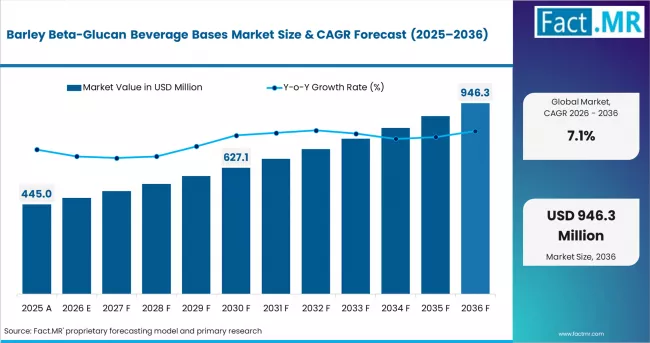
Barley Beta Glucan Beverage Bases Market Market Value Analysis | Source: Fact.MR
Barley Beta-Glucan Beverage Bases Market
| Metric | Details |
|---|---|
| Industry Size (2026E) | USD 445.0 million |
| Industry Value (2036F) | USD 880.0 million |
| CAGR (2026 to 2036) | 7.1% |
Source: Fact.MR analysis. Updated Apr 22, 2026
Summary of the Barley Beta-Glucan Beverage Bases Market
- Market Definition
- The market includes concentrated liquid, syrup, and powder ingredient bases derived from barley containing soluble beta-glucan fiber used in functional beverages formulated for viscosity control, nutritional enrichment, and physiological benefits associated with cholesterol management and glycemic response regulation.
- Demand Drivers
- Increasing incorporation of soluble fiber ingredients across functional beverage formulations targeting cardiovascular and metabolic health positioning.
- Growing demand for cereal-derived functional ingredients supporting development of fiber-enriched ready-to-drink nutritional beverages.
- Rising use of beta-glucan concentrates across dairy alternatives, sports nutrition drinks, and clinical nutrition formulations.
- Expanding utilization of viscosity-modifying polysaccharides supporting texture stabilization across beverage processing environments.
- Increasing preference for clinically supported soluble fiber ingredients compatible with regulatory health claim frameworks.
- Stable integration of barley-derived functional polysaccharides across processed beverage product development workflows.
- Key Segments Analyzed
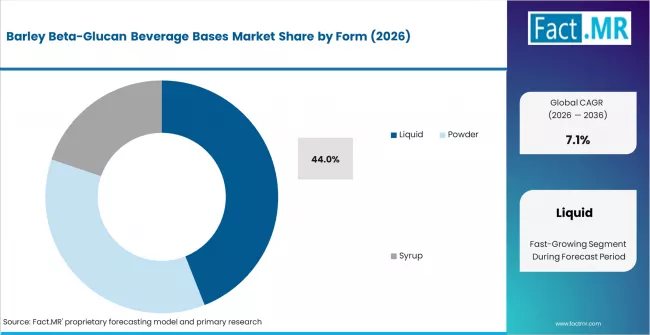
- Form: Liquid accounts for 44% share supported by compatibility with homogenization processes requiring controlled viscosity performance.
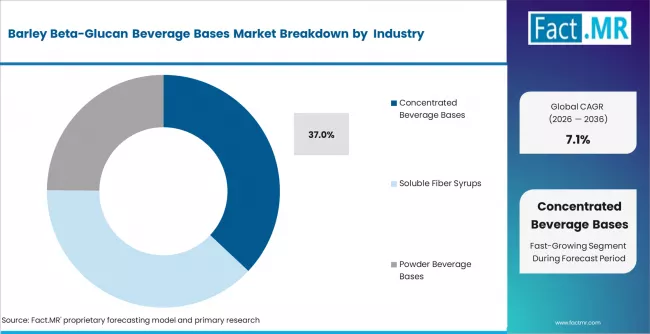
- Product Type: Concentrated beverage bases hold 37% share supported by high solids content enabling dosage flexibility across beverage formulation workflows.
- Application Role: Functional beverages and meal replacement drinks utilize beta-glucan bases to support fiber enrichment requirements.
- Functional Role: Beta-glucan polysaccharide structure supports water binding capacity and rheological stability across beverage matrices.
- Geography: Asia Pacific, Europe, and North America demonstrate steady adoption aligned with demand for soluble fiber ingredient integration.
- Analyst Opinion at Fact MR
- Shambhu Nath Jha, Principal Consultant, Fact MR, opines, 'In this updated edition of the Barley Beta-Glucan Beverage Bases Market report, cereal-derived soluble fiber concentrates support formulation of functional beverages aligned with clinical nutrition positioning through 2036.'
- Strategic Implications or Executive Takeaways
- Strengthen extraction processes supporting preservation of beta-glucan molecular structure across concentrated beverage base formulations.
- Improve viscosity control capability supporting formulation compatibility across ready-to-drink and powdered beverage systems.
- Enhance ingredient functionality supporting dispersion stability across homogenized beverage processing workflows.
- Support formulation development targeting cholesterol management and glycemic response positioning across functional nutrition beverages.
- Maintain compositional consistency supporting standardized soluble fiber concentration across beverage ingredient production.
- Expand application capability supporting integration across dairy alternative and clinical nutrition beverage formulations.
- Methodology
- Primary interviews conducted with functional ingredient manufacturers, beverage formulation specialists, and soluble fiber technology providers.
- Benchmarked against functional beverage demand indicators influencing adoption of cereal-derived soluble fiber ingredients.
- Evaluated extraction technologies supporting concentration and stabilization of beta-glucan polysaccharide structures.
- Hybrid modeling applied combining top-down functional beverage consumption analysis with bottom-up ingredient adoption benchmarking.
- Validation conducted using supplier level production indicators across soluble fiber ingredient manufacturing environments.
- Peer review applied using Fact MR analytical frameworks linking clinical nutrition ingredient demand with cereal-derived functional fiber adoption trends.
A CAGR of 7.1% indicates moderate expansion supported by demand for soluble fiber ingredients associated with cholesterol management positioning. Growth remains steady due to incorporation in ready-to-drink formats, while constraints persist from formulation viscosity challenges, cost sensitivity, and substitution competition from oat beta-glucan sources
China leads with a projected CAGR of 8.4%, supported by increasing use of cereal-derived functional beverage ingredients across packaged drink formulation processes. India follows with a CAGR of 8.1%, driven by expanding incorporation of soluble fiber beverage components across health-oriented drink production environments. The United Kingdom records a CAGR of 7.8%, reflecting steady utilization of beta-glucan beverage bases across functional beverage product development systems. Germany shows a CAGR of 7.6%, supported by consistent demand for cereal-based soluble fiber ingredients across processed
Segmental Analysis
Barley Beta-Glucan Beverage Bases Market Analysis by Form
Barley Beta Glucan Beverage Bases Market Analysis By Form | Source: Fact.MR
- Market Overview: Based on Fact MR assessment, liquid form is projected to account for 44% share of the barley beta glucan beverage bases market in 2026. Liquid ingredient systems support dispersion of soluble beta glucan fibers across beverage formulations requiring controlled viscosity and suspension stability characteristics. Extraction and concentration processes enable retention of polysaccharide structure supporting uniform incorporation across ready to drink beverages and nutritional drink formulations. Liquid format supports compatibility with continuous mixing and homogenization processes requiring stable rheological performance across beverage manufacturing workflows requiring controlled mouthfeel consistency.
- Demand Drivers:
- Dispersion Stability Requirements: Liquid beta glucan bases support uniform distribution of soluble fiber across beverage formulation systems.
- Processing Compatibility Parameters: Liquid format supports integration across mixing and homogenization operations requiring stable viscosity behavior.
- Functional Ingredient Needs: Beta glucan structure supports incorporation across formulated beverages requiring controlled texture performance.
Barley Beta-Glucan Beverage Bases Market Analysis by Product Type
Barley Beta Glucan Beverage Bases Market Analysis By Product Type | Source: Fact.MR
-
Market Overview: Concentrated beverage bases are estimated to hold 37% share of the barley beta glucan beverage bases market in 2026, supported by requirement for high solids content enabling dilution flexibility across beverage manufacturing workflows. Concentrated base formulations support controlled dosage of beta glucan content enabling adjustment of fiber concentration across finished beverage products. Processing compatibility supports integration across blending systems requiring consistent ingredient distribution across beverage formulation operations requiring stable compositional uniformity.
- Demand Drivers:
- Formulation Flexibility Requirements: Concentrated beverage bases support adjustment of beta glucan concentration across finished drink formulations.
- Ingredient Efficiency Parameters: Concentrated format supports reduced transportation volume enabling efficient ingredient handling across beverage manufacturing supply chains.
- Processing Consistency Needs: Concentrated bases support uniform blending performance across beverage production workflows requiring stable fiber distribution characteristics.
Key Dynamics
Barley Beta-Glucan Beverage Bases Market Drivers, Restraints, and Opportunities
Barley Beta Glucan Beverage Bases Market Opportunity Matrix Growth Vs Value | Source: Fact.MR
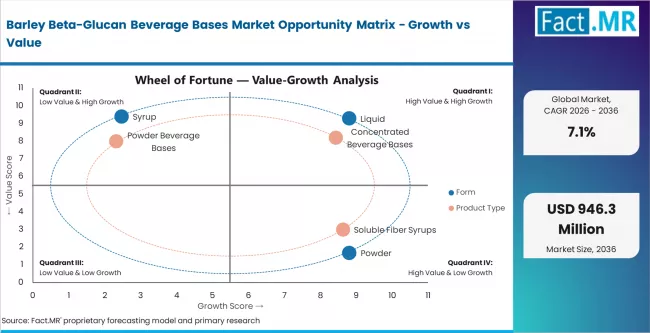
FMR analysts observe that historical demand for beta-glucan ingredients has been structurally linked to cereal-based functional foods where soluble fiber content supports cholesterol reduction and glycemic control claims. The present market size reflects a transition toward beverage-compatible beta-glucan bases that enable incorporation of clinically recognized soluble fiber into ready-to-drink nutrition formats. Structural reality indicates a growth-phase functional ingredient market because beverage delivery formats improve consumer compliance with daily intake thresholds required to support heart health and metabolic benefits. Regulatory acceptance of beta-glucan health claims has reinforced commercial viability of barley-derived soluble fiber in functional food systems.
The current structural shift reflects declining reliance on traditional cereal formats as manufacturers develop low-viscosity beta-glucan extracts suitable for clear beverages, plant-based drinks, and fortified nutrition products. Processing complexity increases ingredient cost per kilogram due to purification and viscosity control requirements, yet premium positioning linked to clinically substantiated fiber functionality supports value growth despite moderate consumption volumes. Demand expansion is concentrated in functional beverage categories targeting metabolic health, digestive wellness, and cardiovascular support claims supported by recognized dietary fiber mechanisms.
- Clinically Supported Fiber: EFSA Article 13.1 and FDA soluble fiber health claim frameworks recognize beta-glucan contribution to cholesterol reduction and glycemic response moderation.
- Functional Beverage Shift: Ingredient suppliers develop low-viscosity barley beta-glucan concentrates enabling incorporation into clear drinks and nutritional beverage formulations.
- Europe Functional Foods: Germany, United Kingdom, and Nordic countries show early adoption due to strong functional food formulation expertise and regulatory familiarity with beta-glucan health claims.
Regional Analysis
The Barley Beta-Glucan Beverage Bases Market is assessed across North America, Europe, and Asia Pacific, segmented by country-level demand in functional beverage formulations, soluble fiber enrichment bases, heart health nutrition ingredients, and plant-derived drink concentrates. Regional demand reflects expansion of functional nutrition beverages and incorporation of cereal-derived soluble fiber ingredients. The full report offers market attractiveness analysis.
.webp "Top Country Growth Comparison Barley Beta Glucan Beverage Bases Market Cagr (2026 2036)")
Top Country Growth Comparison Barley Beta Glucan Beverage Bases Market Cagr (2026 2036) | Source: Fact.MR
CAGR Table
| Country | CAGR (2026–2036) |
|---|---|
| China | 8.4% |
| India | 8.1% |
| United Kingdom | 7.8% |
| Germany | 7.6% |
| United States | 7.1% |
Source: Fact.MR analysis. Updated Apr 22, 2026
Source: Fact MR analysis, based on proprietary forecasting model and primary research
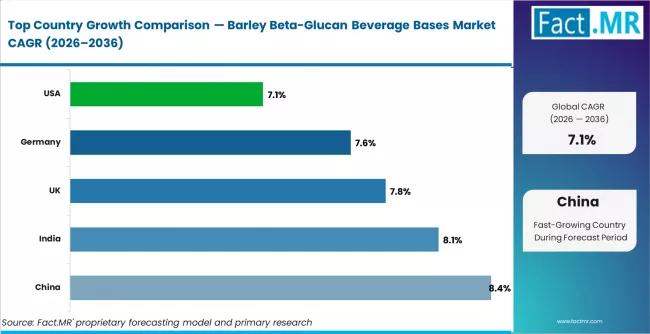
Barley Beta Glucan Beverage Bases Market Cagr Analysis By Country | Source: Fact.MR
Asia Pacific
Asia Pacific functions as the cereal-derived functional ingredient processing hub, supported by expansion of fortified beverage production and increasing utilization of soluble fiber ingredients in nutrition formulations. Tate & Lyle PLC strengthens soluble fiber ingredient capability. Kerry Group plc expands functional beverage base formulation expertise. Ingredion Incorporated supports cereal beta-glucan ingredient innovation.
- China: China is projected to record 8.4% CAGR in barley beta-glucan beverage bases through 2036. National Nutrition Plan functional fiber guideline update (National Health Commission, March 2024) supports soluble fiber beverage ingredient adoption. Kerry Group plc expanded cereal-derived beverage base formulation capability (June 2023).
- India: Adoption of barley beta-glucan beverage bases in India is forecast to grow at 8.1% CAGR through 2036. Food Safety and Standards Authority health ingredient framework update (January 2024) supports fiber-enriched beverage formulation development. Ingredion Incorporated expanded cereal fiber ingredient processing capability (May 2023).
Europe
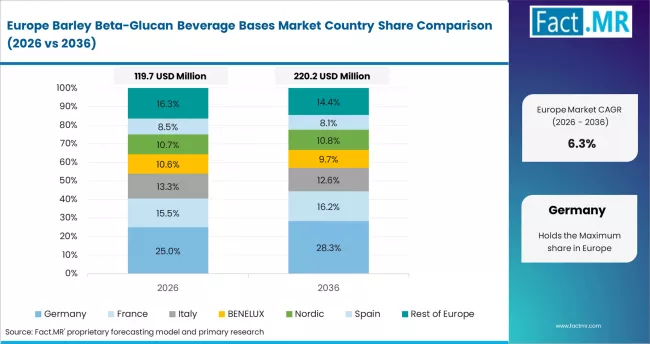
Barley Beta Glucan Beverage Bases Market Europe Country Market Share Analysis, 2026 & 2036 | Source: Fact.MR
Europe operates as the functional beverage formulation center, supported by structured nutrition claim regulations and increasing demand for fiber-enriched drink formulations. Tate & Lyle PLC strengthens beta-glucan ingredient engineering capability. BENEO GmbH expands cereal-derived functional ingredient portfolio. Kerry Group plc supports soluble fiber beverage innovation.
- United Kingdom: Demand expansion for barley beta-glucan beverage bases in United Kingdom is expected at 7.8% CAGR through 2036. UK nutrition reformulation strategy update (Department of Health and Social Care, February 2024) supports functional fiber beverage development. BENEO GmbH expanded beta-glucan ingredient application capability (July 2023).
- Germany: Germany is anticipated to observe 7.6% CAGR in barley beta-glucan beverage bases through 2036. EU nutrition and health claim regulation alignment update (European Food Safety Authority, October 2023) supports soluble fiber beverage ingredient commercialization. Tate & Lyle PLC expanded cereal-derived soluble fiber production capability (April 2023).
North America
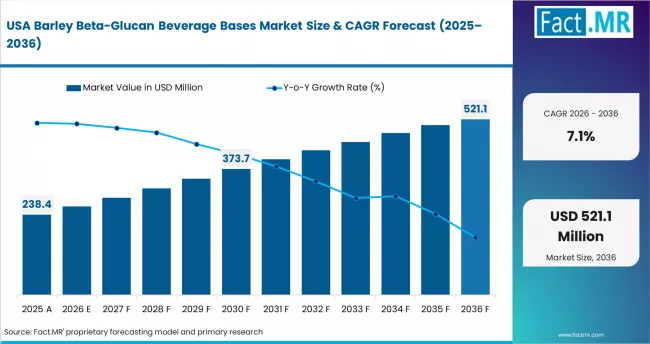
Barley Beta Glucan Beverage Bases Market Country Value Analysis | Source: Fact.MR
North America represents the functional beverage ingredient commercialization environment, supported by expansion of fiber-enriched drink products and increasing adoption of cereal-derived health ingredients across beverage categories. Cargill Incorporated strengthens soluble fiber ingredient capability. Ingredion Incorporated expands functional beverage base formulation technologies. ADM Company supports cereal ingredient innovation.
- United States: The United States is forecast to witness 7.1% CAGR in barley beta-glucan beverage bases through 2036. Dietary Guidelines fiber intake recommendation update (U.S. Department of Agriculture, April 2024) supports soluble fiber beverage ingredient demand. Cargill Incorporated expanded cereal-derived beta-glucan ingredient processing capability (August 2023).
Fact MR's analysis of barley beta-glucan beverage bases market in global regions consists of country-wise assessment that includes China, India, United Kingdom, Germany, and United States. Readers can find functional beverage ingredient trends, soluble fiber developments, nutrition regulation signals, and competitive positioning across key markets.
Competitive Landscape
Competitive Structure and Buyer Dynamics in the Barley Beta-Glucan Beverage Bases Market
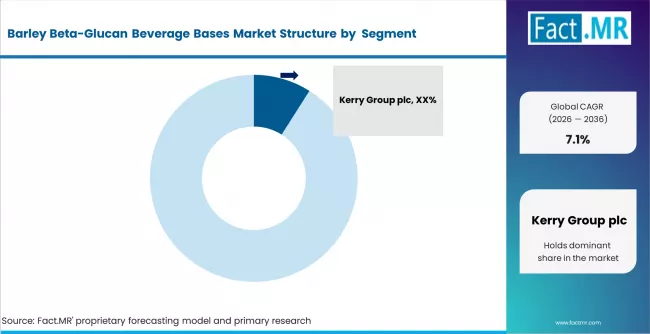
Barley Beta Glucan Beverage Bases Market Analysis By Company | Source: Fact.MR
The competitive structure of the Barley Beta-Glucan Beverage Bases Market is moderately concentrated, with functional ingredient manufacturers and specialty nutrition companies controlling a significant share of soluble fiber ingredient production. Companies such as Kerry Group plc, Tate and Lyle plc, Ingredion Incorporated, DSM Firmenich AG, Cargill Incorporated, Lantmannen Biorefineries, Kemin Industries Inc., Cosucra Groupe Warcoing SA, Naturex SA, and Garuda International Inc. maintain positions through established grain processing capabilities and global ingredient distribution networks. Competition is primarily influenced by beta glucan concentration levels, viscosity control, formulation stability, and compatibility with beverage processing requirements across functional drinks and nutritional products.
Several companies maintain structural advantages through vertically integrated grain sourcing and established expertise in soluble fiber extraction technologies. Firms such as Tate and Lyle plc, Ingredion Incorporated, and Cargill Incorporated benefit from large scale cereal processing infrastructure supporting consistent barley supply. Kerry Group plc and DSM Firmenich AG maintain advantages through application development capabilities aligned with functional beverage formulation requirements. Beverage manufacturers typically adopt multi supplier sourcing strategies to reduce dependence on a single ingredient provider and maintain formulation flexibility. Procurement decisions evaluate suppliers based on ingredient consistency, functional performance reliability, and long term availability, moderating supplier pricing leverage across functional beverage ingredient supply chains.
Key Players of the Barley Beta-Glucan Beverage Bases Market
- Kerry Group plc
- Tate & Lyle plc
- Ingredion Incorporated
- DSM Firmenich AG
- Cargill Incorporated
- Lantmannen Biorefineries
- Garuda International Inc.
- Kemin Industries Inc.
- Cosucra Groupe Warcoing SA
- Naturex SA (Givaudan)
Bibliographies
- [1] European Food Safety Authority. (2023, October). EU nutrition and health claim regulation alignment update. European Food Safety Authority.
- [2] Food Safety and Standards Authority of India. (2024, January). Health ingredient framework update. Government of India.
- [3] National Health Commission. (2024, March). National nutrition plan functional fiber guideline update. Government of China.
- [4] U.S. Department of Agriculture. (2024, April). Dietary guidelines fiber intake recommendation update. U.S. Department of Agriculture.
- [5] Department of Health and Social Care. (2024, February). UK nutrition reformulation strategy update. UK Government.
- [6] BENEO GmbH. (2023, July). Beta glucan ingredient application capability expansion. BENEO GmbH.
- [7] Cargill Incorporated. (2023, August). Cereal derived beta glucan ingredient processing capability expansion. Cargill Incorporated.
- [8] Ingredion Incorporated. (2023, May). Cereal fiber ingredient processing capability expansion. Ingredion Incorporated.
- [9] Kerry Group plc. (2023, June). Cereal derived beverage base formulation capability expansion. Kerry Group plc.
- [10] Tate and Lyle PLC. (2023, April). Cereal derived soluble fiber production capability expansion. Tate and Lyle PLC.
This Report Addresses
- Market size forecasts for 2026 to 2036 based on incorporation of cereal-derived soluble fiber ingredient systems in beverage formulations.
- Opportunity mapping across concentrated beverage bases, soluble fiber syrups, powder beverage bases, and liquid extract ingredient formats.
- Segment and regional forecasts covering functional beverages, dairy alternatives, sports nutrition drinks, meal replacement beverages, and clinical nutrition drink applications.
- Competition benchmarking based on beta-glucan concentration stability, viscosity control performance, solubility characteristics, and compatibility with beverage processing systems.
- Regulatory review covering soluble fiber health claim frameworks and nutrition labeling standards influencing beta-glucan ingredient commercialization.
- Report delivery in PDF, Excel, PPT, and dashboard formats supporting ingredient suppliers, beverage manufacturers, and nutrition formulation developers.
- Supply risk evaluation covering barley raw material availability variability, extraction yield consistency, and substitution competition from oat beta-glucan ingredients.
Barley Beta-Glucan Beverage Bases Market Definition
The Barley Beta-Glucan Beverage Bases Market includes concentrated liquid or powdered ingredient bases derived from barley that contain soluble dietary fiber beta-glucan, used to formulate functional beverages designed to provide viscosity, texture, and nutritional benefits such as cholesterol management, glycemic response control, and digestive support.
Barley Beta-Glucan Beverage Bases Market Inclusions
The report includes global and regional market size estimates, forecast analysis, and segmentation by ingredient form such as liquid concentrates or powder bases, beta-glucan concentration level, application type, end use industry, pricing structure, and supply chain distribution patterns across functional beverage formulation markets.
Barley Beta-Glucan Beverage Bases Market Exclusions
The scope excludes oat beta-glucan ingredients, whole barley grain products, finished packaged beverages where base composition cannot be isolated, and functional fibers not classified as beta-glucan such as inulin, resistant starch, or polydextrose.
Barley Beta-Glucan Beverage Bases Market Research Methodology
- Primary Research: Interviews were conducted with functional ingredient manufacturers, beverage formulators, nutrition specialists, and ingredient distribution companies.
- Desk Research: Public sources included food science publications, company technical documentation, patent literature, and studies on beta-glucan functionality in beverage applications.
- Market-Sizing and Forecasting: A hybrid model combining top-down functional beverage demand evaluation and bottom-up analysis of barley beta-glucan ingredient adoption was applied.
- Data Validation and Update Cycle: Outputs were validated through cross comparison of supplier data, expert consultation, and periodic monitoring of functional beverage formulation developments.
Segmentation
Report Scope
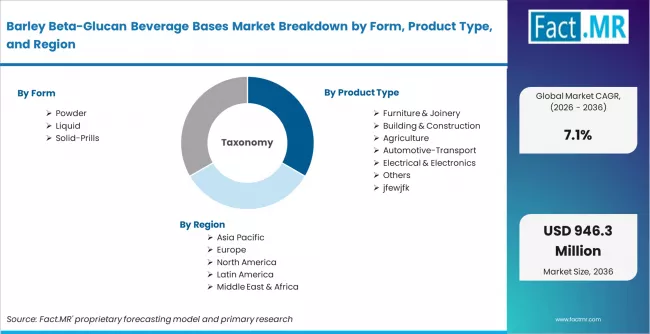
Barley Beta Glucan Beverage Bases Market Breakdown By Form, Product Type, And Region | Source: Fact.MR
| Metric | Value |
|---|---|
| Quantitative Units | USD 445.0 million (2026) to USD 880.0 million (2036), at a CAGR of 7.1% |
| Market Definition | The barley beta-glucan beverage bases market includes soluble fiber ingredient systems derived from barley used to formulate functional beverages with viscosity control, nutritional enrichment, and cholesterol management benefits across health-oriented drink applications. |
| Product Type Segmentation | Concentrated beverage bases, Soluble fiber syrups, Powder beverage bases, Liquid extracts |
| Application Segmentation | Functional beverages, Dairy alternatives, Sports nutrition drinks, Meal replacement beverages, Clinical nutrition drinks |
| Form Segmentation | Liquid, Powder, Syrup |
| Regions Covered | North America, Latin America, Europe, East Asia, South Asia, Oceania, Middle East and Africa |
| Countries Covered | United States, Canada, Germany, France, United Kingdom, Italy, Spain, Sweden, Denmark, China, Japan, South Korea, India, Australia, Brazil, Mexico, United Arab Emirates, South Africa, and 40+ countries |
| Key Companies Profiled | Kerry Group plc, Tate & Lyle plc, Ingredion Incorporated, DSM Firmenich AG, Cargill Incorporated, Lantmannen Biorefineries, Garuda International Inc., Kemin Industries Inc., Cosucra Groupe Warcoing SA, Naturex SA |
| Forecast Period | 2026 to 2036 |
| Approach | Hybrid top-down and bottom-up market estimation based on soluble fiber ingredient demand benchmarking, functional beverage formulation trends, clinical nutrition product development analysis, plant-based beverage innovation patterns, and validation through primary interviews with ingredient manufacturers, beverage formulators, and nutrition product developers. |
Source: Fact.MR analysis. Updated Apr 22, 2026
Barley Beta Glucan Beverage Bases Market Key Segments
-
Product Type:
- Concentrated Beverage Bases
- Soluble Fiber Syrups
- Powder Beverage Bases
- Liquid Extracts
-
Application:
- Functional Beverages
- Dairy Alternatives
- Sports Nutrition Drinks
- Meal Replacement Beverages
- Clinical Nutrition Drinks
-
Form:
- Liquid
- Powder
- Syrup
-
Region:
- North America
- USA
- Canada
- Mexico
- Europe
- Germany
- UK
- France
- Italy
- Spain
- Nordic Countries
- BENELUX
- Rest of Europe
- Asia Pacific
- China
- Japan
- South Korea
- India
- Australia
- Rest of Asia Pacific
- Latin America
- Brazil
- Argentina
- Rest of Latin America
- Middle East and Africa
- Kingdom of Saudi Arabia
- United Arab Emirates
- South Africa
- Rest of Middle East and Africa
- Other Regions
- Oceania
- Central Asia
- Other Markets
- North America
Frequently Asked Questions
How large is the demand for Barley Beta-Glucan Beverage Bases in the global market in 2026?
What will be the market size of Barley Beta-Glucan Beverage Bases in the global market by 2036?
What is the expected demand growth for Barley Beta-Glucan Beverage Bases in the global market between 2026 and 2036?
Which company is identified as a leading manufacturer in the Barley Beta-Glucan Beverage Bases market?
Which form segment is projected to dominate barley beta-glucan beverage base demand by 2026?
Why are liquid barley beta-glucan bases widely used in beverage manufacturing applications?
What is driving demand for barley beta-glucan beverage bases in China?
What is the growth outlook for the Barley Beta-Glucan Beverage Bases market in China?
Why is India an important market for barley-derived beta-glucan ingredients?
What is the growth outlook for the Barley Beta-Glucan Beverage Bases market in India?
How is demand for barley beta-glucan beverage bases evolving in the United Kingdom?
What is the growth outlook for the Barley Beta-Glucan Beverage Bases market in the United Kingdom?
What is the growth outlook for the Barley Beta-Glucan Beverage Bases market in Germany?
How is the United States positioned in the Barley Beta-Glucan Beverage Bases market?
What is the growth outlook for the Barley Beta-Glucan Beverage Bases market in the United States?
What are barley beta-glucan beverage bases and what are they mainly used for?
What does the Barley Beta-Glucan Beverage Bases market include in this report?
What applications are included in the scope of the Barley Beta-Glucan Beverage Bases market?
What is excluded from the scope of the Barley Beta-Glucan Beverage Bases market report?
What does market forecast mean in the Barley Beta-Glucan Beverage Bases market report?
How is the Barley Beta-Glucan Beverage Bases market forecast developed in this report?
What does primary validation indicate in the Barley Beta-Glucan Beverage Bases market analysis?
Who worked on this report


Preview the report firsthand - request a free sample
Free SampleGet the brochure for pricing and purchase details
Download PDF