- Market Value (2025): USD 4.16 Bn
- Estimated Value (2026): USD 4.6 Bn
- Forecast Value (2036): USD 12.5 Bn
- CAGR (2026-2036): 10.5%
What is the Battery Monitoring Solutions Market forecast to be worth by 2036?
USD 4.60 billion in 2026 to USD 12.46 billion by 2036, at a 10.5% CAGR.
- Fact.MR values the battery monitoring solutions market at USD 4.16 billion in 2025, supported by installed battery assets that require persistent condition tracking.
- Revenue is forecast to rise from USD 4.6 billion in 2026 to USD 12.5 billion in 2036, creating USD 7.86 billion in additional market value.
- The resulting 10.5% CAGR is tied to a wider monitoring footprint: more lithium-ion storage, denser data-center backup systems, electrified transport, and remote infrastructure that cannot rely on periodic manual inspection.
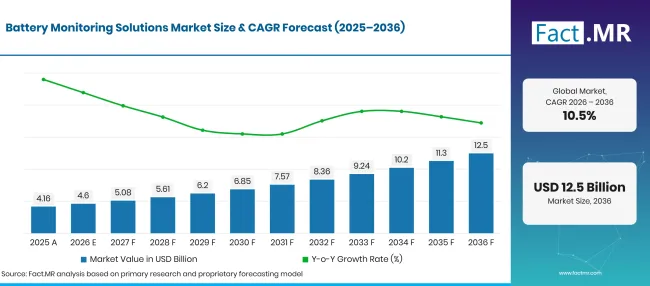
Factmr Battery Monitoring Solutions Market Forecast Global | Source: Fact.MR
| Year | Basis | Market Value (USD billion) |
|---|---|---|
| 2025 | Actual | 4.16 |
| 2026 | Estimate | 4.6 |
| 2036 | Forecast | 12.5 |
| CAGR 2026 to 2036 | Forecast period | 10.5% |
Source: Fact.MR analysis. Updated Oct 17, 2026
What are the defining numbers behind Battery Monitoring Solutions Market growth?
The market adds an estimated USD 7.86 billion between 2026 and 2036. Hardware remains the spending base, lithium-ion systems raise the monitoring intensity, and data centers provide the largest concentration of always-on battery assets.
- Demand Drivers in the Market
- Hyperscale cloud facilities and co-location data centers mandate continuous cell-level battery monitoring to ensure uninterruptible power supply reliability and eliminate costly downtime events. The U.S. Department of Energy Federal Energy Management Program published comprehensive technical specifications requiring automated state of charge, state of health, and thermal tracking for lithium-ion battery energy storage systems [1]. Facility engineers prioritize hardware sensors that detect internal cell short circuits and localized temperature spikes before thermal runaway propagates across battery racks.
- Grid-scale renewable energy storage projects require sophisticated telemetry systems to optimize multi-megawatt battery packs during rapid charge and discharge cycling. The U.S. Department of Energy announced a USD 25 million investment across 11 projects advancing domestic next-generation battery manufacturing, advanced materials, and diagnostic testing architectures [2]. Utility asset managers select monitoring systems that deliver real-time impedance measurements to calculate remaining useful life and schedule targeted cell replacements without taking entire storage strings offline.
- Regulatory modernization and streamlined environmental permitting accelerate the deployment of utility battery storage systems, increasing demand for certified safety monitoring solutions. The U.S. Department of Energy amended review procedures to reduce regulatory hurdles for battery energy storage, solar installations, and transmission projects, accelerating commercial interconnection timelines [3]. Utility operators implement compliant monitoring solutions to satisfy mandatory regional grid safety codes.
- Automotive manufacturers and fleet operators install comprehensive battery diagnostic hardware to track traction pack health and ensure warranty compliance across electric vehicle charging infrastructure. The U.S. Department of Energy allocated USD 131 million to strengthen America's battery supply chain, charging infrastructure, and vehicle battery diagnostic capabilities [4]. Integrated monitoring systems communicate with vehicle control units to adjust charging rates based on real-time cell temperature and voltage balance.
- Key Segments Analyzed
- By Component: Hardware holds 42.3% share in 2026, as physical current transducers, optical isolation amplifiers, cell-level voltage sensors, and centralized data acquisition controllers dominate procurement spending.
- By Battery Type: Lithium-Ion represents 50.0% share in 2026, capturing half of all monitoring installations due to surging demand in electric vehicles, data center battery backups, and grid storage systems.
- By End-User: Data Centers represents 45.9% share in 2026, reflecting critical backup power mandates and continuous telemetry integration across high-density computing server halls.
- By Application: Commercial accounts for 45.9% share in 2026, driven by corporate facilities, enterprise IT infrastructure, and commercial renewable microgrids.
- Analyst Opinion at Fact.MR
- Shambhu Nath Jha, Lead Consultant at Fact.MR, observes that value is moving from periodic battery checks toward continuous diagnostics. The commercial advantage comes from identifying drift at cell level before capacity loss becomes a site-level outage. Vendors that connect accurate sensors with interpretable analytics and existing facility software can address both maintenance savings and uptime risk.
- Strategic Implications
- Energy storage system developers are establishing international technical partnerships to harmonize battery monitoring standards and accelerate utility grid integration across global markets. The U.S. Department of Energy confirmed bilateral collaboration with international partners to expand deployment frameworks and safety benchmarks for large-scale Battery Energy Storage Systems [5].
- Sensor manufacturers are transitioning from wired daisy-chain architectures toward wireless cell monitoring units operating on ultra-low-power radio protocols. Wireless sensor nodes eliminate thousands of feet of complex wiring harnesses inside containerized battery rooms, reducing installation labor and eliminating fire-propagation pathways along cable trays.
- Software vendors are pairing battery monitoring telemetry with cloud analytics platforms to calculate dynamic battery state of health and optimize energy arbitrage schedules. Machine learning models analyze historical voltage recovery curves to detect early lithium plating and electrolyte dry-out before physical failure occurs.
- Data center operators are integrating battery monitoring feeds directly into Data Center Infrastructure Management (DCIM) suites to enable unified facility power tracking. Automated alarm cascades trigger emergency generator start sequences if battery backup reserve capacity falls below mission-critical thresholds.
Germany leads the country outlook at 11.7% CAGR as renewable storage, industrial automation, and UPS modernization expand the monitored battery base. Japan follows at 10.1% through manufacturing and diagnostic applications. The United States reaches 9.1% on data-center and utility storage investment, while the United Kingdom and Brazil grow at 8.3% and 7.3% through commercial resilience and telecom backup requirements.
How does the Battery Monitoring Solutions Market break down by segment?
Hardware 42.3%; Lithium-Ion 50.0%; Data Centers 45.9%; Commercial 45.9% in 2026.
Which Component dominates?
Hardware holds 42.3% share in 2026.
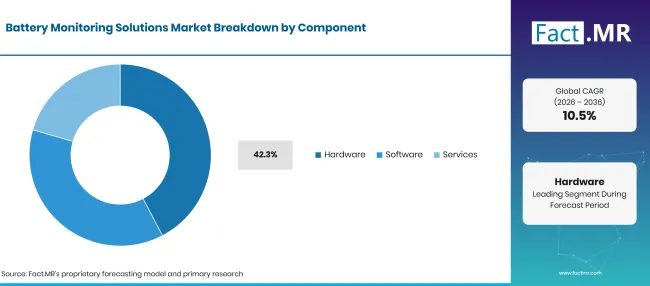
Factmr Battery Monitoring Solutions Market Breakdown Component | Source: Fact.MR
| Component | Share (2026) |
|---|---|
| Hardware (Leading segment) | 42.3% |
| Other segments combined | 57.7%* |
| Total | 100.0% |
Source: Fact.MR analysis. Updated Oct 17, 2026
Hardware components represent the primary share of market expenditure because battery monitoring requires dedicated physical sensors on every cell or battery module. Hardware installations include high-precision voltage probes, Hall effect current sensors, ambient and pilot temperature thermocouples, and centralized controller gateways. Software solutions represent the most rapidly growing value component, providing sophisticated algorithm engines for state-of-health estimation and remote dashboard telemetry. Maintenance services, sensor calibration, and annual diagnostic testing constitute the remaining share of industry revenue. Insights across the battery energy storage systems market and data center power management market highlight the accelerating integration of dedicated hardware controllers into enterprise power racks.
What leads the Battery Type segment?
Lithium-Ion accounts for 50.0% share in 2026.
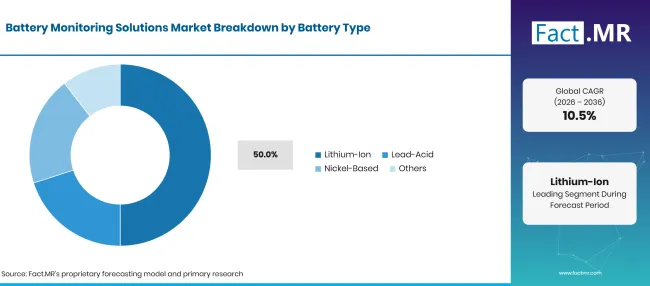
Factmr Battery Monitoring Solutions Market Breakdown Battery Type | Source: Fact.MR
| Battery Type | Share (2026) |
|---|---|
| Lithium-Ion (Leading segment) | 50.0% |
| Other segments combined | 50.0%* |
| Total | 100.0% |
Source: Fact.MR analysis. Updated Oct 17, 2026
Lithium-ion chemistries account for exactly half of all battery monitoring installations, driven by widespread adoption in electric mobility, consumer electronics, and modern data center uninterruptible power systems. Lithium cells require precise voltage and thermal monitoring because overcharging or internal shorting can induce thermal runaway and cell combustion. Lead-acid batteries retain substantial legacy market share across telecommunications towers, railway signaling, and industrial substations, where monitoring systems track electrolyte conductance and individual jar voltages. Nickel-based batteries serve specialized aerospace and extreme-temperature military applications where proven durability is required. Fact.MR research on the data center ups market, the electric vehicle battery management market, and the lead acid battery monitoring market demonstrates ongoing chemical transitions across stationary and motive power applications.
How does End-User demand shape sales?
Data Centers represents 45.9% share in 2026.
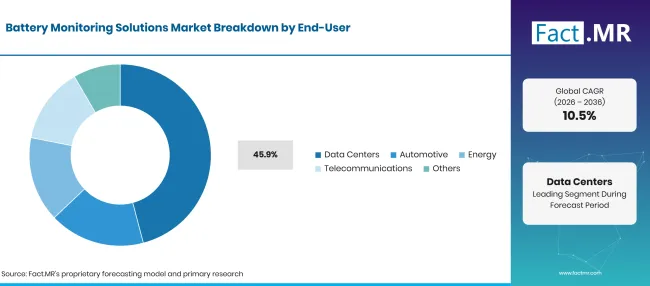
Factmr Battery Monitoring Solutions Market Breakdown End User | Source: Fact.MR
| End-User | Share (2026) |
|---|---|
| Data Centers (Leading segment) | 45.9% |
| Other segments combined | 54.1%* |
| Total | 100.0% |
Source: Fact.MR analysis. Updated Oct 17, 2026
Data centers represent the single largest end-user category, driven by zero-tolerance policies toward unplanned electrical outages across banking, cloud services, and telecommunications backbones. Data center managers install dedicated monitoring on every UPS battery string to verify emergency power readiness 24/7. Automotive applications represent the fastest growing volume segment, where integrated monitoring solutions track high-voltage electric vehicle packs. Utility energy companies utilize monitoring systems across grid-connected solar-plus-storage and wind-buffering battery facilities. Telecommunications operators deploy remote battery monitoring across cell tower networks to ensure continuous cellular service during severe weather grid failures. Complementary Fact.MR evaluations detailing the smart grid battery storage market, the industrial battery chargers market, and the telecom tower energy storage market outline diverse operational monitoring mandates across infrastructure sectors.
What is accelerating Battery Monitoring Solutions Market adoption, and what is holding it back?
Demand is accelerating because battery failures are expensive, distributed assets are difficult to inspect manually, and lithium-ion systems require tighter thermal and electrical oversight. Adoption slows when customers face sensor calibration burdens, incompatible communication protocols, cybersecurity concerns, or difficulty integrating older battery strings with modern analytics platforms.
Drivers Impact Analysis
| DRIVER | (~) % IMPACT ON CAGR | GEOGRAPHIC RELEVANCE | IMPACT TIMELINE |
|---|---|---|---|
| Hyperscale cloud datacenter uptime mandates | +1.8% | North America, Europe, Asia | Short term (<= 2 years) |
| Utility renewable storage grid integration | +1.6% | North America, Europe, China | Short term (<= 2 years) |
| Mandatory fire safety codes for lithium-ion storage | +1.4% | North America, Europe | Medium term (2–4 years) |
| Electric vehicle fast-charging buffer stations | +1.1% | Global | Medium term (2–4 years) |
| Predictive battery degradation AI software | +0.9% | Global | Long term (>= 4 years) |
Source: Fact.MR analysis. Updated Oct 17, 2026
Opportunity Impact Analysis
| OPPORTUNITY | (~) % IMPACT ON CAGR | GEOGRAPHIC RELEVANCE | IMPACT TIMELINE |
|---|---|---|---|
| Wireless mesh sensor nodes for retrofit installations | +1.5% | Global | Short term (<= 2 years) |
| Second-life EV battery stationary storage monitoring | +1.2% | Europe, East Asia | Medium term (2–4 years) |
| Cloud-connected predictive battery analytics platforms | +1.0% | North America, Europe | Medium term (2–4 years) |
| Edge microgrid self-optimizing battery controllers | +0.8% | Latin America, Asia Pacific | Long term (>= 4 years) |
Source: Fact.MR analysis. Updated Oct 17, 2026
Restraints Impact Analysis
| RESTRAINT | (~) % IMPACT ON CAGR | GEOGRAPHIC RELEVANCE | IMPACT TIMELINE |
|---|---|---|---|
| High hardware sensor retrofit expense on large banks | -1.2% | Global | Short term (<= 2 years) |
| Interoperability challenges across legacy protocols | -0.9% | Europe, North America | Medium term (2–4 years) |
| Cybersecurity vulnerabilities in connected energy assets | -0.7% | Global | Medium term (2–4 years) |
| Technical talent shortages in electrochemical diagnostics | -0.5% | Global | Long term (>= 4 years) |
Source: Fact.MR analysis. Updated Oct 17, 2026
Which countries are scaling the Battery Monitoring Solutions Market through 2036?
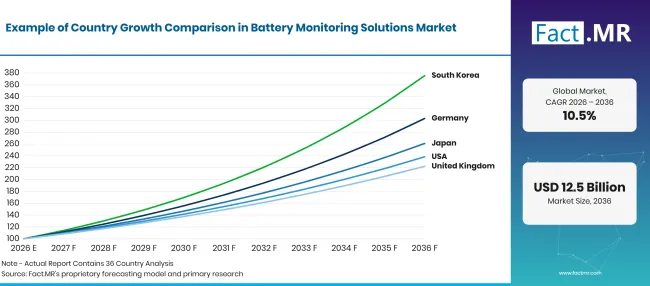
Factmr Battery Monitoring Solutions Market Growth Index | Source: Fact.MR
| Country | CAGR (2026–2036) |
|---|---|
| Germany | 11.7% |
| Japan | 10.1% |
| United States | 9.1% |
| United Kingdom | 8.3% |
| Brazil | 7.3% |
Source: Fact.MR analysis. Updated Oct 17, 2026
Why is Germany leading battery monitoring solution expansion?
11.7% CAGR, propelled by Energiewende renewable energy storage targets, industrial automation battery backups, and strict battery safety regulations.
Germany’s 11.7% CAGR reflects the overlap of three monitored asset classes: factory automation, renewable storage, and data-center backup. As battery fleets become larger and more distributed, operators need cell-level diagnostics that can feed maintenance planning rather than relying on scheduled visual checks.
How is Japan advancing battery diagnostic technology?
10.1% CAGR, driven by grid resilience investments, corporate microgrid installations, and leading automotive battery manufacturing.
Japan is projected to grow at 10.1%, supported by advanced manufacturing and a strong base of precision electronics. Monitoring demand is concentrated in applications where traceable performance, thermal control, and early fault detection are more valuable than simply confirming that a battery remains online.
What supports sustained market leadership in the United States?
9.1% CAGR, underpinned by hyperscale cloud data center construction, utility-scale battery storage capacity additions, and federal energy storage incentives.
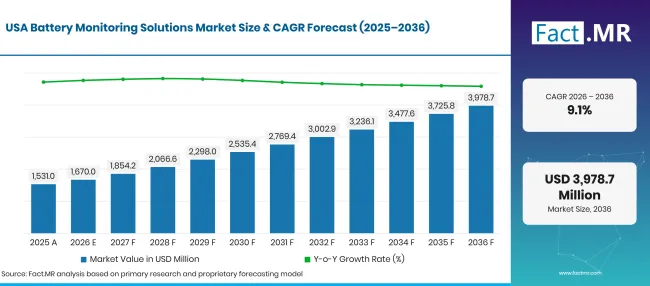
Factmr Battery Monitoring Solutions Market Forecast Usa | Source: Fact.MR
The United States advances at 9.1% as hyperscale computing and grid storage increase the cost of undetected battery degradation. Remote telemetry is particularly valuable across large installations because technicians can prioritize the strings showing abnormal voltage, impedance, or temperature behavior.
Why is the United Kingdom expanding battery storage monitoring?
8.3% CAGR, influenced by rapid national grid battery storage capacity additions and commercial fleet electrification hubs.
United Kingdom growth of 8.3% is linked to commercial continuity and distributed energy systems. Hospitals, financial infrastructure, telecom networks, and renewable projects need condition data that can support maintenance decisions before backup capacity is called upon.
What factors drive growth in Brazil?
7.3% CAGR, shaped by remote telecommunications tower backup modernization, solar-plus-storage microgrids, and industrial backup systems.
Brazil’s 7.3% CAGR is shaped by geography as much as technology. Telecom towers and renewable sites are often spread across areas where routine inspection is costly, making remote battery diagnostics a practical way to prioritize field visits and reduce avoidable service interruptions.
Who leads the Battery Monitoring Solutions Market?
ABB Ltd. holds the leading global market share, delivering comprehensive energy storage monitoring hardware, industrial UPS diagnostic suites, and integrated electrical automation platforms. GE Vernova Inc. and Texas Instruments Incorporated provide advanced utility-scale storage controls, high-voltage battery monitoring integrated circuits, and precision analog sensing solutions. NXP Semiconductors N.V. and Schneider Electric SE supply specialized automotive battery management microcontrollers and data center power management software platforms.
Eaton Corporation plc and Siemens AG engineer enterprise uninterruptible power systems, predictive health analytics software, and industrial electrical monitoring panels. Emerson Electric Co. delivers ruggedized battery monitoring equipment for industrial process plants and telecommunications power installations. Analog Devices Inc. provides industry-standard wireless battery management system silicon, while L&T Technology Services Limited delivers custom engineering services and software integration for battery diagnostics.
Which companies are the key providers?
Key companies include ABB Ltd.; GE Vernova Inc.; Texas Instruments Incorporated; NXP Semiconductors N.V.; Schneider Electric SE; Eaton Corporation plc; Siemens AG; Emerson Electric Co.; Analog Devices Inc.; and L&T Technology Services Limited.
- ABB Ltd.
- GE Vernova Inc.
- Texas Instruments Incorporated
- NXP Semiconductors N.V.
- Schneider Electric SE
- Eaton Corporation plc
- Siemens AG
- Emerson Electric Co.
- Analog Devices Inc.
- L&T Technology Services Limited
Bibliography
- [1] U.S. Department of Energy Federal Energy Management Program. (2025, August 28). Lithium-ion battery storage technical specifications for state of health monitoring and federal facilities.
- [2] U.S. Department of Energy. (2024, December 19). U.S. Department of Energy selects 11 projects to advance domestic manufacturing of next-generation batteries and storage diagnostic systems.
- [3] U.S. Department of Energy. (2024, April 30). DOE reduces regulatory hurdles for energy storage, transmission, and solar projects.
- [4] U.S. Department of Energy. (2024, January 19). U.S. Department of Energy announces $131 million to boost America's battery supply chain and electric vehicle charging infrastructure.
- [5] U.S. Department of Energy. (2024, September 17). U.S.-India Strategic Clean Energy Partnership ministerial joint statement on utility battery storage grid integration.
This Report Answers
- The report evaluates technical capabilities across cell-level voltage sensors, Hall effect current monitors, and predictive software platforms.
- Battery chemistry analysis details why lithium-ion systems account for half of all global monitoring installations and grow at the fastest rate.
- Country-level evaluations explore why Germany and Japan lead market growth across renewable energy storage and industrial automation.
- End-user purchasing reviews illustrate why hyperscale data centers represent the largest single commercial market for battery monitoring systems.
- Competitive profiling benchmarks measurement accuracy ratings, wireless sensor architectures, and DCIM software integrations across leading vendors.
What does the Battery Monitoring Solutions Market cover?
The market covers hardware and software used to observe battery condition, including sensors, controllers, communications, and analytics that report voltage, current, temperature, impedance, state of charge, and state of health. The focus is on systems that turn those measurements into maintenance or protection decisions.
What is included in the scope?
Included revenues come from monitoring hardware, sensor probes, wireless transceivers, acquisition controllers, and dedicated software supplied for commercial, industrial, utility, transport, and infrastructure batteries. Services are counted only where they form part of the monitoring solution sold.
What is excluded from the scope?
Battery cells, racks, containment systems, transformers, generators, chargers, inverters, and rectifiers are outside the defined market unless monitoring functionality is sold as a distinct solution. General facility software and labor are excluded when they are not directly attributable to battery diagnostics.
How Was the Analysis Built?
The analysis draws on 120+ sources, 35+ company portfolios, 25+ countries, and more than 20 industry interviews.
- Primary Research: Primary research includes discussions with manufacturers, service providers, technology developers, distributors, end users, and subject-matter experts. These conversations examine purchasing priorities, product adoption, operational challenges, approval requirements, competitive positioning, and the factors that influence wider market acceptance.
- Desk Research: Desk research covers government statistics, regulatory publications, company filings, trade data, technical studies, industry associations, standards, public policy, and other authoritative sources. Every source used in the analysis is documented in the bibliography.
- Market Sizing and Forecasting: Market estimates combine historical performance, demand indicators, pricing and volume trends, segment shares, company participation, country-level growth, adoption patterns, investment activity, and barriers to market expansion.
- Data Validation and Update Cycle: Findings are validated by comparing primary interviews with public data, company activity, regulatory changes, trade patterns, and industry developments. Regular updates review new product launches, capacity changes, partnerships, approvals, and shifts in commercial adoption.
Segmentation
What is the report’s scope and coverage?
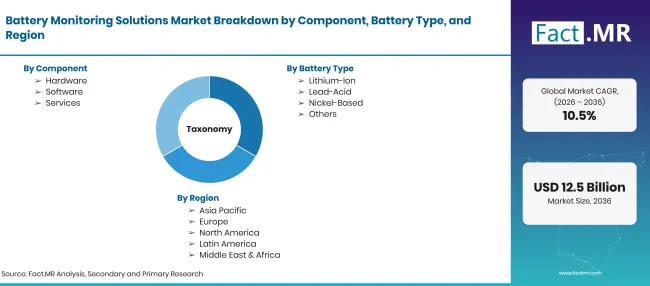
Factmr Battery Monitoring Solutions Market Taxonomy | Source: Fact.MR
| Attribute | Details |
|---|---|
| Quantitative Units | USD billion in 2026 to USD billion by 2036 at 10.5% CAGR |
| Market Definition | Hardware sensors, controllers, and software analytics systems designed to continuously measure and manage voltage, current, temperature, and internal resistance of battery cells. |
| Component | Hardware; Software; Services |
| Battery Type | Lithium-Ion; Lead-Acid; Nickel-Based; Others |
| End-User | Data Centers; Automotive; Energy; Telecommunications; Others |
| Application | Commercial; Residential; Industrial |
| Regions Covered | North America; Latin America; Western Europe; Eastern Europe; East Asia; South Asia & Pacific; Middle East & Africa |
| Countries Covered | Germany; Japan; United States; United Kingdom; Brazil |
| Companies Profiled | ABB; GE Vernova; Texas Instruments; NXP; Schneider Electric; Eaton; Siemens; Emerson; Analog Devices; L&T Technology Services |
| Forecast Period | 2026 to 2036 |
| Approach | Analysis of data center UPS shipment registries, utility energy storage project databases, semiconductor vendor filings, and interviews with facility operations supervisors |
Source: Fact.MR analysis. Updated Oct 17, 2026
How is the market segmented?
-
By Component
- Hardware
- Software
- Services
-
By Battery Type
- Lithium-Ion
- Lead-Acid
- Nickel-Based
- Others
-
By End-User
- Data Centers
- Automotive
- Energy
- Telecommunications
- Others
-
By Application
- Commercial
- Residential
- Industrial
-
By Region
- North America
- Latin America
- Western Europe
- Eastern Europe
- East Asia
- South Asia & Pacific
- Middle East & Africa
Frequently Asked Questions
How big is the battery monitoring solutions market in 2026?
What is the CAGR from 2026 to 2036?
Which component leads?
Which battery type leads?
Which companies participate in battery monitoring solutions?
Who worked on this report


Preview the report firsthand - request a free sample
Free SampleGet the brochure for pricing and purchase details
Download PDF