- Base Value(2025): 1.3 Bn
- Estimated Value(2026): 1.5 Bn
- Forecast Value (2036): 6.2 Bn
- CAGR (2026 - 2036): 15.2%
Battery Pack Fire Detection and Safety Component Systems Market Size, Share and Forecast by Fact.MR
In 2025, the battery pack fire detection and safety component systems market was valued at USD 1.3 billion. Fact MR analysis indicates demand for battery pack fire detection and safety component systems is expected to reach USD 1.5 billion in 2026 and USD 6.2 billion by 2036. FMR estimates the market will expand at a CAGR of 15.2% across the forecast period.
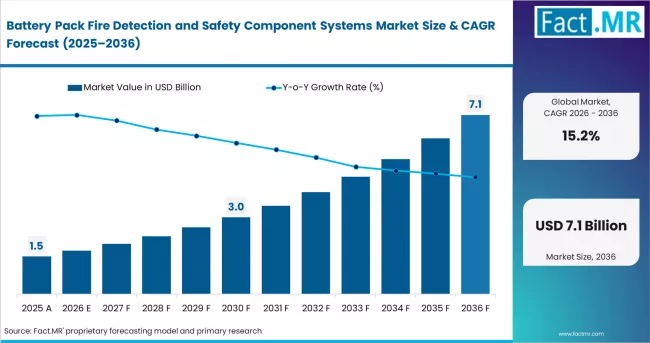
Battery Pack Fire Detection And Safety Component Systems Market Value Analysis | Source: Fact.MR
Summary of Battery Pack Fire Detection and Safety Component Systems Market
The battery pack fire detection and safety component systems market includes sensor and control technologies designed to detect early indicators of thermal runaway, overheating, gas release, and electrical anomalies in battery systems. These solutions integrate gas sensors, temperature sensors, pressure sensors, control units, and suppression materials to improve safety across electric vehicles, stationary energy storage systems, industrial batteries, and consumer electronic devices.
- Demand Drivers
- Expansion of electric vehicle production increasing requirement for thermal runaway detection components in high-capacity battery packs.
- Rising deployment of stationary energy storage systems requiring continuous monitoring of temperature, gas emission, and pressure variation.
- Increasing regulatory focus on battery safety compliance supporting integration of multi-sensor detection architectures.
- Growing adoption of gas sensing technologies capable of detecting electrolyte decomposition prior to ignition risk.
- Integration of battery management electronics supporting real-time monitoring of voltage anomalies and thermal gradients.
- Key Segments Analyzed
- Battery Type: Lithium-ion batteries lead with 72.4% share due to widespread use in electric mobility and energy storage systems.
- Application: Electric vehicles account for 46.7% share supported by integration of thermal anomaly detection technologies in traction battery packs.
- Component: Gas sensors, temperature sensors, and control units show strong demand for early-stage fault detection capability.
- Detection Type: Multi-sensor detection systems gain adoption due to improved reliability in identifying complex battery failure patterns.
- Geography: China and South Korea show strong growth supported by expansion of battery manufacturing capacity.
- Analyst Opinion at Fact MR
- Shambhu Nath Jha, Principal Consultant at Fact MR, states, "Battery safety technologies are evolving toward multi-sensor detection architectures capable of identifying gas release, pressure variation, and abnormal temperature gradients before ignition thresholds are reached. Suppliers capable of improving sensor accuracy and system integration compatibility will maintain strong positioning as electrification expands across mobility and energy storage sectors."
- Strategic Implications
- Expand development of gas and temperature sensing technologies enabling early fault detection.
- Improve integration between safety sensors and battery management electronics supporting continuous monitoring capability.
- Strengthen design of modular safety components supporting scalability across battery system configurations.
- Enhance reliability of suppression materials limiting propagation of thermal events across battery modules.
- Methodology
- Based on primary interviews with battery manufacturers, sensor developers, and safety component suppliers.
- Supported by review of battery safety research, electrochemical failure analysis studies, and supplier technical specifications.
- Market estimation uses hybrid modeling combining supplier revenue analysis with evaluation of electric vehicle and energy storage deployment trends.
- Data validation conducted using technical references and expert consultation inputs.
Battery Pack Fire Detection and Safety Component Systems Market
| Metric | Details |
|---|---|
| Industry Size (2026E) | USD 1.5 billion |
| Industry Value (2036F) | USD 6.2 billion |
| CAGR (2026 to 2036) | 15.2% |
A CAGR of 15.2%, with value increasing from USD 1.5 billion to USD 6.2 billion, indicates transformational expansion driven by safety requirements in electric vehicle and energy storage battery systems. Growth is supported by thermal runaway mitigation standards and multi-sensor integration, while moderated by certification costs, technology reliability validation, and pricing pressure within battery pack supply chains.
China records the fastest growth at 17.4%, supported by increasing installation of thermal runaway detection components in electric vehicle battery architectures. South Korea follows at 16.8%, driven by expansion of advanced battery safety electronics manufacturing capacity. Japan shows 16.1% growth, linked to integration of multi-sensor battery protection modules in next-generation energy storage systems. The USA at 15.2% and Germany at 14.6% represent mature markets where demand is largely replacement-driven due to established deployment of battery safety management technologies. A structural constraint across mature markets is rigorous certification requirements for battery safety components, which extends commercialization timelines for newly engineered detection systems.
Segmental Analysis
Battery Pack Fire Detection and Safety Component Systems Market Analysis by Battery Type
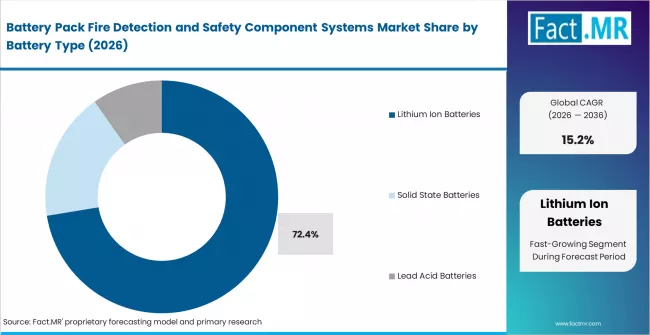
Battery Pack Fire Detection And Safety Component Systems Market Analysis By Battery Type | Source: Fact.MR
- Market Overview: Lithium-ion batteries are projected to hold 72.4% share of the battery pack fire detection and safety component systems market in 2026. Demand concentration reflects widespread deployment of lithium-ion chemistries across mobility, stationary energy storage, and electronic device applications requiring advanced thermal event detection and mitigation mechanisms. Safety component integration supports monitoring of gas emission, temperature variation, and voltage irregularities associated with thermal runaway conditions.
- Demand Drivers:
- Thermal Runaway Risk Management: Lithium-ion battery architectures require multi-sensor safety components capable of detecting abnormal temperature rise and gas release patterns.
- Battery System Monitoring Requirements: Safety modules integrate gas sensors, temperature sensors, and control electronics designed to provide early-stage warning signals across battery pack environments.
- Regulatory Compliance Standards: Battery manufacturers incorporate fire detection components aligned with safety certification requirements governing lithium-ion battery system performance.
Battery Pack Fire Detection and Safety Component Systems Market Analysis by Application
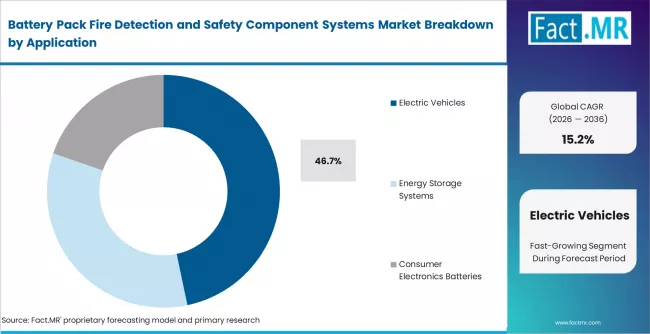
Battery Pack Fire Detection And Safety Component Systems Market Analysis By Application | Source: Fact.MR
- Market Overview: Electric vehicles are estimated to account for 46.7% share in 2026, supported by increasing integration of battery monitoring and safety components designed to detect potential fire risk conditions within high-capacity traction battery systems. Automotive battery packs incorporate layered safety architectures enabling early identification of abnormal electrochemical behavior.
- Demand Drivers:
- Vehicle Safety Requirements: Electric vehicle manufacturers integrate fire detection components designed to identify overheating, gas release, and electrical anomalies within traction battery assemblies.
- High Energy Density Considerations: EV battery systems require advanced monitoring technologies capable of detecting early indicators of cell failure across high-capacity battery pack configurations.
- System Integration Standards: Safety component suppliers develop modules compatible with vehicle battery management systems supporting real-time monitoring of battery operating parameters.
Key Dynamics
Battery Pack Fire Detection and Safety Component Systems Market Drivers, Restraints, and Opportunities
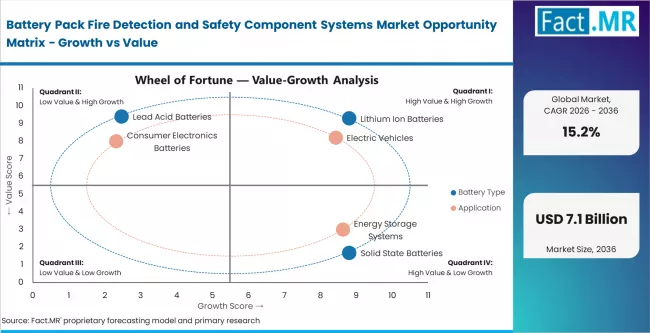
Battery Pack Fire Detection And Safety Component Systems Market Opportunity Matrix Growth Vs Value | Source: Fact.MR
Fact MR analysis indicates the market reflects a high-growth safety engineering segment emerging alongside rapid electrification of transport and grid-scale battery storage deployment. Market size exists because lithium-ion batteries present inherent thermal runaway risk triggered by internal short circuits, overheating, or mechanical damage, creating potential fire and explosion hazards across electric vehicles, consumer electronics, and stationary energy storage systems. Structural demand is driven by the need for early-stage fault detection using gas sensors, temperature sensors, pressure monitors, and battery management system diagnostics capable of identifying precursor conditions before catastrophic failure occurs.
Current dynamics show declining reliance on single-parameter temperature monitoring as manufacturers adopt multi-sensor architectures combining gas detection, thermal imaging, and pressure monitoring technologies that provide earlier warning signals of electrolyte decomposition and cell venting events. Advanced safety component systems command higher per-unit pricing due to integration complexity, compliance testing, and functional safety validation requirements, while adoption expands across EV battery packs and large-scale battery energy storage installations. Market structure reflects a transition toward predictive safety frameworks where software-enabled monitoring complements passive fire protection materials and module-level containment engineering.
- Thermal Runaway Regulation: Standards such as UL 9540 and NFPA 855 establish baseline safety requirements for battery energy storage systems, increasing integration of multi-sensor detection and suppression components within battery packs.
- EV Safety Scaling: China, United States, and Europe electric vehicle production growth is increasing demand for gas sensing, pressure monitoring, and early fault detection systems embedded within battery module architectures.
- Multi-Sensor Integration: Combined gas, thermal, and pressure sensors improve early-stage failure detection by identifying decomposition gases and abnormal temperature gradients before ignition thresholds are reached.
Regional Analysis
The battery pack fire detection and safety component systems market is assessed across Asia Pacific, Europe, and North America, segmented by country-level demand for thermal runaway detection sensors, gas monitoring components, pressure release safety devices, and battery protection control modules used in electric vehicles and energy storage systems. Geographic variation reflects electric mobility expansion, battery manufacturing scale, and safety compliance requirements. The full report offers market attractiveness analysis.
.webp "Top Country Growth Comparison Battery Pack Fire Detection And Safety Component Systems Market Cagr (2026 2036)")
Top Country Growth Comparison Battery Pack Fire Detection And Safety Component Systems Market Cagr (2026 2036) | Source: Fact.MR
CAGR Table
| Country | CAGR (2026–2036) |
|---|---|
| China | 17.4% |
| South Korea | 16.8% |
| Japan | 16.1% |
| USA | 15.2% |
| Germany | 14.6% |
Source: Fact MR analysis, based on proprietary forecasting model and primary research
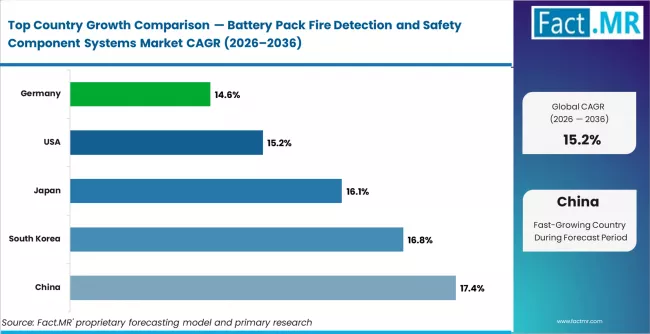
Battery Pack Fire Detection And Safety Component Systems Market Cagr Analysis By Country | Source: Fact.MR
Asia Pacific
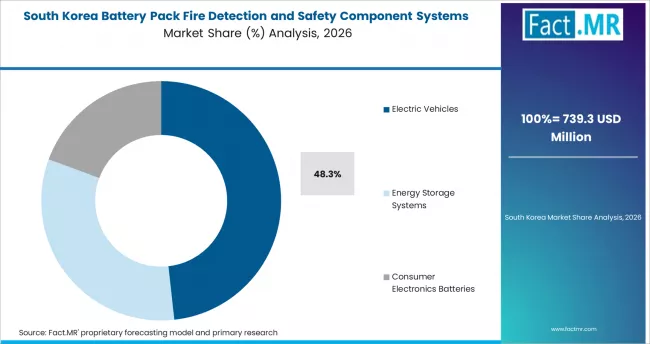
Battery Pack Fire Detection And Safety Component Systems Market South Korea Market Share Analysis By Application | Source: Fact.MR
Asia Pacific functions as the lithium-ion battery safety technology development hub supported by strong electric vehicle production capacity and expansion of battery manufacturing ecosystems. NXP Semiconductors strengthens battery monitoring sensor capability. Panasonic Energy Co., Ltd. expands battery safety component portfolio depth. LG Energy Solution supports thermal runaway detection system innovation.
- China: China is projected to record 17.4% CAGR in battery pack fire detection and safety component systems through 2036. New Energy Vehicle Development Plan update (Ministry of Industry and Information Technology, January 2023) supports advanced battery safety system integration. CATL expanded battery safety monitoring technology capability (June 2023).
- South Korea: South Korea is expected to observe 16.8% CAGR in battery pack fire detection and safety component systems through 2036. K Battery Strategy update (Ministry of Trade, Industry and Energy, February 2023) supports development of advanced battery safety technologies. LG Energy Solution expanded battery protection component research capability (May 2023).
- Japan: Japan is anticipated to expand at 16.1% CAGR in battery pack fire detection and safety component systems through 2036. Green Growth Strategy update (Ministry of Economy, Trade and Industry, March 2023) supports next generation battery safety innovation. Panasonic Energy Co., Ltd. expanded thermal monitoring technology capability (April 2023).
North America
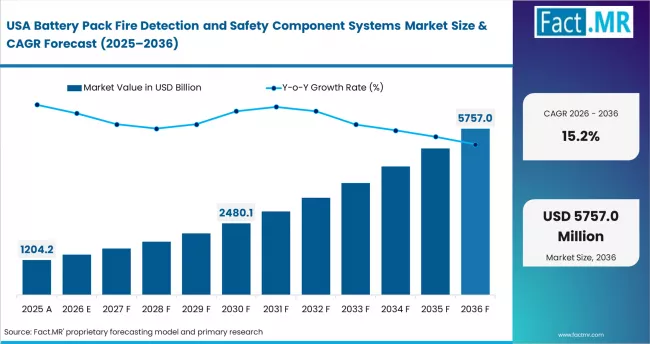
Battery Pack Fire Detection And Safety Component Systems Market Country Value Analysis | Source: Fact.MR
North America operates as the battery safety commercialization center supported by expansion of electric vehicle manufacturing capacity and adoption of advanced battery monitoring systems. Sensata Technologies strengthens battery protection sensor capability. Texas Instruments expands battery management semiconductor portfolio depth. Honeywell International Inc. supports gas detection technology innovation.
- USA: The USA is forecast to grow at 15.2% CAGR in battery pack fire detection and safety component systems through 2036. Inflation Reduction Act battery manufacturing incentive update (U.S. Department of Energy, January 2023) supports development of battery safety technologies. Sensata Technologies expanded battery monitoring component production capability (August 2023).
Europe
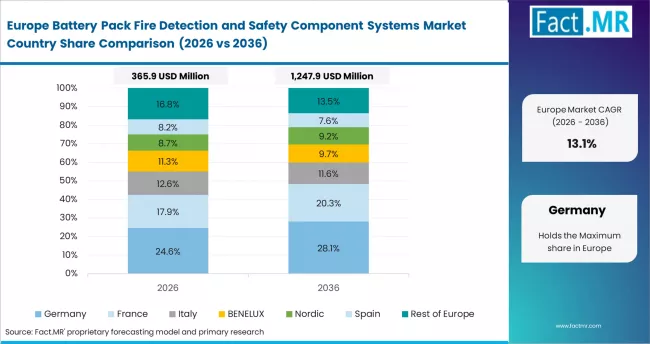
Battery Pack Fire Detection And Safety Component Systems Market Europe Country Market Share Analysis, 2026 & 2036 | Source: Fact.MR
Europe functions as the battery safety compliance laboratory supported by strict electric vehicle safety regulations and increasing demand for certified battery protection systems. Bosch GmbH strengthens battery safety electronics capability. Infineon Technologies expands battery monitoring semiconductor portfolio depth. STMicroelectronics supports protection circuit innovation.
- Germany: Germany is projected to register 14.6% CAGR in battery pack fire detection and safety component systems through 2036. EU Battery Regulation update (European Commission, January 2023) supports integration of advanced battery safety components. Infineon Technologies expanded battery protection semiconductor development capability (July 2023).
Fact MR's analysis of battery pack fire detection and safety component systems market in global regions consists of country-wise assessment that includes China, South Korea, Japan, USA, and Germany. Readers can find battery safety technology trends, electric vehicle component developments, regulatory positioning frameworks, and competitive semiconductor innovation insights.
Competitive Landscape
What is the Competitive Structure of the Battery Pack Fire Detection and Safety Component Systems Market?
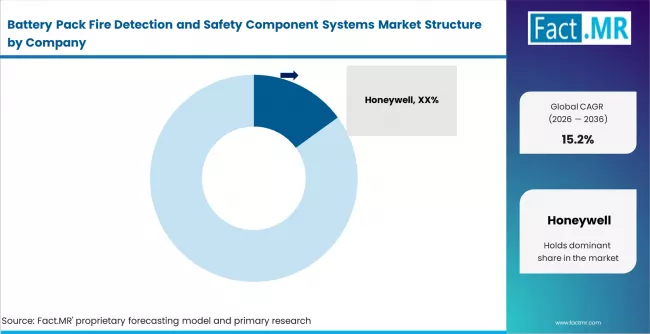
Battery Pack Fire Detection And Safety Component Systems Market Analysis By Company | Source: Fact.MR
The Battery Pack Fire Detection and Safety Component Systems Market demonstrates a moderately concentrated competitive structure, supported by sensor manufacturers, semiconductor suppliers, and industrial safety technology companies with expertise in thermal monitoring and electrical protection systems. Leading companies including Honeywell, Siemens, Bosch, Sensata Technologies, TE Connectivity, Amphenol, Analog Devices, NXP Semiconductors, STMicroelectronics, and Texas Instruments collectively account for nearly 60–70% of global market share, particularly in gas sensing, temperature monitoring, pressure sensing, and control circuitry used in lithium-ion battery safety architectures. Competitive positioning is primarily determined by sensor accuracy, response time, reliability under high thermal stress, and compatibility with battery management systems. High engineering complexity and certification requirements create entry barriers, reinforcing the presence of established suppliers with proven safety-critical electronics capabilities.
Structural advantages are observed among companies possessing integrated portfolios covering sensors, microcontrollers, connectivity components, and system monitoring electronics aligned with battery safety design requirements. Analog Devices and Texas Instruments benefit from strong expertise in analog signal processing and integrated circuit design supporting precise detection of thermal runaway indicators. Buyers typically manage supplier dependency through multi-vendor qualification and validation of sensor accuracy across different battery pack configurations. Procurement decisions often consider calibration stability, long-term reliability, and compliance with automotive and energy storage safety standards. Pricing power remains relatively balanced, though suppliers retain moderate leverage where validated sensing performance and integration compatibility create switching constraints for manufacturers developing advanced battery protection systems.
Key Players of the Battery Pack Fire Detection and Safety Component Systems Market
- Honeywell
- Siemens
- Bosch
- Sensata Technologies
- Amphenol
- TE Connectivity
- Analog Devices
- NXP Semiconductors
- STMicroelectronics
- Texas Instruments
Bibliographies
- [1] Ministry of Industry and Information Technology (MIIT), China. (2023, January). MIIT Priorities for 6G, 5G Deployment, and New Information Infrastructure.
- [2] U.S. Department of Commerce. (2023, February). CHIPS and Science Act Funding Opportunity (NOFO) Launch and Implementation.
- [3] European Commission. (2023, November). General Report on the Activities of the European Union 2023 - Chapter 5: A Europe Fit for the Digital Age (European Chips Act).
- [4] Ministry of Trade, Industry and Energy (MOTIE), South Korea. (2025, November). K-Mobility Global Leadership Strategy (Future Mobility, including HMI).
- [5] Cabinet Office, Government of Japan. (2023). Society 5.0 (Human-Centered Interfaces and Innovation).
- [6] UNECE. (2023). UNECE R157: Automated Lane Keeping Systems and Human-Machine Interface Monitoring.
- [7] U.S. Chamber of Commerce (via Commerce Dept). (2023, August). Status of CHIPS and Science Act One-Year Progress.
- [8] China Embassy (State Council). (2021/2023). Next Generation Artificial Intelligence Development Plan (IT Interfaces).
This Report Addresses
- Market size estimation and revenue forecast for 2026 to 2036 supported by electric vehicle battery production benchmarks and validated safety component integration data.
- Growth opportunity evaluation across gas sensors, temperature sensors, pressure sensors, control units, and fire suppression materials used in battery protection architectures.
- Segment level demand assessment covering thermal runaway detection, gas emission detection, smoke detection, voltage anomaly detection, and multi sensor safety monitoring frameworks.
- Regional adoption analysis identifying demand patterns for battery safety electronics across Asia Pacific, Europe, and North America electric mobility and energy storage markets.
- Competitive benchmarking covering sensor manufacturers and semiconductor suppliers specializing in battery monitoring ICs, detection modules, and functional safety compliant electronic architectures.
- Technology evaluation assessing multi sensor fusion capability, early fault detection algorithms, thermal anomaly identification methods, and integration with battery management systems.
- Supply chain assessment identifying concentration risks in sensing components, microcontroller units, semiconductor fabrication capacity, and certification validation cycles for battery safety electronics.
- Deliverables including PDF report, Excel forecast dataset, presentation ready slides, and segment level market models supporting battery technology investment planning and safety engineering strategy.
Battery Pack Fire Detection and Safety Component Systems Market Definition
The battery pack fire detection and safety component systems market refers to technologies designed to detect early signs of thermal runaway, overheating, gas release, or combustion risks in battery systems. These solutions use sensors, control electronics, and suppression components to prevent fires in electric vehicles, energy storage systems, and consumer battery applications.
Battery Pack Fire Detection and Safety Component Systems Market Definition Inclusions
The report covers global and regional market size assessment and forecast outlook across the defined period. It includes segmentation by component such as temperature sensors, gas sensors, pressure sensors, battery management units, and fire suppression materials. Applications include electric vehicles, energy storage systems, industrial batteries, and consumer electronics. Pricing structure, supply chain configuration, and trade flow dynamics are evaluated.
Battery Pack Fire Detection and Safety Component Systems Market Definition Exclusions
The scope excludes battery cells, battery packs, and general thermal management components not designed for fire detection or safety monitoring. Standard battery monitoring electronics lacking fire risk analytics are not included. Fire protection infrastructure unrelated to battery systems is excluded, focusing strictly on detection sensors, monitoring modules, and safety control components integrated into battery systems.
Battery Pack Fire Detection and Safety Component Systems Market Research Methodology
- Primary Research
- Interviews were conducted with battery system manufacturers, sensor technology providers, EV component suppliers, and safety engineering specialists involved in thermal runaway detection technologies.
- Desk Research
- Technical journals, battery safety studies, patent literature, and component supplier documentation were reviewed to identify sensor technologies capable of detecting temperature rise, gas venting, and pressure anomalies linked to battery failure.
- Market-Sizing and Forecasting
- A hybrid model combining bottom-up supplier revenue assessment and top-down evaluation of electric vehicle and energy storage deployment was applied to estimate market size and growth outlook.
- Data Validation and Update Cycle
- Findings were validated using multiple technical sources, supplier specifications, and expert consultation. Updates reflect advancements in electrolyte vapor sensing, multi-sensor fusion, and predictive thermal anomaly detection technologies.
Report Scope
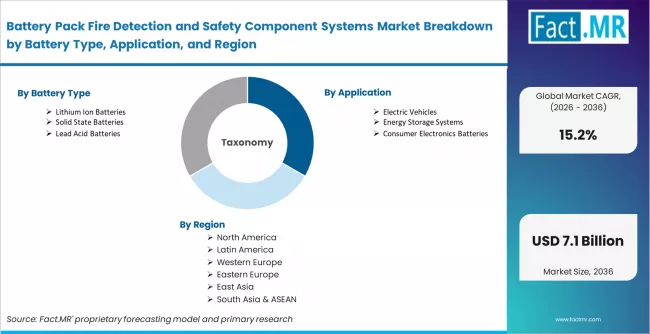
Battery Pack Fire Detection And Safety Component Systems Market Breakdown By Battery Type Application And Region | Source: Fact.MR
| Metric | Value |
|---|---|
| Quantitative Units | USD 1.5 billion (2026) to USD 6.2 billion (2036), at a CAGR of 15.2% |
| Market Definition | The battery pack fire detection and safety component systems market includes sensor-based monitoring and protection technologies designed to identify thermal instability, gas emissions, pressure variation, and electrical anomalies within battery systems. These components support early detection and mitigation of thermal runaway risks, enabling improved operational safety and reliability across electric mobility, stationary energy storage, and electronic device battery architectures. |
| Component Segmentation | Gas sensors, Temperature sensors, Pressure sensors, Control units, Fire suppression materials |
| Detection Type Segmentation | Thermal runaway detection, Gas emission detection, Smoke detection, Voltage anomaly detection, Multi-sensor detection |
| Application Segmentation | Electric vehicles, Energy storage systems, Consumer electronics batteries, Industrial battery systems, Aerospace batteries |
| Battery Type Segmentation | Lithium-ion batteries, Solid-state batteries, Lead-acid batteries, Nickel-based batteries |
| Regions Covered | North America, Latin America, Europe, East Asia, South Asia, Oceania, Middle East and Africa |
| Countries Covered | United States, Canada, Mexico, Brazil, Argentina, Germany, France, United Kingdom, Italy, Spain, China, India, Japan, South Korea, Indonesia, Australia, and 40+ countries |
| Key Companies Profiled | Honeywell, Siemens, Bosch, Sensata Technologies, Amphenol, TE Connectivity, Analog Devices, NXP Semiconductors, STMicroelectronics, Texas Instruments |
| Forecast Period | 2026 to 2036 |
| Approach | Hybrid top-down and bottom-up market estimation validated through primary interviews with battery system manufacturers, sensor technology providers, safety component developers, and energy storage integrators, supported by regulatory safety standards benchmarking, battery production capacity analysis, and evaluation of adoption trends across advanced battery protection systems |
Battery Pack Fire Detection and Safety Component Systems Market Key Segments
-
Component:
- Gas Sensors
- Temperature Sensors
- Pressure Sensors
- Control Units
- Fire Suppression Materials
-
Detection Type:
- Thermal Runaway Detection
- Gas Emission Detection
- Smoke Detection
- Voltage Anomaly Detection
- Multi Sensor Detection
-
Application:
- Electric Vehicles
- Energy Storage Systems
- Consumer Electronics Batteries
- Industrial Battery Systems
- Aerospace Batteries
-
Battery Type:
- Lithium Ion Batteries
- Solid State Batteries
- Lead Acid Batteries
- Nickel Based Batteries
-
Region:
- North America
- USA
- Canada
- Mexico
- Europe
- Germany
- UK
- France
- Italy
- Spain
- Nordic Countries
- BENELUX
- Rest of Europe
- Asia Pacific
- China
- Japan
- South Korea
- India
- Australia
- Rest of Asia Pacific
- Latin America
- Brazil
- Argentina
- Rest of Latin America
- Middle East and Africa
- Kingdom of Saudi Arabia
- United Arab Emirates
- South Africa
- Rest of Middle East and Africa
- Other Regions
- Oceania
- Central Asia
- Other Markets
- North America