Battery Pack Temperature and Voltage Sensor Systems Market (2026 - 2036)

The Battery Pack Temperature and Voltage Sensor Systems Market is segmented by Voltage (12V, 24V, 48V), Communication (Controller Area Network (CAN), Local Interconnect Network (LIN)), Vehicle Category (Passenger Car, Light Commercial Vehicle, Heavy Commercial Vehicle), Vehicle Type (BEV, HEV, PHEV), and Region. Forecast for 2026 to 2036.

Fact.MR analysis indicates that the battery pack temperature and voltage sensor systems market is undergoing a safety-driven transformation. Increasing regulatory focus on battery safety and thermal stability is pushing OEMs to integrate multi-point sensing systems with higher precision and reliability. Cost constraints in mass-market electric vehicles are limiting the adoption of advanced sensor architectures, creating a split between premium EV platforms and cost-sensitive vehicle segments.

Battery Pack Temperature and Voltage Sensor Systems Market Forecast and Outlook By FACT.MR

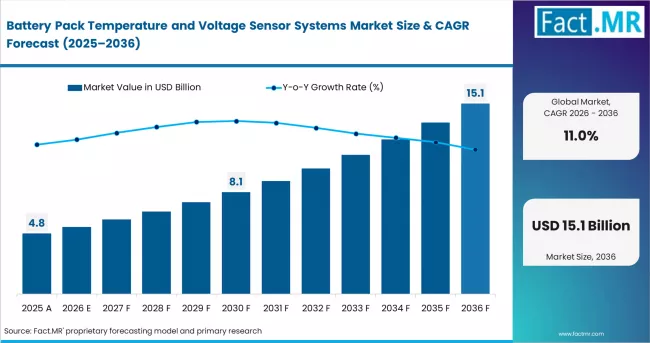
In 2025, the battery pack temperature and voltage sensor systems market was valued at USD 4.3 billion. Based on Fact.MR analysis, demand is estimated to grow to USD 4.8 billion in 2026 and reach USD 13.6 billion by 2036. FACT.MR projects a CAGR of 11.0% during the forecast period.
Battery Pack Temperature And Voltage Sensor Systems Market Value Analysis

Summary of Battery Pack Temperature and Voltage Sensor Systems Market

  • Market Definition
    • Battery pack temperature and voltage sensor systems monitor thermal and electrical conditions inside EV battery packs to ensure safe and efficient operation.
  • Demand Drivers
    • EV production growth is increasing sensor integration per battery pack across all vehicle categories.
    • Thermal runaway prevention requirements are driving adoption of high-precision temperature sensors.
    • High-voltage battery architectures are increasing demand for advanced voltage monitoring systems.
  • Key Segments Analyzed
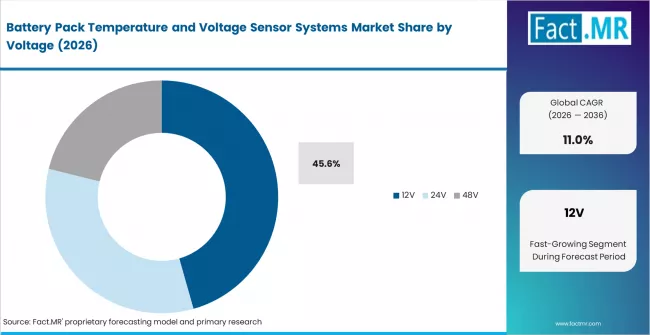
    • By Voltage: 12V is expected to account for 45.6% share in 2026, supported by compatibility with existing vehicle systems.
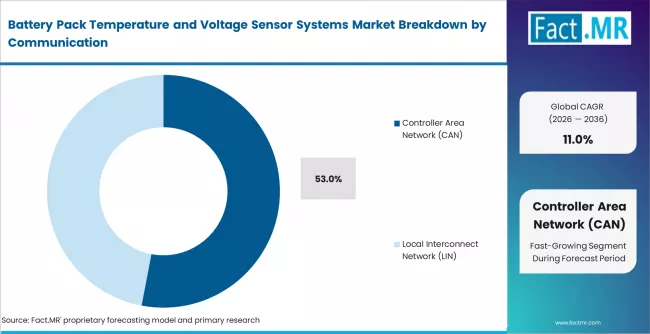
    • By Communication: CAN is projected to hold 53.0% share in 2026, driven by reliability and widespread automotive adoption.
    • By Geography: India leads growth at 13.0% CAGR, supported by EV policy incentives and domestic manufacturing expansion.
  • Analyst Opinion at FACT.MR
    • Shambhu Nath Jha, Senior Analyst at Fact.MR, states, 'CXOs will find that differentiation in this market is shifting toward sensing accuracy, system integration capability, and compliance with battery safety standards rather than cost alone.'
  • Strategic Implications
    • Invest in high-precision sensing technologies to meet evolving safety requirements.
    • Align product portfolios with high-voltage EV platforms to capture higher-value opportunities.
    • Build long-term partnerships with battery pack integrators and OEMs.
  • Methodology
    • Market sizing integrates EV production volumes with sensor-per-pack ratios.
    • Analysis includes OEM sourcing patterns and supplier shipment data.
    • Forecasts incorporate regulatory trends and battery technology evolution.
Metric Value
Estimated Value in 2026 USD 4.8 billion
Forecast Value in 2036 USD 13.6 billion
Forecast CAGR (2026 to 2036) 11.0%

The market is projected to generate USD 8.8 billion in incremental opportunity between 2026 and 2036. Growth is supported by rising EV production and increasing battery complexity, which requires continuous monitoring of thermal and electrical parameters. High-voltage battery architectures and stricter compliance standards are increasing sensor density per battery pack. Cost pressure in entry-level EV segments and consolidation among automotive electronics suppliers continue to influence pricing dynamics.

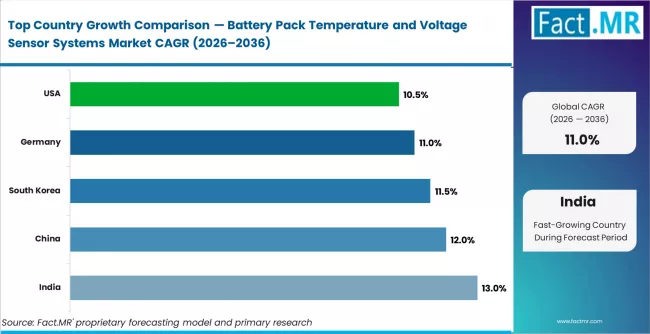
India is estimated to lead with a CAGR of 13.0% in the EV battery sensors market through 2036, supported by EV policy incentives and local battery manufacturing initiatives. China is anticipated to grow at 12.0% CAGR through 2036, driven by large-scale EV production and vertically integrated battery supply chains. South Korea is projected to record 11.5% CAGR through 2036, reflecting its position in advanced battery technologies. Germany is expected to expand at 11.0% CAGR through 2036, supported by regulatory compliance and OEM electrification strategies. The United States is likely to register 10.5% CAGR through 2036, backed by domestic manufacturing incentives and expansion of EV platforms.

Segmental Analysis

Battery Pack Temperature and Voltage Sensor Systems Market Analysis by Voltage
Battery Pack Temperature And Voltage Sensor Systems Market Analysis By Voltage

Based on FACT.MR's battery pack temperature and voltage sensor systems market report, 12V systems are estimated to account for 45.6% share in 2026. This segment leads due to compatibility with auxiliary systems and established automotive electrical architectures. It provides cost efficiency and remains widely adopted across both conventional and electrified vehicles.

  • Bosch Expansion: Robert Bosch GmbH expanded automotive sensor production capacity in 2025 to support EV platform scaling across Europe. [1]
  • TI Development: Texas Instruments Incorporated introduced high-precision battery monitoring ICs for EV applications in 2024. [2]
  • Supply Chain Shift: Automotive OEMs are increasing regional sourcing of electronic components to reduce exposure to semiconductor supply disruptions. [3]

Battery Pack Temperature and Voltage Sensor Systems Market Analysis by Communication
Battery Pack Temperature And Voltage Sensor Systems Market Analysis By Communication

CAN communication is expected to account for 53.0% share of the EV battery sensors market in 2026. Its continued use is supported by strong reliability, fault tolerance, and compatibility with existing automotive electronic control systems. CAN enables stable and secure data transmission across vehicle networks, which is critical for battery monitoring and safety. Widespread adoption across vehicle platforms also helps reduce integration complexity for OEMs and component suppliers.

  • NXP Investment: NXP Semiconductors expanded automotive communication chip development in 2024 to support EV architectures. [4]
  • Protocol Upgrade: CAN FD adoption is increasing to support higher data throughput in battery monitoring systems. [5]
  • OEM Standardization: Global OEMs continue to standardize CAN-based communication for battery systems across vehicle platforms. [6]

Drivers, Restraints, and Opportunities
Battery Pack Temperature And Voltage Sensor Systems Market Opportunity Matrix Growth Vs Value

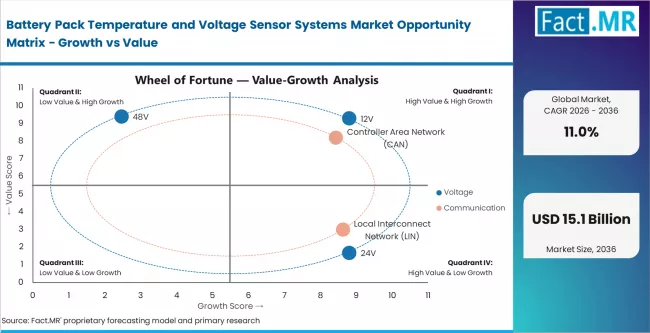
Market expansion is closely tied to the ongoing electrification of mobility and the increasing complexity of battery systems. Demand moves in line with EV production volumes, while changes in battery architecture continue to raise the need for more precise monitoring of temperature, voltage, and current. The current market size reflects a transition phase, where EV platforms are scaling but still adapting to stricter safety and performance standards. As battery capacities increase and charging speeds rise, monitoring requirements become more critical, which supports steady growth in sensor integration.

Sensor systems are moving from standalone monitoring units to integrated, safety-critical modules within the battery management system. Basic sensors are gradually losing relevance in high-performance EV platforms, where higher accuracy, faster response time, and redundancy are required to manage thermal risks and ensure system stability. Advanced sensor systems come with higher costs, which limits their use to premium and mid-to-high segment vehicles. This creates a split pricing structure, where entry-level EVs rely on cost-optimized solutions, while higher-end platforms adopt more complex and reliable sensor architectures.

  • Battery Safety Regulations: Global standards such as UNECE R100 are mandating advanced battery monitoring systems, increasing sensor density and system complexity.
  • High-Voltage Platforms: Growth in 400V and 800V battery systems is increasing demand for precise voltage sensing and fault detection capabilities.
  • Asia Manufacturing Scale: China and India are expanding EV production capacity, driving localized demand for integrated sensor systems within battery supply chains. 

Regional Analysis

The battery pack temperature and voltage sensor systems market is assessed across North America, Europe, Asia Pacific, Latin America, and Middle East & Africa. Regional demand reflects EV adoption rates, regulatory frameworks, and battery manufacturing capacity. The full report provides market attractiveness analysis.

Top Country Growth Comparison Battery Pack Temperature And Voltage Sensor Systems Market Cagr (2026 2036)

Country CAGR (2026 to 2036)
India 13.0%
China 12.0%
South Korea 11.5%
Germany 11.0%
USA 10.5%

Source: Fact.MR (FACTMR) analysis, based on proprietary forecasting model and primary research
Battery Pack Temperature And Voltage Sensor Systems Market Cagr Analysis By Country

Asia Pacific

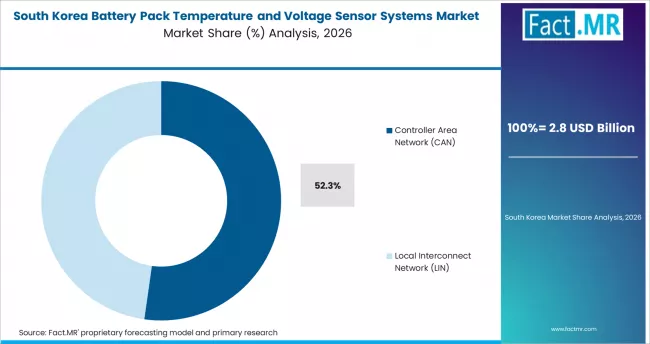
Battery Pack Temperature And Voltage Sensor Systems Market South Korea Market Share Analysis By Communication

Asia Pacific functions as the global production hub for EV batteries and sensor integration. Contemporary Amperex Technology Co., Limited and BYD Company Ltd. drive large-scale demand through vertically integrated supply chains.

  • India: India’s battery pack temperature and voltage sensor systems demand is accelerating alongside rapid EV adoption and policy-backed manufacturing expansion. Government incentives and localization efforts are strengthening the domestic ecosystem, while automakers are scaling EV production capacity. Cities like Pune are emerging as key automotive and component hubs, supporting supplier networks and integration capabilities. The market is projected to reach 13.0% CAGR, reflecting strong alignment between policy, production, and demand. Sensor systems are becoming critical as OEMs prioritize safety, thermal management, and battery efficiency. Suppliers that align with local manufacturing and cost structures can scale faster, while reliance on imports may limit long-term competitiveness.
  • China: China continues to dominate as the largest EV battery production base, supported by integrated supply chains and strong government backing for new energy vehicles. Sensor demand is closely linked to battery output and large-scale EV manufacturing. Growth remains robust, with a 12.0% CAGR expected, driven by continuous expansion in domestic EV production. Dominating Companies reinforce vertical integration, strengthening sensor integration demand. Suppliers that match scale, precision, and cost efficiency can benefit most in this highly competitive ecosystem.
  • South Korea: South Korea’s market benefits from advanced battery technology and strong global supply linkages. Leading manufacturers focus on precision engineering and export-driven growth, which increases demand for high-performance sensor systems. The category continues to expand steadily. A CAGR of 11.5% reflects this momentum, supported by innovation in battery safety and monitoring. Suppliers that align with stringent quality standards and global OEM requirements can strengthen their position, while limited differentiation may restrict opportunities in a technology-driven market.

Europe
Battery Pack Temperature And Voltage Sensor Systems Market Europe Country Market Share Analysis, 2026 & 2036

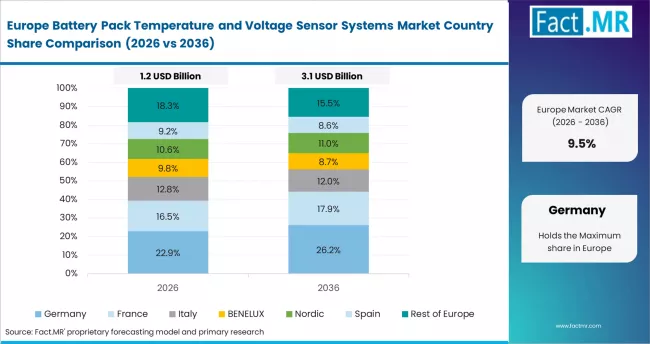
Europe’s EV landscape is shaped by regulation-driven adoption, where emission targets and compliance frameworks guide market direction. Automakers are aligning their electrification strategies with these mandates, accelerating the shift toward battery-powered mobility. Companies such as Volkswagen AG and Stellantis N.V. continue to expand EV portfolios under strict environmental standards.

  • Germany: Germany’s battery sensor systems demand is shaped by strict regulatory frameworks and strong domestic EV production. Automakers are advancing electrification strategies under tightening emission norms, which increases the need for reliable battery monitoring solutions. The market continues to expand steadily, supported by regulatory compliance and industrial investment. Growth is expected at an 11.0% CAGR, reflecting consistent demand across OEMs and suppliers. Companies such as Volkswagen AG are driving integration of advanced battery systems. Suppliers that meet certification and performance standards can secure long-term contracts in this structured market.

North America
Battery Pack Temperature And Voltage Sensor Systems Market Country Value Analysis

North America continues to show stable growth driven by rising EV adoption and strong domestic manufacturing incentives. Policy support encourages local battery production and supply chain development, strengthening demand for integrated components.

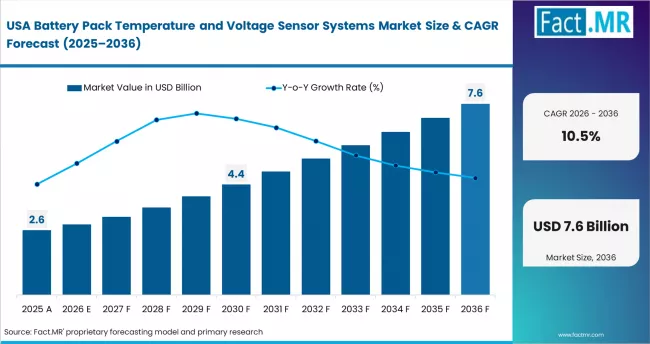
  • U.S.: The United States market reflects a balance between policy support and large-scale EV manufacturing expansion. Domestic production incentives and supply chain localization are strengthening demand for battery monitoring technologies. Automakers continue to invest in platform development and battery integration, increasing the need for precise sensor systems. The market is projected to expand at a 10.5% CAGR, supported by policy frameworks such as the Inflation Reduction Act. Companies like Tesla, Inc. and General Motors Company are scaling EV output, driving demand for integrated sensor solutions. Suppliers that align with domestic production requirements can gain a competitive edge.

FACTMR's analysis of battery pack temperature and voltage sensor systems market in global regions consists of country-wise assessment that includes India, China, South Korea, Germany, and the USA. Readers can find detailed insights on EV production trends, regulatory impact, and supplier positioning.

Competitive Aligners for Market Players
Battery Pack Temperature And Voltage Sensor Systems Market Analysis By Company

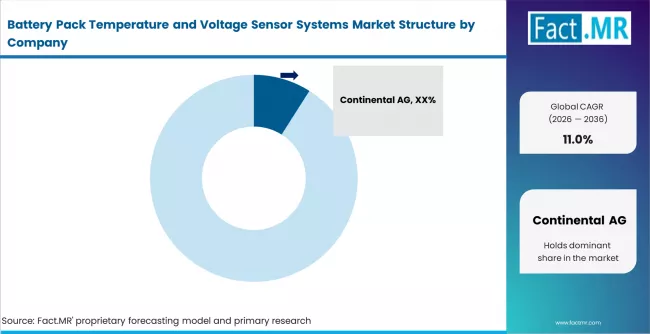
The market remains moderately concentrated, with leading automotive electronics suppliers controlling a significant portion of demand. Competition is shaped more by sensing accuracy, reliability, and integration capability than by price alone. Qualification requirements and safety compliance standards create high entry barriers, as suppliers must meet strict validation processes before being approved for vehicle programs. These requirements limit rapid entry and favor companies with proven performance records.

Established players benefit from long-standing relationships with OEMs and strong system integration capabilities. Bosch, Continental, and NXP Semiconductors maintain their position through global supply networks and advanced engineering capabilities. Their ability to deliver integrated solutions across multiple vehicle platforms strengthens their role in long-term sourcing programs.

Large OEMs retain bargaining strength through multi-sourcing strategies and extended qualification cycles. This approach reduces reliance on a single supplier and limits pricing control. Suppliers are responding by investing in product innovation, improving integration across battery systems, and expanding localized production to align with regional manufacturing requirements and secure long-term contracts.

Key Players

  • Continental AG
  • Robert Bosch GmbH
  • Furukawa Electric Co., Ltd.
  • NXP Semiconductors
  • Vishay Intertechnology Inc.
  • Inomatic GmbH
  • Texas Instruments Incorporated
  • HELLA
  • TE Connectivity
  • Battery Watering Technologies

Bibliography

  • [1] Robert Bosch GmbH, Automotive Electronics Expansion Report, March 2025
  • [2] Texas Instruments, Battery Monitoring IC Release Note, June 2024
  • [3] International Energy Agency, EV Supply Chain Outlook, 2024
  • [4] NXP Semiconductors, Automotive Communication Systems Update, April 2024
  • [5] ISO, CAN FD Standard Documentation, 2024
  • [6] European Commission, EV Electronics Standardization Report, 2025

This Report Addresses

  • Provides detailed intelligence on EV battery sensor systems, covering sensing technologies, integration trends, and system-level requirements across evolving EV platforms.
  • Covers market size from USD 4.8 billion in 2026 to USD 13.6 billion by 2036, reflecting expansion linked to EV production growth and battery complexity.
  • Identifies growth opportunities across EV architectures, battery management systems, and advanced sensing applications tied to safety and performance needs.
  • Offers segment and regional forecasts, with clear analysis of demand patterns across key countries and automotive manufacturing hubs.
  • Evaluates competitive strategies of key players, focusing on integration capability, OEM relationships, and long-term supply positioning.
  • Tracks product innovation and compliance developments, including shifts toward high-accuracy and safety-critical sensor systems.
  • Analyzes regulatory impact on battery safety systems, highlighting how standards influence design, validation, and supplier selection.
  • Delivered in PDF and structured data sheet formats for easier access across commercial and technical teams.

Battery Pack Temperature and Voltage Sensor Systems Market Definition

Battery pack temperature and voltage sensor systems are embedded electronic components used within electric vehicle battery packs to monitor temperature and voltage at the cell and module level. These systems provide real-time data to the battery management system to regulate charging, prevent overheating, and detect faults. Their primary function is to maintain battery safety, performance, and lifespan. The key end use is in electric and hybrid vehicles, where battery stability directly affects vehicle reliability and operating efficiency.

Battery Pack Temperature and Voltage Sensor Systems Market Inclusions

The report covers global and regional demand from 2026 to 2036, including market size, forecasts, and segment-level analysis. It evaluates voltage types, communication protocols, vehicle categories, and vehicle types. The study also includes pricing trends, OEM sourcing patterns, and integration within battery management systems across the electric mobility ecosystem.

Battery Pack Temperature and Voltage Sensor Systems Market Exclusions

The scope excludes full battery management systems, thermal cooling hardware, and complete battery packs. It does not include sensors used outside battery systems such as cabin or drivetrain sensors. The focus remains strictly on temperature and voltage sensing components embedded within battery packs and their direct electronic interfaces.

Battery Pack Temperature and Voltage Sensor Systems Market Research Methodology

  • Primary Research
    • Interviews with EV manufacturers, battery pack integrators, sensor suppliers, and automotive electronics engineers.
  • Desk Research
    • Data sourced from EV policy documents, automotive production databases, company filings, and battery technology publications.
  • Market-Sizing and Forecasting
    • Hybrid model using EV production volumes, battery configurations, and sensor-per-pack ratios.
  • Data Validation and Update Cycle
    • Validated using supplier shipment data and OEM sourcing patterns, updated annually.

Scope of Report

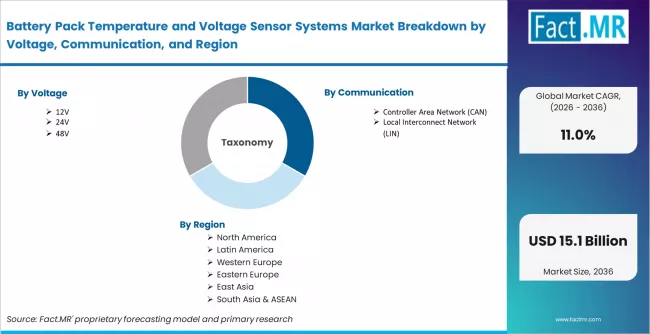
Battery Pack Temperature And Voltage Sensor Systems Market Breakdown By Voltage Communication And Region

Attribute Details
Quantitative Units USD 4.8 billion (2026) to USD 13.6 billion (2036), at a CAGR of 11.0%
Market Definition Battery pack temperature and voltage sensor systems embedded within EV battery packs to monitor thermal and electrical conditions, enabling safe operation, performance optimization, and fault detection across electric and hybrid vehicles globally.
Voltage Segmentation 12V, 24V, 48V
Communication Segmentation Controller Area Network (CAN), Local Interconnect Network (LIN)
Vehicle Category Segmentation Passenger Car, Light Commercial Vehicle, Heavy Commercial Vehicle
Vehicle Type Segmentation BEV, HEV, PHEV
Application Coverage Battery monitoring systems, thermal management support, voltage balancing, fault detection, and safety compliance within EV battery packs
Regions Covered North America, Europe, Asia Pacific, Latin America, Middle East & Africa
Countries Covered USA, Canada, Mexico, Germany, UK, France, Italy, Spain, China, Japan, South Korea, India, ASEAN, Brazil, Argentina, GCC, South Africa, Israel
Key Companies Profiled Continental AG, Robert Bosch GmbH, NXP Semiconductors, Texas Instruments Incorporated, TE Connectivity, HELLA
Forecast Period 2026 to 2036
Approach Hybrid model combining EV production volumes, battery pack configurations, sensor density per pack, average selling prices, and primary interviews with OEMs and suppliers

Battery Pack Temperature and Voltage Sensor Systems Market Segments

  • By Voltage

    • 12V
    • 24V
    • 48V
  • By Communication

    • Controller Area Network (CAN)
    • Local Interconnect Network (LIN)
  • By Vehicle Category

    • Passenger Car
    • Light Commercial Vehicle
    • Heavy Commercial Vehicle
  • By Vehicle Type

    • BEV
    • HEV
    • PHEV
  • By Region

    • North America
      • United States
      • Canada
    • Europe
      • Germany
      • United Kingdom
      • France
      • Italy
      • Spain
    • Asia Pacific
      • China
      • Japan
      • South Korea
      • India
      • ASEAN
    • Latin America
      • Brazil
      • Mexico
      • Argentina
    • Middle East & Africa
      • GCC Countries
      • South Africa
      • Israel

Table of Content

  1. Executive Summary
    • Global Market Outlook
    • Demand to side Trends
    • Supply to side Trends
    • Technology Roadmap Analysis
    • Analysis and Recommendations
  2. Market Overview
    • Market Coverage / Taxonomy
    • Market Definition / Scope / Limitations
  3. Research Methodology
    • Chapter Orientation
    • Analytical Lens and Working Hypotheses
      • Market Structure, Signals, and Trend Drivers
      • Benchmarking and Cross-market Comparability
      • Market Sizing, Forecasting, and Opportunity Mapping
    • Research Design and Evidence Framework
      • Desk Research Programme (Secondary Evidence)
        • Company Annual and Sustainability Reports
        • Peer-reviewed Journals and Academic Literature
        • Corporate Websites, Product Literature, and Technical Notes
        • Earnings Decks and Investor Briefings
        • Statutory Filings and Regulatory Disclosures
        • Technical White Papers and Standards Notes
        • Trade Journals, Industry Magazines, and Analyst Briefs
        • Conference Proceedings, Webinars, and Seminar Materials
        • Government Statistics Portals and Public Data Releases
        • Press Releases and Reputable Media Coverage
        • Specialist Newsletters and Curated Briefings
        • Sector Databases and Reference Repositories
        • Fact.MR Internal Proprietary Databases and Historical Market Datasets
        • Subscription Datasets and Paid Sources
        • Social Channels, Communities, and Digital Listening Inputs
        • Additional Desk Sources
      • Expert Input and Fieldwork (Primary Evidence)
        • Primary Modes
          • Qualitative Interviews and Expert Elicitation
          • Quantitative Surveys and Structured Data Capture
          • Blended Approach
        • Why Primary Evidence is Used
        • Field Techniques
          • Interviews
          • Surveys
          • Focus Groups
          • Observational and In-context Research
          • Social and Community Interactions
        • Stakeholder Universe Engaged
          • C-suite Leaders
          • Board Members
          • Presidents and Vice Presidents
          • R&D and Innovation Heads
          • Technical Specialists
          • Domain Subject-matter Experts
          • Scientists
          • Physicians and Other Healthcare Professionals
        • Governance, Ethics, and Data Stewardship
          • Research Ethics
          • Data Integrity and Handling
      • Tooling, Models, and Reference Databases
    • Data Engineering and Model Build
      • Data Acquisition and Ingestion
      • Cleaning, Normalisation, and Verification
      • Synthesis, Triangulation, and Analysis
    • Quality Assurance and Audit Trail
  4. Market Background
    • Market Dynamics
      • Drivers
      • Restraints
      • Opportunity
      • Trends
    • Scenario Forecast
      • Demand in Optimistic Scenario
      • Demand in Likely Scenario
      • Demand in Conservative Scenario
    • Opportunity Map Analysis
    • Product Life Cycle Analysis
    • Supply Chain Analysis
    • Investment Feasibility Matrix
    • Value Chain Analysis
    • PESTLE and Porter’s Analysis
    • Regulatory Landscape
    • Regional Parent Market Outlook
    • Production and Consumption Statistics
    • Import and Export Statistics
  5. Global Market Analysis 2021 to 2025 and Forecast, 2026 to 2036
    • Historical Market Size Value (USD Million) Analysis, 2021 to 2025
    • Current and Future Market Size Value (USD Million) Projections, 2026 to 2036
      • Y to o to Y Growth Trend Analysis
      • Absolute $ Opportunity Analysis
  6. Global Market Pricing Analysis 2021 to 2025 and Forecast 2026 to 2036
  7. Global Market Analysis 2021 to 2025 and Forecast 2026 to 2036, By Voltage
    • Introduction / Key Findings
    • Historical Market Size Value (USD Million) Analysis By Voltage , 2021 to 2025
    • Current and Future Market Size Value (USD Million) Analysis and Forecast By Voltage , 2026 to 2036
      • 12V
      • 24V
      • 48V
    • Y to o to Y Growth Trend Analysis By Voltage , 2021 to 2025
    • Absolute $ Opportunity Analysis By Voltage , 2026 to 2036
  8. Global Market Analysis 2021 to 2025 and Forecast 2026 to 2036, By Communication
    • Introduction / Key Findings
    • Historical Market Size Value (USD Million) Analysis By Communication, 2021 to 2025
    • Current and Future Market Size Value (USD Million) Analysis and Forecast By Communication, 2026 to 2036
      • Controller Area Network (CAN)
      • Local Interconnect Network (LIN)
    • Y to o to Y Growth Trend Analysis By Communication, 2021 to 2025
    • Absolute $ Opportunity Analysis By Communication, 2026 to 2036
  9. Global Market Analysis 2021 to 2025 and Forecast 2026 to 2036, By Region
    • Introduction
    • Historical Market Size Value (USD Million) Analysis By Region, 2021 to 2025
    • Current Market Size Value (USD Million) Analysis and Forecast By Region, 2026 to 2036
      • North America
      • Latin America
      • Western Europe
      • Eastern Europe
      • East Asia
      • South Asia and Pacific
      • Middle East & Africa
    • Market Attractiveness Analysis By Region
  10. North America Market Analysis 2021 to 2025 and Forecast 2026 to 2036, By Country
    • Historical Market Size Value (USD Million) Trend Analysis By Market Taxonomy, 2021 to 2025
    • Market Size Value (USD Million) Forecast By Market Taxonomy, 2026 to 2036
      • By Country
        • USA
        • Canada
        • Mexico
      • By Voltage
      • By Communication
    • Market Attractiveness Analysis
      • By Country
      • By Voltage
      • By Communication
    • Key Takeaways
  11. Latin America Market Analysis 2021 to 2025 and Forecast 2026 to 2036, By Country
    • Historical Market Size Value (USD Million) Trend Analysis By Market Taxonomy, 2021 to 2025
    • Market Size Value (USD Million) Forecast By Market Taxonomy, 2026 to 2036
      • By Country
        • Brazil
        • Chile
        • Rest of Latin America
      • By Voltage
      • By Communication
    • Market Attractiveness Analysis
      • By Country
      • By Voltage
      • By Communication
    • Key Takeaways
  12. Western Europe Market Analysis 2021 to 2025 and Forecast 2026 to 2036, By Country
    • Historical Market Size Value (USD Million) Trend Analysis By Market Taxonomy, 2021 to 2025
    • Market Size Value (USD Million) Forecast By Market Taxonomy, 2026 to 2036
      • By Country
        • Germany
        • UK
        • Italy
        • Spain
        • France
        • Nordic
        • BENELUX
        • Rest of Western Europe
      • By Voltage
      • By Communication
    • Market Attractiveness Analysis
      • By Country
      • By Voltage
      • By Communication
    • Key Takeaways
  13. Eastern Europe Market Analysis 2021 to 2025 and Forecast 2026 to 2036, By Country
    • Historical Market Size Value (USD Million) Trend Analysis By Market Taxonomy, 2021 to 2025
    • Market Size Value (USD Million) Forecast By Market Taxonomy, 2026 to 2036
      • By Country
        • Russia
        • Poland
        • Hungary
        • Balkan & Baltic
        • Rest of Eastern Europe
      • By Voltage
      • By Communication
    • Market Attractiveness Analysis
      • By Country
      • By Voltage
      • By Communication
    • Key Takeaways
  14. East Asia Market Analysis 2021 to 2025 and Forecast 2026 to 2036, By Country
    • Historical Market Size Value (USD Million) Trend Analysis By Market Taxonomy, 2021 to 2025
    • Market Size Value (USD Million) Forecast By Market Taxonomy, 2026 to 2036
      • By Country
        • China
        • Japan
        • South Korea
      • By Voltage
      • By Communication
    • Market Attractiveness Analysis
      • By Country
      • By Voltage
      • By Communication
    • Key Takeaways
  15. South Asia and Pacific Market Analysis 2021 to 2025 and Forecast 2026 to 2036, By Country
    • Historical Market Size Value (USD Million) Trend Analysis By Market Taxonomy, 2021 to 2025
    • Market Size Value (USD Million) Forecast By Market Taxonomy, 2026 to 2036
      • By Country
        • India
        • ASEAN
        • Australia & New Zealand
        • Rest of South Asia and Pacific
      • By Voltage
      • By Communication
    • Market Attractiveness Analysis
      • By Country
      • By Voltage
      • By Communication
    • Key Takeaways
  16. Middle East & Africa Market Analysis 2021 to 2025 and Forecast 2026 to 2036, By Country
    • Historical Market Size Value (USD Million) Trend Analysis By Market Taxonomy, 2021 to 2025
    • Market Size Value (USD Million) Forecast By Market Taxonomy, 2026 to 2036
      • By Country
        • Kingdom of Saudi Arabia
        • Other GCC Countries
        • Turkiye
        • South Africa
        • Other African Union
        • Rest of Middle East & Africa
      • By Voltage
      • By Communication
    • Market Attractiveness Analysis
      • By Country
      • By Voltage
      • By Communication
    • Key Takeaways
  17. Key Countries Market Analysis
    • USA
      • Pricing Analysis
      • Market Share Analysis, 2025
        • By Voltage
        • By Communication
    • Canada
      • Pricing Analysis
      • Market Share Analysis, 2025
        • By Voltage
        • By Communication
    • Mexico
      • Pricing Analysis
      • Market Share Analysis, 2025
        • By Voltage
        • By Communication
    • Brazil
      • Pricing Analysis
      • Market Share Analysis, 2025
        • By Voltage
        • By Communication
    • Chile
      • Pricing Analysis
      • Market Share Analysis, 2025
        • By Voltage
        • By Communication
    • Germany
      • Pricing Analysis
      • Market Share Analysis, 2025
        • By Voltage
        • By Communication
    • UK
      • Pricing Analysis
      • Market Share Analysis, 2025
        • By Voltage
        • By Communication
    • Italy
      • Pricing Analysis
      • Market Share Analysis, 2025
        • By Voltage
        • By Communication
    • Spain
      • Pricing Analysis
      • Market Share Analysis, 2025
        • By Voltage
        • By Communication
    • France
      • Pricing Analysis
      • Market Share Analysis, 2025
        • By Voltage
        • By Communication
    • India
      • Pricing Analysis
      • Market Share Analysis, 2025
        • By Voltage
        • By Communication
    • ASEAN
      • Pricing Analysis
      • Market Share Analysis, 2025
        • By Voltage
        • By Communication
    • Australia & New Zealand
      • Pricing Analysis
      • Market Share Analysis, 2025
        • By Voltage
        • By Communication
    • China
      • Pricing Analysis
      • Market Share Analysis, 2025
        • By Voltage
        • By Communication
    • Japan
      • Pricing Analysis
      • Market Share Analysis, 2025
        • By Voltage
        • By Communication
    • South Korea
      • Pricing Analysis
      • Market Share Analysis, 2025
        • By Voltage
        • By Communication
    • Russia
      • Pricing Analysis
      • Market Share Analysis, 2025
        • By Voltage
        • By Communication
    • Poland
      • Pricing Analysis
      • Market Share Analysis, 2025
        • By Voltage
        • By Communication
    • Hungary
      • Pricing Analysis
      • Market Share Analysis, 2025
        • By Voltage
        • By Communication
    • Kingdom of Saudi Arabia
      • Pricing Analysis
      • Market Share Analysis, 2025
        • By Voltage
        • By Communication
    • Turkiye
      • Pricing Analysis
      • Market Share Analysis, 2025
        • By Voltage
        • By Communication
    • South Africa
      • Pricing Analysis
      • Market Share Analysis, 2025
        • By Voltage
        • By Communication
  18. Market Structure Analysis
    • Competition Dashboard
    • Competition Benchmarking
    • Market Share Analysis of Top Players
      • By Regional
      • By Voltage
      • By Communication
  19. Competition Analysis
    • Competition Deep Dive
      • Continental AG
        • Overview
        • Product Portfolio
        • Profitability by Market Segments (Product/Age /Sales Channel/Region)
        • Sales Footprint
        • Strategy Overview
          • Marketing Strategy
          • Product Strategy
          • Channel Strategy
      • Robert Bosch GmbH
      • Furukawa Electric Co., Ltd.
      • NXP Semiconductors
      • Vishay Intertechnology Inc.
      • Inomatic GmbH
      • Texas Instruments Incorporated
      • HELLA
      • TE Connectivity
      • Battery Watering Technologies
  20. Assumptions & Acronyms Used

List Of Table

  • Table 1: Global Market Value (USD Million) Forecast by Region, 2021 to 2036
  • Table 2: Global Market Value (USD Million) Forecast by Voltage, 2021 to 2036
  • Table 3: Global Market Value (USD Million) Forecast by Communication, 2021 to 2036
  • Table 4: North America Market Value (USD Million) Forecast by Country, 2021 to 2036
  • Table 5: North America Market Value (USD Million) Forecast by Voltage, 2021 to 2036
  • Table 6: North America Market Value (USD Million) Forecast by Communication, 2021 to 2036
  • Table 7: Latin America Market Value (USD Million) Forecast by Country, 2021 to 2036
  • Table 8: Latin America Market Value (USD Million) Forecast by Voltage, 2021 to 2036
  • Table 9: Latin America Market Value (USD Million) Forecast by Communication, 2021 to 2036
  • Table 10: Western Europe Market Value (USD Million) Forecast by Country, 2021 to 2036
  • Table 11: Western Europe Market Value (USD Million) Forecast by Voltage, 2021 to 2036
  • Table 12: Western Europe Market Value (USD Million) Forecast by Communication, 2021 to 2036
  • Table 13: Eastern Europe Market Value (USD Million) Forecast by Country, 2021 to 2036
  • Table 14: Eastern Europe Market Value (USD Million) Forecast by Voltage, 2021 to 2036
  • Table 15: Eastern Europe Market Value (USD Million) Forecast by Communication, 2021 to 2036
  • Table 16: East Asia Market Value (USD Million) Forecast by Country, 2021 to 2036
  • Table 17: East Asia Market Value (USD Million) Forecast by Voltage, 2021 to 2036
  • Table 18: East Asia Market Value (USD Million) Forecast by Communication, 2021 to 2036
  • Table 19: South Asia and Pacific Market Value (USD Million) Forecast by Country, 2021 to 2036
  • Table 20: South Asia and Pacific Market Value (USD Million) Forecast by Voltage, 2021 to 2036
  • Table 21: South Asia and Pacific Market Value (USD Million) Forecast by Communication, 2021 to 2036
  • Table 22: Middle East & Africa Market Value (USD Million) Forecast by Country, 2021 to 2036
  • Table 23: Middle East & Africa Market Value (USD Million) Forecast by Voltage, 2021 to 2036
  • Table 24: Middle East & Africa Market Value (USD Million) Forecast by Communication, 2021 to 2036

List Of Figures

  • Figure 1: Global Market Pricing Analysis
  • Figure 2: Global Market Value (USD Million) Forecast 2021 to 2036
  • Figure 3: Global Market Value Share and BPS Analysis by Voltage, 2026 and 2036
  • Figure 4: Global Market Y-o-Y Growth Comparison by Voltage, 2026 to 2036
  • Figure 5: Global Market Attractiveness Analysis by Voltage
  • Figure 6: Global Market Value Share and BPS Analysis by Communication, 2026 and 2036
  • Figure 7: Global Market Y-o-Y Growth Comparison by Communication, 2026 to 2036
  • Figure 8: Global Market Attractiveness Analysis by Communication
  • Figure 9: Global Market Value (USD Million) Share and BPS Analysis by Region, 2026 and 2036
  • Figure 10: Global Market Y-o-Y Growth Comparison by Region, 2026 to 2036
  • Figure 11: Global Market Attractiveness Analysis by Region
  • Figure 12: North America Market Incremental Dollar Opportunity, 2026 to 2036
  • Figure 13: Latin America Market Incremental Dollar Opportunity, 2026 to 2036
  • Figure 14: Western Europe Market Incremental Dollar Opportunity, 2026 to 2036
  • Figure 15: Eastern Europe Market Incremental Dollar Opportunity, 2026 to 2036
  • Figure 16: East Asia Market Incremental Dollar Opportunity, 2026 to 2036
  • Figure 17: South Asia and Pacific Market Incremental Dollar Opportunity, 2026 to 2036
  • Figure 18: Middle East & Africa Market Incremental Dollar Opportunity, 2026 to 2036
  • Figure 19: North America Market Value Share and BPS Analysis by Country, 2026 and 2036
  • Figure 20: North America Market Value Share and BPS Analysis by Voltage, 2026 and 2036
  • Figure 21: North America Market Y-o-Y Growth Comparison by Voltage, 2026 to 2036
  • Figure 22: North America Market Attractiveness Analysis by Voltage
  • Figure 23: North America Market Value Share and BPS Analysis by Communication, 2026 and 2036
  • Figure 24: North America Market Y-o-Y Growth Comparison by Communication, 2026 to 2036
  • Figure 25: North America Market Attractiveness Analysis by Communication
  • Figure 26: Latin America Market Value Share and BPS Analysis by Country, 2026 and 2036
  • Figure 27: Latin America Market Value Share and BPS Analysis by Voltage, 2026 and 2036
  • Figure 28: Latin America Market Y-o-Y Growth Comparison by Voltage, 2026 to 2036
  • Figure 29: Latin America Market Attractiveness Analysis by Voltage
  • Figure 30: Latin America Market Value Share and BPS Analysis by Communication, 2026 and 2036
  • Figure 31: Latin America Market Y-o-Y Growth Comparison by Communication, 2026 to 2036
  • Figure 32: Latin America Market Attractiveness Analysis by Communication
  • Figure 33: Western Europe Market Value Share and BPS Analysis by Country, 2026 and 2036
  • Figure 34: Western Europe Market Value Share and BPS Analysis by Voltage, 2026 and 2036
  • Figure 35: Western Europe Market Y-o-Y Growth Comparison by Voltage, 2026 to 2036
  • Figure 36: Western Europe Market Attractiveness Analysis by Voltage
  • Figure 37: Western Europe Market Value Share and BPS Analysis by Communication, 2026 and 2036
  • Figure 38: Western Europe Market Y-o-Y Growth Comparison by Communication, 2026 to 2036
  • Figure 39: Western Europe Market Attractiveness Analysis by Communication
  • Figure 40: Eastern Europe Market Value Share and BPS Analysis by Country, 2026 and 2036
  • Figure 41: Eastern Europe Market Value Share and BPS Analysis by Voltage, 2026 and 2036
  • Figure 42: Eastern Europe Market Y-o-Y Growth Comparison by Voltage, 2026 to 2036
  • Figure 43: Eastern Europe Market Attractiveness Analysis by Voltage
  • Figure 44: Eastern Europe Market Value Share and BPS Analysis by Communication, 2026 and 2036
  • Figure 45: Eastern Europe Market Y-o-Y Growth Comparison by Communication, 2026 to 2036
  • Figure 46: Eastern Europe Market Attractiveness Analysis by Communication
  • Figure 47: East Asia Market Value Share and BPS Analysis by Country, 2026 and 2036
  • Figure 48: East Asia Market Value Share and BPS Analysis by Voltage, 2026 and 2036
  • Figure 49: East Asia Market Y-o-Y Growth Comparison by Voltage, 2026 to 2036
  • Figure 50: East Asia Market Attractiveness Analysis by Voltage
  • Figure 51: East Asia Market Value Share and BPS Analysis by Communication, 2026 and 2036
  • Figure 52: East Asia Market Y-o-Y Growth Comparison by Communication, 2026 to 2036
  • Figure 53: East Asia Market Attractiveness Analysis by Communication
  • Figure 54: South Asia and Pacific Market Value Share and BPS Analysis by Country, 2026 and 2036
  • Figure 55: South Asia and Pacific Market Value Share and BPS Analysis by Voltage, 2026 and 2036
  • Figure 56: South Asia and Pacific Market Y-o-Y Growth Comparison by Voltage, 2026 to 2036
  • Figure 57: South Asia and Pacific Market Attractiveness Analysis by Voltage
  • Figure 58: South Asia and Pacific Market Value Share and BPS Analysis by Communication, 2026 and 2036
  • Figure 59: South Asia and Pacific Market Y-o-Y Growth Comparison by Communication, 2026 to 2036
  • Figure 60: South Asia and Pacific Market Attractiveness Analysis by Communication
  • Figure 61: Middle East & Africa Market Value Share and BPS Analysis by Country, 2026 and 2036
  • Figure 62: Middle East & Africa Market Value Share and BPS Analysis by Voltage, 2026 and 2036
  • Figure 63: Middle East & Africa Market Y-o-Y Growth Comparison by Voltage, 2026 to 2036
  • Figure 64: Middle East & Africa Market Attractiveness Analysis by Voltage
  • Figure 65: Middle East & Africa Market Value Share and BPS Analysis by Communication, 2026 and 2036
  • Figure 66: Middle East & Africa Market Y-o-Y Growth Comparison by Communication, 2026 to 2036
  • Figure 67: Middle East & Africa Market Attractiveness Analysis by Communication
  • Figure 68: Global Market - Tier Structure Analysis
  • Figure 69: Global Market - Company Share Analysis

- Frequently Asked Questions -

How large is the battery pack temperature and voltage sensor systems market in 2025?

The market was valued at USD 4.3 billion in 2025.

What is the estimated market size in 2026?

The market is projected to reach USD 4.8 billion in 2026.

What will be the market size by 2036?

The market is forecast to grow to USD 13.6 billion by 2036.

What is the expected CAGR for this market?

The market is expected to grow at a 11.0% CAGR from 2026 to 2036.

What are battery pack temperature and voltage sensor systems?

These are electronic components used inside EV battery packs to measure temperature and voltage. They help prevent overheating, control charging, and improve battery safety.

Why are these sensor systems important in electric vehicles?

They ensure safe battery operation by monitoring heat and voltage levels. This helps prevent failures, extends battery life, and improves vehicle performance.

Which voltage segment is expected to lead the market?

The 12V segment is expected to account for 45.6% share in 2026, due to its wide use in vehicle systems.

Which communication protocol dominates this market?

CAN (Controller Area Network) is projected to hold 53.0% share in 2026, as it is widely used in automotive electronics.

Which vehicle type is driving demand for these systems?

Battery electric vehicles (BEVs) are the primary drivers, as they require advanced battery monitoring systems.

Which region is growing the fastest in this market?

India is expected to grow the fastest, with a 13.0% CAGR through 2036.

What is driving market growth?

Growth is driven by rising EV production, stricter battery safety regulations, and increasing battery complexity.

What are the main challenges in this market?

Key challenges include cost pressure in entry-level EVs and high qualification requirements for automotive suppliers.

How are high-voltage battery systems affecting demand?

High-voltage systems require more precise monitoring, increasing demand for advanced voltage sensing solutions.

What opportunities exist for companies in this market?

Opportunities include developing high-accuracy sensors, partnering with EV manufacturers, and expanding into high-voltage battery platforms.

Battery Pack Temperature and Voltage Sensor Systems Market