- Base Value(2025): 242 Mn
- Estimated Value(2026): 270 Mn
- Forecast Value (2036): 804 Mn
- CAGR (2026 - 2036): 11.6%
Battery Thermal Pump Couplings Market Forecast 2026 to 2036
In 2025, the battery thermal pump couplings market was valued at USD 242 million. Based on Future Market Insights’ analysis, demand for these specialized components is estimated to grow to USD 270 million in 2026 and USD 804 million by 2036. FMR projects a CAGR of 11.6% during the forecast period. This represents an absolute dollar growth of USD 534 million, a transformational shift as EV architectures move toward high-voltage systems that require extreme thermal precision. While the trend toward 800V fast-charging keeps growth steady, expansion is tempered by feedstock volatility in high-performance polymers and regulatory costs involving stringent leak-proof certifications.
Industry leaders highlight that efficient thermal management is the linchpin of vehicle longevity. As In-Young Lee, President and CEO of Hanon Systems, noted, 'We apply our expertise in thermal management to offer solutions designed to maintain an optimal operating temperature of the electrical and electronic componentry in eco-friendly vehicles' [1].
Regionally, China leads with a 14.0% CAGR, followed by Brazil (13.7%) and USA (11.0%). Conversely, Germany (10.8%), South Korea (10.7%), and Japan (9.9%) are mature markets driven by replacement demand. A significant structural constraint for this group is substitution pressure, as next-generation integrated thermal modules consolidate multiple individual couplings into single-piece cast manifolds.
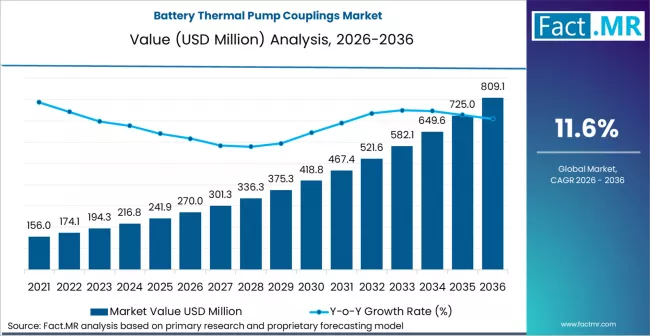
Battery Thermal Pump Couplings Market Market Value Analysis | Source: Fact.MR
Battery Thermal Pump Couplings Market
This market involves mechanical couplings and connectors that link electric coolant pumps to thermal management circuits within an EV battery pack. These components, often made from specialized elastomers or corrosion-resistant alloys, perform the primary industrial function of leak-proof power transmission and vibration isolation between the pump motor and the fluid impeller. The key end-use is in active liquid-cooling systems for electric and hybrid vehicles, where they ensure the consistent flow of thermal fluids to prevent battery overheating during rapid charging and high-performance driving.
What the Report Covers
The report details global and regional market sizes for the 2026 to 2036 forecast period. It segments the industry by product type (flexible and rigid pump couplings), propulsion (BEV and PHEV), and end-user (OEMs and Aftermarket). Analytical dimensions include regional pricing benchmarks and fluid compatibility analysis, tracking how the shift toward dielectric coolants influences material selection for coupling seals and hubs.
What the Report Does Not Cover
The scope excludes the electric pumps themselves and the battery cells they service. It also omits external charging station cooling hardware and standard engine cooling parts for combustion vehicles. Niche applications, such as industrial stationary energy storage (BESS) or aerospace thermal systems, are excluded to focus strictly on pump-to-circuit mechanical couplings within passenger and light-commercial electric vehicle battery packs.
- Primary Research: We interviewed thermal management engineers and pump manufacturers to identify critical failure points and performance requirements for next-generation 800V architectures.
- Desk Research: Analysts reviewed technical SAE journals, patent filings for leak-free connectors, and environmental regulations governing automotive coolant chemistries.
- Market-Sizing and Forecasting: A hybrid model was used, combining top-down global EV production data with bottom-up consumption rates of pump accessories per thermal loop.
Data Validation and Update Cycle
Outputs are cross-verified against manufacturer shipping logs and updated semi-annually to stay aligned with rapid innovations in integrated thermal modules.
Battery Thermal Pump Couplings Market Definition:
The market includes specialized mechanical couplings and connectors used in electric vehicle (EV) battery cooling systems. These components ensure optimal battery temperature by connecting electric coolant pumps to thermal management circuits, preventing overheating during rapid charging and high-performance driving.
Demand Drivers in the Market:
- Thermal Management Necessity: Growing battery capacities and faster charging speeds increase the demand for advanced thermal solutions to maintain battery efficiency and prevent thermal runaway.
- EV Growth: The rise in electric vehicle adoption, driven by environmental concerns and government incentives, is pushing the need for better thermal management in EV battery packs.
- Regulatory Standards: Stricter regulations surrounding battery safety and thermal management are driving OEMs to adopt advanced couplings and connectors to meet these requirements.
Key Segments Analyzed in the Report:
- Pump Type: Electric Coolant Pumps, Refrigerant Pumps, Integrated Thermal Pump Modules, Others.
- Coupling Type: Magnetic Couplings, Elastomeric Flexible Couplings (33% market share by 2026), Metal Disc Couplings, Others.
- Vehicle Segment: Passenger EVs (61% of market share by 2026), LCV EVs, Premium/Luxury EVs, Others.
- Sales Channel: OEM Line-Fit (77% market share by 2026), Tier-1 Integrated, Aftermarket, Others.
Analyst Opinion at FMR:
The market is shifting from basic cooling components to high-performance thermal solutions as EVs move toward high-voltage systems and advanced cooling technologies, making thermal pump couplings crucial for vehicle longevity and safety.
Strategic Implications/Executive Takeaways:
- OEM Adoption: As EV production scales, OEM line-fit solutions dominate, allowing manufacturers to integrate advanced couplings into new vehicles at optimized costs.
- Global Shift in Materials: Increasing use of high-performance elastomers and corrosion-resistant alloys is essential for enhancing efficiency and ensuring leak-proof operations in high-density battery packs.
- Regional Focus: China and Brazil are key growth markets driven by increasing EV production, while Europe and Japan are mature markets focusing on system upgrades to meet stricter thermal management standards.
Methodology:
- Validated through primary interviews with thermal management engineers and pump manufacturers. Market sizing integrates global EV production data with detailed segment analysis and manufacturer shipping logs.
Segmental Analysis
Battery Thermal Pump Couplings Market Analysis by Vehicle Segment
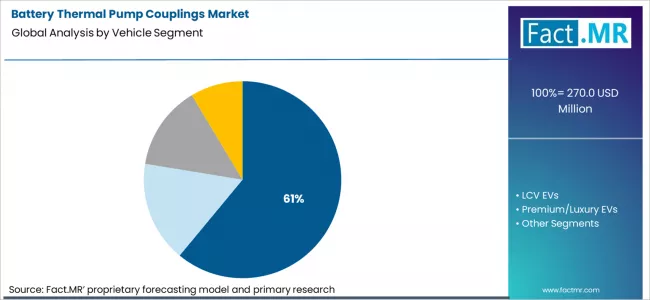
Battery Thermal Pump Couplings Market Analysis By Vehicle Segment | Source: Fact.MR
- Market Overview: Passenger EVs are expected to hold 61% of the battery thermal pump couplings market by 2026. As the largest and most rapidly growing segment in the electric vehicle (EV) industry, passenger EVs drive significant demand for thermal management solutions. Battery thermal pump couplings are crucial for maintaining optimal battery temperature, ensuring efficiency, safety, and longevity in these vehicles.
- Demand Drivers:
- Battery Efficiency and Safety: With the increasing energy demands and larger battery packs in passenger EVs, effective thermal management becomes essential. Thermal pump couplings help maintain the battery at optimal temperatures, preventing overheating and enhancing overall performance.
- EV Adoption Growth: The rapid growth in passenger EV adoption, driven by environmental concerns and governmental support, is pushing for more advanced cooling and thermal management systems, creating a higher need for thermal pump couplings.
- Range and Performance Optimization: Effective battery cooling directly impacts the driving range and overall vehicle performance, prompting automakers to integrate advanced thermal management systems, including thermal pump couplings, into passenger EVs.
Battery Thermal Pump Couplings Market Analysis by Coupling Type
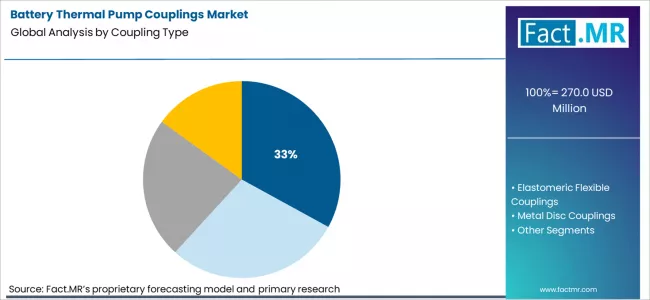
C | Source: Fact.MR
- Market Overview: Elastomeric flexible couplings are projected to capture 33% of the market share by 2026. These couplings are known for their ability to absorb vibrations and allow for flexibility in coupling systems, making them suitable for thermal management in battery systems that require both stability and adaptability.
- Demand Drivers:
- Vibration Damping and Flexibility: Elastomeric flexible couplings help manage the vibrations and slight misalignments commonly encountered in the dynamic thermal pump systems, which are crucial in EV battery systems. This makes them a popular choice for EV manufacturers looking to optimize the thermal management system's durability and efficiency.
- Cost-Effective Solutions: Compared to other coupling types, elastomeric flexible couplings offer a more affordable solution, which is a significant factor for OEMs aiming to balance cost and performance in large-scale EV production.
- Reliability in Thermal Environments: These couplings are highly reliable in varying temperature conditions, providing long-term performance in the high-demand environment of electric vehicle batteries, where thermal stability is paramount.
Battery Thermal Pump Couplings Market Drivers, Restraints, and Opportunities
FMR analysts observe that the battery thermal pump couplings market is a growing segment driven by the increasing demand for advanced EV battery cooling systems. As EVs shift toward larger batteries and faster charging, basic cooling systems reached their limits, creating a need for more reliable thermal management solutions. The 2026 valuation reflects the need for better thermal circulation to ensure battery performance, longevity, and safety.
While demand for traditional cooling components is stabilizing, there is rising adoption of advanced thermal pump couplings designed for variable flow, leak resistance, and vibration control. These high-performance products, though lower in volume, are driving value growth due to their higher price points. The market exists because modern EV batteries require precise temperature regulation, making thermal pump couplings essential.
- Rising Battery Demands: As battery capacities grow, demand for effective thermal management systems increases, driving the need for specialized couplings to prevent overheating.
- OEM Specification Shifts: Automakers are specifying higher-performance couplings to meet stricter thermal management standards, leading to increased per-unit pricing.
- Regional Adoption: In markets like Europe and China, higher EV adoption and regulatory pressure are pushing demand for advanced thermal pump couplings.
Regional Analysis
The global battery thermal pump couplings market is segmented into North America, Europe, Asia-Pacific, and Latin America. This study analyzes high-durability seals and couplings designed for liquid-cooled thermal management systems, critical for maintaining battery stability during ultra-fast charging. The full report offers market attractiveness analysis.
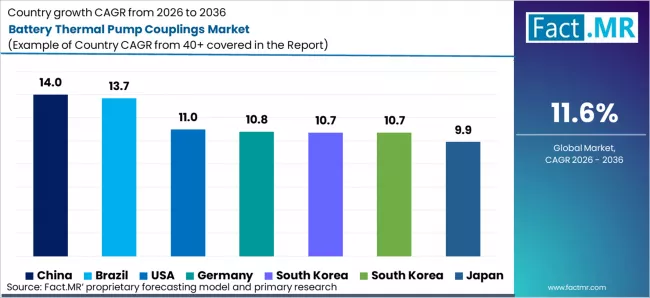
Battery Thermal Pump Couplings Market Cagr Analysis By Country | Source: Fact.MR
| Country | CAGR (2026 to 2036) |
|---|---|
| USA | 11.0% |
| Japan | 9.9% |
| South Korea | 10.7% |
| Germany | 10.8% |
| China | 14.0% |
| UK | 10.7% |
| Brazil | 13.7% |
Source: Fact.MR analysis. Updated Feb 14, 2026
Source: Fact MR (FMR) analysis, based on proprietary forecasting model and primary research
The region serves as the global thermal-safety regulatory hub, where the transition from basic cooling to sophisticated heat-pump-integrated circuits is driven by new battery propagation mandates and infrastructure scaling. Key regional players include Hutchinson SA, which leads with high-performance cooling circuit connectors and precision seals, and Standard Motor Products, Inc., which has expanded its temperature control portfolio to capture the North American EV aftermarket. Valeo also holds a dominant position by providing integrated thermal modules that utilize advanced couplings for high-flow coolant management.
North America Battery Thermal Pump Couplings Market Analysis
- United States: Demand for battery thermal pump couplings in the USA is projected to rise at 11.0% CAGR through 2036. Growth is primarily driven by federal investment in domestic battery manufacturing and safety; for instance, the U.S. Department of Energy announced a $1.7 billion investment in July 2024 to retrofit 11 vehicle manufacturing plants for EV production, including advanced thermal management lines. Additionally, the National Highway Traffic Safety Administration (NHTSA) updated its FMVSS 305a safety standard in late 2024, introducing more stringent battery temperature monitoring and warning requirements that necessitate higher-reliability coupling components.
Asia Pacific Battery Thermal Pump Couplings Market Analysis
- Japan: Demand for battery thermal pump couplings in Japan is projected to rise at 9.9% CAGR through 2036. The market is supported by government-led digital and green transformation initiatives; notably, the Ministry of Economy, Trade and Industry (METI) formulated the Mobility Digital Transformation (DX) Strategy in May 2024, emphasizing hardware-software integration for next-generation thermal efficiency. Furthermore, the Japanese Standards Association (JSA) updated its guidelines for V2H (Vehicle-to-Home) equipment in mid-2025, driving demand for couplings capable of managing heat during prolonged bidirectional energy discharge cycles.
- South Korea: Demand for battery thermal pump couplings in South Korea is projected to rise at 10.7% CAGR through 2036. Growth is propelled by a new national battery certification framework; the Ministry of Land, Infrastructure and Transport (MOLIT) implemented the Revised Automobile Management Act in February 2025, requiring state-led safety testing of thermal management systems. Additionally, the Ministry of Environment issued a joint notification in January 2026 for Smart Charger Guidelines, which incentivize vehicles equipped with advanced thermal pumps to prevent overcharging-related fires in underground parking.
- China: Demand for battery thermal pump couplings in China is projected to rise at 14.0% CAGR through 2036. The market is driven by the world's most stringent battery safety mandates; the Ministry of Industry and Information Technology (MIIT) finalized the GB38031-2025 standard in April 2025, mandating that batteries must not catch fire for two hours after thermal runaway, starting July 2026. Furthermore, the National Energy Administration (NEA) issued high-quality charging guidelines in June 2023, accelerating the deployment of liquid-cooled superchargers that demand specialized coupling hardware for vehicle-side thermal interfaces.
Europe Battery Thermal Pump Couplings Market Analysis
- Germany: Demand for battery thermal pump couplings in Germany is projected to rise at 10.8% CAGR through 2036. Market expansion is anchored by federal infrastructure masterplans; the Federal Ministry for Digital and Transport (BMDV) approved the 2030 Charging Infrastructure Master Plan in November 2025, which focuses on high-power charging networks that require robust thermal management in vehicles. Moreover, the German Federal Government's June 2025 "Responsibility for Germany" initiative provides tax incentives for automotive suppliers investing in high-frequency vibration damping for V2G-enabled drivelines.
- United Kingdom: Demand for battery thermal pump couplings in the UK is projected to rise at 10.7% CAGR through 2036. Growth is steered by government-backed innovation funding and consumer grants; for example, the Office for Zero Emission Vehicles (OZEV) announced a £1.5 billion investment boost for the EV switch in December 2025 to support North East battery manufacturing. Additionally, the Department for Transport (DfT) launched a £10 million technology fund in November 2025 specifically aimed at future-proofing charging supply chains, including the high-durability thermal components required for heavy-duty EV use.
- France: Demand for battery thermal pump couplings in France is projected to rise at 11.6% CAGR through 2036. Key growth factors include ecological subsidies and updated performance scores; the French Ministry for the Ecological Transition extended the Advenir Program in December 2023, offering specific bonuses for smart, bidirectional-capable charging points. Moreover, AVERE-France published updated quality and security standards for bidirectional stations in April 2025, aligning with EU Regulation 2023/1804 (AFIR) regarding safe grid-interactive infrastructure.
Latin America Battery Thermal Pump Couplings Market Analysis
- Brazil: Demand for battery thermal pump couplings in Brazil is projected to rise at 13.7% CAGR through 2036. The market is catalyzed by the National Green Mobility and Innovation Program (Programa Mover), established by Law No. 14.902 in June 2024, which provides R$ 19.3 billion in financial credits for decarbonization and energy efficiency R&D. Furthermore, the Ministry of Development, Industry and Foreign Trade (MDIC) implemented mandatory vehicle efficiency labeling in January 2025, forcing local manufacturers to adopt high-efficiency thermal pumps and specialized couplings to qualify for "Green IPI" tax benefits.
How Are Key Players Competing in the Battery Thermal Pump Couplings Market?
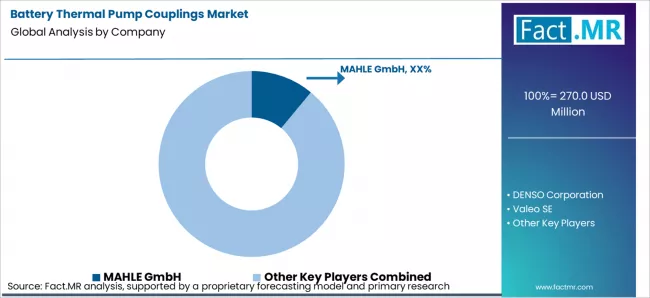
Battery Thermal Pump Couplings Market Analysis By Company | Source: Fact.MR
The battery thermal pump couplings market is driven by key players like MAHLE GmbH, DENSO Corporation, and Valeo SE, focusing on enhancing thermal management for electric vehicles (EVs). These companies are integrating advanced couplings into battery thermal systems, improving energy efficiency and extending battery life. Robert Bosch GmbH and Schaeffler AG are introducing high-performance thermal pump couplings designed to optimize heat dissipation in EV batteries. BorgWarner Inc. and KTR Systems GmbH contribute with innovative coupling technologies that ensure seamless integration into powertrains for improved cooling. Aisin Corporation and Nidec Corporation are focusing on precision coupling solutions for battery packs, while Continental AG works on solutions that balance performance with energy efficiency. These developments reflect a growing trend towards advanced thermal management technologies to meet the needs of the expanding EV market.
Recent Industry Developments
- Supply Contract - NORMA Group eM Safe quick connectors for EV battery thermal management (Aug 25, 2025): NORMA Group announced it won a contract to supply eM Safe quick connectors for battery thermal management on a new U.S.-based OEM EV platform starting in 2027.
- Program Award - NORMA Group cooling water line systems for an Indian EV SUV BEV platform (Feb 28, 2024): NORMA Group announced it will deliver cooling water systems for the power electronics thermal circuit of an Indian automaker’s BEV platform from mid-2024.
- Patent - Thermal management system with a connect/disconnect fluid interface (Published Mar 21, 2024): This patent publication describes a vehicle thermal management system where a container interfaces to establish (and later disconnect) fluid communication via an interface, aligning with serviceable coupling concepts in thermal circuits.
Report Scope
| Metric | Value |
|---|---|
| Quantitative Units | USD 270 million (2026) to USD 804 million (2036), at a CAGR of 11.6% |
| Market Definition | The Battery Thermal Pump Couplings Market includes products designed to manage the thermal performance of electric vehicle battery cooling systems, ensuring optimal performance and safety. |
| By Pump Type | Electric Coolant Pumps, Refrigerant Pumps, Integrated Thermal Pump Modules, Other |
| By Coupling Type | Magnetic Couplings, Elastomeric Flexible Couplings, Metal Disc Couplings, Other |
| By Vehicle Segment | Passenger EVs, LCV EVs, Premium/Luxury EVs, Other |
| By Sales Channel | OEM Line-Fit, Tier-1 Integrated, Aftermarket, Other |
| Regions Covered | North America, Latin America, Europe, East Asia, South Asia, Oceania, Middle East and Africa |
| Countries Covered | United States, Canada, Mexico, Brazil, Argentina, Germany, France, United Kingdom, Italy, Spain, China, India, Japan, South Korea, Indonesia, Australia, and 40+ countries |
| Key Companies Profiled | MAHLE GmbH, DENSO Corporation, Valeo SE, Robert Bosch GmbH, Schaeffler AG, BorgWarner Inc., KTR Systems GmbH, Aisin Corporation, Nidec Corporation, Continental AG |
| Forecast Period | 2026 to 2036 |
| Approach | Hybrid top-down and bottom-up market modeling validated through primary interviews with manufacturers and supported by trade data benchmarking and market research. |
Source: Fact.MR analysis. Updated Feb 14, 2026
Bibliographies
- In-Young Lee Statement: Lee, I.-Y. (2025, November 13). Thermal management solutions for eco-friendly vehicles. Hanon Systems.
- Program Award - NORMA Group Cooling Water Line Systems for an Indian EV SUV BEV Platform: NORMA Group. (2024, February 28). NORMA Group cooling water line systems for an Indian EV SUV BEV platform. NORMA Group.
- Patent - Thermal Management System with a Connect/Disconnect Fluid Interface: U.S. Patent No. 11,849,432. (2024, March 21). Thermal management system with a connect/disconnect fluid interface. United States Patent and Trademark Office.
- Supply Contract - NORMA Group eM Safe Quick Connectors for EV Battery Thermal Management: NORMA Group. (2025, August 25). NORMA Group eM Safe quick connectors for EV battery thermal management. NORMA Group.
Segmentation
Battery Thermal Pump Couplings Market Key Segments
-
By Pump Type :
- Electric Coolant Pumps
- Refrigerant Pumps
- Integrated Thermal Pump Modules
- Other
-
By Coupling Type :
- Magnetic Couplings
- Elastomeric Flexible Couplings
- Metal Disc Couplings
- Other
-
By Vehicle Segment :
- Passenger EVs
- LCV EVs
- Premium/Luxury EVs
- Other
-
By Sales Channel :
- OEM Line-Fit
- Tier-1 Integrated
- Aftermarket
- Other
-
Region :
- North America
- USA
- Canada
- Mexico
- Europe
- Germany
- UK
- France
- Italy
- Spain
- Nordic Countries
- BENELUX
- Rest of Europe
- Asia Pacific
- China
- Japan
- South Korea
- India
- Australia
- Rest of Asia Pacific
- Latin America
- Brazil
- Argentina
- Rest of Latin America
- Middle East and Africa
- Kingdom of Saudi Arabia
- United Arab Emirates
- South Africa
- Rest of Middle East and Africa
- Other Regions
- Oceania
- Central Asia
- Other Markets
- North America
Frequently Asked Questions
How large is the demand for Battery Thermal Pump Couplings in the global market in 2026?
What will be the market size of Battery Thermal Pump Couplings in the global market by 2036?
What is the expected demand growth for Battery Thermal Pump Couplings in the global market between 2026 and 2036?
Which region is expected to show the highest growth rate for Battery Thermal Pump Couplings?
How significant is the growth outlook for Brazil in this market?
What is the growth outlook for the United States in this report?
What is the growth forecast for Japan in the Battery Thermal Pump Couplings market?
Which European markets are highlighted in this analysis?
What is the growth forecast for South Korea in the Battery Thermal Pump Couplings market?
What is the expected growth rate for China in the forecast period?
What is the leading sales channel for Battery Thermal Pump Couplings?
Which company is identified as a leading player in the Battery Thermal Pump Couplings market?
What are Battery Thermal Pump Couplings used for?
What does the Battery Thermal Pump Couplings market include in this report?
How is the market forecast developed in this report?
What is meant by the Battery Thermal Pump Couplings market in this report?
Who worked on this report


Preview the report firsthand - request a free sample
Free SampleGet the brochure for pricing and purchase details
Download PDF